Intrinsic Flow Matching on Quantum Pure-State Manifolds with Phase-Aligned Transport
Pith reviewed 2026-06-26 14:51 UTC · model grok-4.3
The pith
Intrinsic Flow Matching recovers the induced marginal transport field on the complex projective manifold for quantum pure-state ensembles.
A machine-rendered reading of the paper's core claim, the machinery that carries it, and where it could break.
Core claim
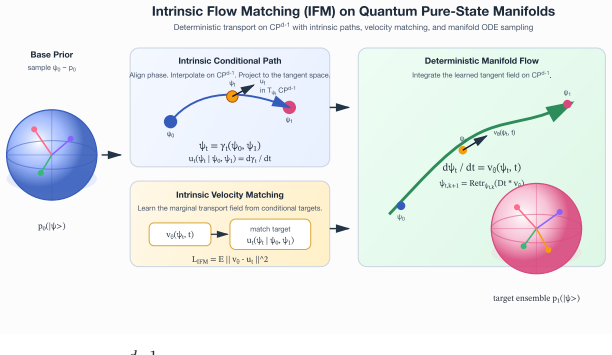
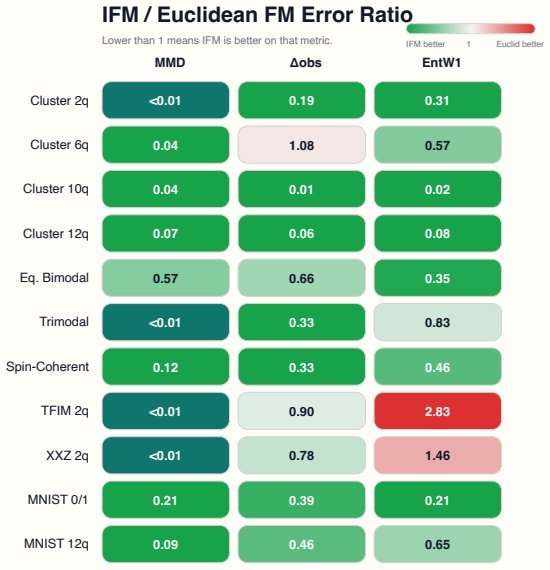
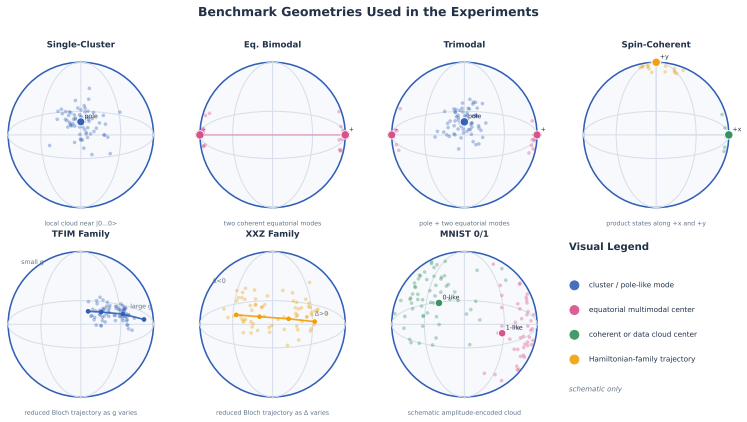
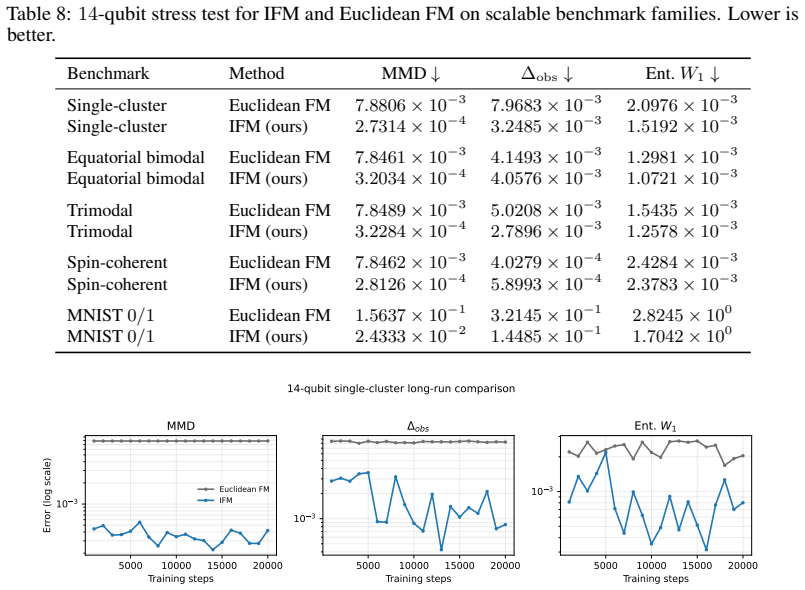
Intrinsic Flow Matching (IFM) is a deterministic transport framework on CP^{d-1} that learns tangent velocity fields using Pancharatnam phase-aligned conditional paths. It replaces local score teachers and reverse-time stochastic sampling with manifold probability flow, while horizontal parameterization removes redundant ambient directions. The IFM objective recovers the induced marginal transport field, represents deterministic projective ensemble flows, and yields endpoint and stability guarantees. Empirical tests show improvements over ambient Euclidean flow matching on higher-qubit, multimodal, spin-coherent, physics-inspired, and amplitude-encoded MNIST benchmarks, with strongest gains
What carries the argument
Pancharatnam phase-aligned conditional paths combined with horizontal parameterization on CP^{d-1}, which define the manifold probability flow whose tangent velocity fields are learned to match the induced marginal.
If this is right
- The IFM objective recovers the induced marginal transport field on the manifold.
- Deterministic projective ensemble flows are represented directly.
- Endpoint and stability guarantees hold for the learned transport.
- Performance gains appear over Euclidean flow matching, particularly on high-dimensional and coherence-sensitive tasks.
Where Pith is reading between the lines
- The deterministic manifold flow could reduce variance compared with stochastic sampling methods in quantum generative modeling.
- The horizontal parameterization may generalize to other homogeneous spaces where redundant directions appear in ambient embeddings.
- Stronger results on coherence-sensitive tasks suggest the phase alignment preserves properties useful for quantum simulation benchmarks.
Load-bearing premise
That Pancharatnam phase-aligned conditional paths combined with horizontal parameterization on CP^{d-1} suffice to define a manifold probability flow whose learned tangent fields match the true induced marginal without hidden fitting or manifold-specific instabilities.
What would settle it
An explicit calculation for a low-dimensional ensemble where the velocity field obtained by minimizing the IFM objective differs from the analytically computed marginal transport field on CP^{d-1}.
Figures
read the original abstract
Quantum pure-state ensembles live on complex projective space, making flat Euclidean generative modeling geometrically mismatched. We introduce Intrinsic Flow Matching (IFM), a deterministic transport framework on $\mathbb{CP}^{d-1}$ that learns tangent velocity fields using Pancharatnam phase-aligned conditional paths. IFM replaces local score teachers and reverse-time stochastic sampling with manifold probability flow, while horizontal parameterization removes redundant ambient directions. We show that the IFM objective recovers the induced marginal transport field, represents deterministic projective ensemble flows, and yields endpoint and stability guarantees. Empirically, IFM often improves over ambient Euclidean flow matching across higher-qubit, multimodal, spin-coherent, physics-inspired, and amplitude-encoded MNIST image-vector benchmarks, with strongest gains on high-dimensional and coherence-sensitive tasks but not uniformly across every metric.
Editorial analysis
A structured set of objections, weighed in public.
Referee Report
Summary. The paper introduces Intrinsic Flow Matching (IFM) as a deterministic transport method on the complex projective manifold CP^{d-1} for quantum pure-state ensembles. It employs Pancharatnam phase-aligned conditional paths together with horizontal parameterization to learn tangent velocity fields, replacing ambient Euclidean flow matching. The central claims are that the IFM objective recovers the induced marginal transport field via conditional expectation on the horizontal bundle, represents deterministic projective ensemble flows, and supplies endpoint and stability guarantees from standard ODE arguments on the compact manifold. Empirical evaluations report improvements over Euclidean baselines on higher-qubit, multimodal, spin-coherent, physics-inspired, and amplitude-encoded MNIST benchmarks, with largest gains on high-dimensional and coherence-sensitive tasks.
Significance. If the derivations hold, the work supplies a geometrically consistent flow-matching framework for quantum state manifolds that respects the Fubini-Study metric and removes redundant ambient directions. The explicit recovery of the marginal velocity field and the phase-alignment construction constitute a clean manifold probability-flow formulation. The reported empirical advantages on coherence-sensitive tasks indicate potential utility for quantum generative modeling; the machine-checked or fully derived endpoint/stability guarantees would be a notable strength.
minor comments (4)
- [Abstract] Abstract: the statement of empirical improvements would be strengthened by naming the primary metrics (e.g., MMD, fidelity) and the number of independent runs used to obtain the reported gains.
- [§4.2] §4.2, Eq. (17): the horizontal-lift construction is stated without an explicit verification that the Pancharatnam connection is indeed metric-compatible for the chosen conditional paths; a one-line check would remove ambiguity.
- [Table 2] Table 2: the spin-coherent and MNIST rows report mean improvements but omit standard deviations or p-values; adding these would make the "strongest gains" claim easier to assess.
- [§5.3] §5.3: the Lipschitz constant argument for stability is sketched but does not reference the specific bound used for the learned vector field; a short remark tying it to the compact manifold would suffice.
Simulated Author's Rebuttal
We thank the referee for the detailed summary of our manuscript and for the positive assessment of the IFM framework, including its geometric consistency with the Fubini-Study metric and the reported empirical advantages. The recommendation for minor revision is noted. However, the report lists no specific major comments requiring point-by-point response.
Circularity Check
No significant circularity detected
full rationale
The paper derives the IFM objective recovery of the induced marginal transport field from the standard conditional expectation identity on the horizontal bundle of CP^{d-1}, with Pancharatnam phase-aligned paths shown as horizontal lifts preserving the Fubini-Study metric; endpoint and stability guarantees follow from ODE well-posedness on the compact manifold once the vector field is Lipschitz. These steps rely on established differential geometry and probability flow identities rather than self-definition, fitted inputs renamed as predictions, or load-bearing self-citations. No equations reduce the claimed results to their inputs by construction, and the empirical benchmarks are presented separately from the derivation.
Axiom & Free-Parameter Ledger
Reference graph
Works this paper leans on
-
[1]
Denoising diffusion probabilistic models
Jonathan Ho, Ajay Jain, and Pieter Abbeel. Denoising diffusion probabilistic models. In Advances in Neural Information Processing Systems, volume 33, pages 6840–6851, 2020
2020
-
[2]
Score-based generative modeling through stochastic differential equations
Yang Song, Jascha Sohl-Dickstein, Diederik P Kingma, Abhishek Kumar, Stefano Ermon, and Ben Poole. Score-based generative modeling through stochastic differential equations. In International Conference on Learning Representations, 2021. 9
2021
-
[3]
Yaron Lipman, Ricky T. Q. Chen, Heli Ben-Hamu, Maximilian Nickel, and Matt Le. Flow matching for generative modeling, 2023
2023
-
[4]
Cambridge university press, 2017
Ingemar Bengtsson and Karol ˙Zyczkowski.Geometry of quantum states: an introduction to quantum entanglement. Cambridge university press, 2017
2017
-
[5]
Quantum machine learning.Nature, 549(7671):195–202, 2017
Jacob Biamonte, Peter Wittek, Nicola Pancotti, Patrick Rebentrost, Nathan Wiebe, and Seth Lloyd. Quantum machine learning.Nature, 549(7671):195–202, 2017
2017
-
[6]
Quantum computing in the nisq era and beyond.Quantum, 2:79, 2018
John Preskill. Quantum computing in the nisq era and beyond.Quantum, 2:79, 2018
2018
-
[7]
Quantum machine learning in feature hilbert spaces
Maria Schuld and Nathan Killoran. Quantum machine learning in feature hilbert spaces. Physical Review Letters, 122(4):040504, 2019
2019
-
[8]
Geometry of quantum states.Communications in Mathematical Physics, 9(1):55–80, 1968
Bogdan Mielnik. Geometry of quantum states.Communications in Mathematical Physics, 9(1):55–80, 1968
1968
-
[9]
Complex hypersurfaces of a complex projective space.Journal of Differential Geometry, 3(1-2):253–256, 1969
Koichi Ogiue. Complex hypersurfaces of a complex projective space.Journal of Differential Geometry, 3(1-2):253–256, 1969
1969
-
[10]
Metric learning on complex projective spaces
Yujin Wu and Mohamed Daoudi. Metric learning on complex projective spaces. InInternational Conference on Smart Multimedia, pages 116–127. Springer, 2022
2022
-
[11]
The quantum-state diffusion model applied to open systems.Journal of Physics A, 25:5677–5691, 1992
Nicolas Gisin and Ian Colin Percival. The quantum-state diffusion model applied to open systems.Journal of Physics A, 25:5677–5691, 1992
1992
-
[12]
Stochastic schrödinger equations.Journal of Physics A: Mathematical and General, 37(9):3189, 2004
Luc Bouten, Madalin Guta, and Hans Maassen. Stochastic schrödinger equations.Journal of Physics A: Mathematical and General, 37(9):3189, 2004
2004
-
[13]
Stochastic schrödinger diffusion models for pure-state ensemble generation, 2026
Jian Xu, Wei Chen, Chao Li, Jingyuan Zheng, Delu Zeng, John Paisley, and Qibin Zhao. Stochastic schrödinger diffusion models for pure-state ensemble generation, 2026. arXiv preprint arXiv:2605.03573
Pith/arXiv arXiv 2026
-
[14]
Flow matching for generative modeling.arXiv preprint arXiv:2210.02747, 2022
Yaron Lipman, Ricky TQ Chen, Heli Ben-Hamu, Maximilian Nickel, and Matt Le. Flow matching for generative modeling.arXiv preprint arXiv:2210.02747, 2022
Pith/arXiv arXiv 2022
-
[15]
Flow matching on general geometries.arXiv preprint arXiv:2302.03660, 2023
Ricky TQ Chen and Yaron Lipman. Flow matching on general geometries.arXiv preprint arXiv:2302.03660, 2023
arXiv 2023
-
[17]
Generalized theory of interference, and its applications: Part i
Shivaramakrishnan Pancharatnam. Generalized theory of interference, and its applications: Part i. coherent pencils. InProceedings of the Indian academy of sciences-section A, volume 44, pages 247–262. Springer, 1956
1956
-
[18]
Deciphering pancharatnam’s discovery of geometric phase: retrospective.Journal of the Optical Society of America A, 40(5):925–931, 2023
Luis Garza-Soto, Nathan Hagen, and Dorilian Lopez-Mago. Deciphering pancharatnam’s discovery of geometric phase: retrospective.Journal of the Optical Society of America A, 40(5):925–931, 2023
2023
-
[19]
Topological transitions of the generalized pancharatnam-berry phase
Manuel F Ferrer-Garcia, Kyrylo Snizhko, Alessio D’errico, Alessandro Romito, Yuval Gefen, and Ebrahim Karimi. Topological transitions of the generalized pancharatnam-berry phase. Science advances, 9(47):eadg6810, 2023
2023
-
[20]
Quantum probability distribution of arrival times and probability current density
V Delgado. Quantum probability distribution of arrival times and probability current density. Physical Review A, 59(2):1010, 1999
1999
-
[21]
Electron spin and probability current density in quantum mechanics.American Journal of Physics, 82(7):681–690, 2014
WB Hodge, SV Migirditch, and William C Kerr. Electron spin and probability current density in quantum mechanics.American Journal of Physics, 82(7):681–690, 2014
2014
-
[22]
Springer, 2005
Robert E Wyatt.Quantum dynamics with trajectories: introduction to quantum hydrodynamics. Springer, 2005. 10
2005
-
[23]
Bohmian mechanics versus madelung quantum hydrodynamics.arXiv preprint arXiv:0904.0723, 2009
Roumen Tsekov. Bohmian mechanics versus madelung quantum hydrodynamics.arXiv preprint arXiv:0904.0723, 2009
Pith/arXiv arXiv 2009
-
[24]
Alexander Tong, Kilian Fatras, Nikolay Malkin, Guillaume Huguet, Yanlei Zhang, Jarrid Rector- Brooks, Guy Wolf, and Yoshua Bengio. Improving and generalizing flow-based generative models with minibatch optimal transport.arXiv preprint arXiv:2302.00482, 2023
Pith/arXiv arXiv 2023
-
[25]
Fast and smooth interpolation on wasserstein space
Sinho Chewi, Julien Clancy, Thibaut Le Gouic, Philippe Rigollet, George Stepaniants, and Austin Stromme. Fast and smooth interpolation on wasserstein space. InInternational confer- ence on artificial intelligence and statistics, pages 3061–3069. PMLR, 2021
2021
-
[26]
Denoising diffusion implicit models, 2022
Jiaming Song, Chenlin Meng, and Stefano Ermon. Denoising diffusion implicit models, 2022
2022
-
[27]
Generative quantum machine learning via denoising diffusion probabilistic models.Physical Review Letters, 132(10):100602, 2024
Bingzhi Zhang, Peng Xu, Xiaohui Chen, and Quntao Zhuang. Generative quantum machine learning via denoising diffusion probabilistic models.Physical Review Letters, 132(10):100602, 2024
2024
-
[28]
Chuangtao Chen, Qinglin Zhao, MengChu Zhou, Zhimin He, Zhili Sun, and Haozhen Situ. Quantum generative diffusion model: a fully quantum-mechanical model for generating quantum state ensemble.arXiv preprint arXiv:2401.07039, 2024
arXiv 2024
-
[29]
Quantum denoising diffusion models
Michael Kölle, Gerhard Stenzel, Jonas Stein, Sebastian Zielinski, Björn Ommer, and Claudia Linnhoff-Popien. Quantum denoising diffusion models. In2024 IEEE International Conference on Quantum Software (QSW), pages 88–98. IEEE, 2024
2024
-
[30]
Mixed-state quantum denoising diffusion probabilistic model.Physical Review A, 111(3):032610, 2025
Gino Kwun, Bingzhi Zhang, and Quntao Zhuang. Mixed-state quantum denoising diffusion probabilistic model.Physical Review A, 111(3):032610, 2025
2025
-
[31]
Xingchao Liu, Chengyue Gong, and Qiang Liu. Flow straight and fast: Learning to generate and transfer data with rectified flow.arXiv preprint arXiv:2209.03003, 2022
Pith/arXiv arXiv 2022
-
[32]
Qiang Liu. Rectified flow: A marginal preserving approach to optimal transport.arXiv preprint arXiv:2209.14577, 2022
Pith/arXiv arXiv 2022
-
[33]
Improving the training of rectified flows.Advances in neural information processing systems, 37:63082–63109, 2024
Sangyun Lee, Zinan Lin, and Giulia Fanti. Improving the training of rectified flows.Advances in neural information processing systems, 37:63082–63109, 2024
2024
-
[34]
Riemannian continuous normalizing flows.Advances in neural information processing systems, 33:2503–2515, 2020
Emile Mathieu and Maximilian Nickel. Riemannian continuous normalizing flows.Advances in neural information processing systems, 33:2503–2515, 2020
2020
-
[35]
Riemannian diffusion models
Chin-Wei Huang, Milad Aghajohari, Joey Bose, Prakash Panangaden, and Aaron Courville. Riemannian diffusion models. InAdvances in Neural Information Processing Systems, 2022
2022
-
[36]
Riemannian score-based generative modelling
Valentin De Bortoli, Emile Mathieu, Michael John Hutchinson, James Thornton, Yee Whye Teh, and Arnaud Doucet. Riemannian score-based generative modelling. InAdvances in Neural Information Processing Systems, 2022
2022
-
[37]
Scaling riemannian diffusion models
Aaron Lou, Minkai Xu, Adam Farris, and Stefano Ermon. Scaling riemannian diffusion models. Advances in Neural Information Processing Systems, 36:80291–80305, 2023
2023
-
[38]
Adaptivity of diffusion models to manifold structures
Rong Tang and Yun Yang. Adaptivity of diffusion models to manifold structures. InInternational Conference on Artificial Intelligence and Statistics, pages 1648–1656. PMLR, 2024
2024
-
[39]
Continuous normalizing flows on manifolds.arXiv preprint arXiv:2104.14959, 2021
Luca Falorsi. Continuous normalizing flows on manifolds.arXiv preprint arXiv:2104.14959, 2021
arXiv 2021
-
[40]
Flowmm: Generating materials with riemannian flow matching.arXiv preprint arXiv:2406.04713, 2024
Benjamin Kurt Miller, Ricky TQ Chen, Anuroop Sriram, and Brandon M Wood. Flowmm: Generating materials with riemannian flow matching.arXiv preprint arXiv:2406.04713, 2024
arXiv 2024
-
[41]
Equivariant flow matching.Advances in Neural Information Processing Systems, 36:59886–59910, 2023
Leon Klein, Andreas Krämer, and Frank Noé. Equivariant flow matching.Advances in Neural Information Processing Systems, 36:59886–59910, 2023
2023
-
[42]
Discrete flow matching.Advances in Neural Information Processing Systems, 37:133345–133385, 2024
Itai Gat, Tal Remez, Neta Shaul, Felix Kreuk, Ricky TQ Chen, Gabriel Synnaeve, Yossi Adi, and Yaron Lipman. Discrete flow matching.Advances in Neural Information Processing Systems, 37:133345–133385, 2024. 11
2024
-
[43]
Quantum flow matching.arXiv preprint arXiv:2508.12413, 2025
Zidong Cui, Pan Zhang, and Ying Tang. Quantum flow matching.arXiv preprint arXiv:2508.12413, 2025
arXiv 2025
-
[44]
Generative modeling of quantum distribution with functional flow matching
Jaehoon Hahm, Tak Hur, Joonseok Lee, and Daniel K Park. Generative modeling of quantum distribution with functional flow matching. InProceedings of the Quantum Techniques in Machine Learning Conference (QTML), 2024
2024
-
[45]
Functional flow matching.arXiv preprint arXiv:2305.17209, 2023
Gavin Kerrigan, Giosue Migliorini, and Padhraic Smyth. Functional flow matching.arXiv preprint arXiv:2305.17209, 2023
arXiv 2023
-
[46]
Shadowfm: Geometric approaches for learning quantum many-body states with flow matching on classical shadows
Jaehoon Hahm and Bryan Clark. Shadowfm: Geometric approaches for learning quantum many-body states with flow matching on classical shadows. Manuscript
-
[47]
Transport equation and cauchy problem for non-smooth vector fields
Luigi Ambrosio. Transport equation and cauchy problem for non-smooth vector fields. In Calculus of Variations and Nonlinear Partial Differential Equations: With a historical overview by Elvira Mascolo, pages 1–41. Springer, 2008
2008
-
[48]
Stability of a 4th-order curvature condition arising in optimal transport theory
Cédric Villani. Stability of a 4th-order curvature condition arising in optimal transport theory. Journal of Functional Analysis, 255(9):2683–2708, 2008
2008
-
[49]
Smooth maps
John M Lee. Smooth maps. InIntroduction to smooth manifolds, pages 30–59. Springer, 2012
2012
-
[50]
Quantum generative adversarial learning.Physical Review Letters, 121(4):040502, 2018
Seth Lloyd and Christian Weedbrook. Quantum generative adversarial learning.Physical Review Letters, 121(4):040502, 2018
2018
-
[51]
Quantum generative adversarial networks
Pierre-Luc Dallaire-Demers and Nathan Killoran. Quantum generative adversarial networks. arXiv preprint arXiv:1804.08641, 2018
Pith/arXiv arXiv 2018
-
[52]
A kernel two-sample test.The journal of machine learning research, 13(1):723–773, 2012
Arthur Gretton, Karsten M Borgwardt, Malte J Rasch, Bernhard Schölkopf, and Alexander Smola. A kernel two-sample test.The journal of machine learning research, 13(1):723–773, 2012
2012
-
[53]
Differentiable learning of quantum circuit born machines.Physical Review A, 98(6):062324, 2018
Jin-Guo Liu and Lei Wang. Differentiable learning of quantum circuit born machines.Physical Review A, 98(6):062324, 2018
2018
-
[54]
The born supremacy: quantum advantage and training of an ising born machine.npj Quantum Information, 6(1):60, 2020
Brian Coyle, Daniel Mills, Vincent Danos, and Elham Kashefi. The born supremacy: quantum advantage and training of an ising born machine.npj Quantum Information, 6(1):60, 2020
2020
-
[55]
A generative modeling approach for benchmarking and training shallow quantum circuits.npj Quantum information, 5(1):45, 2019
Marcello Benedetti, Delfina Garcia-Pintos, Oscar Perdomo, Vicente Leyton-Ortega, Yunseong Nam, and Alejandro Perdomo-Ortiz. A generative modeling approach for benchmarking and training shallow quantum circuits.npj Quantum information, 5(1):45, 2019
2019
-
[56]
Quantum boltzmann machine.Physical Review X, 8(2):021050, 2018
Mohammad H Amin, Evgeny Andriyash, Jason Rolfe, Bohdan Kulchytskyy, and Roger Melko. Quantum boltzmann machine.Physical Review X, 8(2):021050, 2018
2018
-
[57]
Dynamic conditional optimal transport through simulation-free flows.Advances in Neural Information Processing Systems, 37:93602– 93642, 2024
Gavin Kerrigan, Giosue Migliorini, and Padhraic Smyth. Dynamic conditional optimal transport through simulation-free flows.Advances in Neural Information Processing Systems, 37:93602– 93642, 2024
2024
-
[58]
Distributed wasserstein barycenters via dis- placement interpolation.IEEE Transactions on Control of Network Systems, 10(2):785–795, 2022
Pedro Cisneros-Velarde and Francesco Bullo. Distributed wasserstein barycenters via dis- placement interpolation.IEEE Transactions on Control of Network Systems, 10(2):785–795, 2022
2022
-
[59]
Mao Nishino, Martin Bauer, Tom Needham, and Nicolas Charon. A benamou-brenier proximal splitting method for constrained unbalanced optimal transport.arXiv preprint arXiv:2512.09250, 2025
arXiv 2025
-
[60]
Noncyclic continuous pancharatnam–berry phase in dual-beam interfer- ence.Communications Physics, 6(1):132, 2023
Aleksi Leinonen, Antti Hannonen, Henri Partanen, Janne Heikkinen, Tero Setälä, Ari T Friberg, and Tommi K Hakala. Noncyclic continuous pancharatnam–berry phase in dual-beam interfer- ence.Communications Physics, 6(1):132, 2023
2023
-
[61]
Waveguiding driven by the pancharatnam-berry phase.Physical Review A, 107(1):013523, 2023
Chandroth P Jisha, Stree Vithya Arumugam, Lorenzo Marrucci, Stefan Nolte, and Alessan- dro Alberucci. Waveguiding driven by the pancharatnam-berry phase.Physical Review A, 107(1):013523, 2023. 12
2023
-
[62]
Quantum hydrodynam- ics of particle systems with coulomb interaction and quantum bohm potential.Theoretical and Mathematical Physics, 118(2):227–240, 1999
Leonid Stefanovich Kuz’menkov and Sergey Gennad’evich Maksimov. Quantum hydrodynam- ics of particle systems with coulomb interaction and quantum bohm potential.Theoretical and Mathematical Physics, 118(2):227–240, 1999
1999
-
[63]
Neural ordinary differential equations.Advances in neural information processing systems, 31, 2018
Ricky TQ Chen, Yulia Rubanova, Jesse Bettencourt, and David K Duvenaud. Neural ordinary differential equations.Advances in neural information processing systems, 31, 2018
2018
-
[64]
Atomic coherent states in quantum optics.Physical Review A, 6(6):2211, 1972
Fortunato Tito Arecchi, Eric Courtens, Robert Gilmore, and Harry Thomas. Atomic coherent states in quantum optics.Physical Review A, 6(6):2211, 1972
1972
-
[65]
Cambridge university press Cambridge, 1995
Paul M Chaikin, Tom C Lubensky, and Thomas A Witten.Principles of condensed matter physics, volume 10. Cambridge university press Cambridge, 1995
1995
-
[66]
Quantum communication through an unmodulated spin chain.Physical review letters, 91(20):207901, 2003
Sougato Bose. Quantum communication through an unmodulated spin chain.Physical review letters, 91(20):207901, 2003
2003
-
[67]
Gradient-based learning applied to document recognition.Proceedings of the IEEE, 86(11):2278–2324, 2002
Yann LeCun, Léon Bottou, Yoshua Bengio, and Patrick Haffner. Gradient-based learning applied to document recognition.Proceedings of the IEEE, 86(11):2278–2324, 2002. A Additional Related Work Quantum generative modeling and ambient baselines.Generative modeling for quantum data has attracted increasing attention in recent years, with approaches ranging fr...
2002
-
[68]
the projective class [γt(ψ0, ψ1)] is independent of the chosen representatives of [ψ0] and [ψ1]
-
[69]
for every t such that ˜ψt ̸= 0 , the instantaneous velocity ut(ψt |ψ 0, ψ1) belongs to the horizontal tangent spaceH ψt
-
[70]
Lemma 1(Phase alignment maximizes real overlap).Let ψ0, ψ1 ∈C d be unit vectors with ⟨ψ0, ψ1⟩ ̸= 0
the path satisfies the endpoint conditions[γ 0(ψ0, ψ1)] = [ψ0]and[γ 1(ψ0, ψ1)] = [ψ1]. Lemma 1(Phase alignment maximizes real overlap).Let ψ0, ψ1 ∈C d be unit vectors with ⟨ψ0, ψ1⟩ ̸= 0. For any phaseφ∈R, defineψ (φ) 1 :=e iφψ1. Then max φ∈R Re⟨ψ 0, ψ(φ) 1 ⟩=|⟨ψ 0, ψ1⟩|,(43) and the maximizers are exactly the phases for which ⟨ψ0, ψ(φ) 1 ⟩ is real and non...
-
[71]
satisfying the Pancharatnam in-phase condition with respect toψ 0
-
[72]
maximizing the real overlap withψ 0
-
[73]
This proves Proposition 8
minimizing the ambient chord length toψ 0. This proves Proposition 8. Remark 6.The point of Lemmas 1 and 2 is not that projective geometry is reduced to ambient Euclidean geometry. Rather, once one chooses representatives in the quotient spaceCPd−1, there remains a gauge degree of freedom. Phase alignment fixes that freedom in the way that produces the sh...
-
[74]
Hence ¯ψ′ 1 =α(ψ ′ 0, ψ′ 1)−1ψ′ 1 =e iθ0 α(ψ0, ψ1)−1ψ1 =e iθ0 ¯ψ1
= ⟨eiθ0 ψ0, eiθ1 ψ1⟩ |⟨eiθ0 ψ0, eiθ1 ψ1⟩| =e i(θ1−θ0)α(ψ0, ψ1). Hence ¯ψ′ 1 =α(ψ ′ 0, ψ′ 1)−1ψ′ 1 =e iθ0 α(ψ0, ψ1)−1ψ1 =e iθ0 ¯ψ1. The interpolant therefore transforms as ˜ψ′ t = (1−t)ψ ′ 0 +t ¯ψ′ 1 =e iθ0 (1−t)ψ 0 +t ¯ψ1 =e iθ0 ˜ψt. After normalization, γt(ψ′ 0, ψ′
-
[75]
No phase alignment
=e iθ0 γt(ψ0, ψ1), so both define the same point in CPd−1. This proves representative-independence. The endpoint property follows immediately: γ0(ψ0, ψ1) =ψ 0, γ 1(ψ0, ψ1) = ¯ψ1, and[ ¯ψ1] = [ψ1]because they differ by a unit-modulus phase. For tangency, define wt := ¯ψ1 −ψ 0 so that ˙˜ψt =w t. Differentiating the normalized lift ψt = ˜ψt/∥ ˜ψt∥2 gives ˙ψt...
2000
-
[76]
• Depending on the country in which research is conducted, IRB approval (or equivalent) may be required for any human subjects research
Institutional review board (IRB) approvals or equivalent for research with human subjects Question: Does the paper describe potential risks incurred by study participants, whether such risks were disclosed to the subjects, and whether Institutional Review Board (IRB) approvals (or an equivalent approval/review based on the requirements of your country or ...
discussion (0)
Sign in with ORCID, Apple, or X to comment. Anyone can read and Pith papers without signing in.