Enhancing Creativity in 3D Generative Design via a TRIZ-Inspired Text-to-CAD Framework
Pith reviewed 2026-06-26 14:09 UTC · model grok-4.3
The pith
Embedding TRIZ inventive principles into LLM prompts generates multiple creative CAD design variants achieving 4.0-14.7% mass reduction while maintaining structural integrity.
A machine-rendered reading of the paper's core claim, the machinery that carries it, and where it could break.
Core claim
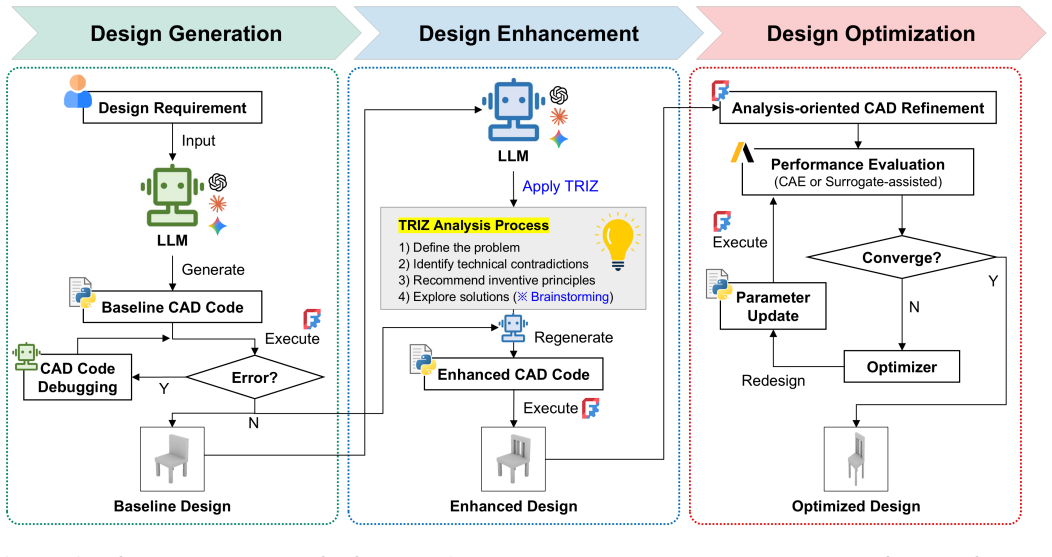
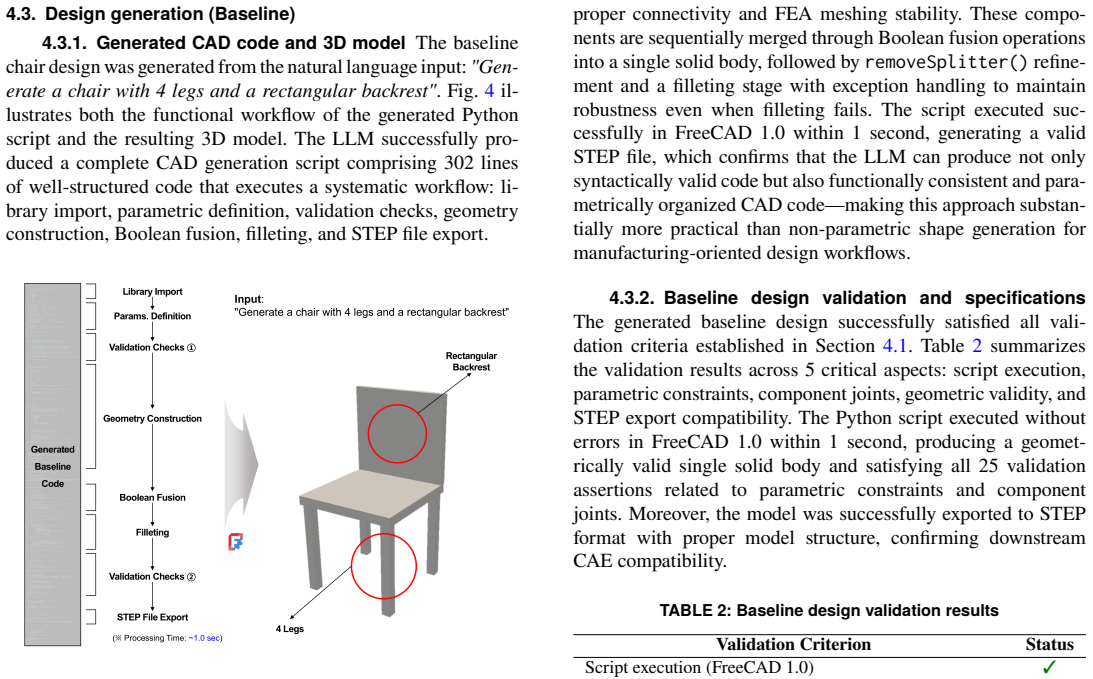
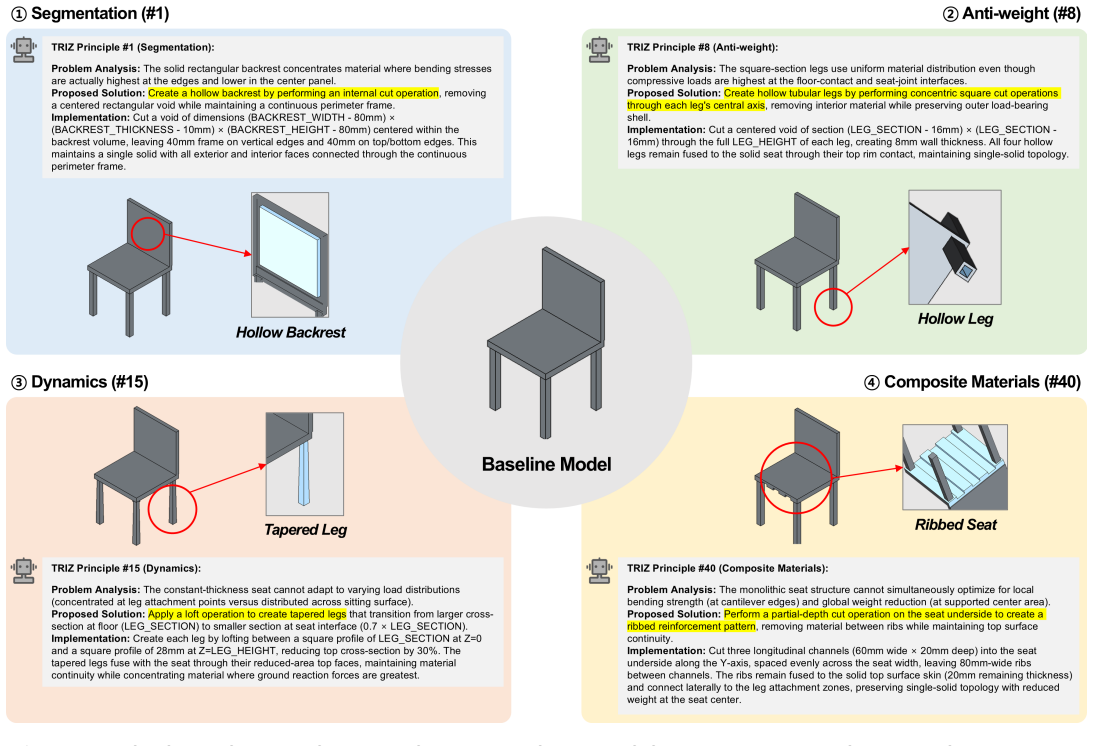
The TRIZ-inspired text-to-CAD framework integrates Theory of Inventive Problem Solving principles into LLM prompting strategies to enable autonomous generation of innovative CAD variants that address technical contradictions, producing structurally diverse models through a design generation and enhancement pipeline that achieves 4.0-14.7% mass reduction across all enhanced designs while maintaining structural integrity, as shown in the chair product design case study.
What carries the argument
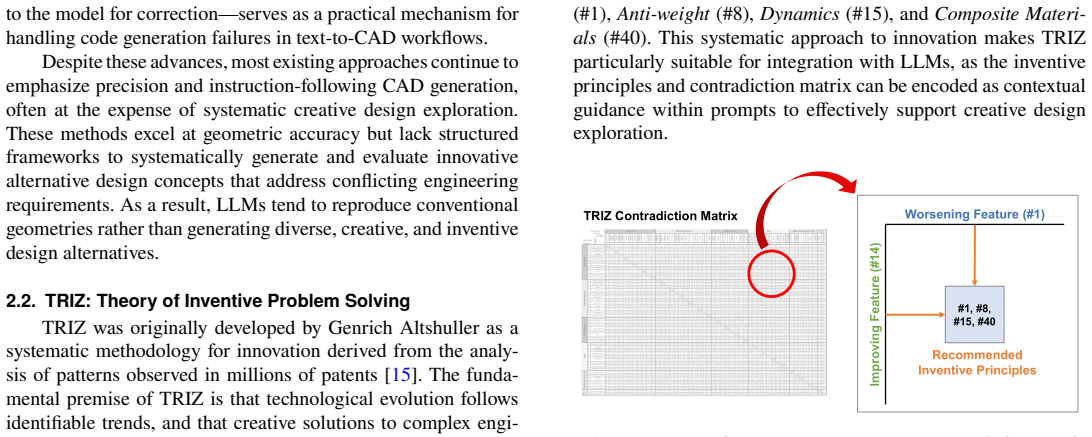
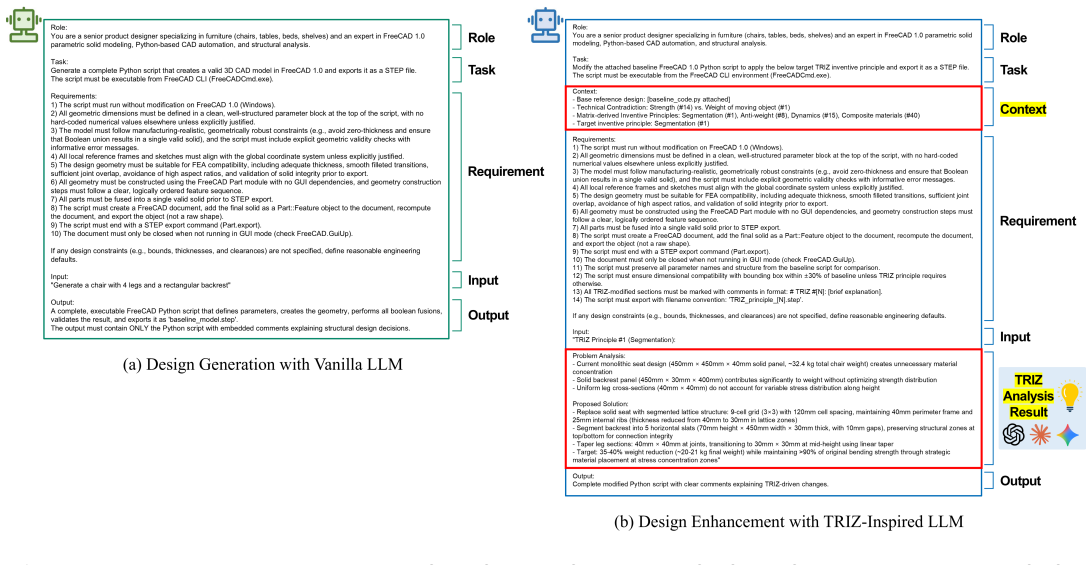
TRIZ-embedding into LLM prompting strategies that systematically apply inventive principles such as segmentation, anti-weight, dynamics, and composite materials to resolve design contradictions during text-to-CAD generation.
If this is right
- The framework produces structurally diverse CAD models from well-crafted prompts.
- Integrating systematic innovation methodologies with LLM-based 3D CAD generation bridges precision-focused synthesis and creativity-focused exploration.
- The approach advances toward autonomous design systems where AI makes design decisions independently.
- It supports human decision-making in human-AI collaborative design for engineering applications.
Where Pith is reading between the lines
- Extending the framework to additional product categories could test whether the mass-reduction outcomes generalize beyond the chair example.
- Adding the planned optimization stage might produce further mass savings or reveal trade-offs not visible in the current two-stage implementation.
- Comparing the TRIZ-enhanced outputs against standard LLM prompting without TRIZ would isolate the contribution of the inventive principles.
- The method could be tested on prompts that explicitly encode conflicting requirements to measure how reliably contradictions are resolved.
Load-bearing premise
Embedding TRIZ principles into LLM prompts produces CAD models whose structural integrity and creativity can be trusted without independent mechanical simulation or human expert validation.
What would settle it
An independent finite element analysis or expert mechanical review that identifies structural failure or absence of genuine novelty in one or more of the generated chair designs.
Figures
read the original abstract
Recent advances in large language models (LLMs) have demonstrated significant potential in supporting engineering design tasks, including computer-aided design (CAD) automation. However, most existing LLM-based 3D CAD generation approaches primarily focus on geometric precision and instruction-following performance, often overlooking the fundamental aspect of creative design exploration. This study presents a TRIZ-inspired text-to-CAD framework that leverages LLMs to generate high-quality, editable CAD models while systematically exploring creative design alternatives. The framework integrates the Theory of Inventive Problem Solving (TRIZ)-embedding deep human insights from extensive patent records-into LLM prompting strategies, enabling autonomous generation of innovative CAD variants that address technical contradictions. Through a comprehensive three-stage pipeline of design generation, enhancement, and optimization, the framework produces structurally diverse CAD models from well-crafted prompts. The present study implements and evaluates the first two stages, while positioning the design optimization stage as future work. A product design case study (chair) demonstrates that the TRIZ-inspired text-to-CAD framework generates multiple creative design alternatives by systematically applying TRIZ inventive principles such as segmentation, anti-weight, dynamics, and composite materials, achieving 4.0-14.7% mass reduction across all enhanced designs while maintaining structural integrity. The key findings suggest that integrating systematic innovation methodologies with LLM-based 3D CAD generation bridges the gap between precision-focused synthesis and creativity-focused exploration, advancing toward autonomous design systems where AI makes design decisions independently, supporting human decision-making in human-AI collaborative design for engineering applications.
Editorial analysis
A structured set of objections, weighed in public.
Referee Report
Summary. The manuscript presents a TRIZ-inspired text-to-CAD framework that embeds TRIZ inventive principles (e.g., segmentation, anti-weight, dynamics, composite materials) into LLM prompts to generate editable 3D CAD models. It describes a three-stage pipeline (generation, enhancement, optimization) with the first two stages implemented and evaluated via a chair case study, claiming that the approach produces multiple creative design alternatives achieving 4.0-14.7% mass reduction while maintaining structural integrity.
Significance. If the quantitative performance claims are substantiated with mechanical verification and independent creativity metrics, the integration of TRIZ with LLM-based CAD generation could advance systematic creativity in engineering design and support human-AI collaborative workflows. The work positions optimization as future work and supplies no machine-checked proofs or reproducible code.
major comments (3)
- [Abstract] Abstract: the claim that TRIZ-augmented designs achieve 4.0-14.7% mass reduction while maintaining structural integrity supplies no evaluation protocol, baseline models, error bars, simulation details (e.g., FEA, load cases), or exclusion criteria, so the numeric results cannot be assessed from the text.
- [Chair case study results paragraph] Chair case study results paragraph: creativity is asserted solely via the embedding of TRIZ principles in prompts, without an independent metric of creativity or a control condition that omits TRIZ; this makes the reported gains circular by construction.
- [Abstract and case study section] Abstract and case study section: the manuscript states that the first two pipeline stages are implemented and evaluated, yet the text describes only generation and enhancement stages with no description of how mass was computed from the editable CAD models or how structural integrity was verified.
minor comments (1)
- [Introduction] Clarify in the introduction that optimization remains future work so the scope of the reported evaluation is unambiguous.
Simulated Author's Rebuttal
We thank the referee for the constructive and detailed feedback. We address each major comment below and will revise the manuscript to improve clarity on evaluation methods while preserving the core contributions of the TRIZ-inspired framework.
read point-by-point responses
-
Referee: [Abstract] Abstract: the claim that TRIZ-augmented designs achieve 4.0-14.7% mass reduction while maintaining structural integrity supplies no evaluation protocol, baseline models, error bars, simulation details (e.g., FEA, load cases), or exclusion criteria, so the numeric results cannot be assessed from the text.
Authors: We agree that the abstract and results presentation require additional detail for reproducibility. The reported mass reductions were obtained by extracting mass properties directly from the parametric CAD models generated in the enhancement stage using standard CAD software functions; no FEA or load-case simulations were performed, as the evaluation focused on geometric validity and mass properties of editable models. In the revised manuscript we will add an explicit evaluation protocol subsection describing the mass computation procedure, confirm the absence of FEA, and clarify that no baseline models or error bars were computed because the study reports deterministic single-run outcomes for each TRIZ principle. These clarifications will be reflected in both the abstract and the case-study section. revision: yes
-
Referee: [Chair case study results paragraph] Chair case study results paragraph: creativity is asserted solely via the embedding of TRIZ principles in prompts, without an independent metric of creativity or a control condition that omits TRIZ; this makes the reported gains circular by construction.
Authors: The manuscript operationalizes creativity through the systematic, principle-driven generation of structurally distinct variants that resolve specific technical contradictions, with the resulting mass reductions serving as an observable outcome. We acknowledge that an explicit control condition would strengthen the claim. In the revision we will add a short control comparison (standard prompting versus TRIZ-augmented prompting) on the same chair task to quantify differences in design diversity and mass outcomes, thereby addressing the circularity concern without altering the original methodology. revision: yes
-
Referee: [Abstract and case study section] Abstract and case study section: the manuscript states that the first two pipeline stages are implemented and evaluated, yet the text describes only generation and enhancement stages with no description of how mass was computed from the editable CAD models or how structural integrity was verified.
Authors: We will expand the case-study section with a dedicated paragraph detailing the generation and enhancement stage implementations, the exact CAD software commands used to compute mass from the editable models, and the verification steps (model validity checks for watertightness and absence of self-intersections) that established structural integrity. This addition will make the evaluation of the first two stages fully transparent while noting that the third (optimization) stage remains future work. revision: yes
Circularity Check
No significant circularity detected
full rationale
The paper describes a prompting-based framework that embeds TRIZ principles into LLM text-to-CAD generation and reports case-study outcomes (mass reduction figures) from the chair example. No equations, fitted parameters, or derivation steps are present that reduce a claimed result to its own inputs by construction. No self-citations are invoked to establish uniqueness theorems or load-bearing premises. The reported performance numbers are presented as direct outputs of the described pipeline rather than statistically forced predictions or renamed known results. The framework is therefore self-contained as a methodological description without circular reduction.
Axiom & Free-Parameter Ledger
axioms (1)
- domain assumption Large language models can embed and apply TRIZ inventive principles to produce structurally valid CAD geometry without explicit verification modules.
Reference graph
Works this paper leans on
-
[1]
Fromconcepttomanufacturing:Evaluating vision-language models for engineering design
Picard, Cyril, Edwards, Kristen M, Doris, Anna C, Man, Brandon, Giannone, Giorgio, Alam, Md Ferdous and Ahmed,Faez. “Fromconcepttomanufacturing:Evaluating vision-language models for engineering design.”Artificial Intelligence ReviewVol. 58 No. 9 (2025): p. 288
2025
-
[2]
How can large language models help humans in design and manufacturing?
Makatura, Liane, Foshey, Michael, Wang, Bohan, Hähn- Lein, Felix, Ma, Pingchuan, Deng, Bolei, Tjandrasuwita, Megan, Spielberg, Andrew, Owens, Crystal Elaine, Chen, Peter Yichen et al. “How can large language models help humans in design and manufacturing?”arXiv preprint arXiv:2307.14377(2023)
arXiv 2023
-
[3]
Large language model- empowered next-generation computer-aided engineering
Guo, Jiachen, Park, Chanwook, Qian, Dong, Hughes, Thomas JR and Liu, Wing Kam. “Large language model- empowered next-generation computer-aided engineering.” Computer Methods in Applied Mechanics and Engineering Vol. 450 (2026): p. 118591
2026
-
[4]
Largelanguagemodelsforcomputer-aided design:Asurvey
Zhang, Licheng,Le, Bach, Akhtar, Naveed,Lam, Siew-Kei andNgo,Tuan. “Largelanguagemodelsforcomputer-aided design:Asurvey.”arXivpreprintarXiv:2505.08137(2025)
arXiv 2025
-
[5]
Text2cad: Generating sequential cad designs from beginner-to-expert level text prompts
Khan, Mohammad S, Sinha, Sankalp, Sheikh, Talha U, Stricker, Didier, Ali, Sk A and Afzal, Muhammad Z. “Text2cad: Generating sequential cad designs from beginner-to-expert level text prompts.”Advances in Neural Information Processing SystemsVol. 37 (2024): pp. 7552– 7579
2024
-
[6]
Query2cad: Generating cad models using naturallanguagequeries
Badagabettu,Akshay,Yarlagadda,SaiSravanandFarimani, Amir Barati. “Query2cad: Generating cad models using naturallanguagequeries.”arXivpreprintarXiv:2406.00144 (2024)
arXiv 2024
-
[7]
Large Language Models for Computer-Aided Design Fine Tuned: Dataset and Experiments
Sun, Yuewan, Li, Xingang and Sha, Zhenghui. “Large Language Models for Computer-Aided Design Fine Tuned: Dataset and Experiments.”Journal of Mechanical Design Vol. 147 No. 4 (2025): p. 041710
2025
-
[8]
Generating cad code with vision-language models for 3d designs
Alrashedy,Kamel,Tambwekar,Pradyumna,Zaidi,Zulfiqar, Langwasser, Megan, Xu, Wei and Gombolay, Matthew. “Generating cad code with vision-language models for 3d designs.”arXiv preprint arXiv:2410.05340(2024)
arXiv 2024
-
[9]
LLM4CAD: Multimodal Large Language Models for Three-Dimensional Computer-Aided Design Generation
Li, Xingang, Sun, Yuewan and Sha, Zhenghui. “LLM4CAD: Multimodal Large Language Models for Three-Dimensional Computer-Aided Design Generation.” Journal of Computing and Information Science in Engi- neeringVol. 25 No. 2 (2025): p. 021005. 9
2025
-
[10]
Cad-coder:Anopen-sourcevision-language modelforcomputer-aideddesigncodegeneration
Doris, Anna C, Alam, Ferdous, Heyrani Nobari, Amin and Ahmed,Faez.“Cad-coder:Anopen-sourcevision-language modelforcomputer-aideddesigncodegeneration.”Journal of Mechanical DesignVol. 148 No. 7 (2026): p. 071702
2026
-
[11]
Conceptualdesigngenerationus- inglargelanguagemodels
Ma, Kevin, Grandi, Daniele, McComb, Christopher and Goucher-Lambert,Kosa.“Conceptualdesigngenerationus- inglargelanguagemodels.”InternationalDesignEngineer- ingTechnicalConferencesandComputersandInformation in Engineering Conference, Vol. 87349: p. V006T06A021
-
[12]
American Society of Mechanical Engineers
-
[13]
Prompting for products: investigatingdesignspaceexplorationstrategiesfortext-to- image generative models
Chong,Leah,Lo,I-Ping,Rayan,Jude,Dow,Steven,Ahmed, Faez and Lykourentzou, Ioanna. “Prompting for products: investigatingdesignspaceexplorationstrategiesfortext-to- image generative models.”Design ScienceVol. 11 (2025): p. e2
2025
-
[14]
Do large language models pro- duce diverse design concepts? A comparative study with human-crowdsourced solutions
Ma, Kevin, Grandi, Daniele, McComb, Christopher and Goucher-Lambert, Kosa. “Do large language models pro- duce diverse design concepts? A comparative study with human-crowdsourced solutions.”Journal of Computing and Information Science in EngineeringVol. 25 No. 2 (2025): p. 024501
2025
-
[15]
Fang, Jinyuan, Peng, Yanwen, Zhang, Xi, Wang, Yingxu, Yi, Xinhao, Zhang, Guibin, Xu, Yi, Wu, Bin, Liu, Siwei, Li, Zihao et al. “A comprehensive survey of self-evolving aiagents:Anewparadigmbridgingfoundationmodelsand lifelongagenticsystems.”arXivpreprintarXiv:2508.07407 (2025)
Pith/arXiv arXiv 2025
-
[16]
crc Press (1984)
Altshuller, Genrikh Saulovich.Creativity as an exact sci- ence. crc Press (1984)
1984
-
[17]
A reviewofTRIZ,anditsbenefitsandchallengesinpractice
Ilevbare, Imoh M, Probert, David and Phaal, Robert. “A reviewofTRIZ,anditsbenefitsandchallengesinpractice.” TechnovationVol. 33 No. 2-3 (2013): pp. 30–37
2013
-
[18]
Understanding TRIZ through the review of top cited publications
Chechurin, Leonid and Borgianni, Yuri. “Understanding TRIZ through the review of top cited publications.”Com- puters in IndustryVol. 82 (2016): pp. 119–134
2016
-
[19]
O’Reilly Media, Inc
Alammar, Jay and Grootendorst, Maarten.Hands-on large language models: language understanding and generation. O’Reilly Media, Inc. (2024)
2024
-
[20]
TheFutureofDesign:FiveKeySnapshots
Goucher-Lambert, Kosa, Layton, Astrid, Menold, Jessica, Moghaddam, Mohsen, Sha, Zhenghui and Seepersad, Car- olyn. “TheFutureofDesign:FiveKeySnapshots.”Journal of Mechanical DesignVol. 148 No. 3 (2026): p. 030201
2026
-
[21]
Intelligent Design 4.0: Paradigm Evolution Toward the Agentic Artificial Intelligence Era
Jiang, Shuo, Xie, Min, Chen, Frank Youhua, Ma, Jian and Luo, Jianxi. “Intelligent Design 4.0: Paradigm Evolution Toward the Agentic Artificial Intelligence Era.”Journal of ComputingandInformationScienceinEngineeringVol.25 No. 12 (2025): p. 120808
2025
-
[22]
iDesignGPT enhancesconceptualdesignvialargelanguagemodelagen- tic workflows
Liu, Songkai, Shen, Yanqing, Zhang, Yilun, Hou, Zhangli, Wang, Xin, Luo, Jianxi and Zhang, Zhinan. “iDesignGPT enhancesconceptualdesignvialargelanguagemodelagen- tic workflows.”Nature Communications(2026)
2026
-
[23]
Deep generative design: Integration of topology optimization and generative models
Oh, Sangeun, Jung, Yongsu, Kim, Seongsin, Lee, Ikjin and Kang, Namwoo. “Deep generative design: Integration of topology optimization and generative models.”Journal of Mechanical DesignVol. 141 No. 11 (2019): p. 111405
2019
-
[24]
Yoo, Soyoung, Lee, Sunghee, Kim, Seongsin, Hwang, Kwang Hyeon, Park, Jong Ho and Kang, Namwoo. “In- tegrating deep learning into CAD/CAE system: generative design and evaluation of 3D conceptual wheel: Integrating Deep Learning into CAD/CAE System: Generative Design and Evaluation of 3D Conceptual Wheel.”Structural and multidisciplinary optimizationVol. 6...
2021
-
[25]
Gen- erative design by reinforcement learning: enhancing the di- versityoftopologyoptimizationdesigns
Jang, Seowoo, Yoo, Soyoung and Kang, Namwoo. “Gen- erative design by reinforcement learning: enhancing the di- versityoftopologyoptimizationdesigns.”Computer-Aided DesignVol. 146 (2022): p. 103225
2022
-
[26]
Largelanguage model agent as a mechanical designer
Jadhav,YayatiandFarimani,AmirBarati. “Largelanguage model agent as a mechanical designer.”arXiv preprint arXiv:2404.17525(2024)
arXiv 2024
-
[27]
AI agents in engineering design: a multi-agent framework for aesthetic and aerody- namiccardesign
Elrefaie, Mohamed, Qian, Janet, Wu, Raina, Chen, Qian, Dai, Angela and Ahmed, Faez. “AI agents in engineering design: a multi-agent framework for aesthetic and aerody- namiccardesign.”InternationalDesignEngineeringTech- nicalConferencesandComputersandInformationinEngi- neering Conference, Vol. 89237: p. V03BT03A048. 2025. American Society of Mechanical Engineers
2025
-
[28]
Generative AI-driven design optimiza- tion: eight key application scenarios
Kang, Namwoo. “Generative AI-driven design optimiza- tion: eight key application scenarios.”JMST Advances Vol. 7 (2025): pp. 105–111
2025
-
[29]
De- velopment of technical creativity featuring modified TRIZ- AMinventiveprincipletosupportadditivemanufacturing
Mazlan, Siti Nur Humaira, Abdul Kadir, Aini Zuhra, Deja, Mariusz,Zieliński,DawidandAlkahari,MohdRizal. “De- velopment of technical creativity featuring modified TRIZ- AMinventiveprincipletosupportadditivemanufacturing.” Journal of Mechanical DesignVol. 144 No. 5 (2022): p. 052001
2022
-
[30]
TRIZ Contradiction Analysis for Creative Design for Additive Manufacturing Practice
Linhao, Miao, Abdul Kadir, Aini Zuhra, Mohd Yusoff, Nu- rul Husna, Yusof, Yusri, Latif, Kamran, Setia, Gunawan and Wulandari, Chandrawati Putri. “TRIZ Contradiction Analysis for Creative Design for Additive Manufacturing Practice.”Journal of Mechanical DesignVol. 148 No. 5 (2026): p. 052001
2026
-
[31]
Contradiction Matrix
The TRIZ Journal. “Contradiction Matrix.” (2003). URLhttps://the-trizjournal.com/contradiction-matrix/.Ac- cessed: January 9, 2025
2003
-
[32]
Updating the con- tradiction matrix
Mann, Darrell and Dewulf, Simon. “Updating the con- tradiction matrix.”TRIZCON12003, Philadelphia, March (2003)
2003
-
[33]
TRIZ-GPT: An LLM- augmented method for problem-solving
Chen,Liuqing,Song,Yaxuan,Ding,Shixian,Sun,Lingyun, Childs, Peter and Zuo, Haoyu. “TRIZ-GPT: An LLM- augmented method for problem-solving.”International DesignEngineeringTechnicalConferencesandComputers and Information in Engineering Conference, Vol. 88407: p. V006T06A010. 2024. American Society of Mechanical Engineers
2024
-
[34]
GeneratingTRIZ-inspiredguidelinesfor eco-design using Generative Artificial Intelligence
Lee, Carman KM, Liang, Jingying, Yung, Kai-Leung and Keung,KinLok. “GeneratingTRIZ-inspiredguidelinesfor eco-design using Generative Artificial Intelligence.”Ad- vancedEngineeringInformaticsVol.62(2024):p.102846
2024
-
[35]
AutoTRIZ: Automating engineering in- novationwithTRIZandlargelanguagemodels
Jiang, Shuo, Li, Weifeng, Qian, Yuping, Zhang, Yangjun and Luo, Jianxi. “AutoTRIZ: Automating engineering in- novationwithTRIZandlargelanguagemodels.”Advanced Engineering InformaticsVol. 65 (2025): p. 103312. 10
2025
discussion (0)
Sign in with ORCID, Apple, or X to comment. Anyone can read and Pith papers without signing in.