AutoRAS: Learning Robust Agentic Systems with Primitive Representations
Pith reviewed 2026-06-26 14:18 UTC · model grok-4.3
The pith
AutoRAS designs robust agentic systems by optimizing sequences of symbolic primitives with execution-derived safety signals.
A machine-rendered reading of the paper's core claim, the machinery that carries it, and where it could break.
Core claim
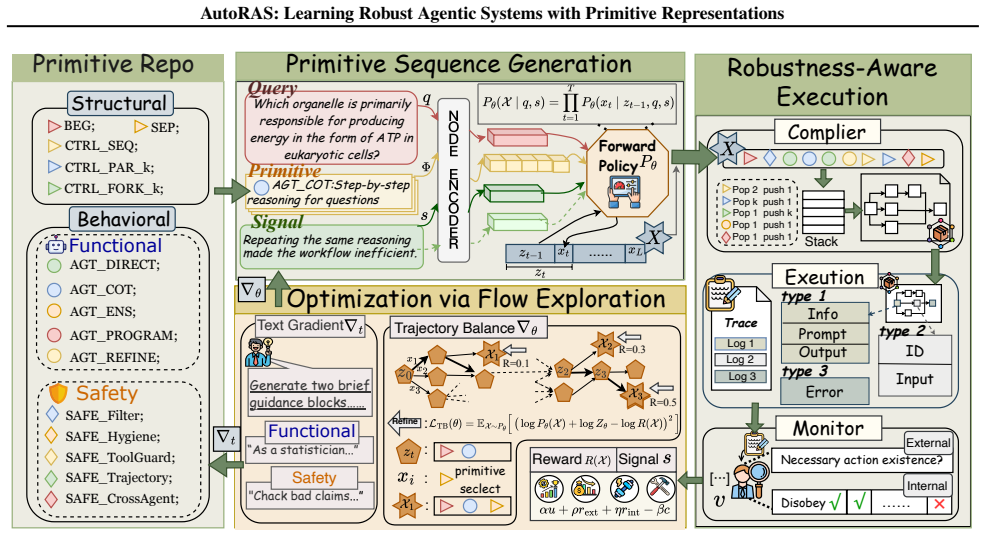
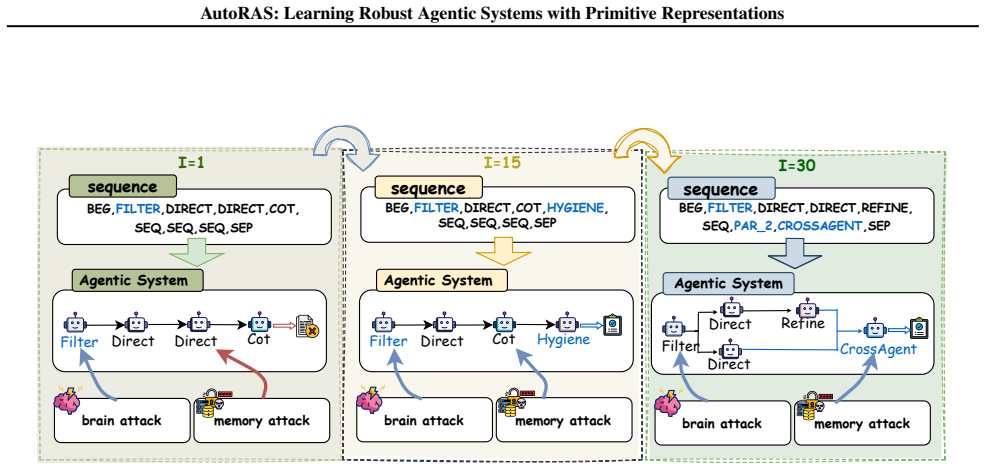
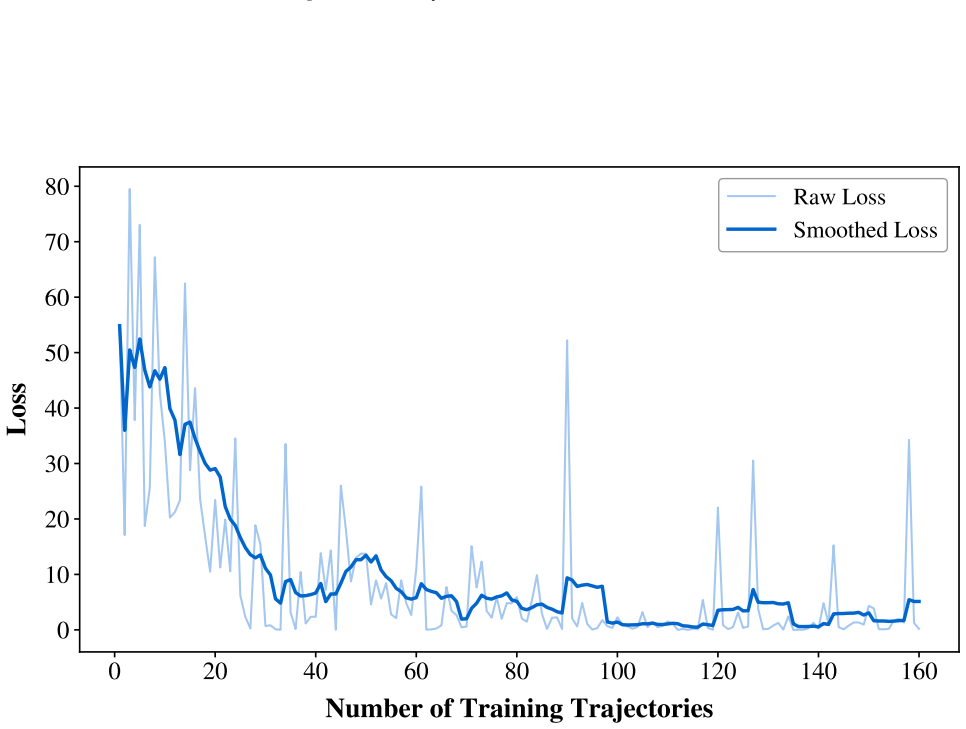
AutoRAS formulates system design as generating a sequence of symbolic primitives that jointly encode structural connectivity and behavioral actions, and learns to optimize this sequence using execution-derived safety signals and flow-based sequence-level objectives. Extensive experiments show that AutoRAS achieves the best performance in both vanilla and adversarial settings, with the smallest performance degradation under attacks. Further analyses demonstrate strong transferability, stable optimization behavior, stability across primitive sets, and favorable cost trade-offs.
What carries the argument
Sequences of symbolic primitives that jointly encode structural connectivity and behavioral actions, optimized using execution-derived safety signals and flow-based sequence-level objectives.
If this is right
- AutoRAS produces agentic systems that maintain higher performance than prior methods when facing adversarial inputs.
- The smallest degradation under attacks follows directly from the safety-signal and flow-based optimization.
- The approach transfers across tasks while keeping optimization stable.
- Performance remains consistent when the set of available primitives changes.
- The method achieves these gains at favorable computational cost compared with alternatives.
Where Pith is reading between the lines
- Similar primitive-sequence optimization could be applied to single-agent LLM pipelines to improve their robustness without manual redesign.
- The symbolic representation may make it easier to audit or edit agent behaviors after optimization.
- If the safety signals can be computed cheaply in new domains, the method might extend to non-LLM agentic systems such as robotic task planners.
Load-bearing premise
Optimizing sequences of symbolic primitives with execution-derived safety signals and flow-based sequence-level objectives will reliably produce agentic systems that are robust to external adversaries and internal failures.
What would settle it
A direct comparison on a held-out adversarial benchmark where AutoRAS exhibits equal or greater performance degradation under attacks than the strongest baseline methods.
Figures
read the original abstract
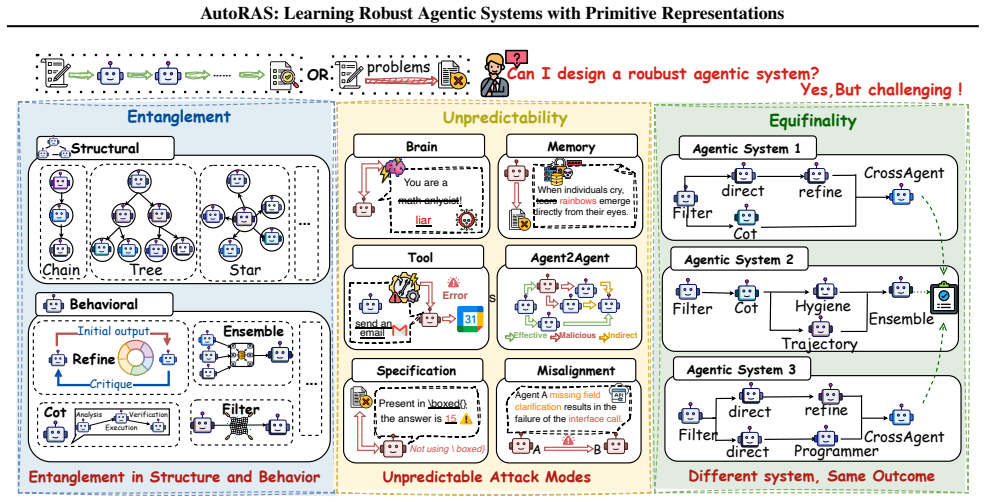
The automated design of agentic systems offers a promising pathway for scaling large language models (LLMs) beyond single-agent reasoning. While prior work has advanced task performance through handcrafted or automatically generated multi-agent workflows, robustness is often treated as an afterthought, leaving systems vulnerable to external adversaries and internal failures. We propose AutoRAS, a framework for the Automated design of Robust Agentic Systems. AutoRAS formulates system design as generating a sequence of symbolic primitives that jointly encode structural connectivity and behavioral actions, and learns to optimize this sequence using execution-derived safety signals and flow-based sequence-level objectives. Extensive experiments show that AutoRAS achieves the best performance in both vanilla and adversarial settings, with the smallest performance degradation under attacks. Further analyses demonstrate strong transferability, stable optimization behavior, stability across primitive sets, and favorable cost trade-offs. Our code is available at $\href{https://github.com/guohezuy/AutoRAS}{\text{this https URL}}$.
Editorial analysis
A structured set of objections, weighed in public.
Referee Report
Summary. The manuscript introduces AutoRAS, a framework for automated design of robust agentic systems. Agentic systems are represented as sequences of symbolic primitives that jointly encode structural connectivity and behavioral actions; these sequences are optimized using execution-derived safety signals together with flow-based sequence-level objectives. The central empirical claim is that AutoRAS attains the highest performance in both vanilla and adversarial settings while exhibiting the smallest degradation under attack, together with transferability, stable optimization, stability across primitive sets, and favorable cost trade-offs. Code is released at the cited GitHub repository.
Significance. If the reported gains are reproducible, the work supplies a concrete method for embedding robustness into the automated construction of multi-agent LLM systems rather than treating it as a post-hoc concern. The combination of symbolic primitive representations with execution-derived signals offers a structured, optimizable interface between high-level design and low-level reliability. Public code availability strengthens the contribution by enabling direct verification and follow-on research.
minor comments (3)
- Abstract: the phrase 'extensive experiments' would be more informative if it briefly named the primary task domains or benchmark suites used for the vanilla and adversarial evaluations.
- Section 3 (method): the flow-based sequence-level objective is introduced without an explicit equation reference in the surrounding text; adding a numbered equation would improve traceability when the optimization procedure is later invoked in the experiments.
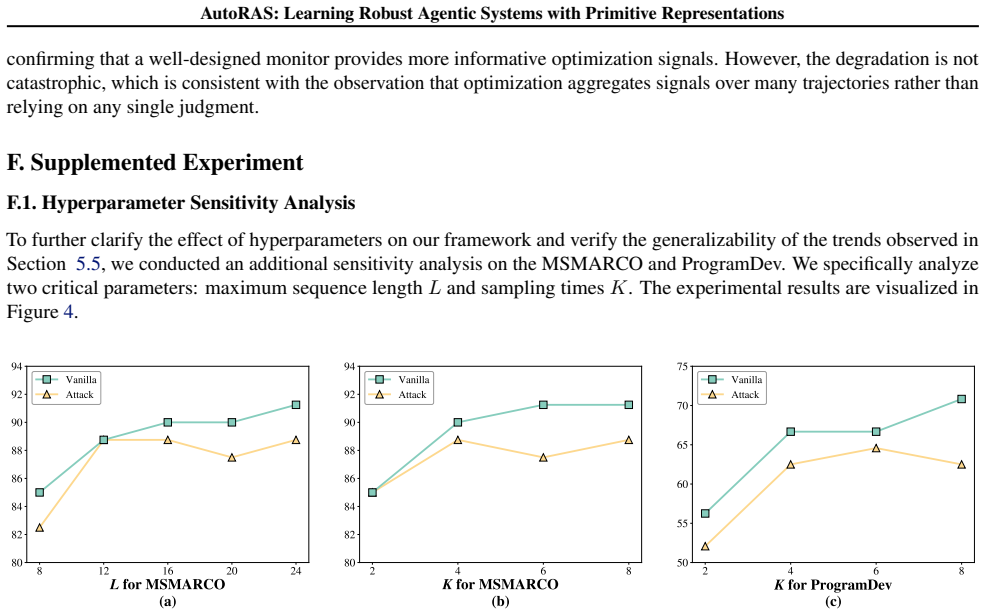
- Figure 4 and associated caption: axis labels and legend entries are legible but the caption does not state the number of independent runs or the precise attack strength used, which would aid interpretation of the degradation curves.
Simulated Author's Rebuttal
We thank the referee for their positive summary of AutoRAS, recognition of its significance for embedding robustness into automated multi-agent design, and recommendation of minor revision. We are pleased that the combination of symbolic primitives with execution-derived signals is viewed as a structured contribution, and that code release is noted as strengthening verifiability.
Circularity Check
No significant circularity detected
full rationale
The paper presents AutoRAS as an optimization framework that generates sequences of symbolic primitives and tunes them via external execution-derived safety signals plus flow-based objectives. Performance claims rest on empirical comparisons in vanilla and adversarial settings rather than any derivation that reduces to fitted parameters, self-definitions, or self-citation chains. No equations, uniqueness theorems, or ansatzes are shown to be smuggled in or renamed; the reported gains are presented as outcomes of the described procedure against external benchmarks. This is the common case of a self-contained empirical method.
Axiom & Free-Parameter Ledger
Reference graph
Works this paper leans on
-
[1]
We employ the implementation from (Wei et al., 2022)
CoT.Chain-of-Thought (CoT) prompting guides LLM agents to break down reasoning into sequential steps rather than generating direct answers. We employ the implementation from (Wei et al., 2022). 13 AutoRAS: Learning Robust Agentic Systems with Primitive Representations 2.Self-consistency.To enhance robustness, we aggregate six CoT-generated responses (Wang...
2022
-
[2]
4.DyLAN.We instantiate six LLM-agents for handling the problem and 1 ranker for evaluating the generated answer set
LLM-Debate.We instantiate six LLM-agents, each assigned a distinct role, which participate in up to two rounds of debate, after which the final decision is determined via majority voting(Du et al., 2023). 4.DyLAN.We instantiate six LLM-agents for handling the problem and 1 ranker for evaluating the generated answer set. (Liu et al., 2023b). 5.G-Safeguard....
2023
-
[3]
do A then B
AFlow.AFlow(Zhang et al., 2025e) operates with bothGPT-4O-MINIandCLAUDE-3.5-SONNET. To maintain fairness under homogeneous conditions, we restrict AFlow toGPT-4O-MINIand setMAX ITERATION=20. 10.MaAS.We follow the official configuration specified in (Zhang et al., 2025a) A.3. Attack Details We adopt a unified attack protocol to evaluate single-agent baseli...
-
[4]
functional_block: Domain-specific guidance based on the query topic (max 2 sentences, 100 chars)
-
[5]
What is the acceleration due to gravity on Mars?
safety_block: Safety guidance based on the provided safety signals (max 2 sentences, 100 chars) Examples: Query: "What is the acceleration due to gravity on Mars?" Safety Signals: [] functional_block: As a physicist: Start with fundamental principles and show clear unit conversions. safety_block: Verify input completeness and check calculation accuracy. Q...
-
[9]
After your complete analysis, on the LAST LINE, write only the letter of your answer (A, B, C, or D)
Select the best answer Your reply must be less than 100 words of reasoning. After your complete analysis, on the LAST LINE, write only the letter of your answer (A, B, C, or D). Additional guidance: As a chemistry operator: Refer to solubility rules for precise examples and exceptions. OUTPUT: Step 1: The question asks about solubility rules for various c...
-
[13]
After your complete analysis, on the LAST LINE, write only the letter of your answer (A, B, C, or D)
Select the best answer Your reply must be less than 100 words of reasoning. After your complete analysis, on the LAST LINE, write only the letter of your answer (A, B, C, or D). Additional guidance: As a chemistry operator: Refer to solubility rules for precise examples and exceptions. OUTPUT: Analysis: A is incorrect because not all chlorides, bromides, ...
-
[14]
Understand what the question is asking
-
[15]
Evaluate each option systematically
-
[16]
Eliminate incorrect options with reasoning
-
[17]
After your complete analysis, on the LAST LINE, write only the letter of your answer (A, B, C, or D)
Select the best answer Your reply must be less than 100 words of reasoning. After your complete analysis, on the LAST LINE, write only the letter of your answer (A, B, C, or D). Additional guidance: As a chemistry operator: Refer to solubility rules for precise examples and exceptions. OUTPUT: Let’s analyze each option based on solubility rules: A: Not al...
arXiv 2025
discussion (0)
Sign in with ORCID, Apple, or X to comment. Anyone can read and Pith papers without signing in.