Peripheral Nitrogen Topology as a Defect-Chemical Switch for Electronic and Magnetic States in Graphene: A First-Principles Study of Pyridinic, Pyridazinic, Pyrrolic, and Pyrazolic Configurations
Pith reviewed 2026-06-26 13:50 UTC · model grok-4.3
The pith
Peripheral nitrogen topology acts as a switch for electronic and magnetic states in graphene with voids.
A machine-rendered reading of the paper's core claim, the machinery that carries it, and where it could break.
Core claim
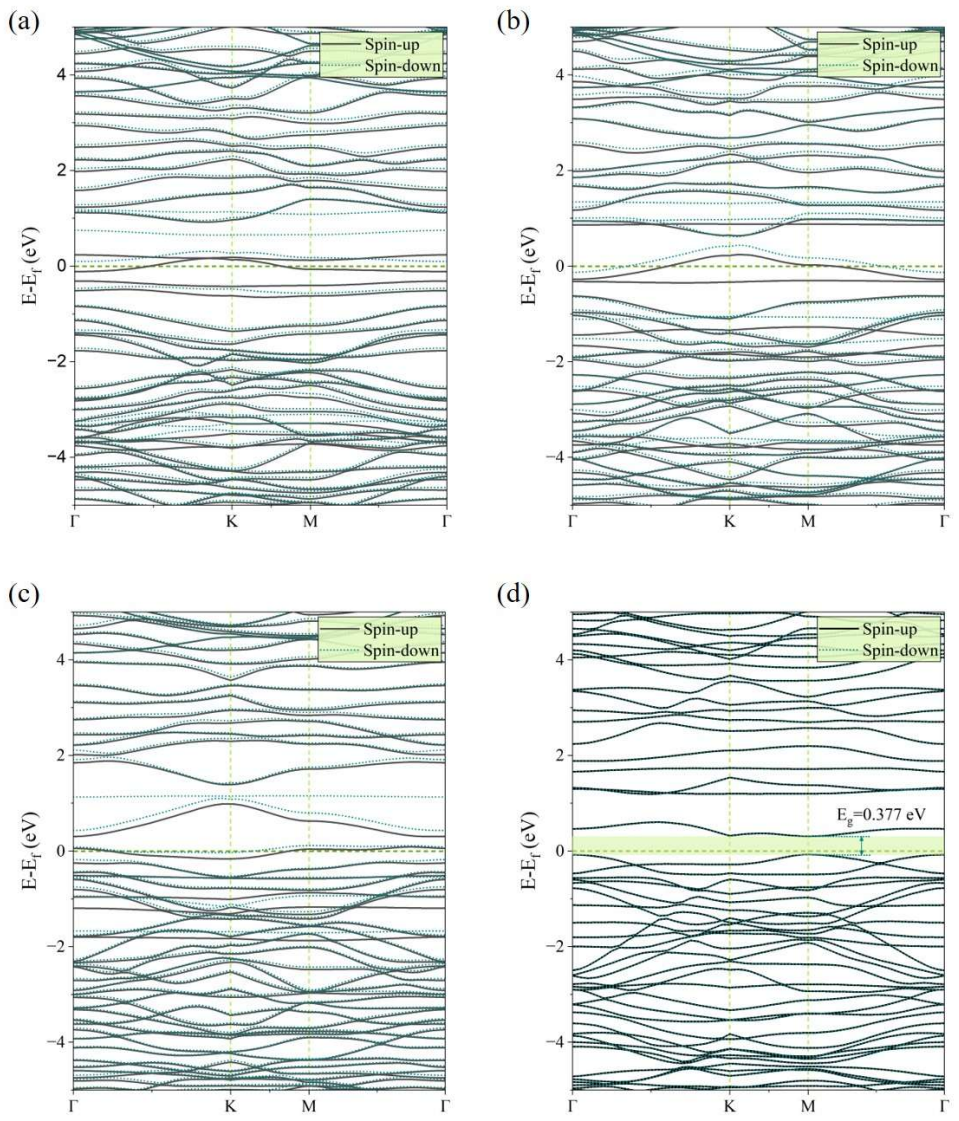
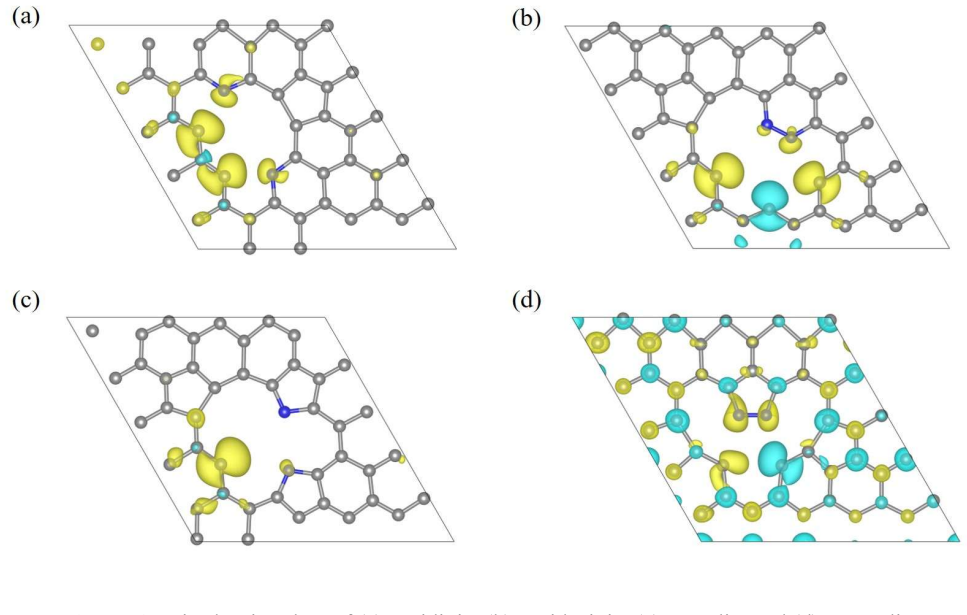
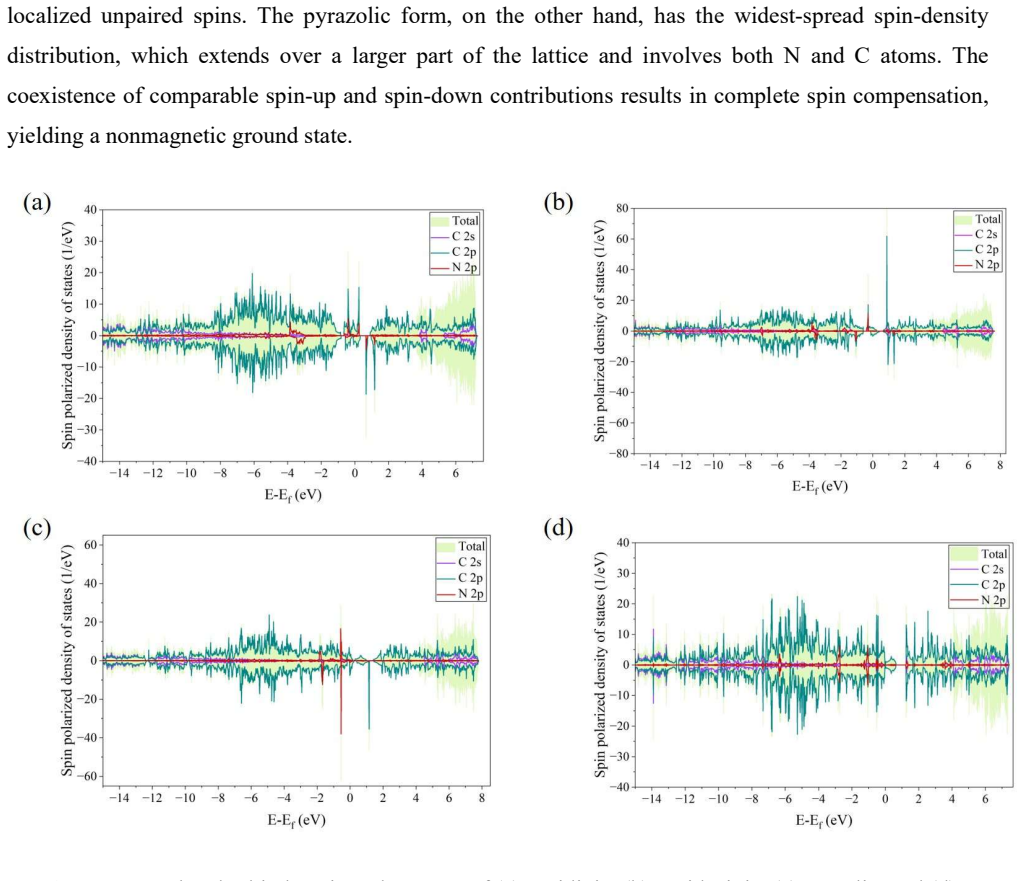
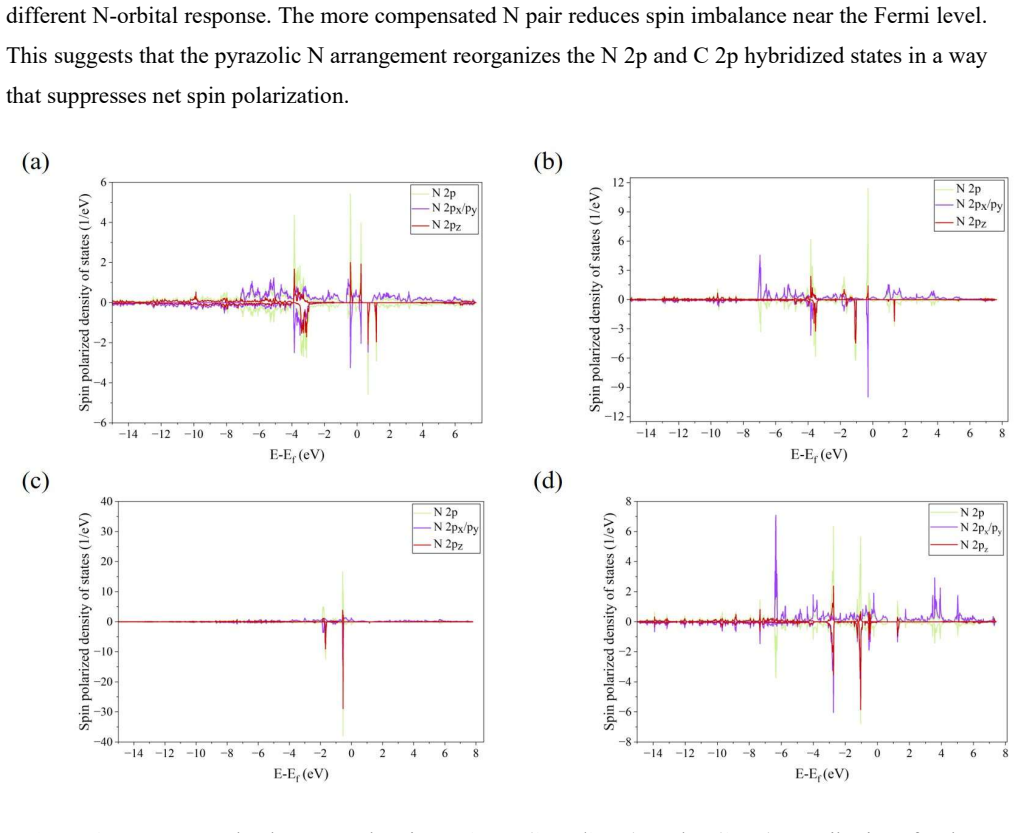
Among the pyridinic, pyridazinic, pyrrolic, and pyrazolic peripheral nitrogen configurations, the pyridinic provides the most favorable structural-energetic balance, while the pyrazolic opens a narrow band gap and is spin-compensated with zero net magnetization, in contrast to the metallic defect-state character and finite spin-polarized moments in the other systems, with magnetism originating from N-modulated vacancy-edge states involving N 2p and neighboring C 2p orbitals.
What carries the argument
The peripheral nitrogen topology around the vacancy, specifically the four heterocyclic configurations, which controls local lattice reconstruction, charge redistribution, and the emergence of spin-polarized defect states.
If this is right
- Pyridinic N configuration is the most stable among the four.
- Pyrazolic configuration results in a semiconducting state with no net magnetization.
- Pyridinic, pyridazinic, and pyrrolic configurations maintain metallic or near-metallic character with finite magnetic moments.
- N atoms serve as electron-accumulating centers that reshape the local electronic environment.
- Magnetism arises from states involving both N 2p and C 2p orbitals at the vacancy edge.
Where Pith is reading between the lines
- This suggests potential for creating graphene devices with integrated semiconducting and spintronic regions through controlled nitrogen placement.
- The method could be applied to other two-dimensional carbon-based materials for similar property tuning.
- Experimental synthesis and characterization of these configurations would provide direct validation of the calculated band gaps and magnetic moments.
- Broader implications include advancing defect engineering for applications in electronics and magnetism without metal dopants.
Load-bearing premise
The spin-polarized first-principles calculations and supercell model accurately represent the energies, band gaps, and magnetic moments of the nitrogen configurations without major inaccuracies from the choice of method or system size.
What would settle it
Observation of a significant band gap or net magnetization in a synthesized pyrazolic nitrogen configuration around a graphene void that contradicts the calculated narrow gap and zero magnetization.
Figures
read the original abstract
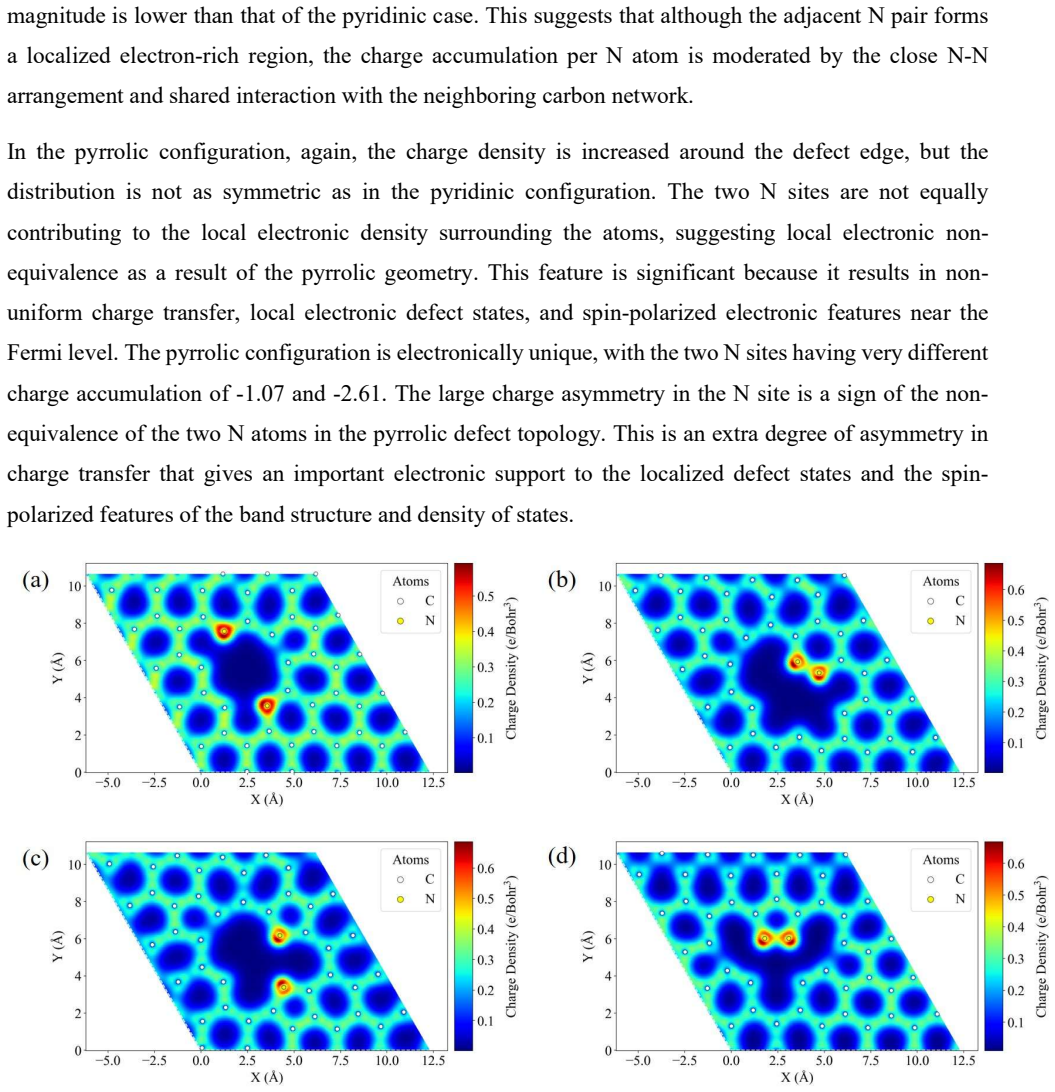
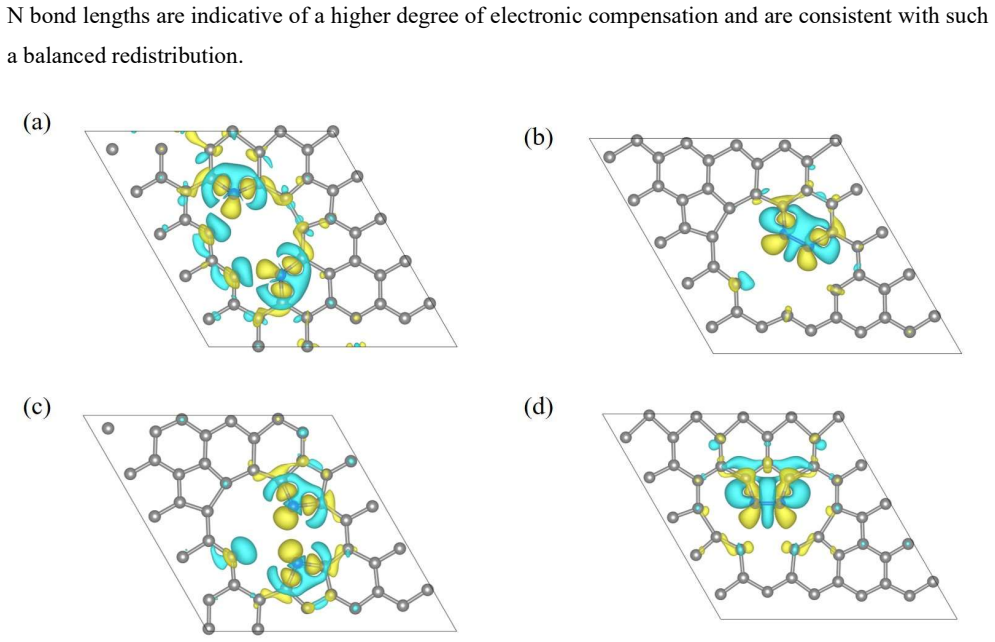
Defect and heteroatom engineering offer powerful routes for tuning the electronic and magnetic properties of graphene, yet the role of specific peripheral nitrogen topologies around graphene voids remains insufficiently understood. Here, spin-polarized first-principles calculations were performed to investigate how four heterocyclic -- like peripheral nitrogen configurations -- pyridinic, pyridazinic, pyrrolic, and pyrazolic modify the structural stability, charge redistribution, electronic structure, and magnetic response of graphene containing a central void. Among the four peripheral N configurations, the pyridinic N provides the most favorable structural-energetic balance among the investigated motifs. Bond-length analysis reveals that nitrogen topology strongly controls local lattice reconstruction. Charge-density, charge-density-difference, and Bader analyses demonstrate that the peripheral N atoms act as electron-accumulating centers and reshape the local electronic environment around the vacancy rim. Spin-resolved band structures show that pyridinic, pyridazinic, and pyrrolic configurations retain metallic or near-metallic defect-state character, whereas pyrazolic graphene opens a narrow band gap. Magnetic analysis further reveals that pyrazolic graphene is spin-compensated, with zero net magnetization, unlike the other systems, which possess finite spin-polarized moments. Spin-density and SPDOS analyses indicate that the magnetism originates from N-modulated vacancy-edge states involving both N 2p and neighboring C 2p orbitals. These findings establish peripheral nitrogen topology not merely as a structural defect descriptor, but as a deterministic defect-chemical switch, offering a metal-free route to pattern active spintronic and semiconducting domains directly into the graphene lattice through controlled vacancy-edge nitrogen coordination.
Editorial analysis
A structured set of objections, weighed in public.
Referee Report
Summary. The manuscript reports spin-polarized first-principles calculations on graphene containing a central void decorated with four peripheral nitrogen topologies (pyridinic, pyridazinic, pyrrolic, pyrazolic). It finds that pyridinic N is energetically most favorable, that bond lengths and charge redistribution are topology-dependent, and that pyrazolic configuration opens a narrow band gap with zero net magnetization while the other three remain metallic/near-metallic with finite spin moments. The magnetism is attributed to N-modulated vacancy-edge states involving N 2p and C 2p orbitals. The central claim is that N topology functions as a deterministic defect-chemical switch for patterning spintronic and semiconducting domains.
Significance. If the reported distinctions in gap opening and spin compensation prove robust, the work would identify a metal-free route to locally engineer electronic and magnetic functionality in graphene via controlled vacancy-edge N coordination, with potential implications for defect-based spintronics.
major comments (2)
- [Computational Methods] Computational Methods (and abstract): the manuscript provides no information on the exchange-correlation functional, plane-wave cutoff, k-point sampling, supercell size, vacuum spacing, or convergence criteria. Because the central claim rests on qualitative distinctions (metallic vs. gapped; finite vs. zero moment) obtained from spin-polarized DFT, the absence of these parameters and of any tests against hybrid functionals or finite-size effects prevents verification that the reported outcomes are not artifacts of standard GGA limitations on defect magnetism and gap underestimation.
- [Results] Results section on band structures and magnetic moments: the claim that pyrazolic graphene is spin-compensated with a narrow gap while the others are metallic with finite moments is load-bearing for the 'deterministic switch' interpretation, yet no sensitivity analysis to functional choice or supercell size is presented. Standard GGA functionals are known to artificially stabilize or suppress magnetism at vacancy-edge states; without such checks the distinctions cannot be taken as robust.
minor comments (2)
- [Abstract] Abstract: the phrasing 'heterocyclic -- like peripheral nitrogen configurations' contains an awkward double dash and unclear modifier; rephrase for clarity.
- [Results] The manuscript should include a table or explicit statement of the computed formation energies, band gaps, and total magnetic moments for all four configurations to allow direct comparison.
Simulated Author's Rebuttal
We thank the referee for the detailed and constructive report. We address the two major comments point-by-point below and will revise the manuscript to incorporate the requested information.
read point-by-point responses
-
Referee: [Computational Methods] Computational Methods (and abstract): the manuscript provides no information on the exchange-correlation functional, plane-wave cutoff, k-point sampling, supercell size, vacuum spacing, or convergence criteria. Because the central claim rests on qualitative distinctions (metallic vs. gapped; finite vs. zero moment) obtained from spin-polarized DFT, the absence of these parameters and of any tests against hybrid functionals or finite-size effects prevents verification that the reported outcomes are not artifacts of standard GGA limitations on defect magnetism and gap underestimation.
Authors: We agree that the original submission omitted explicit computational parameters. In the revised manuscript we will insert a dedicated Computational Methods section that reports the exchange-correlation functional, plane-wave cutoff, k-point sampling, supercell size, vacuum spacing, and all convergence criteria used. We will also add a short paragraph discussing the choice of functional and its known performance for vacancy-edge states in graphene. revision: yes
-
Referee: [Results] Results section on band structures and magnetic moments: the claim that pyrazolic graphene is spin-compensated with a narrow gap while the others are metallic with finite moments is load-bearing for the 'deterministic switch' interpretation, yet no sensitivity analysis to functional choice or supercell size is presented. Standard GGA functionals are known to artificially stabilize or suppress magnetism at vacancy-edge states; without such checks the distinctions cannot be taken as robust.
Authors: We acknowledge that no explicit sensitivity tests to functional or supercell size appear in the submitted manuscript. The observed qualitative distinctions (gap opening and spin compensation exclusively in the pyrazolic topology) arise directly from the different nitrogen coordination patterns and are supported by the spin-density and projected-DOS analyses already presented. In the revision we will add a concise discussion of the robustness of these topology-driven trends, drawing on established literature for similar defect systems, while noting that a full hybrid-functional or larger-supercell benchmark lies beyond the scope of the present study. revision: partial
Circularity Check
No circularity: results are direct DFT outputs
full rationale
The paper performs spin-polarized first-principles calculations on four fixed nitrogen topologies around a graphene void and reports the resulting energies, band structures, charge distributions, and magnetic moments as computed quantities. No parameters are fitted to the target observables, no equations define one reported property in terms of another, and no self-citations supply load-bearing uniqueness theorems or ansatzes. The distinctions (e.g., pyrazolic gap opening and zero moment versus metallic/magnetic behavior in the others) are therefore independent computational outcomes rather than reductions to the input configurations by construction.
Axiom & Free-Parameter Ledger
free parameters (2)
- DFT exchange-correlation functional
- supercell size and vacuum spacing
axioms (1)
- domain assumption Spin-polarized DFT sufficiently describes the magnetic and electronic states of N-decorated graphene vacancies
Reference graph
Works this paper leans on
-
[1]
Science, 2004
Novoselov, K.S., et al., Electric Field Effect in Atomically Thin Carbon Films. Science, 2004. 306(5696): p. 666-669
2004
-
[2]
Reviews of Modern Physics, 2009
Castro Neto, A.H., et al., The electronic properties of graphene. Reviews of Modern Physics, 2009. 81(1): p. 109-162
2009
-
[3]
Solid state communications,
Bolotin, K.I., et al., Ultrahigh electron mobility in suspended graphene. Solid state communications,
-
[4]
146(9-10): p. 351-355
-
[5]
Science, 2008
Lee, C., et al., Measurement of the Elastic Properties and Intrinsic Strength of Monolayer Graphene. Science, 2008. 321(5887): p. 385-388
2008
-
[6]
nature, 2005
Novoselov, K.S., et al., Two-dimensional gas of massless Dirac fermions in graphene. nature, 2005. 438(7065): p. 197-200
2005
-
[7]
Nature nanotechnology, 2010
Schwierz, F., Graphene transistors. Nature nanotechnology, 2010. 5(7): p. 487-496
2010
-
[8]
Reports on Progress in Physics, 2010
Yazyev, O.V., Emergence of magnetism in graphene materials and nanostructures. Reports on Progress in Physics, 2010. 73(5): p. 056501
2010
-
[9]
Nature nanotechnology, 2014
Han, W., et al., Graphene spintronics. Nature nanotechnology, 2014. 9(10): p. 794-807
2014
-
[10]
Yazyev, O.V. and L. Helm, Defect-induced magnetism in graphene. Physical Review B, 2007. 75(12): p. 125408
2007
-
[11]
Physical Review Letters, 2010
Ugeda, M.M., et al., Missing atom as a source of carbon magnetism. Physical Review Letters, 2010. 104(9): p. 096804
2010
-
[12]
Cohen, and S.G
Son, Y.-W., M.L. Cohen, and S.G. Louie, Half-metallic graphene nanoribbons. nature, 2006. 444(7117): p. 347-349
2006
-
[13]
Maiyalagan, and X
Wang, H., T. Maiyalagan, and X. Wang, Review on recent progress in nitrogen-doped graphene: synthesis, characterization, and its potential applications. AcS catalysis, 2012. 2(5): p. 781-794
2012
-
[14]
Nano letters, 2012
Schiros, T., et al., Connecting dopant bond type with electronic structure in N-doped graphene. Nano letters, 2012. 12(8): p. 4025-4031
2012
-
[15]
Physical Review Letters, 1989
Lieb, E.H., Two theorems on the Hubbard model. Physical Review Letters, 1989. 62(10): p. 1201-1204
1989
-
[16]
Fernández-Rossier, and L
Palacios, J.J., J. Fernández-Rossier, and L. Brey, Vacancy-induced magnetism in graphene and graphene ribbons. Physical Review B, 2008. 77(19): p. 195428
2008
-
[17]
Physical Review B— Condensed Matter and Materials Physics, 2012
Joucken, F., et al., Localized state and charge transfer in nitrogen-doped graphene. Physical Review B— Condensed Matter and Materials Physics, 2012. 85(16): p. 161408
2012
-
[18]
Dalton Transactions, 2008(21): p
Cordero, B., et al., Covalent radii revisited. Dalton Transactions, 2008(21): p. 2832-2838
2008
-
[19]
Pauling, L., The nature of the chemical bond. IV. The energy of single bonds and the relative electronegativity of atoms. Journal of the American Chemical Society, 1932. 54(9): p. 3570-3582
1932
-
[20]
Mach, and M
Lazar, P., R. Mach, and M. Otyepka, Spectroscopic fingerprints of graphitic, pyrrolic, pyridinic, and chemisorbed nitrogen in N-doped graphene. The Journal of Physical Chemistry C, 2019. 123(16): p. 10695-10702
2019
-
[21]
Science, 2011
Zhao, L., et al., Visualizing Individual Nitrogen Dopants in Monolayer Graphene. Science, 2011. 333(6045): p. 999-1003
2011
-
[22]
Noor, and T
Yutomo, E.B., F.A. Noor, and T. Winata, Effect of the number of nitrogen dopants on the electronic and magnetic properties of graphitic and pyridinic N-doped graphene–a density-functional study. RSC advances, 2021. 11(30): p. 18371-18380
2021
-
[23]
Babar, R. and M. Kabir, Ferromagnetism in nitrogen-doped graphene. Physical Review B, 2019. 99(11): p. 115442
2019
-
[24]
Piotr, B.s., et al., Doping with Graphitic Nitrogen Triggers Ferromagnetism in Graphene. 2017
2017
-
[25]
Scientific 27 reports, 2016
Miao, Q., et al., Magnetic properties of N-doped graphene with high Curie temperature. Scientific 27 reports, 2016. 6(1): p. 21832
2016
-
[26]
Chemical Engineering Journal, 2018
Wang, X., et al., Chemoselective solution synthesis of pyrazolic-structure-rich nitrogen-doped graphene for supercapacitors and electrocatalysis. Chemical Engineering Journal, 2018. 347: p. 754-762
2018
-
[27]
Journal of Materials Science, 2026: p
Rudra, I., et al., Impact of nitrogen atom clusters and void defects on graphene: a molecular dynamics investigation. Journal of Materials Science, 2026: p. 1-12
2026
-
[28]
Hohenberg, P. and W. Kohn, Inhomogeneous electron gas. Physical review, 1964. 136(3B): p. B864
1964
-
[29]
Reviews of modern physics, 1992
Payne, M.C., et al., Iterative minimization techniques for ab initio total-energy calculations: molecular dynamics and conjugate gradients. Reviews of modern physics, 1992. 64(4): p. 1045
1992
-
[30]
Journal of physics: Condensed matter, 2009
Giannozzi, P., et al., QUANTUM ESPRESSO: a modular and open-source software project for quantum simulations of materials. Journal of physics: Condensed matter, 2009. 21(39): p. 395502
2009
-
[31]
Journal of physics: Condensed matter, 2017
Giannozzi, P., et al., Advanced capabilities for materials modelling with Quantum ESPRESSO. Journal of physics: Condensed matter, 2017. 29(46): p. 465901
2017
-
[32]
Burke, and M
Perdew, J.P., K. Burke, and M. Ernzerhof, Generalized gradient approximation made simple. Physical review letters, 1996. 77(18): p. 3865
1996
-
[33]
Physical review B, 1994
Blöchl, P.E., Projector augmented-wave method. Physical review B, 1994. 50(24): p. 17953
1994
-
[34]
Computational Materials Science, 2014
Dal Corso, A., Pseudopotentials periodic table: From H to Pu. Computational Materials Science, 2014. 95: p. 337-350
2014
-
[35]
Monkhorst, H.J. and J.D. Pack, Special points for Brillouin-zone integrations. Physical review B, 1976. 13(12): p. 5188
1976
-
[36]
General Considerations
BROYDEN, C.G., The Convergence of a Class of Double-rank Minimization Algorithms 1. General Considerations. IMA Journal of Applied Mathematics, 1970. 6(1): p. 76-90
1970
-
[37]
The Computer Journal, 1970
Fletcher, R., A new approach to variable metric algorithms. The Computer Journal, 1970. 13(3): p. 317- 322
1970
-
[38]
Mathematics of Computation, 1970
Goldfarb, D., A Family of Variable-Metric Methods Derived by Variational Means. Mathematics of Computation, 1970. 24(109): p. 23-26
1970
-
[39]
Mathematics of Computation, 1970
Shanno, D.F., Conditioning of Quasi-Newton Methods for Function Minimization. Mathematics of Computation, 1970. 24(111): p. 647-656
1970
-
[40]
Arnaldsson, and H
Henkelman, G., A. Arnaldsson, and H. Jónsson, A fast and robust algorithm for Bader decomposition of charge density. Computational Materials Science, 2006. 36(3): p. 354-360
2006
-
[41]
Zhang, S. and J.E. Northrup, Chemical potential dependence of defect formation energies in GaAs: Application to Ga self-diffusion. Physical review letters, 1991. 67(17): p. 2339
1991
-
[42]
Reviews of modern physics,
Freysoldt, C., et al., First-principles calculations for point defects in solids. Reviews of modern physics,
-
[43]
Von Barth, U. and L. Hedin, A local exchange-correlation potential for the spin polarized case. i. Journal of Physics C: Solid State Physics, 1972. 5(13): p. 1629-1642
1972
-
[44]
Momma, K. and F. Izumi, VESTA 3 for three-dimensional visualization of crystal, volumetric and morphology data. Applied Crystallography, 2011. 44(6): p. 1272-1276
2011
-
[45]
RSC Advances, 2025
Yang, H., et al., Enhancing HER performance via nitrogen defects: a comparative DFT study of Fe and Ru single-atom catalysts on graphene. RSC Advances, 2025. 15(10): p. 7682-7692
2025
-
[46]
Atanassov, and B
Kattel, S., P. Atanassov, and B. Kiefer, Stability, electronic and magnetic properties of in-plane defects in graphene: a first-principles study. The Journal of Physical Chemistry C, 2012. 116(14): p. 8161-8166
2012
-
[47]
Shao, and D
Ma, C., X. Shao, and D. Cao, Nitrogen-doped graphene nanosheets as anode materials for lithium ion batteries: a first-principles study. Journal of Materials Chemistry, 2012. 22(18): p. 8911-8915
2012
discussion (0)
Sign in with ORCID, Apple, or X to comment. Anyone can read and Pith papers without signing in.