The moving Fermi polaron
Pith reviewed 2026-06-26 12:26 UTC · model grok-4.3
The pith
The attractive Fermi polaron enters a molecule-hole continuum at intermediate momenta and ceases to be the ground state.
A machine-rendered reading of the paper's core claim, the machinery that carries it, and where it could break.
Core claim
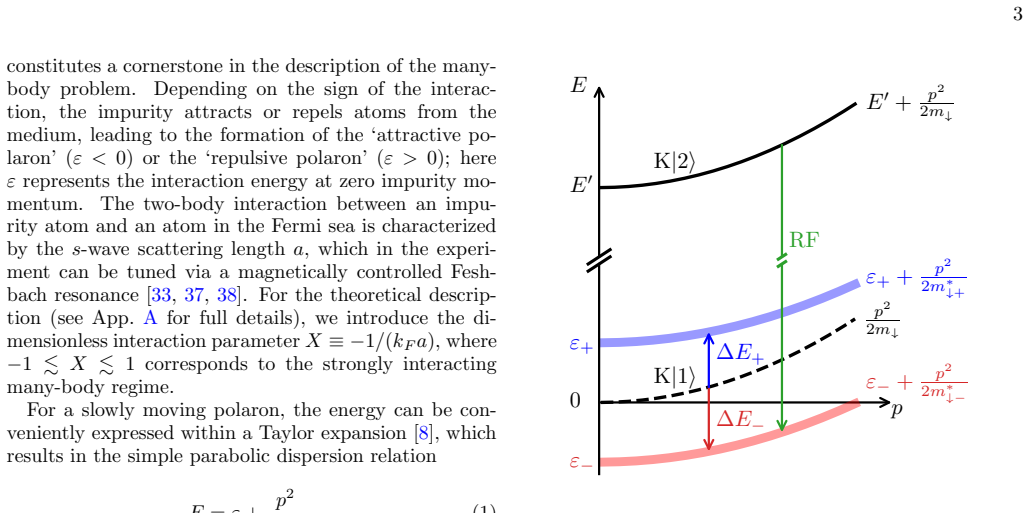
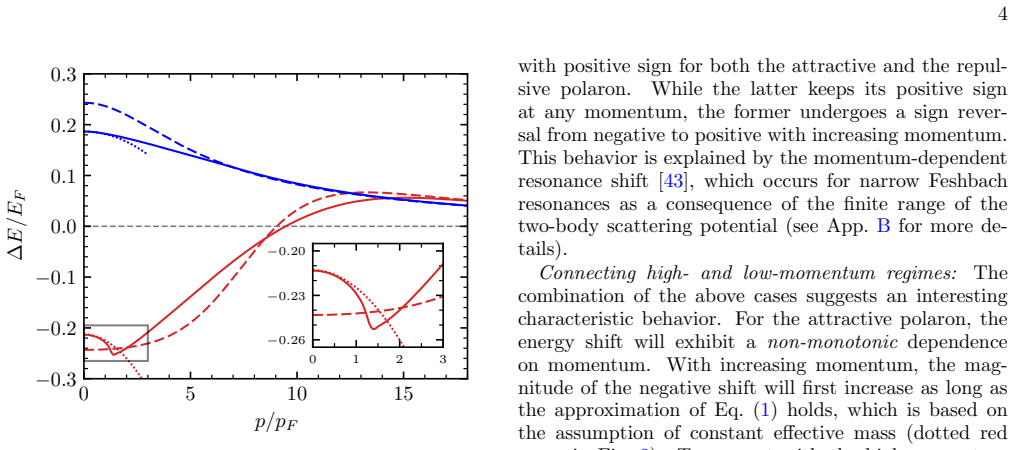
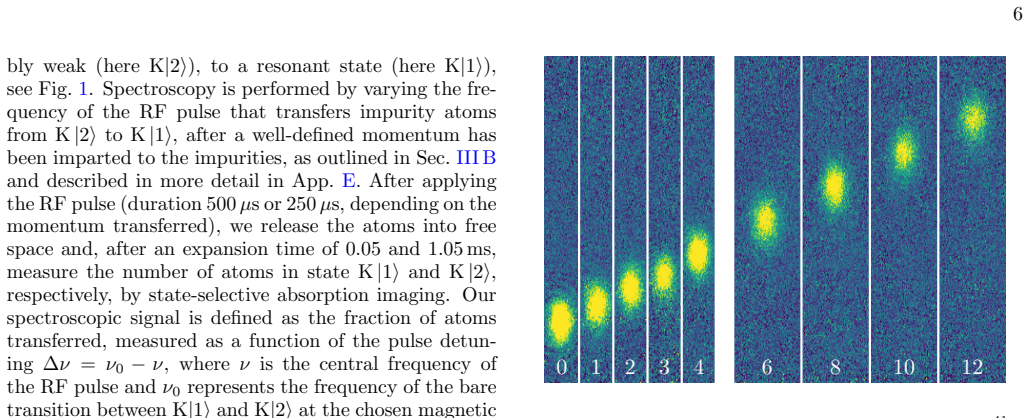
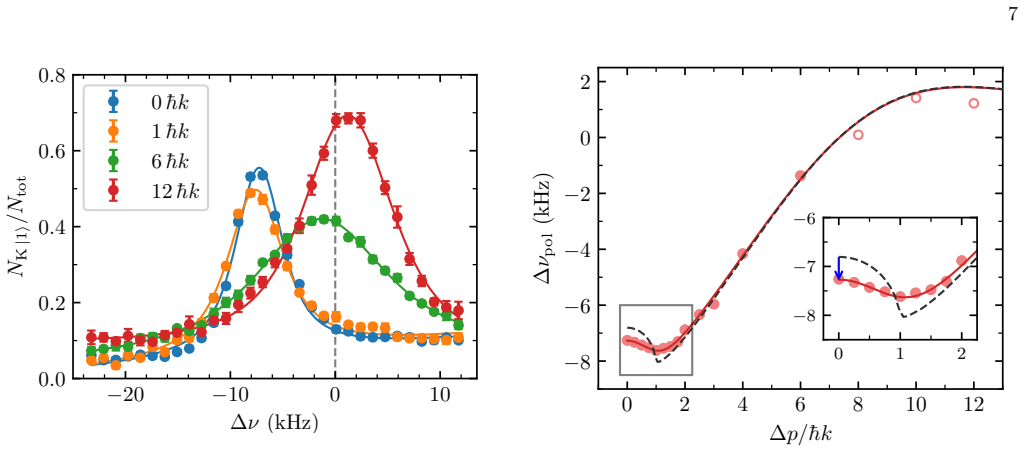
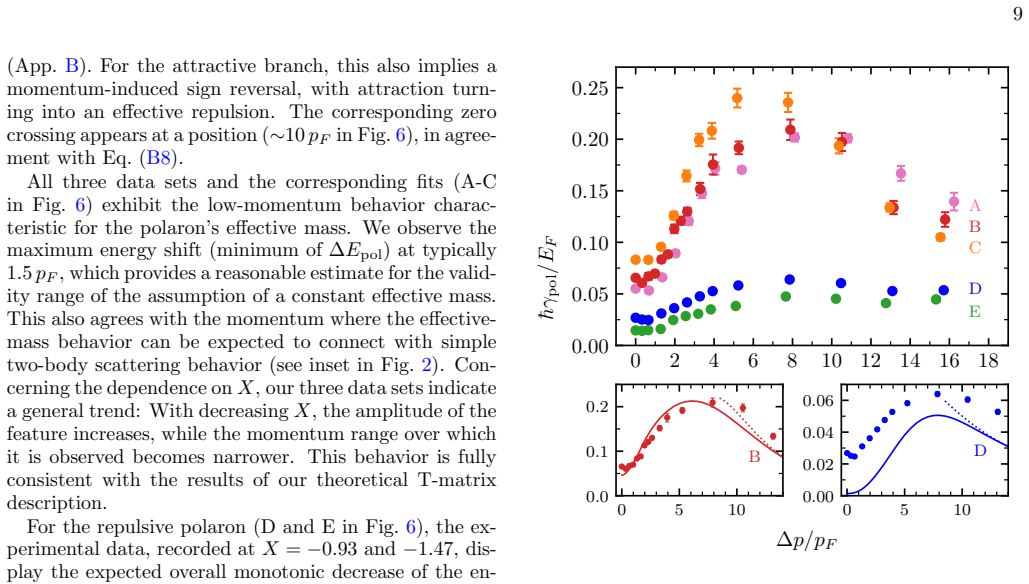
By accelerating impurities with a Raman scheme and recording radio-frequency spectra, the experiment maps the quasiparticle dispersion. For the attractive branch the energy departs from the constant-mass parabola and the linewidth jumps when the polaron enters the molecule-hole continuum, where it is no longer the lowest-energy state; the repulsive branch remains smooth. This establishes a motion-induced polaron-molecule transition.
What carries the argument
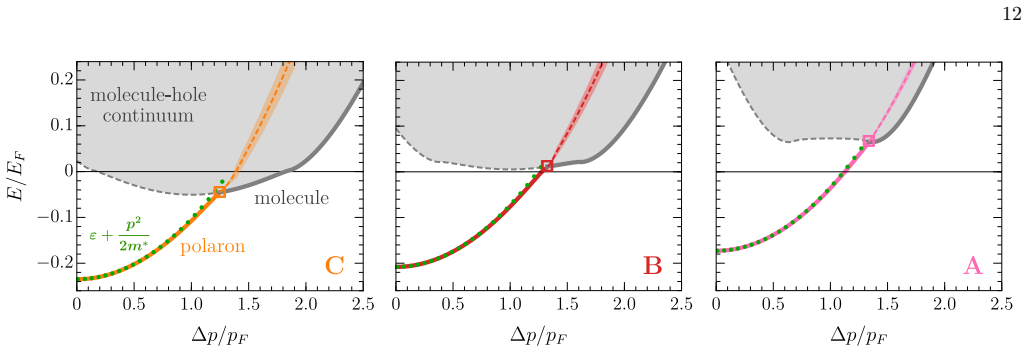
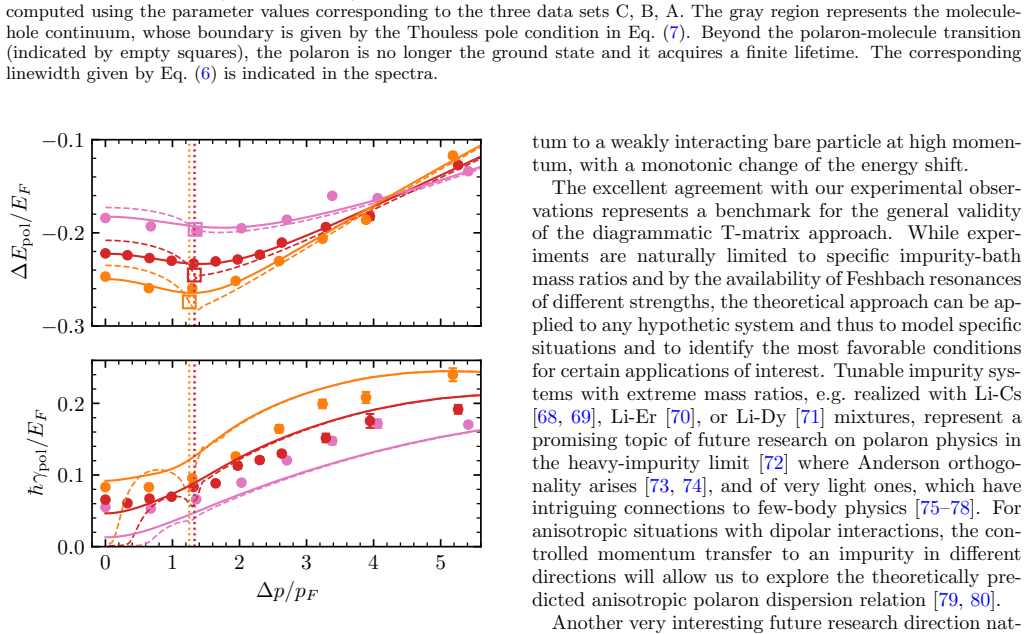
The molecule-hole continuum that sets the threshold at which the attractive polaron is no longer the ground state.
If this is right
- The low-momentum dispersion is quadratic with a constant effective mass for both attractive and repulsive branches.
- At high momenta both branches recover the behavior of a weakly interacting bare particle with small shifts and weak broadening.
- Only the attractive branch exhibits the non-monotonic energy and abrupt broadening at intermediate momenta.
- The transition is identified by direct comparison of measured energies and linewidths with microscopic theory.
Where Pith is reading between the lines
- Similar momentum-driven transitions may appear in other quasiparticle systems once finite-momentum probes become available.
- The result supplies a concrete benchmark for theories that treat polaron-molecule mixing at finite momentum.
- Extensions to two-dimensional or spin-orbit-coupled Fermi seas could reveal whether the transition survives reduced dimensionality or additional couplings.
Load-bearing premise
The Raman acceleration scheme adds momentum without extra heating or spectral broadening that could mimic the reported transition.
What would settle it
A measurement in which the sudden linewidth increase occurs at a momentum clearly different from the calculated molecule-hole threshold.
Figures
read the original abstract
The Fermi polaron, formed by an impurity interacting with a surrounding Fermi sea, exemplifies the canonical quasiparticle concept as a cornerstone in our description of quantum many-body systems across a wide range of energy scales. Experiments on atomic quantum gases have provided profound insights into the universal nature of the Fermi polaron. While most previous studies have focused on the case of zero impurity momentum, finite-momentum properties have remained largely uncharted. Here, we investigate the moving Fermi polaron by combining a novel Raman acceleration scheme with high-precision radio-frequency spectroscopy, exploring the quasiparticle dispersion relation over a wide range of momenta. We compare our measurements of energy shifts and spectral linewidths with a microscopic theory and reach quantitative agreement for all momenta. For low momenta, we find the energy of the moving polaron to be fully consistent with the Fermi liquid picture of a dressed particle with a constant effective mass. At high momenta, the polaron approaches the behavior of a weakly interacting bare particle, featuring small energy shifts and weak broadening. For intermediate momenta, broadening is generally larger and, most strikingly, the behavior differs for attractive and repulsive polarons. While the repulsive polaron exhibits a smooth connection between both regimes along with a monotonic change of the energy shift, the attractive case shows a peculiar non-monotonic behavior. With increasing momentum, the attractive polaron enters a regime where its energy deviates from the constant effective mass expression and broadening suddenly increases. By comparing this observation with theory, we show that this abrupt behavior coincides with the attractive polaron entering a molecule-hole continuum, where it is no longer the ground state. We interpret this as a motion-induced polaron-molecule transition.
Editorial analysis
A structured set of objections, weighed in public.
Referee Report
Summary. The manuscript reports measurements of the dispersion relation of moving Fermi polarons in an atomic quantum gas, achieved via a novel Raman acceleration scheme combined with high-precision radio-frequency spectroscopy. It claims quantitative agreement between measured energy shifts and linewidths and a microscopic theory across a wide momentum range. For low momenta the attractive polaron follows a constant effective-mass Fermi-liquid form; at high momenta it approaches bare-particle behavior. At intermediate momenta the attractive branch exhibits a non-monotonic energy deviation and abrupt linewidth increase that the authors identify with entry into the molecule-hole continuum, constituting a motion-induced polaron-molecule transition; the repulsive branch remains smooth.
Significance. If the Raman protocol is shown to impart momentum without introducing uncontrolled spectral broadening or heating, the work would constitute a significant experimental advance by mapping the finite-momentum regime of the Fermi polaron and furnishing direct evidence for a momentum-driven change in the ground-state character of the attractive quasiparticle.
major comments (2)
- [Experimental methods (Raman acceleration scheme)] The central claim that the observed non-monotonic energy shift and sudden linewidth increase signal entry into the molecule-hole continuum rests on the assumption that the Raman acceleration imparts a delta-function momentum distribution without additional decoherence or differential light shifts. The manuscript provides no quantitative characterization (e.g., measured momentum spread, residual temperature increase, or light-shift calibration) of these potential artifacts at the momenta where the transition is reported.
- [Results and comparison with theory] The abstract and results sections assert quantitative agreement with theory for both energy shifts and linewidths, yet no data tables, error bars on individual points, fitting procedures, or raw spectra are presented. Without these it is impossible to evaluate the statistical significance of the abrupt features or to determine whether the theory comparison is parameter-free or partly adjusted.
minor comments (2)
- [Theory section] Notation for the molecule-hole continuum threshold and the precise definition of the polaron energy relative to the continuum edge should be stated explicitly in the theory section.
- [Figures] Figure captions should include the momentum values at which the abrupt change is claimed and the corresponding theoretical curves.
Simulated Author's Rebuttal
We thank the referee for the careful reading of our manuscript and the constructive comments. We address each major point below.
read point-by-point responses
-
Referee: [Experimental methods (Raman acceleration scheme)] The central claim that the observed non-monotonic energy shift and sudden linewidth increase signal entry into the molecule-hole continuum rests on the assumption that the Raman acceleration imparts a delta-function momentum distribution without additional decoherence or differential light shifts. The manuscript provides no quantitative characterization (e.g., measured momentum spread, residual temperature increase, or light-shift calibration) of these potential artifacts at the momenta where the transition is reported.
Authors: We agree that quantitative characterization of the Raman acceleration is necessary to substantiate the central claim. In the revised manuscript we will add explicit data on the measured momentum spread after acceleration (obtained via time-of-flight imaging), upper bounds on residual temperature increase, and calibration of differential light shifts. These measurements confirm that any additional broadening or shifts remain well below the scale of the observed non-monotonic features and linewidth jump, supporting the identification of the molecule-hole continuum crossing. revision: yes
-
Referee: [Results and comparison with theory] The abstract and results sections assert quantitative agreement with theory for both energy shifts and linewidths, yet no data tables, error bars on individual points, fitting procedures, or raw spectra are presented. Without these it is impossible to evaluate the statistical significance of the abrupt features or to determine whether the theory comparison is parameter-free or partly adjusted.
Authors: The reported energies and linewidths are extracted from Lorentzian fits to the RF spectra; error bars reflect the combined statistical uncertainty from repeated measurements and fit covariance. The theoretical curves are computed from the known experimental parameters (Fermi wave vector, interaction parameter 1/k_F a) with no free parameters. In the revision we will include a supplementary section containing representative raw spectra together with the fits, a table of all extracted values with uncertainties, and a concise description of the fitting protocol, enabling direct assessment of the quantitative agreement and the abrupt features. revision: yes
Circularity Check
No circularity: experimental data compared to independent microscopic theory
full rationale
The paper reports RF spectroscopy measurements of the moving Fermi polaron under Raman acceleration and directly compares the observed energy shifts and linewidths to a microscopic many-body calculation of the quasiparticle dispersion and molecule-hole continuum threshold. No load-bearing step reduces to a fit of the target data, a self-citation that itself assumes the result, or an ansatz smuggled in by definition. The theory supplies an external benchmark whose parameters (interaction strength, Fermi wavevector, etc.) are fixed by the experimental conditions rather than adjusted to reproduce the reported non-monotonic feature. The derivation chain therefore remains self-contained.
Axiom & Free-Parameter Ledger
Reference graph
Works this paper leans on
-
[1]
Three-body models have been frequently used (see e.g
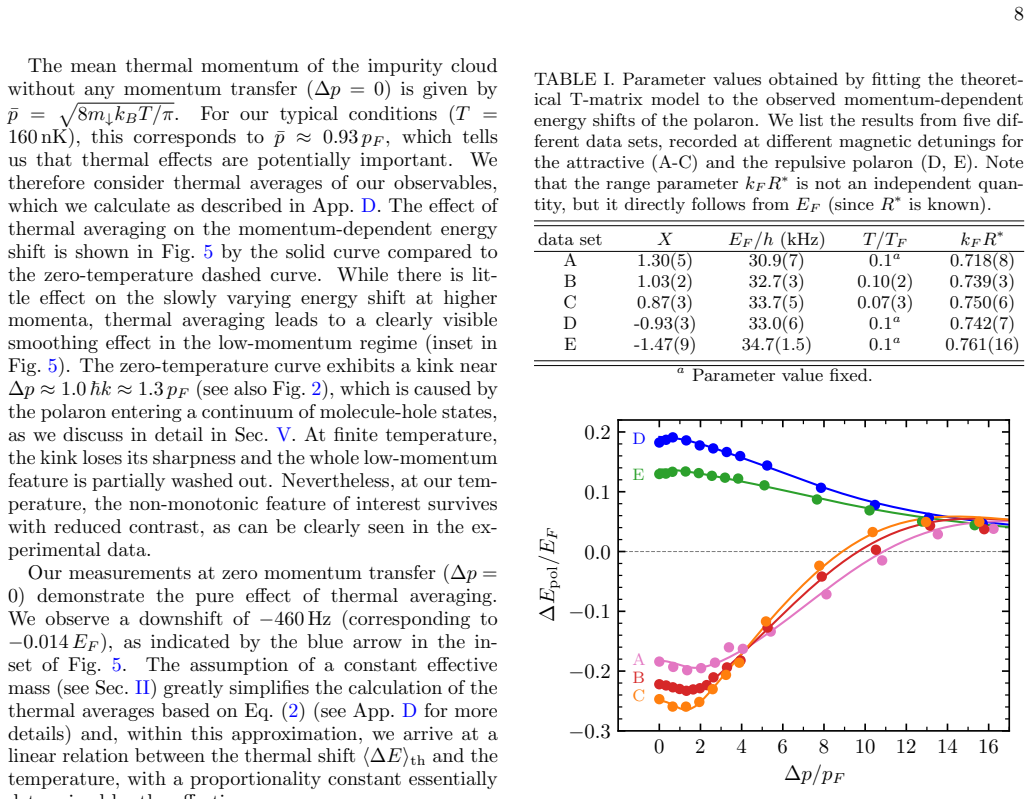
demonstrate the pure effect of thermal averaging. We observe a downshift of−460 Hz (corresponding to −0.014E F ), as indicated by the blue arrow in the in- set of Fig. 5. The assumption of a constant effective mass (see Sec. II) greatly simplifies the calculation of the thermal averages based on Eq. (2) (see App. D for more details) and, within this appro...
-
[2]
Polaron linewidth While the energy obtained from Eq. (A7) using the ladder approximation for the self-energy is very accurate when compared with experiments and with Monte-Carlo 14 calculations [3, 8], it is known to predict a vanishing colli- sional broadening for a moving impurity as long as its mo- mentum remains smaller than a critical value 0< p < p ...
-
[3]
Landau and S
L. Landau and S. Pekar, Effective mass of the polaron, J. Exp. Theor. Phys423, 71 (1948)
1948
-
[4]
Baym and C
G. Baym and C. Pethick,Landau Fermi-Liquid Theory: Concepts and Applications(Wiley-VCH, 1991)
1991
-
[5]
Massignan, M
P. Massignan, M. Zaccanti, and G. M. Bruun, Polarons, dressed molecules and itinerant ferromagnetism in ultra- cold Fermi gases, Rep. Prog. Phys.77, 034401 (2014)
2014
-
[6]
Schmidt, M
R. Schmidt, M. Knap, D. A. Ivanov, J.-S. You, M. Cetina, and E. Demler, Universal many-body response of heavy impurities coupled to a Fermi sea: a review of recent progress, Rep. Prog. Phys.81, 024401 (2018)
2018
-
[7]
Enrico Fermi
R. Grimm, M. Inguscio, S. Stringari, and G. Lam- poresi, eds.,Quantum Mixtures with Ultra-cold Atoms (IOS Press, Amsterdam, 2025) Proceedings of the Inter- national School of Physics “Enrico Fermi”, Course CCXI, Varenna, 18-23 July 2022
2025
-
[8]
Scazza, M
F. Scazza, M. Zaccanti, P. Massignan, M. M. Parish, and J. Levinsen, Repulsive Fermi and Bose Polarons in Quan- tum Gases, Atoms10, 55 (2022)
2022
-
[9]
M. M. Parish and J. Levinsen, Fermi polarons and be- yond (2022), in Ref. [5]
2022
-
[10]
Massignan, R
P. Massignan, R. Schmidt, G. E. Astrakharchik, A. ˙Imamoglu, M. Zwierlein, J. J. Arlt, and G. M. Bruun, Polarons in atomic gases and two-dimensional semicon- ductors, Rev. Mod. Phys. (2026)
2026
-
[11]
Schirotzek, C.-H
A. Schirotzek, C.-H. Wu, A. Sommer, and M. W. Zwier- lein, Observation of Fermi Polarons in a Tunable Fermi Liquid of Ultracold Atoms, Phys. Rev. Lett.102, 230402 (2009)
2009
-
[12]
Nascimb` ene, N
S. Nascimb` ene, N. Navon, K. J. Jiang, L. Tarruell, M. Te- ichmann, J. McKeever, F. Chevy, and C. Salomon, Col- lective Oscillations of an Imbalanced Fermi Gas: Axial 20 Compression Modes and Polaron Effective Mass, Phys. Rev. Lett.103, 170402 (2009)
2009
-
[13]
Kohstall, M
C. Kohstall, M. Zaccanti, M. Jag, A. Trenkwalder, P. Massignan, G. M. Bruun, F. Schreck, and R. Grimm, Metastability and coherence of repulsive polarons in a strongly interacting Fermi mixture, Nature (London) 485, 615 (2012)
2012
-
[14]
Koschorreck, D
M. Koschorreck, D. Pertot, E. Vogt, B. Fr¨ olich, M. Feld, and M. K¨ ohl, Attractive and repulsive Fermi polarons in two dimensions, Nature (London)485, 619 (2012)
2012
-
[15]
Scazza, G
F. Scazza, G. Valtolina, P. Massignan, A. Recati, A. Am- ico, A. Burchianti, C. Fort, M. Inguscio, M. Zaccanti, and G. Roati, Repulsive Fermi Polarons in a Resonant Mixture of Ultracold 6Li Atoms, Phys. Rev. Lett.118, 083602 (2017)
2017
-
[16]
Z. Yan, P. B. Patel, B. Mukherjee, R. J. Fletcher, J. Struck, and M. W. Zwierlein, Boiling a Unitary Fermi Liquid, Phys. Rev. Lett.122, 093401 (2019)
2019
-
[17]
Baroni, B
C. Baroni, B. Huang, I. Fritsche, E. Dobler, G. Anich, E. Kirilov, R. Grimm, M. A. Bastarrachea-Magnani, P. Massignan, and G. M. Bruun, Mediated interactions between Fermi polarons and the role of impurity quan- tum statistics, Nat. Phys.20, 68 (2024)
2024
-
[18]
M.-G. Hu, M. J. Van de Graaff, D. Kedar, J. P. Corson, E. A. Cornell, and D. S. Jin, Bose polarons in the strongly interacting regime, Phys. Rev. Lett.117, 055301 (2016)
2016
-
[19]
N. B. Jørgensen, L. Wacker, K. T. Skalmstang, M. M. Parish, J. Levinsen, R. S. Christensen, G. M. Bruun, and J. J. Arlt, Observation of Attractive and Repulsive Polarons in a Bose-Einstein Condensate, Phys. Rev. Lett. 117, 055302 (2016)
2016
-
[20]
L. A. Pe˜ na Ardila, N. B. Jørgensen, T. Pohl, S. Giorgini, G. M. Bruun, and J. J. Arlt, Analyzing a Bose polaron across resonant interactions, Phys. Rev. A99, 063607 (2019)
2019
-
[21]
Z. Z. Yan, Y. Ni, C. Robens, and M. W. Zwierlein, Bose polarons near quantum criticality, Science368, 190 (2020)
2020
-
[22]
M. G. Skou, T. G. Skov, N. B. Jørgensen, K. K. Nielsen, A. Camacho-Guardian, T. Pohl, G. M. Bruun, and J. J. Arlt, Non-equilibrium quantum dynamics and formation of the Bose polaron, Nat. Phys.17, 731 (2021)
2021
-
[23]
M. G. Skou, K. K. Nielsen, T. G. Skov, A. M. Morgen, N. B. Jørgensen, A. Camacho-Guardian, T. Pohl, G. M. Bruun, and J. J. Arlt, Life and death of the Bose polaron, Phys. Rev. Res.4, 043093 (2022)
2022
-
[24]
A. M. Morgen, S. S. Balling, K. K. Nielsen, T. Pohl, G. M. Bruun, and J. J. Arlt, Quantum beat spectroscopy of repulsive Bose polarons, Phys. Rev. Res.7, L022002 (2025)
2025
-
[25]
Etrych, G
J. Etrych, G. Martirosyan, A. Cao, C. J. Ho, Z. Hadz- ibabic, and C. Eigen, Universal Quantum Dynamics of Bose Polarons, Phys. Rev. X15, 021070 (2025)
2025
- [26]
-
[27]
Grusdt, N
F. Grusdt, N. Mostaan, E. Demler, and L. A. P. Ardila, Impurities and polarons in bosonic quantum gases: a re- view on recent progress, Rep. Progr. Phys.88, 066401 (2025)
2025
-
[28]
C. J. M. Mathy, M. B. Zvonarev, and E. Demler, Quan- tum flutter of supersonic particles in one-dimensional quantum liquids, Nature Physics8, 881 (2012)
2012
-
[29]
Hu and X.-J
H. Hu and X.-J. Liu, Raman spectroscopy of Fermi po- larons, Phys. Rev. A106, 063306 (2022)
2022
-
[30]
von Milczewski and R
J. von Milczewski and R. Schmidt, Momentum- dependent quasiparticle properties of the Fermi polaron from the functional renormalization group, Phys. Rev. A 110, 033309 (2024)
2024
- [31]
-
[32]
M. Horvath, S. Dhar, E. Wybo, D. Trypogeorgos, Y. Guo, M. Zvonarev, M. Knap, M. Landini, and H.-C. N¨ agerl, Observing dissipationless flow of an im- purity in a strongly repulsive quantum fluid (2026), arXiv:2602.12320
arXiv 2026
-
[33]
G. Andrade-S´ anchez and A. Camacho-Guardian, Charged Bose polarons at finite momentum (2026), arXiv:2605.31255
Pith/arXiv arXiv 2026
-
[34]
Navon, S
N. Navon, S. Nascimb` ene, F. Chevy, and C. Salomon, The Equation of State of a Low-Temperature Fermi Gas with Tunable Interactions, Science328, 729 (2010)
2010
-
[35]
C. Chin, R. Grimm, P. S. Julienne, and E. Tiesinga, Fesh- bach resonances in ultracold gases, Rev. Mod. Phys.82, 1225 (2010)
2010
-
[36]
Fritsche, C
I. Fritsche, C. Baroni, E. Dobler, E. Kirilov, B. Huang, R. Grimm, G. M. Bruun, and P. Massignan, Stability and breakdown of Fermi polarons in a strongly interacting Fermi-Bose mixture, Phys. Rev. A103, 053314 (2021)
2021
-
[37]
Grimm and C
R. Grimm and C. Baroni, Fermionic quantum mixtures with tunable interactions (2022), in Ref. [5]
2022
-
[38]
Dobler,Ultracold Mixtures of Lithium and Potassium: An Atomic Beam Source, Raman Transitions and Two- Body Scattering, Ph.D
E. Dobler,Ultracold Mixtures of Lithium and Potassium: An Atomic Beam Source, Raman Transitions and Two- Body Scattering, Ph.D. thesis, University of Innsbruck (2026)
2026
-
[39]
Kokkelmans, Feshbach Resonances in Ultracold Gases, inQuantum Gas Experiments, edited by P
S. Kokkelmans, Feshbach Resonances in Ultracold Gases, inQuantum Gas Experiments, edited by P. T¨ orma and K. Sengstock (Imperial College Press, 2015) pp. 63–85
2015
-
[40]
R. S. Lous, I. Fritsche, M. Jag, F. Lehmann, E. Kir- ilov, B. Huang, and R. Grimm, Probing the Interface of a Phase-Separated State in a Repulsive Bose-Fermi Mix- ture, Phys. Rev. Lett.120, 243403 (2018)
2018
-
[41]
D. S. Petrov, Three-Boson Problem near a Narrow Fesh- bach Resonance, Phys. Rev. Lett.93, 143201 (2004)
2004
-
[42]
C. J. Vale and M. Zwierlein, Spectroscopic probes of quantum gases, Nat. Phys.17, 1305 (2021)
2021
-
[43]
W. E. Liu, Z.-Y. Shi, J. Levinsen, and M. M. Parish, Radio-Frequency Response and Contact of Impurities in a Quantum Gas, Phys. Rev. Lett.125, 065301 (2020)
2020
-
[44]
T¨ orm¨ a, Physics of ultracold Fermi gases revealed by spectroscopies, Phys
P. T¨ orm¨ a, Physics of ultracold Fermi gases revealed by spectroscopies, Phys. Scr.91, 043006 (2016)
2016
-
[45]
M. S. Horvath, R. Thomas, E. Tiesinga, A. B. Deb, and N. Kjærgaard, Above-threshold scattering about a Fesh- bach resonance for ultracold atoms in an optical collider, Nat. Commun.8, 452 (2017)
2017
-
[46]
Cetina, M
M. Cetina, M. Jag, R. S. Lous, J. T. M. Walraven, R. Grimm, R. S. Christensen, and G. M. Bruun, Deco- herence of Impurities in a Fermi Sea of Ultracold Atoms, Phys. Rev. Lett.115, 135302 (2015)
2015
-
[47]
Cetina, M
M. Cetina, M. Jag, R. S. Lous, I. Fritsche, J. T. M. Wal- raven, R. Grimm, J. Levinsen, M. M. Parish, R. Schmidt, M. Knap, and E. Demler, Ultrafast many-body interfer- ometry of impurities coupled to a Fermi sea, Science354, 96 (2016)
2016
-
[48]
F. M. Spiegelhalder, A. Trenkwalder, D. Naik, G. Kerner, E. Wille, G. Hendl, F. Schreck, and R. Grimm, All- 21 optical production of a degenerate mixture of 6Li and 40K and creation of heteronuclear molecules, Phys. Rev. A81, 043637 (2010)
2010
-
[49]
R. S. Lous,Tunable Bose-Fermi and Fermi-Fermi Mix- tures of Potassium and Lithium: Phase Separation, Po- larons, and Molecules, Ph.D. thesis, University of Inns- bruck (2018)
2018
-
[50]
R. S. Lous, I. Fritsche, M. Jag, B. Huang, and R. Grimm, Thermometry of a deeply degenerate Fermi gas with a Bose-Einstein condensate, Phys. Rev. A95, 053627 (2017)
2017
-
[51]
W. E. Liu, Z. Shi, M. M. Parish, and J. Levinsen, Theory of Radio-Frequency Spectroscopy of Impurities in Quan- tum Gases, Phys. Rev. A102, 023304 (2020)
2020
-
[52]
Kasevich, D
M. Kasevich, D. S. Weiss, E. Riis, K. Moler, S. Kasapi, and S. Chu, Atomic velocity selection using stimulated raman transitions, Phys. Rev. Lett.66, 2297 (1991)
1991
-
[53]
Weitz, B
M. Weitz, B. C. Young, and S. Chu, Atomic interferom- eter based on adiabatic population transfer, Phys. Rev. Lett.73, 2563 (1994)
1994
-
[54]
Jaffe, V
M. Jaffe, V. Xu, P. Haslinger, H. M¨ uller, and P. Hamil- ton, Efficient adiabatic spin-dependent kicks in an atom interferometer, Phys. Rev. Lett.121, 040402 (2018)
2018
-
[55]
J. M. McGuirk, M. J. Snadden, and M. A. Kasevich, Large area light-pulse atom interferometry, Phys. Rev. Lett.85, 4498 (2000)
2000
-
[56]
We found indica- tions that some measurements may have been affected by incomplete population transfer
A later analysis of our measurements revealed a poten- tial problem for momentum changes involving more than three subsequent Raman transitions. We found indica- tions that some measurements may have been affected by incomplete population transfer. To avoid any contam- ination of our fit analysis, we generally restrict the fitted momentum range to ∆p≤6ℏk....
-
[57]
Massignan, Polarons and dressed molecules near nar- row Feshbach resonances, Europhys
P. Massignan, Polarons and dressed molecules near nar- row Feshbach resonances, Europhys. Lett.98, 10012 (2012)
2012
-
[58]
G. Ness, C. Shkedrov, Y. Florshaim, O. K. Diessel, J. von Milczewski, R. Schmidt, and Y. Sagi, Observation of a Smooth Polaron-Molecule Transition in a Degenerate Fermi Gas, Phys. Rev. X10, 041019 (2020)
2020
-
[59]
G. M. Bruun, A. Recati, C. J. Pethick, H. Smith, and S. Stringari, Collisional Properties of a Polarized Fermi Gas with Resonant Interactions, Phys. Rev. Lett.100, 240406 (2008)
2008
-
[60]
Massignan and G
P. Massignan and G. M. Bruun, Repulsive polarons and itinerant ferromagnetismin strongly polarized Fermi gases, Eur. Phys. J D65, 83 (2011)
2011
-
[61]
Prokof’ev and B
N. Prokof’ev and B. Svistunov, Fermi-polaron problem: Diagrammatic Monte Carlo method for divergent sign- alternating series, Phys. Rev. B77, 020408 (2008)
2008
-
[62]
M. Punk, P. T. Dumitrescu, and W. Zwerger, Polaron-to- molecule transition in a strongly imbalanced Fermi gas, Phys. Rev. A80, 053605 (2009)
2009
-
[63]
Combescot, S
R. Combescot, S. Giraud, and X. Leyronas, Analytical theory of the dressed bound state in highly polarized Fermi gases, Europhys. Lett.88, 60007 (2010)
2010
-
[64]
G. M. Bruun and P. Massignan, Decay of Polarons and Molecules in a Strongly Polarized Fermi Gas, Phys. Rev. Lett.105, 020403 (2010)
2010
-
[65]
Schmidt and T
R. Schmidt and T. Enss, Excitation spectra and rf response near the polaron-to-molecule transition from the functional renormalization group, Phys. Rev. A83, 063620 (2011)
2011
-
[66]
Trefzger and Y
C. Trefzger and Y. Castin, Impurity in a Fermi sea on a narrow Feshbach resonance: A variational study of the polaronic and dimeronic branches, Phys. Rev. A85, 053612 (2012)
2012
-
[67]
Cui, Fermi polaron revisited: Polaron-molecule tran- sition and coexistence, Phys
X. Cui, Fermi polaron revisited: Polaron-molecule tran- sition and coexistence, Phys. Rev. A102, 061301(R) (2020)
2020
-
[68]
C. Peng, R. Liu, W. Zhang, and X. Cui, Nature of the polaron-molecule transition in Fermi polarons, Phys. Rev. A103, 063312 (2021)
2021
-
[69]
M. M. Parish, H. S. Adlong, W. E. Liu, and J. Levinsen, Thermodynamic signatures of the polaron-molecule tran- sition in a Fermi gas, Phys. Rev. A103, 023312 (2021)
2021
-
[70]
M. Repp, R. Pires, J. Ulmanis, R. Heck, E. D. Kuhnle, M. Weidem¨ uller, and E. Tiemann, Observation of inter- species 6Li-133Cs Feshbach resonances, Phys. Rev. A87, 010701(R) (2013)
2013
-
[71]
S.-K. Tung, C. Parker, J. Johansen, C. Chin, Y. Wang, and P. S. Julienne, Ultracold mixtures of atomic 6Li and 133Cs with tunable interactions, Phys. Rev. A87, 010702(R) (2013)
2013
-
[72]
Sch¨ afer, N
F. Sch¨ afer, N. Mizukami, and Y. Takahashi, Feshbach res- onances of large-mass-imbalance Er-Li mixtures, Phys. Rev. A105, 012816 (2022)
2022
-
[73]
K. Xie, X. Li, Y.-Y. Zhou, J.-H. Luo, S. Wang, Y.-Z. Nie, H.-C. Shen, Y.-A. Chen, X.-C. Yao, and J.-W. Pan, Feshbach spectroscopy of ultracold mixtures of 6Li and 164Dy atoms, Phys. Rev. A111, 023327 (2025)
2025
-
[74]
Lippi, 133Cs Atoms in a 6Li Fermi Sea for Explor- ing Polaron Physics in the Heavy Impurity Limit, Ph.D
E. Lippi, 133Cs Atoms in a 6Li Fermi Sea for Explor- ing Polaron Physics in the Heavy Impurity Limit, Ph.D. thesis, University of Heidelberg (2024)
2024
-
[75]
P. W. Anderson, Infrared Catastrophe in Fermi Gases with Local Scattering Potentials, Phys. Rev. Lett.18, 1049 (1967)
1967
-
[76]
M. Knap, A. Shashi, Y. Nishida, A. Imambekov, D. A. Abanin, and E. Demler, Time-dependent impurity in ul- tracold fermions: Orthogonality catastrophe and beyond, Phys. Rev. X2, 041020 (2012)
2012
-
[77]
O. I. Kartavtsev and A. V. Malykh, Low-energy three- body dynamics in binary quantum gases, J. Phys. B: At. Mol. Opt. Phys.40, 1429 (2007)
2007
-
[78]
C. H. Greene, P. Giannakeas, and J. P´ erez-R´ ıos, Univer- sal few-body physics and cluster formation, Rev. Mod. Phys.89, 035006 (2017)
2017
-
[79]
Naidon and S
P. Naidon and S. Endo, Efimov physics: a review, Rep. Prog. Phys.80, 056001 (2017)
2017
-
[80]
Christianen, J
A. Christianen, J. I. Cirac, and R. Schmidt, Bose polaron and the Efimov effect: A Gaussian-state approach, Phys. Rev. A105, 053302 (2022)
2022
discussion (0)
Sign in with ORCID, Apple, or X to comment. Anyone can read and Pith papers without signing in.