A new classification method based on Minimum Spanning Trees
Pith reviewed 2026-06-26 14:39 UTC · model grok-4.3
The pith
Minimum spanning trees can be adapted from unsupervised clustering to define class boundaries for supervised classification.
A machine-rendered reading of the paper's core claim, the machinery that carries it, and where it could break.
Core claim
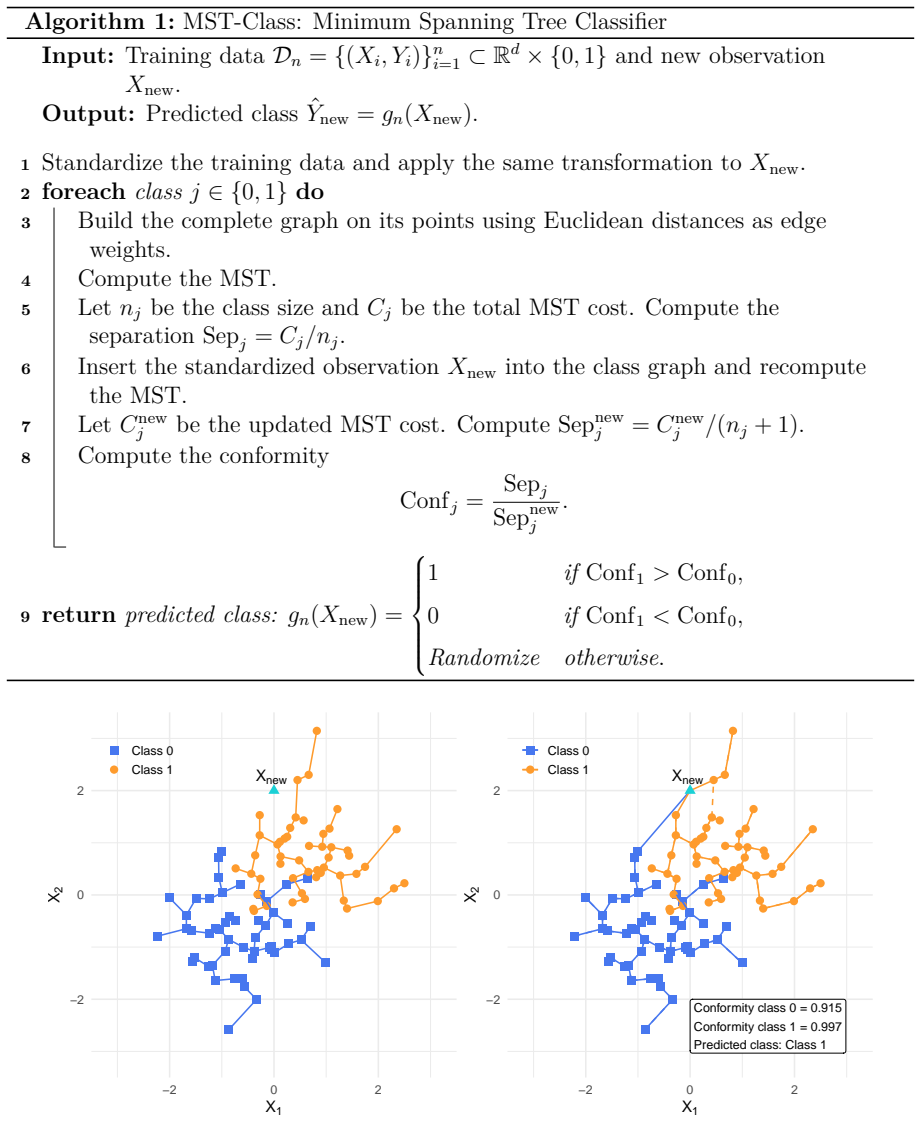
The authors construct a minimum spanning tree on the combined training and test points, then assign each test point the label of the nearest training point along the tree paths, thereby turning the unsupervised MST into a supervised classifier; a robust version replaces the basic edge-removal rule with a more stable criterion that also speeds up the computation.
What carries the argument
The minimum spanning tree on the joint set of labeled and unlabeled points, whose edges are used to propagate class labels in the supervised setting.
If this is right
- The basic MST classifier supplies an alternative decision rule that depends only on the global tree rather than local distances.
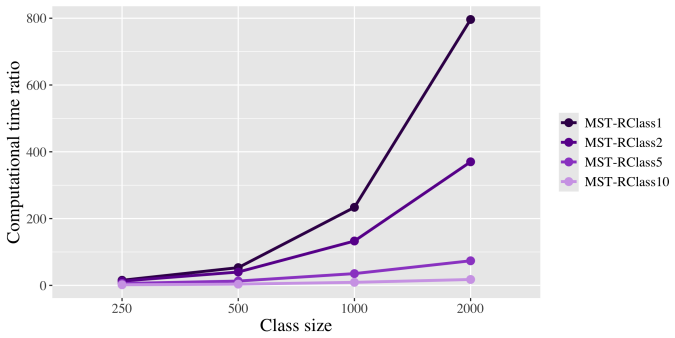
- The robust version simultaneously raises accuracy and reduces run time compared with the basic version.
- The method applies directly to trajectory data, as demonstrated by the aircraft example.
- Simulation results indicate stable performance across varied cluster shapes and noise levels.
Where Pith is reading between the lines
- The same MST construction could be reused for active learning by querying points that lie on tree edges between different classes.
- Replacing Euclidean distances inside the MST with domain-specific metrics might improve results on non-Euclidean data such as sequences or graphs.
- Because the tree is built once on the full set, incremental updates would be needed for streaming classification tasks.
- Comparing the method against kernel-based or deep classifiers on the same benchmark sets would clarify its relative strengths.
Load-bearing premise
That the connectivity structure of a minimum spanning tree on mixed labeled data will separate the known classes reliably enough to assign correct labels to new points.
What would settle it
A collection of labeled point sets in which the MST routinely connects points from different classes more strongly than points within the same class, producing classification error rates higher than those of standard nearest-neighbor or tree-based classifiers on the same data.
Figures
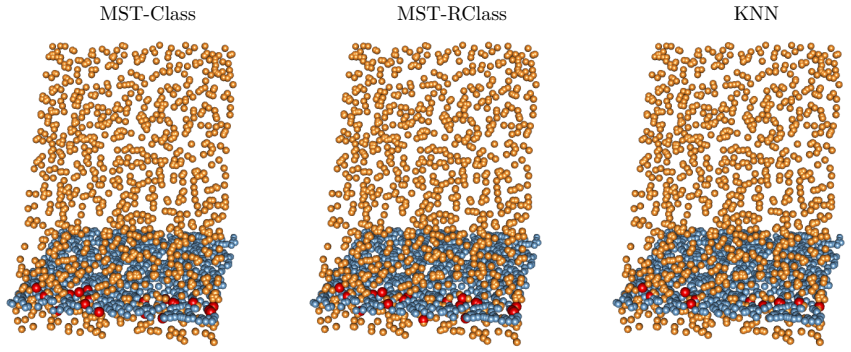
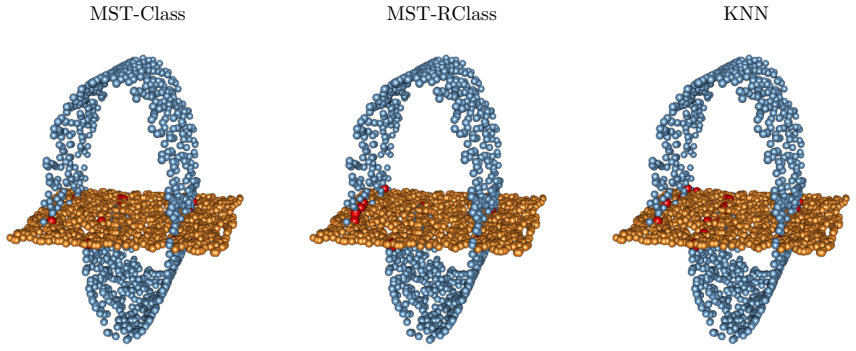
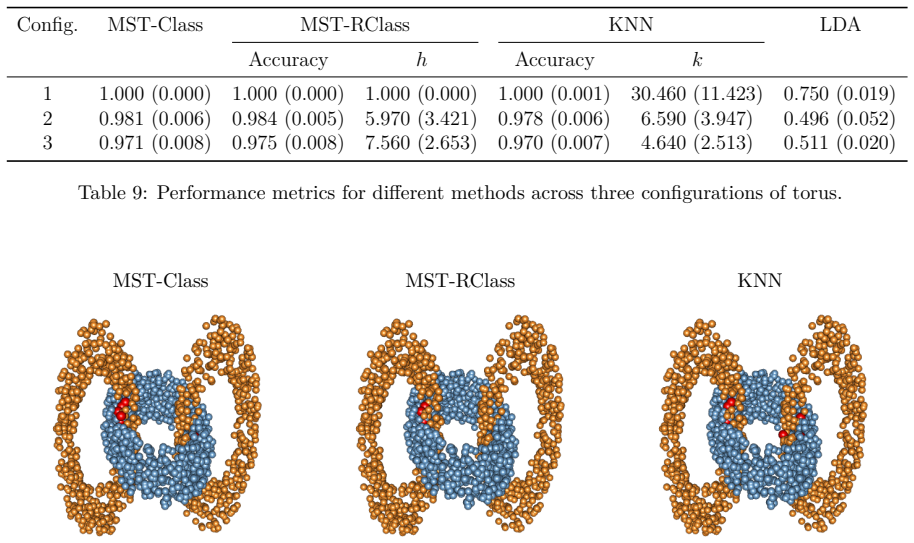
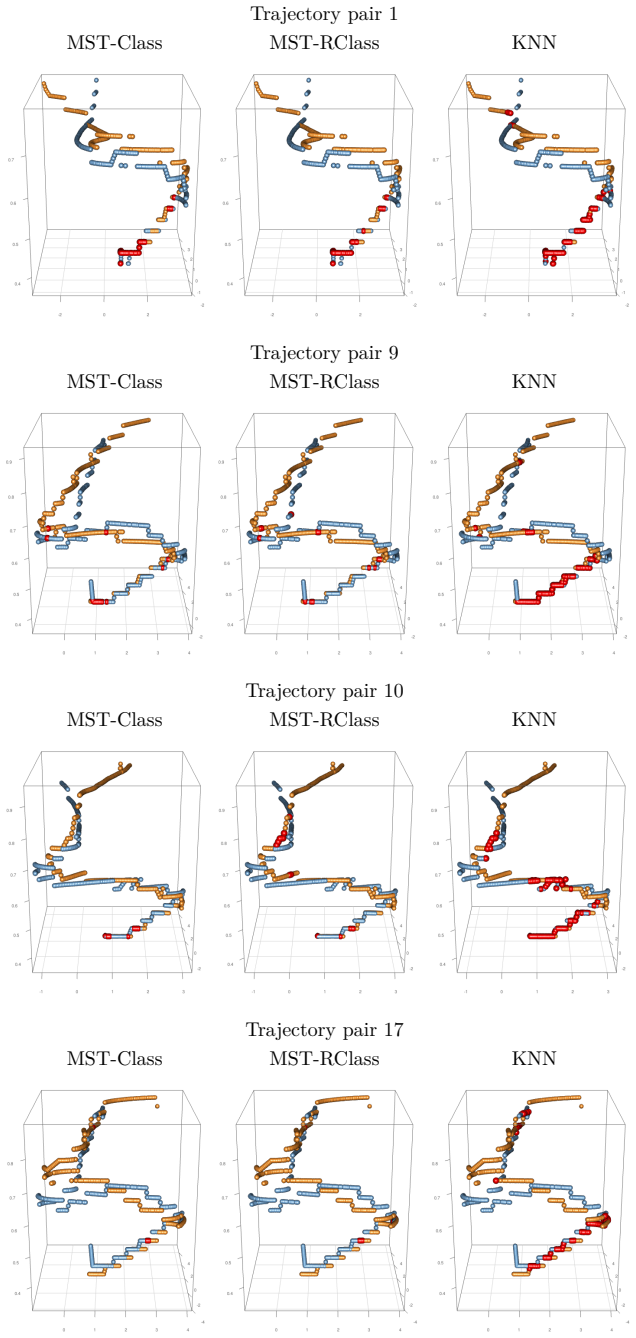
read the original abstract
Minimum Spanning Trees have been used in unsupervised learning, particularly in clustering tasks, due to their ability to recognize clusters by removing edges that are considered inconsistent in defining those clusters. This paper aims to study the use of Minimum Spanning Trees in supervised learning. Specifically, we propose a classification algorithm based on Minimum Spanning Trees. To improve its performance, we introduce a robust version of the method that is also computationally more efficient. We evaluate the effectiveness of our proposed method through an extensive simulation study. We also apply the proposed methodology to a real-world case study involving aircraft trajectories.
Editorial analysis
A structured set of objections, weighed in public.
Referee Report
Summary. The paper proposes a classification algorithm that adapts Minimum Spanning Trees (previously used for unsupervised clustering via inconsistent-edge removal) to supervised settings with known class labels. It introduces a robust variant claimed to improve performance and computational efficiency, evaluates the approach via an extensive simulation study, and applies it to a real-world aircraft-trajectory case study.
Significance. An effective, well-documented MST-based classifier would constitute a novel supervised-learning contribution by repurposing an established unsupervised tool for class-boundary definition. The manuscript, however, supplies no algorithm pseudocode, distance or edge-inconsistency criteria, performance tables, baseline comparisons, or error analysis, so the claimed effectiveness cannot be assessed and the potential impact remains speculative.
major comments (1)
- [Abstract] Abstract: the central claim that the method is effective rests on an 'extensive simulation study' and 'real-world case study,' yet the manuscript provides neither the classification rule (how MST edges define decision boundaries or assign labels), nor any quantitative metrics, baselines, or statistical analysis. This absence renders the evaluation claim unsupported.
Simulated Author's Rebuttal
We thank the referee for their careful review and constructive comments on the manuscript. We address the major comment below and will revise the paper to improve clarity, completeness, and support for the claims made.
read point-by-point responses
-
Referee: [Abstract] Abstract: the central claim that the method is effective rests on an 'extensive simulation study' and 'real-world case study,' yet the manuscript provides neither the classification rule (how MST edges define decision boundaries or assign labels), nor any quantitative metrics, baselines, or statistical analysis. This absence renders the evaluation claim unsupported.
Authors: We agree that the abstract is a high-level summary and does not itself contain the classification rule, pseudocode, distance/edge-inconsistency criteria, performance tables, baseline comparisons, or error analysis. The full manuscript describes the supervised MST classification algorithm (including how edges define boundaries and assign labels) in the methods section, with the robust variant, simulation study (including quantitative metrics and statistical analysis), and aircraft-trajectory case study presented in subsequent sections. To directly address the concern, we will revise the manuscript to add explicit algorithm pseudocode, formal definitions of the distance and inconsistency criteria, performance tables with baselines, and error analysis. We will also revise the abstract to briefly indicate the method and key evaluation elements so that the effectiveness claims are clearly supported by the presented material. revision: yes
Circularity Check
No significant circularity in derivation chain
full rationale
The paper presents a methodological proposal adapting MSTs (previously used for unsupervised clustering via edge removal) to supervised classification, including a robust variant, with evaluation on simulations and aircraft trajectory data. No equations, fitted parameters called predictions, self-citations as load-bearing premises, or other patterns from the enumerated list are present in the provided text. The derivation is self-contained as an original algorithmic construction whose validity rests on external empirical testing rather than reduction to its own inputs by definition.
Axiom & Free-Parameter Ledger
Reference graph
Works this paper leans on
-
[1]
Bernoulli , number =
Ghurumuruhan Ganesan , title =. Bernoulli , number =. 2021 , doi =
2021
-
[2]
and Hell, Pavol , journal=
Graham, R.L. and Hell, Pavol , journal=. On the History of the Minimum Spanning Tree Problem , year=
-
[3]
, title =
Yukich, Joseph E. , title =. 1998 , publisher =
1998
-
[4]
Rate of convergence of power-weighted Euclidean minimal spanning trees , journal =
Sungchul Lee , keywords =. Rate of convergence of power-weighted Euclidean minimal spanning trees , journal =. 2000 , issn =. doi:https://doi.org/10.1016/S0304-4149(99)00091-5 , url =
-
[5]
J.E. Yukich , keywords =. Asymptotics for weighted minimal spanning trees on random points , journal =. 2000 , issn =. doi:https://doi.org/10.1016/S0304-4149(99)00068-X , url =
-
[6]
Penrose and J
Mathew D. Penrose and J. E. Yukich , title =. The Annals of Applied Probability , number =. 2003 , doi =
2003
-
[7]
2023 , url =
R: A Language and Environment for Statistical Computing , author =. 2023 , url =
2023
-
[8]
doi:10.5281/zenodo.7682609 , url =
Gábor Csárdi and Tamás Nepusz and Vincent Traag and Szabolcs Horvát and Fabio Zanini and Daniel Noom and Kirill Müller , year =. doi:10.5281/zenodo.7682609 , url =
-
[9]
Oxford University Press (2000)
Mathew D. Penrose , title =. 2003 , url =. doi:10.1093/ACPROF:OSO/9780198506263.001.0001 , isbn =
work page doi:10.1093/acprof:oso/9780198506263.001.0001 2003
-
[10]
Machine learning , volume=
Support-vector networks , author=. Machine learning , volume=. 1995 , publisher=
1995
-
[11]
Proceedings of the fifth annual workshop on Computational learning theory , pages=
A training algorithm for optimal margin classifiers , author=. Proceedings of the fifth annual workshop on Computational learning theory , pages=
-
[12]
Machine learning , volume=
Induction of decision trees , author=. Machine learning , volume=. 1986 , publisher=
1986
-
[13]
, author=
The perceptron: a probabilistic model for information storage and organization in the brain. , author=. Psychological review , volume=. 1958 , publisher=
1958
-
[14]
1951 , publisher=
Discriminatory analysis, nonparametric discrimination , author=. 1951 , publisher=
1951
-
[15]
Annals of eugenics , volume=
The use of multiple measurements in taxonomic problems , author=. Annals of eugenics , volume=. 1936 , publisher=
1936
-
[16]
The Bell System Technical Journal , volume=
Shortest connection networks and some generalizations , author=. The Bell System Technical Journal , volume=. 1957 , publisher=
1957
-
[17]
Proceedings of the American Mathematical society , volume=
On the shortest spanning subtree of a graph and the traveling salesman problem , author=. Proceedings of the American Mathematical society , volume=
-
[18]
The R Journal , volume=
Package ‘caret’ , author=. The R Journal , volume=
-
[19]
Networks , volume=
Bibliography on Algorithms for Shortest Path, Shortest Spanning Tree, and Related Circuit Routing Problems 1956-1974 , author=. Networks , volume=. 1975 , publisher=
1956
-
[20]
Analysis and design of algorithms in combinatorial optimization , pages=
Complexity of optimum undirected tree problems: a survey of recent results , author=. Analysis and design of algorithms in combinatorial optimization , pages=. 1981 , publisher=
1981
-
[21]
Annals of the History of Computing , volume=
On the history of the minimum spanning tree problem , author=. Annals of the History of Computing , volume=. 2007 , publisher=
2007
-
[22]
Computers & Operations Research , volume=
Minimum-weight spanning tree algorithms a survey and empirical study , author=. Computers & Operations Research , volume=. 2001 , publisher=
2001
-
[23]
, journal=
Zahn, C.T. , journal=. Graph-Theoretical Methods for Detecting and Describing Gestalt Clusters , year=
-
[24]
2006 18th IEEE International Conference on Tools with Artificial Intelligence (ICTAI'06) , pages=
Minimum spanning tree based clustering algorithms , author=. 2006 18th IEEE International Conference on Tools with Artificial Intelligence (ICTAI'06) , pages=. 2006 , organization=
2006
-
[25]
Genome Informatics , volume=
Minimum Spanning Trees for Gene Expression Data Clustering , author=. Genome Informatics , volume=. 2001 , doi=
2001
-
[26]
Sequential image segmentation based on minimum spanning tree representation , journal =
Ali Saglam and Nurdan Akhan Baykan , keywords =. Sequential image segmentation based on minimum spanning tree representation , journal =. 2017 , note =. doi:https://doi.org/10.1016/j.patrec.2016.06.001 , url =
-
[27]
and Wang, X
Li, J. and Wang, X. and Wang, X. , title =. J. Intell. Inf. Syst. , volume =. 2020 , doi =
2020
-
[28]
and Cena, A
Gagolewski, M. and Cena, A. and Bartoszuk, M. and others , title =. J. Classif. , volume =. 2025 , doi =
2025
-
[29]
1985 , publisher=
Discriminatory analysis: nonparametric discrimination, consistency properties , author=. 1985 , publisher=
1985
-
[30]
2023 International Joint Conference on Neural Networks (IJCNN) , pages=
Complex network-based data classification using minimum spanning tree metric and optimization , author=. 2023 International Joint Conference on Neural Networks (IJCNN) , pages=. 2023 , organization=
2023
-
[31]
arXiv preprint arXiv:2503.05772 , year=
Complex Networks for Pattern-Based Data Classification , author=. arXiv preprint arXiv:2503.05772 , year=
-
[32]
2024 , url =
R: A Language and Environment for Statistical Computing , author =. 2024 , url =
2024
-
[33]
Kelly, Markelle and Longjohn, Rachel and Nottingham, Kolby , title =
-
[34]
The Annals of Applied Probability , volume=
The central limit theorem for Euclidean minimal spanning trees II , author=. The Annals of Applied Probability , volume=. 1997 , publisher=
1997
-
[35]
2021 , publisher=
Trajair: A general aviation trajectory dataset , author=. 2021 , publisher=
2021
discussion (0)
Sign in with ORCID, Apple, or X to comment. Anyone can read and Pith papers without signing in.