Symmetry-Enforced Pair-Density Wave and Chiral Interband Superconductivity in Strongly Correlated Kagome Systems
Pith reviewed 2026-06-26 12:26 UTC · model grok-4.3
The pith
Symmetry of Bloch wavefunctions on the Kagome lattice forces a pair-density wave state at the p-type van Hove singularity.
A machine-rendered reading of the paper's core claim, the machinery that carries it, and where it could break.
Core claim
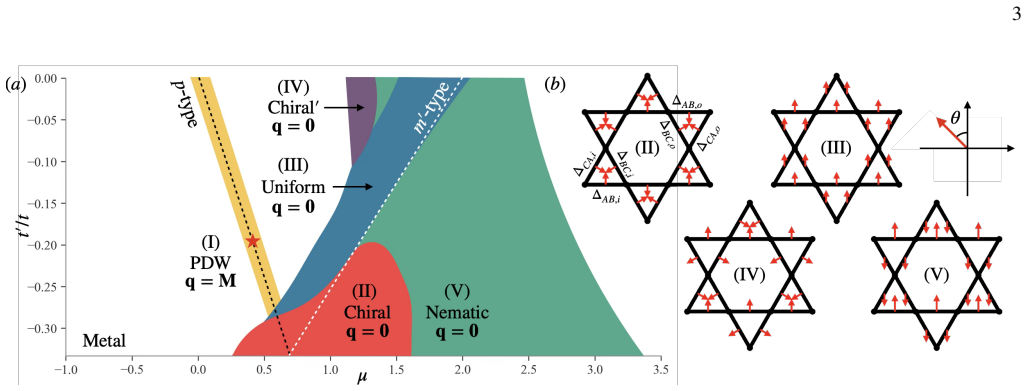
When the chemical potential is tuned to a sublattice-pure (p-type) van Hove singularity (vHS), a PDW state inevitably emerges. Near the m'-type vHS, which features opposite mirror eigenvalues to the conventional m-type vHS, intraband chiral, uniform, and nematic pairing states compete. When further-neighbor hoppings drive the p- and m'-type vHSs towards near degeneracy, phase frustration in the interband pairing channel stabilizes a chiral interband state. The symmetry-enforced sublattice structure of the Bloch wavefunctions gives rise to these unconventional pairing states in the strongly correlated regime.
What carries the argument
The symmetry-enforced sublattice structure of the Bloch wavefunctions on the Kagome lattice, which restricts allowed pairing channels at p-type and m'-type van Hove singularities within the extended t-J model.
If this is right
- A pair-density wave state must emerge at the p-type van Hove singularity due to symmetry constraints on the Bloch wavefunctions.
- Intraband chiral, uniform, and nematic pairing states compete near the m'-type van Hove singularity.
- A chiral interband superconducting state is stabilized by phase frustration when p- and m'-type van Hove singularities are brought near degeneracy.
- Mirror-symmetry constraints on Bloch wavefunctions provide a route to unconventional superconductivity rooted in electronic correlations.
Where Pith is reading between the lines
- The m'-type van Hove singularity supplies a distinct route to chiral pairing that is separate from the conventional m-type case.
- The same symmetry logic may constrain pairing states in other lattices that possess sublattice-dependent van Hove singularities.
- Experimental tuning via doping or pressure to achieve near-degenerate p- and m'-type points could make the chiral interband state accessible.
Load-bearing premise
The extended t-J model on the Kagome lattice captures the relevant physics when the chemical potential is tuned independently to the p-type or m'-type van Hove singularities in the strongly correlated regime.
What would settle it
Finding zero-momentum uniform superconductivity rather than finite-momentum pairing at a p-type van Hove singularity in a Kagome material would contradict the prediction that a pair-density wave state must emerge.
Figures
read the original abstract
The pair-density wave (PDW) state, characterized by Cooper pairing at finite momentum, is a long-sought superconducting phase whose possible realization in Kagome metals is particularly intriguing in the strongly correlated regime. We investigate superconductivity in the extended $t$-$J$ model on the Kagome lattice and show that the symmetry-enforced sublattice structure of the Bloch wavefunctions gives rise to a rich landscape of unconventional pairing states. When the chemical potential is tuned to a sublattice-pure ($p$-type) van Hove singularity (vHS), a PDW state inevitably emerges. Near the $m'$-type vHS, which features opposite mirror eigenvalues to the conventional $m$-type vHS, intraband chiral, uniform, and nematic pairing states compete. When further-neighbor hoppings drive the $p$- and $m'$-type vHSs towards near degeneracy, phase frustration in the interband pairing channel stabilizes a chiral interband state. Our results reveal the previously overlooked $m'$-type vHS as a distinct route to unconventional superconductivity rooted in electronic correlations and mirror-symmetry-constrained Bloch wavefunctions.
Editorial analysis
A structured set of objections, weighed in public.
Referee Report
Summary. The manuscript investigates superconductivity in the extended t-J model on the Kagome lattice, arguing that the symmetry-enforced sublattice structure of Bloch wavefunctions produces a rich landscape of unconventional pairing states. When the chemical potential is tuned to a sublattice-pure (p-type) van Hove singularity, a PDW state inevitably emerges. Near the m'-type vHS (with opposite mirror eigenvalues to the conventional m-type), intraband chiral, uniform, and nematic pairing states compete. When further-neighbor hoppings drive the p- and m'-type vHSs toward near degeneracy, phase frustration in the interband pairing channel stabilizes a chiral interband state. The work identifies the m'-type vHS as a distinct route to unconventional superconductivity rooted in electronic correlations and mirror-symmetry constraints.
Significance. If the central claims hold, the results supply a symmetry-based mechanism for realizing PDW and chiral interband superconductivity in strongly correlated Kagome systems. The identification of the m'-type vHS and the role of mirror eigenvalues in constraining pairing channels constitute a novel contribution that could guide experimental searches in doped kagome metals. The use of the extended t-J model is standard for this class of problems, and the symmetry arguments appear internally self-contained.
minor comments (2)
- [Abstract] Abstract: the phrasing 'inevitably emerges' and 'phase frustration ... stabilizes' would benefit from a brief parenthetical reference to the specific symmetry representation or gap-equation channel that enforces the stated outcome.
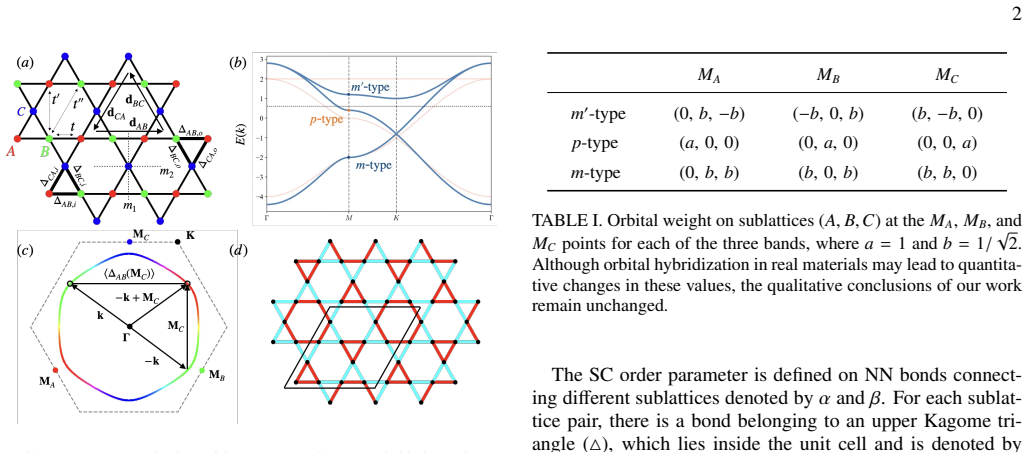
- The distinction between m-type and m'-type vHS is central; a short table or figure caption explicitly listing their mirror eigenvalues and sublattice characters would improve readability for readers unfamiliar with the Kagome point-group representations.
Simulated Author's Rebuttal
We thank the referee for their positive summary of our manuscript, recognition of the novelty in identifying the m'-type vHS, and recommendation for minor revision. No specific major comments were provided in the report.
Circularity Check
No significant circularity; derivation self-contained via symmetry arguments
full rationale
The provided abstract and context describe results as symmetry-enforced from the extended t-J model on the Kagome lattice, with PDW emerging when mu is at p-type vHS and competition near m'-type vHS. No equations or sections are quoted that reduce a prediction to a fitted input by construction, nor any self-citation load-bearing the central claim. The model assumptions are standard and externally falsifiable; symmetry constraints on Bloch wavefunctions provide independent content. This matches the default expectation of no circularity for papers whose central claims rest on model symmetries rather than parameter renaming or self-referential fits.
Axiom & Free-Parameter Ledger
free parameters (2)
- further-neighbor hoppings
- chemical potential
axioms (2)
- domain assumption The extended t-J model captures the essential low-energy physics of strongly correlated Kagome systems.
- standard math Bloch wavefunctions on the Kagome lattice possess symmetry-enforced sublattice structure and definite mirror eigenvalues.
Reference graph
Works this paper leans on
-
[1]
D. F. Agterberg, J. C. S. Davis, S. D. Edkins, E. Fradkin, D. J. Van Harlingen, S. A. Kivelson, P. A. Lee, L. Radzihovsky, J. M. Tranquada, and Y . Wang, The Physics of Pair-Density Waves: Cuprate Superconductors and Beyond, Annual Review of Con- densed Matter Physics11, 231 (2020)
2020
-
[2]
Z.-A. Wang, B. Hu, X. Han, H. Chen, and H.-J. Gao, Recent progress of scanning tunneling microscopy/spectroscopy study of pair density wave in superconductors: Recent progress of scanning tunneling microscopy/spectroscopy study of pair den- sity wave in superconductors, Frontiers of Physics21, 075301 (2026), arXiv:2511.15560 [cond-mat.supr-con]
arXiv 2026
-
[3]
Fulde and R
P. Fulde and R. A. Ferrell, Superconductivity in a strong spin- exchange field, Phys. Rev.135, A550 (1964)
1964
-
[4]
A. I. Larkin and Y . N. Ovchinnikov, Nonuniform state of super- conductors, Zh. Eksp. Teor. Fiz47, 1136 (1964)
1964
-
[5]
Y . Matsuda and H. Shimahara, Fulde-Ferrell-Larkin- Ovchinnikov State in Heavy Fermion Superconductors, Journal of the Physical Society of Japan76, 051005 (2007), arXiv:cond-mat/0702481 [cond-mat.supr-con]
Pith/arXiv arXiv 2007
-
[6]
E. Berg, E. Fradkin, S. A. Kivelson, and J. M. Tranquada, Striped superconductors: how spin, charge and superconduct- ing orders intertwine in the cuprates, New Journal of Physics 11, 115004 (2009)
2009
-
[7]
E. Fradkin, S. A. Kivelson, and J. M. Tranquada, Collo- quium: Theory of intertwined orders in high temperature su- perconductors, Reviews of Modern Physics87, 457 (2015), arXiv:1407.4480 [cond-mat.supr-con]
Pith/arXiv arXiv 2015
-
[8]
P. A. Lee, Amperean pairing and the pseudogap phase of cuprate superconductors, Phys. Rev. X4, 031017 (2014)
2014
-
[9]
M. H. Hamidian, S. D. Edkins, S. H. Joo, A. Kostin, H. Eisaki, S. Uchida, M. J. Lawler, E.-A. Kim, A. P. MacKenzie, K. Fujita, J. Lee, and J. C. S. Davis, Detection of a Cooper-pair density wave in Bi 2Sr2CaCu2O8+x, Nature (London)532, 343 (2016), arXiv:1511.08124 [cond-mat.supr-con]
Pith/arXiv arXiv 2016
-
[10]
H.-D. Chen, O. Vafek, A. Yazdani, and S.-C. Zhang, Pair Den- sity Wave in the Pseudogap State of High Temperature Super- conductors, Phys. Rev. Lett.93, 187002 (2004), arXiv:cond- mat/0402323 [cond-mat.supr-con]
arXiv 2004
-
[11]
Himeda, T
A. Himeda, T. Kato, and M. Ogata, Stripe states with spatially oscillatingd-wave superconductivity in the two-dimensionalt− t ′ −Jmodel, Phys. Rev. Lett.88, 117001 (2002)
2002
-
[12]
W. Chen, W. Ren, N. Kennedy, M. H. Hamidian, S. Uchida, H. Eisaki, P. D. Johnson, S. M. O’Mahony, and J. C. S. Davis, Identification of a nematic pair density wave state in Bi2Sr2CaCu2O8+x, Proceedings of the National Academy of Science119, e2206481119 (2022), arXiv:2206.03910 [cond- mat.supr-con]
arXiv 2022
-
[13]
J. Paglione and R. L. Greene, High-temperature superconduc- tivity in iron-based materials, Nature Physics6, 645 (2010), arXiv:1006.4618 [cond-mat.supr-con]
Pith/arXiv arXiv 2010
-
[14]
H. Zhao, R. Blackwell, M. Thinel, T. Handa, S. Ishida, X. Zhu, A. Iyo, H. Eisaki, A. N. Pasupathy, and K. Fujita, Smectic pair- density-wave order in EuRbFe4As4, Nature (London)618, 940 (2023), arXiv:2306.16570 [cond-mat.supr-con]
arXiv 2023
-
[15]
Y . Liu, T. Wei, G. He, Y . Zhang, Z. Wang, and J. Wang, Pair density wave state in a monolayer high-Tc iron-based supercon- ductor, Nature (London)618, 934 (2023), arXiv:2209.04592 [cond-mat.supr-con]
arXiv 2023
-
[16]
Q. Gu, J. P. Carroll, S. Wang, S. Ran, C. Broyles, H. Siddiquee, N. P. Butch, S. R. Saha, J. Paglione, J. C. S. Davis, and X. Liu, Detection of a pair density wave state in UTe2, Nature (London) 618, 921 (2023), arXiv:2209.10859 [cond-mat.supr-con]
arXiv 2023
-
[17]
A. Aishwarya, J. May-Mann, A. Raghavan, L. Nie, M. Ro- manelli, S. Ran, S. R. Saha, J. Paglione, N. P. Butch, E. Frad- kin, and V . Madhavan, Magnetic-field-sensitive charge density waves in the superconductor UTe 2, Nature (London)618, 928 (2023), arXiv:2207.09491 [cond-mat.supr-con]
arXiv 2023
-
[18]
H. Chen, H. Yang, B. Hu, Z. Zhao, J. Yuan, Y . Xing, G. Qian, Z. Huang, G. Li, Y . Ye, S. Ma, S. Ni, H. Zhang, Q. Yin, C. Gong, Z. Tu, H. Lei, H. Tan, S. Zhou, C. Shen, X. Dong, B. Yan, Z. Wang, and H.-J. Gao, Roton pair density wave in a strong-coupling kagome superconductor, Nature (London)599, 222 (2021)
2021
-
[19]
H. Deng, H. Qin, G. Liu, T. Yang, R. Fu, Z. Zhang, X. Wu, Z. Wang, Y . Shi, J. Liu, H. Liu, X.-Y . Yan, W. Song, X. Xu, Y . Zhao, M. Yi, G. Xu, H. Hohmann, S. C. Holbæk, M. D ¨urrnagel, S. Zhou, G. Chang, Y . Yao, Q. Wang, Z. Guguchia, T. Neupert, R. Thomale, M. H. Fischer, and J.-X. Yin, Chiral kagome superconductivity modulations with residual Fermi arc...
arXiv 2024
-
[20]
Y .-M. Wu, R. Thomale, and S. Raghu, Sublattice interference promotes pair density wave order in kagome metals, Phys. Rev. B108, L081117 (2023)
2023
-
[21]
X.-Y . Yan, G. Liu, H. Deng, X. Xu, H. Ma, H. Qin, J. Zhang, Y . Zhao, X. Fan, W. Song, M. Gao, H. Zhao, Z. Qu, Y . Zhong, K. Okazaki, X. Zheng, Y . Peng, Z. Guguchia, X. Wu, D. Wang, Q.-H. Wang, H. Hohmann, M. D ¨urrnagel, R. Thomale, and J.-X. Yin, Phase-sensitive evidence for pair density waves in a kagome superconductor, Proceedings of the National Ac...
-
[22]
Song, X.-Y
W. Song, X.-Y . Yan, X. Yu, D. Wu, D. Hu, H. Qin, G. Liu, H. Deng, C. Yan, M. Gao, Z. Wang, R. Wu, and J.-X. Yin, Switchable chiral pair density wave in pure csv3sb5, Phys. Rev. B113, 125127 (2026)
2026
-
[23]
X.-Y . Yan, H. Deng, T. Yang, G. Liu, W. Song, H. Miao, Z. Tu, H. Lei, S. Wang, B.-C. Lin, H. Qin, and J.-X. Yin, Chiral Pair Density Waves with Residual Fermi Arcs in RbV3Sb5, Chinese Physics Letters41, 097401 (2024), arXiv:2408.03352 [cond- mat.supr-con]
arXiv 2024
-
[24]
S.-Y . Peng, L.-F. Zhang, and X. Hu, Three-component super- conductivity: the effect of second-order Josephson couplings, arXiv e-prints , arXiv:2605.28221 (2026), arXiv:2605.28221 [cond-mat.supr-con]
Pith/arXiv arXiv 2026
-
[25]
B. R. Ortiz, L. C. Gomes, J. R. Morey, M. Winiarski, M. Bor- delon, J. S. Mangum, I. W. H. Oswald, J. A. Rodriguez-Rivera, J. R. Neilson, S. D. Wilson, E. Ertekin, T. M. McQueen, and E. S. Toberer, New kagome prototype materials: discovery of KV3Sb5, RbV3Sb5, and CsV3Sb5, Phys. Rev. Mater.3, 094407 6 (2019)
2019
-
[26]
Y . Wang, H. Wu, G. T. McCandless, J. Y . Chan, and M. N. Ali, Quantum states and intertwining phases in kagome mate- rials, Nature Reviews Physics5, 635 (2023), arXiv:2303.03359 [cond-mat.str-el]
arXiv 2023
-
[27]
Di Sante, T
D. Di Sante, T. Neupert, G. Sangiovanni, R. Thomale, R. Comin, J. G. Checkelsky, I. Zeljkovic, and S. D. Wilson, Kagome metals, Rev. Mod. Phys.98, 015002 (2026)
2026
-
[28]
B. R. Ortiz, S. M. L. Teicher, Y . Hu, J. L. Zuo, P. M. Sarte, E. C. Schueller, A. M. M. Abeykoon, M. J. Krogstad, S. Rosenkranz, R. Osborn, R. Seshadri, L. Balents, J. He, and S. D. Wilson, CsV3Sb5: AZ 2 topological kagome metal with a superconduct- ing ground state, Phys. Rev. Lett.125, 247002 (2020)
2020
-
[29]
H. Zhao, H. Li, B. R. Ortiz, S. M. L. Teicher, T. Park, M. Ye, Z. Wang, L. Balents, S. D. Wilson, and I. Zeljkovic, Cas- cade of correlated electron states in the kagome superconductor CsV3Sb5, Nature (London)599, 216 (2021), arXiv:2103.03118 [cond-mat.supr-con]
arXiv 2021
-
[30]
L. Yu, C. Wang, Y . Zhang, M. Sander, S. Ni, Z. Lu, S. Ma, Z. Wang, Z. Zhao, H. Chen, K. Jiang, Y . Zhang, H. Yang, F. Zhou, X. Dong, S. L. Johnson, M. J. Graf, J. Hu, H.-J. Gao, and Z. Zhao, Evidence of a hidden flux phase in the topologi- cal kagome metal CsV 3Sb5, arXiv e-prints , arXiv:2107.10714 (2021), arXiv:2107.10714 [cond-mat.supr-con]
arXiv 2021
-
[31]
C. Mielke, D. Das, J. X. Yin, H. Liu, R. Gupta, Y . X. Jiang, M. Medarde, X. Wu, H. C. Lei, J. Chang, P. Dai, Q. Si, H. Miao, R. Thomale, T. Neupert, Y . Shi, R. Khasanov, M. Z. Hasan, H. Luetkens, and Z. Guguchia, Time-reversal symmetry-breaking charge order in a kagome superconductor, Nature (London)602, 245 (2022), arXiv:2106.13443 [cond- mat.mtrl-sci]
arXiv 2022
-
[32]
Y .-X. Jiang, J.-X. Yin, M. M. Denner, N. Shumiya, B. R. Or- tiz, G. Xu, Z. Guguchia, J. He, M. S. Hossain, X. Liu, J. Ruff, L. Kautzsch, S. S. Zhang, G. Chang, I. Belopolski, Q. Zhang, T. A. Cochran, D. Multer, M. Litskevich, Z.-J. Cheng, X. P. Yang, Z. Wang, R. Thomale, T. Neupert, S. D. Wilson, and M. Z. Hasan, Unconventional chiral charge order in kag...
arXiv 2021
-
[33]
Y . Xing, S. Bae, E. Ritz, F. Yang, T. Birol, A. N. Capa Sali- nas, B. R. Ortiz, S. D. Wilson, Z. Wang, R. M. Fernandes, and V . Madhavan, Optical manipulation of the charge-density- wave state in RbV 3Sb5, Nature (London)631, 60 (2024), arXiv:2308.04128 [cond-mat.str-el]
arXiv 2024
-
[34]
Y . Xu, Z. Ni, Y . Liu, B. R. Ortiz, Q. Deng, S. D. Wilson, B. Yan, L. Balents, and L. Wu, Three-state nematicity and magneto- optical Kerr effect in the charge density waves in kagome super- conductors, Nature Physics18, 1470 (2022), arXiv:2204.10116 [cond-mat.str-el]
arXiv 2022
- [35]
-
[36]
H. Li, H. Zhao, B. R. Ortiz, T. Park, M. Ye, L. Balents, Z. Wang, S. D. Wilson, and I. Zeljkovic, Rotation symmetry breaking in the normal state of a kagome superconductor KV 3Sb5, Na- ture Physics18, 265 (2022), arXiv:2104.08209 [cond-mat.supr- con]
arXiv 2022
-
[37]
Q. Wu, Z. X. Wang, Q. M. Liu, R. S. Li, S. X. Xu, Q. W. Yin, C. S. Gong, Z. J. Tu, H. C. Lei, T. Dong, and N. L. Wang, Simultaneous formation of two-fold rotation symmetry with charge order in the kagome superconductor CsV3Sb5 by optical polarization rotation measurement, Phys. Rev. B106, 205109 (2022), arXiv:2110.11306 [cond-mat.supr-con]
arXiv 2022
-
[38]
L. Nie, K. Sun, W. Ma, D. Song, L. Zheng, Z. Liang, P. Wu, F. Yu, J. Li, M. Shan, D. Zhao, S. Li, B. Kang, Z. Wu, Y . Zhou, K. Liu, Z. Xiang, J. Ying, Z. Wang, T. Wu, and X. Chen, Charge-density-wave-driven electronic nematicity in a kagome superconductor, Nature (London)604, 59 (2022)
2022
-
[39]
L. Zheng, Z. Wu, Y . Yang, L. Nie, M. Shan, K. Sun, D. Song, F. Yu, J. Li, D. Zhao, S. Li, B. Kang, Y . Zhou, K. Liu, Z. Xiang, J. Ying, Z. Wang, T. Wu, and X. Chen, Emergent charge order in pressurized kagome superconductor CsV3Sb5, Nature (London) 611, 682 (2022), arXiv:2209.07340 [cond-mat.supr-con]
arXiv 2022
-
[40]
D. F. Agterberg and H. Tsunetsugu, Dislocations and vortices in pair-density-wave superconductors, Nature Physics4, 639 (2008), arXiv:0902.0805 [cond-mat.str-el]
Pith/arXiv arXiv 2008
-
[41]
E. Berg, E. Fradkin, and S. A. Kivelson, Charge-4e super- conductivity from pair-density-wave order in certain high- temperature superconductors, Nature Physics5, 830 (2009), arXiv:0904.1230 [cond-mat.str-el]
Pith/arXiv arXiv 2009
-
[42]
Z. Du, H. Li, S. H. Joo, E. P. Donoway, J. Lee, J. C. S. Davis, G. Gu, P. D. Johnson, and K. Fujita, Imaging the energy gap modulations of the cuprate pair-density-wave state, Nature (London)580, 65 (2020), arXiv:2109.14033 [cond-mat.supr- con]
arXiv 2020
-
[43]
M. Yao, Y . Wang, D. Wang, J.-X. Yin, and Q.-H. Wang, Self-consistent theory of 2×2 pair density waves in kagome superconductors, Phys. Rev. B111, 094505 (2025), arXiv:2408.03056 [cond-mat.supr-con]
arXiv 2025
-
[44]
E. O. Lamponen, S. K. P¨ontys, and P. T¨orm¨a, Superconductivity and pair density waves from nearest-neighbor interactions in frustrated lattice geometries, Phys. Rev. B112, 144514 (2025)
2025
-
[45]
H.-Y . Liu, D. Wang, Z. Wang, and Q.-H. Wang, Genuine pair density wave order on the kagome lattice, arXiv e-prints , arXiv:2604.03531 (2026), arXiv:2604.03531 [cond-mat.supr- con]
Pith/arXiv arXiv 2026
-
[46]
Y . Zhang and Z. Wang, Spin-triplet pair density wave superconductors, Communications Physics8, 337 (2025), arXiv:2408.13886 [cond-mat.supr-con]
arXiv 2025
- [47]
-
[48]
Neupert, M
T. Neupert, M. M. Denner, J.-X. Yin, R. Thomale, and M. Z. Hasan, Charge order and superconductivity in kagome materi- als, Nature Physics18, 137 (2022)
2022
-
[49]
S. D. Wilson and B. R. Ortiz, A V3Sb5 kagome superconductors, Nature Reviews Materials9, 420 (2024), arXiv:2311.05946 [cond-mat.supr-con]
arXiv 2024
-
[50]
M. Roppongi, K. Ishihara, Y . Tanaka, K. Ogawa, K. Okada, S. Liu, K. Mukasa, Y . Mizukami, Y . Uwatoko, R. Grasset, M. Konczykowski, B. R. Ortiz, S. D. Wilson, K. Hashimoto, and T. Shibauchi, Bulk evidence of anisotropic s-wave pairing with no sign change in the kagome superconductor CsV 3Sb5, Nature Communications14, 667 (2023), arXiv:2206.02580 [cond-ma...
arXiv 2023
-
[51]
Z. Guguchia, C. Mielke, D. Das, R. Gupta, J. X. Yin, H. Liu, Q. Yin, M. H. Christensen, Z. Tu, C. Gong, N. Shumiya, M. S. Hossain, T. Gamsakhurdashvili, M. Elender, P. Dai, A. Amato, Y . Shi, H. C. Lei, R. M. Fernandes, M. Z. Hasan, H. Luetkens, and R. Khasanov, Tunable unconventional kagome supercon- ductivity in charge ordered RbV 3Sb5 and KV 3Sb5, Natu...
arXiv 2023
-
[52]
K. Fukushima, K. Obata, S. Yamane, Y . Hu, Y . Li, Y . Yao, Z. Wang, Y . Maeno, and S. Yonezawa, Violation of emer- 7 gent rotational symmetry in the hexagonal Kagome supercon- ductor CsV 3Sb5, Nature Communications15, 2888 (2024), arXiv:2303.11072 [cond-mat.supr-con]
arXiv 2024
-
[53]
D. J. Schultz, G. Palle, A. Mitra, Y . B. Kim, R. M. Fer- nandes, and J. Schmalian, Superconductivity in kagome met- als due to soft loop-current fluctuations, arXiv e-prints , arXiv:2507.16892 (2025), arXiv:2507.16892 [cond-mat.supr- con]
Pith/arXiv arXiv 2025
-
[54]
N. Shumiya, M. S. Hossain, J.-X. Yin, Y .-X. Jiang, B. R. Ortiz, H. Liu, Y . Shi, Q. Yin, H. Lei, S. S. Zhang, G. Chang, Q. Zhang, T. A. Cochran, D. Multer, M. Litskevich, Z.-J. Cheng, X. P. Yang, Z. Guguchia, S. D. Wilson, and M. Z. Hasan, Intrinsic nature of chiral charge order in the kagome superconductor Rb V3Sb5, Phys. Rev. B104, 035131 (2021), arXiv...
arXiv 2021
-
[55]
H. Deng, G. Liu, Z. Guguchia, T. Yang, J. Liu, Z. Wang, Y . Xie, S. Shao, H. Ma, W. Li `ege, F. Bourdarot, X.-Y . Yan, H. Qin, C. Mielke, R. Khasanov, H. Luetkens, X. Wu, G. Chang, J. Liu, M. H. Christensen, A. Kreisel, B. M. Andersen, W. Huang, Y . Zhao, P. Bourges, Y . Yao, P. Dai, and J.-X. Yin, Evidence for time-reversal symmetry-breaking kagome super...
arXiv 2024
-
[56]
S. Zhou and Z. Wang, Chern Fermi pocket, topological pair density wave, and charge-4e and charge-6e superconductivity in kagom´e superconductors, Nature Communications13, 7288 (2022), arXiv:2110.06266 [cond-mat.supr-con]
arXiv 2022
-
[57]
X. Wu, T. Schwemmer, T. M ¨uller, A. Consiglio, G. Sangio- vanni, D. Di Sante, Y . Iqbal, W. Hanke, A. P. Schnyder, M. M. Denner, M. H. Fischer, T. Neupert, and R. Thomale, Nature of unconventional pairing in the kagome superconductorsav 3sb5 (a=K,Rb,Cs), Phys. Rev. Lett.127, 177001 (2021)
2021
-
[58]
Y . Liu, Z.-Y . Liu, J.-K. Bao, P.-T. Yang, L.-W. Ji, S.-Q. Wu, Q.-X. Shen, J. Luo, J. Yang, J.-Y . Liu, C.-C. Xu, W.-Z. Yang, W.-L. Chai, J.-Y . Lu, C.-C. Liu, B.-S. Wang, H. Jiang, Q. Tao, Z. Ren, X.-F. Xu, C. Cao, Z.-A. Xu, R. Zhou, J.-G. Cheng, and G.-H. Cao, Superconductivity under pressure in a chromium-based kagome metal, Nature (London)632, 1032 (...
arXiv 2024
-
[59]
Z. Wang, Y . Guo, H.-Y . Huang, F. Xie, Y . Huang, B. Gao, J. S. Oh, H. Wu, J. Okamoto, G. Channagowdra, C.-T. Chen, F. Ye, X. Lu, Z. Liu, Z. Ren, Y . Fang, Y . Wang, A. Biswas, Y . Zhang, Z. Yue, C. Hu, C. Jozwiak, A. Bostwick, E. Roten- berg, M. Hashimoto, D. Lu, J. Kono, J.-H. Chu, B. I. Yakobson, R. J. Birgeneau, G.-H. Cao, A. Fujimori, D.-J. Huang, Q...
arXiv 2025
-
[60]
M. L. Kiesel and R. Thomale, Sublattice interference in the kagome hubbard model, Phys. Rev. B86, 121105 (2012)
2012
-
[61]
Yu and J.-X
S.-L. Yu and J.-X. Li, Chiral superconducting phase and chiral spin-density-wave phase in a Hubbard model on the kagome lattice, Phys. Rev. B85, 144402 (2012)
2012
-
[62]
A. T. Rømer, S. Bhattacharyya, R. Valent ´ı, M. H. Christensen, and B. M. Andersen, Superconductivity from repulsive interac- tions on the kagome lattice, Phys. Rev. B106, 174514 (2022)
2022
-
[63]
Schwemmer, H
T. Schwemmer, H. Hohmann, M. D¨urrnagel, J. Potten, J. Beyer, S. Rachel, Y .-M. Wu, S. Raghu, T. M ¨uller, W. Hanke, and R. Thomale, Sublattice modulated superconductivity in the kagome hubbard model, Phys. Rev. B110, 024501 (2024)
2024
-
[64]
S. C. Holbæk, M. H. Christensen, A. Kreisel, and B. M. Ander- sen, Unconventional superconductivity protected from disorder on the kagome lattice, Phys. Rev. B108, 144508 (2023)
2023
-
[65]
Liu and T
J. Liu and T. Zhou, Probing the pairing symmetry in kagome superconductors based on the single-particle spectrum, Phys. Rev. B109, 054504 (2024)
2024
-
[66]
Wang, Z.-Z
W.-S. Wang, Z.-Z. Li, Y .-Y . Xiang, and Q.-H. Wang, Competing electronic orders on kagome lattices at van hove filling, Phys. Rev. B87, 115135 (2013)
2013
-
[67]
C. Wen, X. Zhu, Z. Xiao, N. Hao, R. Mondaini, H. Guo, and S. Feng, Superconducting pairing symmetry in the kagome- lattice hubbard model, Phys. Rev. B105, 075118 (2022)
2022
-
[68]
A. H. MacDonald, S. M. Girvin, and D. Yoshioka, t U expansion for the hubbard model, Phys. Rev. B37, 9753 (1988)
1988
-
[69]
Fazekas,Lecture notes on electron correlation and mag- netism, V ol
P. Fazekas,Lecture notes on electron correlation and mag- netism, V ol. 5 (World scientific, 1999)
1999
-
[70]
J. Spałek, t-J Model Then and Now: a Personal Perspective from the Pioneering Times, Acta Physica Polonica A111, 409 (2007), arXiv:0706.4236 [cond-mat.str-el]
Pith/arXiv arXiv 2007
-
[71]
H. Li, Y . B. Kim, and H.-Y . Kee, Intertwined van hove singular- ities as a mechanism for loop current order in kagome metals, Phys. Rev. Lett.132, 146501 (2024)
2024
-
[72]
J. Zhan, H. Hohmann, M. D ¨urrnagel, R. Fu, S. Zhou, Z. Wang, R. Thomale, X. Wu, and J. Hu, Loop current order on the kagome lattice, Phys. Rev. Lett.136, 126001 (2026)
2026
-
[73]
M. L. Kiesel, C. Platt, and R. Thomale, Unconventional fermi surface instabilities in the kagome hubbard model, Phys. Rev. Lett.110, 126405 (2013)
2013
-
[74]
M. M. Denner, R. Thomale, and T. Neupert, Analysis of charge order in the kagome metal A V3Sb5 (A=K,Rb,Cs), Phys. Rev. Lett.127, 217601 (2021)
2021
-
[75]
H. Li, X. Liu, Y . B. Kim, and H.-Y . Kee, Origin ofπ-shifted three-dimensional charge density waves in the kagom ´e metal A V3Sb5 (A=Cs,Rb,K), Phys. Rev. B108, 075102 (2023)
2023
-
[76]
He, S.-L
L.-W. He, S.-L. Yu, and J.-X. Li, Recent progress in quantum spin liquids, fractional magnetization plateaus, and unconven- tional superconductivity in kagome lattices, Quantum Frontiers 4, 22 (2025)
2025
discussion (0)
Sign in with ORCID, Apple, or X to comment. Anyone can read and Pith papers without signing in.