Fidelity- and Perception-Aware Local Implicit Attention for Arbitrary-Scale Image Super-Resolution
Pith reviewed 2026-06-26 12:24 UTC · model grok-4.3
The pith
FPLIA integrates fidelity features into diffusion pipelines for realistic arbitrary-scale super-resolution.
A machine-rendered reading of the paper's core claim, the machinery that carries it, and where it could break.
Core claim
FPLIA is a framework that integrates fidelity-oriented features into a diffusion pipeline for arbitrary-scale image super-resolution by means of the Fidelity and Perception Attention Module, which performs self-attention and cross-attention on fidelity and perceptual features, and the Fidelity and Perception Select Module, which adaptively chooses the most representative features for RGB value prediction, thereby producing reconstructions that are both realistic and faithful.
What carries the argument
Fidelity and Perception Attention Module (FPAM) and Fidelity and Perception Select Module (FPSM), which combine and select between fidelity-oriented and perceptual features via attention mechanisms inside a diffusion pipeline.
If this is right
- FPLIA produces superior perceptual realism on standard ASISR benchmarks.
- Reconstruction accuracy measured by pixel-wise metrics is maintained.
- Risk of structural hallucinations is reduced relative to pure diffusion approaches.
- Complementary fidelity and perceptual features are exploited for RGB prediction.
Where Pith is reading between the lines
- The same attention-selection pattern could be tested on other continuous-scale restoration problems such as video super-resolution.
- The modules might be inserted into non-diffusion generative backbones to check whether the fidelity-perception balance transfers.
- Evaluation on real captured low-resolution images with unknown degradations would test robustness beyond synthetic benchmarks.
Load-bearing premise
The FPAM and FPSM modules integrate into an existing diffusion pipeline without creating new structural inconsistencies or requiring hyperparameter tuning beyond what the paper describes.
What would settle it
Quantitative evaluation on standard ASISR benchmarks in which FPLIA shows no improvement in perceptual metrics such as LPIPS while PSNR and SSIM remain comparable would falsify the central effectiveness claim.
Figures



read the original abstract
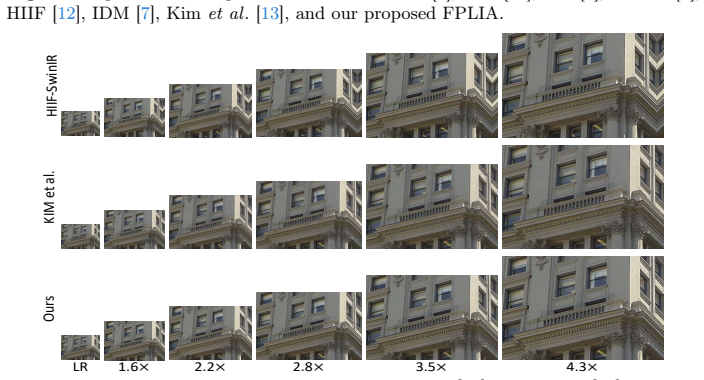
Arbitrary-scale image super-resolution (ASISR) aims to reconstruct high-resolution images from low-resolution inputs over a continuous range of upscaling factors. While traditional pixel-regression approaches often produce overly smooth results that lack realistic details, recent diffusion methods can produce sharper and more realistic textures. However, these diffusion techniques frequently introduce the risk of structural hallucinations. To address these issues, we propose Fidelity- and Perception-Aware Local Implicit Attention (FPLIA), a framework that effectively integrates fidelity-oriented features into a diffusion pipeline to produce realistic and faithful reconstructions for ASISR. We introduce a Fidelity and Perception Attention Module (FPAM), which applies both self-attention and cross-attention to fidelity-oriented and perceptual features to enhance representational capacity. To further exploit their complements, we design a Fidelity and Perception Select Module (FPSM) that adaptively selects the most representative features for RGB values prediction. We conduct extensive experiments to validate the effectiveness of these components. Both qualitative and quantitative results show that FPLIA delivers superior perceptual realism while maintaining reconstruction accuracy on standard ASISR benchmarks. The source code is accessible at the following repository: https://github.com/XUSean0118/FPLIA.
Editorial analysis
A structured set of objections, weighed in public.
Referee Report
Summary. The paper proposes Fidelity- and Perception-Aware Local Implicit Attention (FPLIA) for arbitrary-scale image super-resolution (ASISR). It integrates fidelity-oriented features into a diffusion pipeline via two new modules: the Fidelity and Perception Attention Module (FPAM), which combines self- and cross-attention on fidelity and perceptual features, and the Fidelity and Perception Select Module (FPSM), which adaptively selects features for RGB prediction. The authors claim that extensive experiments on standard ASISR benchmarks demonstrate superior perceptual realism while preserving reconstruction accuracy, and they release the source code publicly.
Significance. If the reported gains hold under scrutiny, the work offers a concrete mechanism for reducing structural hallucinations in diffusion-based ASISR without sacrificing fidelity, which could influence hybrid fidelity-perception designs in image restoration more broadly. The public code release strengthens reproducibility.
minor comments (3)
- The abstract asserts quantitative superiority on benchmarks but supplies no numerical values, ablation tables, or error metrics; adding at least one representative table or set of PSNR/LPIPS numbers in the abstract or §4 would make the central claim immediately verifiable.
- The description of how FPAM and FPSM are inserted into the diffusion pipeline (e.g., at which denoising step or feature level) remains high-level; a diagram or pseudocode in §3 would clarify integration without requiring readers to inspect the repository.
- Notation for the attention operations inside FPAM is not defined in the provided text; consistent variable names and a short equation block would improve readability.
Simulated Author's Rebuttal
We thank the referee for the positive summary, recognition of the work's potential impact on hybrid fidelity-perception designs, and recommendation for minor revision. No specific major comments were provided in the report.
Circularity Check
No significant circularity
full rationale
The paper proposes architectural modules (FPAM, FPSM) for integrating fidelity and perceptual features into a diffusion-based ASISR pipeline and reports empirical results on standard benchmarks with public code. No derivation chain, equations, or self-citations are load-bearing; claims rest on external validation rather than reducing to fitted parameters or self-referential definitions by construction.
Axiom & Free-Parameter Ledger
Reference graph
Works this paper leans on
-
[1]
In: Proc
Agustsson, E., Timofte, R.: NTIRE 2017 challenge on single image super-resolution: Dataset and study. In: Proc. IEEE Conf. on Computer Vision and Pattern Recog- nition Workshop (CVPRW). pp. 1122–1131 (2017) 3, 8, 9, 12, 13, 14
2017
-
[2]
In: Proc
Bevilacqua, M., Roumy, A., Guillemot, C., Alberi-Morel, M.: Low-complexity single- image super-resolution based on nonnegative neighbor embedding. In: Proc. British Machine Vision Conf. (BMVC). pp. 1–10 (2012) 3, 8, 9
2012
-
[3]
In: Proc
Cao, J., Wang, Q., Xian, Y., Li, Y., Ni, B., Pi, Z., Zhang, K., Zhang, Y., Timofte, R., Van Gool, L.: Ciaosr: Continuous implicit attention-in-attention network for arbitrary-scale image super-resolution. In: Proc. IEEE Conf. on Computer Vision and Pattern Recognition (CVPR). pp. 1796–1807 (2023) 1, 2, 4, 8, 9, 10, 11
2023
-
[4]
In: Proc
Chen, H.W., Xu, Y.S., Hong, M.F., Tsai, Y.M., Kuo, H.K., Lee, C.Y.: Cascaded local implicit transformer for arbitrary-scale super-resolution. In: Proc. IEEE Conf. on Computer Vision and Pattern Recognition (CVPR). pp. 18257–18267 (2023) 1, 2, 4, 8, 10, 11
2023
-
[5]
In: Proc
Chen, Y., Liu, S., Wang, X.: Learning continuous image representation with local implicit image function. In: Proc. IEEE Conf. on Computer Vision and Pattern Recognition (CVPR). pp. 8628–8638 (2021) 1, 2, 4, 8, 9, 10, 11, 13
2021
-
[6]
IEEE Trans
Dong, C., Loy, C.C., He, K., Tang, X.: Image super-resolution using deep con- volutional networks. IEEE Trans. Pattern Analysis and Machine Intelligence (TPAMI)38(2), 295–307 (2016) 1
2016
-
[7]
In: Proc
Gao, S., Liu, X., Zeng, B., Xu, S., Li, Y., Luo, X., Liu, J., Zhen, X., Gao, B.Z., Liu, X., Zeng, B., Xu, S., Li, Y., Luo, X., Liu, J., Zhen, X., Zhang, B.: Implicit diffusion models for continuous super-resolution. In: Proc. IEEE Conf. on Computer Vision and Pattern Recognition (CVPR). pp. 10021–10030 (2023) 1, 2, 8, 10, 11
2023
-
[8]
Gaussian Error Linear Units (GELUs)
Hendrycks, D., Gimpel, K.: Bridging nonlinearities and stochastic regularizers with gaussian error linear units. CoRRabs/1606.08415(2016) 9
work page internal anchor Pith review Pith/arXiv arXiv 2016
-
[9]
In: Proc
Hu, X., Mu, H., Zhang, X., Wang, Z., Tan, T., Sun, J.: Meta-sr: A magnification- arbitrary network for super-resolution. In: Proc. IEEE Conf. on Computer Vision and Pattern Recognition (CVPR). pp. 1575–1584 (2019) 1
2019
-
[10]
In: Proc
Huang, J., Singh, A., Ahuja, N.: Single image super-resolution from transformed self-exemplars. In: Proc. IEEE Conf. on Computer Vision and Pattern Recognition (CVPR). pp. 5197–5206 (2015) 3, 8, 9, 10
2015
-
[11]
In: Proc
Jang, E., Gu, S., Poole, B.: Categorical reparameterization with gumbel-softmax. In: Proc. Int. Conf. on Learning Representations (ICLR)(2017) 7
2017
-
[12]
In: Proc
Jiang, Y., Kwan, H.M., Peng, T., Gao, G., Zhang, F., Zhu, X., Sole, J., Bull, D.: HIIF: hierarchical encoding based implicit image function for continuous super- resolution. In: Proc. IEEE Conf. on Computer Vision and Pattern Recognition (CVPR). pp. 2289–2299 (2025) 1, 2, 4, 8, 9, 10, 11
2025
-
[13]
In: Proc
Kim, J., Kim, T.: Arbitrary-scale image generation and upsampling using latent diffusion model and implicit neural decoder. In: Proc. IEEE Conf. on Computer Vision and Pattern Recognition (CVPR). pp. 9202–9211 (2024) 1, 2, 3, 8, 9, 10, 11, 14
2024
-
[14]
In: Proc
Lee, J., Jin, K.H.: Local texture estimator for implicit representation function. In: Proc. IEEE Conf. on Computer Vision and Pattern Recognition (CVPR). pp. 1929–1938 (2022) 1, 2, 4, 8, 10, 11
1929
-
[15]
In: Proc
Liang, J., Cao, J., Sun, G., Zhang, K., Van Gool, L., Timofte, R.: Swinir: Image restoration using swin transformer. In: Proc. IEEE Int. Conf. on Computer Vision Workshop (ICCVW). pp. 1833–1844 (2021) 1, 2, 8, 9 16 Yu-Syuan Xu, Hao-Lun Sun, Hao-Wei Chen, Hsien-Kai Kuo, Chun-Yi Lee
2021
-
[16]
In: Proc
Lim, B., Son, S., Kim, H., Nah, S., Lee, K.M.: Enhanced deep residual networks for single image super-resolution. In: Proc. IEEE Conf. on Computer Vision and Pattern Recognition Workshop (CVPRW). pp. 1132–1140 (2017) 1, 2
2017
-
[17]
Liu, Y., Guo, Y., Zhang, S.: Enhancing multi-scale implicit learning in image super- resolution with integrated positional encoding. CoRRabs/2112.05756(2021) 1
-
[18]
In: Proc
Martin, D.R., Fowlkes, C.C., Tal, D., Malik, J.: A database of human segmented natural images and its application to evaluating segmentation algorithms and measuring ecological statistics. In: Proc. IEEE Int. Conf. on Computer Vision (ICCV). pp. 416–425 (2001) 3, 8, 9, 10
2001
-
[19]
In: Proc
Rombach, R., Blattmann, A., Lorenz, D., Esser, P., Ommer, B.: High-resolution image synthesis with latent diffusion models. In: Proc. IEEE Conf. on Computer Vision and Pattern Recognition (CVPR). pp. 10674–10685 (2022) 2, 9
2022
-
[20]
IEEE Trans
Saharia, C., Ho, J., Chan, W., Salimans, T., Fleet, D.J., Norouzi, M.: Image super- resolution via iterative refinement. IEEE Trans. Pattern Analysis and Machine Intelligence (TPAMI)45(4), 4713–4726 (2023) 1, 2
2023
-
[21]
In: Proc
Timofte, R., Agustsson, E., Gool, L.V., Yang, M., Zhang, L.: NTIRE 2017 challenge on single image super-resolution: Methods and results. In: Proc. IEEE Conf. on Computer Vision and Pattern Recognition Workshop (CVPRW). pp. 1110–1121 (2017) 8
2017
-
[22]
In: Proc
Wang, X., Chen, X., Ni, B., Wang, H., Tong, Z., Liu, YutianWang, X., Chen, X., Ni, B., Wang, H., Tong, Z., Liu, Y.: Deep arbitrary-scale image super-resolution via scale-equivariance pursuit. In: Proc. IEEE Conf. on Computer Vision and Pattern Recognition (CVPR). pp. 1786–1795 (2023) 1
2023
-
[23]
In: Proc
Wang, X., Yu, K., Dong, C., Loy, C.C.: Recovering realistic texture in image super- resolution by deep spatial feature transform. In: Proc. IEEE Conf. on Computer Vision and Pattern Recognition (CVPR). pp. 606–615 (2018) 14
2018
-
[24]
In: Proc
Wang, X., Yu, K., Wu, S., Gu, J., Liu, Y., Dong, C., Qiao, Y., Loy, C.C.: Esrgan: Enhanced super-resolution generative adversarial networks. In: Proc. European Conf. on Computer Vision Workshop (ECCVW). pp. 63–79 (2018) 1
2018
-
[25]
Xu, X., Wang, Z., Shi, H.: Ultrasr: Spatial encoding is a missing key for implicit image function-based arbitrary-scale super-resolution. CoRRabs/2103.12716 (2021) 1
-
[26]
In: Proc
Yang, J., Shen, S., Yue, H., Li, K.: Implicit transformer network for screen content image continuous super-resolution. In: Proc. Conf. on Neural Information Processing Systems (NeurIPS). pp. 13304–13315 (2021) 1
2021
-
[27]
In: Proc
Yao, J., Tsao, L., Lo, Y., Tseng, R., Chang, C., Lee, C.: Local implicit normalizing flow for arbitrary-scale image super-resolution. In: Proc. IEEE Conf. on Computer Vision and Pattern Recognition (CVPR). pp. 1776–1785 (2023) 1
2023
-
[28]
In: Curves and Surfaces
Zeyde, R., Elad, M., Protter, M.: On single image scale-up using sparse- representations. In: Curves and Surfaces. Lecture Notes in Computer Science, vol. 6920, pp. 711–730 (2010) 3, 8, 9, 10
2010
-
[29]
In: Proc
Zhang, R., Isola, P., Efros, A.A., Shechtman, E., Wang, O.: The unreasonable effectiveness of deep features as a perceptual metric. In: Proc. IEEE Conf. on Computer Vision and Pattern Recognition (CVPR). pp. 586–595 (2018) 8
2018
-
[30]
In: Proc
Zhang, Y., Li, K., Li, K., Wang, L., Zhong, B., Fu, Y.: Image super-resolution using very deep residual channel attention networks. In: Proc. European Conf. on Computer Vision (ECCV). pp. 294–310 (2018) 1
2018
-
[31]
In: Proc
Zhang, Y., Tian, Y., Kong, Y., Zhong, B., Fu, Y.: Residual dense network for image super-resolution. In: Proc. IEEE Conf. on Computer Vision and Pattern Recognition (CVPR). pp. 2472–2481 (2018) 1, 2
2018
discussion (0)
Sign in with ORCID, Apple, or X to comment. Anyone can read and Pith papers without signing in.