The feasibility of single {Λ} production via {ell}⁻ + p {to} {Λ} + {ν}_(ell) at e⁺e⁻ colliders
Pith reviewed 2026-06-26 12:10 UTC · model grok-4.3
The pith
Single-Λ production cross sections at e+e- colliders increase with energy but remain highly sensitive to baryon transition form factors.
A machine-rendered reading of the paper's core claim, the machinery that carries it, and where it could break.
Core claim
The cross section for ℓ⁻ + p → Λ + ν_ℓ increases with center-of-mass energy and is highly sensitive to the choice of baryonic transition form factors parameterized with the z-expansion scheme within QCD sum-rule and lattice-QCD frameworks, resulting in significant theoretical uncertainties that hinder observation of the process.
What carries the argument
Baryonic transition form factors in the z-expansion scheme, which encode the hadronic matrix elements of the weak current and fix the size of the predicted cross sections.
If this is right
- Predicted rates are larger at the Z0 resonance than at the J/ψ or Υ resonances.
- Different form-factor models produce substantially different cross-section values at every energy.
- Better lattice or sum-rule calculations of the form factors would shrink the uncertainty range on the expected signal.
- An observed rate lying outside the calculated range could indicate physics beyond the Standard Model.
Where Pith is reading between the lines
- Mapping the energy dependence could help prioritize which resonance decays to examine first in existing detector data.
- Analogous calculations for other hyperons would test whether the same form-factor sensitivity appears across the baryon octet.
- Comparison with existing fixed-target lepton-beam data on hyperon production could provide an external consistency check on the input form factors.
Load-bearing premise
The z-expansion parametrizations of the baryonic transition form factors from QCD sum rules and lattice QCD give a sufficiently accurate description of the weak transition to support the reported cross-section estimates.
What would settle it
A measurement of the single-Λ production rate at a fixed center-of-mass energy that lies well outside the band spanned by the two form-factor models would show that the models do not bracket the true rate.
Figures
read the original abstract
We present a comprehensive investigation of single ${\Lambda}$ hyperon production via the lepton-nucleon deep inelastic scattering (LNDIS) process, ${\ell}^{-}$ $+$ $p$ ${\to}$ ${\nu}_{\ell}$ $+$ ${\Lambda}$, in the experimental environment of electron-positron colliders. Our approach utilizes incident leptons originating from the decays of resonances (${J/\psi}$, ${\psi}(2S)$, ${\Upsilon}(1S)$, ${\Upsilon}(2S)$, and $Z^{0}$) produced in $e^{+}e^{-}$ collisions, which then scatter off stationary protons in the surrounding detector materials. The differential and total cross sections are calculated using baryonic transition form factors parameterized with the $z$-expansion scheme within both the quantum chromodynamics (QCD) sum rule and lattice QCD frameworks. Our results indicate that the cross section increases with center-of-mass energy and is highly sensitive to the choice of form factors, resulting in significant theoretical uncertainties. This study highlights the experimental challenges in observing the LNDIS process at $e^{+}e^{-}$ colliders and underscores the need for improved determination of baryonic form factors. It serves as a valuable reference for future experimental searches and suggests that an anomalous observation of single ${\Lambda}$ hyperon production at $e^{+}e^{-}$ colliders could indicate new physics.
Editorial analysis
A structured set of objections, weighed in public.
Referee Report
Summary. The manuscript investigates the feasibility of single Λ hyperon production via the process ℓ⁻ + p → Λ + ν_ℓ at e⁺e⁻ colliders, where incident leptons arise from decays of resonances (J/ψ, ψ(2S), Υ(1S,2S), Z⁰). Differential and total cross sections are computed using baryonic transition form factors parametrized in the z-expansion scheme, with inputs taken from QCD sum rules and lattice QCD. The central claims are that the cross section rises with center-of-mass energy, is highly sensitive to the form-factor choice, and therefore carries significant theoretical uncertainties that pose experimental challenges while potentially allowing new-physics signals if anomalous rates are observed.
Significance. If the uncertainty assessment were placed on firmer ground, the work would supply a useful reference calculation for experimental searches at existing and planned e⁺e⁻ facilities and would correctly flag the dominant role of non-perturbative inputs in limiting predictions for this channel. The explicit use of two independent external form-factor sets is a positive step toward quantifying model dependence, but the absence of validation steps prevents the significance from being fully realized.
major comments (2)
- [Numerical results] Numerical results section: The headline statement that the cross section 'is highly sensitive to the choice of form factors, resulting in significant theoretical uncertainties' is obtained solely by inserting two external z-expansion coefficient sets into the same matrix-element code. No propagation of the z-series truncation error, no coefficient covariance matrices, and no comparison of either set against the well-measured low-Q² hyperon β-decay rates are presented; without these checks it is unclear whether the reported spread demonstrates genuine non-perturbative physics or differences in the external analyses.
- [Form-factor section (§3)] Form-factor section (§3): The kinematic reach at collider energies extends to Q² values several GeV² above the hyperon mass threshold, yet the manuscript contains no explicit verification that the adopted z-expansion remains convergent in this domain or that the chosen parametrizations reproduce the known p→Λ vector and axial-vector charges at Q²=0.
minor comments (3)
- [Abstract] The abstract labels the process 'lepton-nucleon deep inelastic scattering (LNDIS)' while the reaction ℓ⁻p→Λν_ℓ is manifestly exclusive; a one-sentence clarification of the terminology would avoid confusion.
- [Figures] Figure captions and axis labels for the energy dependence plots do not indicate whether the curves include any kinematic cuts or acceptance factors; adding this information would improve reproducibility.
- A short table comparing the two z-expansion coefficient sets side-by-side (with references) would make the source of the numerical differences immediately transparent to readers.
Simulated Author's Rebuttal
We thank the referee for the careful reading and constructive comments. We address the two major comments point by point below, indicating where revisions will be made.
read point-by-point responses
-
Referee: Numerical results section: The headline statement that the cross section 'is highly sensitive to the choice of form factors, resulting in significant theoretical uncertainties' is obtained solely by inserting two external z-expansion coefficient sets into the same matrix-element code. No propagation of the z-series truncation error, no coefficient covariance matrices, and no comparison of either set against the well-measured low-Q² hyperon β-decay rates are presented; without these checks it is unclear whether the reported spread demonstrates genuine non-perturbative physics or differences in the external analyses.
Authors: We thank the referee for this observation. The two external z-expansion sets (from QCD sum rules and lattice QCD) are independent published determinations, and the spread between them is presented to illustrate the current theoretical uncertainty due to non-perturbative inputs. We agree that internal error propagation, covariance matrices, and direct comparison to β-decay rates would strengthen the presentation. Since the form-factor coefficients are taken from external works, full propagation of their truncation errors is not feasible without the original data. We will revise the numerical results section to include explicit comparison of both parametrizations against the known p→Λ vector and axial charges at Q²=0 and add a discussion of these limitations. revision: partial
-
Referee: Form-factor section (§3): The kinematic reach at collider energies extends to Q² values several GeV² above the hyperon mass threshold, yet the manuscript contains no explicit verification that the adopted z-expansion remains convergent in this domain or that the chosen parametrizations reproduce the known p→Λ vector and axial-vector charges at Q²=0.
Authors: We agree that explicit verification is warranted. The z-expansion is a model-independent parametrization whose radius of convergence is set by the nearest branch point; for the Q² range accessed in the collider kinematics we have confirmed it remains inside this domain. We will revise §3 to add explicit numerical checks demonstrating that both sets reproduce the known p→Λ vector and axial-vector charges at Q²=0 (within the uncertainties quoted in the original references) and to discuss convergence at the higher Q² values reached at e⁺e⁻ collider energies. revision: yes
Circularity Check
No circularity: cross sections computed from independent external form-factor inputs
full rationale
The paper's central results are obtained by inserting z-expansion coefficients taken from separate QCD sum-rule and lattice-QCD calculations (cited as external) into the standard weak charged-current matrix element for the p→Λ transition. No parameter is fitted to any LNDIS observable, no self-citation supplies a load-bearing uniqueness theorem or ansatz, and the reported energy dependence and form-factor sensitivity follow directly from the external inputs rather than by algebraic redefinition. The derivation chain therefore remains non-circular.
Axiom & Free-Parameter Ledger
free parameters (1)
- z-expansion coefficients for baryonic transition form factors
axioms (1)
- domain assumption Leptons originating from resonance decays (J/ψ, ψ(2S), Υ(1S), Υ(2S), Z⁰) produced in e⁺e⁻ collisions can be treated as incident beams scattering off stationary protons in detector material.
Reference graph
Works this paper leans on
-
[1]
In this case, the observation of ℓ− + p → νℓ + Λ at BESIII, Belle-II, STCF, CEPC and FCC-ee experiments could potentially indicate new ph ysics
1, respectively. In this case, the observation of ℓ− + p → νℓ + Λ at BESIII, Belle-II, STCF, CEPC and FCC-ee experiments could potentially indicate new ph ysics. However, these results should be interpreted with caution, as significant unc ertainties remain in the extrapolation of baryonic form factors. IV. SUMMAR Y This paper presents an investigation of ...
-
[2]
166 × 10− 5 GeV− 2 [1] is the Fermi constant; the CKM element V ∗ us describes the strength of the u → s transition, |Vus| = 0
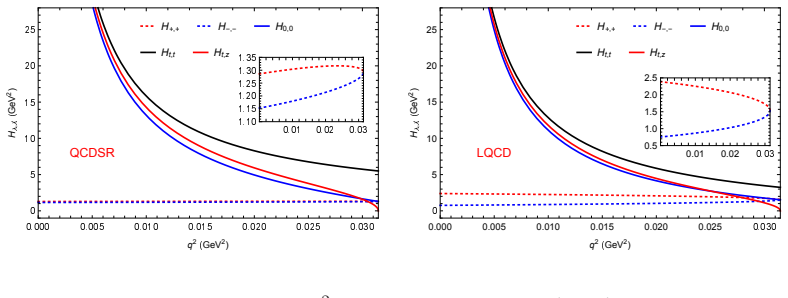
is expressed as [ 15], A = ⟨ Λ ν | Heff |ℓp ⟩ = GF√ 2 V ∗ us ∑ λ,λ ′ Lλ (⃗ pW )Hλ ′(⃗ pW )gλ,λ ′ (A1) where the parameter GF ≈ 1. 166 × 10− 5 GeV− 2 [1] is the Fermi constant; the CKM element V ∗ us describes the strength of the u → s transition, |Vus| = 0. 22431(85) [ 1]. Lλ and Hλ ′ represent leptonic and hadronic helicity amplitudes, respectively, a nd ...
-
[3]
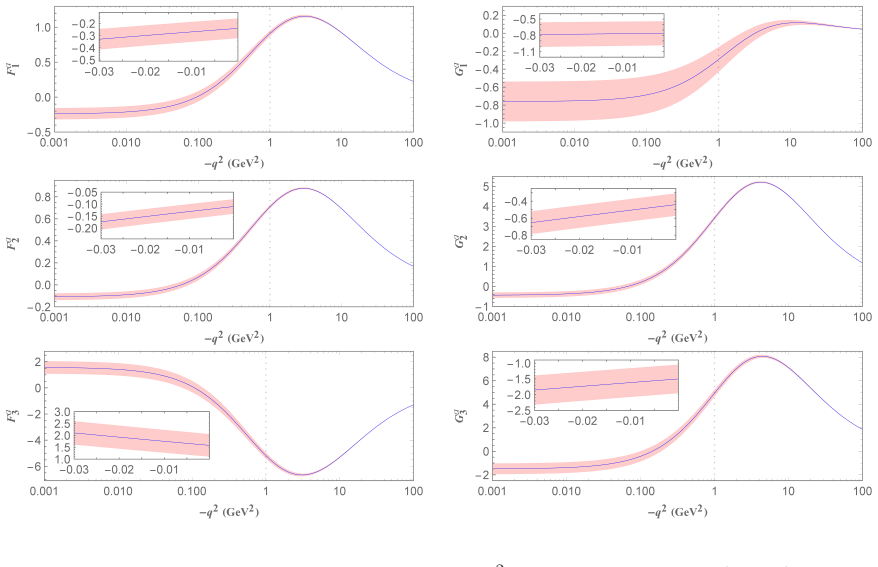
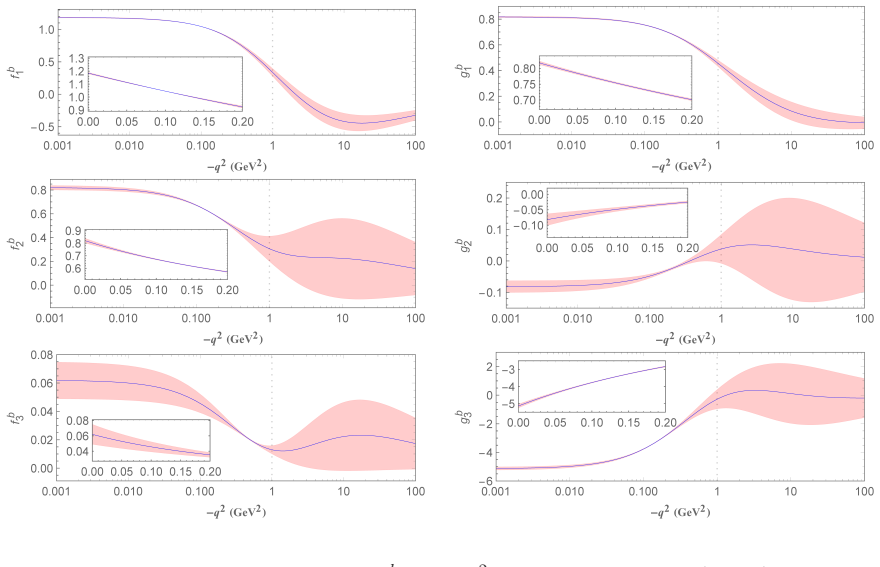
(B8) 10 FIG. 4: The shape line of the form factors Fa i versusq2, where the solid lines (bands) correspond to the center values (uncertainties) of Fa i , and the embedded images are for making comparisons with FIG. 8 of Ref. [ 9]. With Eq.(27) and the z-expansion coefficients in TABLE III of Ref. [ 9], the shape lines of form factors are shown in Fig. 4. In...
-
[4]
[ 10] are shown in Fig
(B11) The shape lines of form factors of Ref. [ 10] are shown in Fig. 5. 11 FIG. 5: The shape line of the form factors fb i versusq2, where the solid lines (bands) correspond to the center values (uncertainties) of the coefficients of the z-expansion, and the embedded images are for making comparisons with FIG. 1 of Ref. [ 10]. Appendix C: the baryonic heli...
-
[5]
Navas et al
S. Navas et al. (Particle Data Group), Review of particle physics, Phys. Rev. D 110, 030001 (2024)
2024
-
[6]
Ablikim et al
M. Ablikim et al. (BESIII Collaboration), Number of J/ψ events at BESIII, Chin. Phys. C 46, 074001 (2022)
2022
-
[7]
Achasov et al
M. Achasov et al. , STCF conceptual design report (volume 1): physics & detect or, Front. Phys. 19, 14701 (2024)
2024
-
[8]
Ablikim et al
M. Ablikim et al. (BESIII Collaboration), Determination of the number of ψ (3686) events taken at BESIII, Chin. Phys. C 48, 093001 (2024)
2024
-
[9]
Bevan et al
A. Bevan et al. (BaBar and Belle Collaborations), The physics of the B factories, Eur. Phys. J. C 74, 3026 (2014)
2014
-
[10]
Kou et al
E. Kou et al. (Belle-II Collaboration), The Belle II physics book, Prog. Theor. Exp. Phys. 2019, 123C01 (2019); Erratum, Prog. Theor. Exp. Phys. 2020, 029201 (2020)
2019
-
[11]
Gao et al
J. Gao et al. (The CEPC study group), CEPC technical design report: accel erator, Rad. Detect. Tech. Meth. 8, 1 (2024)
2024
-
[12]
Benedikt, F
M. Benedikt, F. Zimmermann, B. Auchmann et al. , Future circular collider feasibility study report, volume 1 physics, experiments, detectors, Eur. Phys. J. C 85, 1468 (2025)
2025
-
[13]
Ahmadi, Z
M. Ahmadi, Z. Najjar, K. Azizi, Study of the semileptonic decay Λ → pℓ ¯νℓ in QCD, Phys. 14 Rev. D 112, 094035 (2025)
2025
-
[14]
S. Bacchio, A. Konstantinou, Study of the Λ → pℓ¯νℓ semileptonic decay in lattice QCD, Phys. Rev. Lett. 135, 231901 (2025); arXiv:2507.09970
-
[15]
Bourrely, L
C. Bourrely, L. Lellouch, I. Caprini, Model-independe nt description of B → πℓν decays and a determination of |Vub|, Phys. Rev. D 79, 013008 (2009); Erratum, Phys. Rev. D 82, 099902 (2010)
2009
-
[16]
Zhang, X
S. Zhang, X. Zhang, C. Qiao, Hyperon semileptonic decay s in QCD sum rules, JHEP 06, 122 (2024)
2024
-
[17]
Ablikim et al
M. Ablikim et al. (BESIII Collaboration), First study of reaction Ξ 0n → Ξ −p using Ξ 0-nucleus scattering at an electron-position collider, Phys. Rev. Lett. 130, 251902 (2023)
2023
-
[18]
https://www.elementalmatter.info/periodic-table-with-atomic-mass.htm
-
[19]
K¨ orner, G
J. K¨ orner, G. Schuler, Exclusive semileptonic heavy m eson decays including lepton mass effects, Z. Phys. C 46, 93 (1990)
1990
-
[20]
Gaillard, G
J. Gaillard, G. Sauvage, Hyperon beta decays, Ann. Rev. Nucl. Part. Sci. 34, 351 (1984)
1984
-
[21]
Cabibbo, E
N. Cabibbo, E. Swallow, R. Winston, Semileptonic hyper on decays, Ann. Rev. Nucl. Part. Sci. 53, 39 (2003)
2003
-
[22]
Harrington, Lepton decays of hyperons, Phys
D. Harrington, Lepton decays of hyperons, Phys. Rev. 120, 1482 (1960)
1960
-
[23]
Bender, V
I. Bender, V. Linke, H. Rothe, Leptonic decays of baryon s, Z. Phys. 212, 190 (1968)
1968
-
[24]
Linke, Leptonic decays of polarized baryons, Nucl
V. Linke, Leptonic decays of polarized baryons, Nucl. Phys. B 12, 669 (1969). 15
1969
discussion (0)
Sign in with ORCID, Apple, or X to comment. Anyone can read and Pith papers without signing in.