Magneto-ionic control of topological transport in SrRuO3 via band topology engineering
Pith reviewed 2026-06-26 11:27 UTC · model grok-4.3
The pith
Controllable ionic doping in SrRuO3 shifts the Fermi level to tune anomalous Hall effect polarity and produce reversible topological Hall anomalies.
A machine-rendered reading of the paper's core claim, the machinery that carries it, and where it could break.
Core claim
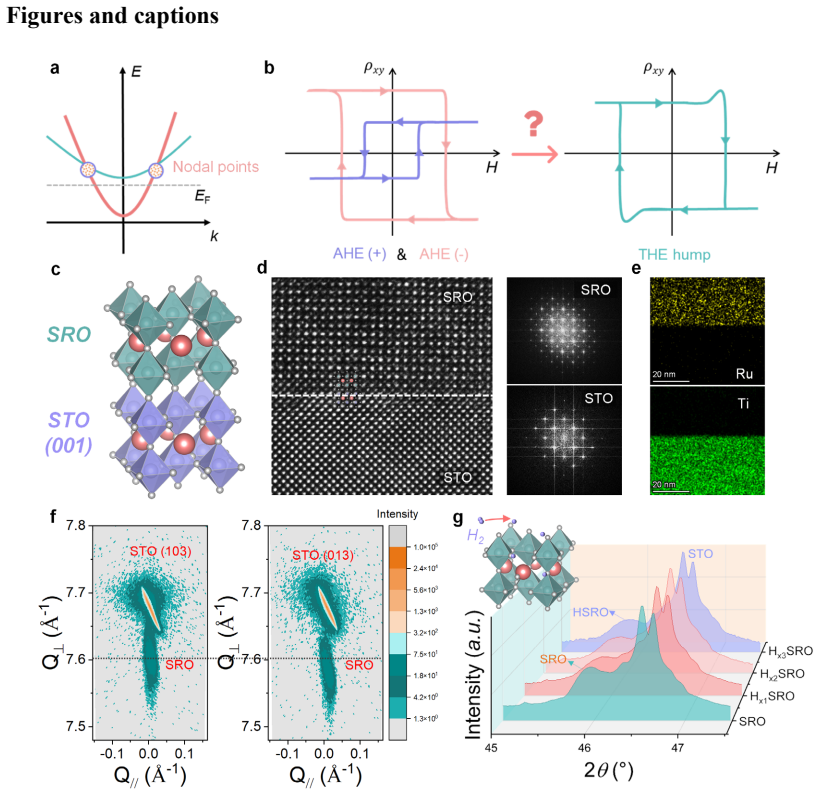
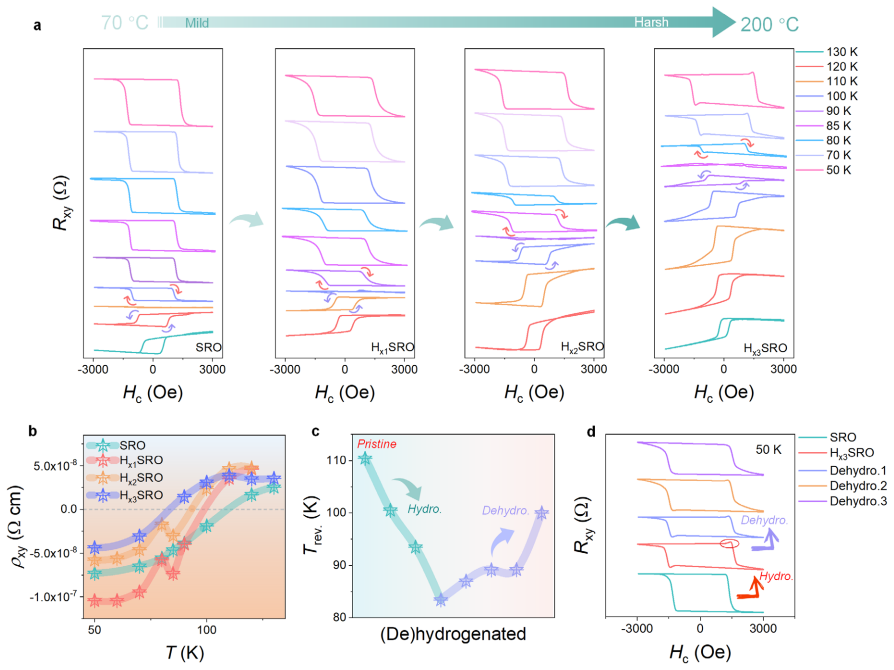
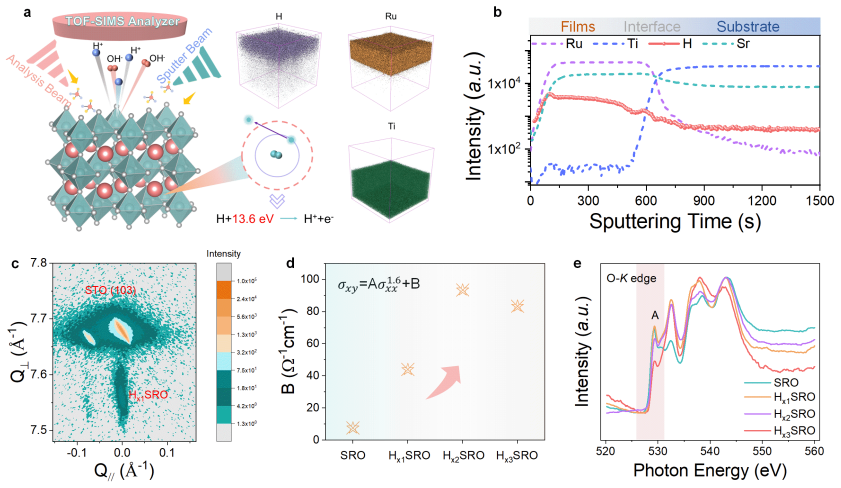
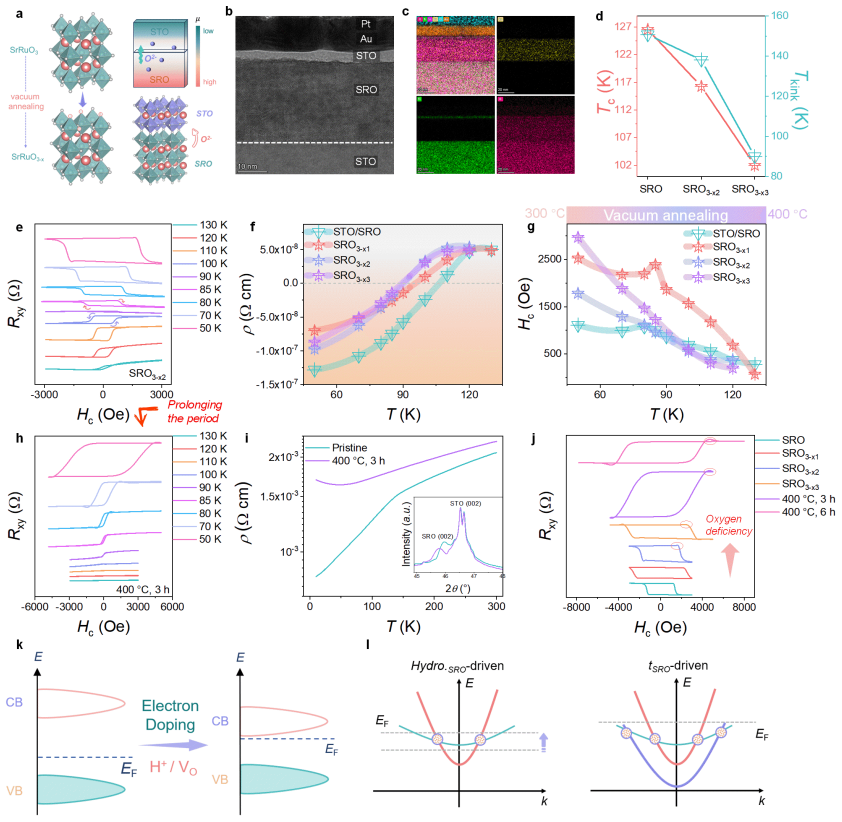
Harnessing controllable protonation or oxygen vacancy incorporation, the Fermi-level upshift relative to avoided band crossings are realized through band filling control, giving rise to tunable reversal temperature of AHE polarity. Of particular note is the emergence of hump like Hall anomalies through extensive ionic doping that can be reversibly switched, irrespective of AHE polarity, providing evidence for a THE signal driven by broken inversion symmetry rather than a two channel AHE.
What carries the argument
Magneto-ionic control via protonation or oxygen vacancy incorporation to achieve Fermi-level upshift and band filling control relative to avoided band crossings.
If this is right
- The reversal temperature of the anomalous Hall effect polarity becomes tunable through the extent of ionic doping.
- Hump-like Hall anomalies emerge with extensive doping and can be switched reversibly regardless of the anomalous Hall polarity.
- Berry curvature can be engineered on demand in strong spin-orbit coupling ferromagnets.
- This enables low-power, reconfigurable all-oxide spintronic devices with controlled topological transport.
Where Pith is reading between the lines
- If the distinction from two-channel AHE holds, similar ionic methods might induce topological Hall effects in other itinerant ferromagnets by symmetry breaking.
- The approach suggests that electric-field driven ionic motion could serve as a dynamic tuning mechanism in thin-film devices beyond static doping.
- Confirmation would link ionic control directly to inversion symmetry breaking in perovskite oxides.
Load-bearing premise
The observed hump-like Hall anomalies are produced by a topological Hall effect from broken inversion symmetry and not by a combination of two anomalous Hall effects with opposite signs.
What would settle it
A detailed lineshape analysis or temperature-dependent modeling that shows whether the Hall data can be fully accounted for by two anomalous Hall channels without needing an additional topological term.
Figures
read the original abstract
The interplay between spin-orbit coupling (SOC) and nontrivial band topology in ferromagnets gives rise to a rich landscape of topological transport phenomena such as anomalous Hall effect (AHE) and topological Hall effect (THE). One central goal in modern spintronics lies in the realization of the active control over topological transport phenomena in a reversible fashion, while unambiguously disentangling respective contributions of THE and AHE to the net Hall effect remains a formidable challenge. Here we establish magneto ionic control as a powerful paradigm for dynamically engineering topological transports in a 4d-orbital SrRuO3 system with sizable SOC and itinerant ferromagnetism. Harnessing controllable protonation or oxygen vacancy incorporation, the Fermi-level upshift relative to avoided band crossings are realized through band filling control, giving rise to tunable reversal temperature of AHE polarity. Of particular note is the emergence of hump like Hall anomalies through extensive ionic doping that can be reversibly switched, irrespective of AHE polarity, providing evidence for a THE signal driven by broken inversion symmetry rather than a two channel AHE. Our findings provide a viable tuning knob for Berry curvature engineering, enabling on demand control of topological transports in strong SOC ferromagnets for low power, reconfigurable all oxide spintronic devices.
Editorial analysis
A structured set of objections, weighed in public.
Referee Report
Summary. The manuscript reports magneto-ionic control (via protonation or oxygen-vacancy incorporation) of band filling in SrRuO3, enabling Fermi-level shifts relative to avoided crossings that tune the temperature at which AHE polarity reverses. It further claims that extensive ionic doping produces reversible hump-like Hall anomalies that constitute a THE signal arising from broken inversion symmetry, rather than a two-channel AHE.
Significance. If the central distinction between THE and two-channel AHE can be rigorously established, the work would demonstrate a practical, reversible knob for Berry-curvature engineering in a 4d itinerant ferromagnet, with implications for reconfigurable oxide spintronics. The approach of using ionic doping to control topology is potentially valuable, but its impact hinges on unambiguous separation of the Hall contributions.
major comments (1)
- [Abstract] Abstract: The claim that the observed hump-like Hall anomalies constitute a THE driven by broken inversion symmetry (rather than a two-channel AHE) is asserted without reference to any quantitative decomposition, multi-component fitting, temperature/field scaling analysis, or independent observable (e.g., real-space imaging or Berry-curvature calculations) that would rule out the conventional alternative. This distinction is load-bearing for the headline result on magneto-ionic control of topological transport.
Simulated Author's Rebuttal
We thank the referee for their careful reading and constructive feedback. The central concern is the need for stronger quantitative distinction between the claimed THE and a possible two-channel AHE. We address this point below and have revised the manuscript to incorporate additional analysis.
read point-by-point responses
-
Referee: [Abstract] Abstract: The claim that the observed hump-like Hall anomalies constitute a THE driven by broken inversion symmetry (rather than a two-channel AHE) is asserted without reference to any quantitative decomposition, multi-component fitting, temperature/field scaling analysis, or independent observable (e.g., real-space imaging or Berry-curvature calculations) that would rule out the conventional alternative. This distinction is load-bearing for the headline result on magneto-ionic control of topological transport.
Authors: We agree that the original presentation would be strengthened by explicit quantitative support. In the revised manuscript we have added multi-component fitting of the Hall resistivity curves and temperature/field scaling analysis that show the hump-like features persist after subtracting the fitted AHE components and cannot be reproduced by a two-channel AHE model alone. We also expand the discussion of how the reversible, polarity-independent appearance of the humps under ionic doping is inconsistent with a simple two-channel AHE scenario. Real-space imaging and dedicated Berry-curvature calculations lie outside the present experimental scope; the revised text now states this limitation clearly while emphasizing the experimental evidence that remains. revision: yes
Circularity Check
No significant circularity in derivation chain
full rationale
The paper presents experimental observations of tunable AHE polarity reversal and hump-like Hall anomalies under ionic doping, interpreting the latter as evidence for THE from broken inversion symmetry. No equations, fitted parameters, or self-citations are shown that reduce any claimed prediction or uniqueness result to the input data by construction. The distinction from two-channel AHE is an interpretive claim based on data features, not a tautological redefinition or self-referential derivation. The chain is self-contained with external falsifiability via Hall measurements and doping control.
Axiom & Free-Parameter Ledger
Reference graph
Works this paper leans on
-
[1]
Large anomalous Hall effect in a non -collinear antiferromagnet at room temperature
Nakatsuji S, Kiyohara N, Higo T. Large anomalous Hall effect in a non -collinear antiferromagnet at room temperature. Nature 527, 212-+ (2015)
2015
-
[2]
Superconductivity and quantized anomalous Hall effect in rhombohedral graphene
Choi Y, et al. Superconductivity and quantized anomalous Hall effect in rhombohedral graphene. Nature 639, (2025)
2025
-
[3]
Topological Hall effect at above room temperature in heterostructures composed of a magnetic insulator and a heavy metal
Shao QM, et al. Topological Hall effect at above room temperature in heterostructures composed of a magnetic insulator and a heavy metal. Nat Electron 2, 182-186 (2019)
2019
-
[4]
Dimensional Crossover-Induced Topological Hall Effect in a Magnetic Topological Insulator
Liu C, et al. Dimensional Crossover-Induced Topological Hall Effect in a Magnetic Topological Insulator. Phys Rev Lett 119, (2017)
2017
-
[5]
Observation of the nonlinear Hall effect under time -reversal-symmetric conditions
Ma Q, et al. Observation of the nonlinear Hall effect under time -reversal-symmetric conditions. Nature 565, 337-+ (2019)
2019
-
[6]
Quantum metric nonlinear Hall effect in a topological antiferromagnetic heterostructure
Gao AY, et al. Quantum metric nonlinear Hall effect in a topological antiferromagnetic heterostructure. Science 381, 181-186 (2023)
2023
-
[7]
Nonlinear Hall effects
Du ZZ, Lu HZ, Xie XC. Nonlinear Hall effects. Nature Reviews Physics 3, 744-752 (2021)
2021
-
[8]
Controlling the helicity of light by electrical magnetization switching
Dainone PA , et al. Controlling the helicity of light by electrical magnetization switching. Nature 627, (2024)
2024
-
[9]
Perpendicular full switching of chiral antiferromagnetic order by current
Higo T, et al. Perpendicular full switching of chiral antiferromagnetic order by current. Nature 607, 474-+ (2022)
2022
-
[10]
Scalable energy-efficient magnetoelectric spin-orbit logic
Manipatruni S, et al. Scalable energy-efficient magnetoelectric spin-orbit logic. Nature 565, 35-+ (2019)
2019
-
[11]
Spin-Orbit Torque Induced by Switchable Crystal Inversion Symmetry Breaking
Zheng Z, et al. Spin-Orbit Torque Induced by Switchable Crystal Inversion Symmetry Breaking. Adv Mater n/a, e73219
-
[12]
Ultrafast Dynamics of Intrinsic Anomalous Hall Effect in the Topological Antiferromagnet Mn 3Sn
Matsuda T , et al. Ultrafast Dynamics of Intrinsic Anomalous Hall Effect in the Topological Antiferromagnet Mn 3Sn. Phys Rev Lett 130, (2023)
2023
-
[13]
Anomalous Nernst and Righi-Leduc Effects in Mn3Sn: Berry Curvature 16 and Entropy Flow
Li XK, et al. Anomalous Nernst and Righi-Leduc Effects in Mn3Sn: Berry Curvature 16 and Entropy Flow. Phys Rev Lett 119, (2017)
2017
-
[14]
Local Disorder -Induced Elevation of Intrinsic Anomalous Hall Conductance in an Electron- Doped Magnetic Weyl Semimetal
Shen JL , et al. Local Disorder -Induced Elevation of Intrinsic Anomalous Hall Conductance in an Electron- Doped Magnetic Weyl Semimetal. Phys Rev Lett 125, (2020)
2020
-
[15]
Magneto-optical spectroscopy on Weyl nodes for anomalous and topological Hall effects in chiral MnGe
Hayashi Y, et al. Magneto-optical spectroscopy on Weyl nodes for anomalous and topological Hall effects in chiral MnGe. Nat Commun 12, (2021)
2021
-
[16]
Evidence for Itinerant Ferromagnetic Flat Bands Producing Large Transverse Responses
Minami S , et al. Evidence for Itinerant Ferromagnetic Flat Bands Producing Large Transverse Responses. Adv Mater, (2026)
2026
-
[17]
Electrical manipulation of a topological antiferromagnetic state
Tsai H, et al. Electrical manipulation of a topological antiferromagnetic state. Nature 580, 608-+ (2020)
2020
-
[18]
High-density switchable skyrmion-like polar nanodomains integrated on silicon
Han L, et al. High-density switchable skyrmion-like polar nanodomains integrated on silicon. Nature 603, 63-+ (2022)
2022
-
[19]
Fractional antiferromagnetic skyrmion lattice induced by anisotropic couplings
Gao S , et al. Fractional antiferromagnetic skyrmion lattice induced by anisotropic couplings. Nature 586, 37-+ (2020)
2020
-
[20]
Observation of room -temperature polar skyrmions
Das S, et al. Observation of room -temperature polar skyrmions. Nature 568, 368-+ (2019)
2019
-
[21]
Emergence of Topological Hall Effect in a SrRuO 3 Single Layer
Qin Q, et al. Emergence of Topological Hall Effect in a SrRuO 3 Single Layer. Adv Mater 31, (2019)
2019
-
[22]
Interface-driven topological Hall effect in SrRuO3-SrIrO3 bilayer
Matsuno J, et al. Interface-driven topological Hall effect in SrRuO3-SrIrO3 bilayer. Sci Adv 2, (2016)
2016
-
[23]
Intrinsic Torques Emerging from Anomalous Velocity in Magnetic Textures
Araki Y , Ieda J. Intrinsic Torques Emerging from Anomalous Velocity in Magnetic Textures. Phys Rev Lett 127, (2021)
2021
-
[24]
Designing Optimal Distorted -Octahedra Superlattices for Strong Topological Hall Effect
Fan YY, et al. Designing Optimal Distorted -Octahedra Superlattices for Strong Topological Hall Effect. Adv Funct Mater 35, (2025)
2025
-
[25]
Defect-Engineered Dzyaloshinskii-Moriya Interaction and Electric-Field- Switchable Topological Spin Texture in SrRuO
Lu JD, et al. Defect-Engineered Dzyaloshinskii-Moriya Interaction and Electric-Field- Switchable Topological Spin Texture in SrRuO
-
[26]
Adv Mater 33, (2021). 17
2021
-
[27]
Electric-field control of anomalous and topological Hall effects in oxide bilayer thin films
Ohuchi Y, et al. Electric-field control of anomalous and topological Hall effects in oxide bilayer thin films. Nat Commun 9, (2018)
2018
-
[28]
Origin of the hump anomalies in the Hall resistance loops of ultrathin SrRuO3/SrIrO3 multilayers
Yang L, et al. Origin of the hump anomalies in the Hall resistance loops of ultrathin SrRuO3/SrIrO3 multilayers. Phys Rev Mater 5, (2021)
2021
-
[29]
Strain relaxation induced transverse resistivity anomalies in SrRuO 3 thin films
Miao LD, et al. Strain relaxation induced transverse resistivity anomalies in SrRuO 3 thin films. Phys Rev B 102, (2020)
2020
-
[30]
Two-channel anomalous Hall effect in SrRuO 3
Kimbell G, et al. Two-channel anomalous Hall effect in SrRuO 3. Phys Rev Mater 4, (2020)
2020
-
[31]
Inhomogeneous ferromagnetism mimics signatures of the topological Hall effect in SrRuO3 films
Kim G, et al. Inhomogeneous ferromagnetism mimics signatures of the topological Hall effect in SrRuO3 films. Phys Rev Mater 4, (2020)
2020
-
[32]
Symmetry-dependent field-free switching of perpendicular magnetization
Liu L, et al. Symmetry-dependent field-free switching of perpendicular magnetization. Nat Nanotechnol 16, 277-+ (2021)
2021
-
[33]
Current-induced magnetization switching in all-oxide heterostructures
Liu L, et al. Current-induced magnetization switching in all-oxide heterostructures. Nat Nanotechnol 14, 939-+ (2019)
2019
-
[34]
Modulation of Spin–Orbit Torque from SrRuO3 by Epitaxial -Strain- Induced Octahedral Rotation
Zhou J , et al. Modulation of Spin–Orbit Torque from SrRuO3 by Epitaxial -Strain- Induced Octahedral Rotation. Adv Mater 33, 2007114 (2021)
2021
-
[35]
Modulation of Spin- Orbit Torque from SrRuO 3 by Epitaxial -Strain- Induced Octahedral Rotation
Zhou J , et al. Modulation of Spin- Orbit Torque from SrRuO 3 by Epitaxial -Strain- Induced Octahedral Rotation. Adv Mater 33, (2021)
2021
-
[36]
Atomic-Scale Metal -Insulator Transition in SrRuO 3 Ultrathin Films Triggered by Surface Termination Conversion
Lee HG , et al. Atomic-Scale Metal -Insulator Transition in SrRuO 3 Ultrathin Films Triggered by Surface Termination Conversion. Adv Mater 32, (2020)
2020
-
[37]
Sign-tunable anomalous Hall effect induced by two -dimensional symmetry-protected nodal structures in ferromagnetic perovskite thin films
Sohn B , et al. Sign-tunable anomalous Hall effect induced by two -dimensional symmetry-protected nodal structures in ferromagnetic perovskite thin films. Nat Mater 20, 1643-+ (2021)
2021
-
[38]
Controllable Thickness Inhomogeneity and Berry Curvature Engineering of Anomalous Hall Effect in SrRuO 3 Ultrathin Films
Wang LF, Feng QY , Lee HG, Ko EK, Lu QY , Noh TW. Controllable Thickness Inhomogeneity and Berry Curvature Engineering of Anomalous Hall Effect in SrRuO 3 Ultrathin Films. Nano Lett 20, 2468-2477 (2020). 18
2020
-
[39]
Real-space observation of ferroelectrically induced magnetic spin crystal in SrRuO3
Seddon SD, et al. Real-space observation of ferroelectrically induced magnetic spin crystal in SrRuO3. Nat Commun 12, (2021)
2021
-
[40]
Manipulation of Magnetism and Hall Effects in Oxide Superlattices by Dimensionality Crossover and Interfacial Dzyaloshinskii -Moriya Interaction
Chen ZJ, et al. Manipulation of Magnetism and Hall Effects in Oxide Superlattices by Dimensionality Crossover and Interfacial Dzyaloshinskii -Moriya Interaction. Adv Funct Mater, (2026)
2026
-
[41]
Berry Phase Engineering in SrRuO 3/SrIrO3/SrTiO3 Superlattices Induced by Band Structure Reconstruction
Zheng DX , et al. Berry Phase Engineering in SrRuO 3/SrIrO3/SrTiO3 Superlattices Induced by Band Structure Reconstruction. ACS Nano 15, 5086-5095 (2021)
2021
-
[42]
Manipulating the insulator -metal transition through tip- induced hydrogenation
Li L, et al. Manipulating the insulator -metal transition through tip- induced hydrogenation. Nat Mater 21, 1246-1251 (2022)
2022
-
[43]
Geometry-driven polar antiferromagnetic metallicity in a double-layered perovskite cobaltate
Zhou Y, et al. Geometry-driven polar antiferromagnetic metallicity in a double-layered perovskite cobaltate. Nat Mater 25, 231-237 (2026)
2026
-
[44]
A correlated ferromagnetic polar metal by design
Zhang J, et al. A correlated ferromagnetic polar metal by design. Nat Mater 23, 912- 919 (2024)
2024
-
[45]
Reversible phase modulation and hydrogen storage in multivalent VO 2 epitaxial thin films
Yoon H, et al. Reversible phase modulation and hydrogen storage in multivalent VO 2 epitaxial thin films. Nat Mater 15, 1113-1119 (2016)
2016
-
[46]
Reversal of Anomalous Hall Effect and Octahedral Tilting in SrRuO 3 Thin Films via Hydrogen Spillover
Han H, et al. Reversal of Anomalous Hall Effect and Octahedral Tilting in SrRuO 3 Thin Films via Hydrogen Spillover. Adv Mater 35, (2023)
2023
-
[47]
Reversible manipulation of the magnetic state in SrRuO 3 through electric- field controlled proton evolution
Li ZL, et al. Reversible manipulation of the magnetic state in SrRuO 3 through electric- field controlled proton evolution. Nat Commun 11, 184 (2020)
2020
-
[48]
Hydrogen‐Associated Multiple Electronic Phase Transitions for d‐ Orbital Transitional Metal Oxides: Progress, Application, and Beyond
Zhou X , et al. Hydrogen‐Associated Multiple Electronic Phase Transitions for d‐ Orbital Transitional Metal Oxides: Progress, Application, and Beyond. Adv Funct Mater 34, 2316536 (2024)
2024
-
[49]
Correlation-driven eightfold magnetic anisotropy in a two -dimensional oxide monolayer
Cui ZZ, et al. Correlation-driven eightfold magnetic anisotropy in a two -dimensional oxide monolayer. Sci Adv 6, (2020)
2020
-
[50]
Manipulating the Hydrogen- Associated Insulator -Metal Transition Through Artificial Microstructure Engineering
Zhou X , et al. Manipulating the Hydrogen- Associated Insulator -Metal Transition Through Artificial Microstructure Engineering. Adv Sci 13, e10771 (2026). 19
2026
-
[51]
Hydrogen-Associated Filling -Controlled Mottronics Within Thermodynamically Metastable Vanadium Dioxide
Zhou X , et al. Hydrogen-Associated Filling -Controlled Mottronics Within Thermodynamically Metastable Vanadium Dioxide. Adv Sci 12, 2414991 (2025)
2025
-
[52]
Localized Control of Curie Temperature in Perovskite Oxide Film by Capping-Layer-Induced Octahedral Distortion
Thomas S, et al. Localized Control of Curie Temperature in Perovskite Oxide Film by Capping-Layer-Induced Octahedral Distortion. Phys Rev Lett 119, 177203 (2017)
2017
-
[53]
Scaling of the anomalous Hall effect in SrRuO3
Haham N, et al. Scaling of the anomalous Hall effect in SrRuO3. Phys Rev B 84, 174439 (2011)
2011
-
[54]
Electric-field control of tri- state phase transformation with a selective dual-ion switch
Lu NP, et al. Electric-field control of tri- state phase transformation with a selective dual-ion switch. Nature 546, 124-128 (2017)
2017
-
[55]
Manipulate the Electronic and Magnetic States in NiCo 2O4 Films through Electric-Field-Induced Protonation at Elevated Temperature
Wang M, et al. Manipulate the Electronic and Magnetic States in NiCo 2O4 Films through Electric-Field-Induced Protonation at Elevated Temperature. Adv Mater 31, 1900458 (2019)
2019
-
[56]
Topotactic Phase Transformation in Vanadium Dioxide through Oxygen Vacancy Ordering with Synergistic Electron Doping via Hydrogenation
Zhou X, et al. Topotactic Phase Transformation in Vanadium Dioxide through Oxygen Vacancy Ordering with Synergistic Electron Doping via Hydrogenation. Small 22, e10736 (2026)
2026
-
[57]
Directional ionic transport across the oxide interface enables low - temperature epitaxy of rutile TiO
Park Y , et al. Directional ionic transport across the oxide interface enables low - temperature epitaxy of rutile TiO
-
[58]
Nat Commun 11, 1401 (2020)
2020
-
[59]
Anionic Flow Valve Across Oxide Heterointerfaces by Remote Electron Doping
Park Y, et al. Anionic Flow Valve Across Oxide Heterointerfaces by Remote Electron Doping. Nano Lett 22, 9306-9312 (2022)
2022
-
[60]
Oxygen Vacancy Engineering for Highly Tunable Ferromagnetic Properties: A Case of SrRuO 3 Ultrathin Film with a SrTiO3 Capping Layer
Ko EK, et al. Oxygen Vacancy Engineering for Highly Tunable Ferromagnetic Properties: A Case of SrRuO 3 Ultrathin Film with a SrTiO3 Capping Layer. Adv Funct Mater 30, (2020)
2020
-
[61]
Engineering Hall Resistivity Anomalies in Epitaxial SrRuO 3 Thin Films by Mo Doping
Prasetiyawati RD, et al. Engineering Hall Resistivity Anomalies in Epitaxial SrRuO 3 Thin Films by Mo Doping. ACS Appl Mater Interfaces 17, 63540-63548 (2025)
2025
discussion (0)
Sign in with ORCID, Apple, or X to comment. Anyone can read and Pith papers without signing in.