Optimizing Pump Conditions of Parametric Amplifiers for Fast Multiplexed Readout of Superconducting Qubits
Pith reviewed 2026-06-26 11:49 UTC · model grok-4.3
The pith
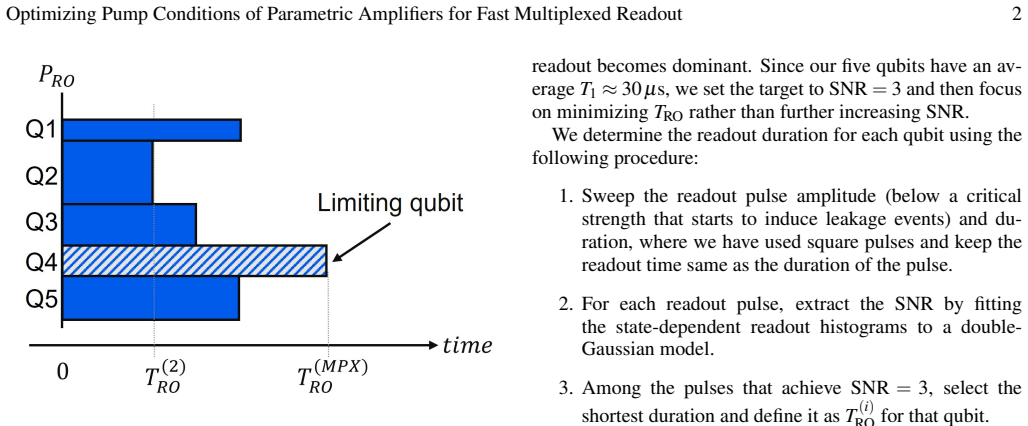
Maximizing SNR improvement at the limiting qubit's frequency minimizes total multiplexed readout time.
A machine-rendered reading of the paper's core claim, the machinery that carries it, and where it could break.
Core claim
Choosing the amplifier pump to maximize the signal-to-noise ratio improvement at the readout frequency of the limiting qubit—the qubit that requires the longest readout time to reach a target SNR—minimizes the total multiplexed readout time. This is shown experimentally on a five-qubit multiplexed readout chain with a traveling-wave parametric amplifier, where the strategy reduces readout time by 320 ns compared with optimizing the average SNR improvement across all qubits, without degrading the target SNR for any qubit.
What carries the argument
The limiting qubit, defined as the one whose readout frequency demands the longest integration time to reach target SNR; the pump condition is chosen to maximize SNR improvement at that specific frequency.
If this is right
- The total multiplexed readout time is set by the worst-performing qubit rather than by an average across the set.
- Pump calibration must be performed at the frequency of the current limiting qubit rather than at a representative or average frequency.
- The demonstrated 320 ns saving is achieved while every qubit still meets its individual target SNR.
- The ordering of qubit readout times follows directly from the measured frequency-dependent SNR improvement curve of the amplifier.
Where Pith is reading between the lines
- If pump settings alter saturation behavior differently at each frequency, the identity of the limiting qubit could shift and require re-identification after each change.
- Pre-allocating readout frequencies to reduce the spread in required integration times could compound the time saving obtained from pump optimization.
- In larger arrays the same principle would identify a new limiting qubit after each frequency or power change, suggesting an iterative calibration loop.
Load-bearing premise
That SNR improvement at one chosen frequency is the dominant factor setting the ordering of required readout times and that no other effects such as saturation or crosstalk will reorder the qubits.
What would settle it
An experiment in which the pump chosen for the original limiting qubit causes a different qubit to become the new limiting one or fails to reduce the measured total time needed to reach target SNR on all qubits.
Figures
read the original abstract
Low-noise parametric amplifiers are widely used as the first-stage amplifier in qubit readout chains. The performance of parametric amplifiers depends sensitively on the choice of the pump condition. We propose a strategy for determining the pump condition that is tailored for fast multiplexed readout. Choosing the amplifier pump to maximize the signal-to-noise ratio (SNR) improvement at the readout frequency of the limiting qubit--the qubit that requires the longest readout time to reach a target SNR--minimizes the total multiplexed readout time. We demonstrate our pump calibration strategy experimentally on a five-qubit multiplexed readout chain with a traveling-wave parametric amplifier. Using our strategy, we reduce the multiplexed readout time by 320 ns compared to optimizing the average SNR improvement on all qubits, without degrading the target SNR for any qubit.
Editorial analysis
A structured set of objections, weighed in public.
Referee Report
Summary. The manuscript claims that for multiplexed readout of superconducting qubits using a traveling-wave parametric amplifier, the optimal pump condition is found by maximizing the SNR improvement specifically at the readout frequency of the limiting qubit (the qubit requiring the longest integration time to reach a target SNR). This choice minimizes the total multiplexed readout time. The claim is supported by an experimental demonstration on a five-qubit chain, where the proposed strategy yields a 320 ns reduction in readout time relative to optimization based on average SNR improvement across all qubits, while still meeting the target SNR on every qubit.
Significance. If the central experimental result holds, the work supplies a practical, hardware-agnostic calibration procedure that directly shortens the readout bottleneck in multiplexed superconducting qubit systems. This is relevant for scaling quantum processors, as faster readout reduces the overhead in quantum error correction cycles and algorithm execution. The approach is notable for being an empirical optimization that measures the time reduction directly rather than relying on fitted models.
major comments (1)
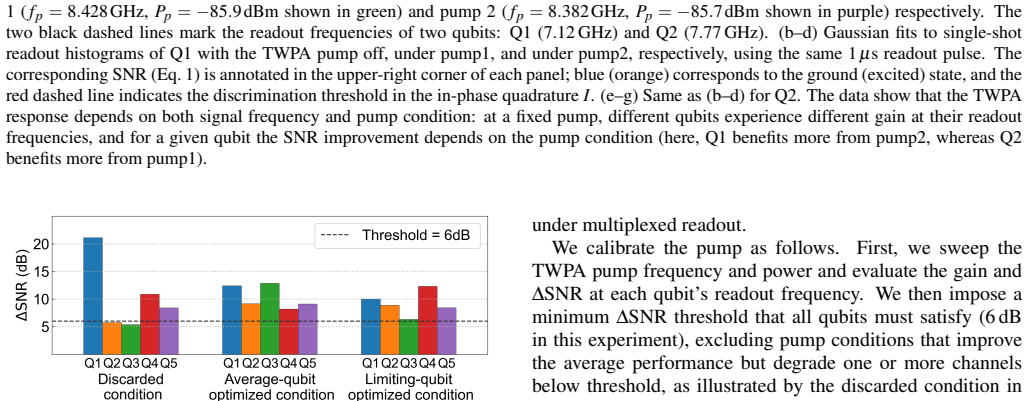
- [Experimental demonstration] Experimental demonstration (results section): the reported 320 ns reduction is presented without error bars, uncertainty quantification, or explicit controls confirming that frequency-dependent saturation, crosstalk, or pump-induced heating do not reorder the qubit readout times; these omissions are load-bearing because the central claim rests on the measured time improvement being attributable solely to the limiting-qubit SNR optimization.
minor comments (2)
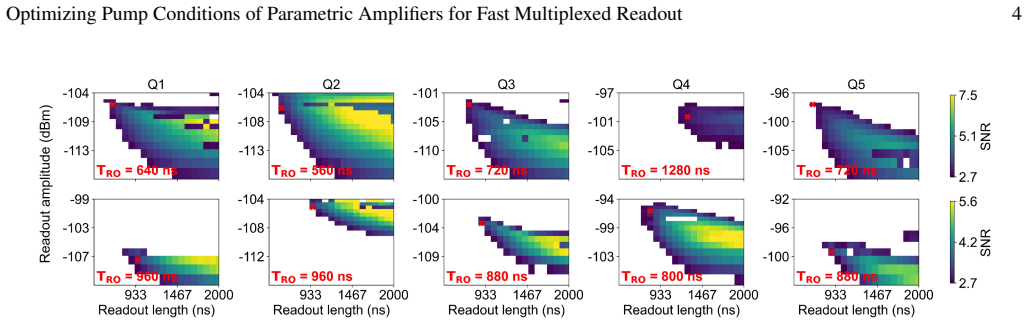
- [Methods] The procedure for identifying the limiting qubit (i.e., how readout times are computed from SNR curves) should be stated explicitly, including any threshold or fitting method used.
- Figure captions and axis labels would benefit from indicating the target SNR value and the integration-time axis units for clarity.
Simulated Author's Rebuttal
We thank the referee for their positive assessment of the work and recommendation for minor revision. We address the single major comment below.
read point-by-point responses
-
Referee: Experimental demonstration (results section): the reported 320 ns reduction is presented without error bars, uncertainty quantification, or explicit controls confirming that frequency-dependent saturation, crosstalk, or pump-induced heating do not reorder the qubit readout times; these omissions are load-bearing because the central claim rests on the measured time improvement being attributable solely to the limiting-qubit SNR optimization.
Authors: We agree that the presentation would be strengthened by explicit uncertainty quantification and controls for the listed effects. In the revised manuscript we will add error bars obtained from repeated measurements of the multiplexed readout times and include additional data or discussion (in the main text or supplement) confirming that frequency-dependent saturation, crosstalk, and pump-induced heating do not reorder the qubit readout times under the reported pump conditions. This will directly support attribution of the 320 ns reduction to the limiting-qubit SNR optimization. revision: yes
Circularity Check
No significant circularity; empirical demonstration
full rationale
The paper proposes an experimental pump optimization strategy for multiplexed qubit readout and validates it via direct measurements on a five-qubit chain, reporting a measured 320 ns reduction. No mathematical derivation chain, fitted parameters renamed as predictions, or self-citation load-bearing steps are present in the provided text. The central claim reduces to observed data rather than any self-referential construction.
Axiom & Free-Parameter Ledger
Reference graph
Works this paper leans on
-
[1]
Physical Review Applied , volume=
Rapid high-fidelity single-shot dispersive readout of superconducting qubits , author=. Physical Review Applied , volume=. 2017 , publisher=
2017
-
[2]
Nature , volume=
Realizing repeated quantum error correction in a distance-three surface code , author=. Nature , volume=. 2022 , publisher=
2022
-
[3]
Physical Review Applied , volume=
Rapid high-fidelity multiplexed readout of superconducting qubits , author=. Physical Review Applied , volume=. 2018 , publisher=
2018
-
[4]
Physical Review Applied , volume=
Fast readout and reset of a superconducting qubit coupled to a resonator with an intrinsic Purcell filter , author=. Physical Review Applied , volume=. 2022 , publisher=
2022
-
[5]
PRX Quantum , volume=
Fast multiplexed superconducting-qubit readout with intrinsic purcell filtering using a multiconductor transmission line , author=. PRX Quantum , volume=. 2025 , publisher=
2025
-
[6]
IEEE Transactions on Applied Superconductivity , volume=
Measurable improvement in multi-qubit readout using a kinetic inductance traveling wave parametric amplifier , author=. IEEE Transactions on Applied Superconductivity , volume=. 2025 , publisher=
2025
-
[7]
Applied Physics Letters , volume=
Single-shot readout of a superconducting flux qubit with a flux-driven Josephson parametric amplifier , author=. Applied Physics Letters , volume=. 2013 , publisher=
2013
-
[8]
Science , volume=
A near--quantum-limited Josephson traveling-wave parametric amplifier , author=. Science , volume=. 2015 , publisher=
2015
-
[9]
Physical Review X , volume=
Photonic-crystal Josephson traveling-wave parametric amplifier , author=. Physical Review X , volume=. 2020 , publisher=
2020
-
[10]
arXiv preprint arXiv:2408.16366 , year=
A small footprint travelling-wave parametric amplifier with a high Signal-to-Noise Ratio improvement in a wide band , author=. arXiv preprint arXiv:2408.16366 , year=
-
[11]
Physical Review Applied , volume=
rf-SQUID-based traveling-wave parametric amplifier with input saturation power of- 84 dBm across more than one octave in bandwidth , author=. Physical Review Applied , volume=. 2025 , publisher=
2025
-
[12]
Applied Physics Letters , volume=
Traveling wave parametric amplifier with Josephson junctions using minimal resonator phase matching , author=. Applied Physics Letters , volume=. 2015 , publisher=
2015
-
[13]
Physical review letters , volume=
Resonant phase matching of Josephson junction traveling wave parametric amplifiers , author=. Physical review letters , volume=. 2014 , publisher=
2014
-
[14]
arXiv preprint arXiv:2507.03642 , year=
High-power readout of a transmon qubit using a nonlinear coupling , author=. arXiv preprint arXiv:2507.03642 , year=
-
[15]
Applied physics reviews , volume=
A quantum engineer's guide to superconducting qubits , author=. Applied physics reviews , volume=. 2019 , publisher=
2019
-
[16]
EPJ Quantum technology , volume=
Engineering cryogenic setups for 100-qubit scale superconducting circuit systems , author=. EPJ Quantum technology , volume=. 2019 , publisher=
2019
-
[17]
Physical review letters , volume=
Heralded state preparation in a superconducting qubit , author=. Physical review letters , volume=. 2012 , publisher=
2012
-
[18]
Physical review letters , volume=
Initialization by measurement of a superconducting quantum bit circuit , author=. Physical review letters , volume=. 2012 , publisher=
2012
-
[19]
Applied Physics Letters , volume=
Frequency division multiplexing readout and simultaneous manipulation of an array of flux qubits , author=. Applied Physics Letters , volume=. 2012 , publisher=
2012
-
[20]
Applied Physics Letters , keywords =
Mutus, J Y and White, T C and Barends, R and Chen, Y and Chen, Z and Chiaro, B and Dunsworth, A and Jeffrey, E and Kelly, J and Megrant, A and Neill, C and O'Malley, P J J and Roushan, P and Sank, D and Vainsencher, A and Wenner, J and Sundqvist, K M and Cleland, A N and Martinis, J M , isbn =. Applied Physics Letters , keywords =
-
[21]
Physical review letters , volume=
Fast accurate state measurement with superconducting qubits , author=. Physical review letters , volume=. 2014 , publisher=
2014
-
[22]
npj Quantum Information , volume=
Fast and high-fidelity dispersive readout of a spin qubit with squeezed microwave and resonator nonlinearity , author=. npj Quantum Information , volume=. 2024 , publisher=
2024
-
[23]
Reviews of Modern Physics , volume=
Introduction to quantum noise, measurement, and amplification , author=. Reviews of Modern Physics , volume=. 2010 , publisher=
2010
-
[24]
Nature , volume =
Deterministic quantum teleportation with feed-forward in a solid state system , author =. Nature , volume =. 2013 , doi =
2013
-
[25]
Science Bulletin , volume =
Deterministic quantum state and gate teleportation between distant superconducting chips , author =. Science Bulletin , volume =. 2025 , doi =
2025
-
[26]
Nature , volume=
Extending the lifetime of a quantum bit with error correction in superconducting circuits , author=. Nature , volume=. 2016 , publisher=
2016
-
[27]
Nature , volume=
Suppressing quantum errors by scaling a surface code logical qubit , author =. Nature , volume=. 2023 , publisher=
2023
-
[28]
Nature , volume=
Real-time quantum error correction beyond break-even , author=. Nature , volume=. 2023 , publisher=
2023
-
[29]
Nature , volume=
Beating the break-even point with a discrete-variable-encoded logical qubit , author=. Nature , volume=. 2023 , publisher=
2023
-
[30]
Dispersive magnetometry with a quantum limited. Physical Review B , author =. 2011 , pages =. doi:10.1103/PhysRevB.83.134501 , number =
-
[31]
Phase-preserving amplification near the quantum limit with a. Nature , author =. 2010 , pages =. doi:10.1038/nature09035 , number =
-
[32]
Optimizing the Nonlinearity and Dissipation of a SNAIL Parametric Amplifier for Dynamic Range , author =. Phys. Rev. Appl. , volume =. 2018 , month =. doi:10.1103/PhysRevApplied.10.054020 , url =
-
[33]
Reflection-enhanced gain in traveling-wave parametric amplifiers , author =. Phys. Rev. B , volume =. 2023 , month =. doi:10.1103/PhysRevB.107.174520 , url =
-
[34]
Journal of Physics D: Applied Physics , volume=
Quantum analysis of second-order effects in superconducting travelling-wave parametric amplifiers , author=. Journal of Physics D: Applied Physics , volume=. 2021 , publisher=
2021
-
[35]
Peripheral circuits for ideal performance of a traveling-wave parametric amplifier , author =. Phys. Rev. Appl. , volume =. 2024 , month =. doi:10.1103/PhysRevApplied.21.064062 , url =
-
[36]
Applied Physics Letters , volume =
Readout of a quantum processor with high dynamic range Josephson parametric amplifiers , author =. Applied Physics Letters , volume =. 2023 , doi =
2023
-
[37]
Applied Physics Letters , number =
Roy, Tanay and Kundu, Suman and Chand, Madhavi and Vadiraj, A M and Ranadive, A and Nehra, N and Patankar, Meghan P and Aumentado, J and Clerk, A A and Vijay, R , doi =. Applied Physics Letters , number =
-
[38]
Lumped-element broadband SNAIL parametric amplifier with on-chip pump filter for multiplexed readout , author =. Phys. Rev. Appl. , volume =. 2025 , month =. doi:10.1103/5l86-pw21 , url =
-
[39]
Benchmarking the Readout of a Superconducting Qubit for Repeated Measurements , author =. Phys. Rev. Lett. , volume =. 2025 , month =. doi:10.1103/PhysRevLett.134.100601 , url =
-
[40]
Floquet-Mode Traveling-Wave Parametric Amplifiers , author =. PRX Quantum , volume =. 2022 , month =. doi:10.1103/PRXQuantum.3.020306 , url =
-
[41]
Applied Physics Letters , volume =
Broadband merged-element Josephson parametric amplifier , author =. Applied Physics Letters , volume =. 2025 , doi =
2025
-
[42]
Optimizing the pump coupling for a three-wave-mixing Josephson parametric amplifier , author =. Phys. Rev. Appl. , volume =. 2025 , month =. doi:10.1103/PhysRevApplied.23.054069 , url =
-
[43]
System characterization of dispersive readout in superconducting qubits , author =. Phys. Rev. Appl. , volume =. 2025 , month =. doi:10.1103/PhysRevApplied.23.024055 , url =
discussion (0)
Sign in with ORCID, Apple, or X to comment. Anyone can read and Pith papers without signing in.