Measuring Magnetic Field Strengths in Galactic Star-forming Regions via the Zeeman Effect with the SKA
Pith reviewed 2026-06-26 11:51 UTC · model grok-4.3
The pith
SKA telescopes will provide enough Zeeman effect detections to build a representative sample of magnetic field strengths in star-forming regions throughout the Galaxy.
A machine-rendered reading of the paper's core claim, the machinery that carries it, and where it could break.
Core claim
The central claim is that observations with the SKA will extend Zeeman effect measurements to many regions within our Galaxy that best represent where most stars form, while providing high-resolution views of the densest star-forming regions. This will create a statistical basis for assessing the role of magnetic fields in molecular cloud evolution and star formation, building on early results from precursors like MeerKAT and FAST.
What carries the argument
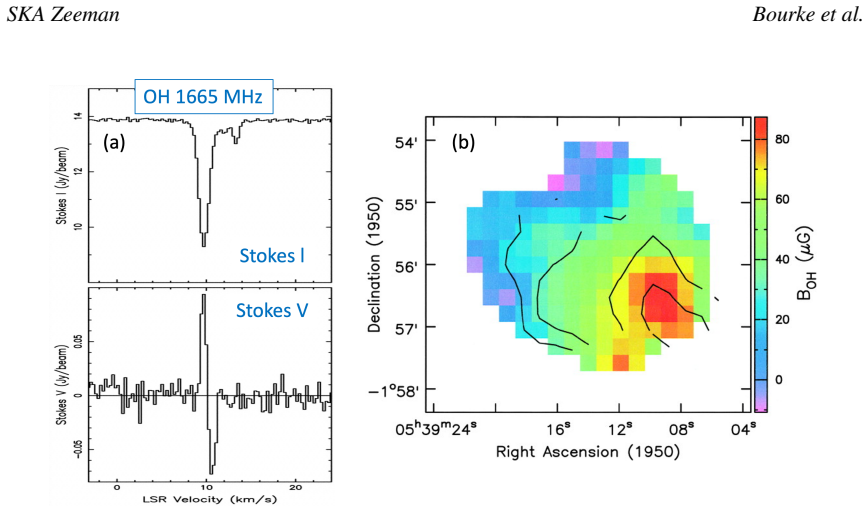
The Zeeman effect in spectral lines, which directly measures magnetic field strengths from a few microGauss in diffuse clouds to tens of milliGauss in dense regions.
If this is right
- Zeeman detections will trace different scales and densities within molecular clouds.
- Field strength variations will be revealed to address regulation by magnetic fields or turbulence.
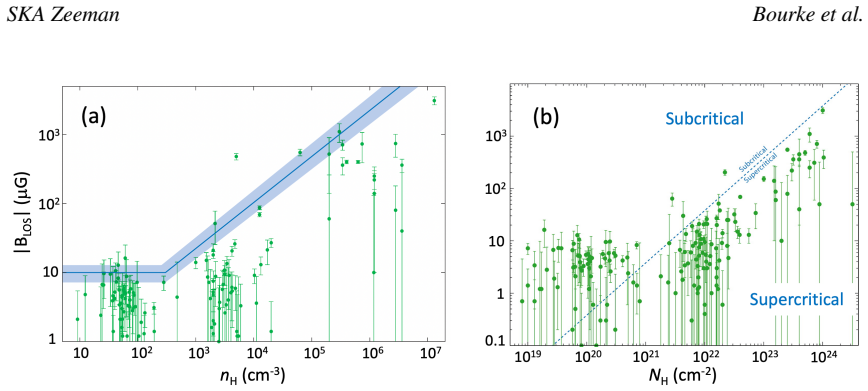
- A larger, less biased sample will test if dense clouds and cores are marginally supercritical.
- Significant advances will occur in studies of magnetic fields in molecular clouds.
Where Pith is reading between the lines
- Such data could be combined with other magnetic field tracers like dust polarization to build three-dimensional field maps.
- Improved understanding might refine simulations of star formation that include magnetic fields.
- If confirmed, it would prioritize SKA time allocation for Zeeman surveys in the galactic plane.
Load-bearing premise
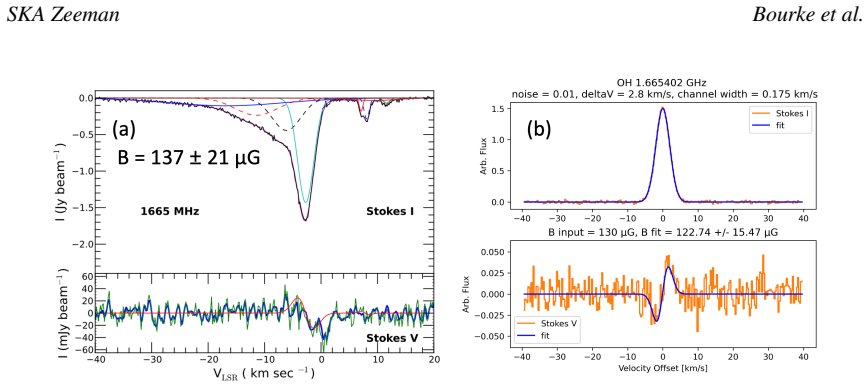
The load-bearing premise is that the SKA's sensitivity and resolution will be sufficient to detect the subtle Zeeman effect in enough regions to create a representative statistical sample despite the expected weak field strengths.
What would settle it
A survey with the SKA that yields fewer than expected new Zeeman detections or fails to cover a range of representative star-forming regions would falsify the prediction of a statistical basis.
Figures


read the original abstract
Magnetic fields thread the interstellar medium from the largest to the smallest scales and play an important role in molecular cloud evolution and star formation. Quantifying this requires measurements of the field strengths, and the most direct way to measure them is via the Zeeman effect in spectral lines. The effect is subtle for the typical field strengths expected from theory, from a few $\mu$G in diffuse molecular clouds to a few 10s of mG in dense star-forming regions, and detections are scarce. Existing measurements of magnetic field strength suggest dense clouds and cores are marginally supercritical (cannot prevent collapse, but can inhibit it), but may be biased due to small sample sizes. Zeeman effect measurements tracing different scales and densities within molecular clouds can reveal the variation of field strengths, providing critical measurements to address the question of whether star formation is primarily regulated by magnetic fields or turbulence on different scales. Observations with SKA precursors such MeerKAT and FAST are beginning to increase the number of Zeeman effect detections in nearby star-forming regions. The SKA will extend their reach to many regions within our Galaxy that are best representative of where most stars form, while zooming in on the densest star-forming regions, providing a statistical basis for the role of magnetic fields in molecular cloud evolution and star formation. We present predictions and plans for Zeeman effect observations with the SKA telescopes, demonstrating the significant advances they will provide for studies of magnetic fields in molecular clouds.
Editorial analysis
A structured set of objections, weighed in public.
Referee Report
Summary. The manuscript reviews the role of magnetic fields in molecular clouds and star formation, notes that Zeeman effect measurements are the most direct probe but are currently scarce due to the subtlety of the effect for expected field strengths (few μG in diffuse gas to tens of mG in dense cores), and argues that SKA (with precursors MeerKAT and FAST already increasing detections) will enable a much larger sample across representative galactic regions and dense star-forming cores. The central claim is that these observations will provide a statistical basis for assessing whether magnetic fields or turbulence regulate star formation on different scales; the paper presents predictions and plans for SKA Zeeman observations to achieve this.
Significance. If the unshown quantitative predictions for detection thresholds and sample sizes are substantiated, the work would offer a useful forward-looking roadmap for leveraging SKA's sensitivity and resolution to address a key open question in star formation theory. The emphasis on tracing field variations across scales and densities, and on avoiding small-sample biases in existing data, is a constructive framing.
major comments (2)
- [Abstract / predictions and plans] Abstract and predictions section: The claim that SKA 'will extend their reach to many regions within our Galaxy that are best representative of where most stars form' and deliver 'a statistical basis' is load-bearing for the paper's central argument, yet no explicit sensitivity calculations, assumed line widths, expected detection rates, error budgets, or target sample sizes are provided to support the extrapolation from current sparse measurements.
- [Introduction] Introduction and discussion of existing measurements: The statement that current Zeeman detections 'may be biased due to small sample sizes' is used to motivate the need for SKA data, but without a quantitative assessment of how many new detections would be required to overcome this bias or what selection effects SKA would mitigate, the significance of the proposed advance cannot be evaluated.
minor comments (1)
- [Abstract] The abstract refers to 'few 10s of mG' without specifying the exact range or citing the theoretical models that predict these values.
Simulated Author's Rebuttal
We thank the referee for their constructive comments. We agree that the manuscript would be strengthened by more explicit quantitative details supporting the predictions and by a quantitative discussion of sample biases, and we will revise accordingly.
read point-by-point responses
-
Referee: [Abstract / predictions and plans] Abstract and predictions section: The claim that SKA 'will extend their reach to many regions within our Galaxy that are best representative of where most stars form' and deliver 'a statistical basis' is load-bearing for the paper's central argument, yet no explicit sensitivity calculations, assumed line widths, expected detection rates, error budgets, or target sample sizes are provided to support the extrapolation from current sparse measurements.
Authors: We acknowledge that the current presentation of predictions would benefit from greater explicitness. In the revised manuscript we will add a dedicated subsection with sensitivity calculations for the relevant Zeeman lines (HI 21 cm and OH), using expected SKA system temperatures, bandwidths and integration times; we will state the assumed line widths drawn from typical molecular-cloud observations; we will provide estimated detection rates scaled from existing MeerKAT/FAST results; we will include an error budget separating instrumental, calibration and astrophysical contributions; and we will list target sample sizes for representative Galactic regions and dense cores. These additions will directly support the claims about reach and statistical power. revision: yes
-
Referee: [Introduction] Introduction and discussion of existing measurements: The statement that current Zeeman detections 'may be biased due to small sample sizes' is used to motivate the need for SKA data, but without a quantitative assessment of how many new detections would be required to overcome this bias or what selection effects SKA would mitigate, the significance of the proposed advance cannot be evaluated.
Authors: We agree that a quantitative treatment of bias reduction is warranted. In the revised introduction we will add an estimate, based on simple statistical sampling arguments, of the minimum number of new detections needed to reduce the impact of small-sample variance to a specified level. We will also enumerate the principal selection effects in the existing Zeeman catalog (preference for nearby, high-column-density, or bright continuum sources) and describe how SKA's combination of sensitivity, resolution and survey speed will mitigate each by enabling observations across a wider range of Galactic environments and densities. revision: yes
Circularity Check
No circularity; forward-looking proposal without derivations or fitted inputs
full rationale
The document is a proposal paper presenting plans for future SKA observations rather than any derivation chain, equations, or fitted parameters. The abstract and provided text contain no mathematical reductions, self-citations used as load-bearing uniqueness theorems, or predictions that reduce to inputs by construction. Claims about statistical samples rest on qualitative assertions about sensitivity and field strengths without explicit quantitative modeling that could be circular. This is self-contained as an observational outlook and matches the default non-circular case.
Axiom & Free-Parameter Ledger
Reference graph
Works this paper leans on
-
[1]
2026 ,publisher =
Mehrnoosh Tahani and author2 and author3 and author4 and author5 ,title =. 2026 ,publisher =
2026
-
[2]
2026 ,publisher =
Agata Karska and author2 and author3 and author4 and author5 ,title =. 2026 ,publisher =
2026
-
[3]
2026 ,publisher =
Pedro Salas and author2 and author3 and author4 and author5 ,title =. 2026 ,publisher =
2026
-
[4]
2026 ,publisher =
Alessio Traficante and author2 and author3 and author4 and author5 ,title =. 2026 ,publisher =
2026
-
[5]
2026 ,publisher =
Timothy Robishaw and author2 and author3 and author4 and author5 ,title =. 2026 ,publisher =
2026
-
[6]
Kazi L. J. Rygl and author2 and author3 and author4 and author5 ,title =. 2026 ,publisher =
2026
-
[7]
The magnetic field of IRAS 16293-2422 as traced by shock-induced H2O masers
The magnetic field of IRAS 16293-2422 as traced by shock-induced H _ 2 O masers. , keywords =. doi:10.1051/0004-6361/201118710 , archivePrefix =. 1204.0004 , primaryClass =
work page internal anchor Pith review Pith/arXiv arXiv doi:10.1051/0004-6361/201118710
-
[8]
, year = 2015, month = aug, volume =
Interstellar Dust Grain Alignment. , year = 2015, month = aug, volume =. doi:10.1146/annurev-astro-082214-122414 , adsurl =
-
[9]
Infrared extinction and polarization due to partially aligned spheroidal grains : models for the dust toward the BN object. , keywords =. doi:10.1086/162974 , adsurl =
-
[10]
Characterizing the magnetic fields of nearby molecular clouds using submillimeter polarization observations. , keywords =. doi:10.1093/mnras/stab596 , archivePrefix =. 2104.04673 , primaryClass =
-
[11]
Polarized Sub-Millimetre Emission from Filamentary Molecular Clouds
Polarized Submillimeter Emission from Filamentary Molecular Clouds. , keywords =. doi:10.1086/317228 , archivePrefix =. astro-ph/0005363 , primaryClass =
work page internal anchor Pith review Pith/arXiv arXiv doi:10.1086/317228
-
[12]
Probing 3D Magnetic Fields Using Thermal Dust Polarization and Grain Alignment Theory. , keywords =. doi:10.3847/1538-4357/ad2a56 , archivePrefix =. 2310.17048 , primaryClass =
-
[13]
A new method to trace three-dimensional magnetic field structure within molecular clouds using dust polarization. , keywords =. doi:10.1093/mnras/stz618 , archivePrefix =. 1810.10020 , primaryClass =
work page internal anchor Pith review Pith/arXiv arXiv doi:10.1093/mnras/stz618
-
[14]
Demonstration of Magnetic Field Tomography with Starlight Polarization toward a Diffuse Sightline of the ISM. , keywords =. doi:10.3847/1538-4357/aafdb2 , archivePrefix =
-
[15]
First Detection of Circular Polarization in 4.7 GHz Excited OH Masers. , keywords =. doi:10.3847/1538-4357/adf639 , archivePrefix =. 2508.05450 , primaryClass =
-
[16]
Galaxies , keywords =
Magnetism Science with the Square Kilometre Array. Galaxies , keywords =
-
[17]
The Polarisation Sky Survey of the Universe's Magnetism (POSSUM): Science goals and survey description. , keywords =. doi:10.1017/pasa.2025.10031 , archivePrefix =. 2505.08272 , primaryClass =
-
[18]
The excitation temperature of the CH 3335-MHz line. , keywords =. doi:10.1093/mnras/staa1188 , adsurl =
-
[19]
Temperature dependent d-d excitations in manganites probed by resonant inelastic x-ray scattering
d-d Excitations in Manganites Probed by Resonant Inelastic X-Ray Scattering. , keywords =. doi:10.1103/PhysRevLett.94.047203 , archivePrefix =. cond-mat/0407326 , primaryClass =
work page internal anchor Pith review Pith/arXiv arXiv doi:10.1103/physrevlett.94.047203
-
[20]
Disruption of bound clusters by photoionization
MAGMO: coherent magnetic fields in the star-forming regions of the Carina-Sagittarius spiral arm tangent. , keywords =. doi:10.1111/j.1365-2966.2012.21722.x , archivePrefix =. 1207.3550 , primaryClass =
-
[21]
Excited-state hydroxyl maser polarimetry: Who ate all the {\pi}s?
Excited-state hydroxyl maser polarimetry: who ate all the s?. , keywords =. doi:10.1093/mnras/stv936 , archivePrefix =. 1504.07062 , primaryClass =
work page internal anchor Pith review Pith/arXiv arXiv doi:10.1093/mnras/stv936
-
[22]
Unveiling the chemistry of interstellar CH. Spectroscopy of the 2 THz N = 2 1 ground state line. , keywords =. doi:10.1051/0004-6361/201731810 , archivePrefix =. 1804.04707 , primaryClass =
work page internal anchor Pith review Pith/arXiv arXiv doi:10.1051/0004-6361/201731810
-
[23]
, keywords =
VLBA polarization observations of the J=7/2, 13.44 GHz OH maser in W3(OH). , keywords =
-
[24]
High-angular-resolution observations of the OH masers in W 51 (Main). , keywords =. doi:10.1086/113640 , adsurl =
-
[25]
2019 , eprint=
Anticipated Performance of the Square Kilometre Array -- Phase 1 (SKA1) , author=. 2019 , eprint=
2019
-
[26]
Bourke and Tao-Chung Ching and Laura Fissel and James A
Tyler L. Bourke and Tao-Chung Ching and Laura Fissel and James A. Green and Jihye Hwang and Arshia Jacob and Boy Lankhaar and Emmanuel Momjian and Kate Pattle and Anuj P. Sarma and Mehrnoosh Tahani and Chenoa Tremblay , year=. Measuring
-
[27]
Bourke and Tao-Chung Ching and Laura Fissel and James A
Tyler L. Bourke and Tao-Chung Ching and Laura Fissel and James A. Green and Jihye Hwang and Arshia Jacob and Boy Lankhaar and Emmanuel Momjian and Kate Pattle and Anuj P. Sarma and Mehrnoosh Tahani and Chenoa Tremblay , title =. 2026 , publisher=
2026
-
[28]
New OH Zeeman measurements of magnetic field strengths in molecular clouds
New OH Zeeman Measurements of Magnetic Field Strengths in Molecular Clouds. , keywords =. doi:10.1086/321405 , archivePrefix =. astro-ph/0102469 , primaryClass =
work page internal anchor Pith review Pith/arXiv arXiv doi:10.1086/321405
-
[29]
2015 , publisher=
Advancing Astrophysics with the Square Kilometre Array (AASKA14) , author=. 2015 , publisher=
2015
-
[30]
Magnetic Field Strengths in Photodissociation Regions
Magnetic Field Strengths in Photodissociation Regions. , keywords =. doi:10.3847/0004-637X/816/1/22 , archivePrefix =. 1511.07383 , primaryClass =
work page internal anchor Pith review Pith/arXiv arXiv doi:10.3847/0004-637x/816/1/22
-
[31]
PRIMA: science cases and requirements for the photometric and polarimetric PRIMAger far-infrared camera. Space Telescopes and Instrumentation 2024: Optical, Infrared, and Millimeter Wave , year = 2024, editor =. doi:10.1117/12.3018024 , adsurl =
-
[32]
Solving for closure errors due to polarization leakage in radio interferometry of unpolarized sources. , keywords =. doi:10.1051/0004-6361:20010799 , archivePrefix =. astro-ph/0106348 , primaryClass =
work page internal anchor Pith review Pith/arXiv arXiv doi:10.1051/0004-6361:20010799
-
[33]
The ALMA Wideband Sensitivity Upgrade. Physics and Chemistry of Star Formation: The Dynamical ISM Across Time and Spatial Scales , year = 2023, editor =. doi:10.48550/arXiv.2211.00195 , archivePrefix =. 2211.00195 , primaryClass =
-
[34]
Synthesis Imaging in Radio Astronomy II , year = 1999, editor =
Polarization in Interferometry. Synthesis Imaging in Radio Astronomy II , year = 1999, editor =
1999
-
[35]
doi:10.1007/978-3-319-44431-4 , adsurl =
Interferometry and Synthesis in Radio Astronomy, 3rd Edition. doi:10.1007/978-3-319-44431-4 , adsurl =
-
[36]
, keywords =
Zeeman splitting in interstellar molecules. , keywords =
-
[37]
VLA H I and OH Zeeman Observations toward M17. , keywords =. doi:10.1086/322444 , adsurl =
-
[38]
A tool to probe magnetic fields in star forming regions
Zeeman effect in sulfur monoxide. A tool to probe magnetic fields in star forming regions. , keywords =. doi:10.1051/0004-6361/201730858 , adsurl =
-
[39]
, year = 1953, month = jul, volume =
Magnetic Fields in Spiral Arms. , year = 1953, month = jul, volume =. doi:10.1086/145731 , adsurl =
-
[40]
Helical Magnetic Fields in the NGC1333 IRAS 4A Protostellar Outflows
Helical Magnetic Fields in the NGC 1333 IRAS 4A Protostellar Outflows. , keywords =. doi:10.3847/0004-637X/819/2/159 , archivePrefix =. 1601.05229 , primaryClass =
work page internal anchor Pith review Pith/arXiv arXiv doi:10.3847/0004-637x/819/2/159
-
[41]
Zeeman Measurements using SO (1 _0 -0 _1 ) Transition and Heterodyne Observations towards the W51 Region
-
[42]
Magnetic Fields in Massive Star-forming Regions (MagMaR). II. Tomography through Dust and Molecular Line Polarization in NGC 6334I(N). , keywords =. doi:10.3847/1538-4357/ac28a1 , archivePrefix =. 2109.09270 , primaryClass =
-
[43]
, keywords =
The magnetic field of the NGC 2024 molecular cloud : detection of OH line Zeeman splitting. , keywords =
2024
-
[44]
CN Zeeman Observations of Molecular Cloud Cores. , keywords =. doi:10.1086/176642 , adsurl =
-
[45]
Detection of the CN Zeeman Effect in Molecular Clouds. , keywords =. doi:10.1086/311952 , adsurl =
-
[46]
OH Zeeman Observations of Dark Clouds. , keywords =. doi:10.1086/172503 , adsurl =
-
[47]
The Chemical Clock of High-mass Star-forming Regions: N _ 2 H ^ + /CCS. , keywords =. doi:10.3847/1538-3881/addf35 , archivePrefix =. 2505.23221 , primaryClass =
-
[48]
The Magnetic Field of the NGC 2024 Molecular Cloud. , keywords =. doi:10.1086/307026 , adsurl =
-
[49]
Magnetic Fields in Molecular Clouds: Observations Confront Theory. , keywords =. doi:10.1086/307483 , adsurl =
-
[50]
OH Zeeman Measurement of the Magnetic Field in the L1544 Core. , keywords =. doi:10.1086/312770 , adsurl =
-
[51]
SCUBA Polarization Measurements of the Magnetic Field Strengths in the L183, L1544, and L43 Prestellar Cores. , keywords =. doi:10.1086/379705 , archivePrefix =. astro-ph/0305604 , primaryClass =
work page internal anchor Pith review Pith/arXiv arXiv doi:10.1086/379705
-
[52]
Magnetic Fields in Interstellar Clouds from Zeeman Observations: Inference of Total Field Strengths by Bayesian Analysis. , keywords =. doi:10.1088/0004-637X/725/1/466 , adsurl =
-
[53]
Magnetic Fields in Molecular Clouds. , year = 2012, month = sep, volume =. doi:10.1146/annurev-astro-081811-125514 , adsurl =
-
[54]
Frontiers in Astronomy and Space Sciences , keywords =
Review of Zeeman Effect Observations of Regions of Star Formation K Zeeman Effect, Magnetic Fields, Star formation, Masers, Molecular clouds. Frontiers in Astronomy and Space Sciences , keywords =. doi:10.3389/fspas.2019.00066 , archivePrefix =. 1911.06210 , primaryClass =
-
[55]
, year = 1974, month = jul, volume =
Magnetic Fields in the Orion Molecular Cloud from the Zeeman Effect in so. , year = 1974, month = jul, volume =. doi:10.1086/181556 , adsurl =
-
[56]
Physical Review , year = 1951, month = mar, volume =
The Strength of Interstellar Magnetic Fields. Physical Review , year = 1951, month = mar, volume =. doi:10.1103/PhysRev.81.890.2 , adsurl =
-
[57]
, year = 1951, month = sep, volume =
The Polarization of Starlight by Aligned Dust Grains. , year = 1951, month = sep, volume =. doi:10.1086/145464 , adsurl =
-
[58]
Protostars and Planets II , year = 1985, editor =
Molecular clouds and star formation: an overview. Protostars and Planets II , year = 1985, editor =
1985
-
[59]
Physical Conditions in Regions of Star Formation
Physical Conditions in Regions of Star Formation. , keywords =. doi:10.1146/annurev.astro.37.1.311 , archivePrefix =. astro-ph/9905050 , primaryClass =
work page internal anchor Pith review Pith/arXiv arXiv doi:10.1146/annurev.astro.37.1.311
-
[60]
, keywords =
Strong magnetic fields in interstellar H2O maser clumps. , keywords =
-
[61]
Full-Polarization Observations of OH Masers in Massive Star-forming Regions. I. Data. , keywords =. doi:10.1086/431669 , archivePrefix =. astro-ph/0505148 , primaryClass =
work page internal anchor Pith review Pith/arXiv arXiv doi:10.1086/431669
-
[62]
The balloon-borne large-aperture submillimeter telescope for polarimetry: BLAST-Pol
The balloon-borne large-aperture submillimeter telescope for polarimetry: BLAST-Pol. Millimeter, Submillimeter, and Far-Infrared Detectors and Instrumentation for Astronomy V , year = 2010, editor =. doi:10.1117/12.857601 , archivePrefix =. 1007.1390 , primaryClass =
work page internal anchor Pith review Pith/arXiv arXiv doi:10.1117/12.857601 2010
-
[63]
POL-2: a polarimeter for the James-Clerk-Maxwell telescope. Millimeter, Submillimeter, and Far-Infrared Detectors and Instrumentation for Astronomy VIII , year = 2016, editor =. doi:10.1117/12.2231943 , adsurl =
-
[64]
The Balloon-borne Large Aperture Submillimeter Telescope for Polarimetry-BLASTPol: performance and results from the 2012 Antarctic flight. Ground-based and Airborne Telescopes V , year = 2014, editor =. doi:10.1117/12.2054759 , archivePrefix =. 1407.3815 , primaryClass =
work page internal anchor Pith review Pith/arXiv arXiv doi:10.1117/12.2054759 2012
-
[65]
Measuring Magnetic Fields from Water Masers in the Synchrotron Protostellar Jet in W3(H$_2$O)
Measuring magnetic fields from water masers in the synchrotron protostellar jet in W3(H _ 2 O). , keywords =. doi:10.1051/0004-6361/201629321 , archivePrefix =. 1608.02951 , primaryClass =
work page internal anchor Pith review Pith/arXiv arXiv doi:10.1051/0004-6361/201629321
-
[66]
On mapping the magnetic field direction in molecular clouds by polarization measurements. , keywords =. doi:10.1086/183446 , adsurl =
-
[67]
, keywords =
On the Zeeman splitting of high N recombination lines. , keywords =
-
[68]
A Survey of C _ 4 H, C _ 6 H, and C _ 6 H ^ - With the Green Bank Telescope. , keywords =. doi:10.1088/0004-637X/691/2/1494 , adsurl =
-
[69]
Galactic and Intergalactic Magnetic Fields , year = 1990, editor =
Magnetic Fields in Dark Cloud Cores and H2O Masers. Galactic and Intergalactic Magnetic Fields , year = 1990, editor =
1990
-
[70]
, keywords =
The magnetic field in the dense gas bordering W3(OH). , keywords =
-
[71]
The magnetic fields in the Orion Kleinmann-Low Nebula as derived from hydroxyl maser radiation. , keywords =. doi:10.1086/160281 , adsurl =
-
[72]
Journal of Astronomical Instrumentation , keywords =
HAWC+, the Far-Infrared Camera and Polarimeter for SOFIA. Journal of Astronomical Instrumentation , keywords =. doi:10.1142/S2251171718400081 , adsurl =
-
[73]
Interferometric observations of the structure of main-line OH sources. , keywords =. doi:10.1093/mnras/169.3.545 , adsurl =
-
[74]
Protostars and Planets III , year = 1993, editor =
Magnetic Fields in Star-Forming Regions - Observations. Protostars and Planets III , year = 1993, editor =
1993
-
[75]
A Search for Carbon-Chain-Rich Cores in Dark Clouds
A Search for Carbon-Chain-rich Cores in Dark Clouds. , keywords =. doi:10.1088/0004-637X/699/1/585 , archivePrefix =. 0905.3511 , primaryClass =
work page internal anchor Pith review Pith/arXiv arXiv doi:10.1088/0004-637x/699/1/585
-
[76]
Detection of Two Carbon-Chain-Rich Cores; CB130-3 and L673-SMM4
Detection of Two Carbon-chain-rich Cores: CB130-3 and L673-SMM4. , keywords =. doi:10.1088/0004-637X/736/1/4 , archivePrefix =. 1105.0081 , primaryClass =
work page internal anchor Pith review Pith/arXiv arXiv doi:10.1088/0004-637x/736/1/4
-
[77]
Cosmic Magnetic Fields: From Planets, to Stars and Galaxies , year = 2009, editor =
Zeeman splitting in the diffuse interstellar medium-The Milky Way and beyond. Cosmic Magnetic Fields: From Planets, to Stars and Galaxies , year = 2009, editor =. doi:10.1017/S174392130903141X , adsurl =
-
[78]
Open Research Europe , keywords =
Atacama Large Aperture Submillimeter Telescope (AtLAST) science: Our Galaxy. Open Research Europe , keywords =. doi:10.12688/openreseurope.17450.1 , archivePrefix =. 2403.00917 , primaryClass =
-
[79]
The magnetic field in the dense photodissociation region of DR 21. , keywords =. doi:10.1093/mnras/staa3898 , archivePrefix =. 2012.08253 , primaryClass =
-
[80]
The Formation of Massive Stars
The Formation of Massive Stars. Protostars and Planets V , year = 2007, editor =. doi:10.48550/arXiv.astro-ph/0602012 , archivePrefix =. astro-ph/0602012 , primaryClass =
work page internal anchor Pith review Pith/arXiv arXiv doi:10.48550/arxiv.astro-ph/0602012 2007
discussion (0)
Sign in with ORCID, Apple, or X to comment. Anyone can read and Pith papers without signing in.