Bridging Phase-Field Model and Deep Learning for Predicting 2D and 3D Microstructure Evolution in Ternary Alloys
Pith reviewed 2026-06-26 11:39 UTC · model grok-4.3
The pith
A hybrid phase-field and attention-based deep learning model predicts microstructure evolution in ternary alloys hundreds of timesteps ahead.
A machine-rendered reading of the paper's core claim, the machinery that carries it, and where it could break.
Core claim
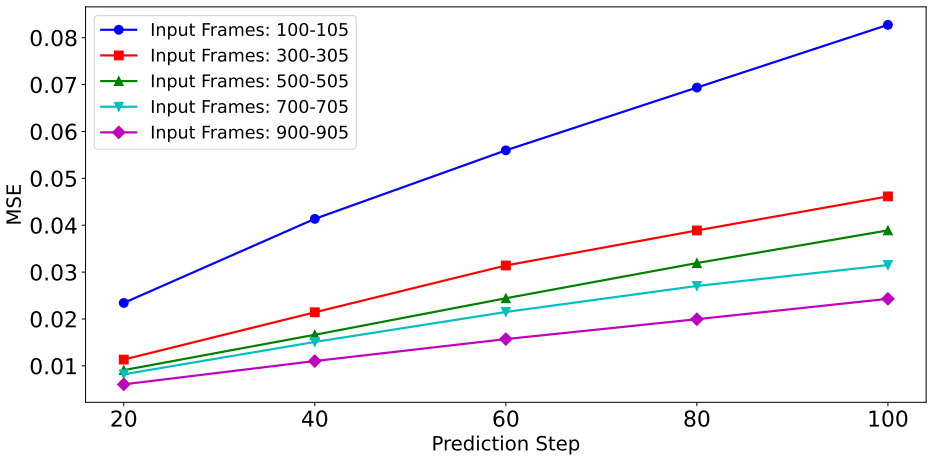
The central claim is that a hybrid strategy lets the phase-field model capture early-stage spinodal decomposition mechanisms accurately while an attention-enhanced ConvLSTM network, trained on those data, efficiently and faithfully predicts late-stage coarsening dynamics in both two and three dimensions, maintaining accuracy hundreds of timesteps ahead and generalizing to unseen compositions.
What carries the argument
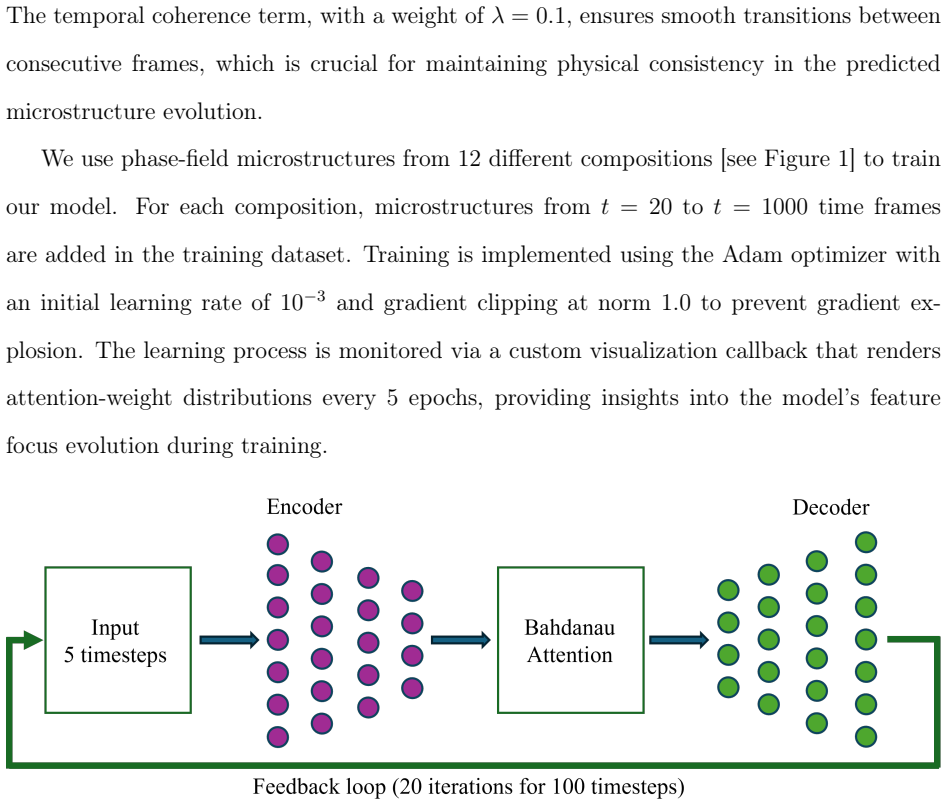
An attention-augmented ConvLSTM network paired with a dimensionality-reducing autoencoder and a slice-by-slice strategy for three-dimensional data, trained directly on phase-field simulation outputs.
If this is right
- Early rapid evolution is handled by the phase-field model while late-stage dynamics are predicted by the trained network at far lower computational cost.
- The model generalizes to compositions outside the training distribution.
- The slice-by-slice approach extends the same architecture from two-dimensional to three-dimensional microstructures.
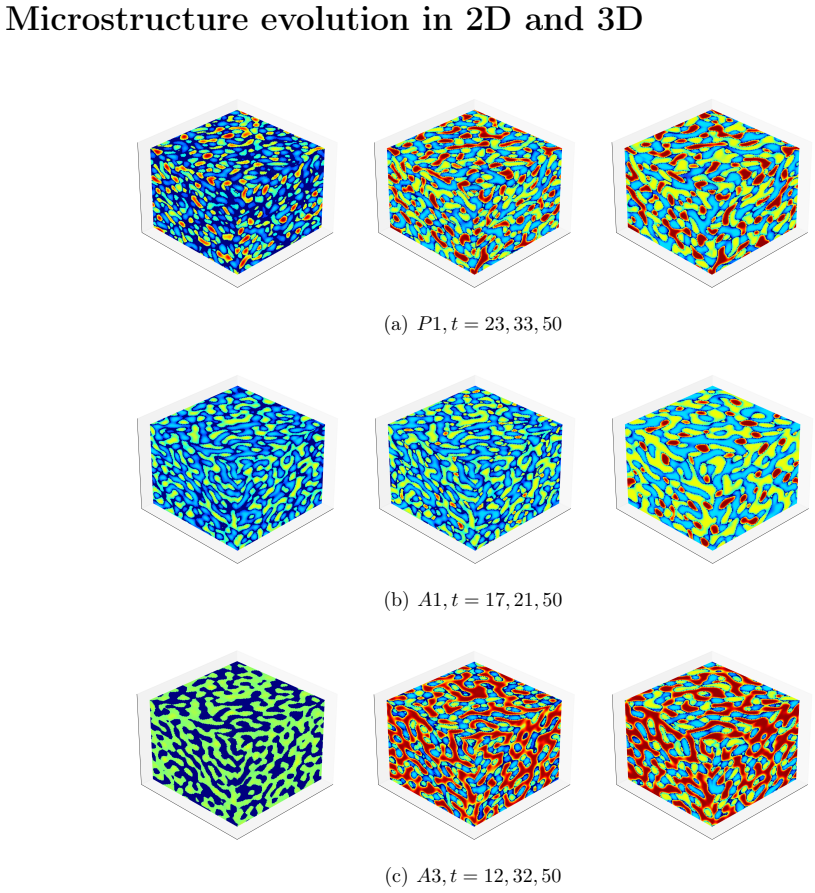
- Three distinct early-stage phase-separation mechanisms are captured in the training data.
Where Pith is reading between the lines
- Such a hybrid workflow could shorten the computational loop for screening alloy compositions aimed at hierarchical nanoporous structures.
- The same hand-off strategy might apply to other microstructure evolution problems where early transients are fast and late coarsening is slow.
- Coupling the trained model with experimental tomography data could test whether the learned patterns transfer beyond simulation.
Load-bearing premise
The phase-field model supplies accurate enough early-stage data that the learned deep learning patterns can extrapolate late-stage coarsening without explicit physical constraints.
What would settle it
Direct comparison of the deep learning predictions against independent phase-field runs continued to 400 timesteps for a held-out composition would show whether the reported fidelity holds.
Figures
read the original abstract
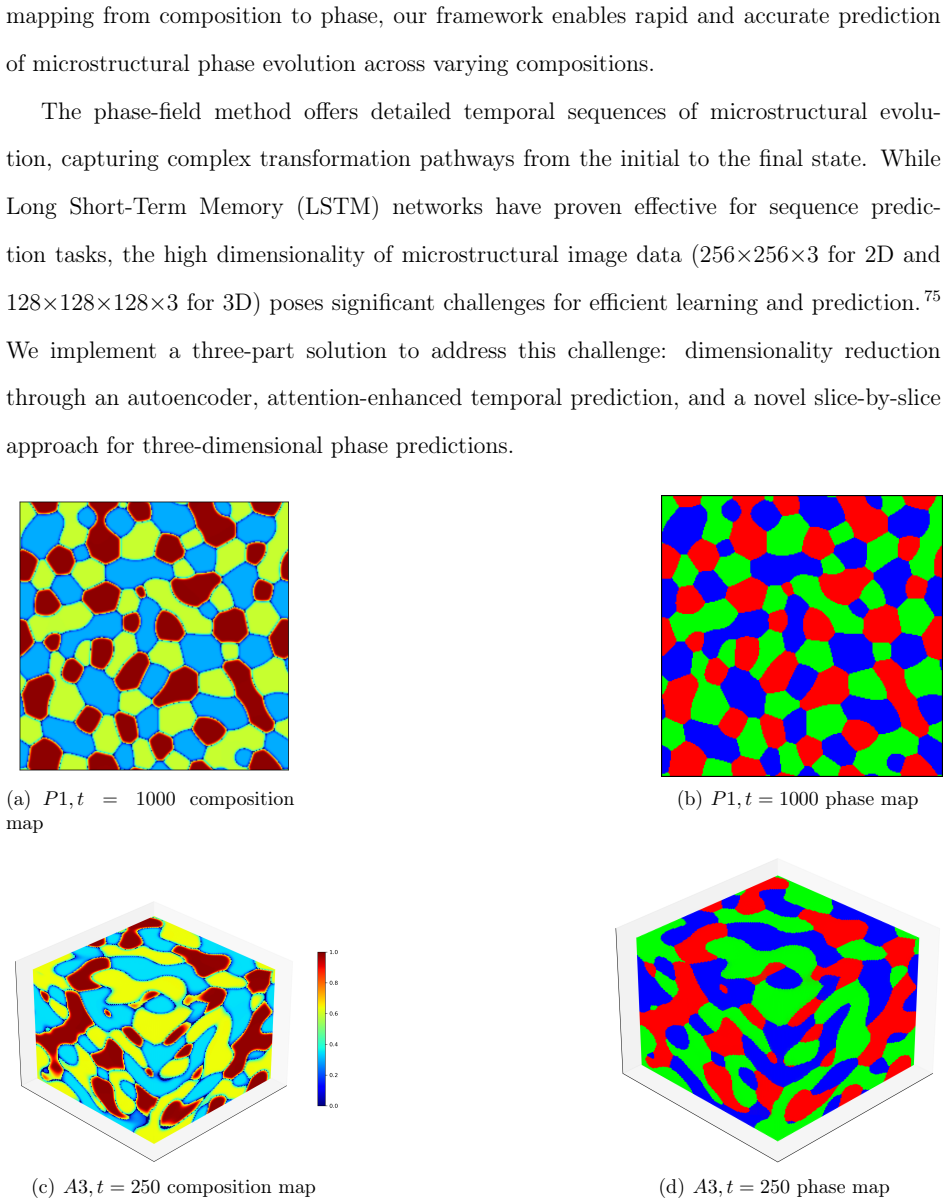
We develop a hybrid framework that integrates a phase-field model (PFM) with an attention-enhanced deep learning (DL) architecture to study ternary spinodal dealloying, a sophisticated self-organization approach used to fabricate three-dimensional bicontinuous, hierarchical nanoporous materials. The study captures three distinct phase-separation mechanisms that emerge during the early stages of spinodal decomposition in both two and three dimensions. The DL workflow consists of three key components: (i) a dimensionality-reducing autoencoder that provides compact representations of high-resolution microstructure images (256x256x3), (ii) an attention-augmented convolutional long short-term memory (ConvLSTM) network that learns complex spatiotemporal correlations governing microstructure evolution, and (iii) a novel slice-by-slice strategy that enables extension of the model to three-dimensional systems (128x128x128x3). We further demonstrate a hybrid simulation strategy in which PFM accurately captures rapid early-stage microstructure evolution, while the DL model efficiently predicts late-stage coarsening dynamics. The trained DL model achieves remarkable predictive accuracy, maintaining fidelity up to 400 timesteps ahead and generalizing to compositions outside the training distribution. By bridging the physical fidelity of PFM with the computational efficiency of DL, this framework establishes a robust platform for predictive modeling of microstructure evolution in complex multicomponent systems.
Editorial analysis
A structured set of objections, weighed in public.
Referee Report
Summary. The manuscript develops a hybrid phase-field model (PFM) plus deep-learning framework for ternary spinodal dealloying. An autoencoder compresses 256×256×3 (2D) or 128×128×128×3 (3D) microstructure snapshots; an attention-augmented ConvLSTM learns spatiotemporal evolution; a slice-by-slice strategy extends the model to 3D. The hybrid workflow runs PFM for early-stage decomposition and switches to the trained DL model for late-stage coarsening, claiming that the DL component maintains fidelity for 400 timesteps and generalizes to compositions outside the training set.
Significance. If the quantitative claims hold, the work would demonstrate a practical route to accelerate long-horizon microstructure simulations while retaining physical fidelity, which is valuable for designing bicontinuous nanoporous materials. The attention mechanism and hybrid PFM-DL coupling are conceptually attractive; however, the absence of reported error metrics and conservation checks limits the immediate impact.
major comments (3)
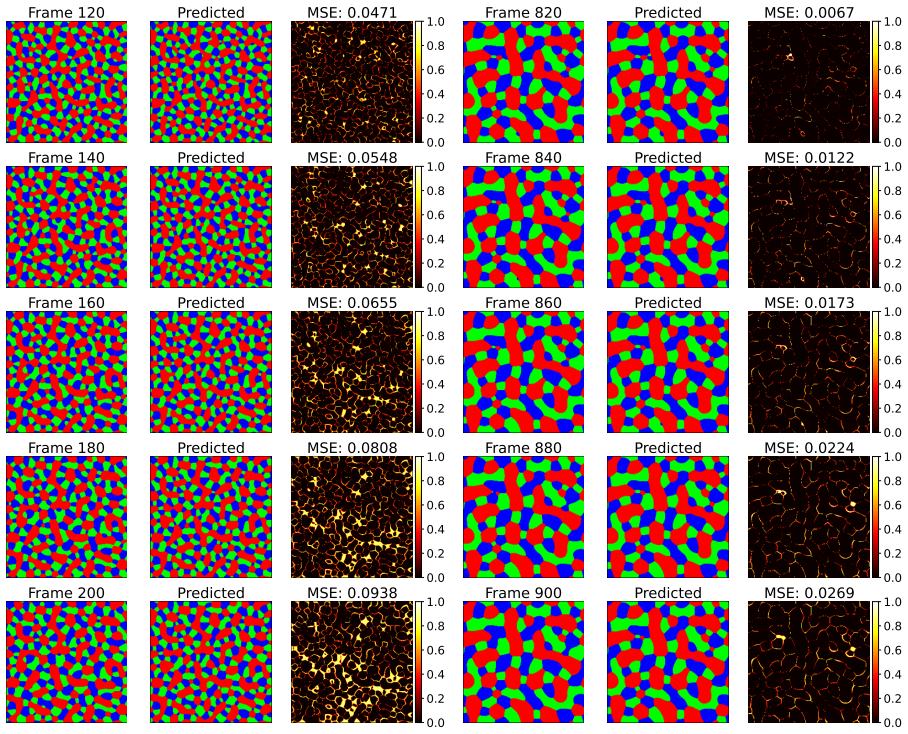
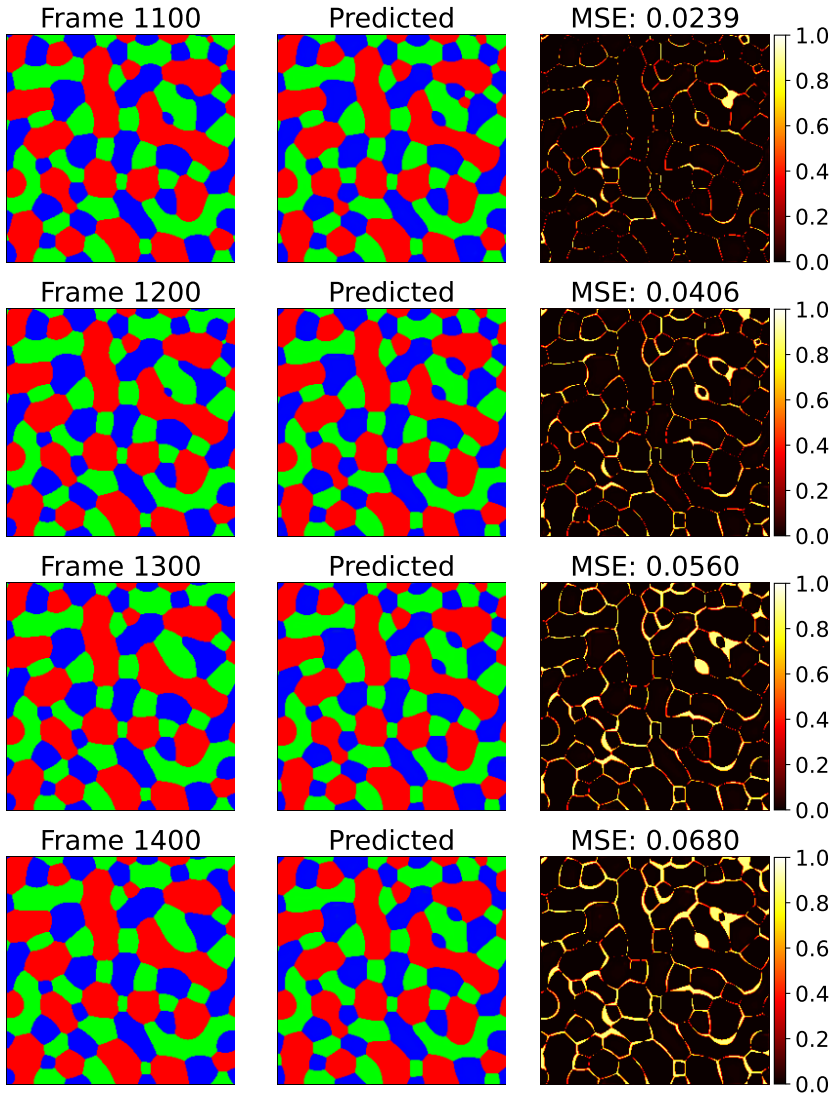
- [Abstract] Abstract: the central claim that the DL model 'achieves remarkable predictive accuracy, maintaining fidelity up to 400 timesteps ahead' is unsupported by any quantitative error metric (MSE, conservation error, interface-area error), baseline comparison, or error-bar analysis. Without these numbers the 400-step extrapolation cannot be evaluated.
- [DL workflow description] DL architecture and training (implied Methods/Results sections): the autoencoder + attention-ConvLSTM pipeline contains no physics-informed loss term, projection step, or post-processing that enforces conservation of the three component fractions. Because ternary spinodal dealloying is mass-conserving, any cumulative drift over 400 steps would invalidate both the fidelity claim and the out-of-distribution generalization result.
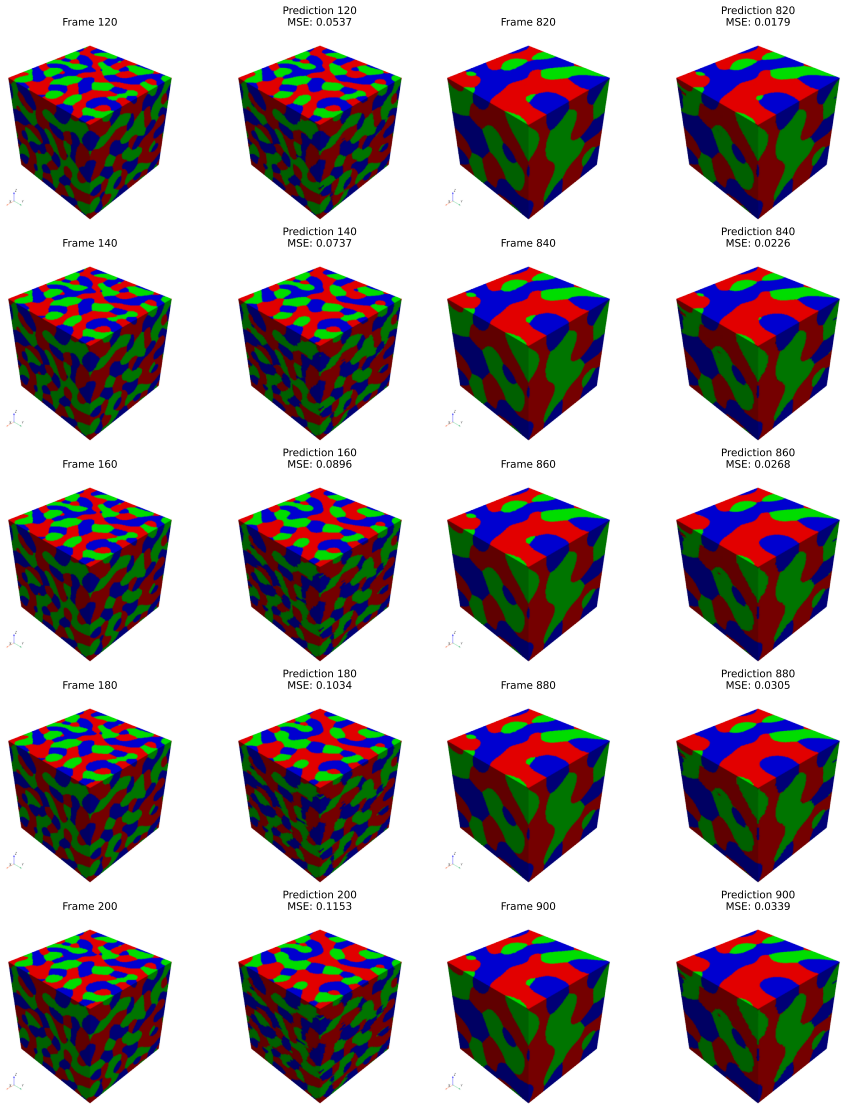
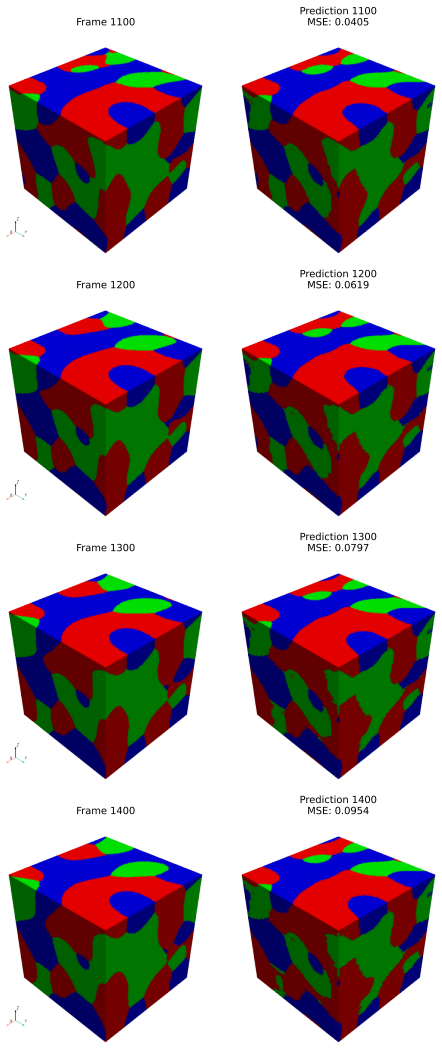
- [3D extension paragraph] 3D extension (slice-by-slice strategy): treating the 128×128×128 volume as independent 2D slices decouples the third dimension, allowing possible drift in volume fractions and interface topology across slices. No test of global conservation or topological consistency after 400 steps is described, yet this is load-bearing for the 3D generalization claim.
minor comments (2)
- [Abstract] The abstract states three distinct phase-separation mechanisms are captured but does not name or illustrate them; a short enumeration or figure reference would improve clarity.
- [Methods] Notation for the autoencoder latent dimension and ConvLSTM hidden-state size is not introduced before the results are discussed.
Simulated Author's Rebuttal
We thank the referee for the constructive and detailed comments, which highlight important aspects needed to strengthen the quantitative support for our claims. We address each major comment below and will incorporate the suggested additions in a revised manuscript.
read point-by-point responses
-
Referee: [Abstract] Abstract: the central claim that the DL model 'achieves remarkable predictive accuracy, maintaining fidelity up to 400 timesteps ahead' is unsupported by any quantitative error metric (MSE, conservation error, interface-area error), baseline comparison, or error-bar analysis. Without these numbers the 400-step extrapolation cannot be evaluated.
Authors: We agree that the abstract claim requires explicit quantitative backing to be evaluable. In the revised manuscript we will add MSE, per-component conservation errors, interface-area errors, baseline comparisons (e.g., against non-attention ConvLSTM and linear extrapolation), and error bars derived from multiple independent runs to substantiate the 400-timestep fidelity. revision: yes
-
Referee: [DL workflow description] DL architecture and training (implied Methods/Results sections): the autoencoder + attention-ConvLSTM pipeline contains no physics-informed loss term, projection step, or post-processing that enforces conservation of the three component fractions. Because ternary spinodal dealloying is mass-conserving, any cumulative drift over 400 steps would invalidate both the fidelity claim and the out-of-distribution generalization result.
Authors: The referee is correct that no explicit conservation mechanism is present. While the training data originate from mass-conserving PFM simulations, we will add a physics-informed conservation penalty to the loss function (or a post-prediction projection onto the valid composition simplex) and report the resulting long-term conservation errors in the revision. revision: yes
-
Referee: [3D extension paragraph] 3D extension (slice-by-slice strategy): treating the 128×128×128 volume as independent 2D slices decouples the third dimension, allowing possible drift in volume fractions and interface topology across slices. No test of global conservation or topological consistency after 400 steps is described, yet this is load-bearing for the 3D generalization claim.
Authors: We acknowledge that the slice-by-slice approach does not inherently guarantee 3D consistency. In the revision we will add explicit global 3D conservation checks (total volume fractions across all slices) and topological consistency metrics (e.g., interface connectivity or Euler number) evaluated on the assembled 3D volumes after 400-step predictions. revision: yes
Circularity Check
No significant circularity; hybrid PFM-DL workflow is self-contained
full rationale
The paper trains an attention-augmented ConvLSTM (plus autoencoder) on microstructure snapshots generated by an independent phase-field model, then applies the trained network to forecast later timesteps or unseen compositions. This is standard supervised learning on external simulation data; the output predictions are not algebraically identical to the training inputs, nor are any load-bearing steps reduced to self-citations, fitted parameters renamed as predictions, or ansatzes imported from the authors' prior work. The 400-step extrapolation claim rests on empirical validation against held-out PFM runs rather than on any definitional equivalence. No equations or sections exhibit the enumerated circularity patterns.
Axiom & Free-Parameter Ledger
Reference graph
Works this paper leans on
-
[1]
ACS Applied Materials & Interfaces , volume =
Chen, Xin and Yang, Lin and Zhang, Yuan and Zhang, Donglin and Song, Jiaqi and Feng, Jiaqi and Zhao, Xiuchen and Zhang, Gang and Huo, Yongjun , title =. ACS Applied Materials & Interfaces , volume =. 2025 , doi =
2025
-
[2]
ACS Applied Materials & Interfaces , volume =
Feng, Longsheng and Huang, Sijia and Heo, Tae Wook and Biener, Juergen , title =. ACS Applied Materials & Interfaces , volume =. 2024 , doi =
2024
-
[3]
Scope of generative artificial intelligence in microstructural studies: a case study , year =
Ahmad, Owais and Panwar, Vishal and Das, Kaushik and Mukherjee, Rajdip and Bhowmick, Somnath , journal =. Scope of generative artificial intelligence in microstructural studies: a case study , year =. doi:10.1088/1402-4896/ade832 , publisher =
-
[4]
Bo Xu and Guozheng Kang and Qianhua Kan and Chao Yu and Xi Xie , journal =. Phase field simulation on the cyclic degeneration of one-way shape memory effect of NiTi shape memory alloy single crystal , year =. doi:10.1016/j.ijmecsci.2019.105303 , keywords =
-
[5]
Phase field modeling of fracture in fiber reinforced composite laminate , year =
Peng Zhang and Xiaofei Hu and Tinh Quoc Bui and Weian Yao , journal =. Phase field modeling of fracture in fiber reinforced composite laminate , year =. doi:10.1016/j.ijmecsci.2019.07.007 , keywords =
-
[6]
Pengfei Li and Julien Yvonnet and Christelle Combescure , journal =. An extension of the phase field method to model interactions between interfacial damage and brittle fracture in elastoplastic composites , year =. doi:10.1016/j.ijmecsci.2020.105633 , keywords =
-
[7]
Numerical simulation of three-dimensional multicomponent Cahn–Hilliard systems , year =
Shiwei Zhou and Yi Min Xie , journal =. Numerical simulation of three-dimensional multicomponent Cahn–Hilliard systems , year =. doi:10.1016/j.ijmecsci.2021.106349 , keywords =
-
[8]
Deep learning-driven prediction of microstructure evolution via latent space interpolation , year =
Gaikwad, Sachin and Kasilingam, Thejas and Ahmad, Owais and Mukherjee, Rajdip and Bhowmick, Somnath , journal =. Deep learning-driven prediction of microstructure evolution via latent space interpolation , year =. doi:10.1103/5ngk-4v9j , issue =
-
[9]
Ahmad, Owais and Maurya, Rakesh and Mukherjee, Rajdip and Bhowmick, Somnath , title =. 2024 , volume =. doi:10.4028/p-6W4IXl , keywords =
-
[10]
E.Bruce Nauman and David Qiwei He , journal =. 1994 , issn =. doi:10.1016/0032-3861(94)90757-9 , keywords =
-
[11]
Saurabh Tiwari and Prathamesh Satpute and Supriyo Ghosh , journal =. 2025 , issn =. doi:10.1016/j.commatsci.2024.113518 , keywords =
-
[12]
Cong Yang and Qingyan Xu and Baicheng Liu , journal =. 2017 , issn =. doi:10.1016/j.commatsci.2017.04.031 , keywords =
-
[13]
Pengzhi Li and Yan Pei and Jianqiang Li , journal =. 2023 , issn =. doi:10.1016/j.asoc.2023.110176 , keywords =
-
[14]
2002 , doi=
Yoshihiro Suwa and Yoshiyuki Saito and Kazumi Ochi and Takahiro Aoki and Kanako Goto and Kotaro Abe , journal =. 2002 , doi=
2002
-
[15]
L.Q. Chen and Jie Shen , journal =. 1998 , issn =. doi:10.1016/S0010-4655(97)00115-X , keywords =
-
[16]
2012 , issn =
Park, Jin Man and Han, Jun Hee and Mattern, Norbert and Kim, Do Hyang and Eckert, Jurgen , journal =. 2012 , issn =
2012
-
[17]
S.W. Sohn and W. Yook and W.T. Kim and D.H. Kim , journal =. 2012 , issn =. doi:10.1016/j.intermet.2011.12.021 , keywords =
-
[18]
H.J. Chang and W. Yook and E.S. Park and J.S. Kyeong and D.H. Kim , journal =. 2010 , issn =. doi:10.1016/j.actamat.2009.12.034 , keywords =
-
[19]
, journal =
Pattanayak, Pulok and Asokan, S. , journal =. 2004 , issn =
2004
-
[20]
Norbert Mattern and Thomas Gemming and J. 2010 , issn =. doi:10.1016/j.jallcom.2009.10.013 , keywords =
-
[21]
N. Mattern and G. Goerigk and U. Vainio and M.K. Miller and T. Gemming and J. Eckert , journal =. 2009 , issn =. doi:10.1016/j.actamat.2008.10.028 , keywords =
-
[22]
G. Goerigk and N. Mattern , journal =. 2009 , issn =. doi:10.1016/j.actamat.2009.04.028 , keywords =
-
[23]
and Thomas, G
Okada, M. and Thomas, G. and Homma, M. and Kaneko, H. , journal =. 1978 , volume=
1978
-
[24]
Chu, S. N. G. and Nakahara, S. and Strege, K. E. and Johnston, W. D., Jr. , journal =. 1985 , issn =. doi:10.1063/1.335368 , eprint =
-
[25]
and Ralph, Brian , journal =
Louise Makin, P. and Ralph, Brian , journal =. 1984 , issn =
1984
-
[26]
doi:10.1007/BF02668132 , adsurl =
The effect of prior deformation on spinodal age hardening in Cu-15 Ni-8 Sn alloy. doi:10.1007/BF02668132 , adsurl =
-
[27]
and Lele, S
Singh, J. and Lele, S. and Ranganathan, S. , journal =. 1980 , issn =
1980
-
[28]
Yaode Yin and Hongjun Yu , journal =. A thermodynamic-consistent phase-field model for fracture in temperature-dependent materials , year =. doi:10.1016/j.ijmecsci.2025.110382 , keywords =
-
[29]
Chen, L.-Q. and Yang, W. , journal =. Computer simulation of the domain dynamics of a quenched system with a large number of nonconserved order parameters: The grain-growth kinetics , year =. doi:10.1103/physrevb.50.15752 , source =
-
[31]
John W. Cahn , journal =. On spinodal decomposition in cubic crystals , year =. doi:10.1016/0001-6160(62)90114-1 , issue =
-
[32]
W. A. Tiller and G. M. Pound and J. P. Hirth , journal =. A critique on the mathematical theory of spinodal decomposition , year =. doi:10.1016/0001-6160(70)90027-1 , issue =
-
[33]
J. W. Cahn and J. E. Hilliard , journal =. Spinodal decomposition: A reprise , year =. doi:10.1016/0001-6160(71)90127-1 , issue =
-
[34]
Phase-field simulations of ferroelectric/ferroelastic polarization switching , year =
Jie Wang and San Qiang Shi and Long Qing Chen and Yulan Li and Tong Yi Zhang , journal =. Phase-field simulations of ferroelectric/ferroelastic polarization switching , year =. doi:10.1016/j.actamat.2003.10.011 , issue =
-
[35]
Boettinger, W.J. and Warren, J.A. and Beckermann, C. and Karma, A. , journal =. Phase-field simulation of solidification , year =. doi:10.1146/annurev.matsci.32.101901.155803 , source =
-
[36]
Quantitative phase-field modeling of dendritic growth in two and three dimensions , year =
Karma, Alain and Rappel, Wouter-Jan , journal =. Quantitative phase-field modeling of dendritic growth in two and three dimensions , year =. doi:10.1103/physreve.57.4323 , issue =
-
[37]
Phase-field formulation for quantitative modeling of alloy solidification , year =
Alain Karma , journal =. Phase-field formulation for quantitative modeling of alloy solidification , year =. doi:10.1103/physrevlett.87.115701 , issue =
-
[38]
Cogswell and Guanglong Xu and Srdjan Milenkovic and Yuwen Cui , journal =
Bin Tang and Daniel A. Cogswell and Guanglong Xu and Srdjan Milenkovic and Yuwen Cui , journal =. The formation mechanism of eutectic microstructures in NiAl-Cr composites , year =. doi:10.1039/c6cp01921h , issue =
-
[39]
L. Chen and J. Chen and R. A. Lebensohn and Y. Z. Ji and T. W. Heo and S. Bhattacharyya and K. Chang and S. Mathaudhu and Z. K. Liu and L. Q. Chen , journal =. An integrated fast Fourier transform-based phase-field and crystal plasticity approach to model recrystallization of three dimensional polycrystals , year =. doi:10.1016/j.cma.2014.12.007 , keywords =
-
[40]
Danan Fan and S. P. Chen and Long Qing Chen and P. W. Voorhees , journal =. Phase-field simulation of 2-D Ostwald ripening in the high volume fraction regime , year =. doi:10.1016/s1359-6454(01)00393-7 , issue =
-
[41]
D. Rodney and Y. Le Bouar and Alphonse Finel , journal =. Phase field methods and dislocations , year =. doi:10.1016/s1359-6454(01)00379-2 , issue =
-
[42]
Y. M. Jin and A. G. Khachaturyan , journal =. Phase field microelasticity theory of dislocation dynamics in a polycrystal: Model and three-dimensional simulations , year =. doi:10.1080/09500830110062825 , issue =
-
[43]
Dynamic instabilities of fracture under biaxial strain using a phase field model , year =
Hervé Henry and Herbert Levine , journal =. Dynamic instabilities of fracture under biaxial strain using a phase field model , year =. doi:10.1103/physrevlett.93.105504 , issue =
-
[44]
Phase field modeling of crack propagation , year =
Robert Spatschek and Efim Brener and Alain Karma , journal =. Phase field modeling of crack propagation , year =. doi:10.1080/14786431003773015 , issue =
-
[45]
L. O. Eastgate and J. P. Sethna and M. Rauscher and T. Cretegny and C. S. Chen and C. R. Myers , journal =. Fracture in mode I using a conserved phase-field model , year =. doi:10.1103/physreve.65.036117 , issue =
-
[46]
Christian Miehe and Martina Hofacker and Fabian Welschinger , journal =. A phase field model for rate-independent crack propagation: Robust algorithmic implementation based on operator splits , year =. doi:10.1016/j.cma.2010.04.011 , issue =
-
[47]
P. H. Leo and J. S. Lowengrub and H. J. Jou , journal =. A diffuse interface model for microstructural evolution in elastically stressed solids , year =. doi:10.1016/s1359-6454(97)00377-7 , issue =
-
[48]
M. P. Gururajan and T. A. Abinandanan , journal =. Phase inversion in two-phase solid systems driven by an elastic modulus mismatch , year =. doi:10.1080/14786430701647984 , issue =
-
[50]
Toshiyuki Koyama and Hidehiro Onodera , journal =. Phase-field simulation of phase decomposition in Fe-Cr-Co alloy under an external magnetic field , year =. doi:10.1007/bf03185980 , issue =
-
[51]
Phase-field modeling of microstructure evolutions in magnetic materials , year =
Toshiyuki Koyama , journal =. Phase-field modeling of microstructure evolutions in magnetic materials , year =. doi:10.1088/1468-6996/9/1/013006 , issue =
-
[52]
and Mukherjee, R
Mukherjee, A. and Mukherjee, R. and Ankit, K. and Bhattacharya, A. and Nestler, B. , journal =. Influence of substrate interaction and confinement on electric-field-induced transition in symmetric block-copolymer thin films , year =
-
[53]
Arnab Mukherjee and Kumar Ankit and Andreas Reiter and Michael Selzer and Britta Nestler , journal =. Electric-field-induced lamellar to hexagonally perforated lamellar transition in diblock copolymer thin films: Kinetic pathways , year =. doi:10.1039/c6cp04903f , issue =
-
[54]
L. X. Lv and L. Zhen and C. Y. Xu and X. Y. Sun , journal =. Phase field simulation of spinodal decomposition under external magnetic field , year =. doi:10.1016/j.jmmm.2009.12.001 , issue =
-
[55]
Xin-Wei Wu and Mingyang Chen and Liao-Liang Ke , journal =. An electro-thermo-mechanical coupling phase-field model of defect evolution induced by electromigration in interconnects , year =. doi:10.1016/j.ijmecsci.2024.109792 , keywords =
-
[56]
R.J Livak and G Thomas , journal =. 1974 , issn =. doi:10.1016/0001-6160(74)90156-4 , url =
-
[57]
E.P. Butler and G. Thomas , journal =. 1970 , issn =. doi:10.1016/0001-6160(70)90150-1 , url =
-
[58]
F. Findik and H. M. Flower , journal =. 1992 , number =. doi:10.1179/mst.1992.8.3.197 , publisher =
-
[59]
M.I.M. Copetti , journal =. 2000 , issn =. doi:10.1016/S0378-4754(99)00153-6 , keywords =
-
[60]
Ma, Yu-qiang , journal =. 2001 , issn =. doi:10.1063/1.1343838 , eprint =
-
[61]
Travasso, Rui D. M. and Buxton, Gavin A. and Kuksenok, Olga and Good, Kevin and Balazs, Anna C. , journal =. 2005 , issn =
2005
-
[62]
Alfarraj, Abdulrahman A. and Nauman, E. Bruce , journal =. 2007 , number =. doi:10.1002/mats.200700025 , keywords =
-
[63]
Long-Qing Chen , journal =. 1993 , issn =. doi:10.1016/0956-716X(93)90419-S , url =
-
[64]
Long-Qing Chen , journal =. 1994 , issn =. doi:10.1016/0956-7151(94)90482-0 , url =
-
[65]
, journal =
Eyre, David J. , journal =. 1993 , number =
1993
-
[66]
2013 , doi=
Atsuo Yasumori , journal =. 2013 , doi=
2013
-
[67]
and Nishio, K
Masuda, H. and Nishio, K. and Baba, N. , journal =. 1994 , issn =
1994
-
[68]
McMillan, P. W. and Matthews, C. E. , journal =. 1976 , issn =
1976
-
[69]
James, P. F. , journal =. 1975 , issn =
1975
-
[70]
Ahmad, Owais and Kumar, Naveen and Mukherjee, Rajdip and Bhowmick, Somnath , journal =. 2023 , pages =. doi:10.1103/PhysRevMaterials.7.083802 , issue =
-
[71]
Computation , VOLUME =
Taye, Mohammad Mustafa , TITLE =. Computation , VOLUME =. 2023 , NUMBER =
2023
-
[72]
Abdi, Herve and Williams, Lynne J. , journal =. 2010 , number =. doi:10.1002/wics.101 , keywords =
-
[73]
1958 , number =
Cahn, John W and Hilliard, John E , journal =. 1958 , number =
1958
-
[74]
Bhattacharyya, Saswata and Abinandanan, TA , journal =. 2003 , pages =. doi:10.1007/bf02712812 , publisher =
-
[75]
Kramer, Edward J and Green, Peter and Palmstr. 1984 , number =. doi:10.1016/0032-3861(84)90205-2 , publisher =
-
[76]
Ghosh, Supriyo and Mukherjee, Arnab and Abinandanan, TA and Bose, Suryasarathi , journal =. 2017 , number =. doi:10.1039/c7cp01816a , publisher =
-
[77]
2012 , publisher=
Lee, Hyun Geun and Choi, Jeong-Whan and Kim, Junseok , journal =. 2012 , publisher=
2012
-
[78]
Cahn, John W , journal =. 1961 , number =. doi:10.1016/0001-6160(61)90182-1 , publisher =
-
[79]
Pfleiderer, S and Ball, DGA and Bailey, RC , journal =. 1993 , number =. doi:10.1016/0098-3004(93)90053-8 , publisher =
-
[80]
Bostanabad, Ramin and Zhang, Yichi and Li, Xiaolin and Kearney, Tucker and Brinson, L. Catherine and Apley, Daniel W. and Liu, Wing Kam and Chen, Wei , journal =. 2018 , issn =. doi:10.1016/J.PMATSCI.2018.01.005 , keywords =
-
[81]
SHI, Xingjian and Chen, Zhourong and Wang, Hao and Yeung, Dit-Yan and Wong, Wai-kin and WOO, Wang-chun , booktitle =
-
[82]
2022 , doi =
De, Subhayan and Reynolds, Matthew and Hassanaly, Malik and King, Ryan N and Doostan, Alireza , journal =. 2022 , doi =
2022
discussion (0)
Sign in with ORCID, Apple, or X to comment. Anyone can read and Pith papers without signing in.