Information Design under Uncertain Utilities: Probabilistic and CVaR Approaches
Pith reviewed 2026-06-26 11:36 UTC · model grok-4.3
The pith
Information design with uncertain agent payoffs admits convex reformulations under linear-quadratic-Gaussian structure using probabilistic and CVaR constraints.
A machine-rendered reading of the paper's core claim, the machinery that carries it, and where it could break.
Core claim
The paper establishes that augmenting the Bayes correlated equilibrium with a corrector policy yields the Cal-BCE concept, which preserves incentive compatibility under payoff uncertainty. Under a linear-quadratic-Gaussian structure, the information design problem with two-sided probabilistic and CVaR constraints admits convex reformulations as second-order cone programs and semidefinite programs, with feasibility ensured by a Hadamard invertibility condition on the relevant matrices. A joint decentralization theorem further shows that these designs bound the covariances between agents' actions, with the CVaR version providing a tighter bound at a given tolerance level.
What carries the argument
The Calibrated Bayes Correlated Equilibrium (Cal-BCE), which incorporates a corrector policy to maintain incentive compatibility when payoff coefficients are uncertain.
If this is right
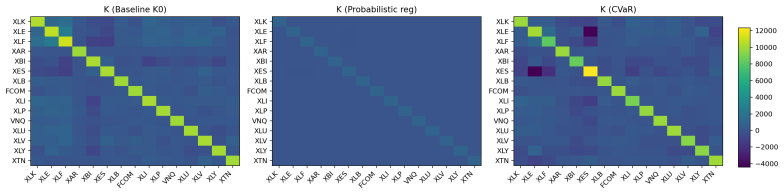
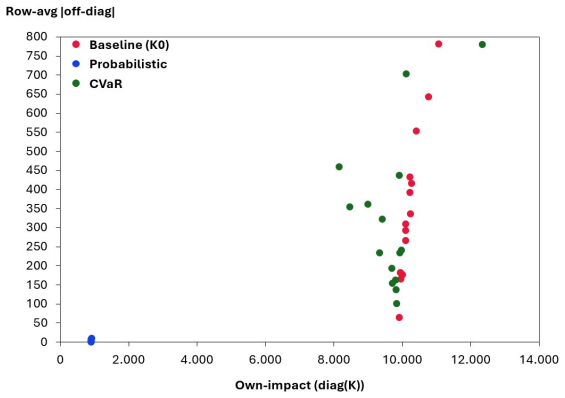
- The probabilistic and CVaR designs both limit cross-agent action covariances.
- The CVaR design caps these covariances more tightly than the probabilistic design at the same tolerance.
- Realized performance ordering between the designs depends on the specific calibration thresholds used.
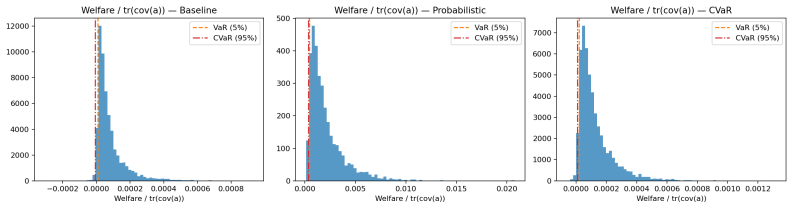
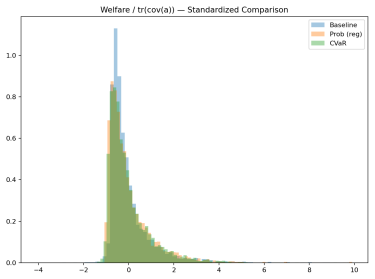
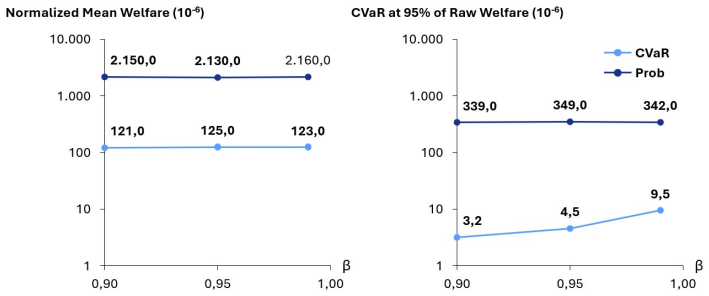
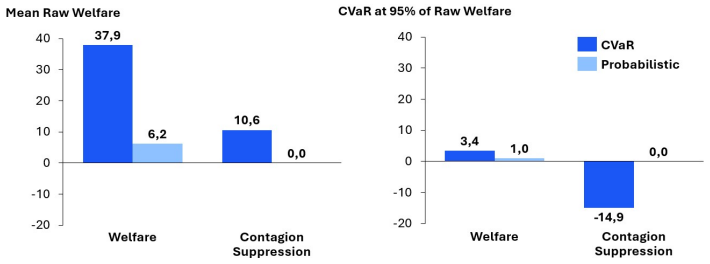
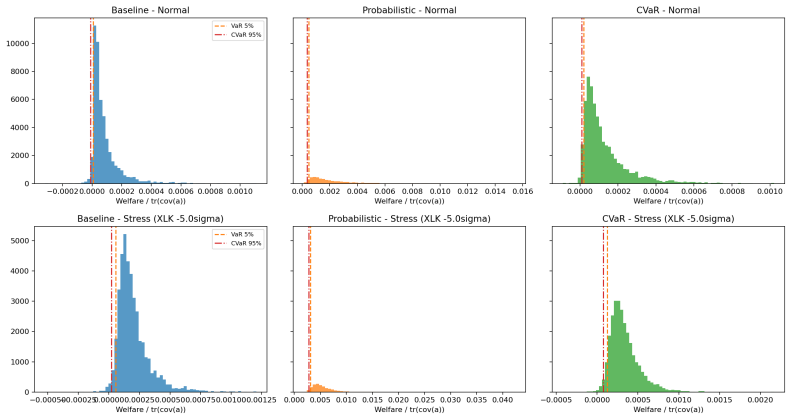
- Experiments on sector ETFs demonstrate that the probabilistic approach yields higher average welfare while CVaR offers superior protection against poor outcomes.
Where Pith is reading between the lines
- The methods could apply to other classes of risk measures if similar convex reformulations exist.
- Practitioners facing payoff uncertainty might select between the two designs depending on whether mean performance or tail risks matter more in their application.
- The covariance capping result suggests potential applications in regulating information flows in systems where agents have private but uncertain valuations.
Load-bearing premise
The problem must have a linear-quadratic-Gaussian structure and satisfy the Hadamard invertibility condition to allow the convex reformulations and guarantee their feasibility.
What would settle it
Observe whether the second-order cone or semidefinite programs derived in the paper produce solutions when applied to a linear-quadratic-Gaussian instance that meets the Hadamard condition, or check if the ETF experiments replicate the reported welfare and tail performance differences.
Figures
read the original abstract
This paper studies information design when the designer lacks precise knowledge of agents' payoff coefficients. The Calibrated Bayes Correlated Equilibrium (Cal-BCE) is introduced as a solution concept that augments the Bayes correlated equilibrium with a corrector policy preserving incentive compatibility under the designer's structural uncertainty, adapting its revelation principle to this setting. The design problem is nonconvex in general, but under a linear-quadratic-Gaussian structure it admits convex second-order cone and semidefinite reformulations under two-sided probabilistic and conditional value-at-risk (CVaR) constraints, with feasibility guaranteed by a Hadamard invertibility condition. A joint decentralization theorem shows that both designs cap cross-agent action covariances, the CVaR design more tightly at a common tolerance; but because the formulations operate at design-specific feasibility thresholds, the realized ordering is calibration-dependent. Experiments on fifteen sector ETFs confirm the trade-off: the probabilistic design attains higher mean welfare and the CVaR design better tail protection, with neither dominating outright.
Editorial analysis
A structured set of objections, weighed in public.
Referee Report
Summary. The paper introduces the Calibrated Bayes Correlated Equilibrium (Cal-BCE) as a solution concept for information design under uncertain agent utilities. Under a linear-quadratic-Gaussian structure, the design problem with two-sided probabilistic and CVaR constraints is claimed to admit convex second-order cone and semidefinite programming reformulations, with feasibility ensured by a Hadamard invertibility condition. A joint decentralization theorem is stated showing that both designs bound cross-agent action covariances (with CVaR tighter at equal tolerance), though realized ordering is calibration-dependent. Experiments on fifteen sector ETFs are reported to illustrate the mean-welfare versus tail-protection trade-off.
Significance. If the claimed convex reformulations and decentralization result hold under the stated LQG assumptions, the work would supply tractable optimization tools for information design with structural uncertainty, extending BCE concepts to robust settings and offering concrete guidance via the ETF experiments on the calibration dependence of design ordering.
major comments (1)
- [Abstract] Abstract: the central claim that the LQG structure yields convex SOC/SDP reformulations (preserving incentive compatibility via Cal-BCE) is asserted without any equations, derivation steps, or verification that the reformulations remain incentive-compatible; this is load-bearing for the contribution and cannot be assessed from the supplied material.
minor comments (1)
- The ETF experiments are described only at a high level without data tables, error bars, baseline comparisons, or explicit values for the risk-tolerance parameters, limiting evaluation of the reported trade-off.
Simulated Author's Rebuttal
We thank the referee for the detailed review and for identifying the need to strengthen the abstract's presentation of the core technical claim. We address the single major comment below and indicate the planned revision.
read point-by-point responses
-
Referee: [Abstract] Abstract: the central claim that the LQG structure yields convex SOC/SDP reformulations (preserving incentive compatibility via Cal-BCE) is asserted without any equations, derivation steps, or verification that the reformulations remain incentive-compatible; this is load-bearing for the contribution and cannot be assessed from the supplied material.
Authors: We agree that the abstract, being a concise summary, does not contain the equations or derivation steps. The full manuscript derives the convex SOCP and SDP reformulations in Sections 3.2–3.3 under the LQG structure, shows that the Cal-BCE corrector policy preserves incentive compatibility by construction, and invokes the Hadamard invertibility condition for feasibility. The decentralization theorem appears in Section 4. Because the referee notes that the claim cannot be assessed from the supplied material, we will revise the abstract to include a brief high-level outline of the reformulation steps together with explicit references to the relevant theorems and sections. This change will be incorporated in the next version of the manuscript. revision: yes
Circularity Check
No significant circularity identified
full rationale
The provided abstract and description introduce Cal-BCE as a solution concept and claim that under an LQG structure the design problem admits convex SOC/SDP reformulations with feasibility via a Hadamard invertibility condition, plus a joint decentralization theorem on covariance capping. No equations, self-citations, fitted parameters renamed as predictions, or ansatzes smuggled via prior work are quoted or described that would reduce any central claim to its own inputs by construction. The calibration-dependence note on ordering is an explicit acknowledgment of parameter sensitivity rather than a hidden circularity. The derivation chain is therefore self-contained against the stated structural assumptions, with ETF experiments serving as external checks.
Axiom & Free-Parameter Ledger
free parameters (1)
- risk tolerance levels
axioms (2)
- domain assumption The underlying information design problem has linear-quadratic-Gaussian structure
- domain assumption Hadamard invertibility condition holds
Reference graph
Works this paper leans on
-
[1]
Systemic risk and stability in financial networks.American Economic Review, 105(2):564–608, 2015
Daron Acemoglu, Asuman Ozdaglar, and Alireza Tahbaz-Salehi. Systemic risk and stability in financial networks.American Economic Review, 105(2):564–608, 2015
2015
-
[2]
Warning against recurring risks: An information design approach.Management Science, 66(10):4612–4629, 2020
Saed Alizamir, Francis de V´ ericourt, and Shouqiang Wang. Warning against recurring risks: An information design approach.Management Science, 66(10):4612–4629, 2020
2020
-
[3]
Zachariadis
Ricardo Alonso and Konstantinos E. Zachariadis. Persuading large investors. Discussion Paper DP15792, Centre for Economic Policy Research (CEPR), 2021
2021
-
[4]
Regret- minimizing bayesian persuasion.Games and Economic Behavior, 136:226–248, 2022
Yakov Babichenko, Inbal Talgam-Cohen, Haifeng Xu, and Konstantin Zabarnyi. Regret- minimizing bayesian persuasion.Games and Economic Behavior, 136:226–248, 2022
2022
-
[5]
Pricing decisions in a two-period closed-loop supply chain under asymmetric information and uncertainty.European Journal of Operational Research, 313:845–860, 2024
Cornelia Beranek, Werner Jammernegg, and Stefan Langer. Pricing decisions in a two-period closed-loop supply chain under asymmetric information and uncertainty.European Journal of Operational Research, 313:845–860, 2024
2024
-
[6]
First-price auctions with general information structures: Implications for bidding and revenue.Econometrica, 85(1):107–143, 2017
Dirk Bergemann, Benjamin Brooks, and Stephen Morris. First-price auctions with general information structures: Implications for bidding and revenue.Econometrica, 85(1):107–143, 2017
2017
-
[7]
Optimal information disclosure in classic auctions.American Economic Review: Insights, 4(3):267–282, 2022
Dirk Bergemann, Tibor Heumann, Stephen Morris, Constantine Sorokin, and Eyal Winter. Optimal information disclosure in classic auctions.American Economic Review: Insights, 4(3):267–282, 2022
2022
-
[8]
Robust predictions in games with incomplete informa- tion.Econometrica, 81(4):1251–1308, 2013
Dirk Bergemann and Stephen Morris. Robust predictions in games with incomplete informa- tion.Econometrica, 81(4):1251–1308, 2013
2013
-
[9]
Information design: A unified perspective.Journal of Economic Literature, 57(1):44–95, March 2019
Dirk Bergemann and Stephen Morris. Information design: A unified perspective.Journal of Economic Literature, 57(1):44–95, March 2019
2019
-
[10]
Studies on robust social influence mechanisms: In- centives for efficient network routing in uncertain settings.IEEE Control Systems Magazine, 37(1):98–115, 2017
Philip N Brown and Jason R Marden. Studies on robust social influence mechanisms: In- centives for efficient network routing in uncertain settings.IEEE Control Systems Magazine, 37(1):98–115, 2017
2017
-
[11]
The value of information design in supply chain man- agement.Management Science, 71(8):6545–6558, 2025
Ozan Candogan and Huseyin Gurkan. The value of information design in supply chain man- agement.Management Science, 71(8):6545–6558, 2025
2025
-
[12]
Optimal disclosure of information to privately informed agents.Theoretical Economics, 18(3):1225–1269, 2023
Ozan Candogan and Philipp Strack. Optimal disclosure of information to privately informed agents.Theoretical Economics, 18(3):1225–1269, 2023. 31
2023
-
[13]
Information design in optimal auctions.Journal of Economic Theory, 211:105710, 2023
Yi-Chun Chen and Xiangqian Yang. Information design in optimal auctions.Journal of Economic Theory, 211:105710, 2023
2023
-
[14]
Reducing congestion through information design
Sanmay Das, Emir Kamenica, and Renee Mirka. Reducing congestion through information design. In2017 55th Annual Allerton Conference on Communication, Control, and Computing (Allerton), pages 1279–1284, 2017
2017
-
[15]
Constrained information design.Mathematics of Operations Research, 49(1):78–106, 2024
Laura Doval and Vasiliki Skreta. Constrained information design.Mathematics of Operations Research, 49(1):78–106, 2024
2024
-
[16]
Preparing for the worst but hoping for the best: Robust (bayesian) persuasion.Econometrica, 90(5):2017–2051, 2022
Piotr Dworczak and Alessandro Pavan. Preparing for the worst but hoping for the best: Robust (bayesian) persuasion.Econometrica, 90(5):2017–2051, 2022
2017
-
[17]
Financial fragility and information design.Economics Letters, 232:111356, 2023
Zhongjie Fan and Dunzhe Tang. Financial fragility and information design.Economics Letters, 232:111356, 2023
2023
-
[18]
Ferguson, Philip N
Bryce L. Ferguson, Philip N. Brown, and Jason R. Marden. Information signaling with con- current monetary incentives in bayesian congestion games.IEEE Transactions on Intelligent Transportation Systems, 25(7):8028–8041, 2024
2024
-
[19]
Griesbach, Martin Hoefer, Max Klimm, and Tim Koglin
Simon M. Griesbach, Martin Hoefer, Max Klimm, and Tim Koglin. Information design for congestion games with unknown demand. InProceedings of the AAAI Conference on Artificial Intelligence, volume 38, pages 9722–9730, 2024
2024
-
[20]
Persuading multiple audiences: Strategic complementarities and (robust) regulatory disclosures
Nicolas Inostroza. Persuading multiple audiences: Strategic complementarities and (robust) regulatory disclosures. Working Paper 4400717, Rotman School of Management, March 2023
2023
-
[21]
Interactive information design.Mathe- matics of Operations Research, 47(1):153–175, 2022
Fr´ ed´ eric Koessler, Marie Laclau, and Tristan Tomala. Interactive information design.Mathe- matics of Operations Research, 47(1):153–175, 2022
2022
-
[22]
Persuasion with unknown beliefs.Theoretical Economics, 17(3):1075–1107, 2022
Svetlana Kosterina. Persuasion with unknown beliefs.Theoretical Economics, 17(3):1075–1107, 2022
2022
-
[23]
Information disclosure and full surplus extraction in mechanism design
Daniel Kr¨ ahmer. Information disclosure and full surplus extraction in mechanism design. Journal of Economic Theory, 189:105020, 2020
2020
-
[24]
Information design with unknown prior, 2025
Ce Li and Tao Lin. Information design with unknown prior, 2025
2025
-
[25]
Social value of public information.American Economic Review, 92(5):1521–1534, 2002
Stephen Morris and Hyun Song Shin. Social value of public information.American Economic Review, 92(5):1521–1534, 2002
2002
-
[26]
The design of macroprudential stress tests.The Review of Financial Studies, 36(11):4460–4501, 2023
Dmitry Orlov, Pavel Zryumov, and Andrzej Skrzypacz. The design of macroprudential stress tests.The Review of Financial Studies, 36(11):4460–4501, 2023
2023
-
[27]
Kulkarni
Shraddha Pathak and Ankur A. Kulkarni. A scalable bayesian persuasion framework for epidemic containment on heterogeneous networks.Journal of Mathematical Economics, 119:103134, 2025
2025
-
[28]
Optimization of conditional value-at-risk.Journal of risk, 2:21–42, 2000
R Tyrrell Rockafellar and Stanislav Uryasev. Optimization of conditional value-at-risk.Journal of risk, 2:21–42, 2000
2000
-
[29]
Robust social welfare maximization via information design in linear-quadratic-gaussian games.IEEE Control Systems Letters, 7:3096–3101, 2023
Furkan Sezer and Ceyhun Eksin. Robust social welfare maximization via information design in linear-quadratic-gaussian games.IEEE Control Systems Letters, 7:3096–3101, 2023. 32
2023
-
[30]
Optimal information provision for strategic hybrid workers
Sohil Shah, Saurabh Amin, and Patrick Jaillet. Optimal information provision for strategic hybrid workers. In2022 IEEE 61st Conference on Decision and Control (CDC), pages 3807–
-
[31]
Information design, signaling, and central bank transparency.International Journal of Central Banking, 14(5):223–258, December 2018
Wataru Tamura. Information design, signaling, and central bank transparency.International Journal of Central Banking, 14(5):223–258, December 2018
2018
-
[32]
Value of information in bayesian routing games.Operations Research, 69(1):148–163, 2021
Manxi Wu, Saurabh Amin, and Asuman E Ozdaglar. Value of information in bayesian routing games.Operations Research, 69(1):148–163, 2021
2021
-
[33]
Learning to persuade on the fly: Robustness against ignorance.Operations Research, 73(1):194–208, 2025
You Zu, Krishnamurthy Iyer, and Haifeng Xu. Learning to persuade on the fly: Robustness against ignorance.Operations Research, 73(1):194–208, 2025. A Notation Here is a table introducing the key notation of the paper. Table 6: Summary of key notation. Symbol Description ζ(ω|γ) Information structure: distribution of signalsωgiven payoff stateγ ϕ(a|γ) Actio...
2025
discussion (0)
Sign in with ORCID, Apple, or X to comment. Anyone can read and Pith papers without signing in.