Beyond Time Series: Spatial Reasoning for Epidemic Forecasting via Multimodal Learning
Pith reviewed 2026-06-26 12:10 UTC · model grok-4.3
The pith
Fusing misaligned spatial auxiliary signals with temporal surveillance data via attention improves epidemic forecasting accuracy.
A machine-rendered reading of the paper's core claim, the machinery that carries it, and where it could break.
Core claim
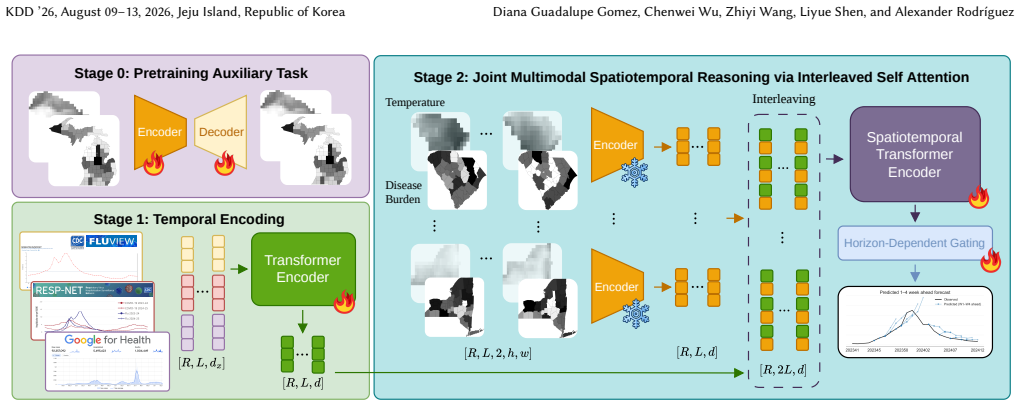
M-SPICE performs joint reasoning over temporal disease dynamics and spatial context via attention-based multimodal fusion, allowing spatial signals to selectively condition temporal representations across forecast horizons, and this leads to outperforming state-of-the-art baselines in real-world epidemic forecasting tasks.
What carries the argument
Attention-based multimodal fusion that selectively conditions temporal representations with spatially localized auxiliary signals.
If this is right
- Outperforms multivariate time-series, multimodal, and epidemiological forecasting baselines across settings.
- Maintains strong probabilistic forecasting performance.
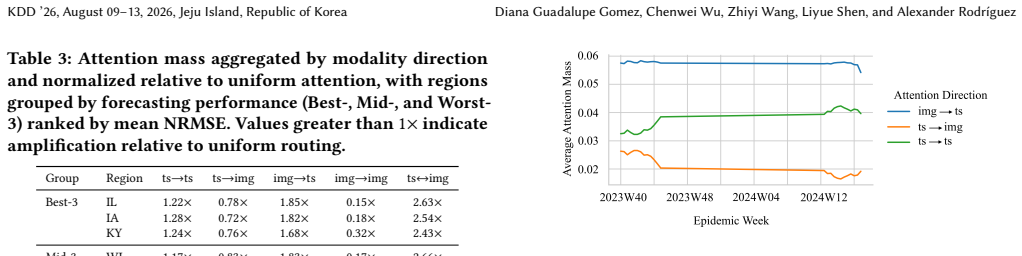
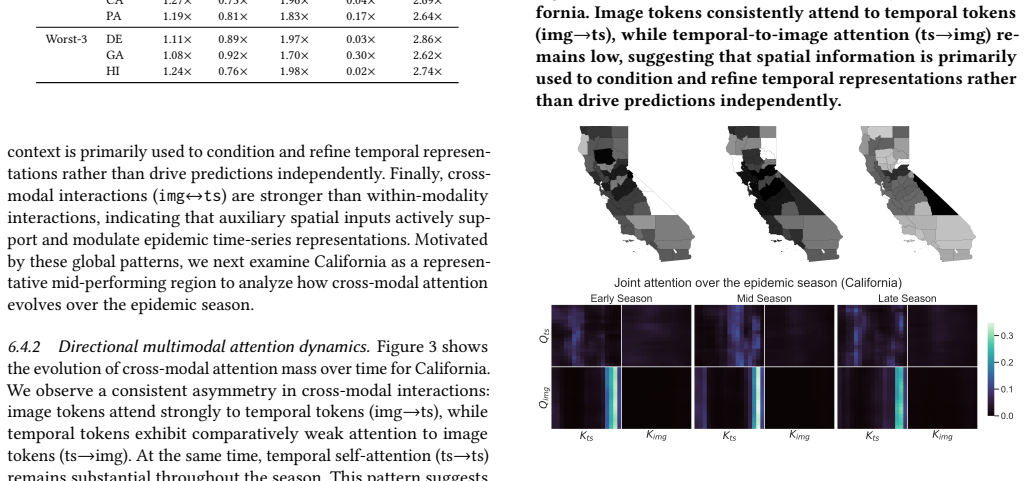
- Interpretability analyses show when, where, and how spatial signals are leveraged.
- Purely temporal, region-aggregated models are most likely to fail in certain settings.
Where Pith is reading between the lines
- This method might extend to forecasting other phenomena with spatiotemporal structure, such as traffic flow or environmental changes.
- Public health agencies could use the interpretability to prioritize data collection in regions where spatial signals matter most.
- Future work could test if the framework reduces the need for fine-grained surveillance data by leveraging cheaper auxiliary sources.
Load-bearing premise
Spatially localized auxiliary signals misaligned in resolution and structure can be selectively fused via attention to meaningfully condition temporal representations across forecast horizons.
What would settle it
Running the same real-time evaluation on COVID-19, influenza, and ILI datasets and finding that M-SPICE does not achieve higher accuracy or better probabilistic scores than the baselines would disprove the performance claim.
Figures
read the original abstract
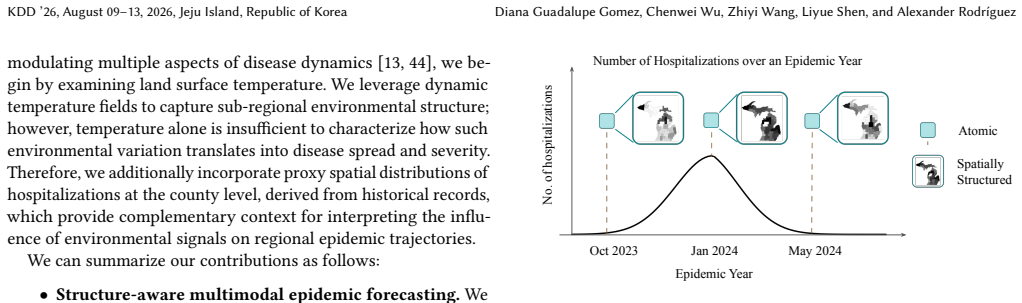
Epidemic forecasting models typically rely on surveillance data reported over administrative regions, treating them as atomic units, thereby obscuring sub-regional spatial structure that shapes disease dynamics. We introduce a spatially structured multimodal epidemic forecasting setting that integrates region-level temporal surveillance data with spatially localized auxiliary signals that are misaligned in resolution and structure, reflecting realistic public health reporting constraints. Building on this formulation, we propose M-SPICE (Multimodal SPatIal Context for Epidemic Forecasting), a structure-aware spatiotemporal forecasting framework that performs joint reasoning over temporal disease dynamics and spatial context via attention-based multimodal fusion, allowing spatial signals to selectively condition temporal representations across forecast horizons. We evaluate our approach on real-world COVID-19, influenza, and influenza-like illness (ILI) forecasting tasks under realistic real-time evaluation protocols. Across all forecasting settings, our method consistently outperforms state-of-the-art multivariate time-series, multimodal, and epidemiological forecasting baselines while maintaining strong probabilistic forecasting performance. Finally, interpretability analyses reveal when, where, and how spatial signals are leveraged, highlighting settings in which purely temporal, region-aggregated models are most likely to fail.
Editorial analysis
A structured set of objections, weighed in public.
Referee Report
Summary. The paper introduces a spatially structured multimodal epidemic forecasting setting that integrates region-level temporal surveillance data with spatially localized auxiliary signals misaligned in resolution and structure. It proposes the M-SPICE framework, which performs joint reasoning over temporal disease dynamics and spatial context via attention-based multimodal fusion to selectively condition temporal representations across forecast horizons. The work evaluates this on real-world COVID-19, influenza, and ILI forecasting tasks under realistic real-time protocols, claiming consistent outperformance over multivariate time-series, multimodal, and epidemiological baselines while maintaining strong probabilistic performance, supported by interpretability analyses on when spatial signals are leveraged.
Significance. If the claimed outperformance holds under rigorous evaluation, the work would be significant for epidemic forecasting by addressing the limitation of treating administrative regions as atomic units and incorporating realistic misaligned spatial auxiliary signals common in public health data. The attention-based selective fusion mechanism provides a plausible way to handle such data, and the interpretability analyses add value by identifying settings where purely temporal models fail. This could influence multimodal approaches in epidemiology and related spatiotemporal forecasting domains.
major comments (1)
- [Abstract] Abstract: the central claim that the method 'consistently outperforms state-of-the-art multivariate time-series, multimodal, and epidemiological forecasting baselines' across all forecasting settings is presented without any metrics, specific baselines, error bars, tables, figures, or evaluation protocol details, which is load-bearing for assessing the empirical contribution.
minor comments (1)
- [Abstract] The framework description in the abstract is high-level; expanding on the attention fusion mechanism with at least one equation or pseudocode would improve clarity for readers.
Simulated Author's Rebuttal
We thank the referee for their constructive feedback and positive assessment of the work's potential significance in advancing multimodal approaches to epidemic forecasting. We address the single major comment below.
read point-by-point responses
-
Referee: [Abstract] Abstract: the central claim that the method 'consistently outperforms state-of-the-art multivariate time-series, multimodal, and epidemiological forecasting baselines' across all forecasting settings is presented without any metrics, specific baselines, error bars, tables, figures, or evaluation protocol details, which is load-bearing for assessing the empirical contribution.
Authors: We agree that the abstract presents the performance claim at a high level without quantitative specifics or protocol details. This is conventional for abstracts due to length constraints, but the referee is correct that the claim is central and the abstract could be more informative on its own. The full manuscript provides all requested details in Sections 4 and 5, including the real-time evaluation protocol, specific baselines (multivariate time-series, multimodal, and epidemiological models), metrics with error bars, tables, and figures. We will revise the abstract to briefly reference the evaluation setting and note that results are supported by extensive quantitative comparisons in the main text. revision: yes
Circularity Check
No significant circularity detected
full rationale
The paper introduces a new multimodal forecasting setting and an attention-based architecture (M-SPICE) whose central claims rest on empirical outperformance across real-world tasks rather than any mathematical derivation or first-principles result. No equations, fitted parameters presented as predictions, self-definitional constructions, or load-bearing self-citations appear in the provided text. The evaluation protocol and interpretability analyses are independent of the model definition itself, so none of the enumerated circularity patterns apply.
Axiom & Free-Parameter Ledger
Reference graph
Works this paper leans on
-
[1]
Bijaya Adhikari, Xinfeng Xu, Naren Ramakrishnan, and B Aditya Prakash. 2019. Epideep: Exploiting embeddings for epidemic forecasting. InProceedings of the 25th ACM SIGKDD International Conference on Knowledge Discovery & Data Mining. 577–586
2019
-
[2]
Nick Altieri, Rebecca L Barter, James Duncan, Raaz Dwivedi, Karl Kumbier, Xiao Li, Robert Netzorg, Briton Park, Chandan Singh, Yan Shuo Tan, et al. 2021. Curating a COVID-19 Data Repository and Forecasting County-Level Death Counts in the United States.Harvard Data Science Review(2021)
2021
-
[3]
Duygu Balcan, Vittoria Colizza, Bruno Gonçalves, Hao Hu, José J Ramasco, and Alessandro Vespignani. 2009. Multiscale mobility networks and the spatial spreading of infectious diseases.Proceedings of the National Academy of Sciences 106, 51 (2009), 21484–21489
2009
-
[4]
Shailesh Bavadekar, Andrew Dai, John Davis, Damien Desfontaines, Ilya Eck- stein, Katie Everett, Alex Fabrikant, Gerardo Flores, Evgeniy Gabrilovich, Kr- ishna Gadepalli, et al. 2020. Google COVID-19 search trends symptoms dataset: Anonymization process description (version 1.0).arXiv preprint arXiv:2009.01265 (2020)
arXiv 2020
-
[5]
George E. P. Box, Gwilym M. Jenkins, Gregory C. Reinsel, and Greta M. Ljung. 2015.Time Series Analysis: Forecasting and Control. Wiley
2015
-
[6]
Centers for Disease Control and Prevention (CDC). 2025. Respiratory Virus Hospitalization Surveillance Network (RESP-NET). https://www.cdc.gov/resp- net/dashboard. Accessed: 2025-10-04
2025
-
[7]
Centers for Disease Control and Prevention (CDC). 2025. U.S. Outpatient Influenza-like Illness Surveillance Network (ILINet). https://www.cdc.gov/flu/ weekly/overview.htm. Accessed: 2025-10-04
2025
-
[8]
Matteo Chinazzi, Jessica T Davis, Ana Pastore y Piontti, Kunpeng Mu, Nicolò Gozzi, Marco Ajelli, Nicola Perra, and Alessandro Vespignani. 2024. A multiscale modeling framework for Scenario Modeling: Characterizing the heterogeneity of the COVID-19 epidemic in the US.Epidemics47 (2024), 100757
2024
-
[9]
KyungHyun Cho, Bart van Merrienboer, Dzmitry Bahdanau, and Yoshua Bengio
-
[10]
arXiv:1409.1259 http://arxiv.org/abs/1409
On the Properties of Neural Machine Translation: Encoder-Decoder Ap- proaches.CoRRabs/1409.1259 (2014). arXiv:1409.1259 http://arxiv.org/abs/1409. 1259
Pith/arXiv arXiv 2014
-
[11]
Esther Li Wen Choo, Kris V Parag, Jo Yi Chow, and Jue Tao Lim. 2026. Measur- ing real-time disease transmissibility with temperature-dependent generation intervals.PLOS Computational Biology22, 1 (2026), e1013820
2026
-
[12]
Ayush Chopra, Alexander Rodríguez, Jayakumar Subramanian, Arnau Quera- Bofarull, Balaji Krishnamurthy, B Aditya Prakash, and Ramesh Raskar. 2023. Differentiable Agent-based Epidemiology. InProceedings of the 2023 International Conference on Autonomous Agents and Multiagent Systems. 1848–1857
2023
-
[13]
Cramer, Evan L
Estee Y. Cramer, Evan L. Ray, Velma K. Lopez, Johannes Bracher, Andrea Brennen, Alvaro J. Castro Rivadeneira, Aaron Gerding, Tilmann Gneiting, Katie H. House, et al. 2022. Evaluation of individual and ensemble probabilistic forecasts of COVID-19 mortality in the United States.Proceedings of the National Academy of Sciences119, 15 (2022), e2113561119
2022
-
[14]
Benjamin D Dalziel, Stephen Kissler, Julia R Gog, Cecile Viboud, Ottar N Bjørnstad, C Jessica E Metcalf, and Bryan T Grenfell. 2018. Urbanization and humidity shape the intensity of influenza epidemics in US cities.Science362, 6410 (2018), 75–79
2018
-
[15]
Songgaojun Deng, Shusen Wang, Huzefa Rangwala, Lijing Wang, and Yue Ning
-
[16]
InProceedings of the 29th ACM international conference on information & knowledge management
Cola-GNN: Cross-location attention based graph neural networks for long- term ILI prediction. InProceedings of the 29th ACM international conference on information & knowledge management. 245–254
-
[17]
Junyi Gao, Rakshith Sharma, Cheng Qian, Lucas M Glass, Jeffrey Spaeder, Justin Romberg, Jimeng Sun, and Cao Xiao. 2021. STAN: spatio-temporal attention network for pandemic prediction using real-world evidence.Journal of the American Medical Informatics Association28, 4 (2021), 733–743
2021
-
[18]
Zhihan Gao, Xingjian Shi, Hao Wang, Yi Zhu, Yuyang Bernie Wang, Mu Li, and Dit-Yan Yeung. 2022. Earthformer: Exploring space-time transformers for earth system forecasting.Advances in Neural Information Processing Systems35 (2022), 25390–25403
2022
-
[19]
Isaac Gibbs and Emmanuel Candes. 2021. Adaptive Conformal Inference Un- der Distribution Shift. InAdvances in Neural Information Processing Systems, M. Ranzato, A. Beygelzimer, Y. Dauphin, P.S. Liang, and J. Wortman Vaughan (Eds.), Vol. 34. Curran Associates, Inc., 1660–1672. https://proceedings.neurips. cc/paper_files/paper/2021/file/0d441de75945e5acbc86...
2021
-
[20]
Vishrawas Gopalakrishnan, Sayali Pethe, Sarah Kefayati, Raman Srinivasan, Paul Hake, Ajay Deshpande, Xuan Liu, Etter Hoang, Marbelly Davila, Simone Bianco, et al. 2021. Globally local: Hyper-local modeling for accurate forecast of COVID-19.Epidemics37 (2021), 100510
2021
-
[21]
2023.ERA5 hourly data on single levels from 1940 to present
Hans Hersbach, Bill Bell, Paul Berrisford, Gianpaolo Biavati, András Horányi, Joaquín Muñoz Sabater, Julien Nicolas, Céline Peubey, Raluca Radu, Irina Rozum, Dirk Schepers, Adrian Simmons, Chiara Soci, Dick Dee, and Jean-Noël Thépaut. 2023.ERA5 hourly data on single levels from 1940 to present. doi:10.24381/cds. adbb2d47 Accessed: 23-08-2024
-
[22]
SIAM Review42(4), 599– 653 (2000)
Herbert W. Hethcote. 2000. The Mathematics of Infectious Diseases.SIAM Rev. 42, 4 (Jan. 2000), 599–653. doi:10.1137/S0036144500371907
-
[23]
Robert Hinch, William JM Probert, Anel Nurtay, Michelle Kendall, Chris Wymant, Matthew Hall, Katrina Lythgoe, Ana Bulas Cruz, Lele Zhao, Andrea Stewart, et al. 2021. OpenABM-Covid19—An agent-based model for non-pharmaceutical interventions against COVID-19 including contact tracing.PLoS computational biology17, 7 (2021), e1009146
2021
-
[24]
Inga Holmdahl and Caroline Buckee. 2020. Wrong but useful—what covid-19 epidemiologic models can and cannot tell us.New England Journal of Medicine 383, 4 (2020), 303–305
2020
-
[25]
Xiaoyong Jin, Yu-Xiang Wang, and Xifeng Yan. 2021. Inter-Series Attention Model for COVID-19 Forecasting. InProceedings of the 2021 SIAM International Conference on Data Mining (SDM). SIAM, 495–503
2021
-
[26]
Harshavardhan Kamarthi, Lingkai Kong, Alexander Rodríguez, Chao Zhang, and B Aditya Prakash. 2021. When in Doubt: Neural Non-Parametric Uncer- tainty Quantification for Epidemic Forecasting.Advances in Neural Information Processing Systems34 (2021)
2021
-
[27]
Aditya Prakash
Harshavardhan Kamarthi, Alexander Rodríguez, and B. Aditya Prakash. 2022. Back2Future: Leveraging Backfill Dynamics for Improving Real-time Predictions in Future. InThe Tenth International Conference on Learning Representations, ICLR 2022, Virtual Event, April 25-29, 2022. OpenReview.net. https://openreview.net/ forum?id=L01Nn_VJ9i
2022
-
[28]
Chen Liu, Wenfang Yao, Kejing Yin, William K Cheung, and Jing Qin. 2025. Multimodal Disease Progression Modeling via Spatiotemporal Disentanglement and Multiscale Alignment.Advances in Neural Information Processing Systems (2025)
2025
-
[29]
Madhav Marathe and Anil Kumar S Vullikanti. 2013. Computational epidemiology. Commun. ACM56, 7 (2013), 88–96
2013
-
[30]
Sarabeth M Mathis, Alexander E Webber, Tomás M León, Erin L Murray, Monica Sun, Lauren A White, Logan C Brooks, Alden Green, Addison J Hu, Roni Rosen- feld, et al. 2024. Evaluation of FluSight influenza forecasting in the 2021–22 and 2022–23 seasons with a new target laboratory-confirmed influenza hospitaliza- tions.Nature communications15, 1 (2024), 6289
2024
-
[31]
Vishwali Mhasawade, Yuan Zhao, and Rumi Chunara. 2021. Machine learning and algorithmic fairness in public and population health.Nature Machine Intelligence 3, 8 (2021), 659–666
2021
-
[32]
Payal Mohapatra, Yueyuan Sui, Akash Pandey, Stephen Xia, and Qi Zhu. 2025. MAESTRO: Adaptive Sparse Attention and Robust Learning for Multimodal Dy- namic Time Series. InThe Thirty-ninth Annual Conference on Neural Information Processing Systems
2025
-
[33]
Elaine O Nsoesie, John S Brownstein, Naren Ramakrishnan, and Madhav V Marathe. 2014. A systematic review of studies on forecasting the dynamics of influenza outbreaks.Influenza and other respiratory viruses8, 3 (2014), 309–316
2014
-
[34]
Dave Osthus and Kelly R Moran. 2021. Multiscale influenza forecasting.Nature communications12, 1 (2021), 1–11
2021
-
[35]
Sen Pei, Sasikiran Kandula, Wan Yang, and Jeffrey Shaman. 2018. Forecasting the spatial transmission of influenza in the United States.Proceedings of the National Academy of Sciences115, 11 (2018), 2752–2757
2018
-
[36]
Reich, Logan C
Nicholas G. Reich, Logan C. Brooks, Spencer J. Fox, Sasikiran Kandula, Craig J. McGowan, Evan Moore, Dave Osthus, Evan L. Ray, Abhinav Tushar, Teresa K. Yamana, Matthew Biggerstaff, Michael A. Johansson, Roni Rosenfeld, and Jeffrey Shaman. 2019. Accuracy of real-time multi-model ensemble forecasts for seasonal influenza in the US.Public Library of Science...
2019
-
[37]
Reich Lab. 2024. MetroCast Hub Data Portal. https://reichlab.io/metrocast- dashboard/datapage.html. Accessed: February 2026
2024
-
[38]
Cabr- era, Andrew Chin, Eu Jing Chua, Brian Clark, Sarah Colquhoun, Nat DeFries, David C
Alex Reinhart, Logan Brooks, Maria Jahja, Aaron Rumack, Jingjing Tang, Sumit Agrawal, Wael Al Saeed, Taylor Arnold, Amartya Basu, Jacob Bien, Ángel A. Cabr- era, Andrew Chin, Eu Jing Chua, Brian Clark, Sarah Colquhoun, Nat DeFries, David C. Farrow, Jodi Forlizzi, Jed Grabman, Samuel Gratzl, Alden Green, George Haff, Robin Han, Kate Harwood, Addison J. Hu,...
2021
-
[39]
Alexander Rodríguez, Jiaming Cui, Naren Ramakrishnan, Bijaya Adhikari, and B Aditya Prakash. 2023. Einns: epidemiologically-informed neural networks. In Proceedings of the AAAI conference on artificial intelligence, Vol. 37. 14453–14460
2023
-
[40]
Alexander Rodríguez, Harshavardhan Kamarthi, Pulak Agarwal, Javen Ho, Mira Patel, Suchet Sapre, and B Aditya Prakash. 2024. Machine learning for data-centric epidemic forecasting.Nature Machine Intelligence6, 10 (2024), 1122–1131. Beyond Time Series: Spatial Reasoning for Epidemic Forecasting via Multimodal Learning KDD ’26, August 09–13, 2026, Jeju Islan...
2024
-
[41]
Aditya Prakash
Alexander Rodríguez, Anika Tabassum, Jiaming Cui, Jiajia Xie, Javen Ho, Pulak Agarwal, Bijaya Adhikari, and B. Aditya Prakash. 2021. DeepCOVID: An Opera- tional Deep Learning-driven Framework for Explainable Real-time COVID-19 Forecasting. InProceedings of the AAAI Conference on Artificial Intelligence, Vol. 35. 15393–15400
2021
-
[42]
Wenxi Ruan, Yinglin Liang, Zhaobin Sun, and Xingqin An. 2025. Climate warming and influenza dynamics: the modulating effects of seasonal temperature increases on epidemic patterns.npj Climate and Atmospheric Science8, 1 (2025), 72
2025
-
[43]
Jeffrey Shaman and Melvin Kohn. 2009. Absolute humidity modulates influenza survival, transmission, and seasonality.Proceedings of the National Academy of Sciences106, 9 (2009), 3243–3248
2009
-
[44]
Jeffrey Shaman, Virginia E Pitzer, Cécile Viboud, Bryan T Grenfell, and Marc Lipsitch. 2010. Absolute humidity and the seasonal onset of influenza in the continental United States.PLoS biology8, 2 (2010), e1000316
2010
-
[45]
Xingjian Shi, Zhourong Chen, Hao Wang, Dit-Yan Yeung, Wai-Kin Wong, and Wang-chun Woo. 2015. Convolutional LSTM Network: A Machine Learn- ing Approach for Precipitation Nowcasting.CoRRabs/1506.04214 (2015). arXiv:1506.04214 http://arxiv.org/abs/1506.04214
Pith/arXiv arXiv 2015
-
[46]
Radina P Soebiyanto, Farida Adimi, and Richard K Kiang. 2010. Modeling and predicting seasonal influenza transmission in warm regions using climatological parameters.PloS one5, 3 (2010), e9450
2010
-
[47]
Guancheng Wan, Zewen Liu, Xiaojun Shan, Max S.Y. Lau, B. Aditya Prakash, and Wei Jin. 2025. Epidemiology-Aware Neural ODE with Continuous Disease Trans- mission Graph. InForty-second International Conference on Machine Learning
2025
-
[48]
Lijing Wang, Aniruddha Adiga, Jiangzhuo Chen, Adam Sadilek, Srinivasan Venka- tramanan, and Madhav Marathe. 2022. Causalgnn: Causal-based graph neural networks for spatio-temporal epidemic forecasting. InProceedings of the AAAI conference on artificial intelligence, Vol. 36. 12191–12199
2022
-
[49]
Shiyu Wang, Haixu Wu, Xiaoming Shi, Tengge Hu, Huakun Luo, Lintao Ma, James Y Zhang, and JUN ZHOU. 2024. TimeMixer: Decomposable Multiscale Mixing for Time Series Forecasting. InInternational Conference on Learning Representations (ICLR)
2024
-
[50]
Haixu Wu, Jiehui Xu, Jianmin Wang, and Mingsheng Long. 2021. Autoformer: Decomposition Transformers with Auto-Correlation for Long-Term Series Fore- casting. InAdvances in Neural Information Processing Systems
2021
-
[51]
Joseph T Wu, Kathy Leung, and Gabriel M Leung. 2020. Nowcasting and forecast- ing the potential domestic and international spread of the 2019-nCoV outbreak originating in Wuhan, China: a modelling study.The lancet395, 10225 (2020), 689–697
2020
-
[52]
Yuexin Wu, Yiming Yang, Hiroshi Nishiura, and Masaya Saitoh. 2018. Deep Learning for Epidemiological Predictions. InThe 41st International ACM SIGIR Conference on Research & Development in Information Retrieval. ACM, 1085–1088
2018
-
[53]
Zonghan Wu, Shirui Pan, Guodong Long, Jing Jiang, Xiaojun Chang, and Chengqi Zhang. 2020. Connecting the Dots: Multivariate Time Series Forecasting with Graph Neural Networks. InProceedings of the 26th ACM SIGKDD International Conference on Knowledge Discovery & Data Mining
2020
-
[54]
Yang Ye, Abhishek Pandey, Carolyn Bawden, Dewan Md Sumsuzzman, Rimpi Ra- jput, Affan Shoukat, Burton H Singer, Seyed M Moghadas, and Alison P Galvani
-
[55]
Integrating artificial intelligence with mechanistic epidemiological model- ing: a scoping review of opportunities and challenges.Nature Communications 16, 1 (2025), 581
2025
-
[56]
Bing Yu, Haoteng Yin, and Zhanxing Zhu. 2018. Spatio-temporal Graph Con- volutional Networks: A Deep Learning Framework for Traffic Forecasting. In Proceedings of the 27th International Joint Conference on Artificial Intelligence (IJCAI)
2018
-
[57]
Xinlu Zhang, Shiyang Li, Zhiyu Chen, Xifeng Yan, and Linda Ruth Petzold. 2023. Improving medical predictions by irregular multimodal electronic health records modeling. InInternational conference on machine learning. PMLR, 41300–41313
2023
-
[58]
Yunhao Zhang and Junchi Yan. 2023. Crossformer: Transformer Utilizing Cross- Dimension Dependency for Multivariate Time Series Forecasting. InInternational Conference on Learning Representations. A Data Preprocessing Spatial data preprocessing.Weekly county-level COVID-19 hospi- talization maps were constructed from CDC-reported admissions per100 ,000popu...
arXiv 2023
discussion (0)
Sign in with ORCID, Apple, or X to comment. Anyone can read and Pith papers without signing in.