Magnetovolume effect in SrRu1-xCoxO3 (x = 0.0, 0.05)
Pith reviewed 2026-06-26 10:52 UTC · model grok-4.3
The pith
The positive magnetovolume effect in SrRu1-xCoxO3 arises from competition between RuO6 octahedra tilting and Co2+ spin-orbit interaction.
A machine-rendered reading of the paper's core claim, the machinery that carries it, and where it could break.
Core claim
The magnetovolume effect in SrRu1-xCoxO3 is related to competition between robust tilting/rotation of RuO6 octahedra and spin-orbit interaction of the doped Co2+ ions.
What carries the argument
competition between robust tilting/rotation of RuO6 octahedra and spin-orbit interaction of the doped Co2+ ions
If this is right
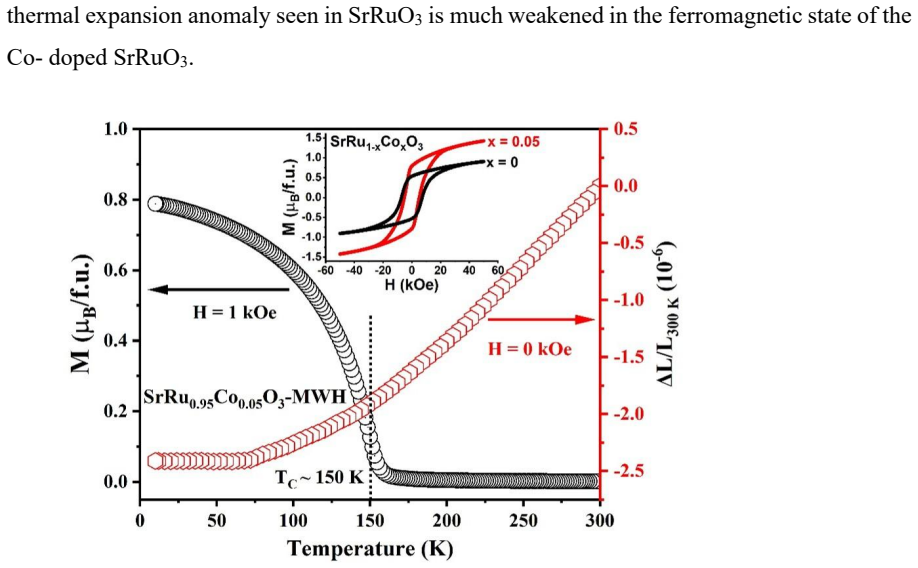
- The spontaneous thermal expansion is diminished upon 5% Co doping.
- The volume magnetostriction reaches a maximum of 60 ppm near the Curie temperature.
- Magnetostriction is anisotropic at 10 K but becomes isotropic above 80 K in the doped compound.
- Microwave synthesis produces samples with magnetic and transport properties matching those from conventional long-duration heating.
Where Pith is reading between the lines
- If the competition mechanism holds, similar volume effects may appear in other doped ruthenates where structural rigidity and spin-orbit coupling can be tuned independently.
- Direct structural probes could test whether octahedra tilting remains unchanged with doping as assumed.
- Extending measurements to higher doping levels might reveal whether spin-orbit effects eventually dominate the volume response.
Load-bearing premise
The measured isotropic expansion and its doping dependence can be attributed primarily to competition between octahedra tilting and Co spin-orbit coupling without direct structural refinement or calculations to isolate contributions.
What would settle it
Observation of significant changes in RuO6 octahedra tilting angles with Co doping via neutron diffraction would undermine the proposed mechanism.
Figures
read the original abstract
Polycrystalline SrRu1-xCoxO3 (x = 0.0, 0.05) and CaRuO3 were rapidly synthesized (< 1 hour) by microwave irradiation of oxide powders, and their magnetic, magnetoresistance, thermal expansion, and magnetostriction properties were investigated. The microwave-synthesised SrRuO3 exhibits a ferromagnetic transition at TC = 160 K, metallic-type resistivity, and negative magnetoresistance, with magnitudes comparable to those of a sample synthesized by conventional heating over 24 hours. Upon lowering the temperature from 300 K, the linear thermal expansion shows a transition from the usual contraction in the paramagnetic state to spontaneous expansion in the ferromagnetic state (invar-like effect). The application of an external magnetic field at a fixed temperature results in isotropic expansion of the length, implying a positive magnetovolume effect. The volume magnetostriction is 40 ppm at 10 K in a magnetic field of 50 kOe, and it reaches a maximum value of 60 ppm close to TC. The spontaneous thermal expansion is diminished in SrRu0.95Co0.05O3. While the magnetostriction is anisotropic at 10 K, the isotropic behaviour is recovered above 80 K, and the maximum value of the positive magnetovolume is comparable to that of the parent compound. Our results suggest that the magnetovolume effect in SrRu1-xCoxO3 is related to competition between robust tilting/rotation of RuO6 octahedra and spin-orbit interaction of the doped Co2+ ions
Editorial analysis
A structured set of objections, weighed in public.
Referee Report
Summary. The manuscript reports rapid microwave synthesis (<1 h) of polycrystalline SrRu1-xCoxO3 (x=0, 0.05) and CaRuO3, followed by measurements of magnetization, resistivity, magnetoresistance, linear thermal expansion, and magnetostriction. For x=0 the ferromagnetic transition occurs at TC=160 K with metallic resistivity and negative MR comparable to conventionally prepared samples; below TC an invar-like spontaneous expansion appears, and an external field produces isotropic positive magnetovolume (volume magnetostriction reaching 60 ppm near TC and 40 ppm at 10 K in 50 kOe). The spontaneous expansion is reduced upon 5 % Co doping while the maximum positive magnetovolume remains comparable; the authors conclude that the effect arises from competition between robust RuO6 octahedral tilting/rotation and spin-orbit coupling of the dilute Co2+ ions.
Significance. The experimental observation of a doping-dependent positive magnetovolume effect in these ruthenates adds concrete data on magnetoelastic coupling near the ferromagnetic transition. The microwave synthesis route is shown to yield samples with properties equivalent to those from 24-hour conventional heating, which is a practical methodological note. The interpretive claim linking the effect specifically to tilting-SOC competition, however, is not supported by any structural or computational evidence presented in the work.
major comments (1)
- [Abstract / concluding discussion] Abstract and final paragraph: the central interpretive statement that the magnetovolume effect 'is related to competition between robust tilting/rotation of RuO6 octahedra and spin-orbit interaction of the doped Co2+ ions' is unsupported by the data. The manuscript contains only bulk thermal-expansion, magnetostriction, magnetization, and resistivity curves; no Rietveld refinements, temperature-dependent lattice parameters, octahedral tilt angles, or DFT+SOC calculations are provided that would demonstrate (i) that tilting remains unchanged with 5 % Co substitution or (ii) that Co2+ SOC dominates over other possible contributions (e.g., doping-induced bandwidth changes or ordinary magnetoelastic coupling).
minor comments (2)
- The reported magnetostriction amplitudes (40 ppm, 60 ppm) are given without stated uncertainties or details on how the isotropic component was extracted from the three orthogonal measurements.
- Sample characterization is limited; inclusion of representative XRD patterns, SEM images, or oxygen stoichiometry analysis would strengthen the claim that the microwave-synthesized material is phase-pure and comparable to conventionally prepared specimens.
Simulated Author's Rebuttal
We thank the referee for the detailed review and constructive criticism. We address the single major comment below and will revise the manuscript accordingly.
read point-by-point responses
-
Referee: [Abstract / concluding discussion] Abstract and final paragraph: the central interpretive statement that the magnetovolume effect 'is related to competition between robust tilting/rotation of RuO6 octahedra and spin-orbit interaction of the doped Co2+ ions' is unsupported by the data. The manuscript contains only bulk thermal-expansion, magnetostriction, magnetization, and resistivity curves; no Rietveld refinements, temperature-dependent lattice parameters, octahedral tilt angles, or DFT+SOC calculations are provided that would demonstrate (i) that tilting remains unchanged with 5 % Co substitution or (ii) that Co2+ SOC dominates over other possible contributions (e.g., doping-induced bandwidth changes or ordinary magnetoelastic coupling).
Authors: We agree that the manuscript presents only bulk property measurements and contains no direct structural refinements, temperature-dependent lattice parameters, or DFT+SOC calculations. The interpretive statement in the abstract and concluding paragraph is therefore a hypothesis motivated by (a) the observed suppression of spontaneous expansion upon 5% Co substitution while the maximum positive magnetovolume remains comparable, and (b) literature knowledge of robust RuO6 tilting in SrRuO3 together with the large spin-orbit coupling expected for Co2+. We will revise both the abstract and the final paragraph to present the tilting-SOC competition as one possible explanation consistent with the doping trends, rather than as a firm conclusion. We will also add an explicit statement that further structural and theoretical studies are needed to test this scenario and to distinguish it from other magnetoelastic contributions. These textual changes will be incorporated in the revised manuscript. revision: yes
Circularity Check
No circularity; purely experimental report with direct measurements only
full rationale
The paper contains no equations, fitted parameters, predictions, or derivations. All reported quantities (TC, thermal expansion coefficients, magnetostriction values, resistivity) are direct experimental observations. The final sentence of the abstract offers an interpretive suggestion linking the data to octahedral tilting and Co SOC, but this is not derived from any model or self-referential chain within the paper. No self-citations, ansatzes, or uniqueness theorems are invoked as load-bearing steps. The derivation chain is empty; the work is self-contained against external benchmarks as a set of measurements.
Axiom & Free-Parameter Ledger
axioms (1)
- domain assumption Standard assumptions of condensed-matter sample preparation and measurement, including phase purity after synthesis and accurate control of temperature and magnetic field during dilatometry.
Reference graph
Works this paper leans on
-
[1]
1 R. J. Bouchard and J. L. Gillson, Electrical properties of CaRuO 3 and SrRuO3 single crystals, Mat. Res. Bull, 7, 873 (1972). 2 J. M. Longo, P. M. Raccah, and J. B. Goodenough, Magnetic Properties of SrRuO3 and CaRuO3, J. Appl. Phys., 39, 1327 (1968). 3 G. Herranz, B. Martı́nez, J. Fontcuberta, F. Sánchez, M. V. Garcı́a-Cuenca, C. Ferrater; and M
1972
-
[2]
Varela, SrRuO3/SrTiO3/SrRuO3 heterostructures for magnetic tunnel junctions, J. Appl. Phys. , 93, 8035 (2003). 4 J. P. Velev, C. G. Duan, J. D. Burton, A. Smogunov, M. K. Niranjan, E. Tosatti, S. S. Jaswal, E Y
2003
-
[3]
Lett., 9, 427 (2008)
Tsymbal, Magnetic Tunnel Junctions with Ferroelectric Barriers: Prediction of Four Resistance States from First Principle, Nano. Lett., 9, 427 (2008). 5 M. Cuoco, and A. Di Bernardo, Materials challenges for SrRuO 3: From conventional to quantum electronics APL Mater., 10, 090902 (2022). 6 Y. Gu, Q. Wang, We. Hu, W. Liu, Z. Zhang, F . Pan, and C. Song , A...
2008
-
[4]
Beasley, Structure, physical properties, and applications of SrRuO3 thin films, Rev. Mod. Phys., 84, 253-298 (2012). 8 N. Kikugwaga, R. Baumbach, J. S. Boorks, T. Terashima, S. Uji, and Y. Maeno, Single -crystal growth of perovskite ruthanate SrRuO 3 by floating zone method, Cryst . Growth De s., 15,5573 (2015). 9 S. Kunkemöller, F. Sauer, A. A. Nugroho, ...
2012
-
[5]
Balagurov, Evidence for band ferromagnetism in SrRuO3 from neutron diffraction, J. Magn. Magn. Mater, 305, 491 (2006). 18 B. Dabrowski, M. Adveev, C. Chmaissem, S. Kolenik, P. W. Klamut, M. Maxwell, and J. D
2006
-
[6]
Invar systems
Jorgensen, Freezing of octahedral tilts below the Curie temperature in SrRu1-vO3 perovskites, Phys. Rev. B, 71, 104411 (2005). 19 S. Lee, J. R. Zhang, S. Torii, S. Choi, D-Y. Cho, T. Kamiyama, J. Yu, K. A. McEwen and J-G. Park, Large-plane deformation of RuO6 octahedron and ferromagnetism of bulk SrRuO3, J. Phys:. Conden. Matt., 25, 465601 (2013). 15 20 F...
2005
-
[7]
Whittaker, T. D. Drysdale, S. W. King. D. H. Gregory, Modern Microwave methods in solid state inorganic materials chemistry: from fundamental to manufacturing, Chem. Rev., 114, 1170 (2014). 26 J. P. Siebert, C. M. Hamm, and C. S. Birkil, Microwave heating and spark plasma sintering as non- conventional synthesis methods to access thermoelectric and magnet...
2014
-
[8]
Biscarini, H. E. Troiani, J. Curiale, and R. D. Sanchez, Microwave assisted synthesis of manganese mixed oxide nanostructures using plastic templates, J. Solid State Chem., 177, 3949 (2004). 30 J. Prado-Gonjal, A. M. Arevalo-Lopez, and E. Moran, Microwave -assisted synthesis: A fast and efficient route to produce LaMO3 (M= Al, Cr, Mn, Fe, Co) perovskite m...
2004
discussion (0)
Sign in with ORCID, Apple, or X to comment. Anyone can read and Pith papers without signing in.