Quantum Otto engine with decoupled idle levels in a non-Hermitian XY model
Pith reviewed 2026-06-26 10:37 UTC · model grok-4.3
The pith
Tuning the non-Hermitian parameter in a two-qubit XY model transitions the system from dissipative behavior to a genuine quantum Otto heat engine while raising efficiency toward a fraction of the Carnot limit.
A machine-rendered reading of the paper's core claim, the machinery that carries it, and where it could break.
Core claim
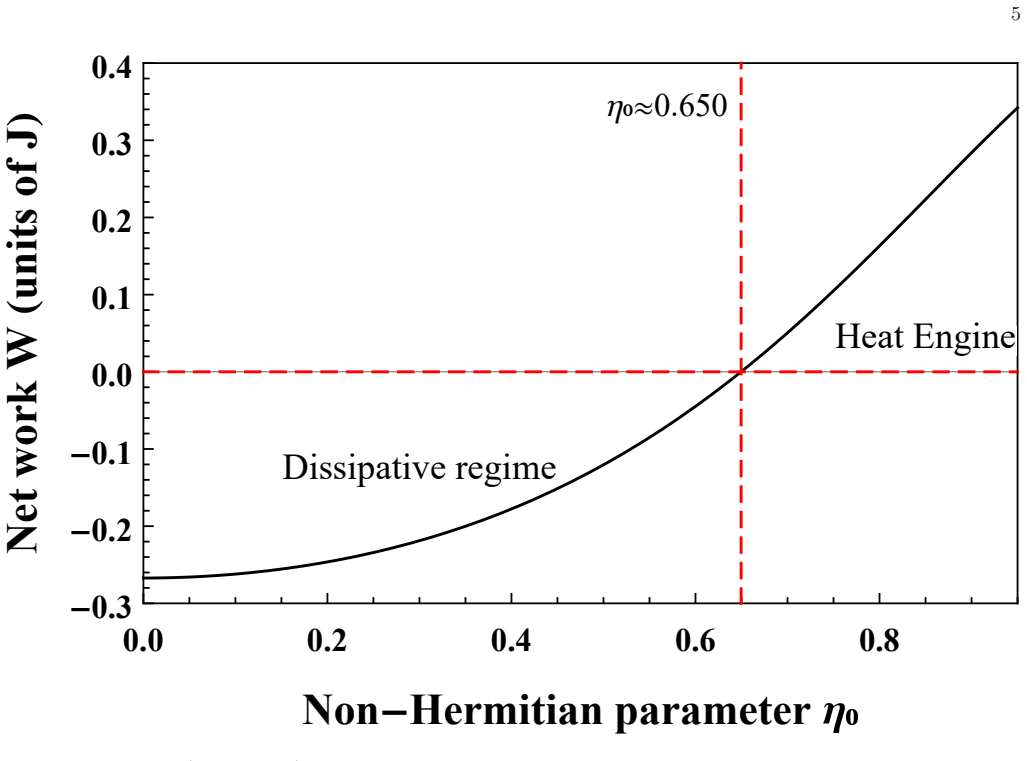
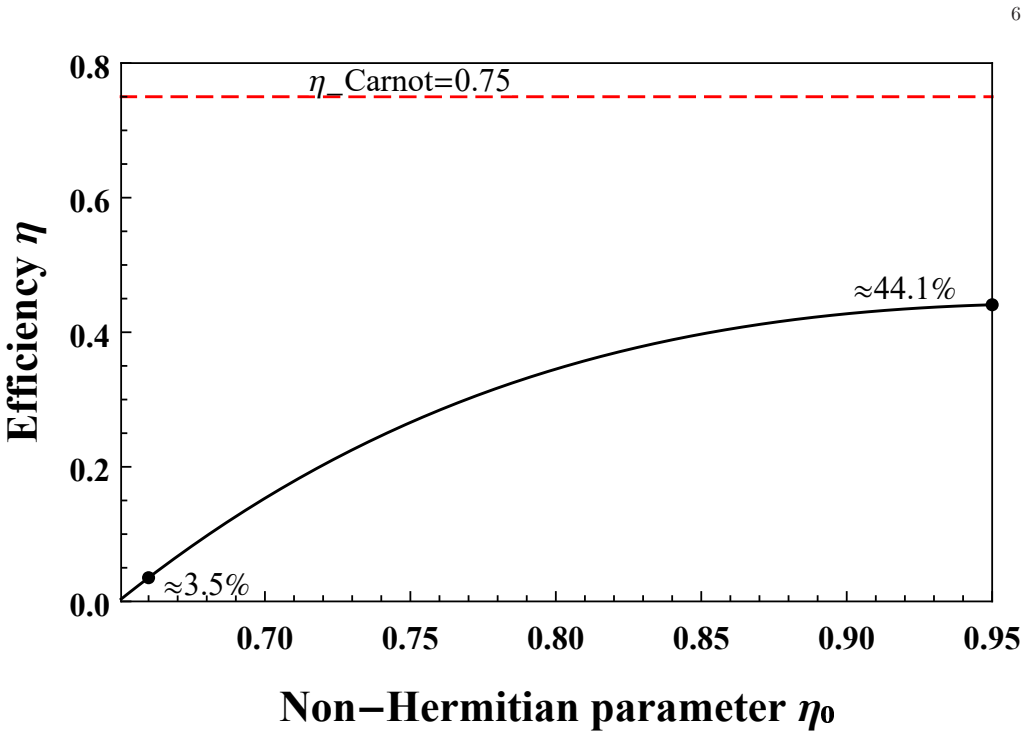
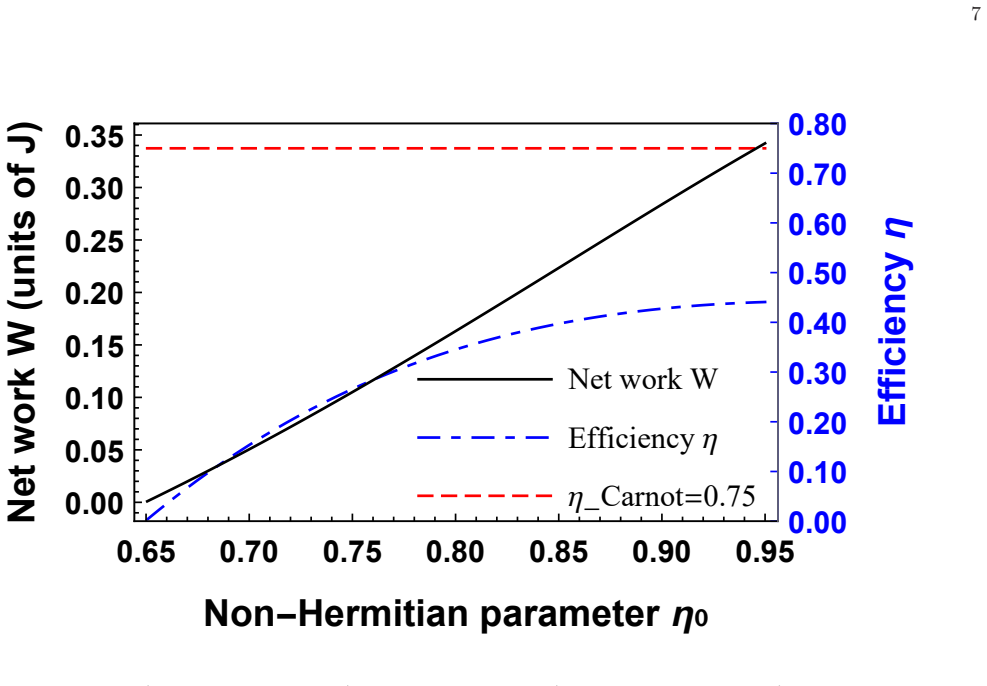
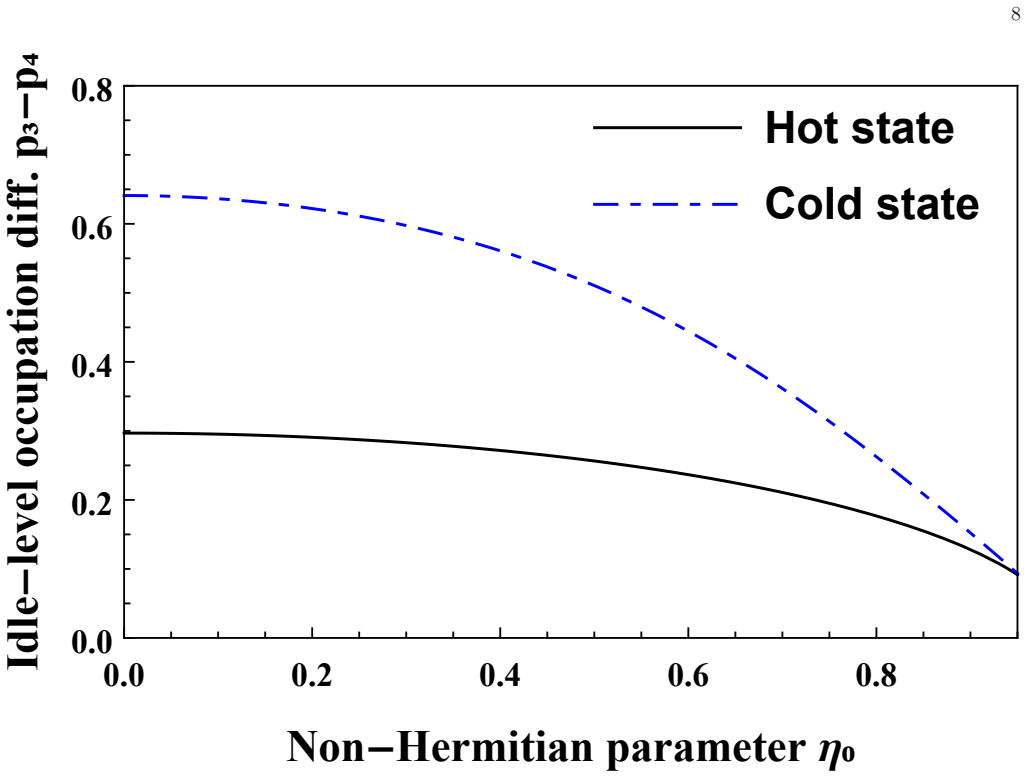
The energy spectrum of the two-qubit non-Hermitian XY model with staggered imaginary magnetic field naturally decouples into a pair of working levels dependent on the external field and a pair of idle levels completely independent of it. Tuning the non-Hermitian parameter eta_0 drives a continuous transition from a dissipative regime with negative net work and net heat absorption from the hot reservoir into a genuine heat engine mode, while simultaneously enhancing both output work and efficiency. As eta_0 increases within the stable PT-unbroken phase, the engine efficiency rises significantly, reaching a substantial fraction of the Carnot limit, because compression of the idle-level gap red
What carries the argument
Decoupling of the spectrum into field-dependent working levels and field-independent idle levels, with the non-Hermitian parameter eta_0 controlling the idle gap and thereby the thermal occupation weights.
If this is right
- The numerator of the net-work expression remains independent of eta_0 while the denominator varies through hyperbolic-cosine functions, supplying the mathematical basis for idle-level control.
- Engine efficiency increases continuously with eta_0 inside the PT-unbroken phase and reaches a substantial fraction of the Carnot value.
- The reported transition, work enhancement, and efficiency gain remain robust under variations of the model parameters.
- A concrete mapping exists for implementing the engine in trapped-ion quantum simulators.
Where Pith is reading between the lines
- The same idle-level compression effect might appear in other non-Hermitian spin chains if analogous spectral decoupling occurs.
- Engineering the non-Hermitian strength could become a practical handle for switching thermodynamic operating modes in small quantum devices.
- The mechanism offers a route to test how PT symmetry breaking boundaries affect heat-engine performance in open quantum systems.
Load-bearing premise
The energy spectrum naturally decouples into working levels that depend on the external field and idle levels that are completely independent of it.
What would settle it
A direct calculation or measurement showing that the idle levels acquire dependence on the external field once realistic noise, decoherence, or larger system sizes are included would falsify the idle-level control mechanism.
Figures
read the original abstract
We study a quantum Otto cycle in a two-qubit non-Hermitian XY model with a staggered imaginary magnetic field. The energy spectrum of this system naturally decouples into a pair of working levels that depend on the external field and a pair of idle levels that are completely independent of it, thereby providing the first concrete microscopic realization of the idle-level quantum heat engine architecture proposed by de~Oliveira and Jonathan [Phys. Rev. E 104, 044133 (2021)] in a physical spin model. Tuning the non-Hermitian parameter eta_0 drives a continuous transition from a dissipative regime with negative net work and net heat absorption from the hot reservoir into a genuine heat engine mode, while simultaneously enhancing both output work and efficiency. As eta_0 increases within the stable PT-unbroken phase, the engine efficiency rises significantly, reaching a substantial fraction of the Carnot limit. This effect originates from the compression of the idle-level gap, which redistributes the level occupation weights in the hot and cold equilibrium states and thereby modulates the absorbed heat. The numerator of the net work expression is independent of eta_0, but the denominator depends on eta_0 indirectly through hyperbolic cosine functions -- this is the mathematical root of the idle-level control mechanism. We provide a detailed analysis of the robustness of these findings against parameter variations, a critical comparison of the non-Hermitian control with the Hermitian limit, and a concrete experimental proposal for trapped-ion quantum simulators. Our results demonstrate that non-Hermiticity serves as an indispensable tool for steering both the operation mode and the performance of a quantum engine.
Editorial analysis
A structured set of objections, weighed in public.
Referee Report
Summary. The manuscript studies a quantum Otto cycle in a two-qubit non-Hermitian XY model with staggered imaginary magnetic field. The energy spectrum is claimed to decouple into working levels that depend on the external field and idle levels that are completely independent of it, providing a microscopic realization of the idle-level engine architecture of de Oliveira and Jonathan. Tuning the non-Hermitian parameter η₀ is shown to drive a continuous transition from a dissipative regime (negative net work, heat absorption from hot reservoir) to a genuine heat-engine regime while increasing both output work and efficiency, with the latter reaching a substantial fraction of the Carnot limit. This arises because the numerator of the net-work expression is independent of η₀ while the denominator depends on it through hyperbolic-cosine factors in the partition function; the effect is traced to compression of the idle-level gap that redistributes occupations. The paper includes robustness checks against parameter variations, a comparison with the Hermitian limit, and a trapped-ion experimental proposal.
Significance. If the decoupling and analytic expressions hold, the work supplies the first concrete physical spin-model realization of the idle-level quantum heat engine proposal and demonstrates non-Hermiticity as a control knob for both operation mode and performance. The explicit separation of η₀ dependence into numerator versus denominator, the robustness analysis, and the concrete experimental proposal are strengths. The result is of interest to the quantum thermodynamics and non-Hermitian physics communities.
major comments (2)
- [Hamiltonian and spectrum section] The central claim rests on the exact decoupling of idle-level energies from the external field (abstract and results description). The manuscript must supply the explicit Hamiltonian matrix and its eigenvalues (or a clear proof of independence) in the model-definition section so that readers can verify that the idle energies remain strictly field-independent; without this step the idle-level control mechanism lacks a demonstrated microscopic foundation.
- [Robustness analysis section] The robustness analysis examines variations of parameters inside the ideal model but supplies no checks against generic perturbations (small real staggered-field components, additional spin couplings, or environmental terms) that would generically make idle energies acquire field dependence. Because any such dependence would remove the claimed numerator-denominator separation and eliminate the η₀-driven transition to positive work, this omission is load-bearing for the assertion that the architecture is realized in a physical spin model.
minor comments (2)
- Ensure consistent notation for the non-Hermitian parameter (η₀ versus eta_0) across all equations and figure captions.
- The abstract states that efficiency reaches 'a substantial fraction of the Carnot limit'; a quantitative statement (e.g., the maximum ratio obtained) should appear in the main text or a table for precision.
Simulated Author's Rebuttal
We thank the referee for the positive assessment of our work and for the constructive major comments. We address each point below and will revise the manuscript accordingly.
read point-by-point responses
-
Referee: [Hamiltonian and spectrum section] The central claim rests on the exact decoupling of idle-level energies from the external field (abstract and results description). The manuscript must supply the explicit Hamiltonian matrix and its eigenvalues (or a clear proof of independence) in the model-definition section so that readers can verify that the idle energies remain strictly field-independent; without this step the idle-level control mechanism lacks a demonstrated microscopic foundation.
Authors: We agree. In the revised manuscript we will insert the explicit 4×4 Hamiltonian matrix (in the computational basis) together with the closed-form eigenvalues in the model-definition section. This will make the field-independence of the two idle eigenvalues immediately verifiable and will supply the required microscopic foundation for the idle-level architecture. revision: yes
-
Referee: [Robustness analysis section] The robustness analysis examines variations of parameters inside the ideal model but supplies no checks against generic perturbations (small real staggered-field components, additional spin couplings, or environmental terms) that would generically make idle energies acquire field dependence. Because any such dependence would remove the claimed numerator-denominator separation and eliminate the η₀-driven transition to positive work, this omission is load-bearing for the assertion that the architecture is realized in a physical spin model.
Authors: We acknowledge that the existing robustness section only varies parameters inside the exact model. Generic perturbations that break the precise form of the staggered imaginary field would indeed lift the decoupling. Because a systematic study of arbitrary perturbations would require an entirely different Hamiltonian and lies outside the scope of the present work, we will add a clarifying paragraph noting this limitation and emphasizing that the architecture is realized exactly only for the engineered non-Hermitian XY model proposed for trapped-ion implementation. revision: partial
Circularity Check
No significant circularity detected
full rationale
The paper's central derivation begins from the explicit two-qubit non-Hermitian XY Hamiltonian with staggered imaginary field, whose spectrum is stated to decouple into field-dependent working levels and field-independent idle levels; this decoupling is presented as following directly from diagonalization rather than being imposed by definition. Net work and efficiency expressions are then obtained from the resulting eigenvalues and the partition function containing hyperbolic-cosine factors whose eta_0 dependence is algebraic, not fitted or renamed. The sole external citation is to the de Oliveira-Jonathan proposal being realized, with no self-citation load-bearing the claims and no ansatz, uniqueness theorem, or prediction-by-construction steps. The reported eta_0-driven transition therefore retains independent content from the model's spectrum and thermodynamics.
Axiom & Free-Parameter Ledger
free parameters (1)
- eta_0
axioms (3)
- domain assumption The two-qubit non-Hermitian XY Hamiltonian with staggered imaginary magnetic field possesses an energy spectrum that exactly decouples into field-dependent working levels and field-independent idle levels.
- domain assumption The system remains inside the PT-unbroken phase for the range of eta_0 considered, so all eigenvalues stay real.
- standard math Standard quantum thermodynamics: the working medium reaches thermal equilibrium with hot and cold reservoirs during the isochoric strokes.
Reference graph
Works this paper leans on
-
[1]
In the computational basis {|↑↑⟩, |↑↓⟩, |↓↑⟩, |↓↓⟩}, H takes the block-diagonal form: H = − 2J h0 0 0 − 2J γ 0 − 2iJ η0 − 2J 0 0 − 2J 2iJ η0 0 − 2J γ 0 0 2 J h0
(3) Note that since σ α 1 σ α 2 = σ α 2 σ α 1 for Pauli matrices, the two forms of the Hamiltonian are mathematic ally identical. In the computational basis {|↑↑⟩, |↑↓⟩, |↓↑⟩, |↓↓⟩}, H takes the block-diagonal form: H = − 2J h0 0 0 − 2J γ 0 − 2iJ η0 − 2J 0 0 − 2J 2iJ η0 0 − 2J γ 0 0 2 J h0 . (4) This structure decouples the full Hilbert space ...
-
[2]
Hot isochore (h = hH , T = Th): the system equilibrates with the hot reservoir, reaching interna l energy U1 = U (hH , T h)
-
[3]
The occupation probabilities in the instantaneous biorthogonal eigenba sis remain frozen, yielding internal energy U2 = ∑ i p(1) i Ei(hC )
Adiabatic expansion (hH → hC ): the system is isolated and the external field h is slowly reduced. The occupation probabilities in the instantaneous biorthogonal eigenba sis remain frozen, yielding internal energy U2 = ∑ i p(1) i Ei(hC )
-
[4]
Cold isochore (h = hC , T = Tc): the system equilibrates with the cold reservoir, releasing heat an d attaining internal energy U3 = U (hC, T c)
-
[5]
Tianchi Talents
Adiabatic compression (hC → hH ): the external field h is slowly raised back to its initial value while the occupation probabilities stay frozen, leading to internal energy U4 = ∑ i p(3) i Ei(hH ). The heat exchanges and net work over one cycle satisfy Qh = U1 − U4, Q c = U2 − U3, W = Qh − Qc, (9) where Qh and Qc denote the heat exchanged with the hot and ...
-
[6]
= 0 (A8) gives the eigenvalues E3 = − 2J √ 1 − η2 0, E 4 = +2J √ 1 − η2
-
[7]
[34], we define the parameters for the idle-level subspace: d3 = iη0 + √ 1 − η2 0, d 4 = iη0 − √ 1 − η2
(A9) 10 Following Li et al. [34], we define the parameters for the idle-level subspace: d3 = iη0 + √ 1 − η2 0, d 4 = iη0 − √ 1 − η2
-
[8]
(A12) For the non-Hermitian idle-level subspace, we need to construct t he left eigenvectors (eigenvectors of H †) to form a biorthogonal basis
(A10) The unnormalized right eigenvectors are: |Ψ R 3 ⟩ = 1 √ 1 + |d3|2 (d3| ↑↓⟩+ | ↓↑⟩) , (A11) |Ψ R 4 ⟩ = 1 √ 1 + |d4|2 (d4| ↑↓⟩+ | ↓↑⟩) . (A12) For the non-Hermitian idle-level subspace, we need to construct t he left eigenvectors (eigenvectors of H †) to form a biorthogonal basis. The left eigenvectors satisfy ⟨Ψ L k |H = Ek⟨Ψ L k |, and their unnorma...
-
[9]
Computing the normalization constants ci = ⟨Ψ L i |Ψ R i ⟩ yields c3 = 1 + d3d∗ 5 = 2 √ 1 − η2 0 ( √ 1 − η2 0 + iη0 ) , (A16) c4 = 1 + d4d∗ 6 = 2 √ 1 − η2 0 ( √ 1 − η2 0 − iη0 )
(A15) Biorthogonal normalization The biorthonormality condition is ⟨Ψ L i |Ψ R j ⟩ = δij. Computing the normalization constants ci = ⟨Ψ L i |Ψ R i ⟩ yields c3 = 1 + d3d∗ 5 = 2 √ 1 − η2 0 ( √ 1 − η2 0 + iη0 ) , (A16) c4 = 1 + d4d∗ 6 = 2 √ 1 − η2 0 ( √ 1 − η2 0 − iη0 ) . (A17) We keep the left eigenvectors unchanged and scale the right eigenv ectors as |Ψ R...
-
[10]
95, the gap is 2 B = 4 J √ 1 − 0
(B2) 11 For η0 = 0 . 95, the gap is 2 B = 4 J √ 1 − 0. 952 ≈ 4J × 0. 312 ≈ 1. 25J, which is still sizable. With a typical cycle time τ ≫ 1/J , A34 ≪ 1 is easily satisfied. For η0 = 0 . 99, the gap shrinks to ≈ 0. 56J, making A34 about 5 times larger, and adiabaticity becomes harder to maintain. Our choice η0 < 0. 95 ensures A34 < 0. 01 for τ = 100 /J , con...
2081
-
[11]
J. Gemmer, M. Michel, and G. Mahler, Quantum Thermodynamics: Emergence of Thermodynamic Behav ior Within Composite Quantum Systems (Springer, Berlin, 2004). https://doi.org/10.1007/978-3-540-70510-9
-
[12]
S. Vinjanampathy and J. Anders, Contemp. Phys. 57, 545 (2016). https://doi.org/10.1080/00107514.2016.1201896
-
[13]
J. Goold, M. Huber, A. Riera, L. del Rio, and P. Skrzypczyk , J. Phys. A: Math. Theor. 49, 143001 (2016). https://doi.org/10.1088/1751-8113/49/14/143001
-
[14]
F. Binder, L. A. Correa, C. Gogolin, J. Anders, and G. Ades so (eds.), Thermodynamics in the Quantum Regime: Funda- mental Aspects and New Directions (Springer, Cham, 2018). https://doi.org/10.1007/978-3-319-99046-0
-
[15]
O. Abah, J. Roßnagel, G. Jacob, S. Deffner, F. Schmidt-Kal er, K. Singer, and E. Lutz, Phys. Rev. Lett. 109, 203006 (2012). https://doi.org/10.1103/PhysRevLett.109.203006
-
[16]
J. Roßnagel, S. T. Dawkins, K. N. Tolazzi, O. Abah, E. Lutz , F. Schmidt-Kaler, and K. Singer, Science 344, 1250091 (2014). https://doi.org/10.1126/science.1250091
-
[17]
J. Kl¨ atzow, J. N. Becker, P. M. Ledingham, C. Weinzettl, K. T. Kaczmarek, D. J. Saunders, J. Nunn, I. A. Walmsley, R. Uzdin, and E. Poem, Phys. Rev. Lett. 122, 110601 (2019). https://doi.org/10.1103/PhysRevLett.122.110601
-
[18]
J. P. S. Peterson, T. B. Batalh˜ ao, M. Herrera, A. M. Souza , R. S. Sarthour, I. S. Oliveira, and R. M. Serra, Phys. Rev. Lett. 123, 240601 (2019). https://doi.org/10.1103/PhysRevLett.123.240601
-
[19]
R. Alicki, J. Phys. A: Math. Gen. 12, L103 (1979). https://doi.org/10.1088/0305-4470/12/5/007
-
[20]
R. Kosloff, J. Chem. Phys. 80, 1625 (1984). https://doi.org/10.1063/1.446860
-
[21]
E. Geva and R. Kosloff, J. Chem. Phys. 96, 3054 (1992). https://doi.org/10.1063/1.461951
-
[22]
H. T. Quan, Y.-X. Liu, C. P. Sun, and F. Nori, Phys. Rev. E 76, 031105 (2007). https://doi.org/10.1103/PhysRevE.76.031105
-
[23]
R. Kosloff and Y. Rezek, Entropy 19, 136 (2017). https://doi.org/10.3390/e19040136
-
[24]
C. M. Bender and S. Boettcher, Phys. Rev. Lett. 80, 5243 (1998). https://doi.org/10.1103/PhysRevLett.80.5243
-
[25]
C. M. Bender, Rep. Prog. Phys. 70, 947 (2007). https://doi.org/10.1088/0034-4885/70/6/R03
-
[26]
Non-Hermitian physics and PT symmetry,
R. El-Ganainy, K. G. Makris, M. Khajavikhan, Z. H. Mussl imani, S. Rotter, and D. N. Christodoulides, Nat. Phys. 14, 11 (2018). https://doi.org/10.1038/nphys4323
-
[27]
V. V. Konotop, J. Yang, and D. A. Zezyulin, Rev. Mod. Phys . 88, 035002 (2016). https://doi.org/10.1103/RevModPhys.88.035002
-
[28]
L. Feng, R. El-Ganainy, and L. Ge, Nat. Photonics 11, 752 (2017). https://doi.org/10.1038/s41566-017-0031
-
[29]
˙S. K. ¨Ozdemir, S. Rotter, F. Nori, and L. Yang, Nat. Mater. 18, 783 (2019). https://doi.org/10.1038/s41563-019-0304-9
-
[30]
C. E. R¨ uter, K. G. Makris, R. El-Ganainy, D. N. Christod oulides, M. Segev, and D. Kip, Nat. Phys. 6, 192 (2010). https://doi.org/10.1038/nphys1515
-
[31]
Y. Ashida, Z. Gong, and M. Ueda, Adv. Phys. 69, 249 (2020). https://doi.org/10.1080/00018732.2021.1883316
-
[32]
S. Lin and Z. Song, Phys. Rev. E 92, 022135 (2015). https://doi.org/10.1103/PhysRevE.92.022135
-
[33]
A. Insinga, B. Andresen, P. Salamon, and R. Kosloff, Phys . Rev. E 97, 062153 (2018). https://doi.org/10.1103/PhysRevE.97.062153
-
[34]
J.-W. Zhang, J.-Q. Zhang, G.-Y. Ding, J.-C. Li, J.-T. Bu , B. Wang, L.-L. Yan, S.-L. Su, L. Chen, F. Nori, ˙S. K. ¨Ozdemir, F. Zhou, H. Jing, and M. Feng, Nat. Commun. 13, 6225 (2022). https://doi.org/10.1038/s41467-022-33932-9
-
[35]
Y. Chen, Y. Wang, and Z. Li, Chin. Phys. B 28, 100501 (2019). https://doi.org/10.1088/1674-1056/ab439a
-
[36]
S. K. Manikandan, S. Ghosh, and S. Nandi, J. Phys. A: Math . Theor. 52, 185302 (2019). https://doi.org/10.1088/1751-8121/ab167c
-
[37]
S. Dey, S. Bhattacharyya, and S. Chakraborty, EPL 130, 50003 (2020). https://doi.org/10.1209/0295-5075/130/50003
-
[38]
A. Purkayastha, M. Kulkarni, and R. Mukhopadhyay, Phys . Rev. B 101, 235412 (2020). https://doi.org/10.1103/PhysRevB.101.235412
-
[39]
W. Yang, Y. Ding, and Y. Chen, Phys. Rev. E 103, 052132 (2021). https://doi.org/10.1103/PhysRevE.103.052132
-
[40]
S. Khandelwal, N. Brunner, and G. Haack, arXiv:2101.11 553 [quant-ph] (2021). https://arxiv.org/abs/2101.11553
arXiv 2021
-
[41]
A. Mostafazadeh, Int. J. Geom. Methods Mod. Phys. 7, 1191 (2010). https://doi.org/10.1142/S0219887810001833
-
[42]
T. R. de Oliveira and D. Jonathan, Phys. Rev. E 104, 044133 (2021). https://doi.org/10.1103/PhysRevE.104.044133
-
[43]
A. M. N. de Almeida, T. R. de Oliveira, and D. Jonathan, ar Xiv:2312.12350 [quant-ph] (2023). https://arxiv.org/abs/2312.12350
arXiv 2023
-
[44]
Y. Li, P.-P. Zhang, L.-Z. Hu, Y.-L. Xu, and X.-M. Kong, Qu antum Inf. Process. 22, 277 (2023). https://doi.org/10.1007/s11128-023-04031-z
-
[45]
B. Gardas, S. Deffner, and A. Saxena, Sci. Rep. 6, 23408 (2016). https://doi.org/10.1038/srep23408
-
[46]
C. D. Bruzewicz, J. Chiaverini, R. McConnell, and J. M. S age, Appl. Phys. Rev. 6, 021314 (2019). https://doi.org/10.1063/1.5088164
-
[47]
J. Li, Z. Luo, T. Xin, H. Wang, D. Lu, and B. Zeng, npj Quant um Inf. 5, 1 (2019). https://doi.org/10.1038/s41534-018-0123-6
-
[48]
M. Campisi, P. H¨ anggi, and P. Talkner, Rev. Mod. Phys. 83, 771 (2011). https://doi.org/10.1103/RevModPhys.83.771 15
-
[49]
Reports on Progress in Physics75(12), 126001 (2012) https://doi.org/ 10.1088/0034-4885/75/12/126001
U. Seifert, Rep. Prog. Phys. 75, 126001 (2012). https://doi.org/10.1088/0034-4885/75/12/126001
-
[50]
C. Jarzynski, Phys. Rev. Lett. 78, 2690 (1997). https://doi.org/10.1103/PhysRevLett.78.2690
-
[51]
G. E. Crooks, J. Stat. Phys. 90, 1481 (1999). https://doi.org/10.1023/A:1023066317855
-
[52]
M. Esposito, U. Harbola, and S. Mukamel, Rev. Mod. Phys. 81, 1665 (2009). https://doi.org/10.1103/RevModPhys.81.1665
-
[53]
W. K. Wootters, Phys. Rev. Lett. 80, 2245 (1998). https://doi.org/10.1103/PhysRevLett.80.2245
-
[54]
Reviews of Modern Physics , volume =
L. Amico, R. Fazio, A. Osterloh, and V. Vedral, Rev. Mod. Phys. 80, 517 (2008). https://doi.org/10.1103/RevModPhys.80.517
-
[55]
R. Horodecki, P. Horodecki, M. Horodecki, and K. Horode cki, Rev. Mod. Phys. 81, 865 (2009). https://doi.org/10.1103/RevModPhys.81.865
-
[56]
E. Chitambar and G. Gour, Rev. Mod. Phys. 91, 025001 (2019). https://doi.org/10.1103/RevModPhys.91.025001
discussion (0)
Sign in with ORCID, Apple, or X to comment. Anyone can read and Pith papers without signing in.