Unified Mass-Scaled QPO Signatures of Kerr Sen Black Holes from Stellar Mass to Supermassive Sources
Pith reviewed 2026-06-26 10:00 UTC · model grok-4.3
The pith
Kerr-Sen black hole shock-cone oscillations produce QPO frequencies that scale inversely with mass to match observations from stellar-mass to supermassive black holes.
A machine-rendered reading of the paper's core claim, the machinery that carries it, and where it could break.
Core claim
The central claim is that the charge-related deformation of the Kerr-Sen spacetime alters shock-cone morphology and the resulting mass accretion rate variability, shifting characteristic frequencies and generating near-resonant harmonic structures close to 3:2 and 2:1 ratios; after inverse-mass scaling, these numerically obtained frequencies show reasonable agreement with observed QPOs in GRS 1915+105, IGR J17091-3624, M82 X-1, NGC 5408 X-1, RE J1034+396, 1H 0707-495, and ESO 113-G010, supporting the possibility of a unified framework for interpreting timing features across black hole mass ranges.
What carries the argument
The mass accretion rate time series extracted from numerical simulations of equatorial relativistic BHL flow around Kerr-Sen black holes, whose power spectral density is decomposed into multi-component Lorentzian profiles to isolate dominant QPO-like modes.
If this is right
- Kerr-Sen shock-cone oscillations can serve as a unified framework for timing features over a broad range of black hole masses.
- The approach may help constrain mass and spin parameters for sources whose properties remain observationally uncertain.
- Combined hydrodynamical and timing diagnostics can test the extent of empirical deviations from Kerr spacetime.
- Near-resonant harmonic structures produced in the simulations offer specific frequency ratios for observational comparison.
Where Pith is reading between the lines
- If the scaling holds, the same simulation pipeline could be rerun for other non-Kerr metrics to generate testable frequency templates.
- High-cadence monitoring of additional intermediate-mass black hole candidates could tighten bounds on the charge parameter.
- Incorporating radiative transfer post-processing would allow direct comparison with energy-dependent QPO data rather than accretion-rate proxies alone.
Load-bearing premise
The simulated mass accretion rate oscillations correspond directly to observed QPOs through simple inverse-mass scaling without further modeling of radiative transfer or disk emission.
What would settle it
Detection of QPO frequencies in any of the compared sources that deviate substantially from the mass-scaled values predicted by the Kerr-Sen shock-cone simulations, after accounting for the quoted spin values.
Figures



read the original abstract
In this study, we numerically investigate Bondi-Hoyle-Lyttleton (BHL) accretion around Kerr-Sen black holes and examine how the charge-related deformation of the spacetime affects the shock-cone morphology, the variation of the mass accretion rate, and the quasi-periodic oscillation (QPO)-like temporal behavior. The relativistic BHL flow is solved numerically in the equatorial plane for two different black hole spin parameters, a = 0.9 M and a = 0.5 M. From the numerically computed mass accretion rate signal, we calculate the power spectral density (PSD) and perform multi-component Lorentzian fits to identify the dominant QPO-like modes excited around the black hole. The results show that the Kerr-Sen deformation shifts the characteristic frequencies, changes the coherence properties of the oscillation modes, and produces near-resonant harmonic structures close to 3:2 and 2:1. By using inverse mass scaling, the numerically computed frequencies are compared with observed QPOs from stellar-mass, intermediate-mass, and supermassive black hole systems. In particular, reasonable agreement between the numerical simulation results and observations is found for the sources GRS 1915+105, IGR J17091-3624, M82 X-1, NGC 5408 X-1, RE J1034+396, 1H 0707-495, and ESO 113-G010. This comparative analysis indicates that Kerr-Sen black hole shock-cone oscillations may provide a unified framework for interpreting timing features over a broad range of black hole masses and may additionally contribute to constraining the mass and spin parameters of sources whose properties are not yet fully established observationally. These findings further imply that combined hydrodynamical and timing diagnostics constitute a promising approach for assessing the extent to which deviations associated with the Kerr-Sen geometry can be empirically distinguished from those of the Kerr spacetime.
Editorial analysis
A structured set of objections, weighed in public.
Referee Report
Summary. The manuscript numerically simulates equatorial Bondi-Hoyle-Lyttleton accretion onto Kerr-Sen black holes at spins a=0.9M and a=0.5M, extracts QPO-like modes from the PSD of the mass-accretion-rate time series via multi-Lorentzian fits, notes shifts and near-resonant 3:2/2:1 structures due to the charge deformation, and applies inverse-mass scaling to report reasonable agreement with observed QPOs in GRS 1915+105, IGR J17091-3624, M82 X-1, NGC 5408 X-1, RE J1034+396, 1H 0707-495, and ESO 113-G010, proposing that shock-cone oscillations supply a unified framework across stellar to supermassive scales.
Significance. If the frequency mapping survives radiative post-processing, the work would supply a concrete hydrodynamical mechanism for QPO generation in non-Kerr spacetimes and a potential route to joint mass-spin constraints; the numerical extraction of modes from BHL flows and the explicit inverse-mass scaling constitute reproducible steps that could be tested further.
major comments (2)
- [Numerical setup and comparison with observations] The unified-framework claim (abstract) rests on the premise that dominant frequencies identified in the Ṁ(t) PSD map directly to observed X-ray QPO frequencies. The simulations solve only the relativistic hydro equations; no radiative transfer, Comptonization, or disk-emission modeling is performed, leaving untested whether the reported 3:2 and 2:1 structures would survive in the emergent light curve.
- [Abstract and results] The statement of 'reasonable agreement' after inverse-mass scaling is presented without quantitative metrics, χ^{2} values, or resolution tests; the matches are described qualitatively, which weakens the cross-mass-scale claim.
minor comments (2)
- [Methods] The multi-Lorentzian fitting procedure and the precise definition of the charge deformation parameter's effect on the shock-cone frequencies could be stated more explicitly.
- [Results] Figure captions or tables listing the fitted frequencies, widths, and scaled values for each source would improve traceability of the comparisons.
Simulated Author's Rebuttal
We thank the referee for the constructive feedback on our manuscript. We address each major comment below and indicate the revisions we will incorporate in the next version.
read point-by-point responses
-
Referee: [Numerical setup and comparison with observations] The unified-framework claim (abstract) rests on the premise that dominant frequencies identified in the Ṁ(t) PSD map directly to observed X-ray QPO frequencies. The simulations solve only the relativistic hydro equations; no radiative transfer, Comptonization, or disk-emission modeling is performed, leaving untested whether the reported 3:2 and 2:1 structures would survive in the emergent light curve.
Authors: We agree that our simulations are purely hydrodynamical and do not include radiative transfer or emission modeling. This is an inherent limitation of the current study, and the direct mapping to X-ray light curves remains an assumption. Similar hydro-only analyses have been employed in prior QPO literature to identify dynamical mechanisms. We have revised the abstract, introduction, and discussion sections to explicitly frame the results as a hydrodynamical mechanism for QPO generation and to note that survival of the frequency structures in the emergent radiation requires future radiative post-processing. This clarification strengthens rather than weakens the unified-framework proposal by defining its current scope. revision: partial
-
Referee: [Abstract and results] The statement of 'reasonable agreement' after inverse-mass scaling is presented without quantitative metrics, χ² values, or resolution tests; the matches are described qualitatively, which weakens the cross-mass-scale claim.
Authors: We accept that the original presentation relies on qualitative description. In the revised manuscript we add a dedicated table that lists the inverse-mass-scaled numerical frequencies against the observed QPO values for each cited source, together with the relative percentage differences. We also include a short subsection reporting resolution tests (three grid resolutions) that demonstrate convergence of the dominant Lorentzian-fitted modes to within a few percent. These additions provide the requested quantitative support while preserving the original conclusions. revision: yes
Circularity Check
No significant circularity detected
full rationale
The paper's chain consists of independent numerical solution of relativistic BHL hydrodynamics in Kerr-Sen spacetime for fixed spins a=0.9M and a=0.5M, extraction of dominant frequencies via multi-Lorentzian fits to the PSD of the simulated Ṁ(t) time series, and subsequent application of standard inverse-mass scaling (f ∝ 1/M) for external comparison against observed QPO frequencies in listed sources. No step reduces by construction to its own inputs: the simulated frequencies are generated from the hydro equations without reference to the observational data, the Lorentzian fitting is performed on the numerical PSD alone, and the scaling is a physical expectation independent of the specific sources chosen for illustration. The text contains no self-citations, uniqueness theorems, or ansatzes that load-bear the central claim. The reported 'reasonable agreement' is a post-simulation comparison, not a fitted prediction or self-definitional equivalence.
Axiom & Free-Parameter Ledger
free parameters (2)
- Black hole spin parameter a =
0.9M, 0.5M
- Kerr-Sen charge deformation parameter
axioms (2)
- domain assumption The spacetime geometry is exactly the Kerr-Sen metric
- domain assumption BHL accretion can be accurately modeled in the equatorial plane with the chosen numerical scheme
Reference graph
Works this paper leans on
-
[1]
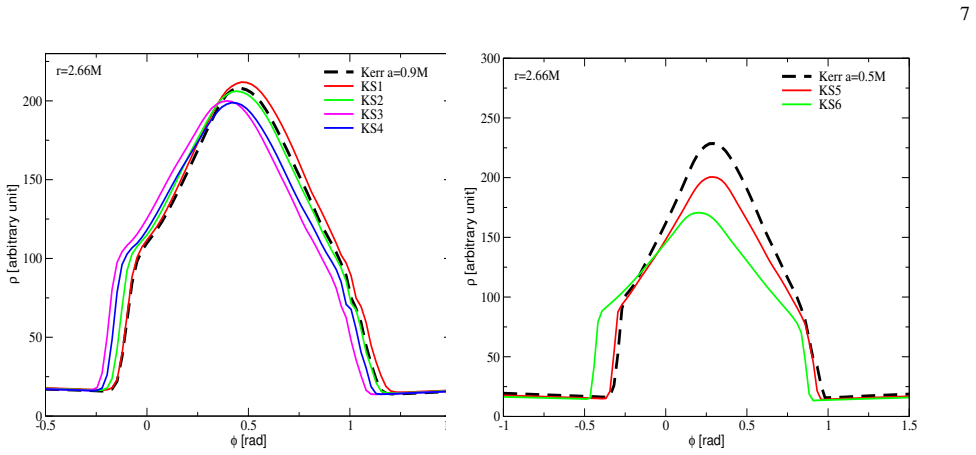
Thus, the inter- action between the black hole spin and the Kerr–Sen defor- mation parameters defines both the shock-cone morphology and the temporal behavior of the accretion rate. These resul ts show that the variation in the mass-accretion rate appears a s an important condition for observationally distinguishin g the 8 5000 10000 15000 20000 25000 3000...
-
[2]
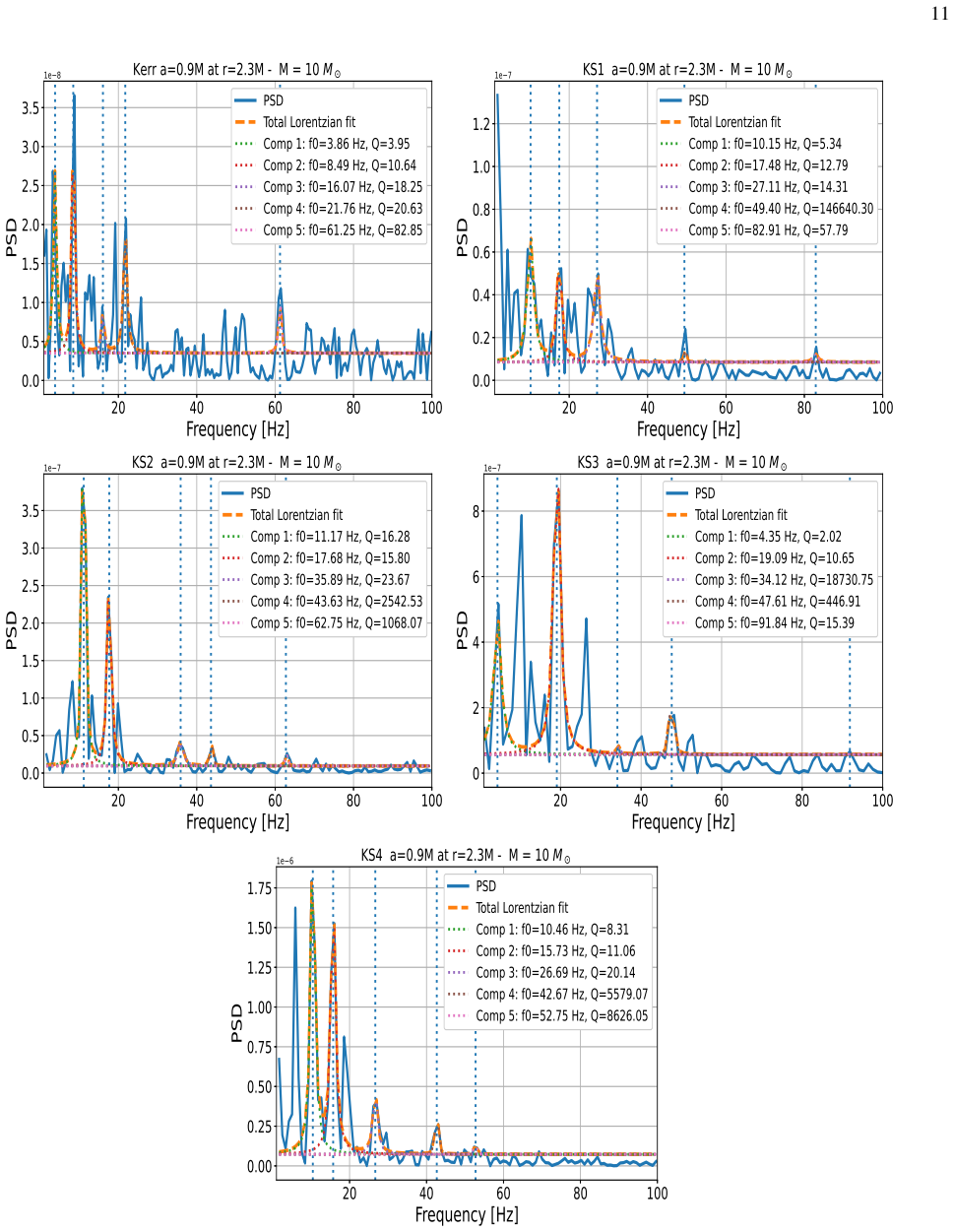
The dominant Lorentzian components occur approximately at 10 . 15, 17 . 48, 27 . 11, 49 . 40, and 82 . 91 Hz. The low-frequency components at 10 . 15 and 17 . 48 Hz show that the oscillations of the shock cone excite more than one mode in the inner accretion flow. The component around
-
[3]
11 Hz is particularly important because the ratio of these frequencies, 27 . 11/ 17. 48 ≃ 1. 55, gives an approximate 3:2 ratio. These types of resonance conditions are frequently discussed in the context of black-hole QPO phenomenology [ 34, 59, 60]. Such a near-commensurable structure may be the result of nonlinear couplings between the modes trapped in...
-
[4]
61, and 91 . 84 Hz. When compared with the KS1 and KS2 models, the frequency distribution is more irregular, show - ing that the stronger deformation changes the oscillatory r e- sponse of the accretion flow. The low-frequency component at
-
[5]
On the other hand, the components at 19
35 Hz may be a result of the global modulation of the shock cone. On the other hand, the components at 19 . 09, 34 . 12, and 47 . 61 Hz may have formed as a result of the excitation of the modes trapped inside the shock cone in the post-shock region. An approximately 2:1 ratio is observed between 91 . 84 and 47 . 61 Hz, since 91 . 84/ 47. 61 ≃1. 93. In ge...
-
[6]
67, and 52
69, 42 . 67, and 52 . 75 Hz. This model appears as one of the models that produces the clearest near-resonant struct ure among the models considered so far. For example, the ratio
-
[7]
73/ 10. 46 ≃ 1. 50 gives a value very close to the 3:2 re- lation. The ratio 52 . 75/ 26. 69 ≃ 1. 98 produces a resonance state very close to 2:1. Thus, the KS4 model, which describes a strongly deformed case, supports the formation of multipl e coupled oscillation modes. This behavior is consistent wit h the strong temporal variations previously observed...
-
[8]
90, and 68 . 72 Hz. The low-frequency component at
-
[9]
74 Hz has a very large quality factor, Q = 79. 04. This im- plies that this peak is highly coherent. This peak may have emerged as a result of the slow variation of the global mod- ulation of the shock structure. The component at 16 . 74 Hz has a very small quality factor. This shows that this peak is very broad and has very low coherence. This means that...
-
[10]
03, and 59 . 27 Hz. This model represents the case with the strongest Kerr–Sen deformation for the moderately rota t- ing black hole model with a = 0. 5M. The PSD structure formed in this case shows that more complex oscillation be- havior occurs. The low-frequency component at 11 . 63 Hz has a moderate quality factor. In contrast, the peak at 21 . 17 Hz ...
-
[11]
03/ 21. 17 ≃ 1. 99, which is very close to a 2:1 harmonic structure. In addition, 59 . 27 Hz gives 59 . 27/ 21. 17 ≃ 2. 80, indicating that higher-order harmonics or nonlinear coupl ings may exist. Thus, the KS6 model shows that, in the strongly de- formed case, a mixture of coherent peaks can form, together with broader oscillation components and near-ha...
1915
-
[12]
91 Hz obtained in the KS1 model are rescaled according to the observed mass range of this source, the frequencies ar e found to be in the ranges 0. 75–3 . 53 Hz and 1. 26–5 . 92 Hz. The numerical QPO-like peaks calculated for this source are com - patible with the observed 3 . 32 and 5 . 07 Hz QPOs. Thus, the KS1 model can reproduce the observed QPO pair ...
-
[13]
In the KS5 model, the frequencies obtained for a black hole with M = 10M⊙ are 53
5M also provides important comparison results for the source M82 X—1 as seen in Table III. In the KS5 model, the frequencies obtained for a black hole with M = 10M⊙ are 53. 90 and 68 . 72 Hz. When these frequencies are rescaled according to the observed mass range of M82 X–1, the QPO frequencies become 0 . 82–3 . 85 Hz and 1 . 04–4 . 91 Hz. These values f...
-
[14]
The corresponding observed black-hole masses vary in the range 1000–9000 M⊙
020 Hz. The corresponding observed black-hole masses vary in the range 1000–9000 M⊙. When the numerically com- puted frequencies 10 . 15 and 17 . 48 Hz of the rapidly rotating black-hole model KS1 are rescaled using the observed masses, the numerical results for the source NGC 5408 X–1 are found to be in the ranges 0 . 011–0 . 102 Hz and 0 . 019–0 . 175 H...
1915
-
[15]
74 Hz, computed for a black-hole mass of M = 10M⊙, are rescaled using the observed black-hole masses in the range 1000–9000 M⊙, the frequencies are found to occur in the ranges 0 . 005–0 . 047 Hz and 0 . 019–0 . 167 Hz. The sec- ond scaled frequency interval includes the observed 0 . 010–
-
[16]
Thus, the KS5 model can explain only part of the observed temporal behavior of this source
020 Hz range, while the first interval extends below the ob- served band. Thus, the KS5 model can explain only part of the observed temporal behavior of this source. However, the KS5 model does not naturally reproduce the observed range completely, as in the KS1 model. This implies that the KS1 model may be a stronger model for explaining the source NGC 54...
-
[17]
When the Kerr–Sen model KS1, namely the model with spin parameter a = 0
83) ×10−4 Hz, while the observed black-hole mass is re- ported to be in the range (1–4) ×106M⊙. When the Kerr–Sen model KS1, namely the model with spin parameter a = 0. 9M, is considered, the numerically computed frequencies for a black-hole mass of M = 10M⊙ are 49 . 40 and 82 . 91 Hz. If these frequencies are rescaled using the observed mass of th e sour...
-
[18]
These rescaled frequency intervals are com- patible with the observed QPO range
87) ×10−4 Hz. These rescaled frequency intervals are com- patible with the observed QPO range. Thus, both the KS1 and KS5 models are capable of explaining the observed temporal behavior of the source RE J1034 +396. On the other hand, the spin of this source has not been fully calculated. There- fore, due to the agreement between the numerically computed Q...
-
[19]
This appears as the numerical QPO-like be- 15 TABLE III
15) ×10−4 Hz. This appears as the numerical QPO-like be- 15 TABLE III. Comparison between observed intermediate-mass black-hole QPO candidates and the mass-scaled numerical Ke rr–Sen frequen- cies. The numerical frequencies are originally computed fo r M = 10M⊙and are rescaled using Eq. 11. Source Observed mass Observationally Observed QPOs Numeri cal mod...
-
[20]
Thus, the KS4 model can also explain the observed QPO frequency of 1H 0707–495
63 ×10−4 Hz at the upper edge of the scaled interval. Thus, the KS4 model can also explain the observed QPO frequency of 1H 0707–495. Since both the KS1 and KS4 models are results of the rapidly rotating case ( a = 0. 9M) of the Kerr– Sen family, the agreement between the models for this source shows that this source has a rapidly rotating black hole, as ...
1915
-
[21]
07 Hz has been observed from this source. When the nu- merical frequencies calculated for the rapidly rotating bl ack- hole model KS1 are recalculated with mass scaling by using the observed mass of this source, the frequency ranges 0 . 75–
-
[22]
53 Hz and 1 . 26–5 . 92 Hz are obtained. This is seen to be compatible with the frequency range observed from the source M82 X–1. At the same time, the numerical frequencies ob- tained from the KS5 model for the moderately rotating black hole are also seen to be compatible with the observational re - sults of the same source. In particular, the agreement ...
-
[23]
This suggests that this source may be com- patible with a moderate-to-rapidly rotating Kerr–Sen blac k hole
83 ×10−4 Hz. This suggests that this source may be com- patible with a moderate-to-rapidly rotating Kerr–Sen blac k hole. For the observed source 1H 0707–495, it is calculated that both the KS1 and KS4 models are compatible with the observed QPO frequency 2 . 63 ×10−4 Hz within the mass range predicted for the source. Since both models belong to the rapid...
-
[24]
79 ×10−5 Hz
70 ×10−5 Hz from the numerical results of KS5 is very close to the observed frequency component 6 . 79 ×10−5 Hz. On the other hand, the KS4 model is compatible only with the lower 17 part of the observed frequencies. Thus, from the comparison with supermassive black holes, it is found that the spin of th e source RE J1034 +396 lies in the moderate-to-rapi...
-
[25]
Roy P . Kerr. Gravitational field of a spinning mass as an exam- ple of algebraically special metrics. Phys. Rev. Lett. , 11:237– 238, 1963
1963
-
[26]
Chandrasekhar
S. Chandrasekhar. The Mathematical Theory of Black Holes. Fundam. Theor . Phys., 9:5–26, 1984
1984
-
[27]
First m87 event hor i- zon telescope results
Event Horizon Telescope Collaboration. First m87 event hor i- zon telescope results. vi. the shadow and mass of the central black hole. Astrophysical Journal Letters, 875:L6, 2019
2019
-
[28]
First sagittarius a* event horizon telescope results
Event Horizon Telescope Collaboration. First sagittarius a* event horizon telescope results. vi. testing the black hole metric. Astrophysical Journal Letters, 930:L17, 2022
2022
-
[29]
K. S. Stelle. Renormalization of Higher Derivative Quantum Gravity. Phys. Rev. D, 16:953–969, 1977
1977
-
[30]
Testing General Relativity with Prese nt and Future Astrophysical Observations
Emanuele Berti et al. Testing General Relativity with Prese nt and Future Astrophysical Observations. Class. Quant. Grav. , 32:243001, 2015
2015
-
[31]
Modified Gravity and Cosmology
Yashar Akrami et al. Modified Gravity and Cosmology. An Up- date by the CANTATA Network. Springer, 2021
2021
-
[32]
A first course in string theory
Barton Zwiebach. A first course in string theory . Cambridge university press, 2004
2004
-
[33]
Lectures on string theory , vol- ume 346
Dieter Lüst and Stefan Theisen. Lectures on string theory , vol- ume 346. Springer, 1989
1989
-
[34]
Gravity: An introduction to Einstein’s gene ral relativity, American Association of Physics Teachers, 200 3
James B Hartle. Gravity: An introduction to Einstein’s gene ral relativity, American Association of Physics Teachers, 200 3
-
[35]
Generalized hidden symmetries and the kerr - sen black hole
Tsuyoshi Houri, David Kubiz ˇnák, Claude M Warnick, and Y ukinori Yasui. Generalized hidden symmetries and the kerr - sen black hole. Journal of High Energy Physics , 2010(7):1–33, 2010
2010
-
[36]
Cosmic censorship conjecture in kerr-sen blac k hole
Bogeun Gwak. Cosmic censorship conjecture in kerr-sen blac k hole. Physical Review D, 95(12):124050, 2017
2017
-
[37]
Shadows of charged rotat- ing black holes: Kerr–newman versus kerr–sen
Sérgio Vinicius Monteiro CB Xavier, Pedro VP Cunha, Luís CB Crispino, and Carlos AR Herdeiro. Shadows of charged rotat- ing black holes: Kerr–newman versus kerr–sen. International Journal of Modern Physics D , 29(11):2041005, 2020
2020
-
[38]
Saswati Roy, Shubham Kala, Atanu Singha, Hemwati Nandan, and Asoke K. Sen. Deflection of light due to Kerr Sen black hole in heterotic string theory using material medium appro ach. Eur . Phys. J. C, 85(7):772, 2025
2025
-
[39]
The mathematical theory of black holes , volume 69
Subrahmanyan Chandrasekhar and Subrahmanyan Chan- drasekhar. The mathematical theory of black holes , volume 69. Oxford university press, 1998
1998
-
[40]
Null geodesics and observables around the kerr–sen black hole
Rashmi Uniyal, Hemwati Nandan, and KD Purohit. Null geodesics and observables around the kerr–sen black hole. Classical and Quantum Gravity , 35(2):025003, 2017
2017
-
[41]
Erratum: Charged black holes in string theory
David Garfinkle, Gary T Horowitz, and Andrew Strominger. Erratum: Charged black holes in string theory. Physical Review D, 45(10):3888, 1992
1992
-
[42]
Testing black hole candidates with electroma g- netic radiation
Cosimo Bambi. Testing black hole candidates with electroma g- netic radiation. Rev. Mod. Phys., 89(2):025001, 2017
2017
-
[43]
Bondi and F
H. Bondi and F. Hoyle. On the mechanism of accretion by stars. Monthly Notices of the Royal Astronomical Society , 104(5):273–282, 10 1944
1944
-
[44]
Hoyle and R
F. Hoyle and R. A. Lyttleton. The effect of interstellar matter on climatic variation. Proceedings of the Cambridge Philosophical Society, 35:405, January 1939
1939
-
[45]
Font, Jose M
Jose A. Font, Jose M. Ibanez, and Philippos Papadopoulos. Nu - merical simulations of relativistic wind accretion on to bl ack holes using godunov-type methods. 10 1999
1999
-
[46]
General Relativistic Magnetohydrody- namic Bondi–Hoyle Accretion
Andrew J Penner. General Relativistic Magnetohydrody- namic Bondi–Hoyle Accretion. Mon. Not. Roy. Astron. Soc. , 414:1467, 2011
2011
-
[47]
F. D. Lora-Clavijo, A. Cruz-Osorio, and Enrique Moreno Mén- dez. Relativistic Bondi–hoyle–lyttleton Accretion Onto a Ro- tating Black Hole: Density Gradients. Astrophys. J. Suppl. , 219(2):30, 2015
2015
-
[48]
The comparison of alternative spacetimes us- ing the spherical accretion around the black hole
Orhan Donmez. The comparison of alternative spacetimes us- ing the spherical accretion around the black hole. Mod. Phys. Lett. A, 39(16):2450076, 2024. 18
2024
-
[49]
From low- to high-frequency QPOs around the non-rotating hairy Horndeski black hole: Microquasar G RS 1915+105
Orhan Donmez. From low- to high-frequency QPOs around the non-rotating hairy Horndeski black hole: Microquasar G RS 1915+105. JHEAp, 45:1–18, 2025
1915
-
[50]
Accretion flow around kerr metric in the infra-red limit of asymptotically safe gr avity
Orhan Donmez, Sushant G Ghosh, Muhammad Y ousaf, Ghu- lam Mustafa, and Farruh Atamurotov. Accretion flow around kerr metric in the infra-red limit of asymptotically safe gr avity. J. Cosmol. Astropart. Phys., 2026(04):045, 2026
2026
-
[51]
Relativistic accretion process onto rotating black ho les in einstein-euler-heisenberg nonlinear electrodynamic g ravity
Orhan Donmez, G Mustafa, Himanshu Chaudhary, M Y ousaf, Abdelmalek Bouzenada, Allah Ditta, and Farruh Atamuro- tov. Relativistic accretion process onto rotating black ho les in einstein-euler-heisenberg nonlinear electrodynamic g ravity. Phys. Dark Universe, 52:102271, 2026
2026
-
[52]
Chakrabarti, K
Sandip K. Chakrabarti, K. Acharyya, and D. Molteni. Quasi- periodic oscillations in numerical simulation of accretio n flows around black holes. 11 2002
2002
-
[53]
On the development of QPOs in Bondi-Hoyle accretion flows
Orhan Donmez, Olindo Zanotti, and Luciano Rezzolla. On the development of QPOs in Bondi-Hoyle accretion flows. Mon. Not. Roy. Astron. Soc., 412:1659–1668, 2011
2011
-
[54]
Bondi-Hoyle-Lyttleton accretion around the rotating hairy Horndeski black hole
Orhan Donmez. Bondi-Hoyle-Lyttleton accretion around the rotating hairy Horndeski black hole. JCAP, 09:006, 2024
2024
-
[55]
Test- ing strong gravitational field using the Johannsen–Psaltis met- ric: Bondi–Hoyle–Lyttleton accretion model and QPO studie s
Orhan Donmez, Sardor Murodov, and Javlon Rayimbaev. Test- ing strong gravitational field using the Johannsen–Psaltis met- ric: Bondi–Hoyle–Lyttleton accretion model and QPO studie s. Annals Phys., 486:170350, 2026
2026
-
[56]
S. E. Motta, T. M. Belloni, L. Stella, T. Muñoz Darias, and R. Fender. Precise mass and spin measurements for a stellar- mass black hole through X-ray timing: the case of GRO J1655−40. Mon. Not. Roy. Astron. Soc. , 437(3):2554–2565, 2014
2014
-
[57]
Solutions to the relativistic pr e- cession model
Adam Ingram and Sara Motta. Solutions to the relativistic pr e- cession model. Mon. Not. Roy. Astron. Soc., 444(3):2065–2070, 2014
2065
-
[58]
Remillard and Je ffrey E
Ronald A. Remillard and Je ffrey E. McClintock. X-ray Prop- erties of Black-Hole Binaries. Ann. Rev. Astron. Astrophys. , 44:49–92, 2006
2006
-
[59]
S. E. Motta. Quasi periodic oscillations in black hole binar ies. Astron. Nachr ., 337(4/5):398–403, 2017
2017
-
[60]
A review of quasi-periodic oscil- lations from black hole X-ray binaries: observation and the ory
Adam Ingram and Sara Motta. A review of quasi-periodic oscil- lations from black hole X-ray binaries: observation and the ory. New Astron. Rev., 85:101524, 2019
2019
-
[61]
Belloni and Diego Altamirano
Tomaso M. Belloni and Diego Altamirano. Discovery of a 34 Hz Quasi-Periodic Oscillation in the X-ray emission of GRS 1915+105. Mon. Not. Roy. Astron. Soc. , 432:19, 2013
1915
-
[62]
Belloni, Dipankar Bhattacharya, Pietro Caccese, V arun Bhalerao, Santosh V adawale, and J
Tomaso M. Belloni, Dipankar Bhattacharya, Pietro Caccese, V arun Bhalerao, Santosh V adawale, and J. S. Yadav. A variable- frequency HFQPO in GRS 1915 +105 as observed with As- troSat. Mon. Not. Roy. Astron. Soc., 489(1):1037–1043, 2019
1915
-
[63]
Sreehari, Anuj Nandi, Santabrata Das, V
H. Sreehari, Anuj Nandi, Santabrata Das, V . K. Agrawal, Samir Mandal, M. C. Ramadevi, and Tilak Katoch. AstroSat view of GRS 1915 +105 during the soft state: detection of HFQPOs and estimation of mass and spin. Mon. Not. Roy. Astron. Soc. , 499(4):5891–5901, 2020
1915
-
[64]
spectro-temporal
N. Iyer, A. Nandi, and S. Mandal. Determination of the Mass of igr J17091–3624 From “spectro-temporal” V ariations Dur ing the Onset phase of the 2011 Outburst. Astrophys. J., 807(1):108, 2015
2011
-
[65]
Detection of X-Ray Polarization in the Hard State of IGR J17091-3624: Spectropolarimetric Study with IXPE and NuS- TAR Data
Dipak Debnath, Subham Srimani, and Hsiang-Kuang Chang. Detection of X-Ray Polarization in the Hard State of IGR J17091-3624: Spectropolarimetric Study with IXPE and NuS- TAR Data. Astrophys. J., 989(2):165, 2025
2025
-
[66]
Pasham, Tod E
Dheeraj R. Pasham, Tod E. Strohmayer, and Richard F. Mushotzky. A 400 solar mass black hole in the Ultraluminous X-ray source M82 X-1 accreting close to its Eddington limit. Nature, 513:74, 2014
2014
-
[67]
Mucciarelli, P
P . Mucciarelli, P . Casella, T. Belloni, Luca Zampieri, and P . Ranalli. A variable quasi-periodic ocillation in m82 x-1. tim- ing and spectral analysis of xmm-newton and rossixte observ a- tions. Mon. Not. Roy. Astron. Soc. , 365:1123–1130, 2006
2006
-
[68]
Pasham and Tod E
Dheeraj R. Pasham and Tod E. Strohmayer. A Multi-epoch Timing and Spectral Study of the Ultraluminous X-Ray Source NGC 5408 X-1 with XMM-Newton. 2012
2012
-
[69]
The host galaxy of a narrow- line Seyfert 1 galaxy, RE J1034+396, with X-ray quasi-periodic oscillations
Wei-Hao Bian and Kai Huang. The host galaxy of a narrow- line Seyfert 1 galaxy, RE J1034+396, with X-ray quasi-periodic oscillations. MNRAS, 401(1):507–512, January 2010
2010
-
[70]
A. C. Fabian, A. Zoghbi, D. Wilkins, T. Dwelly, P . Uttley, N. Schartel, G. Miniutti, L. Gallo, D. Grupe, S. Komossa, and M. Santos-Lleó. 1h 0707-495 in 2011: an x-ray source within a gravitational radius of the event horizon. Monthly Notices of the Royal Astronomical Society, 419(1):116–123, 01 2012
2011
-
[71]
Two Quasi- periodic Oscillations in ESO 113-G010
Peng Zhang, Jing-Zhi Yan, and Qing-Zhong Liu. Two Quasi- periodic Oscillations in ESO 113-G010. Chinese Astronomy and Astrophysics, 44(1):32–40, January 2020
2020
-
[72]
José A. Font. Numerical hydrodynamics in general relativit y. Living Reviews in Relativity , 6, 2000
2000
-
[73]
Code development of three-dimensional gen- eral relativistic hydrodynamics with AMR (Adaptive-Mesh Re- finement) and results from special and general relativistic hy- drodynamic
Orhan Donmez. Code development of three-dimensional gen- eral relativistic hydrodynamics with AMR (Adaptive-Mesh Re- finement) and results from special and general relativistic hy- drodynamic. Astrophys. Space Sci., 293:323–354, 2004
2004
-
[74]
Simulation of astrophysi- cal jet using the special relativistic hydrodynamics code
Orhan Donmez and Refik Kayali. Simulation of astrophysi- cal jet using the special relativistic hydrodynamics code. Appl. Math. Comput., 182:1286–1298, 2006
2006
-
[75]
Destroying kerr-sen black holes
Haryanto M Siahaan. Destroying kerr-sen black holes. Physical Review D, 93(6):064028, 2016
2016
-
[76]
Param- eters estimation and strong gravitational lensing of nonsi ngular kerr-sen black holes
Sushant G Ghosh, Rahul Kumar, and Shafqat Ul Islam. Param- eters estimation and strong gravitational lensing of nonsi ngular kerr-sen black holes. Journal of Cosmology and Astroparticle Physics, 2021(03):056, 2021
2021
-
[77]
Escape probability of particle fro m kerr-sen black hole
Ming Zhang and Jie Jiang. Escape probability of particle fro m kerr-sen black hole. Nuclear Physics B , 964:115313, 2021
2021
-
[78]
String e ffect on the relative time delay in the kerr–sen black hole
RN Izmailov, R Kh Karimov, AA Potapov, and KK Nandi. String e ffect on the relative time delay in the kerr–sen black hole. Annals of Physics, 413:168069, 2020
2020
-
[79]
Hidden conformal symmetry for dyonic kerr-sen black hole and its gauged fam- ily
Muhammad Fitrah Alfian Rangga Sakti. Hidden conformal symmetry for dyonic kerr-sen black hole and its gauged fam- ily. The European Physical Journal C , 83(3):255, 2023
2023
-
[80]
O. Donmez. Accretion dynamics and QPO signatures around quantum-corrected black hole: a comparison with Kerr space - time. Eur . Phys. J. C, 85(9):1019, 2025
2025
discussion (0)
Sign in with ORCID, Apple, or X to comment. Anyone can read and Pith papers without signing in.