Robust SCMA Codebook Design: A Hardware-Aware Autoencoder Approach
Pith reviewed 2026-06-26 09:34 UTC · model grok-4.3
The pith
An autoencoder trained with embedded CFO and Wiener phase noise models produces SCMA codebooks that suppress bit error floors in OFDM without real-time phase tracking.
A machine-rendered reading of the paper's core claim, the machinery that carries it, and where it could break.
Core claim
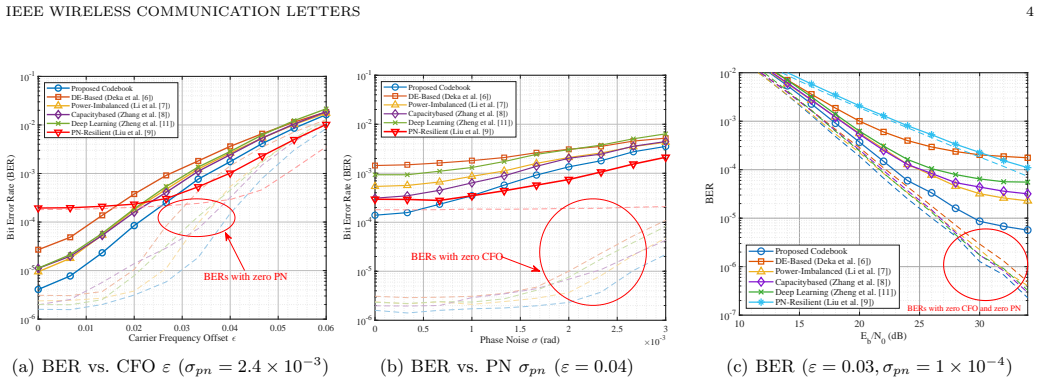
By embedding differentiable CFO and Wiener PN layers into the training loop of an end-to-end autoencoder, the learned SCMA codebooks suppress the bit error floors induced by these hardware impairments in OFDM-SCMA systems without requiring real-time phase tracking.
What carries the argument
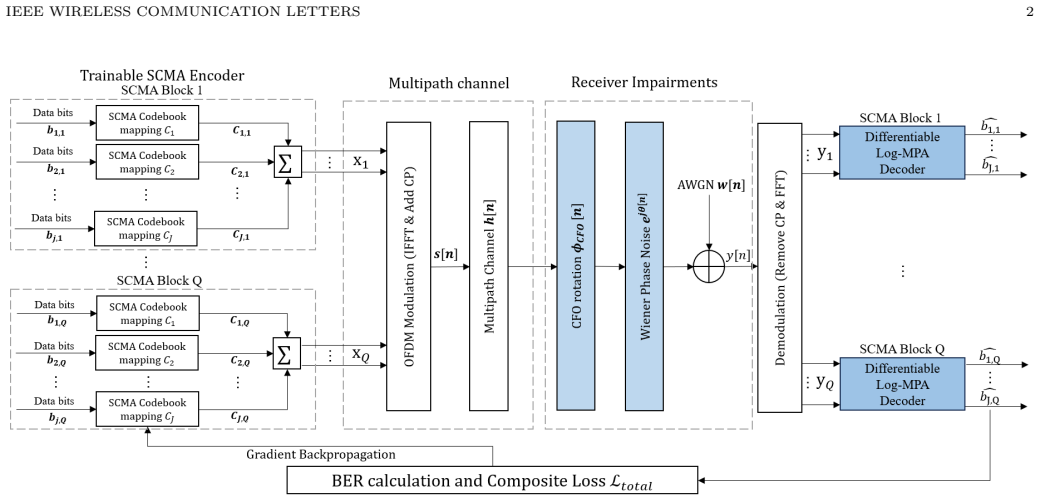
Hardware-aware end-to-end autoencoder that inserts differentiable CFO and Wiener PN layers directly into the training loop to optimize SCMA codebooks.
If this is right
- The codebooks maintain low error rates across a range of CFO and PN strengths without additional receiver compensation.
- System designers can avoid the latency and power cost of real-time phase tracking loops.
- The same training structure can be reused for other code-domain NOMA schemes that operate over OFDM.
- Multicarrier diversity is retained while the codebook itself compensates for orthogonality violations.
Where Pith is reading between the lines
- The method could be applied to additional impairments such as sampling clock offset or power amplifier nonlinearity by adding corresponding differentiable layers.
- If the learned codebooks generalize, receiver complexity in massive machine-type communication scenarios could drop because less digital signal processing is needed for phase correction.
- Training with hardware models may allow shorter pilot sequences, improving spectral efficiency in grant-free access.
Load-bearing premise
The statistical models of CFO and Wiener phase noise used inside the training loop match the behavior of the impairments that actually occur in deployed hardware.
What would settle it
Field tests or hardware-in-the-loop experiments that apply the learned codebooks to real RF front-ends and still observe bit-error-rate floors under measured CFO and PN levels would falsify the central claim.
Figures
read the original abstract
Sparse code multiple access (SCMA) is a promising code-domain non-orthogonal multiple access scheme which is transmitted over orthogonal frequency division multiplexing (OFDM) to exploit multicarrier diversity. In practice, however, carrier frequency offset (CFO) and phase noise (PN) may disrupt the subcarrier orthogonality in OFDM-SCMA systems. Addressing this research problem from a new SCMA codebook design angle, we propose a hardware-aware end-to-end autoencoder that embeds differentiable CFO and Wiener PN layers into the training loop. Simulations show that the proposed codebook effectively suppresses the bit error floors caused by CFO and PN without requiring real-time phase tracking.
Editorial analysis
A structured set of objections, weighed in public.
Referee Report
Summary. The manuscript proposes a hardware-aware end-to-end autoencoder for SCMA codebook design in OFDM systems. Differentiable CFO rotation and Wiener-process phase-noise layers are inserted after the modulator and used during training; the resulting codebooks are claimed to suppress BER floors induced by these impairments without requiring real-time phase tracking, with the claim supported by simulations under the modeled impairments.
Significance. If the learned codebooks prove robust when the assumed impairment statistics match real RF hardware, the approach would constitute a useful design methodology that directly optimizes SCMA constellations for practical impairments, potentially simplifying receiver processing in code-domain NOMA deployments.
major comments (2)
- [Abstract] Abstract: the claim that 'simulations show that the proposed codebook effectively suppresses the bit error floors' is presented without any description of simulation setup, baselines, number of Monte-Carlo trials, error-bar reporting, or data-exclusion criteria, rendering the central empirical claim unverifiable from the provided information.
- [Simulation and Evaluation] The training and evaluation both employ exactly the same differentiable CFO (constant normalized frequency offset) and Wiener-increment PN layers; no over-the-air measurements, no comparison against measured oscillator spectra, and no sensitivity analysis to model mismatch (e.g., time-correlated CFO or non-Wiener PN statistics) are reported. This directly bears on whether the reported floor suppression generalizes beyond the synthetic training distribution.
minor comments (1)
- [Abstract] Notation for the normalized CFO and PN variance parameters should be defined explicitly when first introduced, together with the numerical ranges used in training and testing.
Simulated Author's Rebuttal
We thank the referee for the constructive comments on our manuscript. We address each major comment below, clarifying the scope of our work and indicating planned revisions where appropriate.
read point-by-point responses
-
Referee: [Abstract] Abstract: the claim that 'simulations show that the proposed codebook effectively suppresses the bit error floors' is presented without any description of simulation setup, baselines, number of Monte-Carlo trials, error-bar reporting, or data-exclusion criteria, rendering the central empirical claim unverifiable from the provided information.
Authors: The abstract is intentionally concise to summarize the contribution. Full details of the simulation setup (OFDM-SCMA system parameters, CFO/PN models with specific normalized values), baselines (standard SCMA codebooks from literature and random designs), Monte-Carlo trials (at least 10^5-10^6 per SNR point for reliable BER estimation down to 10^-5), and evaluation criteria are provided in Sections III (system model and training) and IV (results and comparisons). No data exclusion was applied beyond standard error counting. We will revise the abstract to include a brief reference to these sections and key parameters to improve standalone verifiability. revision: partial
-
Referee: [Simulation and Evaluation] The training and evaluation both employ exactly the same differentiable CFO (constant normalized frequency offset) and Wiener-increment PN layers; no over-the-air measurements, no comparison against measured oscillator spectra, and no sensitivity analysis to model mismatch (e.g., time-correlated CFO or non-Wiener PN statistics) are reported. This directly bears on whether the reported floor suppression generalizes beyond the synthetic training distribution.
Authors: Our contribution centers on embedding differentiable impairment layers into the autoencoder training loop to optimize SCMA codebooks for robustness under the standard CFO and Wiener PN models used in the OFDM literature. Training and evaluation share the same model by design, as the objective is end-to-end optimization against these impairments without real-time tracking. We acknowledge that the work does not include over-the-air validation, measured hardware spectra, or mismatch sensitivity tests (e.g., to time-varying CFO or alternative PN processes). These aspects are outside the current simulation-focused scope. We will add an explicit limitations paragraph in the conclusion discussing generalization and suggesting future extensions to real hardware and model mismatch. revision: partial
Circularity Check
No significant circularity; validation rests on external simulation benchmarks
full rationale
The manuscript describes an end-to-end autoencoder whose training loop incorporates differentiable CFO rotation and Wiener-process PN layers, with all reported BER results generated from Monte-Carlo simulations that employ exactly those same synthetic impairment models. No equations, fitted parameters, or self-citations are shown that would reduce the claimed floor-suppression result to a tautological re-statement of the training inputs. The performance claims are therefore evaluated against an independent simulation benchmark rather than by construction, placing the work in the normal non-circular category.
Axiom & Free-Parameter Ledger
Reference graph
Works this paper leans on
-
[1]
Sparse code multiple access,
H. Nikopour and H. Baligh, “Sparse code multiple access,” in 2013 IEEE 24th Annual International Symposium on Personal, Indoor, and Mobile Radio Communications (PIMRC), 2013, pp. 332–336
2013
-
[2]
Sparse or dense: A comparative study of code-domain NOMA systems,
Z. Liu and L.-L. Yang, “Sparse or dense: A comparative study of code-domain NOMA systems,” IEEE Transactions on Wireless Communications, vol. 20, no. 8, pp. 4768–4780, 2021
2021
-
[3]
Evolution of NOMA toward next generation multiple access (NGMA) for 6G,
Y. Liu, S. Zhang, X. Mu, Z. Ding, R. Schober, N. Al-Dhahir, E. Hossain, and X. Shen, “Evolution of NOMA toward next generation multiple access (NGMA) for 6G,” IEEE Journal on Selected Areas in Communications, vol. 40, no. 4, pp. 1037– 1071, 2022
2022
-
[4]
SCMA codebook design,
M. Taherzadeh, H. Nikopour, A. Bayesteh, and H. Baligh, “SCMA codebook design,” in 2014 IEEE 80th Vehicular Tech- nology Conference (VTC2014-Fall), 2014, pp. 1–5
2014
-
[5]
Understanding the effects of phase noise in orthogonal frequency division multiplexing (OFDM),
A. Garcia Armada, “Understanding the effects of phase noise in orthogonal frequency division multiplexing (OFDM),” IEEE Transactions on Broadcasting, vol. 47, no. 2, pp. 153–159, 2001
2001
-
[6]
Design of SCMA codebooks using differential evolution,
K. Deka, M. Priyadarsini, S. Sharma, and B. Beferull-Lozano, “Design of SCMA codebooks using differential evolution,” in 2020 IEEE International Conference on Communications Work- shops (ICC Workshops), 2020, pp. 1–7. IEEE WIRELESS COMMUNICATION LETTERS 6
2020
-
[7]
Design of power-imbalanced SCMA codebook,
X. Li, Z. Gao, Y. Gui, Z. Liu, P. Xiao, and L. Yu, “Design of power-imbalanced SCMA codebook,” IEEE Transactions on Vehicular Technology, vol. 71, no. 2, pp. 2140–2145, 2022
2022
-
[8]
A capacity-based codebook design method for sparse code multiple access systems,
S. Zhang, K. Xiao, B. Xiao, Z. Chen, B. Xia, D. Chen, and S. Ma, “A capacity-based codebook design method for sparse code multiple access systems,” in 2016 8th International Conference on Wireless Communications & Signal Processing (WCSP), 2016, pp. 1–5
2016
-
[9]
BER analysis of SCMA-OFDM systems in the presence of carrier frequency offset,
H. Liu, Q. Luo, Z. Liu, S. Luo, P. Xiao, and R. Lin, “BER analysis of SCMA-OFDM systems in the presence of carrier frequency offset,” IEEE Communications Letters, vol. 28, no. 1, pp. 213–217, 2024
2024
-
[10]
Phase noise resilient codebook design for sparse code multiple access,
H. Liu, Q. Luo, Z. Liu, S. Luo, P. Xiao, and X. Yuan, “Phase noise resilient codebook design for sparse code multiple access,” IEEE Wireless Communications Letters, vol. 14, no. 6, pp. 1603– 1607, 2025
2025
-
[11]
An introduction to deep learning for the physical layer,
T. O’Shea and J. Hoydis, “An introduction to deep learning for the physical layer,” IEEE Transactions on Cognitive Commu- nications and Networking, vol. 3, no. 4, pp. 563–575, 2017
2017
-
[12]
A deep learning- based codebook design method with MED constraints for uplink SCMA systems,
Y. Zheng, X. Hou, H. Wang, and S. Zhang, “A deep learning- based codebook design method with MED constraints for uplink SCMA systems,” IEEE Internet of Things Journal, vol. 13, no. 2, pp. 2383–2394, 2026
2026
-
[13]
A novel multitask learning empowered codebook design for downlink SCMA networks,
Q. Luo, Z. Liu, G. Chen, Y. Ma, and P. Xiao, “A novel multitask learning empowered codebook design for downlink SCMA networks,” IEEE Wireless Communications Letters, vol. 11, no. 6, pp. 1268–1272, 2022
2022
-
[14]
Phase noise estimation in OFDM systems,
B. Gävert, M. Coldrey, and T. Eriksson, “Phase noise estimation in OFDM systems,” IEEE Transactions on Communications, vol. 73, no. 6, pp. 4349–4362, 2025
2025
discussion (0)
Sign in with ORCID, Apple, or X to comment. Anyone can read and Pith papers without signing in.