Tensor Train Decomposition-based 3D Implicit Full Waveform Inversion with Multi-scale Structural Similarity
Pith reviewed 2026-06-26 06:13 UTC · model grok-4.3
The pith
Tensor train decomposition of the velocity model into core tensors predicted by axis-specific implicit networks enables memory-efficient 3D full waveform inversion.
A machine-rendered reading of the paper's core claim, the machinery that carries it, and where it could break.
Core claim
The 3D velocity model is expressed as the product of low-rank core tensors in tensor train format, each core predicted by an axis-specific implicit neural network; optimizing these networks with a multi-scale structural similarity loss yields accurate and continuous velocity reconstructions from 3D full waveform data, even under challenging conditions such as poor starting models or absent low frequencies.
What carries the argument
Tensor train (TT) decomposition of the velocity model into low-rank core tensors, each generated by an axis-specific implicit neural network (INR) from 1D coordinate inputs.
If this is right
- The inversion maintains high resolution and accuracy with significantly lower memory consumption than direct INR methods.
- Structural consistency from the low-rank TT structure improves continuity of the reconstructed velocity field.
- The M-SSIM loss mitigates cycle skipping by leveraging multi-scale features including ultra-low frequencies.
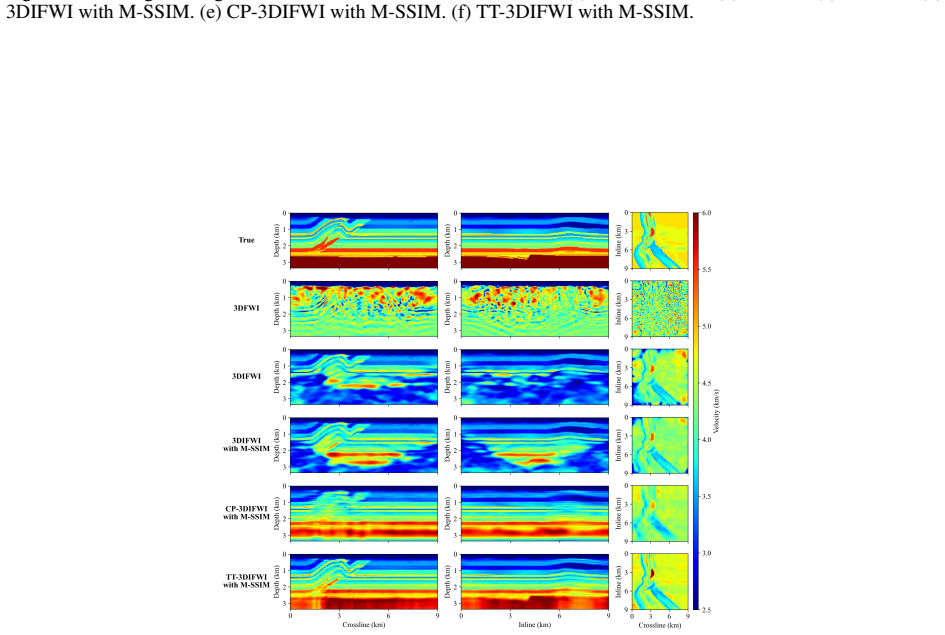
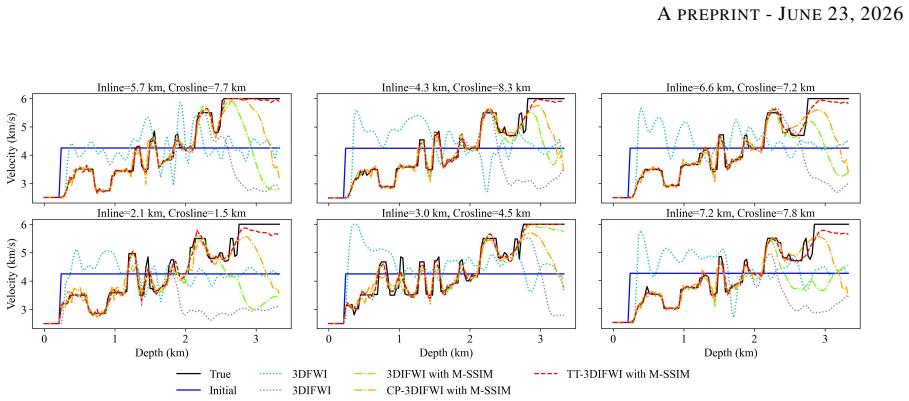
- Accurate results are obtained on both synthetic examples and challenging land datasets.
- Performance holds even when initial models are poor or low-frequency data is missing.
Where Pith is reading between the lines
- Similar TT-based reparameterization could be applied to other inverse problems in geophysics that involve high-dimensional model spaces.
- Testing the method on time-lapse or 4D data could show whether the low-rank structure captures temporal consistency.
- The axis-specific INRs might be swapped for other approximators if the TT cores exhibit different smoothness properties.
Load-bearing premise
The subsurface velocity model possesses a low-rank structure in tensor train format that captures the essential features needed for accurate wave propagation modeling.
What would settle it
Running the method on a velocity model known to require high TT rank for accurate representation and comparing the inversion error to standard FWI or direct INR approaches on the same data.
Figures






read the original abstract
Three-dimensional full waveform inversion (3DFWI) is a powerful technique for reconstructing high-resolution subsurface velocity models. However, its application is often limited by high memory requirements, computational costs, and sensitivity to cycle skipping. To overcome these challenges, we propose a novel tensor train (TT) decomposition-based 3D implicit full waveform inversion framework (TT-3DIFWI) combined with a multi-scale structural similarity (M-SSIM) objective function. In this framework, the 3D velocity model is represented by TT decomposition as a product of a series of low-rank core tensors. Then, three axis-specific implicit neural network representations (INR) based on one-dimensional vector coordinates as input are constructed to predict these core tensors, rather than directly predicting the velocity model. This INR reparameterization method based on TT decomposition can significantly reduce the memory consumption of INR training while maintaining the accuracy and resolution of the 3D velocity model reconstruction. Meanwhile, the low-rank structure of TT decomposition also ensures the structural consistency of the reconstruction velocity, thereby improving the accuracy and continuity of the inversion result. Furthermore, the M-SSIM objective function can compare the multi-scale structural differences between predicted and observed data, and utilize the ultra-low frequency features to reduce cycle skipping. Numerical experiments on synthetic and challenging land datasets demonstrate that TT-3DIFWI with M-SSIM achieves accurate and continuous velocity reconstruction, even with poor initial models or missing low-frequency data.
Editorial analysis
A structured set of objections, weighed in public.
Referee Report
Summary. The manuscript proposes TT-3DIFWI, a 3D full-waveform inversion framework that represents the velocity model via tensor-train (TT) decomposition whose low-rank cores are predicted by three axis-specific implicit neural representations (INRs) rather than a single 3D INR. An M-SSIM loss is introduced to compare multi-scale structural features between predicted and observed data and thereby mitigate cycle skipping. The authors claim that the TT low-rank structure additionally enforces structural consistency, yielding accurate and continuous velocity models on both synthetic and land datasets even from poor initial models or band-limited data.
Significance. If the experimental claims are substantiated, the TT+axis-wise INR parameterization offers a memory-efficient route to high-resolution 3D FWI while the M-SSIM term addresses a long-standing robustness issue. The combination is technically novel within the geophysics literature and could be of practical interest for land datasets where low-frequency content is limited.
major comments (2)
- [Abstract, §3] Abstract and §3 (methods): the central assertion that "the low-rank structure of TT decomposition also ensures the structural consistency of the reconstruction velocity" is load-bearing for the claimed improvement in continuity, yet the reported experiments compare the full TT-3DIFWI+M-SSIM pipeline against baselines that differ simultaneously in objective function, parameterization, and decomposition. No ablation that varies TT rank while holding M-SSIM and INR architecture fixed is described, nor are quantitative continuity metrics (total variation, edge coherence, or structural similarity on the velocity model itself) supplied to isolate the TT contribution.
- [Results] Results section: the abstract states that "numerical experiments … demonstrate that TT-3DIFWI with M-SSIM achieves accurate and continuous velocity reconstruction," but supplies no quantitative metrics (RMSE, SSIM, or misfit values), baseline tables, error analysis, or details on the synthetic/land data sets, initial models, or frequency content. Without these, the soundness of the central empirical claim cannot be evaluated.
minor comments (1)
- [§3] Notation for the TT cores and the three axis-specific INRs should be introduced with explicit equations and dimension indices to avoid ambiguity when the reader compares the memory scaling claims.
Simulated Author's Rebuttal
We thank the referee for the constructive feedback, which helps clarify the contributions and strengthen the empirical support in our manuscript. We address each major comment below and will incorporate revisions as noted.
read point-by-point responses
-
Referee: [Abstract, §3] Abstract and §3 (methods): the central assertion that "the low-rank structure of TT decomposition also ensures the structural consistency of the reconstruction velocity" is load-bearing for the claimed improvement in continuity, yet the reported experiments compare the full TT-3DIFWI+M-SSIM pipeline against baselines that differ simultaneously in objective function, parameterization, and decomposition. No ablation that varies TT rank while holding M-SSIM and INR architecture fixed is described, nor are quantitative continuity metrics (total variation, edge coherence, or structural similarity on the velocity model itself) supplied to isolate the TT contribution.
Authors: We agree that isolating the TT decomposition's contribution requires an ablation that varies only the TT rank while holding the M-SSIM loss and INR architecture fixed, and that quantitative continuity metrics on the velocity model (e.g., total variation or edge coherence) would directly support the structural-consistency claim. The current comparisons demonstrate overall pipeline improvement but do not separate the low-rank effect. We will add the requested ablation study and continuity metrics to the revised manuscript. revision: yes
-
Referee: [Results] Results section: the abstract states that "numerical experiments … demonstrate that TT-3DIFWI with M-SSIM achieves accurate and continuous velocity reconstruction," but supplies no quantitative metrics (RMSE, SSIM, or misfit values), baseline tables, error analysis, or details on the synthetic/land data sets, initial models, or frequency content. Without these, the soundness of the central empirical claim cannot be evaluated.
Authors: We acknowledge that the results section would benefit from explicit quantitative tables (RMSE, SSIM, data misfit) and expanded details on datasets, initial models, and frequency bands to allow direct evaluation of the claims. While the manuscript contains visual comparisons and some supporting numbers, a consolidated baseline table and error analysis are absent. We will add these elements in the revision. revision: yes
Circularity Check
No significant circularity in derivation chain
full rationale
The paper proposes TT-3DIFWI, a parameterization of the velocity model via tensor-train cores predicted by axis-specific INRs, optimized under an M-SSIM loss. The statement that low-rank TT structure ensures structural consistency is an appeal to a known algebraic property of TT decomposition rather than a result derived inside the paper. No equation reduces a claimed prediction to a fitted quantity by construction, no self-citation chain is load-bearing, and no ansatz is smuggled via prior work. The numerical experiments compare full pipelines but do not constitute a circular derivation; the method remains self-contained against external benchmarks.
Axiom & Free-Parameter Ledger
Reference graph
Works this paper leans on
-
[1]
Inversion of seismic reflection data in the acoustic approximation.GEOPHYSICS, 49(8):1259– 1266, August 1984
Albert Tarantola. Inversion of seismic reflection data in the acoustic approximation.GEOPHYSICS, 49(8):1259– 1266, August 1984
1984
-
[2]
Virieux and S
J. Virieux and S. Operto. An overview of full-waveform inversion in exploration geophysics.GEOPHYSICS, 74(6):WCC1–WCC26, November 2009
2009
-
[3]
Full waveform tomography for lithospheric imaging: results from a blind test in a realistic crustal model.Geophysical Journal International, 168(1):133–151, 2007
AJ Brenders and RG Pratt. Full waveform tomography for lithospheric imaging: results from a blind test in a realistic crustal model.Geophysical Journal International, 168(1):133–151, 2007
2007
-
[4]
Full-waveform inversion: The next leap forward in subsalt imaging.The Leading Edge, 37(1):67b1–67b6, 2018
Xukai Shen, Imtiaz Ahmed, Andrew Brenders, Joe Dellinger, John Etgen, and Scott Michell. Full-waveform inversion: The next leap forward in subsalt imaging.The Leading Edge, 37(1):67b1–67b6, 2018
2018
-
[5]
Reflection seismic waveform tomography.Journal of Geophysical Research: Solid Earth, 114(B3), 2009
Yanghua Wang and Ying Rao. Reflection seismic waveform tomography.Journal of Geophysical Research: Solid Earth, 114(B3), 2009
2009
-
[6]
Anisotropic 3d full-waveform inversion.Geophysics, 78(2):R59– R80, 2013
Michael Warner, Andrew Ratcliffe, Tenice Nangoo, Joanna Morgan, Adrian Umpleby, Nikhil Shah, Vetle Vinje, Ivan Štekl, Lluís Guasch, Caroline Win, et al. Anisotropic 3d full-waveform inversion.Geophysics, 78(2):R59– R80, 2013
2013
-
[7]
Correlation-based reflection full-waveform inversion.Geophysics, 80(4):R189–R202, 2015
Benxin Chi, Liangguo Dong, and Yuzhu Liu. Correlation-based reflection full-waveform inversion.Geophysics, 80(4):R189–R202, 2015
2015
-
[8]
Full-waveform inversion for salt: A coming of age.The Leading Edge, 38(3):204–213, 2019
Ping Wang, Zhigang Zhang, Jiawei Mei, Feng Lin, and Rongxin Huang. Full-waveform inversion for salt: A coming of age.The Leading Edge, 38(3):204–213, 2019
2019
-
[9]
Wavefield reconstruction inversion via physics-informed neural networks
Chao Song and Tariq A Alkhalifah. Wavefield reconstruction inversion via physics-informed neural networks. IEEE Transactions on Geoscience and Remote Sensing, 60:1–12, 2021
2021
-
[10]
Wave-equation traveltime inversion.Geophysics, 56(5):645–653, 1991
Yi Luo and Gerard T Schuster. Wave-equation traveltime inversion.Geophysics, 56(5):645–653, 1991
1991
-
[11]
Frequency-domain wave-equation traveltime inversion with a monofrequency component.GEOPHYSICS, 86(6):R913–R926, November 2021
Jianhua Wang, Jizhong Yang, Liangguo Dong, and Yuzhu Liu. Frequency-domain wave-equation traveltime inversion with a monofrequency component.GEOPHYSICS, 86(6):R913–R926, November 2021
2021
-
[12]
Wave-equation migration velocity analysis
Paul Sava and Biondo Biondi. Wave-equation migration velocity analysis. i. theory.Geophysical Prospecting, 52(6):593–606, 2004
2004
-
[13]
Migration velocity analysis and waveform inversion.Geophysical prospecting, 56(6):765–790, 2008
William W Symes. Migration velocity analysis and waveform inversion.Geophysical prospecting, 56(6):765–790, 2008
2008
-
[14]
Abdullah Alali, Bingbing Sun, and Tariq Alkhalifah. The effectiveness of a pseudo-inverse extended Born operator to handle lateral heterogeneity for imaging and velocity analysis applications.Geophysical Prospecting, 68(4):1154–1166, May 2020
2020
-
[15]
Full waveform inversion for reflected seismic data
Sheng Xu, D Wang, F Chen, Yu Zhang, and G Lambare. Full waveform inversion for reflected seismic data. In 74th EAGE Conference and Exhibition incorporating EUROPEC 2012, pages cp–293. European Association of Geoscientists & Engineers, 2012
2012
-
[16]
Simultaneous inversion of the background velocity and the perturbation in full-waveform inversion.Geophysics, 80(6):R317–R329, 2015
Zedong Wu and Tariq Alkhalifah. Simultaneous inversion of the background velocity and the perturbation in full-waveform inversion.Geophysics, 80(6):R317–R329, 2015
2015
-
[17]
A review on reflection-waveform inversion.Petroleum Science, 17(2):334–351, April 2020
Gang Yao, Di Wu, and Shang-Xu Wang. A review on reflection-waveform inversion.Petroleum Science, 17(2):334–351, April 2020. 18 APREPRINT- JUNE23, 2026
2020
-
[18]
Physics- informed machine learning.Nature Reviews Physics, 3(6):422–440, 2021
George Em Karniadakis, Ioannis G Kevrekidis, Lu Lu, Paris Perdikaris, Sifan Wang, and Liu Yang. Physics- informed machine learning.Nature Reviews Physics, 3(6):422–440, 2021
2021
-
[19]
Sensing prior constraints in deep neural networks for solving exploration geophysical problems.Proceedings of the National Academy of Sciences, 120(23):e2219573120, 2023
Xinming Wu, Jianwei Ma, Xu Si, Zhengfa Bi, Jiarun Yang, Hui Gao, Dongzi Xie, Zhixiang Guo, and Jie Zhang. Sensing prior constraints in deep neural networks for solving exploration geophysical problems.Proceedings of the National Academy of Sciences, 120(23):e2219573120, 2023
2023
-
[20]
Review of physics-informed machine-learning inversion of geophysical data.Geophysics, 89(6):T337–T356, 2024
Gerard T Schuster, Yuqing Chen, and Shihang Feng. Review of physics-informed machine-learning inversion of geophysical data.Geophysics, 89(6):T337–T356, 2024
2024
-
[21]
Chao Song, Tariq Alkhalifah, Umair bin Waheed, Silin Wang, and Cai Liu. Physics-constrained deep-learning- based full-waveform inversion: A practical source-independent strategy with two real data applications.IEEE Transactions on Geoscience and Remote Sensing, 2026
2026
-
[22]
Velocity model building with a modified fully convolutional network
Wenlong Wang, Fangshu Yang, and Jianwei Ma. Velocity model building with a modified fully convolutional network. InSEG International Exposition and Annual Meeting, pages SEG–2018. SEG, 2018
2018
-
[23]
Deep-learning inversion: A next-generation seismic velocity model building method.Geophysics, 84(4):R583–R599, 2019
Fangshu Yang and Jianwei Ma. Deep-learning inversion: A next-generation seismic velocity model building method.Geophysics, 84(4):R583–R599, 2019
2019
-
[24]
Inversionnet: An efficient and accurate data-driven full waveform inversion.IEEE Transactions on Computational Imaging, 6:419–433, 2019
Yue Wu and Youzuo Lin. Inversionnet: An efficient and accurate data-driven full waveform inversion.IEEE Transactions on Computational Imaging, 6:419–433, 2019
2019
-
[25]
Multiscale data-driven seismic full-waveform inversion with field data study.IEEE transactions on geoscience and remote sensing, 60:1–14, 2021
Shihang Feng, Youzuo Lin, and Brendt Wohlberg. Multiscale data-driven seismic full-waveform inversion with field data study.IEEE transactions on geoscience and remote sensing, 60:1–14, 2021
2021
-
[26]
Seismic Full-Waveform Inversion Using Deep Learning Tools and Techniques
Alan Richardson. Seismic full-waveform inversion using deep learning tools and techniques.arXiv preprint arXiv:1801.07232, 2018
work page internal anchor Pith review Pith/arXiv arXiv 2018
-
[27]
Deep recurrent architectures for seismic tomography
Amir Adler, Mauricio Araya-Polo, and Tomaso Poggio. Deep recurrent architectures for seismic tomography. In 81st EAGE conference and exhibition 2019, volume 2019, pages 1–5. European Association of Geoscientists & Engineers, 2019
2019
-
[28]
Seismic velocity estimation: A deep recurrent neural-network approach
Gabriel Fabien-Ouellet and Rahul Sarkar. Seismic velocity estimation: A deep recurrent neural-network approach. Geophysics, 85(1):U21–U29, 2020
2020
-
[29]
Data-driven seismic waveform inversion: A study on the robustness and generalization.IEEE Transactions on Geoscience and Remote sensing, 58(10):6900–6913, 2020
Zhongping Zhang and Youzuo Lin. Data-driven seismic waveform inversion: A study on the robustness and generalization.IEEE Transactions on Geoscience and Remote sensing, 58(10):6900–6913, 2020
2020
-
[30]
Stochastic seismic waveform inversion using generative adversarial networks as a geological prior.Mathematical Geosciences, 52(1):53–79, 2020
Lukas Mosser, Olivier Dubrule, and Martin J Blunt. Stochastic seismic waveform inversion using generative adversarial networks as a geological prior.Mathematical Geosciences, 52(1):53–79, 2020
2020
-
[31]
Seismic impedance inversion based on cycle-consistent generative adversarial network.Petroleum Science, 19(1):147–161, 2022
Yu-Qing Wang, Qi Wang, Wen-Kai Lu, Qiang Ge, and Xin-Fei Yan. Seismic impedance inversion based on cycle-consistent generative adversarial network.Petroleum Science, 19(1):147–161, 2022
2022
-
[32]
Implicit seismic full waveform inversion with deep neural representation.Journal of Geophysical Research: Solid Earth, 128(3):e2022JB025964, 2023
Jian Sun, Kristopher Innanen, Tianze Zhang, and Daniel Trad. Implicit seismic full waveform inversion with deep neural representation.Journal of Geophysical Research: Solid Earth, 128(3):e2022JB025964, 2023
2023
-
[33]
Multilayer perceptron and bayesian neural network- based elastic implicit full waveform inversion.IEEE Transactions on Geoscience and Remote Sensing, 61:1–16, 2023
Tianze Zhang, Jian Sun, Daniel Trad, and Kristopher Innanen. Multilayer perceptron and bayesian neural network- based elastic implicit full waveform inversion.IEEE Transactions on Geoscience and Remote Sensing, 61:1–16, 2023
2023
-
[34]
Fwigan: Full-waveform inversion via a physics-informed generative adversarial network.Journal of Geophysical Research: Solid Earth, 128(4):e2022JB025493, 2023
Fangshu Yang and Jianwei Ma. Fwigan: Full-waveform inversion via a physics-informed generative adversarial network.Journal of Geophysical Research: Solid Earth, 128(4):e2022JB025493, 2023
2023
-
[35]
Gabor wavelet-activation implicit neural learning for full-waveform inversion
Fangshu Yang and Jianwei Ma. Gabor wavelet-activation implicit neural learning for full-waveform inversion. Geophysics, 90(3):R71–R87, 2025
2025
-
[36]
Velocity model building by 3d frequency-domain, full-waveform inversion of wide-aperture seismic data.Geophysics, 73(5):VE101–VE117, 2008
Hafedh Ben-Hadj-Ali, Stéphane Operto, and Jean Virieux. Velocity model building by 3d frequency-domain, full-waveform inversion of wide-aperture seismic data.Geophysics, 73(5):VE101–VE117, 2008
2008
-
[37]
Three-dimensional elastic full waveform inversion using seismic data from the sleipner area.Geophysical Journal International, 202(3):1877–1894, 2015
Espen Birger Raknes, Børge Arntsen, and Wiktor Weibull. Three-dimensional elastic full waveform inversion using seismic data from the sleipner area.Geophysical Journal International, 202(3):1877–1894, 2015
2015
-
[38]
Patrick Amestoy, Romain Brossier, Alfredo Buttari, Jean-Yves L’Excellent, Theo Mary, Ludovic Métivier, Alain Miniussi, and Stephane Operto. Fast 3d frequency-domain full-waveform inversion with a parallel block low-rank multifrontal direct solver: Application to obc data from the north sea.Geophysics, 81(6):R363–R383, 2016
2016
-
[39]
Anisotropic 3d elastic full-wavefield inversion to directly estimate elastic properties and its role in interpretation
Haiyang Wang, Olivier Burtz, Partha Routh, Don Wang, Jake Violet, Rongrong Lu, and Spyros Lazaratos. Anisotropic 3d elastic full-wavefield inversion to directly estimate elastic properties and its role in interpretation. The Leading Edge, 40(4):277–286, 2021
2021
-
[40]
3-d bayesian variational full waveform inversion.Geophysical Journal International, 234(1):546–561, 2023
Xin Zhang, Angus Lomas, Muhong Zhou, York Zheng, and Andrew Curtis. 3-d bayesian variational full waveform inversion.Geophysical Journal International, 234(1):546–561, 2023. 19 APREPRINT- JUNE23, 2026
2023
-
[41]
M-ssim-3difwi: Three- dimensional implicit full waveform inversion based on the multi-scale structural similarity.IEEE Transactions on Geoscience and Remote Sensing, (99):1–1, 2026
Liangsheng He, Chao Song, Tariq Alkhalifah, Tiansheng Chen, Tao Liu, and Cai Liu. M-ssim-3difwi: Three- dimensional implicit full waveform inversion based on the multi-scale structural similarity.IEEE Transactions on Geoscience and Remote Sensing, (99):1–1, 2026
2026
-
[42]
Approximation capabilities of multilayer feedforward networks.Neural networks, 4(2):251–257, 1991
Kurt Hornik. Approximation capabilities of multilayer feedforward networks.Neural networks, 4(2):251–257, 1991
1991
-
[43]
Multilayer feedforward networks with a nonpolynomial activation function can approximate any function.Neural networks, 6(6):861–867, 1993
Moshe Leshno, Vladimir Ya Lin, Allan Pinkus, and Shimon Schocken. Multilayer feedforward networks with a nonpolynomial activation function can approximate any function.Neural networks, 6(6):861–867, 1993
1993
-
[44]
Integrating deep neural networks with full-waveform inversion: Reparameterization, regularization, and uncertainty quantification.Geophysics, 87(1):R93–R109, 2022
Weiqiang Zhu, Kailai Xu, Eric Darve, Biondo Biondi, and Gregory C Beroza. Integrating deep neural networks with full-waveform inversion: Reparameterization, regularization, and uncertainty quantification.Geophysics, 87(1):R93–R109, 2022
2022
-
[45]
Implicit neural representations with periodic activation functions.Advances in neural information processing systems, 33:7462– 7473, 2020
Vincent Sitzmann, Julien Martel, Alexander Bergman, David Lindell, and Gordon Wetzstein. Implicit neural representations with periodic activation functions.Advances in neural information processing systems, 33:7462– 7473, 2020
2020
-
[46]
Liangsheng He, Chao Song, and Cai Liu. MS_ATpV-FWI: Full waveform inversion based on multi-scale structural similarity index measure and anisotropic total p-variation regularization.arXiv preprint arXiv:2504.01695, 2025
-
[47]
Local-crosscorrelation elastic full-waveform inversion.Geophysics, 84(6):R897–R908, 2019
Zhendong Zhang and Tariq Alkhalifah. Local-crosscorrelation elastic full-waveform inversion.Geophysics, 84(6):R897–R908, 2019
2019
-
[48]
Toward high-fidelity imaging: Dynamic matching fwi and its applications.The Leading Edge, 42(2):124–132, 2023
Yi Huang, Jian Mao, James Sheng, Mike Perz, Yang He, Feng Hao, Faqi Liu, Bin Wang, Seet Li Yong, Daniel Chaikin, et al. Toward high-fidelity imaging: Dynamic matching fwi and its applications.The Leading Edge, 42(2):124–132, 2023
2023
-
[49]
Full-intensity waveform inversion
Yike Liu, Bin He, Huiyi Lu, Zhendong Zhang, Xiao-Bi Xie, and Yingcai Zheng. Full-intensity waveform inversion. Geophysics, 83(6):R649–R658, 2018
2018
-
[50]
Addressing cycle-skipping in full-waveform inversion using acoustic wave energy
Zhonglei Li and Gang Yao. Addressing cycle-skipping in full-waveform inversion using acoustic wave energy. Geophysical Prospecting, 73(3):960–976, 2025. 20
2025
discussion (0)
Sign in with ORCID, Apple, or X to comment. Anyone can read and Pith papers without signing in.