Influence of mass transfer stability on the formation of post-common-envelope binaries
Pith reviewed 2026-06-26 07:28 UTC · model grok-4.3
The pith
Enhanced mass transfer stability reduces the predicted number of post-common-envelope binaries with solar-type companions.
A machine-rendered reading of the paper's core claim, the machinery that carries it, and where it could break.
Core claim
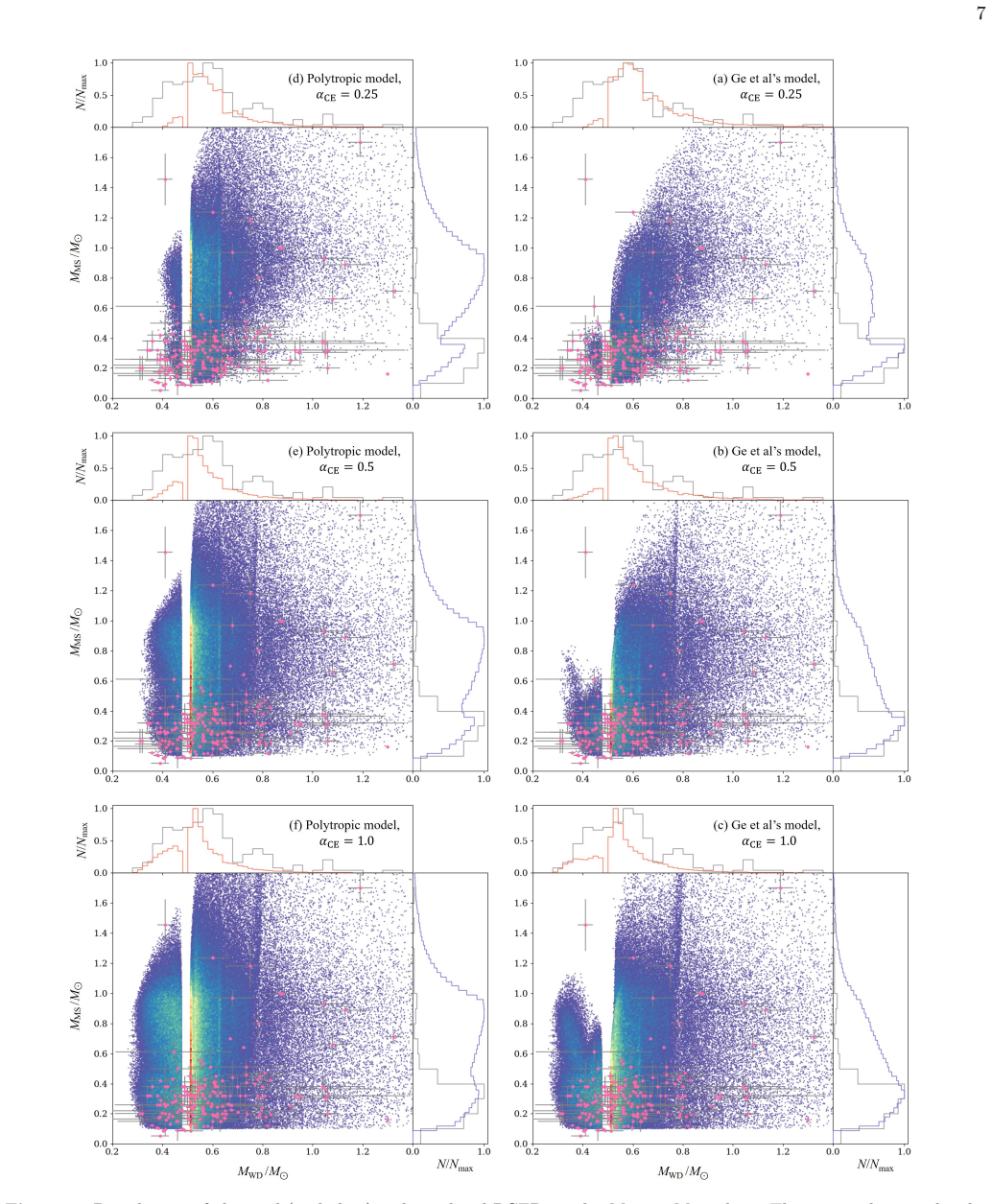
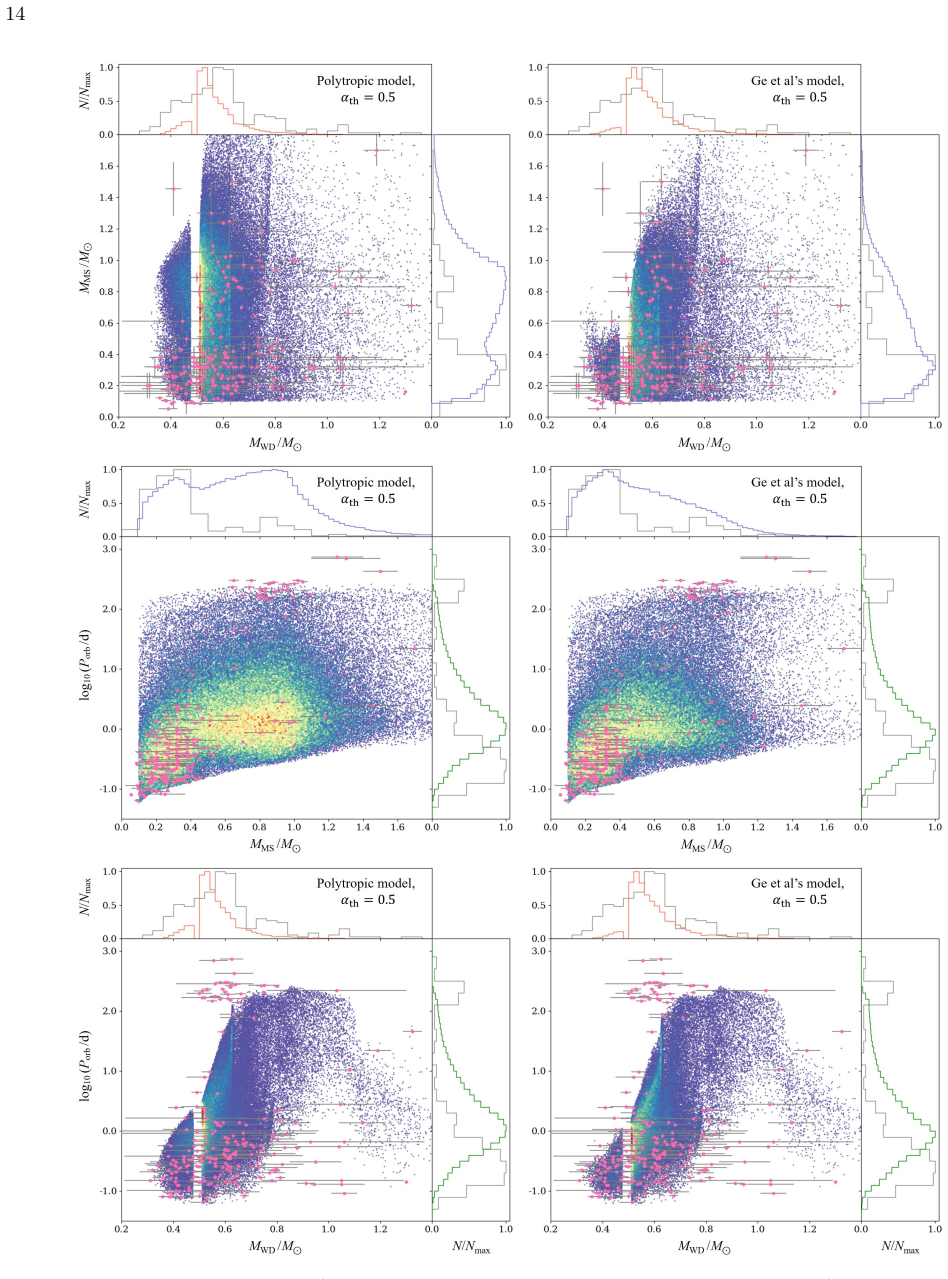
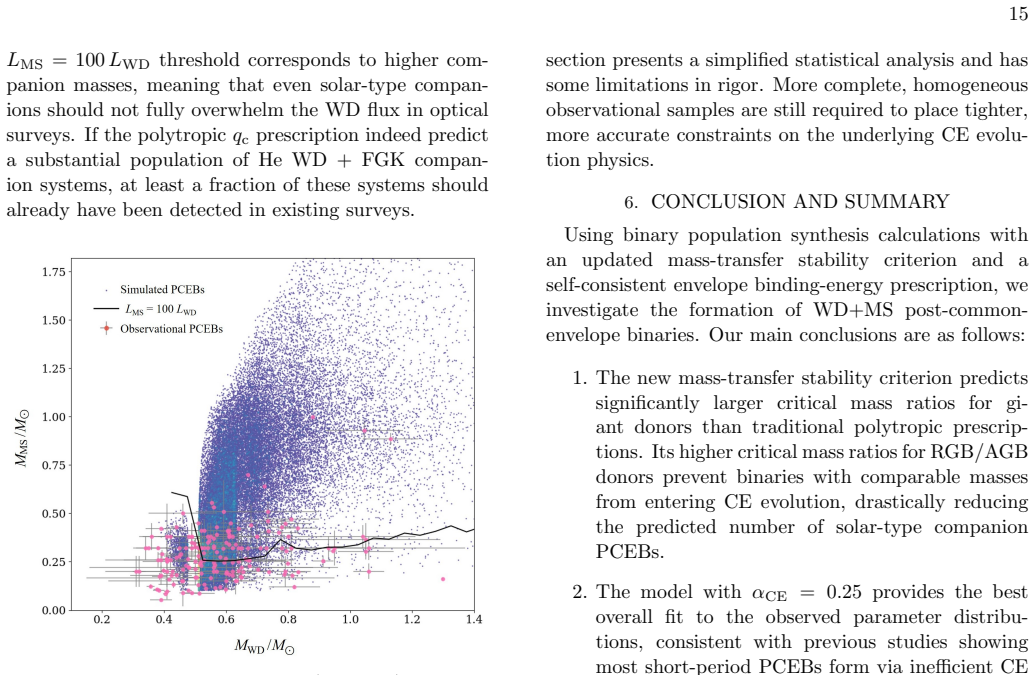
The enhanced mass transfer stability is an additional mechanism responsible for the observed dearth of post-common-envelope binaries with solar-type main sequence companions; neither magnetic braking nor selection effects alone can fully account for this deficit, and a combination of all three processes is most likely required. Models with inefficient common envelope evolution (α_CE=0.25) provide the best overall match to the observed population.
What carries the argument
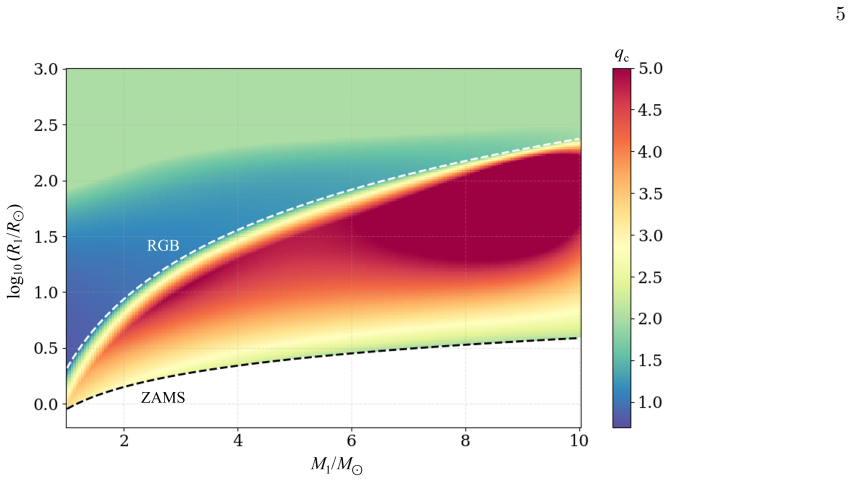
Physically motivated mass transfer stability criterion in the Binary Star Evolution code, which decides whether mass transfer remains stable or triggers common-envelope evolution and thereby filters the predicted population.
If this is right
- The observed population is best reproduced only when mass transfer stability, magnetic braking, and selection effects operate together.
- Low common-envelope efficiency (α_CE = 0.25) yields the closest agreement with the compiled white-dwarf plus main-sequence sample.
- Systems with M-dwarf companions remain largely unaffected by the change in stability criterion.
- Traditional polytropic stability criteria systematically overproduce solar-type post-common-envelope binaries.
Where Pith is reading between the lines
- The same stability criterion could alter predicted rates for other common-envelope outcomes such as double white dwarfs or Type Ia supernova progenitors.
- Detailed stellar-structure calculations could test whether the adopted stability boundary shifts with metallicity or rotation.
- Future Gaia or LSST samples of post-common-envelope binaries with precise masses and periods offer a direct test of the combined three-mechanism explanation.
Load-bearing premise
The mass transfer stability criterion used in the code accurately reflects the conditions under which real stars avoid common-envelope evolution.
What would settle it
A volume-complete survey that finds a substantially higher fraction of post-common-envelope binaries with solar-type companions than the updated models predict would falsify the claim that stability provides the missing reduction.
Figures
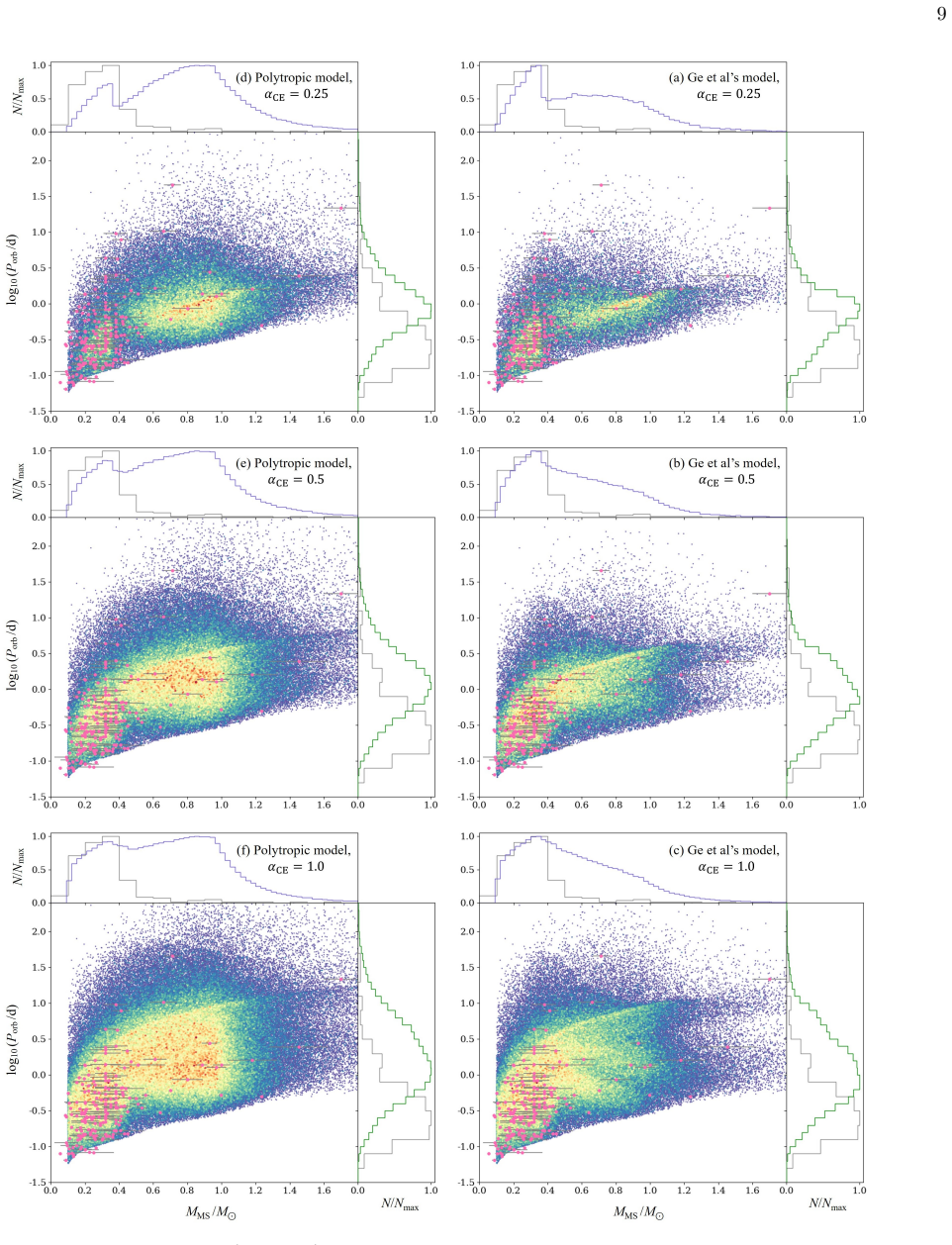
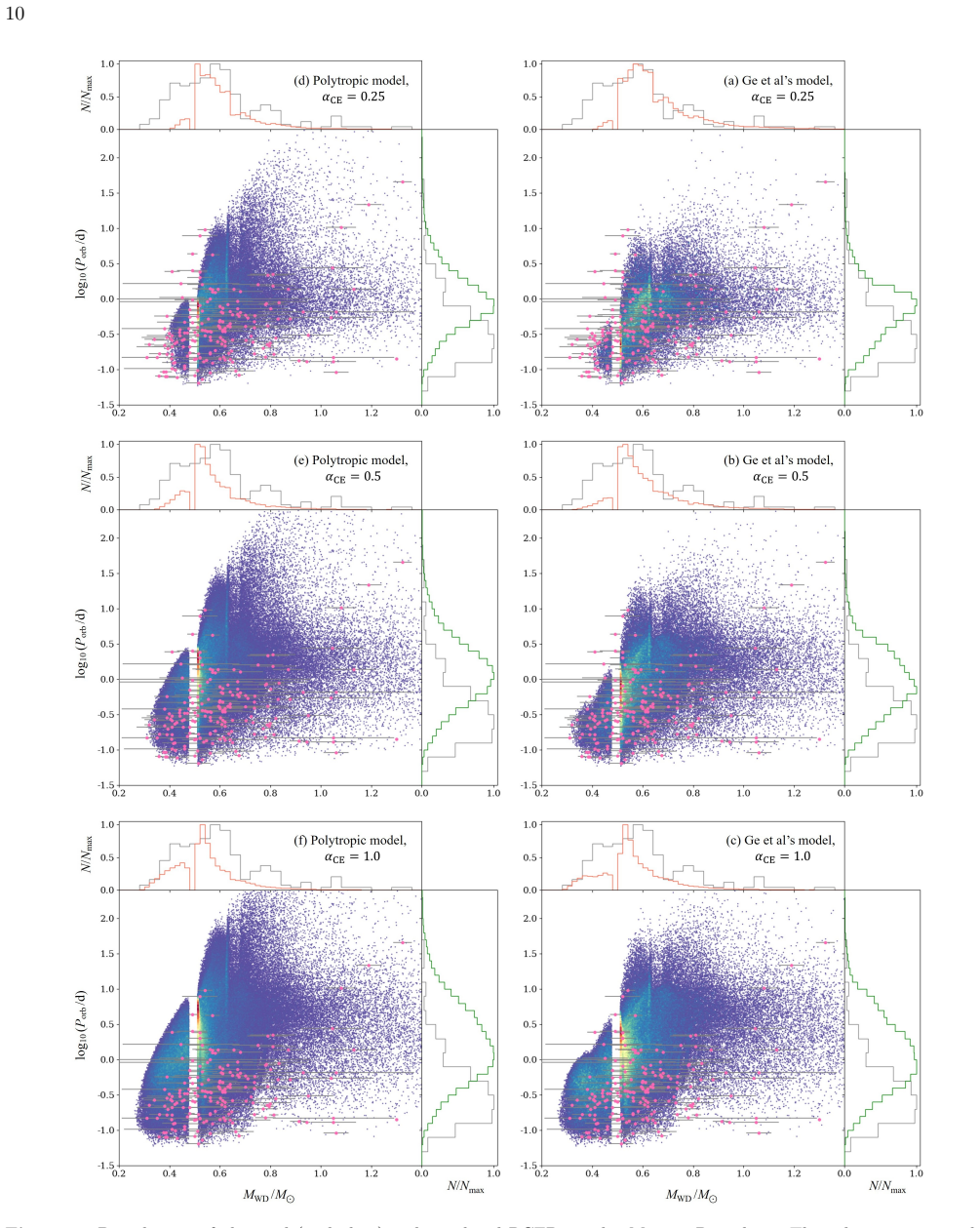
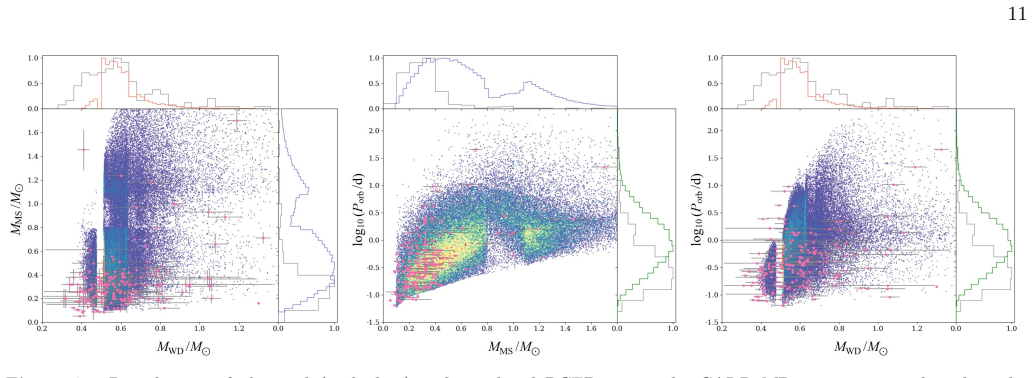
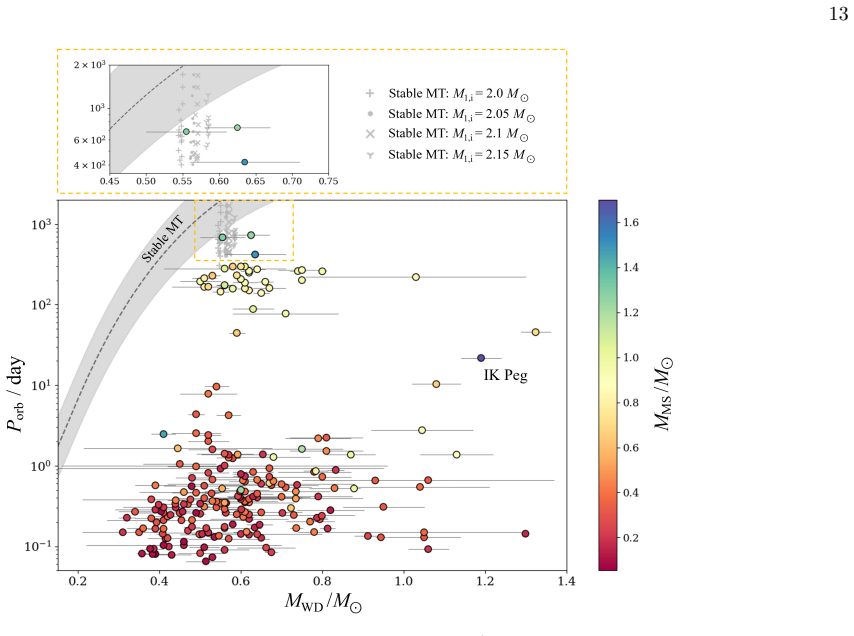
read the original abstract
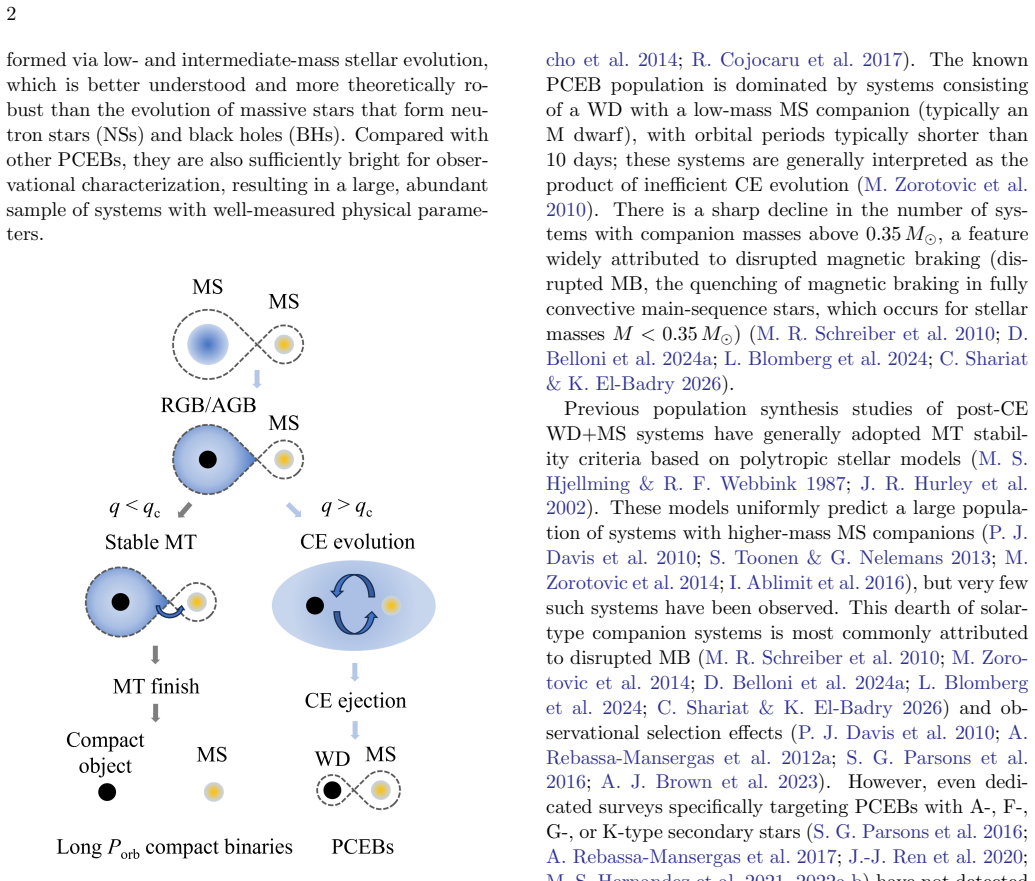
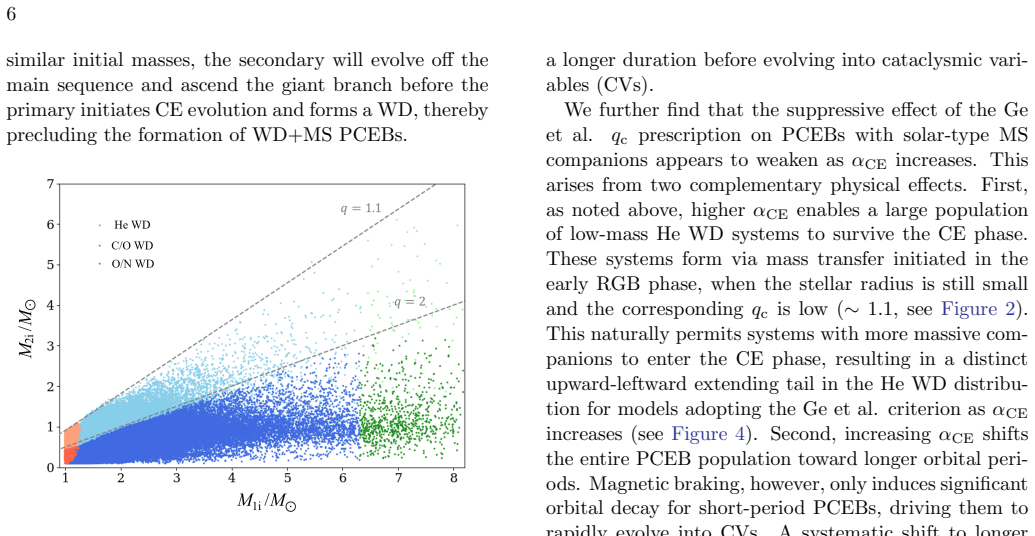
Post-common-envelope binaries are the natural laboratories for constraining the physics of common envelope evolution, which is one of the most uncertain phases in binary stellar evolution. Traditional binary population synthesis models, adopting mass transfer stability criteria based on polytropic stellar models, systematically overpredict the number of post-common-envelope binaries with solar-type main-sequence companions. In this work, we present an updated binary population synthesis model using the rapid binary evolution code \textit{Binary Star Evolution}, incorporating a physically motivated mass transfer stability criterion and a self-consistent envelope binding energy prescription. We compile a comprehensive sample of classic white dwarf + main sequence post-common-envelope binaries with well-measured parameters, hosting both M-dwarf and A/F/G/K- stars. We find that the enhanced mass transfer stability is an additional mechanism responsible for the observed dearth of post-common-envelope binaries with solar-type main sequence companions; neither magnetic braking nor selection effects alone can fully account for this deficit, and a combination of all three processes is most likely required. Models with inefficient common envelope evolution ($\alpha_{\rm CE}=0.25$) provide the best overall match to the observed population. These results highlight the critical role of MT stability in shaping the observed post-common-envelope binaries population and provide new constraints on common envelope evolution.
Editorial analysis
A structured set of objections, weighed in public.
Referee Report
Summary. The paper claims that an updated BSE population synthesis model incorporating a physically motivated mass transfer stability criterion (replacing the polytropic one) and a self-consistent envelope binding energy prescription shows that enhanced MT stability is an additional mechanism (beyond magnetic braking and selection effects) responsible for the observed dearth of post-common-envelope binaries with solar-type main-sequence companions; models with α_CE=0.25 provide the best overall match to a compiled sample of WD+MS PCEBs.
Significance. If the new stability criterion is shown to be accurate, the work would strengthen the case that mass transfer stability shapes the PCEB population and provide useful constraints on common-envelope efficiency. The compilation of an observational sample with both M-dwarf and A/F/G/K companions is a positive contribution.
major comments (2)
- [Abstract and §2] Abstract and model description: the claim that the new criterion explains part of the dearth relies on the assumption that it correctly identifies the stable-MT/CE boundary for ~1 M⊙ donors, but the manuscript supplies no validation against detailed stellar models or hydrodynamical calculations; without this, the population synthesis result could be an artifact of the criterion rather than a physical explanation.
- [Results (comparison to observations)] Results section comparing models to the compiled sample: α_CE=0.25 is selected because it yields the best overall match; this makes the central assertion that the combination of the stability criterion plus this specific efficiency reproduces the data circular rather than an independent prediction.
minor comments (1)
- [Abstract] The abstract would benefit from including at least one quantitative metric (e.g., a goodness-of-fit value or ratio of predicted-to-observed numbers) rather than stating only that the model provides the 'best overall match'.
Simulated Author's Rebuttal
We thank the referee for the detailed and constructive report. We address each major comment below. Revisions have been made to clarify the physical basis of the stability criterion, add discussion of its limitations, and distinguish the independent role of the new criterion from the choice of α_CE. These changes strengthen the manuscript without altering its core conclusions.
read point-by-point responses
-
Referee: [Abstract and §2] Abstract and model description: the claim that the new criterion explains part of the dearth relies on the assumption that it correctly identifies the stable-MT/CE boundary for ~1 M⊙ donors, but the manuscript supplies no validation against detailed stellar models or hydrodynamical calculations; without this, the population synthesis result could be an artifact of the criterion rather than a physical explanation.
Authors: We agree that direct validation against detailed stellar models or hydrodynamical simulations for the ~1 M⊙ regime is not presented in the current manuscript. The criterion is physically motivated by the response of the stellar structure to mass loss (as described in §2), but we acknowledge this leaves open the possibility of systematic bias. In the revised manuscript we have added a dedicated paragraph in §2 that (i) summarizes the derivation from the adiabatic response and (ii) cites existing comparisons in the literature between similar stability criteria and both 1D stellar models and limited hydrodynamical work. We also explicitly state the assumption and its uncertainty so that readers can assess the robustness of the population-synthesis results. revision: partial
-
Referee: [Results (comparison to observations)] Results section comparing models to the compiled sample: α_CE=0.25 is selected because it yields the best overall match; this makes the central assertion that the combination of the stability criterion plus this specific efficiency reproduces the data circular rather than an independent prediction.
Authors: The stability criterion itself is independent of α_CE; it is fixed by the donor response and is applied before any common-envelope phase is invoked. The main result—that enhanced stability reduces the predicted number of solar-type PCEBs—is present for all tested values of α_CE. We select α_CE=0.25 only as the value that simultaneously reproduces the observed period and mass-ratio distributions once the new stability boundary is adopted. In the revised text we have rephrased the abstract and §4 to emphasize that the stability effect operates across the α_CE range and that the low-efficiency value is a secondary constraint, not a prerequisite for the stability conclusion. This removes any appearance of circularity. revision: partial
Circularity Check
No significant circularity detected
full rationale
The paper implements an updated mass transfer stability criterion in the BSE code, compiles an observed PCEB sample, and compares population synthesis outputs for different α_CE values against that external sample. The statement that α_CE=0.25 provides the best match is the direct result of running the models and inspecting the match to data, not a self-referential definition or a fitted input relabeled as a prediction. The central claim that enhanced MT stability contributes to the observed dearth rests on the new criterion's effect on the synthesized population and is independent of the α_CE tuning step. No load-bearing derivation step reduces to its own inputs by construction; the work is a standard parameter study benchmarked against observations.
Axiom & Free-Parameter Ledger
free parameters (1)
- alpha_CE =
0.25
axioms (2)
- domain assumption Polytropic stellar models yield inaccurate mass-transfer stability criteria for solar-type stars in binaries.
- domain assumption The updated mass-transfer stability criterion implemented in BSE is physically motivated and more accurate than polytropic prescriptions.
Reference graph
Works this paper leans on
-
[1]
Progress in Particle and Nuclear Physics , keywords =
Binary stars in the new millennium. Progress in Particle and Nuclear Physics , keywords =. doi:10.1016/j.ppnp.2023.104083 , archivePrefix =. 2311.11454 , primaryClass =
-
[2]
Post-common-envelope binaries from SDSS. IX: Constraining the common-envelope efficiency
Post-common-envelope binaries from SDSS. IX: Constraining the common-envelope efficiency. , keywords =. doi:10.1051/0004-6361/200913658 , archivePrefix =. 1006.1621 , primaryClass =
work page internal anchor Pith review Pith/arXiv arXiv doi:10.1051/0004-6361/200913658
-
[3]
Post common envelope binaries from SDSS. XI. The white dwarf mass distributions of CVs and pre-CVs. , keywords =. doi:10.1051/0004-6361/201116626 , archivePrefix =. 1108.4600 , primaryClass =
work page internal anchor Pith review Pith/arXiv arXiv doi:10.1051/0004-6361/201116626
-
[4]
Post common envelope binaries from SDSS. XII. The orbital period distribution. , keywords =. doi:10.1051/0004-6361/201117514 , archivePrefix =. 1109.6662 , primaryClass =
work page internal anchor Pith review Pith/arXiv arXiv doi:10.1051/0004-6361/201117514
-
[5]
Post common envelope binaries from SDSS. VIII. Evidence for disrupted magnetic braking. , keywords =. doi:10.1051/0004-6361/201013990 , adsurl =
-
[6]
The Companion Mass Distribution of Post Common Envelope Hot Subdwarf Binaries: Evidence for Boosted and Disrupted Magnetic Braking?. , keywords =. doi:10.1088/1538-3873/ad94a2 , archivePrefix =. 2408.15334 , primaryClass =
-
[7]
Evidence for saturated and disrupted magnetic braking from samples of detached close binaries with M and K dwarfs. , keywords =. doi:10.1051/0004-6361/202347931 , archivePrefix =. 2311.04309 , primaryClass =
-
[8]
Thresholds for Rapid Mass Transfer in Binary System. I. Polytropic Models. , keywords =. doi:10.1086/165412 , adsurl =
-
[9]
Evolution of binary stars and the effect of tides on binary populations. , keywords =. doi:10.1046/j.1365-8711.2002.05038.x , archivePrefix =. astro-ph/0201220 , primaryClass =
-
[10]
A comprehensive population synthesis study of post-common envelope binaries. , keywords =. doi:10.1111/j.1365-2966.2009.16138.x , archivePrefix =. 0903.4152 , primaryClass =
-
[11]
The effect of common-envelope evolution on the visible population of post-common-envelope binaries
The effect of common-envelope evolution on the visible population of post-common-envelope binaries. , keywords =. doi:10.1051/0004-6361/201321753 , archivePrefix =. 1309.0327 , primaryClass =
work page internal anchor Pith review Pith/arXiv arXiv doi:10.1051/0004-6361/201321753
-
[12]
Monte Carlo simulations of post-common-envelope white dwarf + main sequence binaries: The effects of including recombination energy. , keywords =. doi:10.1051/0004-6361/201323039 , archivePrefix =. 1407.3301 , primaryClass =
work page internal anchor Pith review Pith/arXiv arXiv doi:10.1051/0004-6361/201323039
-
[13]
Monte Carlo Population Synthesis of Post-common-envelope White Dwarf Binaries and Type Ia supernova Rate. , keywords =. doi:10.3847/0004-637X/826/1/53 , archivePrefix =. 1605.03646 , primaryClass =
work page internal anchor Pith review Pith/arXiv arXiv doi:10.3847/0004-637x/826/1/53
-
[14]
Three close white dwarf binaries with G-type secondary stars
The White Dwarf Binary Pathways Survey - IV. Three close white dwarf binaries with G-type secondary stars. , keywords =. doi:10.1093/mnras/staa3815 , archivePrefix =. 2012.04683 , primaryClass =
-
[15]
Two close post-common envelope binaries with TESS light curves
The white dwarf binary pathways survey - VI. Two close post-common envelope binaries with TESS light curves. , keywords =. doi:10.1093/mnras/stac604 , archivePrefix =. 2203.01745 , primaryClass =
-
[16]
A post-common envelope binary with a massive white dwarf and an active G-type secondary star
The white dwarf binary pathways survey - VIII. A post-common envelope binary with a massive white dwarf and an active G-type secondary star. , keywords =. doi:10.1093/mnras/stac2837 , archivePrefix =. 2209.15591 , primaryClass =
-
[17]
Wide post-common envelope binaries containing ultramassive white dwarfs: evidence for efficient envelope ejection in massive asymptotic giant branch stars. , keywords =. doi:10.1093/mnras/stad4005 , archivePrefix =. 2309.15905 , primaryClass =
-
[18]
Wide Post-common Envelope Binaries from Gaia: Orbit Validation and Formation Models. , keywords =. doi:10.1088/1538-3873/ad6809 , archivePrefix =. 2405.06020 , primaryClass =
-
[19]
A Not-so-compact Companion: Massive, Oversized White Dwarf in a Post-common-envelope Eclipsing Binary. , keywords =. doi:10.3847/1538-3881/ae3b42 , archivePrefix =. 2601.14378 , primaryClass =
-
[20]
Formation of long-period post-common envelope binaries. I. No extra energy is needed to explain oxygen-neon white dwarfs paired with AFGK-type main-sequence stars. , keywords =. doi:10.1051/0004-6361/202449235 , archivePrefix =. 2401.07692 , primaryClass =
-
[21]
Formation of long-period post-common-envelope binaries. II. Explaining the self-lensing binary KOI 3278. , keywords =. doi:10.1051/0004-6361/202449320 , archivePrefix =. 2401.17510 , primaryClass =
-
[22]
Adiabatic Mass Loss in Binary Stars. I. Computational Method. , keywords =. doi:10.1088/0004-637X/717/2/724 , archivePrefix =. 1005.3099 , primaryClass =
work page internal anchor Pith review Pith/arXiv arXiv doi:10.1088/0004-637x/717/2/724
-
[23]
Adiabatic Mass Loss in Binary Stars. II. From Zero-age Main Sequence to the Base of the Giant Branch. , keywords =. doi:10.1088/0004-637X/812/1/40 , archivePrefix =. 1507.04843 , primaryClass =
work page internal anchor Pith review Pith/arXiv arXiv doi:10.1088/0004-637x/812/1/40
-
[24]
Adiabatic Mass Loss in Binary Stars. III. From the Base of the Red Giant Branch to the Tip of the Asymptotic Giant Branch. , keywords =. doi:10.3847/1538-4357/aba7b7 , archivePrefix =. 2007.09848 , primaryClass =
-
[25]
Criteria for Dynamical Timescale Mass Transfer of Metal-poor Intermediate-mass Stars. , keywords =. doi:10.3847/1538-4357/acb7e9 , archivePrefix =. 2302.00183 , primaryClass =
-
[26]
On the Binding Energy Parameter $\lambda$ of Common Envelope Evolution
On the Binding Energy Parameter of Common Envelope Evolution. , keywords =. doi:10.1088/0004-637X/716/1/114 , archivePrefix =. 1004.4957 , primaryClass =
work page internal anchor Pith review Pith/arXiv arXiv doi:10.1088/0004-637x/716/1/114
-
[27]
, year = 2010, month = oct, volume =
ERRATUM: ``On the Binding Energy Parameter of Common Envelope Evolution'' <A href=``/abs/2010ApJ...716..114X''>(2010, ApJ, 716, 114)</A>. , year = 2010, month = oct, volume =. doi:10.1088/0004-637X/722/2/1985 , adsurl =
-
[28]
Comprehensive analytic formulae for stellar evolution as a function of mass and metallicity. , keywords =. doi:10.1046/j.1365-8711.2000.03426.x , archivePrefix =. astro-ph/0001295 , primaryClass =
-
[29]
The Initial Mass Function and Stellar Birthrate in the Solar Neighborhood. , keywords =. doi:10.1086/190629 , adsurl =
-
[30]
The Distribution of Visual Binaries with Two Bright Components. , keywords =. doi:10.1086/168190 , adsurl =
-
[31]
Research in Astronomy and Astrophysics , keywords =
Binary Population Synthesis. Research in Astronomy and Astrophysics , keywords =. doi:10.1088/1674-4527/20/10/161 , archivePrefix =. 2009.08611 , primaryClass =
-
[32]
Origin of apparent period variations in eclipsing post-common-envelope binaries
Origin of apparent period variations in eclipsing post-common-envelope binaries. , keywords =. doi:10.1051/0004-6361/201220321 , archivePrefix =. 1211.5356 , primaryClass =
work page internal anchor Pith review Pith/arXiv arXiv doi:10.1051/0004-6361/201220321
-
[33]
Four eclipsing white dwarf main-sequence binaries
How many cataclysmic variables are crossing the period gap? A test for the disruption of magnetic braking. , keywords =. doi:10.1111/j.1365-2966.2008.13675.x , archivePrefix =. 0805.4700 , primaryClass =
-
[34]
The Thermal Equilibrium Mass-loss Model and Its Applications in Binary Evolution. , keywords =. doi:10.3847/1538-4365/ab98f6 , archivePrefix =. 2006.00774 , primaryClass =
-
[35]
Influence of a mass transfer stability criterion on double white dwarf populations. , keywords =. doi:10.1051/0004-6361/202243893 , archivePrefix =. 2211.01861 , primaryClass =
-
[36]
Double white dwarfs as progenitors of R Coronae Borealis stars and type I supernovae. , keywords =. doi:10.1086/161701 , adsurl =
-
[37]
The Common Envelope Phase in the Evolution of Binary Stars. , keywords =. doi:10.1086/166419 , adsurl =
-
[38]
The Common Envelope Evolution Outcome-A Case Study on Hot Subdwarf B Stars. , keywords =. doi:10.3847/1538-4357/ac75d3 , archivePrefix =. 2205.14256 , primaryClass =
-
[39]
The Common Envelope Evolution Outcome. II. Short-orbital-period Hot Subdwarf B Binaries Reveal a Clear Picture. , keywords =. doi:10.3847/1538-4357/ad158e , archivePrefix =. 2311.17304 , primaryClass =
-
[40]
Rapid Stellar and Binary Population Synthesis with COMPAS. , keywords =. doi:10.3847/1538-4365/ac416c , archivePrefix =. 2109.10352 , primaryClass =
-
[41]
Three long period white dwarf plus subgiant binaries
The white dwarf binary pathways survey - IX. Three long period white dwarf plus subgiant binaries. , keywords =. doi:10.1093/mnras/stac3368 , archivePrefix =. 2211.08440 , primaryClass =
-
[42]
The relation between white dwarf mass and orbital period in wide binary radio pulsars. , keywords =. doi:10.1093/mnras/273.3.731 , adsurl =
-
[43]
Photometric follow-up of 43 new eclipsing white dwarf plus main-sequence binaries from the ZTF survey. , keywords =. doi:10.1093/mnras/stad612 , archivePrefix =. 2302.11392 , primaryClass =
-
[44]
Post-common envelope binaries from SDSS - XVI. Long orbital period systems and the energy budget of common envelope evolution. , keywords =. doi:10.1111/j.1365-2966.2012.20880.x , archivePrefix =. 1203.1208 , primaryClass =
-
[45]
A Catalog of Potential Post-Common Envelope Binaries. , keywords =. doi:10.3847/1538-4357/ac13ac , archivePrefix =. 2107.05221 , primaryClass =
-
[46]
A post-common-envelope binary with double-peaked Balmer emission lines from TMTS. , keywords =. doi:10.1051/0004-6361/202553732 , archivePrefix =. 2504.18202 , primaryClass =
-
[47]
Four eclipsing white dwarf main-sequence binaries
Post-common-envelope binaries from SDSS - V. Four eclipsing white dwarf main-sequence binaries. , keywords =. doi:10.1111/j.1365-2966.2008.14378.x , archivePrefix =. 0812.2510 , primaryClass =
-
[48]
Two dynamically discovered compact object candidate binary systems from LAMOST low-resolution survey. , keywords =. doi:10.1093/mnras/stae1590 , archivePrefix =. 2406.17340 , primaryClass =
-
[49]
Discovery of a pre-cataclysmic binary with unusual chromaticity of the eclipsed white dwarf by the GPX survey. , keywords =. doi:10.1093/mnras/staa547 , archivePrefix =. 2002.08031 , primaryClass =
-
[50]
LAMOST J101356.33+272410.7: A Detached White Dwarf─Main-sequence Binary with a Massive White Dwarf within the Period Gap. , keywords =. doi:10.3847/1538-4357/adc0fa , archivePrefix =. 2501.01171 , primaryClass =
-
[51]
Two unseen massive white dwarf candidates in close binaries. , keywords =. doi:10.1093/pasj/psaf148 , archivePrefix =. 2509.12808 , primaryClass =
-
[52]
Discovery of three self-lensing binaries from Kepler
Discovery of Three Self-lensing Binaries from Kepler. , keywords =. doi:10.3847/1538-3881/aaaaaf , archivePrefix =. 1801.07874 , primaryClass =
work page internal anchor Pith review Pith/arXiv arXiv doi:10.3847/1538-3881/aaaaaf
-
[53]
A new technique for calculations of binary stellar evolution application to magnetic braking. , keywords =. doi:10.1086/161569 , adsurl =
-
[54]
Evolved cataclysmic variables as progenitors of AM CVn stars. , keywords =. doi:10.1093/mnras/stad354 , archivePrefix =. 2301.12992 , primaryClass =
-
[55]
Reversing the verdict: Cataclysmic variables could be the dominant progenitors of AM CVn binaries after all. , keywords =. doi:10.1051/0004-6361/202347047 , archivePrefix =. 2305.19312 , primaryClass =
-
[56]
Revisiting the extremely long-period cataclysmic variables V479 Andromedae and V1082 Sagittarii. , keywords =. doi:10.1051/0004-6361/202556385 , archivePrefix =. 2508.21358 , primaryClass =
-
[57]
Evolving LMXBs: CARB Magnetic Braking. , keywords =. doi:10.3847/2041-8213/ab571c , archivePrefix =. 1911.05790 , primaryClass =
-
[58]
On Convective Turnover Times and Dynamos in Low-mass Stars. , keywords =. doi:10.3847/1538-4357/adde4d , archivePrefix =. 2410.20000 , primaryClass =
-
[59]
Rotation Period Evolution in Low-mass Binary Stars: The Impact of Tidal Torques and Magnetic Braking. , keywords =. doi:10.3847/1538-4357/ab2ed2 , archivePrefix =. 1903.05686 , primaryClass =
-
[60]
Stellar Spin-down in Post-mass-transfer Binary Systems. , keywords =. doi:10.3847/1538-4357/ad54be , archivePrefix =. 2403.17279 , primaryClass =
-
[61]
The Binding Energy Parameter for Common Envelope Evolution
The binding energy parameter for common envelope evolution. Research in Astronomy and Astrophysics , keywords =. doi:10.1088/1674-4527/16/8/126 , archivePrefix =. 1605.03668 , primaryClass =
work page internal anchor Pith review Pith/arXiv arXiv doi:10.1088/1674-4527/16/8/126
-
[62]
A population synthesis study of the Gaia 100 pc unresolved white dwarf-main-sequence binary population. , keywords =. doi:10.1051/0004-6361/202452989 , archivePrefix =. 2502.11593 , primaryClass =
-
[63]
doi:10.1111/j.1365-2966.2011.20052.x
Post-common envelope binaries from SDSS - XIV. The DR7 white dwarf-main-sequence binary catalogue. , keywords =. doi:10.1111/j.1365-2966.2011.19923.x , archivePrefix =. 1110.1000 , primaryClass =
-
[64]
Triage of the Gaia DR3 astrometric orbits. II. A census of white dwarfs. , keywords =. doi:10.1093/mnras/stae773 , archivePrefix =. 2309.15143 , primaryClass =
-
[65]
Stellar Multiplicity. , keywords =. doi:10.1146/annurev-astro-081710-102602 , archivePrefix =. 1303.3028 , primaryClass =
work page internal anchor Pith review Pith/arXiv arXiv doi:10.1146/annurev-astro-081710-102602
-
[66]
Mind Your Ps and Qs: The Interrelation between Period (P) and Mass-ratio (Q) Distributions of Binary Stars. , keywords =. doi:10.3847/1538-4365/aa6fb6 , archivePrefix =. 1606.05347 , primaryClass =
work page internal anchor Pith review Pith/arXiv arXiv doi:10.3847/1538-4365/aa6fb6
-
[67]
Structure and Evolution of Close Binary Systems , year = 1976, editor =
Common Envelope Binaries. Structure and Evolution of Close Binary Systems , year = 1976, editor =
1976
-
[68]
Common Envelope Evolution: Where we stand and how we can move forward
Common envelope evolution: where we stand and how we can move forward. , keywords =. doi:10.1007/s00159-013-0059-2 , archivePrefix =. 1209.4302 , primaryClass =
work page internal anchor Pith review Pith/arXiv arXiv doi:10.1007/s00159-013-0059-2
-
[69]
A Global View of Post-interaction White Dwarf-main Sequence Binaries. , keywords =. doi:10.1088/1538-3873/ae453b , archivePrefix =. 2601.00439 , primaryClass =
-
[70]
, keywords =
Tidal evolution in close binary systems. , keywords =
-
[71]
Monte Carlo simulations of post-common-envelope white dwarf + main sequence binaries: comparison with the SDSS DR7 observed sample. , keywords =. doi:10.1051/0004-6361/201323052 , archivePrefix =. 1404.5464 , primaryClass =
work page internal anchor Pith review Pith/arXiv arXiv doi:10.1051/0004-6361/201323052
-
[72]
The population of white dwarf-main sequence binaries in the SDSS DR 12
The population of white dwarf-main sequence binaries in the SDSS DR 12. , keywords =. doi:10.1093/mnras/stx1326 , archivePrefix =. 1705.05888 , primaryClass =
work page internal anchor Pith review Pith/arXiv arXiv doi:10.1093/mnras/stx1326
-
[73]
Reconstructing post-common envelope white dwarf─main-sequence binary histories through inverse population synthesis techniques: A case study of ZTF eclipsing binaries. , keywords =. doi:10.1051/0004-6361/202554039 , archivePrefix =. 2505.01505 , primaryClass =
-
[74]
The SDSS spectroscopic catalogue of white dwarf-main-sequence binaries: new identifications from DR 9-12. , keywords =. doi:10.1093/mnras/stw554 , archivePrefix =. 1603.01017 , primaryClass =
work page internal anchor Pith review Pith/arXiv arXiv doi:10.1093/mnras/stw554
-
[75]
The White Dwarf Binary Pathways Survey I: A sample of FGK stars with white dwarf companions
The white dwarf binary pathways survey - I. A sample of FGK stars with white dwarf companions. , keywords =. doi:10.1093/mnras/stw2143 , archivePrefix =. 1604.01613 , primaryClass =
work page internal anchor Pith review Pith/arXiv arXiv doi:10.1093/mnras/stw2143
-
[76]
The white dwarf binary pathways survey - II. Radial velocities of 1453 FGK stars with white dwarf companions from LAMOST DR 4. , keywords =. doi:10.1093/mnras/stx2259 , archivePrefix =. 1708.09480 , primaryClass =
work page internal anchor Pith review Pith/arXiv arXiv doi:10.1093/mnras/stx2259
-
[77]
The White Dwarf Binary Pathways Survey. V. The Gaia White Dwarf Plus AFGK Binary Sample and the Identification of 23 Close Binaries. , keywords =. doi:10.3847/1538-4357/abc017 , archivePrefix =. 2010.02885 , primaryClass =
-
[78]
Searching for GEMS: Discovery of the Nearby Post-Common-Envelope Binary System TIC-460388167
Searching for GEMS: Discovery of the Nearby Post-common-envelope Binary System TIC-460388167. , keywords =. doi:10.3847/1538-4357/ae6246 , archivePrefix =. 2604.07527 , primaryClass =
work page internal anchor Pith review Pith/arXiv arXiv doi:10.3847/1538-4357/ae6246
-
[79]
Characterization of the eclipsing post-common-envelope binary TIC 60040774. , keywords =. doi:10.1093/mnras/stac2197 , archivePrefix =. 2208.02986 , primaryClass =
-
[80]
, year = 1994, month = sep, volume =
A possible criterion for envelope ejection in asymptotic giant branch or first giant branch stars. , year = 1994, month = sep, volume =. doi:10.1093/mnras/270.1.121 , adsurl =
discussion (0)
Sign in with ORCID, Apple, or X to comment. Anyone can read and Pith papers without signing in.