Signatures of gravity-mediated dark matter interaction in theories with large extra dimensions
Pith reviewed 2026-06-26 08:24 UTC · model grok-4.3
The pith
In theories with large extra dimensions the summed gravitational Kaluza-Klein modes produce an effective dark-matter-nucleon interaction strength scaling as m_p m_χ M_*^{-4}.
A machine-rendered reading of the paper's core claim, the machinery that carries it, and where it could break.
Core claim
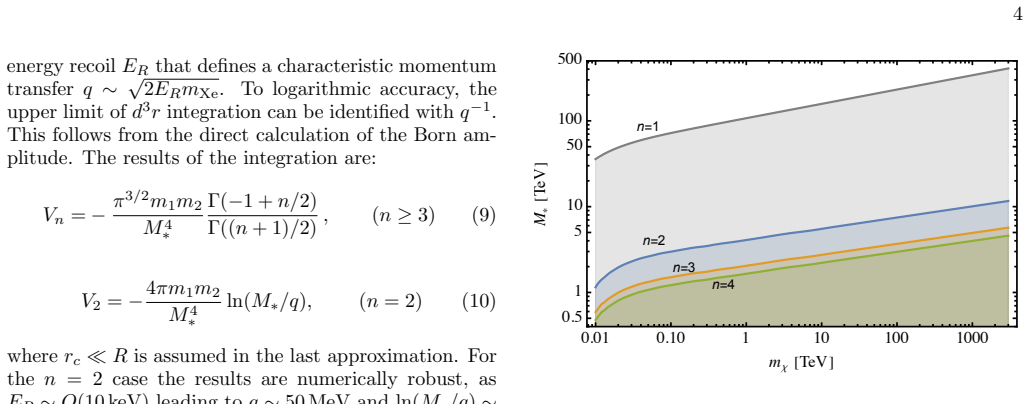
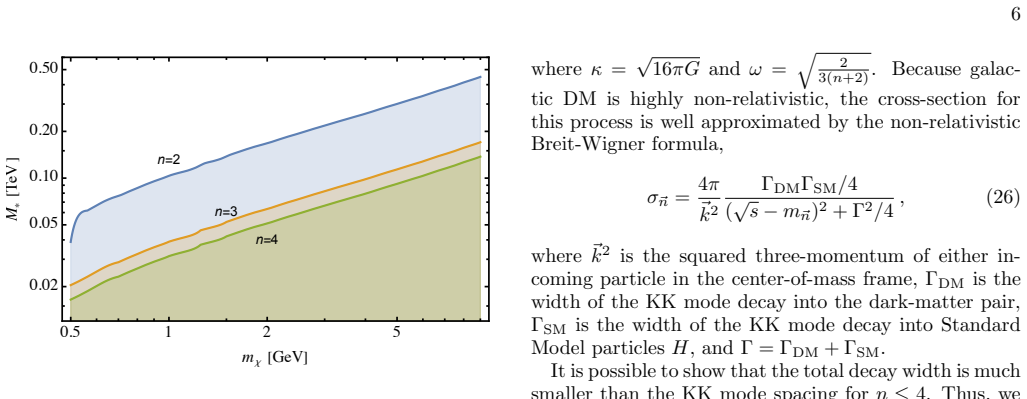
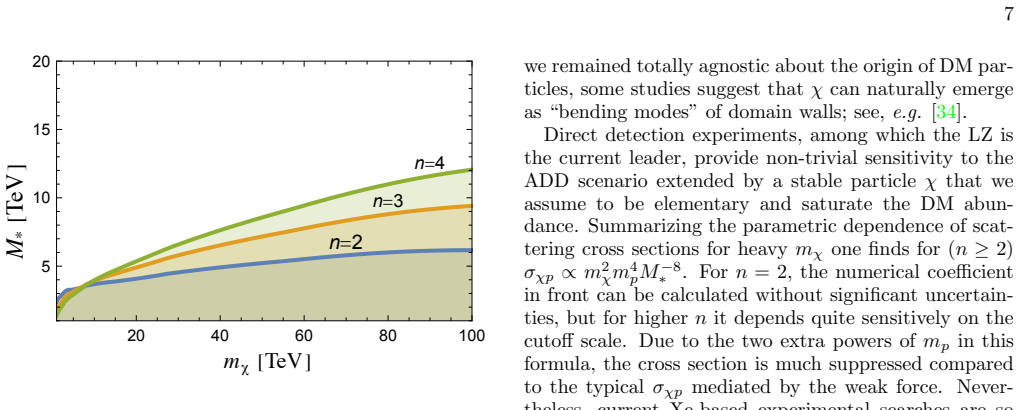
The cumulative exchange of the gravitational Kaluza-Klein modes leads to the effective strength of interactions with the Standard Model nucleons that scales as m_p m_χ M_*^{-4}. This interaction is confronted with sensitivity achieved in the large Xe-based underground direct detection experiments and derives bounds on the {m_χ, M_*} parameter space that stretches all the way to M_* ∼ few TeV. The annihilation cross section for scalar χ that can resonantly annihilate via the on-shell KK modes into the SM particles W±, Z, h scales as ⟨σv⟩ ∼ m_χ^n M_*^{-n-2}, and stringent limits on the same parameter space can be derived from observations of high-energy galactic γ rays.
What carries the argument
The cumulative exchange of gravitational Kaluza-Klein modes, which produces an effective four-dimensional interaction strength scaling as m_p m_χ M_*^{-4}.
If this is right
- Current xenon experiments already exclude portions of the {m_χ, M_*} plane extending to M_* of a few TeV.
- Scalar dark matter candidates acquire additional constraints from the resonant annihilation channel observed through galactic gamma rays.
- The interaction rate grows with dark matter mass, so heavier candidates become easier to detect through this mechanism.
- The scaling with the number of extra dimensions n appears in the indirect-detection cross section but not in the direct-detection strength.
Where Pith is reading between the lines
- Future detectors with lower thresholds could map the dependence on n by comparing direct and indirect signals.
- The resonant annihilation feature implies that gamma-ray spectra may show lines or bumps at energies set by the KK mass gap.
- Absence of signals at the predicted level would require either non-scalar dark matter or a breakdown of the four-dimensional effective theory at low energies.
Load-bearing premise
The effective four-dimensional description obtained by summing over KK modes remains valid at the energies and distances probed by direct-detection experiments.
What would settle it
A null result from xenon direct detection experiments at the cross-section level predicted for M_* = 2 TeV and m_χ = 50 GeV would rule out the claimed interaction strength scaling.
Figures
read the original abstract
Dark matter particles that couple to the Standard Model only through gravity are usually regarded as inaccessible to laboratory detection. This expectation can change in theories with $n$ extra spatial dimensions, where gravity is enhanced at short distances and the potential scales as $1/r^{1+n}$. We reconsider the gravity-mediated dark matter (DM) interactions in Arkani-Hamed-Dimopoulos-Dvali (ADD) models with $n$ large extra dimensions. The cumulative exchange of the gravitational Kaluza-Klein (KK) modes leads to the effective strength of interactions with the Standard Model nucleons that scales as $m_pm_\chi M_*^{-4}$, where $ m_\chi$ is the mass of DM and $M_*$ is the fundamental $4+n$ dimensional mass scale. We confront this interaction with sensitivity achieved in the large Xe-based underground direct detection experiments and derive bounds on the $\{m_\chi,M_*\}$ parameter space that stretches all the way to $M_*\sim$ few TeV. We also address the indirect detection of scalar $\chi$ that can resonantly annihilate via the on-shell KK modes into the SM particles $W^\pm,Z,h$. The annihilation cross section for the process scales as $\langle\sigma v\rangle \sim m_\chi^nM_*^{-n-2}$, and stringent limits on the same parameter space can be derived from observations of high-energy galactic $\gamma$ rays.
Editorial analysis
A structured set of objections, weighed in public.
Referee Report
Summary. The paper claims that in ADD models with n large extra dimensions, the cumulative exchange of gravitational Kaluza-Klein modes produces an effective DM-nucleon interaction strength scaling as m_p m_χ M_*^{-4}. This scaling is used to derive bounds on the {m_χ, M_*} parameter space from Xe-based direct detection experiments, reaching M_* ∼ few TeV. For scalar DM, resonant annihilation via on-shell KK modes into SM particles yields ⟨σv⟩ ∼ m_χ^n M_*^{-n-2}, from which additional constraints are obtained using galactic γ-ray observations.
Significance. If the effective-theory scaling and validity assumptions hold, the work would be significant for showing that gravity-mediated DM in extra-dimensional scenarios can produce detectable signals in existing direct- and indirect-detection experiments, yielding concrete bounds on M_* down to the TeV scale that complement collider searches. The explicit scaling relations for both detection channels constitute a falsifiable prediction for the {m_χ, M_*} plane.
major comments (2)
- [Abstract] Abstract: the effective interaction strength is stated to scale as m_p m_χ M_*^{-4} with no explicit n dependence, yet the standard ADD short-distance potential V(r) ∼ m_p m_χ / (M_*^{n+2} r^{n+1}) has a three-dimensional Fourier transform (Born amplitude) that introduces n-dependent powers of momentum transfer q. Because the nuclear recoil spectrum in Xe detectors depends on these powers, the quoted M_* reach cannot be taken as uniform for general n; the derivation must either fix n (most likely n=2) or demonstrate how the n factors cancel in the rate.
- [Abstract] Abstract (indirect-detection paragraph): the annihilation cross section is given with explicit n dependence (⟨σv⟩ ∼ m_χ^n M_*^{-n-2}), while the direct-detection scaling is written without n. This internal inconsistency in the presentation of the two channels undermines the claim that the same {m_χ, M_*} bounds apply uniformly; the manuscript must reconcile the two expressions or restrict the analysis to a single fixed n.
Simulated Author's Rebuttal
We thank the referee for the careful reading and the specific comments on the abstract. We address each point below and will make the necessary revisions to clarify the assumptions and ensure consistency.
read point-by-point responses
-
Referee: [Abstract] Abstract: the effective interaction strength is stated to scale as m_p m_χ M_*^{-4} with no explicit n dependence, yet the standard ADD short-distance potential V(r) ∼ m_p m_χ / (M_*^{n+2} r^{n+1}) has a three-dimensional Fourier transform (Born amplitude) that introduces n-dependent powers of momentum transfer q. Because the nuclear recoil spectrum in Xe detectors depends on these powers, the quoted M_* reach cannot be taken as uniform for general n; the derivation must either fix n (most likely n=2) or demonstrate how the n factors cancel in the rate.
Authors: We agree that the abstract presents the direct-detection scaling without explicit n dependence. The derivation in the manuscript body uses the short-distance ADD potential and performs the sum over KK modes for the specific case n=2, which produces the quoted M_*^{-4} factor after accounting for the relation to the 4D Planck scale. The n-dependent momentum factors arising from the Fourier transform of the potential are included in the differential event rate and nuclear form-factor treatment in Section 3. To resolve the ambiguity, we will revise the abstract to state explicitly that the direct-detection results and M_* bounds are derived for n=2. revision: yes
-
Referee: [Abstract] Abstract (indirect-detection paragraph): the annihilation cross section is given with explicit n dependence (⟨σv⟩ ∼ m_χ^n M_*^{-n-2}), while the direct-detection scaling is written without n. This internal inconsistency in the presentation of the two channels undermines the claim that the same {m_χ, M_*} bounds apply uniformly; the manuscript must reconcile the two expressions or restrict the analysis to a single fixed n.
Authors: The referee correctly notes the differing n dependence in the two channels as presented in the abstract. The direct-detection analysis is performed for n=2 (hence the M_*^{-4} scaling), while the resonant annihilation cross section retains the general-n form because it depends on the KK-mode density of states, which scales with n. We will revise the abstract and the introductory paragraphs to make this distinction explicit, stating that direct-detection bounds apply to n=2 while indirect-detection results are shown for general n (or a representative range). This removes the apparent inconsistency without altering the underlying calculations. revision: yes
Circularity Check
No circularity; bounds derived from external experimental limits
full rationale
The paper starts from the ADD model potential scaling as 1/r^{1+n}, sums the KK tower to obtain the quoted effective nucleon coupling m_p m_χ M_*^{-4} (abstract), and then compares the resulting rates to published experimental sensitivities of Xe detectors and gamma-ray observations. No parameter is fitted to the same data used to define the model, no self-citation supplies a load-bearing uniqueness theorem or ansatz, and the annihilation scaling retains explicit n dependence. The derivation chain is therefore independent of its target outputs.
Axiom & Free-Parameter Ledger
axioms (2)
- domain assumption The Arkani-Hamed-Dimopoulos-Dvali (ADD) model with n large extra dimensions is the correct ultraviolet completion.
- domain assumption The effective four-dimensional interaction obtained by summing KK modes is valid for the momentum transfers in direct detection and for the annihilation kinematics.
invented entities (1)
-
Kaluza-Klein graviton modes
no independent evidence
Reference graph
Works this paper leans on
-
[1]
SM- like
(followed closely in sensitivity by XENONnT [1] and PandaX-4T [3]). We will show that the experimental re- sults impose novel constraints on the{m χ, M∗}param- eter space, provided thatm χ is indeed at or above the electroweak scale. The main results of our work are repre- sented by the plots of the sensitivity of the LZ detector to gravity-mediated DM pa...
-
[2]
dark form factors
and LZ [24]. First we consider the casen≥2 since the corresponding potential (4) is highly singular, and separately studyn= 1 which is relatively long range. These calculations can be conducted using standard dia- grammatic techniques using the summation over masses of KK modes with an effective cutoff, or directly in the position space usingV(r). A. DM-n...
-
[3]
E. Aprileet al.(XENON), WIMP Dark Matter Search Using a 3.1 Tonne-Year Exposure of the XENONnT Experiment, Phys. Rev. Lett.135, 221003 (2025), arXiv:2502.18005 [hep-ex]
-
[4]
J. Aalberset al.(LZ), Search for new physics in low- energy electron recoils from the first LZ exposure, Phys. Rev. D108, 072006 (2023), arXiv:2307.15753 [hep-ex]
-
[5]
Z. Boet al.(PandaX), Dark Matter Search Results from 1.54 Tonne·Year Exposure of PandaX-4T, Phys. Rev. Lett.134, 011805 (2025), arXiv:2408.00664 [hep-ex]
-
[6]
P. Agneset al.(DarkSide-50), Search for low-mass dark matter WIMPs with 12 ton-day exposure of DarkSide- 8 50, Phys. Rev. D107, 063001 (2023), arXiv:2207.11966 [hep-ex]
- [7]
-
[8]
Q. Arnaudet al.(EDELWEISS), First germanium-based constraints on sub-MeV Dark Matter with the EDEL- WEISS experiment, Phys. Rev. Lett.125, 141301 (2020), arXiv:2003.01046 [astro-ph.GA]
-
[9]
A Large Mass Hierarchy from a Small Extra Dimension
L. Randall and R. Sundrum, A Large mass hierarchy from a small extra dimension, Phys. Rev. Lett.83, 3370 (1999), arXiv:hep-ph/9905221
work page internal anchor Pith review Pith/arXiv arXiv 1999
-
[10]
L. Randall and R. Sundrum, An Alternative to compact- ification, Phys. Rev. Lett.83, 4690 (1999), arXiv:hep- th/9906064
-
[11]
Antoniadis, A Possible new dimension at a few TeV, Phys
I. Antoniadis, A Possible new dimension at a few TeV, Phys. Lett. B246, 377 (1990)
1990
-
[12]
New Dimensions at a Millimeter to a Fermi and Superstrings at a TeV
I. Antoniadis, N. Arkani-Hamed, S. Dimopoulos, and G. R. Dvali, New dimensions at a millimeter to a Fermi and superstrings at a TeV, Phys. Lett. B436, 257 (1998), arXiv:hep-ph/9804398
work page internal anchor Pith review Pith/arXiv arXiv 1998
-
[13]
The Hierarchy Problem and New Dimensions at a Millimeter
N. Arkani-Hamed, S. Dimopoulos, and G. R. Dvali, The Hierarchy problem and new dimensions at a millimeter, Phys. Lett. B429, 263 (1998), arXiv:hep-ph/9803315
work page internal anchor Pith review Pith/arXiv arXiv 1998
-
[14]
N. Arkani-Hamed, S. Dimopoulos, and G. R. Dvali, Phenomenology, astrophysics and cosmology of theories with submillimeter dimensions and TeV scale quantum gravity, Phys. Rev. D59, 086004 (1999), arXiv:hep- ph/9807344
-
[15]
H. M. Lee, M. Park, and V. Sanz, Gravity-mediated (or Composite) Dark Matter, Eur. Phys. J. C74, 2715 (2014), arXiv:1306.4107 [hep-ph]
work page internal anchor Pith review Pith/arXiv arXiv 2014
-
[16]
H. M. Lee, M. Park, and V. Sanz, Gravity-mediated (or Composite) Dark Matter Confronts Astrophysical Data, JHEP05, 063, arXiv:1401.5301 [hep-ph]
work page internal anchor Pith review Pith/arXiv arXiv
-
[17]
N. Bernal, M. Dutra, Y. Mambrini, K. Olive, M. Peloso, and M. Pierre, Spin-2 Portal Dark Matter, Phys. Rev. D 97, 115020 (2018), arXiv:1803.01866 [hep-ph]
work page internal anchor Pith review Pith/arXiv arXiv 2018
-
[18]
A. de Giorgi and S. Vogl, Dark matter interacting via a massive spin-2 mediator in warped extra-dimensions, JHEP11, 036, arXiv:2105.06794 [hep-ph]
-
[19]
A. de Giorgi and S. Vogl, Warm dark matter from a grav- itational freeze-in in extra dimensions, JHEP04, 032, arXiv:2208.03153 [hep-ph]
- [20]
- [21]
-
[22]
G. Aadet al.(ATLAS), Search for new phenomena in events with an energetic jet and missing transverse momentum inppcollisions at √s=13 TeV with the ATLAS detector, Phys. Rev. D103, 112006 (2021), arXiv:2102.10874 [hep-ex]
- [23]
-
[24]
G. F. Giudice, R. Rattazzi, and J. D. Wells, Quantum gravity and extra dimensions at high-energy colliders, Nucl. Phys. B544, 3 (1999), arXiv:hep-ph/9811291
work page internal anchor Pith review Pith/arXiv arXiv 1999
- [25]
-
[26]
Dark Matter Search Results from 4.2 Tonne-Years of Exposure of the LUX-ZEPLIN (LZ) Experiment
J. Aalberset al.(LZ), Dark Matter Search Results from 4.2 Tonne-Years of Exposure of the LUX-ZEPLIN (LZ) Experiment, Phys. Rev. Lett.135, 011802 (2025), arXiv:2410.17036 [hep-ex]
work page internal anchor Pith review Pith/arXiv arXiv 2025
-
[27]
M. B. Wise and Y. Zhang, Stable Bound States of Asym- metric Dark Matter, Phys. Rev. D90, 055030 (2014), [Er- ratum: Phys.Rev.D 91, 039907 (2015)], arXiv:1407.4121 [hep-ph]
work page internal anchor Pith review Pith/arXiv arXiv 2014
-
[28]
J. D. Lewin and P. F. Smith, Review of mathematics, numerical factors, and corrections for dark matter exper- iments based on elastic nuclear recoil, Astropart. Phys. 6, 87 (1996)
1996
-
[29]
On electromagnetic contributions in WIMP quests
R. Bernabeiet al., On electromagnetic contributions in WIMP quests, Int. J. Mod. Phys. A22, 3155 (2007), arXiv:0706.1421 [astro-ph]
work page internal anchor Pith review Pith/arXiv arXiv 2007
- [30]
-
[31]
M. J. Dolan, F. Kahlhoefer, and C. McCabe, Directly detecting sub-GeV dark matter with electrons from nu- clear scattering, Phys. Rev. Lett.121, 101801 (2018), arXiv:1711.09906 [hep-ph]
work page internal anchor Pith review Pith/arXiv arXiv 2018
-
[32]
Yiet al., Direct observation of the Migdal effect in- duced by neutron bombardment, Nature649, 580 (2026)
D. Yiet al., Direct observation of the Migdal effect in- duced by neutron bombardment, Nature649, 580 (2026)
2026
-
[33]
Xuet al., Search for the Migdal effect in liquid xenon with keV-level nuclear recoils, Phys
J. Xuet al., Search for the Migdal effect in liquid xenon with keV-level nuclear recoils, Phys. Rev. D109, L051101 (2024), arXiv:2307.12952 [hep-ex]
-
[34]
T. Han, J. D. Lykken, and R.-J. Zhang, On Kaluza-Klein states from large extra dimensions, Phys. Rev. D59, 105006 (1999), arXiv:hep-ph/9811350
work page internal anchor Pith review Pith/arXiv arXiv 1999
-
[35]
M. L. Ahnenet al.(MAGIC, Fermi-LAT), Limits to Dark Matter Annihilation Cross-Section from a Com- bined Analysis of MAGIC and Fermi-LAT Observa- tions of Dwarf Satellite Galaxies, JCAP02, 039, arXiv:1601.06590 [astro-ph.HE]
work page internal anchor Pith review Pith/arXiv arXiv
-
[36]
J. A. R. Cembranos, A. Dobado, and A. L. Maroto, Brane world dark matter, Phys. Rev. Lett.90, 241301 (2003), arXiv:hep-ph/0302041
work page internal anchor Pith review Pith/arXiv arXiv 2003
-
[37]
Rapid Asymmetric Inflation and Early Cosmology in Theories with Sub-Millimeter Dimensions
N. Arkani-Hamed, S. Dimopoulos, N. Kaloper, and J. March-Russell, Rapid asymmetric inflation and early cosmology in theories with submillimeter dimensions, Nucl. Phys. B567, 189 (2000), arXiv:hep-ph/9903224
work page internal anchor Pith review Pith/arXiv arXiv 2000
-
[38]
R. Allahverdi, C. Bird, S. Groot Nibbelink, and M. Pospelov, Cosmological bounds on large extra di- mensions from nonthermal production of Kaluza-Klein modes, Phys. Rev. D69, 045004 (2004), arXiv:hep- ph/0305010
discussion (0)
Sign in with ORCID, Apple, or X to comment. Anyone can read and Pith papers without signing in.