Harnessing Josephson-Shapiro physics to verify interlayer exciton superfluidity
Pith reviewed 2026-06-26 06:21 UTC · model grok-4.3
The pith
Shapiro steps in a Dayem-bridge excitonic Josephson junction can verify zero-field exciton superfluidity.
A machine-rendered reading of the paper's core claim, the machinery that carries it, and where it could break.
Core claim
Observation of Shapiro steps in a Dayem-bridge excitonic Josephson junction would provide direct evidence of exciton superfluidity by demonstrating phase coherence in the neutral condensate, with the response showing distinct nonmonotonic behavior across the BCS-BEC crossover due to changes in the healing length.
What carries the argument
Shapiro steps in the current-voltage response of the Dayem-bridge excitonic Josephson junction under microwave drive.
If this is right
- Shapiro plateaus should appear at resolvable current and voltage values in double-bilayer graphene.
- The same plateaus should remain observable in low-density double-layer transition-metal dichalcogenides.
- The Shapiro response should change nonmonotonically as density crosses the BCS-BEC regime.
- Exciton bilayers could function as a platform for neutral Josephson devices.
Where Pith is reading between the lines
- Confirmation would enable studies of neutral superfluid phase dynamics at zero magnetic field.
- The nonmonotonic signature could serve as an experimental marker for the BCS-BEC crossover in bilayer systems.
- The approach might extend to testing phase coherence in other electrically neutral paired condensates.
Load-bearing premise
The junction must operate such that only the superfluid condensate contributes to the current-phase relation, with no significant interference from normal tunneling, disorder, or charging effects.
What would settle it
Fabricating the Dayem-bridge junction and measuring its current-voltage curve under microwave irradiation to check for the predicted voltage plateaus and their nonmonotonic density dependence.
Figures
read the original abstract
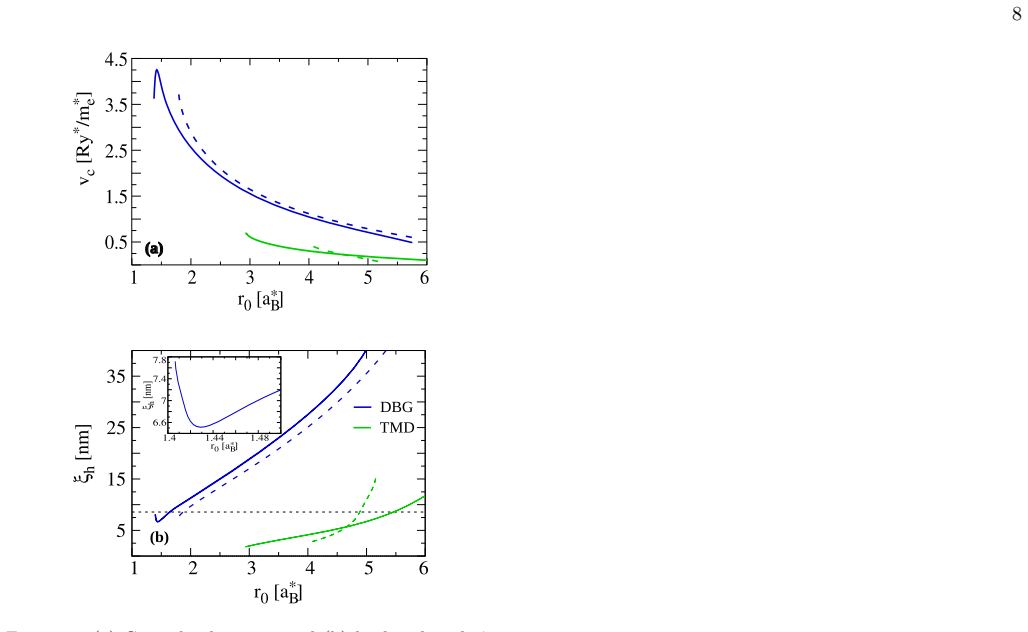
Obtaining definitive evidence for zero-magnetic-field exciton superfluidity in electron-hole bilayers remains a longstanding challenge because the condensate is electrically neutral and its phase coherence is difficult to probe directly. We propose a direct test based on Shapiro steps in a Dayem-bridge excitonic Josephson junction. We predict clearly resolvable Shapiro plateaus in experimentally accessible current and voltage regimes for double-bilayer graphene and, in the low-density regime, double-layer transition-metal dichalcogenides. Moreover, by tuning the density across the BCS-BEC crossover we show that the Shapiro response acquires a distinct nonmonotonic evolution. This is determined by the nonmonotonic behavior of the healing length in the crossover from bosonic to fermionic excitations. Observation of these signatures would provide direct evidence of exciton superfluidity and establish exciton bilayers as a platform for neutral Josephson devices.
Editorial analysis
A structured set of objections, weighed in public.
Referee Report
Summary. The manuscript proposes using Shapiro steps in a Dayem-bridge excitonic Josephson junction as a direct probe of interlayer exciton superfluidity in double-bilayer graphene and low-density double-layer transition-metal dichalcogenides. It predicts clearly resolvable Shapiro plateaus in experimentally accessible regimes and shows that the Shapiro response evolves nonmonotonically with density across the BCS-BEC crossover, with the nonmonotonicity determined by the healing length of the condensate.
Significance. If the predictions are borne out, the work would supply a concrete, falsifiable signature for phase coherence in electrically neutral exciton condensates, which has been difficult to establish directly. The nonmonotonic density dependence tied to the BCS-BEC crossover constitutes a distinctive testable feature that could distinguish superfluid from normal behavior. The proposal also positions exciton bilayers as a platform for neutral Josephson devices. These elements make the manuscript significant for both verification of exciton superfluidity and potential device applications.
major comments (1)
- [experimental feasibility discussion] The claim that Shapiro plateaus remain clearly resolvable rests on the assumption that the current-phase relation is dominated by the superfluid condensate. The manuscript does not provide quantitative estimates of the parameter regimes in which normal-state tunneling, disorder, or charging effects remain negligible (see the experimental feasibility discussion). Without such bounds, the resolvability prediction cannot be assessed as load-bearing for the central claim.
minor comments (1)
- The abstract and main text use 'double-bilayer graphene' and 'double-layer transition-metal dichalcogenides' interchangeably with slight variations; adopt consistent terminology throughout.
Simulated Author's Rebuttal
We thank the referee for the positive evaluation and the recommendation for minor revision. The single major comment is addressed below; we will incorporate the requested quantitative estimates into the revised manuscript.
read point-by-point responses
-
Referee: The claim that Shapiro plateaus remain clearly resolvable rests on the assumption that the current-phase relation is dominated by the superfluid condensate. The manuscript does not provide quantitative estimates of the parameter regimes in which normal-state tunneling, disorder, or charging effects remain negligible (see the experimental feasibility discussion). Without such bounds, the resolvability prediction cannot be assessed as load-bearing for the central claim.
Authors: We agree that the manuscript would be strengthened by explicit bounds on the regimes where normal-state contributions remain subdominant. In the revision we will add a dedicated subsection (or expanded appendix) that estimates (i) the ratio of normal tunneling conductance to the Josephson critical current using measured interlayer resistances in double-bilayer graphene and TMD devices, (ii) the disorder-induced phase-slip rate relative to the Josephson frequency using reported mobility values, and (iii) the charging energy scale compared with the Josephson energy for the proposed Dayem-bridge geometry. These estimates will be anchored to parameters from existing experiments and will delineate the density and bias windows in which the predicted Shapiro plateaus should remain resolvable. revision: yes
Circularity Check
No significant circularity in derivation chain
full rationale
The paper's central claims consist of theoretical predictions for observable Shapiro plateaus and their nonmonotonic density dependence, derived from standard Josephson junction physics and the known nonmonotonic healing length across the BCS-BEC crossover. No equations, fitted parameters, or self-citations are presented that reduce any prediction to an input by construction. The derivation relies on external physical principles rather than internal redefinition or self-referential fitting, making the argument self-contained against external benchmarks.
Axiom & Free-Parameter Ledger
axioms (1)
- domain assumption Exciton condensate in electron-hole bilayers supports a Josephson current-phase relation analogous to charged superconductors
Reference graph
Works this paper leans on
-
[1]
A Dayem bridge is a nanoconstriction joining two regions of bulk super- fluid
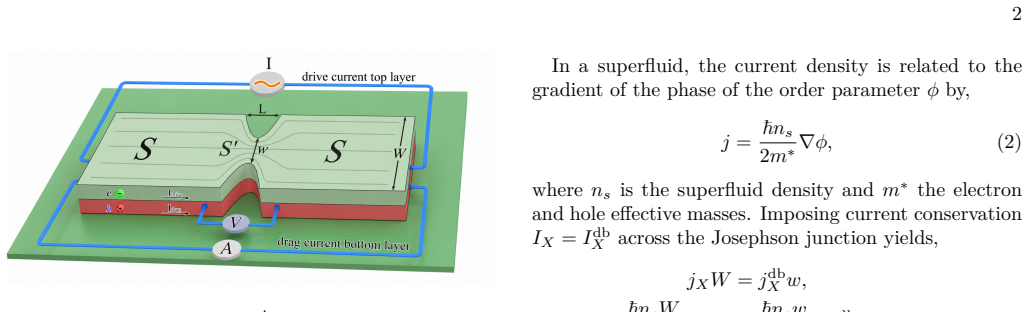
in a Dayem bridge Josephson junction [ 30, 31] could be employed as a direct phase-coherence probe of super- fluidity with neutral bilayer excitons. A Dayem bridge is a nanoconstriction joining two regions of bulk super- fluid. The current in the nanoconstriction is higher than in the bulk regions, allowing the formation of an S-S′-S or S-N -S junction in...
Pith/arXiv arXiv 2026
-
[2]
G. W. Burg, N. Prasad, K. Kim, T. Taniguchi, K. Watan- abe, A. H. MacDonald, L. F. Register, and E. Tutuc, Strongly enhanced tunneling at total charge neutrality in double-bilayer graphene- WSe2 heterostructures, Phys. Rev. Lett. 120, 177702 (2018)
2018
-
[3]
Z. Wang, D. A. Rhodes, K. Watanabe, T. Taniguchi, J. C. Hone, J. Shan, and K. F. Mak, Evidence of high- temperature exciton condensation in two-dimensional atomic double layers, Nature (London) 574, 76 (2019)
2019
-
[4]
J. Gu, L. Ma, S. Liu, K. Watanabe, T. Taniguchi, J. C. Hone, J. Shan, and K. F. Mak, Dipolar excitonic insula- tor in a moiré lattice, Nat. Phys. 18, 395 (2022)
2022
-
[5]
L. Ma, P. X. Nguyen, Z. Wang, Y. Zeng, K. Watanabe, T. Taniguchi, A. H. MacDonald, K. F. Mak, and J. Shan, Strongly correlated excitonic insulator in atomic double layers, Nature (London) 598, 585 (2021)
2021
-
[6]
P. X. Nguyen, L. Ma, R. Chaturvedi, K. Watanabe, T. Taniguchi, J. Shan, and K. F. Mak, Perfect coulomb drag in a dipolar excitonic insulator, Science 388, 274 (2025)
2025
-
[7]
R. Qi, Q. Li, J. Nie, R. Xia, H. Kim, H. Lim, J. Xie, T. Taniguchi, K. Watanabe, M. F. Crommie, A. H. Mac- Donald, and F. Wang, Two-component exciton conden- sates in an electron–hole bilayer, Nature 10.1038/s41586- 026-10636-y (2026)
-
[8]
Y. E. Lozovik and V. I. Yudson, A new mechanism for superconductivity: Pairing between spatially separated electrons and holes, Sov. Phys. JETP 44, 389 (1976) , (Zh. Eksp. Teor. Fiz. 71, 738-753 (1976))
1976
-
[9]
Zeng and A
Y. Zeng and A. H. MacDonald, Electrically controlled two-dimensional electron-hole fluids, Phys. Rev. B 102, 085154 (2020)
2020
-
[10]
Xie and A
M. Xie and A. H. MacDonald, Electrical reservoirs for bilayer excitons, Phys. Rev. Lett. 121, 067702 (2018)
2018
-
[11]
Pieri, D
P. Pieri, D. Neilson, and G. C. Strinati, Effects of density imbalance on the BCS-BEC crossover in semiconductor electron-hole bilayers, Phys. Rev. B 75, 113301 (2007)
2007
-
[12]
Salasnich, P
L. Salasnich, P. A. Marchetti, and F. Toigo, Super- fluidity, sound velocity, and quasicondensation in the two-dimensional BCS-BEC crossover, Phys. Rev. A 88, 053612 (2013)
2013
-
[13]
López Ríos, A
P. López Ríos, A. Perali, R. J. Needs, and D. Neil- son, Evidence from quantum Monte Carlo simulations of large-gap superfluidity and BCS-BEC crossover in double electron-hole layers, Phys. Rev. Lett. 120, 177701 (2018)
2018
-
[14]
Su and A
J.-J. Su and A. H. MacDonald, How to make a bilayer exciton condensate flow, Nat. Phys. 4, 799 (2008)
2008
-
[15]
Nandi, A
D. Nandi, A. D. K. Finck, J. P. Eisenstein, L. N. Pfeif- fer, and K. W. West, Exciton condensation and perfect Coulomb drag, Nature 488, 481 (2012)
2012
-
[16]
V. L. Ginzburg and L. D. Landau, On the Theory of superconductivity, Zh. Eksp. Teor. Fiz. 20, 1064 (1950)
1950
-
[17]
I. B. Spielman, J. P. Eisenstein, L. N. Pfeiffer, and K. W. West, Resonantly enhanced tunneling in a double layer quantum Hall ferromagnet, Phys. Rev. Lett. 84, 5808 (2000)
2000
-
[18]
B. N. Narozhny and A. Levchenko, Coulomb drag, Rev. Mod. Phys. 88, 025003 (2016)
2016
-
[19]
J. I. A. Li, T. Taniguchi, K. Watanabe, J. Hone, and C. Dean, Excitonic superfluid phase in double bilayer graphene, Nat. Phys. 13, 751 (2017)
2017
-
[20]
X. Liu, J. I. A. Li, K. Watanabe, T. Taniguchi, J. Hone, B. I. Halperin, P. Kim, and C. R. Dean, Crossover be- tween strongly coupled and weakly coupled exciton su- perfluids, Science 375, 205 (2022)
2022
-
[21]
B. D. Josephson, Possible new effects in superconductive tunnelling, Phys. Lett. 1, 251 (1962)
1962
-
[22]
P. W. Anderson and J. M. Rowell, Probable observation of the Josephson superconducting tunneling effect, Phys. Rev. Lett. 10, 230 (1963)
1963
-
[23]
Sukhatme, Y
K. Sukhatme, Y. Mukharsky, T. Chui, and D. Pearson, Observation of the ideal josephson effect in superfluid 4he, Nature 411, 280 (2001)
2001
-
[24]
Ancilotto, L
F. Ancilotto, L. Salasnich, and F. Toigo, DC Josephson effect with Fermi gases in the Bose-Einstein regime, Phys. Rev. A 79, 033627 (2009)
2009
-
[25]
Spuntarelli, P
A. Spuntarelli, P. Pieri, and G. C. Strinati, Josephson effect throughout the BCS-BEC crossover, Phys. Rev. Lett. 99, 040401 (2007)
2007
-
[26]
Taghinejad, A
H. Taghinejad, A. A. Eftekhar, P. M. Campbell, B. Beatty, M. Taghinejad, Y. Zhou, C. J. Perini, H. Moradinejad, W. E. Henderson, E. V. Woods, X. Zhang, P. Ajayan, E. J. Reed, E. M. Vogel, and A. Adibi, Strain relaxation via formation of cracks in compositionally modulated two-dimensional semiconduc- tor alloys, npj 2D Mater. Appl 2, 10 (2018)
2018
-
[27]
Mahjouri-Samani, M.-W
M. Mahjouri-Samani, M.-W. Lin, K. Wang, A. R. Lupini, J. Lee, L. Basile, A. Boulesbaa, C. M. Rouleau, A. A. Puretzky, I. N. Ivanov, K. Xiao, M. Yoon, and D. B. Geo- hegan, Patterned arrays of lateral heterojunctions within monolayer two-dimensional semiconductors, Nat. Com- 6 mun. 6, 7749 (2015)
2015
-
[28]
Frisenda, A
R. Frisenda, A. J. Molina-Mendoza, T. Mueller, A. Castellanos-Gomez, and H. S. J. van der Zant, Atom- ically thin p–n junctions based on two-dimensional ma- terials, Chem. Soc. Rev. 47, 3339 (2018)
2018
-
[29]
C. Gong, H. Zhang, W. Wang, L. Colombo, R. M. Wal- lace, and K. Cho, Band alignment of two–dimensional transition metal dichalcogenides: Application in tun- nel field effect transistors, App. Phys. Lett. 107, 139904 (2015)
2015
-
[30]
Shapiro, Josephson currents in superconducting tun- neling: The effect of microwaves and other observations, Phys
S. Shapiro, Josephson currents in superconducting tun- neling: The effect of microwaves and other observations, Phys. Rev. Lett. 11, 80 (1963)
1963
-
[31]
A. H. Dayem and J. J. Wiegand, Behavior of thin-film superconducting bridges in a microwave field, Phys. Rev. 155, 419 (1967)
1967
-
[32]
K. K. Likharev, Superconducting weak links, Rev. Mod. Phys. 51, 101 (1979)
1979
-
[33]
Makhlin, G
Y. Makhlin, G. Schön, and A. Shnirman, Quantum-state engineering with josephson-junction devices, Rev. Mod. Phys. 73, 357 (2001)
2001
-
[34]
Astafiev, Y
O. Astafiev, Y. A. Pashkin, Y. Nakamura, T. Yamamoto, and J. S. Tsai, Temperature square dependence of the low frequency 1/f charge noise in the josephson junction qubits, Phys. Rev. Lett. 96, 137001 (2006)
2006
-
[35]
J. Koch, T. M. Yu, J. Gambetta, A. A. Houck, D. I. Schuster, J. Majer, A. Blais, M. H. Devoret, S. M. Girvin, and R. J. Schoelkopf, Charge-insensitive qubit design de- rived from the cooper pair box, Phys. Rev. A 76, 042319 (2007)
2007
-
[36]
C. R. Dean, A. F. Young, I. Meric, C. Lee, L. Wang, S. Sorgenfrei, K. Watanabe, T. Taniguchi, P. Kim, K. L. Shepard, and J. Hone, Boron nitride substrates for high- quality graphene electronics, Nat. Nanotechnol. 5, 722 (2010)
2010
-
[37]
J. I. A. Li, T. Taniguchi, K. Watanabe, J. Hone, A. Levchenko, and C. R. Dean, Negative Coulomb drag in double bilayer graphene, Phys. Rev. Lett. 117, 046802 (2016)
2016
-
[38]
Gong, G.-B
Z. Gong, G.-B. Liu, H. Yu, D. Xiao, X. Cui, X. Xu, and W. Yao, Magnetoelectric effects and valley-controlled spin quantum gates in transition metal dichalcogenide bilayers, Nat. Commun. 4, 2053 (2013)
2053
-
[39]
Gumann, T
A. Gumann, T. Dahm, and N. Schopohl, Microscopic theory of superconductor-constriction-superconductor josephson junctions in a magnetic field, Phys. Rev. B 76, 064529 (2007)
2007
-
[40]
C. D. Shelly, P. See, J. Ireland, E. J. Romans, and J. M. Williams, Weak link nanobridges as single flux quan- tum elements, Superconductor Science and Technology 30, 095013 (2017)
2017
-
[41]
C. D. Shelly, P. See, I. Rungger, and J. M. Williams, Existence of shapiro steps in the dissipative regime in superconducting weak links, Phys. Rev. Appl. 13, 024070 (2020)
2020
-
[42]
Battisti, J
S. Battisti, J. Koch, A. Paghi, L. Ruf, A. Gulian, S. Teknowijoyo, C. Cirillo, Z. M. Kakhaki, C. Attanasio, E. Scheer, A. Di Bernardo, G. De Simoni, and F. Gia- zotto, Demonstration of high-impedance superconduct- ing nbre dayem bridges, Applied Physics Letters 124, 172601 (2024)
2024
-
[43]
Tinkham, Introduction to Superconductivity, Dover Books on Physics Series (Dover Publications, 2004)
M. Tinkham, Introduction to Superconductivity, Dover Books on Physics Series (Dover Publications, 2004)
2004
-
[44]
Russer, Influence of microwave radiation on cur- rent‐voltage characteristic of superconducting weak links, Journal of Applied Physics 43, 2008 (1972)
P. Russer, Influence of microwave radiation on cur- rent‐voltage characteristic of superconducting weak links, Journal of Applied Physics 43, 2008 (1972)
2008
-
[45]
Gross, A
R. Gross, A. Marx, and F. Deppe, Applied Superconduc- tivity: Josephson Effect and Superconducting Electron- ics (Walter de Gruyter GmbH, Berlin/Boston, 2016)
2016
-
[46]
A. A. Golubov, M. Y. Kupriyanov, and E. Il’ichev, The current-phase relation in Josephson junctions, Rev. Mod. Phys. 76, 411 (2004)
2004
-
[47]
Rontani and L
M. Rontani and L. J. Sham, Coherent exciton trans- port in semiconductors, in Novel Superfluids: Volume 2 , edited by K.-H. Bennemann and J. B. Ketterson (Oxford University Press, 2014)
2014
-
[48]
Combescot, M
R. Combescot, M. Y. Kagan, and S. Stringari, Collective mode of homogeneous superfluid Fermi gases in the BEC- BCS crossover, Phys. Rev. A 74, 042717 (2006)
2006
-
[49]
Pascucci and L
F. Pascucci and L. Salasnich, Josephson effect with superfluid fermions in the two-dimensional BCS-BEC crossover, Phys. Rev. A 102, 013325 (2020)
2020
-
[50]
Perali, D
A. Perali, D. Neilson, and A. R. Hamilton, High- temperature superfluidity in double-bilayer graphene, Phys. Rev. Lett. 110, 146803 (2013)
2013
-
[51]
X. Liu, K. Watanabe, T. Taniguchi, B. I. Halperin, and P. Kim, Quantum Hall drag of exciton condensate in graphene, Nat. Phys. 13, 746 (2017)
2017
-
[52]
Landau, Theory of the superfluidity of Helium II, Phys
L. Landau, Theory of the superfluidity of Helium II, Phys. Rev. 60, 356 (1941)
1941
-
[53]
P. W. Anderson, Random–phase approximation in the theory of superconductivity, Phys. Rev. 112, 1900 (1958)
1900
-
[54]
N. N. Bogoliubov, On the theory of superfluidity, J. Phys. 11, 23 (1947)
1947
-
[55]
Salasnich and F
L. Salasnich and F. Toigo, Composite bosons in the two– dimensional BCS–BEC crossover from Gaussian fluctua- tions, Phys. Rev. A 91, 011604 (2015)
2015
-
[56]
Pascucci, S
F. Pascucci, S. Conti, A. Perali, J. Tempere, and D. Neil- son, Effects of intralayer correlations on electron-hole double-layer superfluidity, Phys. Rev. B 109, 094512 (2024). 7 End Matter Appendix A: Healing length—The healing length at zero temperature is defined as, ξh = ℏ m∗vc , (10) with the superfluid critical velocity given by the Landau criterion...
2024
discussion (0)
Sign in with ORCID, Apple, or X to comment. Anyone can read and Pith papers without signing in.