Field-level weak lensing cosmology with <100 simulations using multifidelity simulation-based inference
Pith reviewed 2026-06-26 07:25 UTC · model grok-4.3
The pith
Fewer than 100 high-fidelity simulations suffice for accurate field-level weak lensing cosmology via multifidelity inference.
A machine-rendered reading of the paper's core claim, the machinery that carries it, and where it could break.
Core claim
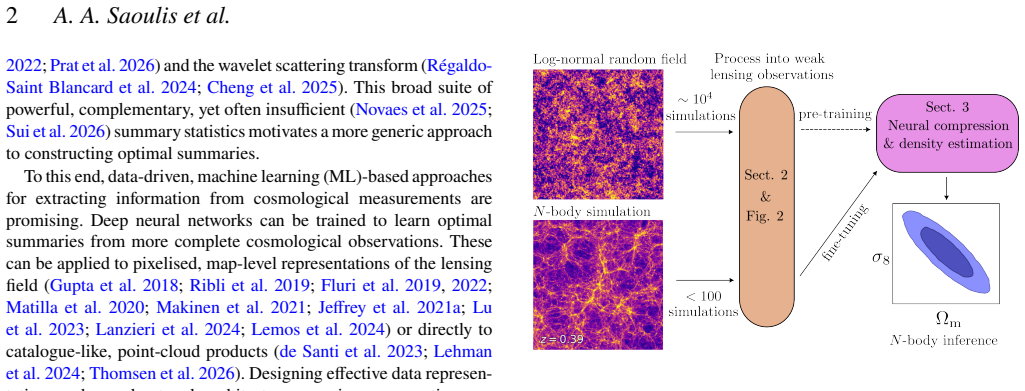
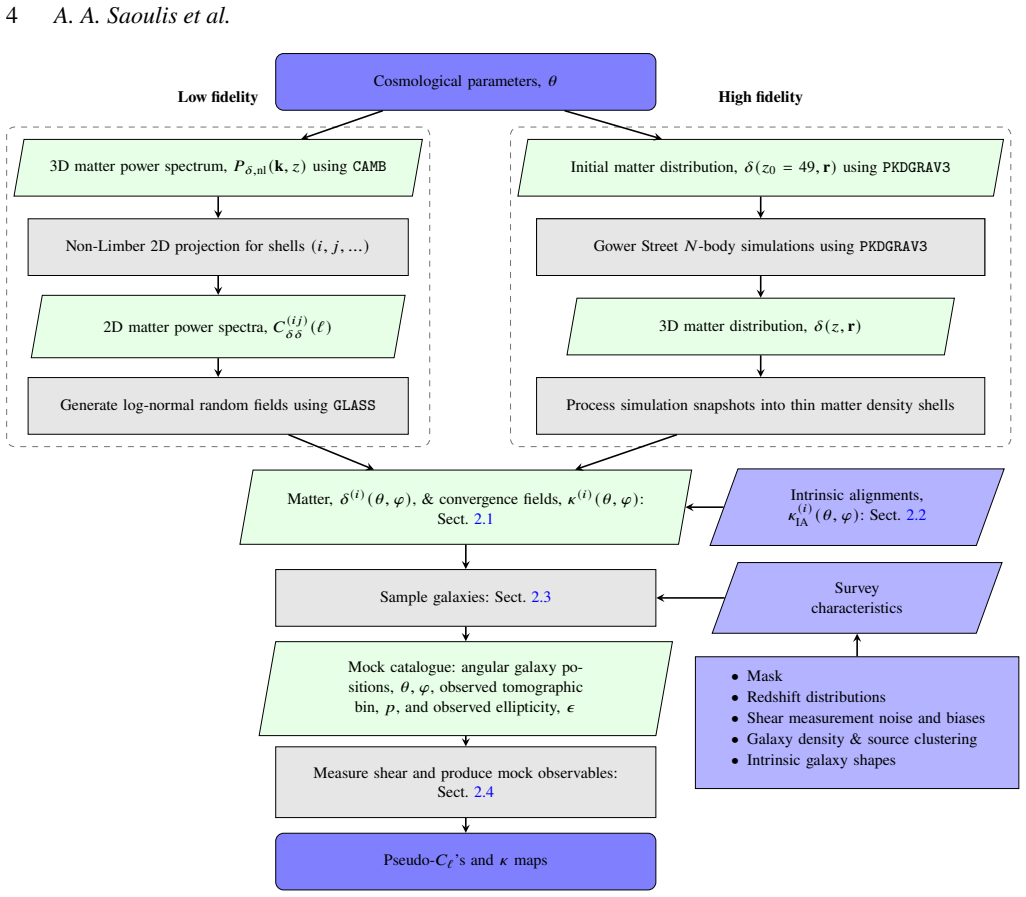
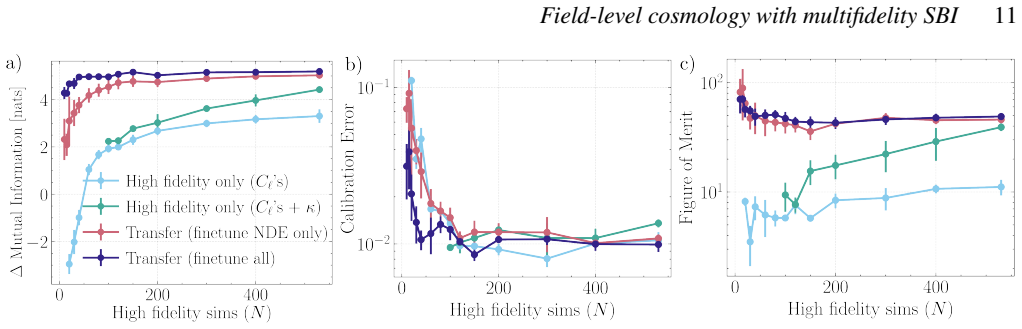
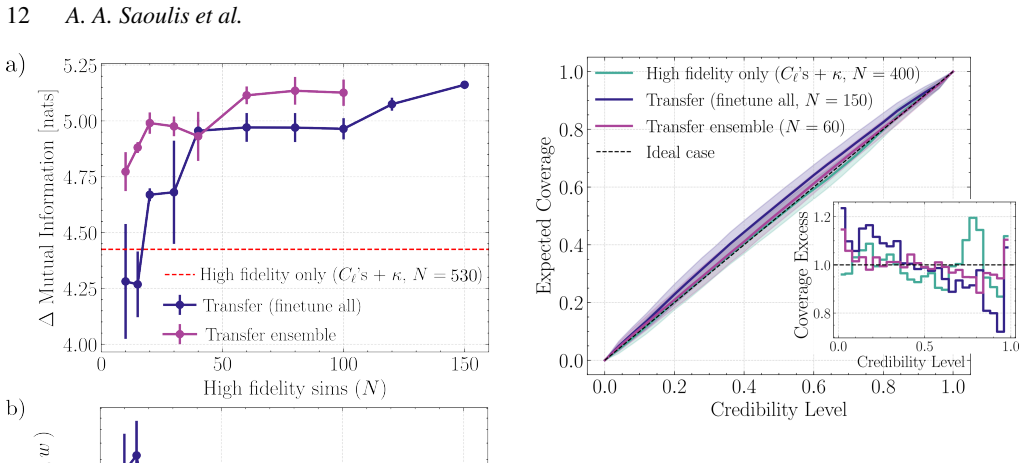
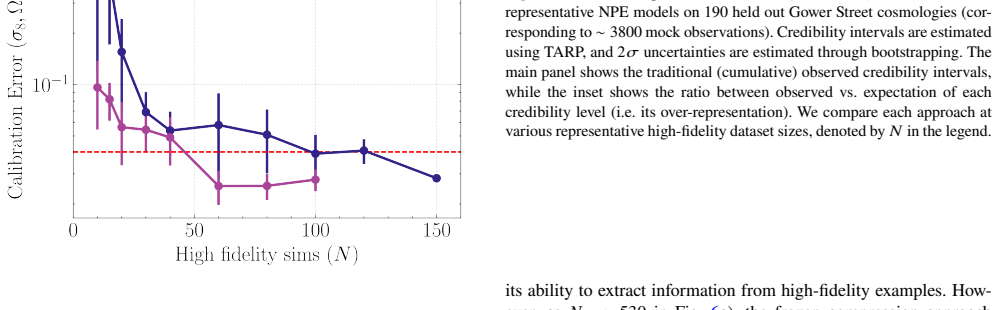
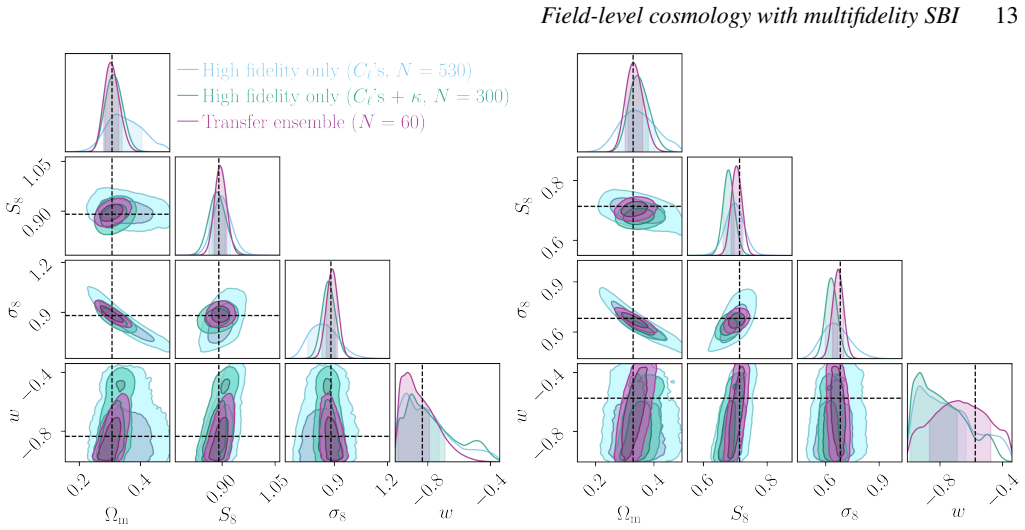
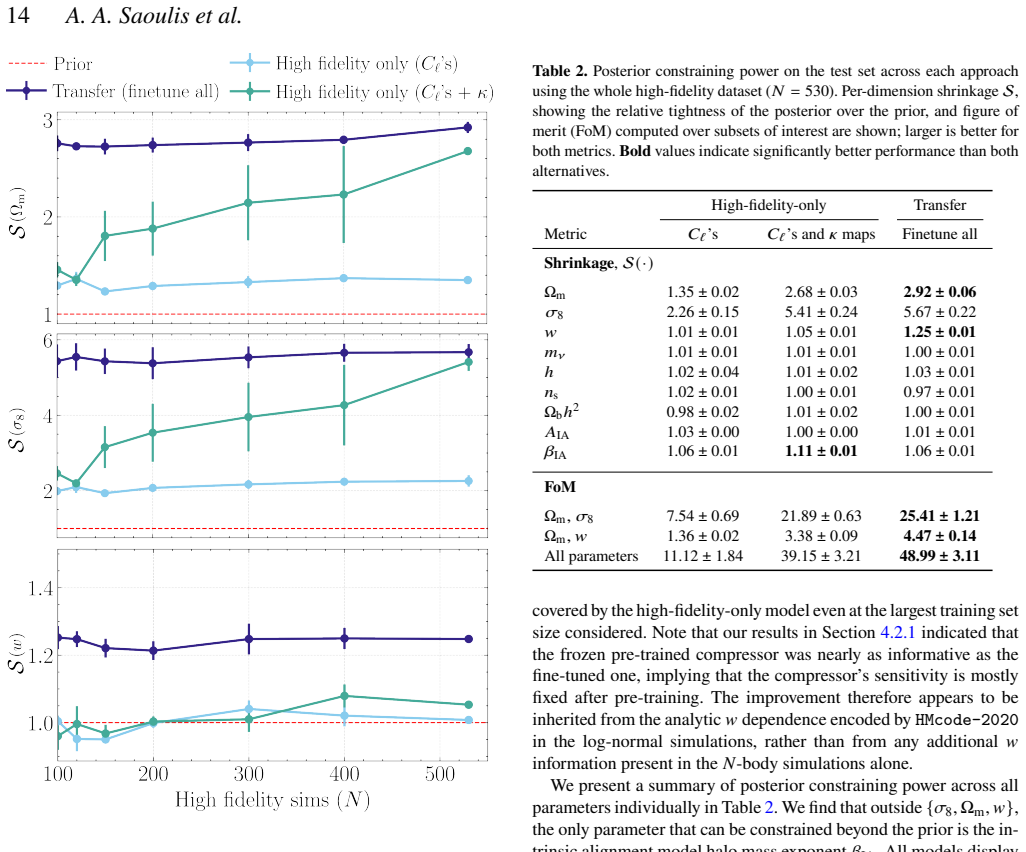
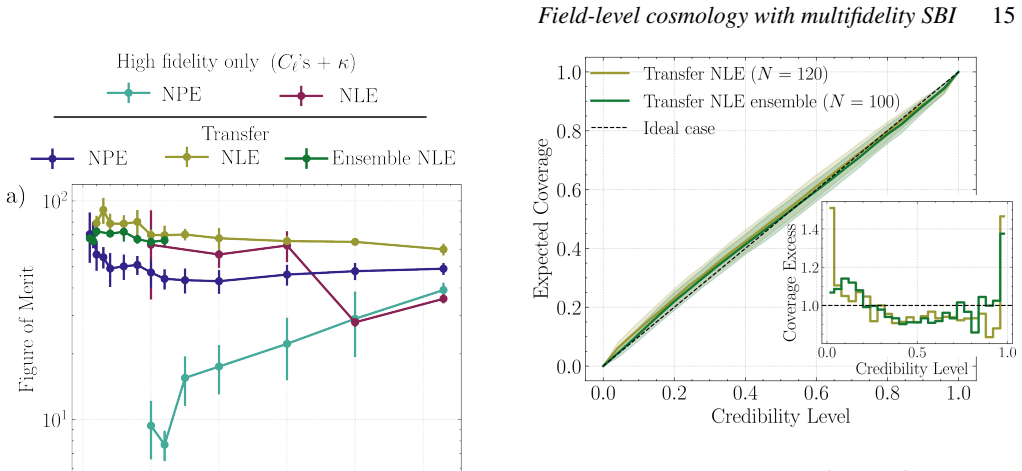
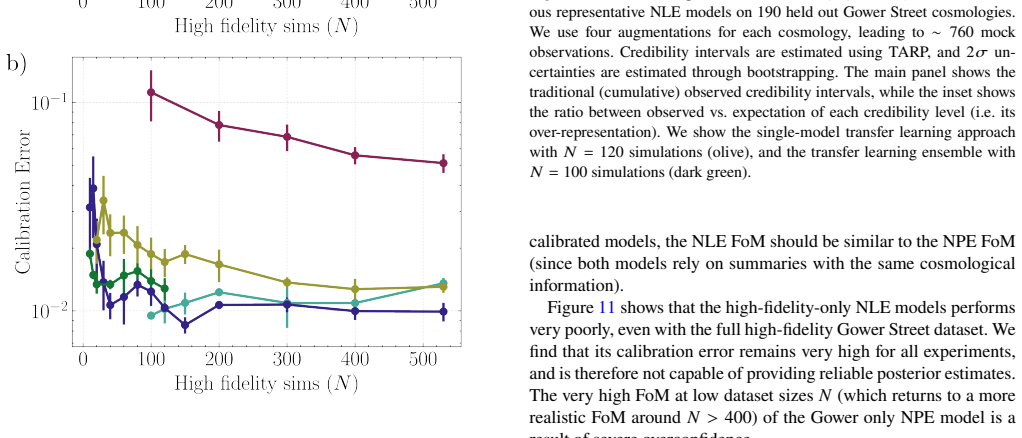
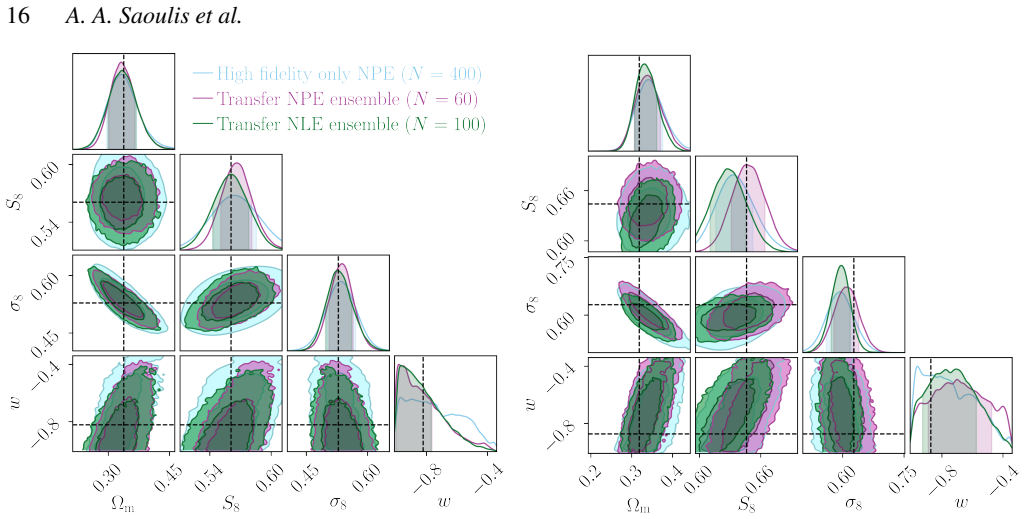
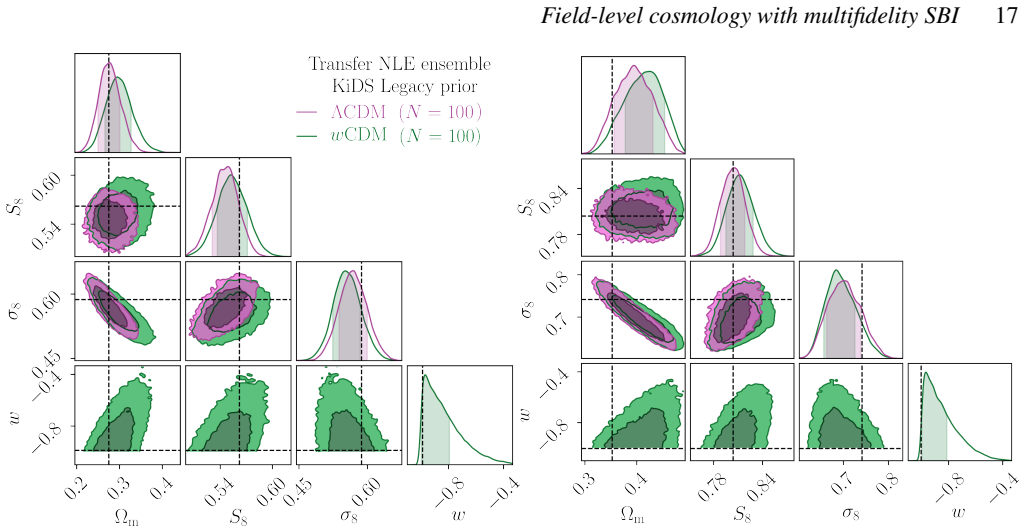
Pre-training neural compression and inference models on log-normal GLASS simulations and fine-tuning them on 60-100 high-fidelity N-body simulations yields informative and well-calibrated cosmological posteriors for field-level weak lensing analysis of KiDS-Legacy-like mocks, reducing the required simulation cost by an order of magnitude.
What carries the argument
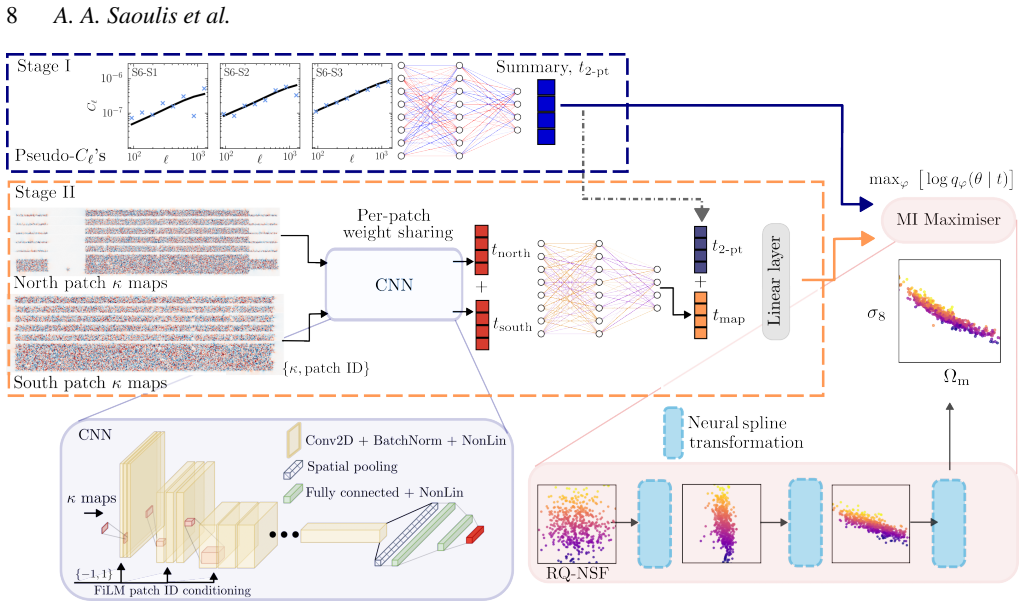
Multifidelity simulation-based inference: neural models pre-trained on fast log-normal mocks then fine-tuned on a small set of N-body simulations.
If this is right
- Field-level inference from the full shear field becomes computationally feasible for ongoing and future surveys.
- The extra cosmological information beyond power-spectrum statistics can be accessed without prohibitive simulation budgets.
- Simulation-based inference pipelines for similar large-scale structure analyses require far fewer high-fidelity runs.
- Posteriors remain well-calibrated even when the bulk of training data comes from approximate simulations.
Where Pith is reading between the lines
- The same pre-train then fine-tune strategy could be tested on real KiDS or DES data to check for residual biases from the log-normal approximation.
- The method may extend directly to other probes such as galaxy clustering where high-fidelity mocks are also expensive.
- Surveys planning even larger data volumes could adopt hybrid simulation budgets as a default rather than training from scratch on N-body runs.
- The transfer learning step might be further optimized by varying the number or fidelity level of the pre-training mocks.
Load-bearing premise
Log-normal GLASS simulations capture enough of the shear field's statistical structure that models pre-trained on them transfer successfully when fine-tuned on only 60-100 N-body runs.
What would settle it
Running the same analysis with several thousand high-fidelity N-body simulations and finding that the resulting posteriors differ substantially in width, location, or calibration from those obtained with the 60-100 simulation multifidelity procedure.
Figures
read the original abstract
We perform a realistic KiDS-Legacy mock analysis with field-level neural compression and simulation-based inference using fewer than 100 $N$-body simulations. The weak lensing shear field encodes substantially more cosmological information than standard two-point summary statistics such as the power spectrum. Field-level inference can fully exploit this information, but physical realism at the field-level requires very high-fidelity simulations. This poses a major challenge for simulation-based inference (SBI): accurate empirical density modelling and deep-learning-based neural compression require many training simulations, but achieving physical realism at the field level makes each simulation extremely costly. We demonstrate that multifidelity SBI can alleviate this tension by substantially reducing the number of high-fidelity simulations needed for accurate cosmological inference. We pre-train neural inference models on realistic KiDS-Legacy-like shear mocks using fast log-normal GLASS simulations and fine-tune them on a small set of high-fidelity $N$-body simulations. We show that between $60$-$100$ high-fidelity simulations are sufficient to obtain informative and well-calibrated cosmological posteriors, enabling an order-of-magnitude reduction in simulation cost for accurate field-level inference in a realistic setting.
Editorial analysis
A structured set of objections, weighed in public.
Referee Report
Summary. The manuscript demonstrates a multifidelity simulation-based inference (SBI) method for field-level weak lensing cosmology. It involves pre-training neural compression and density estimation models on a large number of fast log-normal GLASS simulations and then fine-tuning them with 60-100 high-fidelity N-body simulations to infer cosmological parameters from KiDS-Legacy-like mock shear fields, claiming that this yields informative and well-calibrated posteriors with significantly reduced computational cost.
Significance. If the results hold, this approach would represent a substantial advance in making field-level inference feasible by reducing the number of expensive N-body simulations required by an order of magnitude, which could have important implications for analyzing data from current and future weak lensing surveys.
major comments (2)
- [Abstract] Abstract: The assertion that the posteriors are 'well-calibrated' is presented without any quantitative metrics (such as coverage probabilities or PIT histograms), validation plots, or description of the assessment procedure. This is load-bearing for the central claim that the multifidelity procedure produces accurate field-level posteriors.
- [Methods] The multifidelity pipeline assumes that pre-training on GLASS log-normal mocks transfers sufficient non-Gaussian structure so that fine-tuning on 60-100 N-body simulations recovers the relevant higher-order correlations in the shear field. No explicit test (e.g., comparison of learned features, higher-order statistics, or calibration on held-out N-body data versus a from-scratch baseline) is described to verify this transfer at the field level rather than at the power-spectrum level.
minor comments (1)
- Provide the exact counts of GLASS pre-training simulations and N-body fine-tuning simulations, along with the precise KiDS-Legacy survey specifications used in the mocks, to aid reproducibility.
Simulated Author's Rebuttal
We thank the referee for their constructive and detailed review. We address each major comment point-by-point below, proposing revisions where they strengthen the presentation of our results without altering the core findings.
read point-by-point responses
-
Referee: [Abstract] Abstract: The assertion that the posteriors are 'well-calibrated' is presented without any quantitative metrics (such as coverage probabilities or PIT histograms), validation plots, or description of the assessment procedure. This is load-bearing for the central claim that the multifidelity procedure produces accurate field-level posteriors.
Authors: We agree that the abstract, as a concise summary, should explicitly reference the quantitative calibration tests. The manuscript already reports coverage probabilities and PIT histograms evaluated on held-out N-body simulations (Section 4.3 and associated figures). We will revise the abstract to briefly state that calibration was assessed via these metrics and that the posteriors are well-calibrated according to them. revision: yes
-
Referee: [Methods] The multifidelity pipeline assumes that pre-training on GLASS log-normal mocks transfers sufficient non-Gaussian structure so that fine-tuning on 60-100 N-body simulations recovers the relevant higher-order correlations in the shear field. No explicit test (e.g., comparison of learned features, higher-order statistics, or calibration on held-out N-body data versus a from-scratch baseline) is described to verify this transfer at the field level rather than at the power-spectrum level.
Authors: We acknowledge that an explicit demonstration of non-Gaussian feature transfer would strengthen the methods section. The current validation relies on end-to-end posterior calibration and information gain relative to a power-spectrum baseline. We will add a dedicated paragraph and supplementary figure comparing higher-order statistics (e.g., aperture mass peaks and bispectrum amplitudes) extracted from the pre-trained versus fine-tuned networks on held-out N-body fields, together with a direct comparison against a from-scratch SBI model trained only on the 60–100 N-body simulations. revision: yes
Circularity Check
No circularity: empirical multifidelity transfer demonstrated on mocks
full rationale
The paper reports an empirical demonstration in which neural compressors and SBI models are pre-trained on GLASS log-normal mocks and fine-tuned on 60-100 N-body simulations, with posteriors evaluated for calibration and information content on independent KiDS-Legacy-like mock data. No derivation step reduces by construction to a fitted parameter, self-citation, or renamed input; the central claim is the observed success of the transfer-learning pipeline rather than a mathematical identity. The abstract and described procedure contain no self-definitional relations, fitted-input predictions, or load-bearing self-citations. This is a standard empirical result whose validity rests on external validation against the held-out mocks, not on internal redefinition.
Axiom & Free-Parameter Ledger
axioms (1)
- domain assumption Log-normal GLASS simulations capture sufficient statistical properties of the weak lensing shear field for effective pre-training of neural compression and inference models that transfer to N-body simulations.
Reference graph
Works this paper leans on
-
[1]
Euclid: I. Overview of the Euclid mission. , keywords =. doi:10.1051/0004-6361/202450810 , archivePrefix =. 2405.13491 , primaryClass =
-
[2]
The Astrophysical Journal , volume=
LSST: from science drivers to reference design and anticipated data products , author=. The Astrophysical Journal , volume=. 2019 , publisher=
2019
-
[3]
Journal of Cosmology and Astroparticle Physics , volume=
The Simons Observatory: science goals and forecasts , author=. Journal of Cosmology and Astroparticle Physics , volume=. 2019 , publisher=
2019
-
[4]
arXiv preprint arXiv:1503.03757 , year=
Wide-field infrarred survey telescope-astrophysics focused telescope assets WFIRST-AFTA 2015 report , author=. arXiv preprint arXiv:1503.03757 , year=
Pith/arXiv arXiv 2015
-
[5]
Validation on simulations , author=
Dark Energy Survey Year 3 results: Simulation-based cosmological inference with wavelet harmonics, scattering transforms, and moments of weak lensing mass maps. Validation on simulations , author=. Physical Review D , volume=. 2024 , publisher=
2024
-
[6]
arXiv preprint arXiv:2105.13548 , year=
Dark energy survey year 3 results: Multi-probe modeling strategy and validation , author=. arXiv preprint arXiv:2105.13548 , year=
-
[7]
Physics Reports , volume=
The intrinsic alignment of galaxies and its impact on weak gravitational lensing in an era of precision cosmology , author=. Physics Reports , volume=. 2015 , publisher=
2015
-
[8]
Monthly Notices of the Royal Astronomical Society , volume=
The impact of intrinsic alignment on current and future cosmic shear surveys , author=. Monthly Notices of the Royal Astronomical Society , volume=. 2016 , publisher=
2016
-
[9]
Monthly Notices of the Royal Astronomical Society: Letters , volume=
Detection of the significant impact of source clustering on higher order statistics with DES Year 3 weak gravitational lensing data , author=. Monthly Notices of the Royal Astronomical Society: Letters , volume=. 2024 , publisher=
2024
-
[10]
The Astrophysical Journal , volume=
COSMOS: Stochastic bias from measurements of weak lensing and galaxy clustering , author=. The Astrophysical Journal , volume=. 2012 , publisher=
2012
-
[11]
Astronomy & Astrophysics , volume=
KiDS and Euclid: Cosmological implications of a pseudo angular power spectrum analysis of KiDS-1000 cosmic shear tomography , author=. Astronomy & Astrophysics , volume=. 2022 , publisher=
2022
-
[12]
Monthly Notices of the Royal Astronomical Society , volume=
Dark energy survey year 3 results: Cosmology with peaks using an emulator approach , author=. Monthly Notices of the Royal Astronomical Society , volume=. 2022 , publisher=
2022
-
[13]
Astronomy & Astrophysics , volume=
KiDS-SBI: Simulation-based inference analysis of KiDS-1000 cosmic shear , author=. Astronomy & Astrophysics , volume=. 2025 , publisher=
2025
-
[14]
Monthly Notices of the Royal Astronomical Society , volume=
Dark Energy Survey Year 3 results: Curved-sky weak lensing mass map reconstruction , author=. Monthly Notices of the Royal Astronomical Society , volume=. 2021 , publisher=
2021
-
[15]
Journal of Cosmology and Astroparticle Physics , volume=
Pixelization effects in cosmic shear angular power spectra , author=. Journal of Cosmology and Astroparticle Physics , volume=. 2025 , publisher=
2025
-
[16]
Monthly Notices of the Royal Astronomical Society , volume=
Dark Energy Survey year 3 results: covariance modelling and its impact on parameter estimation and quality of fit , author=. Monthly Notices of the Royal Astronomical Society , volume=. 2021 , publisher=
2021
-
[17]
Monthly Notices of the Royal Astronomical Society , volume =
Wallis, Christopher G R and Price, Matthew A and McEwen, Jason D and Kitching, Thomas D and Leistedt, Boris and Plouviez, Antoine , title =. Monthly Notices of the Royal Astronomical Society , volume =. 2022 , month =. doi:10.1093/mnras/stab3235 , url =
-
[18]
Physical Review D—Particles, Fields, Gravitation, and Cosmology , volume=
Intrinsic alignment-lensing interference as a contaminant of cosmic shear , author=. Physical Review D—Particles, Fields, Gravitation, and Cosmology , volume=. 2004 , publisher=
2004
-
[19]
Monthly Notices of the Royal Astronomical Society , volume=
Intrinsic and extrinsic galaxy alignment , author=. Monthly Notices of the Royal Astronomical Society , volume=. 2001 , publisher=
2001
-
[20]
Monthly Notices of the Royal Astronomical Society , volume=
Intrinsic galaxy alignments from the 2SLAQ and SDSS surveys: luminosity and redshift scalings and implications for weak lensing surveys , author=. Monthly Notices of the Royal Astronomical Society , volume=. 2007 , publisher=
2007
-
[21]
Monthly Notices of the Royal Astronomical Society , volume=
The mass dependence of dark matter halo alignments with large-scale structure , author=. Monthly Notices of the Royal Astronomical Society , volume=. 2018 , publisher=
2018
-
[22]
Astronomy & Astrophysics , volume=
KiDS-1000: Constraints on the intrinsic alignment of luminous red galaxies , author=. Astronomy & Astrophysics , volume=. 2021 , publisher=
2021
-
[23]
Astronomy & Astrophysics , volume=
Constraints on intrinsic alignment contamination of weak lensing surveys using the MegaZ-LRG sample , author=. Astronomy & Astrophysics , volume=. 2011 , publisher=
2011
-
[24]
New Journal of Physics , volume=
Dark energy constraints from cosmic shear power spectra: impact of intrinsic alignments on photometric redshift requirements , author=. New Journal of Physics , volume=
-
[25]
Astronomy & Astrophysics , volume=
KiDS-1000: Weak lensing and intrinsic alignment around luminous red galaxies , author=. Astronomy & Astrophysics , volume=. 2025 , publisher=
2025
-
[26]
Schneider, P. Weak Gravitational Lensing. Gravitational Lensing: Strong, Weak and Micro. 2006. doi:10.1007/978-3-540-30310-7_3
-
[27]
Astronomy & Astrophysics , volume=
KiDS-Legacy: Cosmological constraints from cosmic shear with the complete Kilo-Degree Survey , author=. Astronomy & Astrophysics , volume=. 2025 , publisher=
2025
-
[28]
arXiv preprint arXiv:2512.11041 , year=
KiDS-Legacy: Constraining dark energy, neutrino mass, and curvature , author=. arXiv preprint arXiv:2512.11041 , year=
-
[29]
Monthly Notices of the Royal Astronomical Society , volume=
Cosmic microwave background temperature and polarization pseudo-C ℓ estimators and covariances , author=. Monthly Notices of the Royal Astronomical Society , volume=. 2005 , publisher=
2005
-
[30]
Astronomy & Astrophysics , volume=
KiDS-Legacy calibration: Unifying shear and redshift calibration with the SKiLLS multi-band image simulations , author=. Astronomy & Astrophysics , volume=. 2023 , publisher=
2023
-
[31]
Astronomy & Astrophysics , volume=
KiDS-Legacy: Redshift distributions and their calibration , author=. Astronomy & Astrophysics , volume=. 2025 , publisher=
2025
-
[32]
Monthly Notices of the Royal Astronomical Society , volume=
A simulation-based inference pipeline for cosmic shear with the Kilo-Degree Survey , author=. Monthly Notices of the Royal Astronomical Society , volume=. 2023 , publisher=
2023
-
[33]
The Astrophysical Journal , volume=
Neutrino mass constraint from an Implicit Likelihood Analysis of BOSS voids , author=. The Astrophysical Journal , volume=. 2024 , publisher=
2024
-
[34]
Physical Review D , volume=
Cosmology from HSC Y1 weak lensing data with combined higher-order statistics and simulation-based inference , author=. Physical Review D , volume=. 2025 , publisher=
2025
-
[35]
Monthly Notices of the Royal Astronomical Society , volume=
KiDS-1000 and DES-Y1 combined: Cosmology from peak count statistics , author=. Monthly Notices of the Royal Astronomical Society , volume=. 2024 , publisher=
2024
-
[36]
Physical Review D , volume=
Field-level simulation-based inference of galaxy clustering with convolutional neural networks , author=. Physical Review D , volume=. 2024 , publisher=
2024
-
[37]
Physical Review D , volume=
Cosmological constraints from the nonlinear galaxy bispectrum , author=. Physical Review D , volume=. 2024 , publisher=
2024
-
[38]
Physical Review D , volume=
Galaxy clustering analysis with SimBIG and the wavelet scattering transform , author=. Physical Review D , volume=. 2024 , publisher=
2024
-
[39]
Journal of High Energy Astrophysics , volume=
Cosmology intertwined: A review of the particle physics, astrophysics, and cosmology associated with the cosmological tensions and anomalies , author=. Journal of High Energy Astrophysics , volume=. 2022 , publisher=
2022
-
[40]
Journal of Cosmology and Astroparticle Physics , volume=
Fast likelihood-free inference in the LSS Stage IV era , author=. Journal of Cosmology and Astroparticle Physics , volume=. 2024 , publisher=
2024
-
[41]
Journal of Cosmology and Astroparticle Physics , volume=
EFTofLSS meets simulation-based inference: 8 from biased tracers , author=. Journal of Cosmology and Astroparticle Physics , volume=. 2024 , publisher=
2024
-
[42]
Proceedings of the National Academy of Sciences , volume=
The frontier of simulation-based inference , author=. Proceedings of the National Academy of Sciences , volume=. 2020 , publisher=
2020
-
[43]
Monthly Notices of the Royal Astronomical Society , volume=
Massive optimal data compression and density estimation for scalable, likelihood-free inference in cosmology , author=. Monthly Notices of the Royal Astronomical Society , volume=. 2018 , publisher=
2018
-
[44]
Fast -free Inference of Simulation Models with Bayesian Conditional Density Estimation , url =
Papamakarios, George and Murray, Iain , booktitle =. Fast -free Inference of Simulation Models with Bayesian Conditional Density Estimation , url =
-
[45]
Proceedings of the 36th International Conference on Machine Learning , pages =
Automatic Posterior Transformation for Likelihood-Free Inference , author =. Proceedings of the 36th International Conference on Machine Learning , pages =. 2019 , editor =
2019
-
[46]
Proceedings of the Twenty-Second International Conference on Artificial Intelligence and Statistics , pages =
Sequential Neural Likelihood: Fast Likelihood-free Inference with Autoregressive Flows , author =. Proceedings of the Twenty-Second International Conference on Artificial Intelligence and Statistics , pages =. 2019 , editor =
2019
-
[47]
Symposium on Advances in Approximate Bayesian Inference , pages=
Likelihood-free inference with emulator networks , author=. Symposium on Advances in Approximate Bayesian Inference , pages=. 2019 , organization=
2019
-
[48]
Likelihood-free
Hermans, Joeri and Begy, Volodimir and Louppe, Gilles , booktitle =. Likelihood-free. 2020 , editor =
2020
-
[49]
Proceedings of the 37th International Conference on Machine Learning , pages =
On Contrastive Learning for Likelihood-free Inference , author =. Proceedings of the 37th International Conference on Machine Learning , pages =. 2020 , editor =
2020
-
[50]
Truncated proposals for scalable and hassle-free simulation-based inference , url =
Deistler, Michael and Goncalves, Pedro J and Macke, Jakob H , booktitle =. Truncated proposals for scalable and hassle-free simulation-based inference , url =
-
[51]
Monthly Notices of the Royal Astronomical Society , volume=
Likelihood-free inference with neural compression of DES SV weak lensing map statistics , author=. Monthly Notices of the Royal Astronomical Society , volume=. 2021 , publisher=
2021
-
[52]
Journal of Cosmology and Astroparticle Physics , volume=
Hybrid summary statistics: neural weak lensing inference beyond the power spectrum , author=. Journal of Cosmology and Astroparticle Physics , volume=. 2025 , publisher=
2025
-
[53]
Computational Astrophysics and Cosmology , volume=
PKDGRAV3: beyond trillion particle cosmological simulations for the next era of galaxy surveys , author=. Computational Astrophysics and Cosmology , volume=. 2017 , publisher=
2017
-
[54]
Astrophysics source code library , pages=
Camb: Code for anisotropies in the microwave background , author=. Astrophysics source code library , pages=
-
[55]
International workshop on multiple classifier systems , pages=
Ensemble methods in machine learning , author=. International workshop on multiple classifier systems , pages=. 2000 , organization=
2000
-
[56]
Advances in neural information processing systems , volume=
Simple and scalable predictive uncertainty estimation using deep ensembles , author=. Advances in neural information processing systems , volume=
-
[57]
International Conference on Artificial Intelligence and Statistics , pages=
Simulation-based stacking , author=. International Conference on Artificial Intelligence and Statistics , pages=. 2024 , organization=
2024
-
[58]
IEEE transactions on pattern analysis and machine intelligence , volume=
Fine-tuning CNN image retrieval with no human annotation , author=. IEEE transactions on pattern analysis and machine intelligence , volume=. 2018 , publisher=
2018
-
[59]
Proceedings of the AAAI conference on artificial intelligence , volume=
Film: Visual reasoning with a general conditioning layer , author=. Proceedings of the AAAI conference on artificial intelligence , volume=
-
[60]
Large Scale
Andrew Brock and Jeff Donahue and Karen Simonyan , booktitle=. Large Scale. 2019 , url=
2019
-
[61]
The Astrophysical Journal , volume=
C3NN: cosmological correlator convolutional neural network an interpretable machine-learning framework for cosmological analyses , author=. The Astrophysical Journal , volume=. 2024 , publisher=
2024
-
[62]
Journal of Cosmology and Astroparticle Physics , volume=
Massive s through the CNN lens: interpreting the field-level neutrino mass information in weak lensing , author=. Journal of Cosmology and Astroparticle Physics , volume=. 2025 , publisher=
2025
-
[63]
The Astrophysical Journal , volume=
Interpreting Cosmological Information from Neural Networks in the Hydrodynamic Universe , author=. The Astrophysical Journal , volume=. 2025 , publisher=
2025
-
[64]
Machine Learning: Science and Technology , volume=
A robust estimator of mutual information for deep learning interpretability , author=. Machine Learning: Science and Technology , volume=. 2023 , publisher=
2023
-
[65]
Physical Review D , volume=
CDM and early dark energy in latent space: A data-driven parametrization of the CMB temperature power spectrum , author=. Physical Review D , volume=. 2025 , publisher=
2025
-
[66]
Astronomy & Astrophysics , volume=
How informative are summaries of the cosmic 21 cm signal? , author=. Astronomy & Astrophysics , volume=. 2024 , publisher=
2024
-
[67]
The Astrophysical Journal , volume=
How to evaluate the sufficiency and complementarity of summary statistics for cosmic fields: an information-theoretic perspective , author=. The Astrophysical Journal , volume=. 2026 , publisher=
2026
-
[68]
Journal of Cosmology and Astroparticle Physics , volume=
Lossless, scalable implicit likelihood inference for cosmological fields , author=. Journal of Cosmology and Astroparticle Physics , volume=. 2021 , publisher=
2021
-
[69]
Physical Review D , volume=
Distinguishing standard and modified gravity cosmologies with machine learning , author=. Physical Review D , volume=. 2019 , publisher=
2019
-
[70]
arXiv preprint arXiv:1606.08415 , year=
Gaussian error linear units (gelus) , author=. arXiv preprint arXiv:1606.08415 , year=
-
[71]
Advances in neural information processing systems , volume=
Diffusion models beat gans on image synthesis , author=. Advances in neural information processing systems , volume=
-
[72]
Physical Review D , volume=
Cosmological constraints with deep learning from KiDS-450 weak lensing maps , author=. Physical Review D , volume=. 2019 , publisher=
2019
-
[73]
Monthly Notices of the Royal Astronomical Society , volume=
Fast likelihood-free cosmology with neural density estimators and active learning , author=. Monthly Notices of the Royal Astronomical Society , volume=. 2019 , publisher=
2019
-
[74]
The Astrophysical Journal Supplement Series , volume=
The dark energy survey: Data release 1 , author=. The Astrophysical Journal Supplement Series , volume=. 2018 , publisher=
2018
-
[75]
Publications of the Astronomical Society of Japan , volume=
The Hyper Suprime-Cam SSP survey: overview and survey design , author=. Publications of the Astronomical Society of Japan , volume=. 2018 , publisher=
2018
-
[76]
Publications of the Astronomical Society of Japan , volume=
Cosmology from cosmic shear power spectra with Subaru Hyper Suprime-Cam first-year data , author=. Publications of the Astronomical Society of Japan , volume=. 2019 , publisher=
2019
-
[77]
Monthly Notices of the Royal Astronomical Society , volume=
Gravitational lensing analysis of the Kilo-Degree Survey , author=. Monthly Notices of the Royal Astronomical Society , volume=. 2015 , publisher=
2015
-
[78]
Physics of the Dark Universe , volume=
The CosmoVerse White Paper: Addressing observational tensions in cosmology with systematics and fundamental physics , author=. Physics of the Dark Universe , volume=. 2025 , publisher=
2025
-
[79]
Astronomy & Astrophysics , volume=
The fifth data release of the Kilo Degree Survey: Multi-epoch optical/NIR imaging covering wide and legacy-calibration fields , author=. Astronomy & Astrophysics , volume=. 2024 , publisher=
2024
-
[80]
Physical Review D , volume=
Dark energy survey year 3 results: Cosmological constraints from cluster abundances, weak lensing, and galaxy clustering , author=. Physical Review D , volume=. 2025 , publisher=
2025
discussion (0)
Sign in with ORCID, Apple, or X to comment. Anyone can read and Pith papers without signing in.