C²GR: Coupled Comprehensive Generative Replay for a Continually Learnable Universal Segmentation Model
Pith reviewed 2026-06-26 08:56 UTC · model grok-4.3
The pith
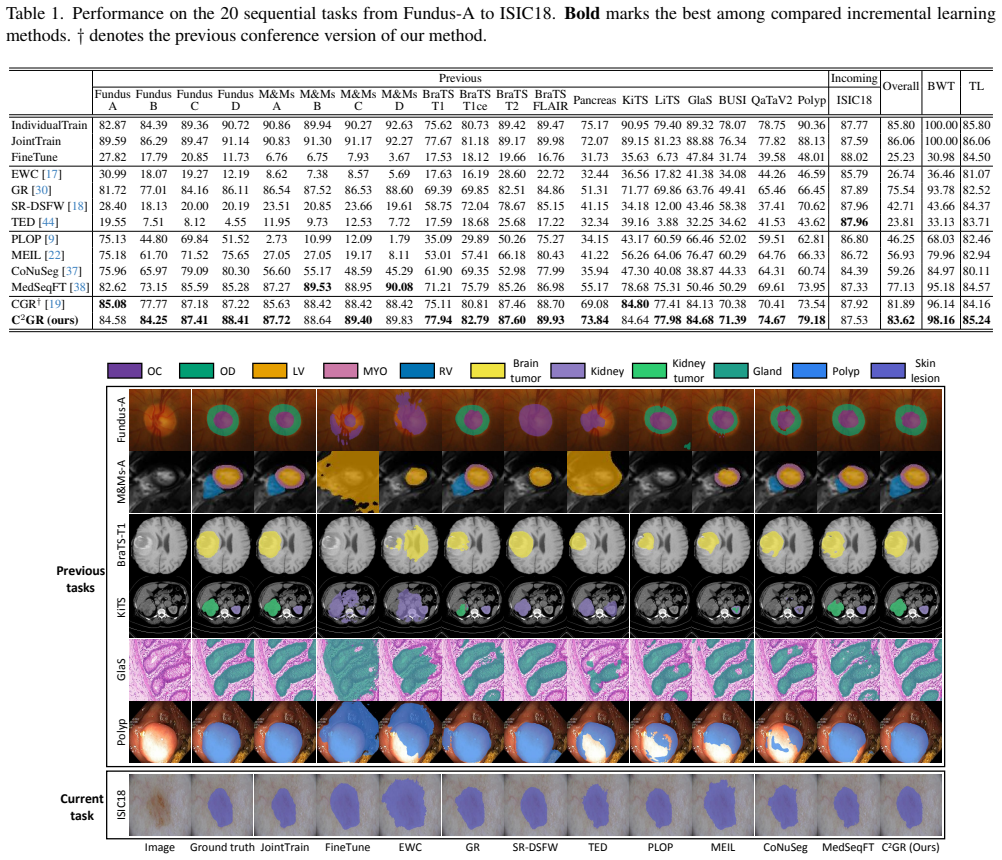
C^2GR keeps universal segmentation performance within 2.44 percent of joint training by generating aligned image-mask pairs from prior tasks during incremental updates.
A machine-rendered reading of the paper's core claim, the machinery that carries it, and where it could break.
Core claim
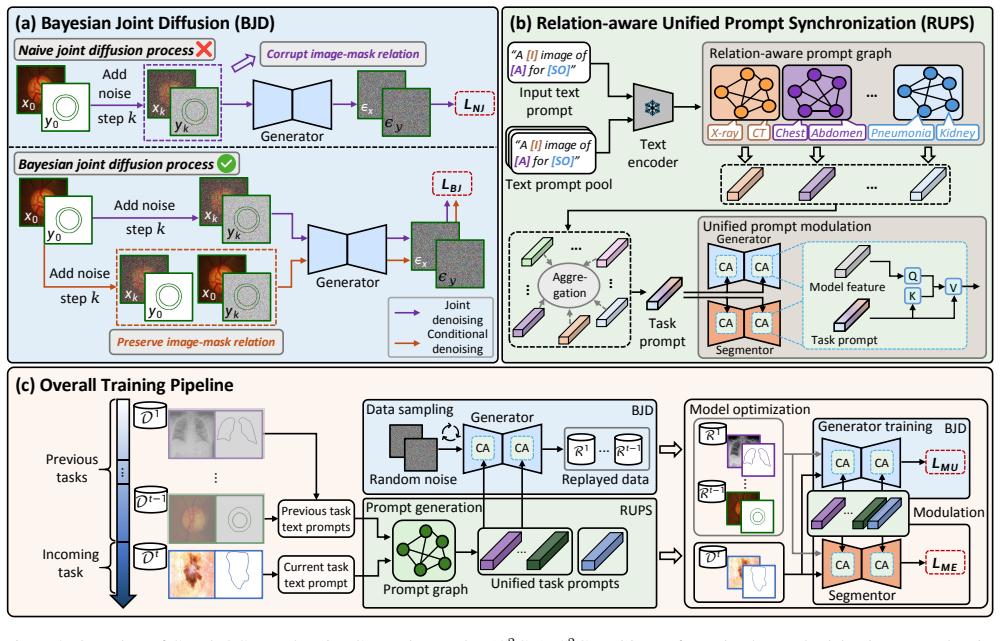
Coupled Comprehensive Generative Replay simultaneously produces image-mask pairs for past tasks via Bayesian Joint Diffusion, which optimizes conditional distributions to preserve correspondence, and Relation-aware Unified Prompt Synchronization, which modulates both generator and segmentor through a shared task-relation prompt to keep their optimization aligned under concurrent appearance and objective shifts.
What carries the argument
Bayesian Joint Diffusion that models image-mask correspondence as conditional distributions learned by conditional denoising, paired with Relation-aware Unified Prompt Synchronization that applies a shared prompt to coordinate generator and segmentor updates.
If this is right
- A single model can be updated sequentially from new medical departments without storing or redistributing earlier patient scans.
- The same framework handles both modality shifts and changes in segmentation objectives within one continual-learning run.
- Generative replay becomes practical for dense prediction tasks once correspondence and optimization synchronization are enforced together.
Where Pith is reading between the lines
- The same coupling of diffusion-based pair generation and prompt-based synchronization could be tested on continual learning problems outside medical imaging where input-label relationships also drift.
- If the prompt mechanism generalizes, it might reduce the usual requirement for separate hyperparameter schedules when training paired generative and discriminative models.
- Extending the method to non-diffusion generators would test whether the correspondence-preserving benefit is specific to the Bayesian joint formulation or more broadly applicable.
Load-bearing premise
The generated image-mask pairs remain structurally accurate and the shared prompt keeps generator and segmentor training synchronized without creating artifacts that harm segmentation quality.
What would settle it
A controlled test in which the generated pairs exhibit measurable misalignment between image and mask or the overall performance gap versus joint training exceeds 2.44 percent across the same 20 tasks.
Figures
read the original abstract
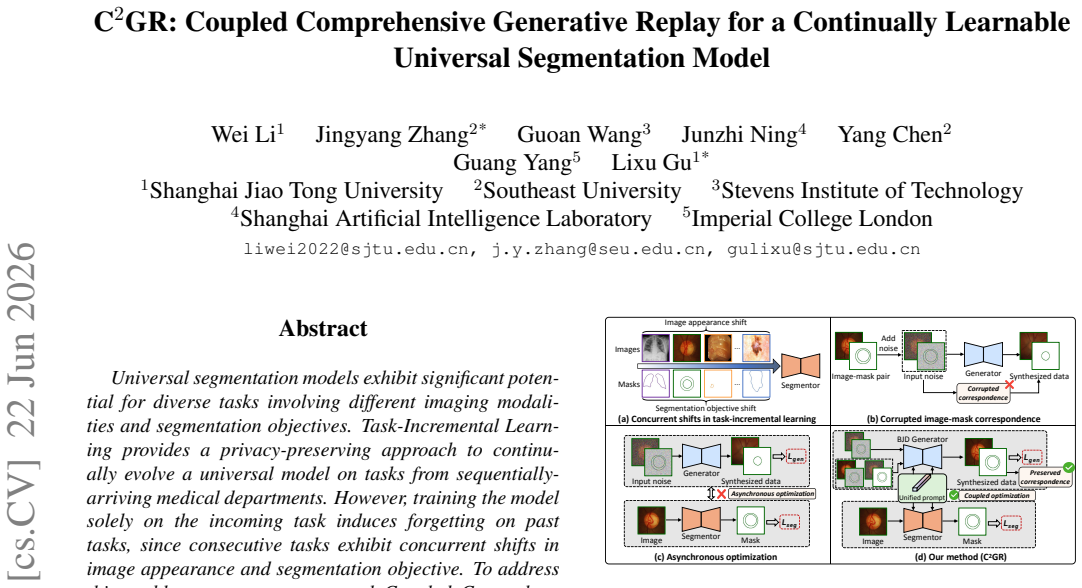
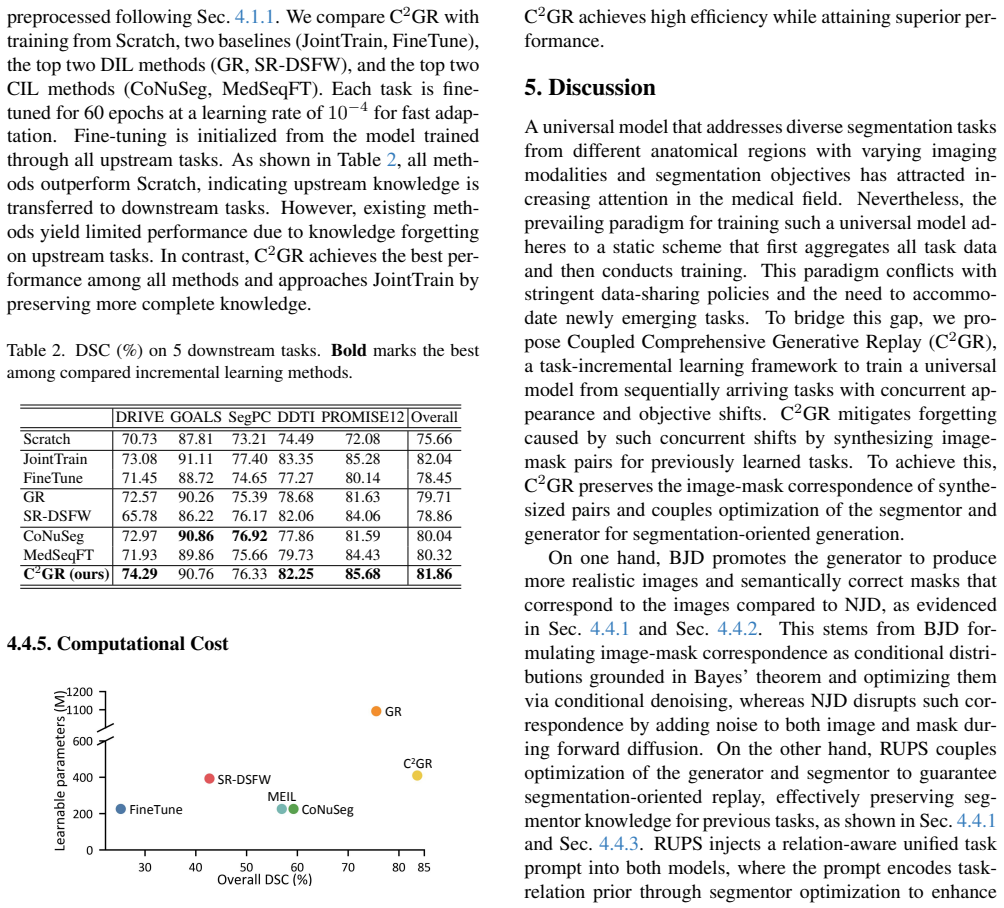
Universal segmentation models exhibit significant potential for diverse tasks involving different imaging modalities and segmentation objectives. Task-Incremental Learning provides a privacy-preserving approach to continually evolve a universal model on tasks from sequentially-arriving medical departments. However, training the model solely on the incoming task induces forgetting on past tasks, since consecutive tasks exhibit concurrent shifts in image appearance and segmentation objective. To address this problem, we propose a novel Coupled Comprehensive Generative Replay (C^2GR) framework that simultaneously synthesizes image-mask pairs of previous tasks to mitigate forgetting under concurrent appearance and objective shifts. This requires preserving image-mask correspondence for structure-realistic generation and bridging asynchronous optimization of the generator and segmentor for segmentation-oriented generation. Specifically, we propose a Bayesian Joint Diffusion (BJD) method that formulates the correspondence as conditional distributions optimized via conditional denoising. Furthermore, we develop a Relation-aware Unified Prompt Synchronization (RUPS) scheme to simultaneously modulate the generator and segmentor via a shared task-relation-aware prompt for synchronizing their optimization. Experiments on 20 tasks spanning diverse modalities and objectives demonstrate that C^2GR exhibits only a 2.44% drop in overall performance compared to joint training with all task data, effectively alleviating forgetting from the concurrent shifts. Our code will be made publicly available at https://github.com/mar-cry/C2GR.
Editorial analysis
A structured set of objections, weighed in public.
Referee Report
Summary. The manuscript introduces the C²GR framework for task-incremental continual learning of universal segmentation models. It targets forgetting induced by concurrent shifts in image appearance and segmentation objectives across sequentially arriving tasks. The method uses Bayesian Joint Diffusion (BJD) to model and preserve image-mask correspondence via conditional denoising, and Relation-aware Unified Prompt Synchronization (RUPS) to jointly modulate the generator and segmentor with a shared task-relation-aware prompt. The central empirical claim is that, across 20 tasks spanning diverse modalities and objectives, C²GR incurs only a 2.44% drop in overall performance relative to joint training on all data.
Significance. If the reported performance holds under rigorous verification, the work would offer a practical advance for privacy-preserving continual adaptation of segmentation models in medical imaging. The coupling of generative replay with synchronized prompt-based optimization addresses a specific challenge of dual shifts that standard replay methods may not handle. The explicit commitment to public code release supports reproducibility and is a clear strength.
major comments (3)
- [Abstract] Abstract: The central quantitative claim of a 2.44% performance drop versus joint training is presented without any accompanying information on the evaluation metric(s), number of runs, standard deviation, statistical tests, or the specific baselines and comparison methods used. This information is load-bearing for assessing whether the result demonstrates effective alleviation of forgetting.
- [Experiments] Experiments section: No ablation studies, component-wise comparisons, or controls isolating the contributions of BJD versus RUPS (or versus standard generative replay) are referenced. Without these, it is not possible to attribute the small performance gap specifically to the proposed mechanisms for preserving correspondence and synchronizing optimization.
- [Methods] Methods: The abstract describes BJD as formulating correspondence via conditional distributions and RUPS as using a shared prompt, but supplies no equations, algorithmic pseudocode, or implementation details. These omissions prevent evaluation of whether the components reliably handle concurrent appearance and objective shifts without introducing new artifacts.
minor comments (2)
- [Abstract] The acronym C²GR is introduced but the expansion is given only once; ensure consistent use of the full name on first mention in all sections.
- [Abstract] The code availability statement should include a permanent DOI or archive link in addition to the GitHub URL for long-term accessibility.
Simulated Author's Rebuttal
We thank the referee for the constructive comments on clarity, experimental validation, and methodological detail. We address each point below and will revise the manuscript to strengthen these aspects.
read point-by-point responses
-
Referee: [Abstract] Abstract: The central quantitative claim of a 2.44% performance drop versus joint training is presented without any accompanying information on the evaluation metric(s), number of runs, standard deviation, statistical tests, or the specific baselines and comparison methods used. This information is load-bearing for assessing whether the result demonstrates effective alleviation of forgetting.
Authors: We agree that the abstract requires additional context for the key claim. In the revision we will explicitly state the evaluation metric underlying 'overall performance', report the number of runs performed, include standard deviations, and list the primary baselines and comparison methods. No statistical significance tests were conducted in the original experiments. revision: yes
-
Referee: [Experiments] Experiments section: No ablation studies, component-wise comparisons, or controls isolating the contributions of BJD versus RUPS (or versus standard generative replay) are referenced. Without these, it is not possible to attribute the small performance gap specifically to the proposed mechanisms for preserving correspondence and synchronizing optimization.
Authors: We acknowledge that the current experiments section lacks component ablations. We will add a dedicated ablation study in the revised manuscript that isolates the contributions of BJD (correspondence preservation) and RUPS (optimization synchronization) as well as a direct comparison against standard generative replay without the coupled mechanisms. revision: yes
-
Referee: [Methods] Methods: The abstract describes BJD as formulating correspondence via conditional distributions and RUPS as using a shared prompt, but supplies no equations, algorithmic pseudocode, or implementation details. These omissions prevent evaluation of whether the components reliably handle concurrent appearance and objective shifts without introducing new artifacts.
Authors: We agree that the Methods section would benefit from greater formality. We will add the explicit conditional distribution formulation and denoising objective for BJD, the mathematical description of the shared prompt synchronization in RUPS, and pseudocode for the overall training procedure to enable precise evaluation of how the components address the dual shifts. revision: yes
Circularity Check
No significant circularity
full rationale
The paper's central claim is an empirical result: experiments across 20 tasks show a 2.44% performance drop versus joint training. The abstract and description introduce algorithmic components (BJD for conditional denoising, RUPS for prompt synchronization) without any equations, derivations, or parameter-fitting steps that reduce the reported outcome to a self-referential definition or fitted input. No self-citations are invoked as load-bearing uniqueness theorems, and the performance metric is presented as an experimental measurement rather than a constructed prediction. The argument chain is therefore self-contained against external benchmarks.
Axiom & Free-Parameter Ledger
axioms (1)
- domain assumption Diffusion models can be conditioned to preserve structural correspondence between generated images and masks.
invented entities (2)
-
Bayesian Joint Diffusion (BJD)
no independent evidence
-
Relation-aware Unified Prompt Synchronization (RUPS)
no independent evidence
Reference graph
Works this paper leans on
-
[1]
Dataset of breast ultrasound images.Data in Brief, 28:104863, 2020
Walid Al-Dhabyani, Mohammed Gomaa, Hussien Khaled, and Aly Fahmy. Dataset of breast ultrasound images.Data in Brief, 28:104863, 2020. 6
2020
-
[2]
The medical segmentation decathlon.Nat
Michela Antonelli, Annika Reinke, Spyridon Bakas, Key- van Farahani, Annette Kopp-Schneider, Bennett A Landman, Geert Litjens, Bjoern Menze, Olaf Ronneberger, Ronald M Summers, et al. The medical segmentation decathlon.Nat. Commun., 13(1):4128, 2022. 6
2022
-
[3]
Ujjwal Baid, Satyam Ghodasara, Suyash Mohan, Michel Bilello, Evan Calabrese, Errol Colak, Keyvan Farahani, Jayashree Kalpathy-Cramer, Felipe C Kitamura, Sarthak Pati, et al. The rsna-asnr-miccai brats 2021 benchmark on brain tumor segmentation and radiogenomic classification. arXiv preprint arXiv:2107.02314, 2021. 6
Pith/arXiv arXiv 2021
-
[4]
One transformer fits all distributions in multi-modal diffu- sion at scale
Fan Bao, Shen Nie, Kaiwen Xue, Chongxuan Li, Shi Pu, Yaole Wang, Gang Yue, Yue Cao, Hang Su, and Jun Zhu. One transformer fits all distributions in multi-modal diffu- sion at scale. InInternational Conference on Machine Learn- ing, pages 1692–1717. PMLR, 2023. 4
2023
-
[5]
Campello, Polyxeni Gkontra, Cristian Izquierdo, Carlos Mart ´ın-Isla, Alireza Sojoudi, Peter M
V ´ıctor M. Campello, Polyxeni Gkontra, Cristian Izquierdo, Carlos Mart ´ın-Isla, Alireza Sojoudi, Peter M. Full, Klaus Maier-Hein, Yao Zhang, Zhiqiang He, Jun Ma, et al. Multi- centre, multi-vendor and multi-disease cardiac segmentation: The m&ms challenge.IEEE Trans. Med. Imag., 40(12): 3543–3554, 2021. 6
2021
-
[6]
An image is worth 1/2 tokens after layer 2: Plug-and-play inference accelera- tion for large vision-language models
Liang Chen, Haozhe Zhao, Tianyu Liu, Shuai Bai, Junyang Lin, Chang Zhou, and Baobao Chang. An image is worth 1/2 tokens after layer 2: Plug-and-play inference accelera- tion for large vision-language models. InComputer Vision – ECCV 2024, pages 19–35. Springer, 2025. 11
2024
-
[7]
Noel Codella, Veronica Rotemberg, Philipp Tschandl, M Emre Celebi, Stephen Dusza, David Gutman, Brian Helba, Aadi Kalloo, Konstantinos Liopyris, Michael Marchetti, et al. Skin lesion analysis toward melanoma detection 2018: A challenge hosted by the interna- tional skin imaging collaboration (isic).arXiv preprint arXiv:1902.03368, 2019. 6
Pith/arXiv arXiv 2018
-
[8]
Aysen Degerli, Serkan Kiranyaz, Muhammad E. H. Chowd- hury, and Moncef Gabbouj. Osegnet: Operational segmen- tation network for covid-19 detection using chest x-ray im- ages. In2022 IEEE International Conference on Image Pro- cessing (ICIP), pages 2306–2310, 2022. 6
2022
-
[9]
Plop: Learning without forgetting for contin- ual semantic segmentation
Arthur Douillard, Yifu Chen, Arnaud Dapogny, and Matthieu Cord. Plop: Learning without forgetting for contin- ual semantic segmentation. In2021 IEEE/CVF Conference on Computer Vision and Pattern Recognition (CVPR), pages 4039–4049, 2021. 2, 3, 7, 8
2021
-
[10]
Pranet: Parallel reverse attention network for polyp segmentation
Deng-Ping Fan, Ge-Peng Ji, Tao Zhou, Geng Chen, Huazhu Fu, Jianbing Shen, and Ling Shao. Pranet: Parallel reverse attention network for polyp segmentation. InMedical Image Computing and Computer Assisted Intervention, pages 263–
-
[11]
Dataset and evaluation algorithm design for goals challenge
Huihui Fang, Fei Li, Huazhu Fu, Junde Wu, Xiulan Zhang, and Yanwu Xu. Dataset and evaluation algorithm design for goals challenge. InOphthalmic Medical Image Analy- sis, pages 135–142. Springer, 2022. 9
2022
-
[12]
Training like a medical resident: Context-prior learning toward universal medical image segmentation
Yunhe Gao. Training like a medical resident: Context-prior learning toward universal medical image segmentation. In 2024 IEEE/CVF Conference on Computer Vision and Pat- tern Recognition (CVPR), pages 11194–11204, 2024. 2
2024
-
[13]
Segpc- 2021: A challenge & dataset on segmentation of multiple myeloma plasma cells from microscopic images.Med
Anubha Gupta, Shiv Gehlot, Shubham Goswami, Sachin Motwani, Ritu Gupta, ´Alvaro Garc´ıa Faura, Dejan ˇStepec, Tomaˇz Martin ˇciˇc, Reza Azad, Dorit Merhof, et al. Segpc- 2021: A challenge & dataset on segmentation of multiple myeloma plasma cells from microscopic images.Med. Im- age Anal., 83:102677, 2023. 9
2021
-
[14]
Maier-Hein, Xi- aoshuai Hou, Chunmei Xie, Fengyi Li, Yang Nan, Guangrui Mu, Zhiyong Lin, Miofei Han, et al
Nicholas Heller, Fabian Isensee, Klaus H. Maier-Hein, Xi- aoshuai Hou, Chunmei Xie, Fengyi Li, Yang Nan, Guangrui Mu, Zhiyong Lin, Miofei Han, et al. The state of the art in kidney and kidney tumor segmentation in contrast-enhanced ct imaging: Results of the kits19 challenge.Med. Image Anal., 67:101821, 2021. 6
2021
-
[15]
Classifier-free diffusion guidance.arXiv preprint arXiv:2207.12598, 2022
Jonathan Ho and Tim Salimans. Classifier-free diffusion guidance.arXiv preprint arXiv:2207.12598, 2022. 5
Pith/arXiv arXiv 2022
-
[16]
Denoising diffu- sion probabilistic models
Jonathan Ho, Ajay Jain, and Pieter Abbeel. Denoising diffu- sion probabilistic models. InProceedings of the 34th Inter- national Conference on Neural Information Processing Sys- tems, 2020. 4
2020
-
[17]
Rusu, Kieran Milan, John Quan, Tiago Ramalho, Agnieszka Grabska- Barwinska, et al
James Kirkpatrick, Razvan Pascanu, Neil Rabinowitz, Joel Veness, Guillaume Desjardins, Andrei A. Rusu, Kieran Milan, John Quan, Tiago Ramalho, Agnieszka Grabska- Barwinska, et al. Overcoming catastrophic forgetting in neu- ral networks.Proceedings of the National Academy of Sci- ences, 114(13):3521–3526, 2017. 2, 3, 7, 8
2017
-
[18]
Domain- incremental cardiac image segmentation with style-oriented replay and domain-sensitive feature whitening.IEEE Trans
Kang Li, Lequan Yu, and Pheng-Ann Heng. Domain- incremental cardiac image segmentation with style-oriented replay and domain-sensitive feature whitening.IEEE Trans. Med. Imag., 42(3):570–581, 2023. 1, 2, 3, 5, 7, 8
2023
-
[19]
Comprehensive generative replay for task-incremental seg- mentation with concurrent appearance and semantic forget- ting
Wei Li, Jingyang Zhang, Pheng-Ann Heng, and Lixu Gu. Comprehensive generative replay for task-incremental seg- mentation with concurrent appearance and semantic forget- ting. InMedical Image Computing and Computer Assisted Intervention, pages 80–90. Springer, 2024. 2, 3, 7, 8
2024
-
[20]
Evaluation of prostate segmentation algorithms for mri: The promise12 challenge.Med
Geert Litjens, Robert Toth, Wendy van de Ven, Caroline Hoeks, Sjoerd Kerkstra, Bram van Ginneken, Graham Vin- cent, Gwenael Guillard, Neil Birbeck, Jindang Zhang, et al. Evaluation of prostate segmentation algorithms for mri: The promise12 challenge.Med. Image Anal., 18(2):359–373,
-
[21]
Landman, Yixuan Yuan, Alan Yuille, Yucheng Tang, and Zongwei Zhou
Jie Liu, Yixiao Zhang, Jie-Neng Chen, Junfei Xiao, Yongyi Lu, Bennett A. Landman, Yixuan Yuan, Alan Yuille, Yucheng Tang, and Zongwei Zhou. Clip-driven univer- sal model for organ segmentation and tumor detection. In 2023 IEEE/CVF International Conference on Computer Vi- sion (ICCV), pages 21095–21107, 2023. 1, 5
2023
-
[22]
Learning incrementally to segment multi- ple organs in a ct image
Pengbo Liu, Xia Wang, Mengsi Fan, Hongli Pan, Minmin Yin, Xiaohong Zhu, Dandan Du, Xiaoying Zhao, Li Xiao, Lian Ding, et al. Learning incrementally to segment multi- ple organs in a ct image. InMedical Image Computing and Computer Assisted Intervention, pages 714–724. Springer,
-
[23]
Segment anything in medical images.Nat
Jun Ma, Yuting He, Feifei Li, Lin Han, Chenyu You, and Bo Wang. Segment anything in medical images.Nat. Commun., 15(1):654, 2024. 1, 2, 3
2024
-
[24]
Medsegfactory: Text-guided generation of medical image- mask pairs
Jiawei Mao, Yuhan Wang, Yucheng Tang, Daguang Xu, Kang Wang, Yang Yang, Zongwei Zhou, and Yuyin Zhou. Medsegfactory: Text-guided generation of medical image- mask pairs. In2025 IEEE/CVF International Conference on Computer Vision (ICCV), pages 21525–21535, 2025. 2, 4, 5
2025
-
[25]
An open access thy- roid ultrasound image database
Lina Pedraza, Carlos Vargas, Fabi ´an Narv´aez, Oscar Dur´an, Emma Mu ˜noz, and Eduardo Romero. An open access thy- roid ultrasound image database. In10th International Sym- posium on Medical Information Processing and Analysis, page 92870W. International Society for Optics and Photon- ics, SPIE, 2015. 9
2015
-
[26]
Privacy in the age of medical big data.Nat
W Nicholson Price and I Glenn Cohen. Privacy in the age of medical big data.Nat. Med., 25(1):37–43, 2019. 1
2019
-
[27]
Learning transferable visual models from natural language supervi- sion
Alec Radford, Jong Wook Kim, Chris Hallacy, Aditya Ramesh, Gabriel Goh, Sandhini Agarwal, Girish Sastry, Amanda Askell, Pamela Mishkin, Jack Clark, et al. Learning transferable visual models from natural language supervi- sion. InInternational conference on machine learning, pages 8748–8763. PMLR, 2021. 5
2021
-
[28]
High-resolution image synthesis with latent diffusion models
Robin Rombach, Andreas Blattmann, Dominik Lorenz, Patrick Esser, and Bj ¨orn Ommer. High-resolution image synthesis with latent diffusion models. In2022 IEEE/CVF Conference on Computer Vision and Pattern Recognition (CVPR), pages 10674–10685, 2022. 6, 10
2022
-
[29]
U-net: Convolutional networks for biomedical image segmentation
Olaf Ronneberger, Philipp Fischer, and Thomas Brox. U-net: Convolutional networks for biomedical image segmentation. InMedical Image Computing and Computer-Assisted Inter- vention, pages 234–241. Springer, 2015. 7
2015
-
[30]
Continual learning with deep generative replay
Hanul Shin, Jung Kwon Lee, Jaehong Kim, and Jiwon Kim. Continual learning with deep generative replay. InProceed- ings of the 31st International Conference on Neural Infor- mation Processing Systems, page 2994–3003, 2017. 2, 3, 5, 7, 8
2017
-
[31]
Pluim, Hao Chen, Xi- aojuan Qi, Pheng-Ann Heng, Yun Bo Guo, Li Yang Wang, Bogdan J
Korsuk Sirinukunwattana, Josien P.W. Pluim, Hao Chen, Xi- aojuan Qi, Pheng-Ann Heng, Yun Bo Guo, Li Yang Wang, Bogdan J. Matuszewski, Elia Bruni, Urko Sanchez, et al. Gland segmentation in colon histology images: The glas challenge contest.Med. Image Anal., 35:489–502, 2017. 6
2017
-
[32]
Staal, M.D
J. Staal, M.D. Abramoff, M. Niemeijer, M.A. Viergever, and B. van Ginneken. Ridge-based vessel segmentation in color images of the retina.IEEE Trans. Med. Imag., 23(4):501– 509, 2004. 9
2004
-
[33]
Incremental few-shot semantic segmenta- tion via multi-level switchable visual prompts
Maoxian Wan, Kaige Li, Qichuan Geng, Weimin Shi, and Zhong Zhou. Incremental few-shot semantic segmenta- tion via multi-level switchable visual prompts. In2025 IEEE/CVF International Conference on Computer Vision (ICCV), pages 24113–24122, 2025. 2
2025
-
[34]
Sam- med3d-moe: Towards a non-forgetting segment anything model via mixture of experts for 3d medical image segmen- tation
Guoan Wang, Jin Ye, Junlong Cheng, Tianbin Li, Zhaolin Chen, Jianfei Cai, Junjun He, and Bohan Zhuang. Sam- med3d-moe: Towards a non-forgetting segment anything model via mixture of experts for 3d medical image segmen- tation. InMedical Image Computing and Computer Assisted Intervention, pages 552–561. Springer, 2024. 1, 3
2024
-
[35]
Continual alignment for sam: Rethinking foundation models for medical image segmentation in con- tinual learning
Jiayi Wang, Wei Dai, Haoyu Wang, Sihan Yang, Haixia Bi, and Jian Sun. Continual alignment for sam: Rethinking foundation models for medical image segmentation in con- tinual learning. InProceedings of the IEEE/CVF Conference on Computer Vision and Pattern Recognition, pages 7520– 7529, 2026. 3
2026
-
[36]
Dofe: Domain-oriented feature em- bedding for generalizable fundus image segmentation on un- seen datasets.IEEE Trans
Shujun Wang, Lequan Yu, Kang Li, Xin Yang, Chi-Wing Fu, and Pheng-Ann Heng. Dofe: Domain-oriented feature em- bedding for generalizable fundus image segmentation on un- seen datasets.IEEE Trans. Med. Imag., 39(12):4237–4248,
-
[37]
Continual nuclei segmentation via prototype-wise rela- tion distillation and contrastive learning.IEEE Trans
Huisi Wu, Zhaoze Wang, Zebin Zhao, Cheng Chen, and Jing Qin. Continual nuclei segmentation via prototype-wise rela- tion distillation and contrastive learning.IEEE Trans. Med. Imag., 42(12):3794–3804, 2023. 2, 3, 7, 8
2023
-
[38]
Yiwen Ye, Yicheng Wu, Xiangde Luo, He Zhang, Ziyang Chen, Ting Dang, Yanning Zhang, and Yong Xia. Medseqft: Sequential fine-tuning foundation models for 3d medical im- age segmentation.arXiv preprint arXiv:2509.06096, 2025. 3, 7, 8
arXiv 2025
-
[39]
Learning towards synchronous network memorizability and generalizability for continual segmenta- tion across multiple sites
Jingyang Zhang, Peng Xue, Ran Gu, Yuning Gu, Mianxin Liu, Yongsheng Pan, Zhiming Cui, Jiawei Huang, Lei Ma, and Dinggang Shen. Learning towards synchronous network memorizability and generalizability for continual segmenta- tion across multiple sites. InMedical Image Computing and Computer Assisted Intervention, pages 380–390. Springer,
-
[40]
S3r: Shape and semantics-based selective regulariza- tion for explainable continual segmentation across multiple sites.IEEE Trans
Jingyang Zhang, Ran Gu, Peng Xue, Mianxin Liu, Hao Zheng, Yefeng Zheng, Lei Ma, Guotai Wang, and Lixu Gu. S3r: Shape and semantics-based selective regulariza- tion for explainable continual segmentation across multiple sites.IEEE Trans. Med. Imag., 42(9):2539–2551, 2023. 2, 3
2023
-
[41]
Dc²t: Disentanglement-guided consoli- dation and consistency training for semi-supervised cross- site continual segmentation.IEEE Trans
Jingyang Zhang, Jialun Pei, Dunyuan Xu, Yueming Jin, and Pheng-Ann Heng. Dc²t: Disentanglement-guided consoli- dation and consistency training for semi-supervised cross- site continual segmentation.IEEE Trans. Med. Imag., 44(2): 903–914, 2025. 2
2025
-
[42]
Genera- tive ai enables medical image segmentation in ultra low-data regimes.Nat
Li Zhang, Basu Jindal, Ahmed Alaa, Robert Weinreb, David Wilson, Eran Segal, James Zou, and Pengtao Xie. Genera- tive ai enables medical image segmentation in ultra low-data regimes.Nat. Commun., 16(1):6486, 2025. 2
2025
-
[43]
A generalist foundation model and database for open-world medical image segmentation.Nat
Siqi Zhang, Qizhe Zhang, Shanghang Zhang, Xiaohong Liu, Jingkun Yue, Ming Lu, Huihuan Xu, Jiaxin Yao, Xiaobao Wei, Jiajun Cao, et al. A generalist foundation model and database for open-world medical image segmentation.Nat. Biomed. Eng, pages 1–16, 2025. 1
2025
-
[44]
Boosting knowledge diversity, accuracy, and stability via tri-enhanced distillation for domain continual medical image segmentation.Med
Zhanshi Zhu, Xinghua Ma, Wei Wang, Suyu Dong, Kuan- quan Wang, Lianming Wu, Gongning Luo, Guohua Wang, and Shuo Li. Boosting knowledge diversity, accuracy, and stability via tri-enhanced distillation for domain continual medical image segmentation.Med. Image Anal., 94:103112,
discussion (0)
Sign in with ORCID, Apple, or X to comment. Anyone can read and Pith papers without signing in.