Electrochemical DNA Hairpin Sensors for Differentiating Small Molecule Intercalation from Minor Groove Binding
Pith reviewed 2026-06-26 05:39 UTC · model grok-4.3
The pith
A four-base-pair DNA hairpin on gold electrodes detects intercalators and distinguishes them from minor groove binders by changes in voltammetric signal.
A machine-rendered reading of the paper's core claim, the machinery that carries it, and where it could break.
Core claim
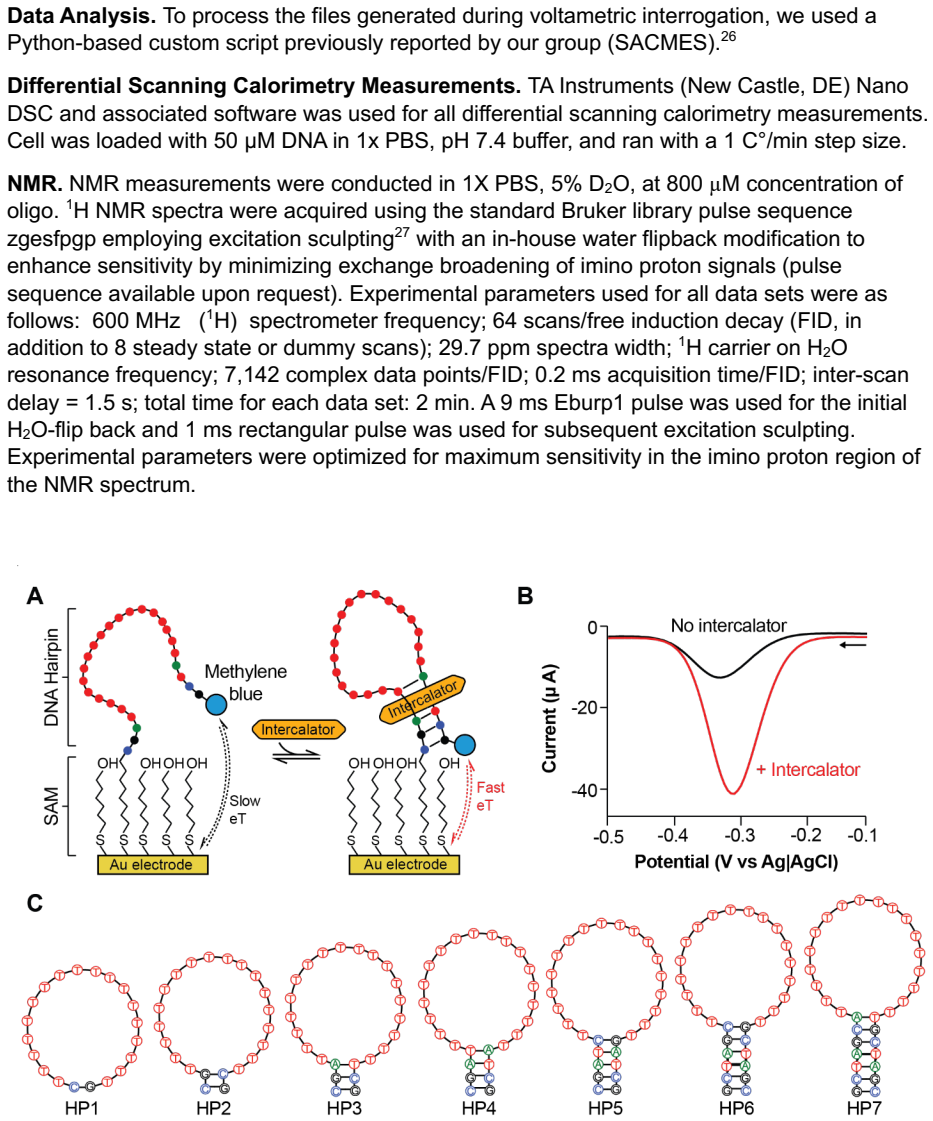
Hairpin oligos self-assembled on gold electrodes via 3' thiol linkers and labeled at the 5' end with methylene blue report intercalator binding through increased voltammetric current caused by stem closure; the optimal four-base-pair stem sequence HP4 responds to five intercalators across a broad concentration range with EC50 values in agreement with literature KD values and produces significantly higher signal gain with intercalators than with minor groove binders.
What carries the argument
The thiol-linked DNA hairpin oligo carrying methylene blue, where intercalator binding stabilizes the stem and increases redox current at the gold electrode.
Load-bearing premise
The observed increase in voltammetric current is produced specifically by intercalator-driven hairpin formation rather than by nonspecific adsorption or other surface changes.
What would settle it
A control experiment in which a known minor groove binder or nonbinding compound produces signal gain comparable to that of an intercalator would falsify the claimed specificity.
Figures
read the original abstract
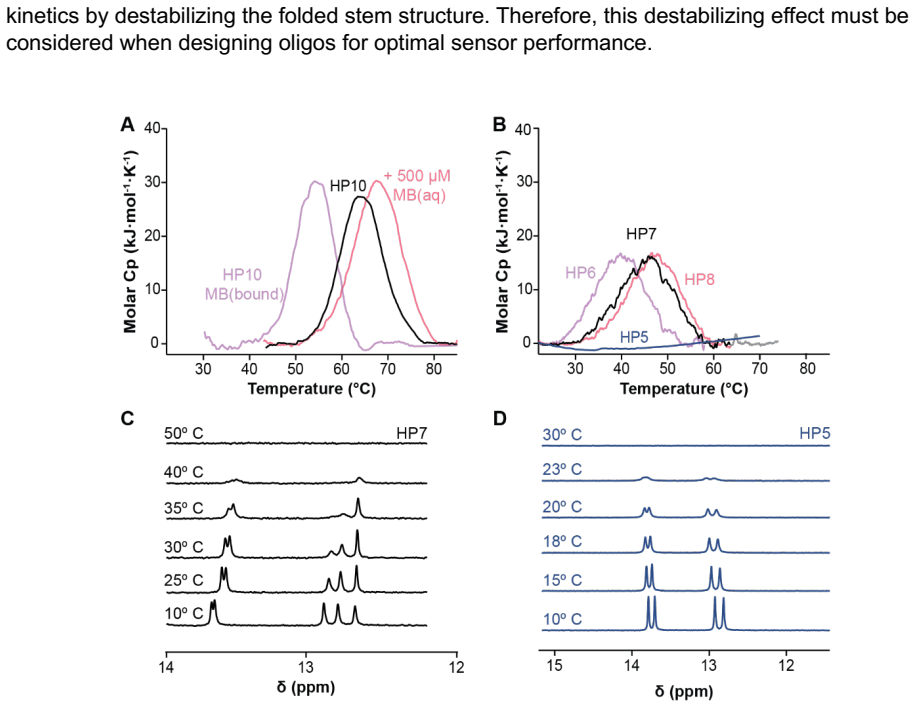
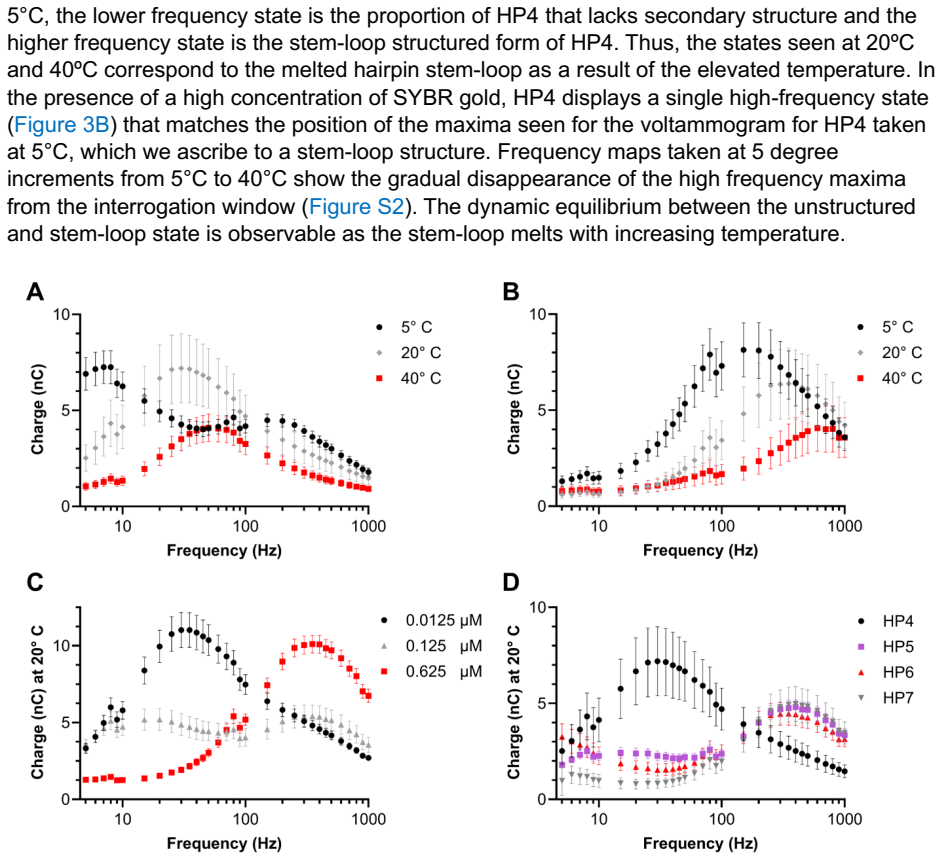
Small molecule double-stranded DNA intercalators have significant potential for therapeutic applications. However, screening for and confirming a drug candidate's intercalative behavior remains labor-intensive and costly. To address this, we investigated the sequence and biophysical parameters that affect the performance of electrochemical DNA hairpin sensors for streamlined identification of structural intercalators. These sensors utilize oligonucleotide (oligo) sequences that form hairpins upon intercalator binding. The 3prime end of the oligo is modified with alkylthiol linkers for gold electrode surface monolayer self-assembly, while the 5prime end carries a methylene blue redox reporter. Hairpin formation enhances electron transfer between methylene blue and the gold electrode, which can be detected via voltammetry. We tested seven hairpin structures varying in stem length and sequence. Our optimal oligo, HP4, features a four-base-pair stem and responds to five DNA intercalators over a broad detection range, with EC50 in close agreement with published affinity (KD) values for these interactions. We further demonstrate HP4s ability to discriminate intercalator binding from a series of minor groove binders through significant differences in signal gain upon incubation. Altogether, our strategy establishes a platform for identifying intercalative compounds that should support the development of DNA-targeting therapeutics.
Editorial analysis
A structured set of objections, weighed in public.
Referee Report
Summary. The manuscript develops electrochemical DNA hairpin sensors consisting of thiol-linked oligos with a 5'-methylene blue reporter that form hairpins upon small-molecule intercalation, increasing voltammetric current at the gold electrode. Seven hairpin variants differing in stem length and sequence were tested; the optimal HP4 (four-base-pair stem) responds to five intercalators over a broad range with EC50 values stated to agree with published KD affinities, and produces significantly different signal gains for intercalators versus minor-groove binders, thereby providing a platform to identify intercalative compounds.
Significance. If the voltammetric signal can be shown to arise specifically from intercalator-driven hairpin closure rather than non-specific surface effects, the approach would supply a rapid, low-cost electrochemical screen for DNA intercalators that could complement existing biophysical methods in therapeutic development. The work tests multiple stem lengths and reports agreement with external KD values, but these strengths cannot yet be evaluated because supporting data, statistics, and controls are absent from the presented summary.
major comments (3)
- [Abstract] Abstract: the central claim that EC50 values for HP4 are 'in close agreement with published affinity (KD) values' is presented without error bars, raw titration curves, fitting details, number of replicates, or any statistical comparison; this absence prevents assessment of whether the agreement is meaningful or merely qualitative.
- [Abstract] Abstract: the discrimination result ('significant differences in signal gain upon incubation' between intercalators and minor-groove binders) is stated without tabulated signal-gain values, p-values, or description of how significance was calculated; the claim is therefore not reproducible from the given information.
- [Abstract] Abstract (mechanism description): the interpretation that increased current reports intercalator-induced stem hybridization (bringing MB closer to the electrode) is invoked for both the EC50-KD agreement and the binding-mode discrimination, yet no controls are described that would exclude direct small-molecule adsorption altering the monolayer, non-specific DNA-electrode contacts, or redox-reporter stacking independent of hairpin geometry.
minor comments (1)
- [Abstract] Abstract contains the typographical error 'HP4s ability' (should be 'HP4's ability').
Simulated Author's Rebuttal
We thank the referee for their review and the opportunity to address these points. We respond to each major comment below, noting where revisions to the abstract or manuscript are appropriate.
read point-by-point responses
-
Referee: [Abstract] Abstract: the central claim that EC50 values for HP4 are 'in close agreement with published affinity (KD) values' is presented without error bars, raw titration curves, fitting details, number of replicates, or any statistical comparison; this absence prevents assessment of whether the agreement is meaningful or merely qualitative.
Authors: The abstract is space-limited and therefore summarizes rather than details the supporting statistics. The full manuscript reports raw titration curves (Figure 2), EC50 values derived from three independent replicates with standard error, and the fitting procedure in the Methods. The agreement with literature KD values holds within a factor of approximately two across the five intercalators tested. We will revise the abstract to state that EC50 values are means from n=3 experiments. revision: partial
-
Referee: [Abstract] Abstract: the discrimination result ('significant differences in signal gain upon incubation' between intercalators and minor-groove binders) is stated without tabulated signal-gain values, p-values, or description of how significance was calculated; the claim is therefore not reproducible from the given information.
Authors: The abstract again summarizes the key finding. The manuscript contains the signal-gain values for each compound (Figure 3 and associated table), calculated as percent change in peak current, together with p-values from two-tailed t-tests (p < 0.01) comparing the intercalator and minor-groove-binder cohorts (n=3). We will add a brief clause to the abstract indicating that the differences are statistically significant (p < 0.01, n=3). revision: partial
-
Referee: [Abstract] Abstract (mechanism description): the interpretation that increased current reports intercalator-induced stem hybridization (bringing MB closer to the electrode) is invoked for both the EC50-KD agreement and the binding-mode discrimination, yet no controls are described that would exclude direct small-molecule adsorption altering the monolayer, non-specific DNA-electrode contacts, or redox-reporter stacking independent of hairpin geometry.
Authors: We agree that explicit controls strengthen the mechanistic interpretation. The manuscript already includes control experiments with a non-hairpin-forming oligo and with a redox-inactive surface, but we will expand the Results and Discussion to describe these controls in greater detail and to address potential non-specific adsorption or reporter-stacking effects directly. revision: yes
Circularity Check
No circularity; experimental comparison to external literature
full rationale
The paper reports experimental voltammetric measurements on DNA hairpin oligos, with EC50 values compared directly to independently published KD affinities from external sources rather than fitted or derived from the authors' own equations or prior self-citations. No derivation chain, parameter fitting presented as prediction, or load-bearing self-citation exists. The central claims rest on observed signal differences and external benchmarks, making the work self-contained against external data.
Axiom & Free-Parameter Ledger
free parameters (1)
- stem length and base sequence of tested hairpins
axioms (1)
- domain assumption Intercalator binding to the stem region induces hairpin folding that brings the 5' methylene blue closer to the 3' thiol-gold surface, increasing electron transfer rate.
Reference graph
Works this paper leans on
-
[1]
M.; Norden, B.; Lincoln, P., Complex DNA binding kinetics resolved by combined circular dichroism and luminescence analysis
Westerlund, F.; Nordell, P.; Blechinger, J.; Santos, T. M.; Norden, B.; Lincoln, P., Complex DNA binding kinetics resolved by combined circular dichroism and luminescence analysis. J Phys Chem B 2008, 112, 6688-94. 16. Hegde, A. H.; Seetharamappa, J., Fluorescence and circular dichroism studies on binding and conformational aspects of an anti-leukemic dru...
2008
-
[2]
L.; Shaka, A
Hwang, T. L.; Shaka, A. J., Water Suppression That Works. Excitation Sculpting Using Arbitrary Wave-Forms and Pulsed-Field Gradients. Journal of Magnetic Resonance, Series A 1995, 112, 275-279. 28. Zadeh, J. N.; Steenberg, C. D.; Bois, J. S.; Wolfe, B. R.; Pierce, M. B.; Khan, A. R.; Dirks, R. M.; Pierce, N. A., NUPACK: Analysis and design of nucleic acid...
1995
-
[3]
Journal of Electroanalytical Chemistry 1995, 384, 115-122
Komorsky-Lovrić, Š.; Lovrić, M., Square-wave voltammetry of quasi-reversible surface redox reactions. Journal of Electroanalytical Chemistry 1995, 384, 115-122. 41. White, R. J.; Phares, N.; Lubin, A. A.; Xiao, Y.; Plaxco, K. W., Optimization of electrochemical aptamer-based sensors via optimization of probe packing density and surface chemistry. Langmuir...
1995
-
[4]
D., Binding to the DNA minor groove by heterocyclic dications: from AT-specific monomers to GC recognition with dimers
Nanjunda, R.; Wilson, W. D., Binding to the DNA minor groove by heterocyclic dications: from AT-specific monomers to GC recognition with dimers. Curr Protoc Nucleic Acid Chem 2012, Chapter 8, Unit8 8. 54. Lin, D. Z.; Pan, K. J.; Li, Y.; Charles, B. M. I.; Zhang, L.; Jayarapu, K. N.; Li, T.; Tran, J. V.; Goddard, W. A., 3rd; Luo, Z.; Liu, Y., A high-throug...
2012
discussion (0)
Sign in with ORCID, Apple, or X to comment. Anyone can read and Pith papers without signing in.