RadioRange: An Open-Source Digital Twin-based Ranging Simulator for UWB, Wi-Fi, and 5G
Pith reviewed 2026-06-27 04:31 UTC · model grok-4.3
The pith
RadioRange supplies an open-source simulator that runs UWB, Wi-Fi, and 5G ranging on identical ray-traced channels while toggling eleven hardware impairments.
A machine-rendered reading of the paper's core claim, the machinery that carries it, and where it could break.
Core claim
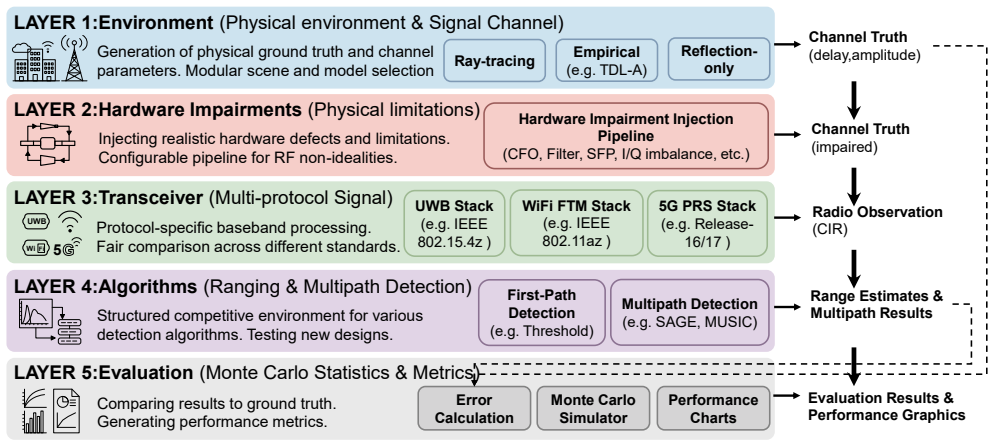
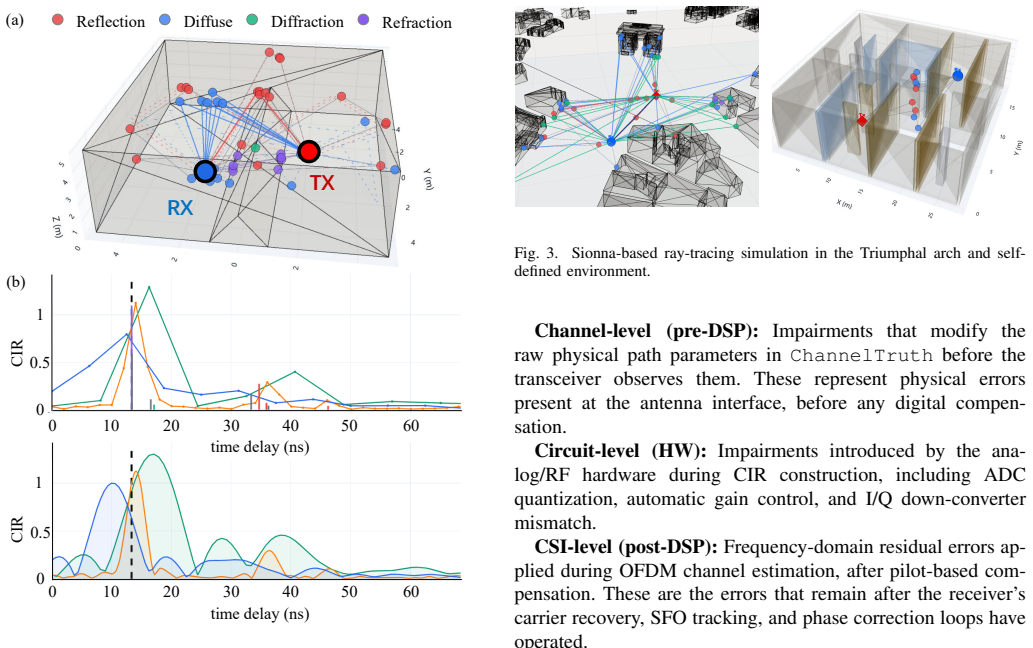
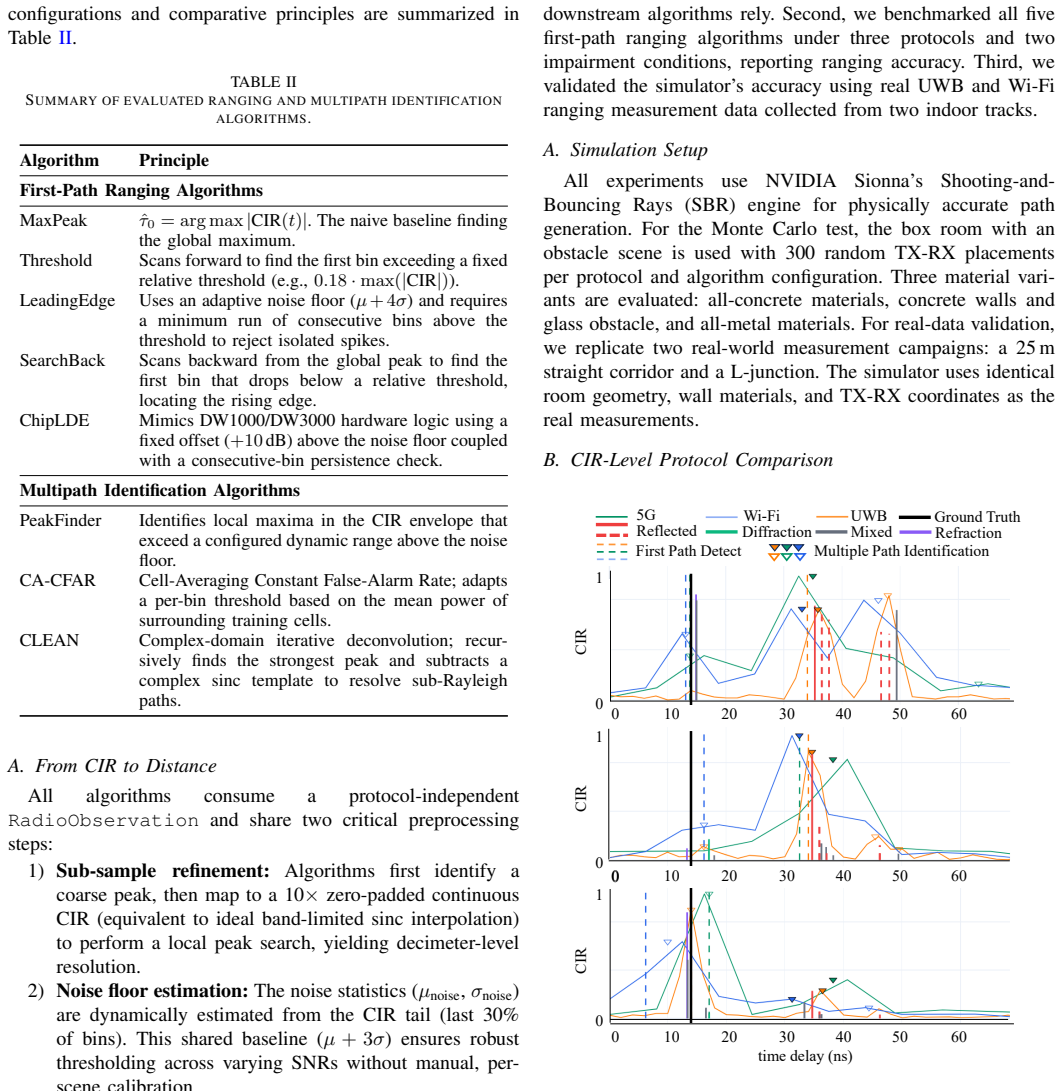
We present RadioRange, an open-source, positioning-first digital twin that unifies UWB, Wi-Fi, and 5G NR on identical ray-traced physical channels. The platform models eleven independently toggleable hardware impairments across three injection stages, spanning antenna-level offsets, RF circuit non-idealities, and post-compensation CSI residuals, each with documented physical models and protocol-specific defaults. Five first-path ranging detectors and three multipath identification algorithms are provided within a protocol-specific evaluation framework, enabling controlled Monte Carlo benchmarking and systematic ablation studies. The simulator is validated against real-world UWB and Wi-Fi mea
What carries the argument
The unified ray-traced physical channel with eleven toggleable hardware impairments injected at antenna, RF-circuit, and post-compensation stages.
If this is right
- Enables direct Monte Carlo comparison of ranging accuracy across UWB, Wi-Fi, and 5G under matched physical conditions.
- Permits ablation studies that isolate the contribution of each hardware impairment to ranging error.
- Supplies a common testbed for evaluating first-path detectors and multipath algorithms on the same channel realizations.
- Allows researchers to reproduce and extend the reported geometry-dependent multipath bias findings.
Where Pith is reading between the lines
- The same ray-tracing backbone could be reused to test emerging protocols or new frequency bands without rebuilding the physical model.
- Dominant impairments identified through ablation could guide hardware design priorities for ranging applications.
- Extending the validation set to additional environments would strengthen claims that the digital twin generalizes beyond the original UWB and Wi-Fi measurements.
Load-bearing premise
The ray-traced channels and the eleven modeled hardware impairments are representative enough of real hardware and environments to support fair protocol comparisons.
What would settle it
A new set of real-world 5G NR ranging measurements in an environment where the simulated ranging errors or multipath bias deviate substantially from the measured values even after all eleven impairments are enabled.
Figures
read the original abstract
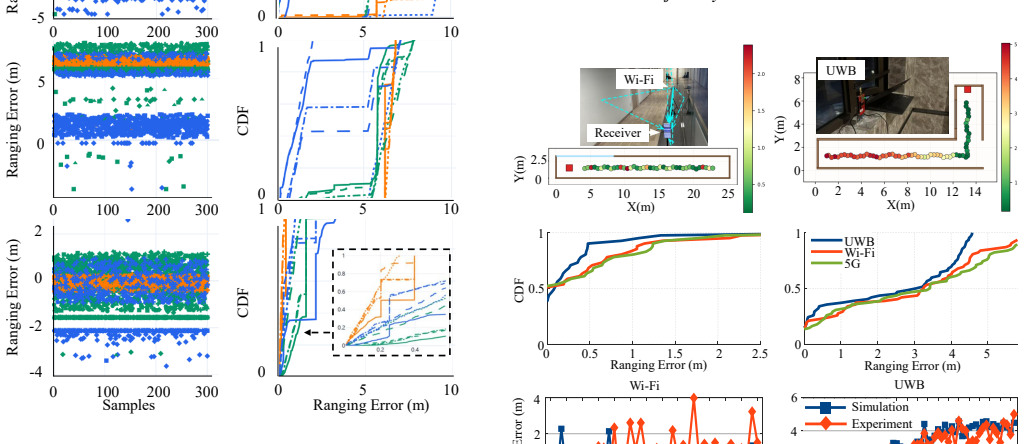
Accurate RF-based ranging is critical for location-aware wireless systems, yet no open platform exists for fair, reproducible comparison across protocols under realistic hardware impairments. Existing simulators target communication-layer metrics and lack ranging algorithms, impairment models, and positioning-specific evaluation. We present RadioRange, an open-source, positioning-first digital twin that unifies UWB, Wi-Fi, and 5G NR on identical ray-traced physical channels. The platform models eleven independently toggleable hardware impairments across three injection stages, spanning antenna-level offsets, RF circuit non-idealities, and post-compensation CSI residuals, each with documented physical models and protocol-specific defaults. Five first-path ranging detectors and three multipath identification algorithms are provided within a protocol-specific evaluation framework, enabling controlled Monte Carlo benchmarking and systematic ablation studies. The simulator is validated against real-world UWB and Wi-Fi measurements, demonstrating that the channel model captures geometry-dependent multipath bias. RadioRange-Sim is publicly available at https://github.com/Togure/RadioRange.
Editorial analysis
A structured set of objections, weighed in public.
Referee Report
Summary. The paper presents RadioRange, an open-source positioning-first digital twin simulator that unifies UWB, Wi-Fi, and 5G NR ranging on identical ray-traced physical channels. It models eleven toggleable hardware impairments (antenna offsets, RF non-idealities, post-compensation CSI residuals) with protocol-specific defaults, provides five first-path detectors and three multipath algorithms, and supports Monte Carlo benchmarking and ablation studies. Validation against real-world UWB and Wi-Fi measurements is reported to show that the channel model captures geometry-dependent multipath bias.
Significance. If the ray-traced channels and impairment models prove representative, the tool would fill a documented gap by enabling reproducible, fair cross-protocol ranging comparisons and controlled ablation studies under identical physical conditions—an open-source contribution with clear utility for the positioning community. The positioning-first design and documented physical models for impairments are positive features.
major comments (1)
- [Abstract] Abstract: The central claim of unification across UWB, Wi-Fi, and 5G NR on identical channels rests on validation reported only for UWB and Wi-Fi measurements; no real-world 5G NR dataset, error statistics, or equivalent multipath-bias demonstration is described. This leaves cross-protocol ablation studies that include 5G NR as an unverified modeling assumption rather than an empirically supported result, which is load-bearing for the paper's stated purpose of enabling fair protocol comparisons.
Simulated Author's Rebuttal
We thank the referee for the constructive feedback and positive assessment of RadioRange's contributions. We address the major comment below.
read point-by-point responses
-
Referee: [Abstract] Abstract: The central claim of unification across UWB, Wi-Fi, and 5G NR on identical channels rests on validation reported only for UWB and Wi-Fi measurements; no real-world 5G NR dataset, error statistics, or equivalent multipath-bias demonstration is described. This leaves cross-protocol ablation studies that include 5G NR as an unverified modeling assumption rather than an empirically supported result, which is load-bearing for the paper's stated purpose of enabling fair protocol comparisons.
Authors: We agree that the manuscript reports empirical validation only against real-world UWB and Wi-Fi measurements and does not include a 5G NR dataset or equivalent multipath-bias statistics. This stems from the limited availability of public 5G NR ranging datasets with matched ground truth and hardware characterization suitable for direct comparison. The unification across protocols is implemented via the shared ray-traced channel model and the eleven toggleable impairment models, which are applied consistently at the physical layer. To address the concern, we will revise the abstract to explicitly delineate the scope of empirical validation (UWB and Wi-Fi) while noting that 5G NR support relies on the modeled framework. We will also add a paragraph in the validation and discussion sections clarifying the modeling assumptions for 5G NR and identifying collection of 5G ranging data as future work. revision: yes
Circularity Check
No circularity; simulator tool with external real-world validation
full rationale
The manuscript introduces an open-source simulator (RadioRange) that unifies protocols on ray-traced channels and provides impairment models plus ranging detectors. Validation is performed against independent real-world UWB and Wi-Fi measurements, with no equations, fitted parameters, or predictions that reduce to the inputs by construction. No self-citation chains, ansatzes smuggled via prior work, or self-definitional steps appear in the derivation or claims. The 5G unification rests on modeling assumptions rather than a circular derivation.
Axiom & Free-Parameter Ledger
free parameters (1)
- protocol-specific defaults for the eleven impairments
axioms (1)
- domain assumption Ray-tracing accurately models the physical channels for UWB, Wi-Fi, and 5G NR.
Reference graph
Works this paper leans on
-
[1]
Ultra wideband indoor positioning technologies: Analysis and recent advances,
A. Alarifi, A. Al-Salman, M. Alsaleh, A. Alnafessah, S. Al- Hadhrami, M. A. Al-Ammar, and H. S. Al-Khalifa, “Ultra wideband indoor positioning technologies: Analysis and recent advances,”Sensors, vol. 16, no. 5, p. 707, 2016
2016
-
[2]
Wi-fi rtt indoor positioning using visibility matching with nlos receptions,
Z. Lyu, S. Bai, X. Wang, L. Li, and G. Zhang, “Wi-fi rtt indoor positioning using visibility matching with nlos receptions,”IEEE Internet of Things Journal, vol. 12, no. 12, pp. 18 779–18 790, 2025
2025
-
[3]
Verification: Accuracy evaluation of wifi fine time measurements on an open platform,
M. Ibrahim, H. Liu, M. Jawahar, V . Nguyen, M. Gruteser, R. Howard, B. Yu, and F. Bai, “Verification: Accuracy evaluation of wifi fine time measurements on an open platform,” inPro- ceedings of the 24th annual international conference on mobile computing and networking, 2018, pp. 417–427
2018
-
[4]
Overview of positioning in 5g new radio,
R. Keating, M. S ¨aily, J. Hulkkonen, and J. Karjalainen, “Overview of positioning in 5g new radio,” in2019 16th interna- tional symposium on wireless communication systems (ISWCS). IEEE, 2019, pp. 320–324
2019
-
[5]
5g; nr; study on channel model for frequencies from 0.5 to 100 ghz,
3GPP, “5g; nr; study on channel model for frequencies from 0.5 to 100 ghz,” Tech. Rep. TR 38.901, V16.1.0, 2020
2020
-
[6]
Ranging in a dense multipath environment using an uwb radio link,
J.-Y . Lee and R. A. Scholtz, “Ranging in a dense multipath environment using an uwb radio link,”IEEE journal on selected areas in communications, vol. 20, no. 9, pp. 1677–1683, 2002
2002
-
[7]
Ieee 802.11 ax: Challenges and requirements for future high efficiency wifi,
M. S. Afaqui, E. Garcia-Villegas, and E. Lopez-Aguilera, “Ieee 802.11 ax: Challenges and requirements for future high efficiency wifi,”IEEE wireless communications, vol. 24, no. 3, pp. 130–137, 2016
2016
-
[8]
MathWorks,5G Toolbox User’s Guide, 2023
2023
-
[9]
Sionna: An open-source library for next-generation physical layer research,
J. Hoydis, S. Cammerer, F. A. Aoudia, A. Vem, N. Binder, G. Marcus, and A. Keller, “Sionna: An open-source library for next-generation physical layer research,”arXiv preprint arXiv:2203.11854, 2022
-
[10]
R 2 tt: High- accuracy 3d localization using ray-tracing-based wi-fi rtt virtual fingerprints for challenging scenarios,
X. Wang, X. Liu, Z. Lyu, R. Xu, and W. Wen, “R 2 tt: High- accuracy 3d localization using ray-tracing-based wi-fi rtt virtual fingerprints for challenging scenarios,”IEEE Transactions on Mobile Computing, 2026
2026
-
[11]
Decawave Ltd.,DW1000 User Manual, V ersion 2.19, 2017
2017
-
[12]
Compensation of iq imbalance and phase noise in ofdm systems,
J. Tubbax, B. Come, L. Van der Perre, S. Donnay, M. Engels, H. De Man, and M. Moonen, “Compensation of iq imbalance and phase noise in ofdm systems,”IEEE Transactions on Wireless Communications, vol. 4, no. 3, pp. 872–877, 2005
2005
-
[13]
Schenk,RF imperfections in high-rate wireless systems: im- pact and digital compensation
T. Schenk,RF imperfections in high-rate wireless systems: im- pact and digital compensation. Springer, 2008
2008
-
[14]
Analysis of cfar processors in nonhomogeneous background,
P. P. Gandhi and S. A. Kassam, “Analysis of cfar processors in nonhomogeneous background,”IEEE Transactions on Aerospace and Electronic systems, vol. 24, no. 4, pp. 427–445, 1988
1988
-
[15]
Evaluation of an ultra-wide-band propagation channel,
R.-M. Cramer, R. A. Scholtz, and M. Z. Win, “Evaluation of an ultra-wide-band propagation channel,”IEEE Transactions on Antennas and Propagation, vol. 50, no. 5, pp. 561–570, 2002
2002
discussion (0)
Sign in with ORCID, Apple, or X to comment. Anyone can read and Pith papers without signing in.