Interpretable Material Spatial Intelligence for Discovery of Governing Microstructural Features
Pith reviewed 2026-06-26 13:37 UTC · model grok-4.3
The pith
Materials Spatial Intelligence learns shared latent representations from multimodal microstructural data to identify features governing mechanical behavior in alloys.
A machine-rendered reading of the paper's core claim, the machinery that carries it, and where it could break.
Core claim
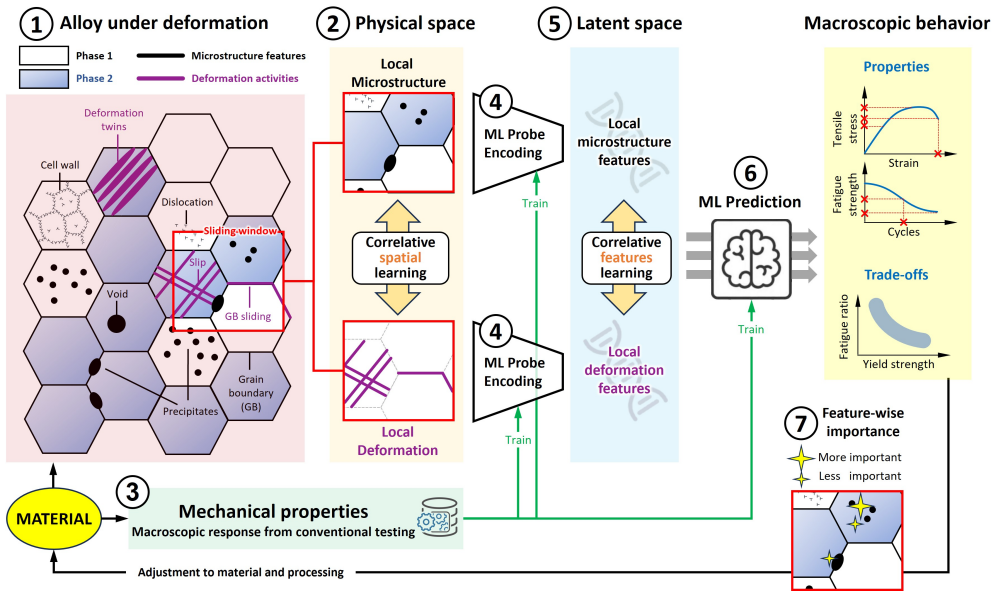
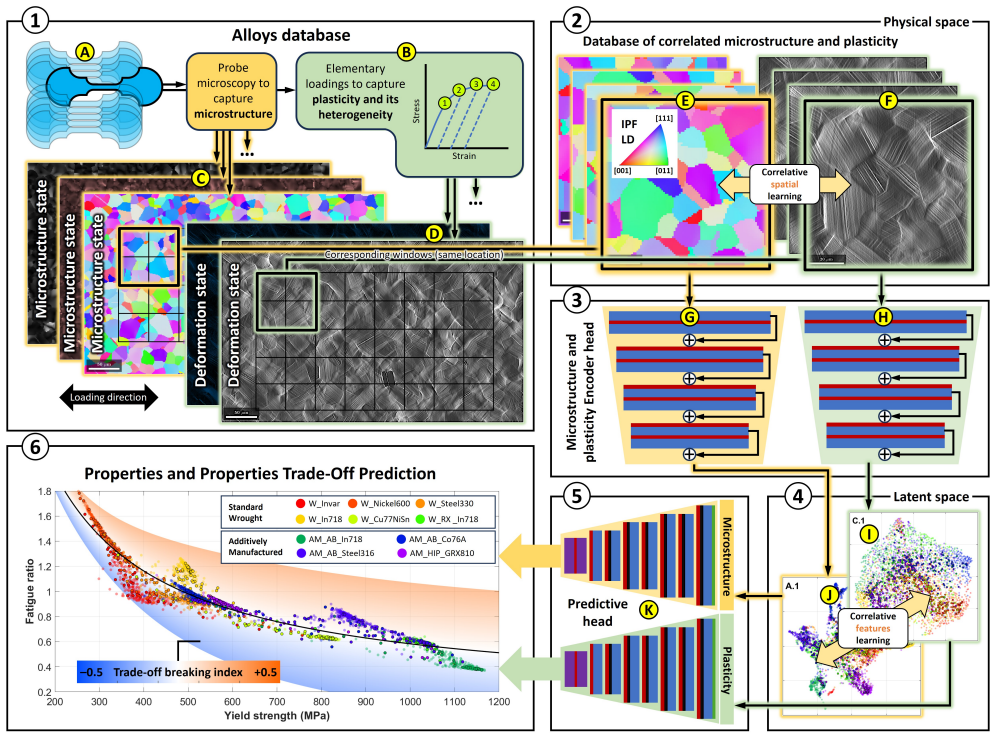
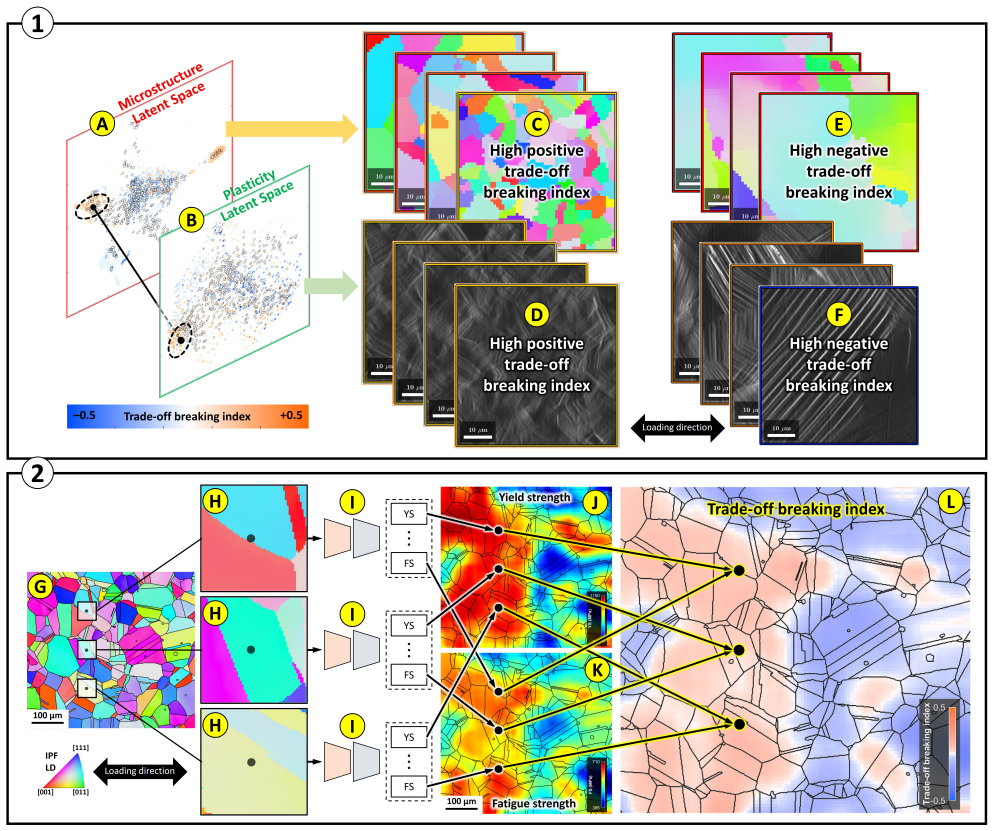
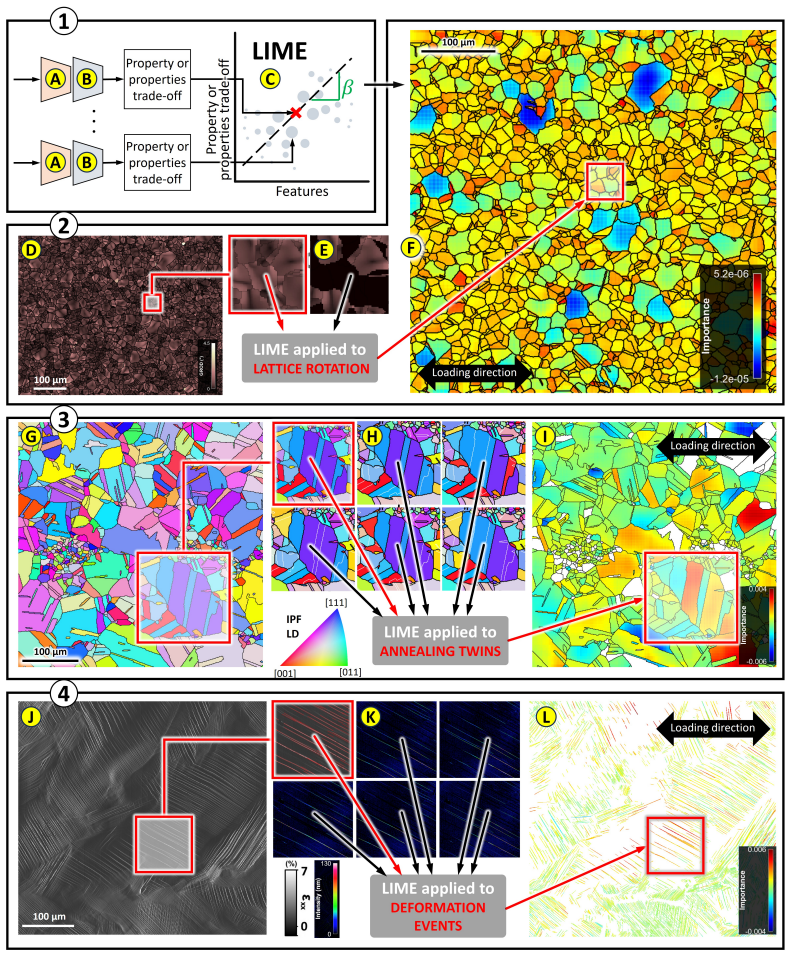
MSI encodes high-resolution microstructural and deformation data into shared latent representations that preserve spatial relationships while supporting property prediction, interpretation, and optimization; by combining multimodal representation learning, MSI identifies the key features governing mechanical behavior and property trade-offs in structural alloys, enabling feature-driven microstructure optimization and mechanism discovery.
What carries the argument
Materials Spatial Intelligence (MSI), a multimodal representation learning framework that creates shared latent spaces from spatial observations to preserve relationships while identifying governing features.
If this is right
- MSI supports property prediction that retains spatial organization in the input data.
- The framework identifies specific microstructural features that control mechanical behavior and trade-offs.
- Feature-driven optimization of microstructures for desired properties becomes feasible.
- Mechanism discovery in material systems extends beyond prediction to actionable insight.
Where Pith is reading between the lines
- The same spatial encoding approach could apply to other modalities such as thermal or electrical response maps in non-alloy systems.
- If the latent spaces prove robust, they might support generative models that propose new microstructures optimized for multiple properties at once.
- Validation against physics-based simulations could test whether discovered features align with known deformation mechanisms.
Load-bearing premise
The learned latent representations from multimodal spatial data will preserve and reveal causal governing microstructural features rather than correlations.
What would settle it
A controlled experiment in which microstructures are modified to alter only the features MSI identifies as governing, followed by mechanical testing that shows no corresponding change in the predicted properties.
Figures
read the original abstract
Many material systems exhibit complex spatial and temporal interactions across multiple length scales and modalities that govern macroscopic behavior. Although Machine Learning (ML) is widely used in materials science to predict this behavior, most approaches still rely on handcrafted descriptors or aggregated representations that overlook spatial organization, limiting insight into governing mechanisms. We introduce Materials Spatial Intelligence (MSI), a framework inspired by spatial intelligence that learns directly from multimodal spatial observations of material systems. MSI encodes high-resolution microstructural and deformation data into shared latent representations that preserve spatial relationships while supporting property prediction, interpretation, and optimization. By combining multimodal representation learning, MSI identifies the key features governing mechanical behavior and property trade-offs in structural alloys. Beyond prediction, MSI enables feature-driven microstructure optimization and mechanism discovery. More broadly, MSI establishes a foundation for applying spatial intelligence to materials science, leveraging interpretable ML systems to accelerate scientific discovery and materiel design
Editorial analysis
A structured set of objections, weighed in public.
Referee Report
Summary. The paper introduces the Materials Spatial Intelligence (MSI) framework, inspired by spatial intelligence, which learns directly from multimodal spatial observations of material systems. MSI encodes high-resolution microstructural and deformation data into shared latent representations that preserve spatial relationships while supporting property prediction, interpretation, and optimization. By combining multimodal representation learning, MSI is claimed to identify the key features governing mechanical behavior and property trade-offs in structural alloys, enabling feature-driven microstructure optimization and mechanism discovery.
Significance. If the claims were substantiated with methods and validation, MSI could advance interpretable ML in materials science by addressing limitations of handcrafted descriptors and enabling spatial-relationship-preserving representations for mechanism discovery and design. No such substantiation is present, so significance cannot be assessed.
major comments (2)
- [Abstract] Abstract: The claim that MSI 'identifies the key features governing mechanical behavior and property trade-offs' and enables 'mechanism discovery' lacks any description of a causal identification procedure (e.g., interventions or physics constraints); the described multimodal representation learning produces statistical associations by construction, leaving the 'governing' and 'mechanism' language unsupported.
- [Abstract] Abstract: No equations, algorithms, datasets, results, or validation experiments are provided to demonstrate how shared latent representations are formed, how spatial relationships are preserved, or how the framework achieves prediction, interpretation, or optimization.
Simulated Author's Rebuttal
We thank the referee for their thoughtful comments. We address each major comment below and agree that revisions to the abstract are warranted to ensure the claims accurately reflect the manuscript content.
read point-by-point responses
-
Referee: [Abstract] Abstract: The claim that MSI 'identifies the key features governing mechanical behavior and property trade-offs' and enables 'mechanism discovery' lacks any description of a causal identification procedure (e.g., interventions or physics constraints); the described multimodal representation learning produces statistical associations by construction, leaving the 'governing' and 'mechanism' language unsupported.
Authors: We agree that the abstract employs language implying causality ('governing', 'mechanism discovery') that is not supported by the described methods. The framework performs multimodal representation learning to extract statistical associations between spatial features and properties. We will revise the abstract to use precise terminology such as 'identifies key features correlated with' and 'facilitates exploration of potential mechanisms via interpretable representations'. revision: yes
-
Referee: [Abstract] Abstract: No equations, algorithms, datasets, results, or validation experiments are provided to demonstrate how shared latent representations are formed, how spatial relationships are preserved, or how the framework achieves prediction, interpretation, or optimization.
Authors: The provided manuscript consists of a high-level conceptual description. No equations, algorithms, datasets, results, or validation experiments appear in the text. We acknowledge this limitation and will revise the manuscript either by expanding it with the missing technical details or by adjusting the abstract and claims to position MSI as a proposed framework without empirical substantiation in the current version. revision: yes
Circularity Check
No circularity; framework claims rest on standard representation learning without self-referential reductions
full rationale
The paper presents MSI as a multimodal representation learning framework that encodes spatial microstructural data into latent representations for prediction, interpretation, and optimization. No equations, fitted parameters renamed as predictions, self-definitional steps, or load-bearing self-citations are described in the provided text. The central claim that latent representations 'identify the key features governing mechanical behavior' follows directly from the definition of representation learning applied to the input data modalities; it does not reduce to a tautology or fitted input by construction. The derivation chain is therefore self-contained against external benchmarks of representation learning methods.
Axiom & Free-Parameter Ledger
axioms (1)
- domain assumption Multimodal spatial observations of microstructures contain identifiable governing features for mechanical behavior
invented entities (1)
-
Materials Spatial Intelligence (MSI) framework
no independent evidence
Reference graph
Works this paper leans on
-
[1]
Olson, G. B. Computational design of hierarchically structured materials.Science277, 1237–1242, DOI: 10.1126/science. 277.5330.1237 (1997)
-
[2]
& Krishnan, N
Miret, S. & Krishnan, N. A. Enabling large language models for real-world materials discovery.Nat. Mach. Intell.7, 991–998 (2025). 3.Tang, Y .et al.A multimodal large language model for materials science.Nat. Mach. Intell.1–14 (2026)
2025
-
[3]
Ahlawat, D.et al.A family of large language models for materials research with insights into model adaptability in continued pretraining.Nat. Mach. Intell.1–14 (2026)
2026
-
[4]
& Kochmann, D
Bastek, J.-H. & Kochmann, D. M. Inverse design of nonlinear mechanical metamaterials via video denoising diffusion models.Nat. Mach. Intell.5, 1466–1475 (2023)
2023
-
[5]
Igashov, I.et al.Equivariant 3d-conditional diffusion model for molecular linker design.Nat. Mach. Intell.6, 417–427 (2024)
2024
-
[6]
Li, T., Biferale, L., Bonaccorso, F., Scarpolini, M. A. & Buzzicotti, M. Synthetic lagrangian turbulence by generative diffusion models.Nat. Mach. Intell.6, 393–403 (2024)
2024
-
[7]
Hafner, D., Pasukonis, J., Ba, J. & Lillicrap, T. Mastering diverse control tasks through world models.Nature640, 647–653, DOI: 10.1038/s41586-025-08744-2 (2025)
-
[8]
Mater.7, 86 (2021)
Xie, X.et al.Mechanistic data-driven prediction of as-built mechanical properties in metal additive manufacturing.npj Comput. Mater.7, 86 (2021)
2021
-
[9]
Liu, Y .et al.Experimental discovery of structure–property relationships in ferroelectric materials via active learning.Nat. Mach. Intell.4, 341–350 (2022)
2022
-
[10]
Wang, X.et al.Multimodal learning with next-token prediction for large multimodal models.Nature650, 327–333, DOI: 10.1038/s41586-025-10041-x (2026)
-
[11]
Rudin, C. Stop explaining black box machine learning models for high stakes decisions and use interpretable models instead.Nat. Mach. Intell.1, 206–215, DOI: 10.1038/s42256-019-0048-x (2019)
-
[12]
E.et al.Physics-informed machine learning.Nat
Karniadakis, G. E.et al.Physics-informed machine learning.Nat. Rev. Phys.3, 422–440, DOI: 10.1038/ s42254-021-00314-5 (2021)
2021
-
[13]
communications5, 3580 (2014)
Wei, Y .et al.Evading the strength–ductility trade-off dilemma in steel through gradient hierarchical nanotwins.Nat. communications5, 3580 (2014)
2014
-
[14]
& Zhang, Z
Pang, J., Li, S., Wang, Z. & Zhang, Z. General relation between tensile strength and fatigue strength of metallic materials. Mater. Sci. Eng. A564, 331–341 (2013). 16.Stinville, J.et al.On the origins of fatigue strength in crystalline metallic materials.Science377, 1065–1071 (2022)
2013
-
[15]
& Dang Van, K
Charkaluk, É., Bignonnet, A., Constantinescu, A. & Dang Van, K. Fatigue design of structures under thermomechanical loadings.Fatigue & Fract. Eng. Mater. & Struct.25, 1199–1206 (2002)
2002
-
[16]
R., Lagoudas, D
Cassagne, A. R., Lagoudas, D. C. & le Graverend, J.-B. A multi-scale modeling of complex thermomechanical loading paths in high-temperature shape memory alloys using a crystal-plasticity framework.Int. J. Plast.104598 (2025)
2025
-
[17]
Prouteau, J., Villechaise, P., Signor, L. & Cormier, J. Early stages of fatigue crack initiation in relation with twin boundaries in polycrystalline ni-based superalloy ad730™.Metall. Mater. Transactions ADOI: 10.1007/s11661-022-06916-7 (2022)
-
[18]
Anjaria, D.et al.Plastic deformation delocalization at cryogenic temperatures in a nickel-based superalloy.Acta Materialia276, 120106, DOI: https://doi.org/10.1016/j.actamat.2024.120106 (2024)
-
[19]
Texier, D.et al.Strain localization in the alloy 718 ni-based superalloy: From room temperature to 650 °c.Acta Materialia 268, 119759, DOI: https://doi.org/10.1016/j.actamat.2024.119759 (2024)
-
[20]
Mater.(2026)
Yvinec, T.et al.Low stress grain boundary mediated plasticity and early fracture at basal twist grain boundaries in a titanium alloy.Commun. Mater.(2026)
2026
-
[21]
S.et al.Advances and opportunities in high-throughput small-scale mechanical testing.Curr
Gianola, D. S.et al.Advances and opportunities in high-throughput small-scale mechanical testing.Curr. Opin. Solid State Mater. Sci.27, 101090, DOI: https://doi.org/10.1016/j.cossms.2023.101090 (2023)
-
[22]
C.et al.High-throughput stochastic tensile performance of additively manufactured stainless steel.J
Salzbrenner, B. C.et al.High-throughput stochastic tensile performance of additively manufactured stainless steel.J. Mater. Process. Technol.241, 1–12, DOI: https://doi.org/10.1016/j.jmatprotec.2016.10.023 (2017)
-
[23]
Gu, D.et al.Material-structure-performance integrated laser-metal additive manufacturing.Science372, eabg1487 (2021)
2021
-
[24]
Ren, J.et al.Strong yet ductile nanolamellar high-entropy alloys by additive manufacturing.Nature608, 62–68 (2022)
2022
-
[25]
Gao, S.et al.Additive manufacturing of alloys with programmable microstructure and properties, nat. commun. 14 (2023) 6752. 28.Zhu, T. & Chen, W. Mechanical behaviour of additively manufactured metals.Nat. Mater.1–13 (2026)
2023
-
[26]
Borg, C. K. H.et al.Expanded dataset of mechanical properties and observed phases of multi-principal element alloys. Sci. Data7, DOI: 10.1038/s41597-020-00768-9 (2020). 16/49
-
[27]
Reports11, DOI: 10.1038/s41598-021-90237-z (2021)
Lee, J.-W.et al.A machine-learning-based alloy design platform that enables both forward and inverse predictions for thermo-mechanically controlled processed (tmcp) steel alloys.Sci. Reports11, DOI: 10.1038/s41598-021-90237-z (2021). 31.Hu, Q.-M. & Yang, R. The endless search for better alloys.Science378, 26–27 (2022)
-
[28]
Deng, Y .et al.An intelligent design for ni-based superalloy based on machine learning and multi-objective optimization. Mater. Des.221, 110935, DOI: https://doi.org/10.1016/j.matdes.2022.110935 (2022)
-
[29]
Gu, Y ., Stiles, C. D. & El-Awady, J. A. A statistical perspective for predicting the strength of metals: Revisiting the hall–petch relationship using machine learning.Acta Materialia266, 119631, DOI: https://doi.org/10.1016/j.actamat. 2023.119631 (2024). 34.Sohail, Y .et al.Machine-learning design of ductile fenicoalta alloys with high strength.Nature643...
-
[30]
Black, R. L.et al.High-throughput high-resolution digital image correlation measurements by multi-beam sem imaging. Exp. Mech.63, 939–953, DOI: 10.1007/s11340-023-00961-y (2023)
-
[31]
& Kacher, J
DeRonja, J., Nowell, M., Wright, S. & Kacher, J. Generational assessment of ebsd detectors for cross-correlation-based analysis: From scintillators to direct detection.Ultramicroscopy257, 113913 (2024)
2024
-
[32]
Calvat, M.et al.Plasticity encoding and mapping during elementary loading for accelerated mechanical properties prediction.Scripta Materialia273, 117082 (2026)
2026
-
[33]
Resolving the geometrically necessary dislocation content by conventional electron backscattering diffraction
Pantleon, W. Resolving the geometrically necessary dislocation content by conventional electron backscattering diffraction. Scripta Materialia58, 994–997 (2008)
2008
-
[34]
Charact.169, 110600, DOI: https://doi.org/10.1016/j.matchar.2020.110600 (2020)
Stinville, J.et al.Measurement of elastic and rotation fields during irreversible deformation using heaviside-digital image correlation.Mater. Charact.169, 110600, DOI: https://doi.org/10.1016/j.matchar.2020.110600 (2020)
-
[35]
41.Anjaria, D.et al.Dynamic plastic deformation delocalization in fcc solid solution metals.Nat
Bourdin, F.et al.Measurements of plastic localization by heaviside-digital image correlation.Acta Materialia157, 307 – 325, DOI: https://doi.org/10.1016/j.actamat.2018.07.013 (2018). 41.Anjaria, D.et al.Dynamic plastic deformation delocalization in fcc solid solution metals.Nat. Commun.(2026)
-
[36]
why should i trust you?
Ribeiro, M. T., Singh, S. & Guestrin, C. " why should i trust you?" explaining the predictions of any classifier. In Proceedings of the 22nd ACM SIGKDD international conference on knowledge discovery and data mining, 1135–1144 (2016)
2016
-
[38]
Hu, H., Briffod, F., Shiraiwa, T. & Enoki, M. Automated slip system identification and strain analysis framework using high-resolution digital image correlation data: Application to a bimodal ti-6al-4v alloy.Int. J. Plast.166, 103618, DOI: https://doi.org/10.1016/j.ijplas.2023.103618 (2023)
-
[39]
Ni, R.et al.Automated analysis framework of strain partitioning and deformation mechanisms via multimodal fusion and computer vision.Int. J. Plast.182, 104119, DOI: https://doi.org/10.1016/j.ijplas.2024.104119 (2024)
-
[40]
Charact.115406 (2025)
Bean, C.et al.Statistical analyses of plastic deformation events via computer vision: Case study of additive manufactured microstructures.Mater. Charact.115406 (2025)
2025
-
[41]
A.et al.Fatigue crack initiation, slip localization and twin boundaries in a nickel-based superalloy.Curr
Stein, C. A.et al.Fatigue crack initiation, slip localization and twin boundaries in a nickel-based superalloy.Curr. Opin. Solid State Mater. Sci.18, 244–252 (2014)
2014
-
[42]
& Wang, Z
Zhang, Z. & Wang, Z. Grain boundary effects on cyclic deformation and fatigue damage.Prog. Mater. Sci.53, 1025–1099 (2008)
2008
-
[43]
& Cailletaud, G
Me´ ric, L., Poubanne, P. & Cailletaud, G. Single crystal modeling for structural calculations: part 1—model presentation. J. Eng. materials Technol.(1991)
1991
-
[44]
& Berveiller, M
Berbenni, S., Favier, V . & Berveiller, M. Impact of the grain size distribution on the yield stress of heterogeneous materials.Int. J. Plast.23, 114–142 (2007)
2007
-
[45]
Zhou, C., Biner, S. B. & LeSar, R. Discrete dislocation dynamics simulations of plasticity at small scales.Acta Materialia 58, 1565–1577 (2010)
2010
-
[46]
A., Stukowski, A., Oppelstrup, T
Zepeda-Ruiz, L. A., Stukowski, A., Oppelstrup, T. & Bulatov, V . V . Probing the limits of metal plasticity with molecular dynamics simulations.Nature550, 492–495 (2017)
2017
-
[47]
& Cailletaud, G
Cormier, J. & Cailletaud, G. Constitutive modeling of the creep behavior of single crystal superalloys under non-isothermal conditions inducing phase transformations.Mater. Sci. Eng. A527, 6300–6312 (2010)
2010
-
[48]
Castelluccio, G. M. & McDowell, D. L. Mesoscale cyclic crystal plasticity with dislocation substructures.Int. J. Plast. 98, 1–26 (2017)
2017
-
[49]
& Kim, J
Zhu, D., Zhang, W., Ding, Z. & Kim, J. Investigation of crack propagation driving force based on crystal plasticity and cyclic j-integral.Eng. Fract. Mech.289, 109362 (2023)
2023
-
[50]
Liu, J., Xiong, W., Behera, A., Thompson, S. & To, A. C. Mean-field polycrystal plasticity modeling with grain size and shape effects for laser additive manufactured fcc metals.Int. J. Solids Struct.112, 35–42 (2017). 17/49
2017
-
[51]
Healy, C. J. & Ackland, G. J. Molecular dynamics simulations of compression–tension asymmetry in plasticity of fe nanopillars.Acta Materialia70, 105–112 (2014)
2014
-
[52]
& Barbe, F
Calvat, M., Keller, C. & Barbe, F. Micromechanical analysis of a unimodal and a bimodal polycrystal with paired microstructures of ultrafine grains, 2d & 3d.Eur. J. Mech.109, 105434 (2025)
2025
-
[53]
& Degallaix, S
Aubin, V ., Quaegebeur, P. & Degallaix, S. Cyclic plasticity of a duplex stainless steel under non-proportional loading. Mater. Sci. Eng. A346, 208–215 (2003)
2003
-
[54]
S., Raghu, T., Bhattacharjee, P
Kumar, S. S., Raghu, T., Bhattacharjee, P. P., Rao, G. A. & Borah, U. Strain rate dependent microstructural evolution during hot deformation of a hot isostatically processed nickel base superalloy.J. Alloy. Compd.681, 28–42 (2016)
2016
-
[55]
Hull, D. & Bacon, D. Chapter 9 - dislocation arrays and crystal boundaries. In Hull, D. & Bacon, D. (eds.)Introduction to Dislocations (Fifth Edition), 171–204, DOI: https://doi.org/10.1016/B978-0-08-096672-4.00009-8 (Butterworth- Heinemann, Oxford, 2011), fifth edition edn
-
[56]
Andani, M. T.et al.A quantitative study of stress fields ahead of a slip band blocked by a grain boundary in unalloyed magnesium.Sci. Reports10, DOI: 10.1038/s41598-020-59684-y (2020)
-
[57]
T., Lakshmanan, A., Sundararaghavan, V ., Allison, J
Andani, M. T., Lakshmanan, A., Sundararaghavan, V ., Allison, J. & Misra, A. Estimation of micro-hall-petch coefficients for prismatic slip system in mg-4al as a function of grain boundary parameters.Acta Materialia226, 117613, DOI: https://doi.org/10.1016/j.actamat.2021.117613 (2022)
-
[58]
Guo, Y ., Britton, T. B. & Wilkinson, A. J.Stress Concentrations, Slip Bands and Grain Boundaries In Commercially Pure Titanium, chap. 173, 1017–1021 (John Wiley And Sons, Ltd, 2016). https://onlinelibrary.wiley.com/doi/pdf/10.1002/ 9781119296126.ch173
2016
-
[59]
Edwards, T. E. J., Maeder, X., Ast, J., Berger, L. & Michler, J. Mapping pure plastic strains against locally applied stress: Revealing toughening plasticity.Sci. Adv.8, eabo5735, DOI: 10.1126/sciadv.abo5735 (2022). https://www.science.org/ doi/pdf/10.1126/sciadv.abo5735
-
[60]
Cleveringa, H., Van der Giessen, E. & Needleman, A. A discrete dislocation analysis of bending.Int. J. Plast.15, 837–868, DOI: https://doi.org/10.1016/S0749-6419(99)00013-3 (1999)
-
[61]
Chakravarthy, S. S. & Curtin, W. Effect of source and obstacle strengths on yield stress: A discrete dislocation study.J. Mech. Phys. Solids58, 625 – 635, DOI: https://doi.org/10.1016/j.jmps.2010.03.004 (2010). 68.Cleveringa, H., Van der Giessen, E. & Needleman, A. Discrete dislocation simulations and size dependent hardening in single slip.J. Phys. IV Fr...
-
[62]
A., Kalidindi, S., Doherty, R
Salem, A. A., Kalidindi, S., Doherty, R. & Semiatin, S. Strain hardening due to deformation twinning in α-titanium: Mechanisms.Metall. Mater. Transactions A37, 259–268 (2006)
2006
-
[63]
Bean, C.et al.Heterogeneous slip localization in an additively manufactured 316l stainless steel.Int. J. Plast.159, 103436 (2022)
2022
-
[64]
& Hémery, S
Yvinec, T., Valle, V ., Hamon, F. & Hémery, S. A criterion for slip transfer in ti-6al-4 v determined using hr-dic: toward a quantitative assessment of slip length in microtextured regions.Mater. & Des.115974 (2026)
2026
-
[65]
Cyclic slip irreversibilities and the evolution of fatigue damage.Metall
Mughrabi, H. Cyclic slip irreversibilities and the evolution of fatigue damage.Metall. Mater. Transactions A40, 1257–1279, DOI: 10.1007/s11661-009-9839-8 (2009)
-
[66]
Stinville, J.et al.Direct measurements of slip irreversibility in a nickel-based superalloy using high resolution digital image correlation.Acta Materialia186, 172–189, DOI: https://doi.org/10.1016/j.actamat.2019.12.009 (2020). 76.Pan, Q. & Lu, L. Fatigue in metals and alloys.Nat. Mater.25, 357–365 (2026)
-
[67]
Stinville, J. C.et al.Fatigue deformation in a polycrystalline nickel base superalloy at intermediate and high temperature: Competing failure modes.Acta Materialia152, 16 – 33, DOI: https://doi.org/10.1016/j.actamat.2018.03.035 (2018)
-
[68]
Stinville, J.et al.Insights into plastic localization by crystallographic slip from emerging experimental and numerical approaches.Annu. Rev. Mater. Res.53, 275–317, DOI: https://doi.org/10.1146/annurev-matsci-080921-102621 (2023)
-
[69]
Vermeij, T., Peerlings, R., Geers, M. & Hoefnagels, J. Automated identification of slip system activity fields from digital image correlation data.Acta Materialia243, 118502, DOI: https://doi.org/10.1016/j.actamat.2022.118502 (2023)
-
[70]
Mornout, C., Slokker, G., Vermeij, T., König, D. & Hoefnagels, J. Slide: Automated identification and quantification of grain boundary sliding and opening in 3d.Scripta Materialia268, 116861, DOI: https://doi.org/10.1016/j.scriptamat. 2025.116861 (2025)
-
[71]
4.01 - cyclic deformation, crack initiation, and low-cycle fatigue
Polák, J. 4.01 - cyclic deformation, crack initiation, and low-cycle fatigue. In Milne, I., Ritchie, R. & Karihaloo, B. (eds.) Comprehensive Structural Integrity, 1 – 39, DOI: https://doi.org/10.1016/B0-08-043749-4/04060-X (Pergamon, Oxford, 2003)
-
[72]
Mughrabi, H. Cyclic slip irreversibility and fatigue life: A microstructure-based analysis.Acta Materialia61, 1197 – 1203, DOI: https://doi.org/10.1016/j.actamat.2012.10.029 (2013). 18/49
-
[73]
Charpagne, M.et al.Slip localization in inconel 718: A three-dimensional and statistical perspective.Acta Materialia 215, 117037, DOI: https://doi.org/10.1016/j.actamat.2021.117037 (2021)
-
[74]
Hong, S. I. & Laird, C. Mechanisms of slip mode modification in f.c.c. solid solutions.Acta Metall. et Materialia38, 1581–1594, DOI: https://doi.org/10.1016/0956-7151(90)90126-2 (1990)
-
[75]
Charpagne, M., Stinville, J., Wang, F., Philips, N. & Pollock, T. Orientation dependent plastic localization in the refractory high entropy alloy hfnbtatizr at room temperature.Mater. Sci. Eng. A848, 143291, DOI: https://doi.org/10.1016/j.msea. 2022.143291 (2022). 86.Goodfellow, I., Bengio, Y . & Courville, A.Deep Learning(MIT Press, 2016). http://www.dee...
-
[76]
npj Comput
Calvat, M.et al.Learning metal microstructural heterogeneity through spatial mapping of diffraction latent space features. npj Comput. Mater.11, 284 (2025)
2025
-
[77]
M., Belal, T., Anik, M
Islam, M. M., Belal, T., Anik, M. A. H. C. & Sharif, A. Predicting materials using variational autoencoders: A systematic literature review.Arch. Comput. Methods Eng.1–52 (2026)
2026
-
[78]
McInnes, L., Healy, J. & Melville, J. Umap: Uniform manifold approximation and projection for dimension reduction. arXiv preprint arXiv:1802.03426(2018)
Pith/arXiv arXiv 2018
-
[79]
biotechnology37, 38–44 (2019)
Becht, E.et al.Dimensionality reduction for visualizing single-cell data using umap.Nat. biotechnology37, 38–44 (2019)
2019
-
[80]
Bobbio, L. D.et al.Additive manufacturing of a functionally graded material from ti-6al-4v to invar: Experimental characterization and thermodynamic calculations.Acta Materialia127, 133–142 (2017)
2017
-
[81]
& Des.256, 114115, DOI: https://doi.org/10.1016/j.matdes.2025.114115 (2025)
Bean, C.et al.Accelerated fatigue strength prediction via additive manufactured functionally graded materials and high-throughput plasticity quantification.Mater. & Des.256, 114115, DOI: https://doi.org/10.1016/j.matdes.2025.114115 (2025)
discussion (0)
Sign in with ORCID, Apple, or X to comment. Anyone can read and Pith papers without signing in.