Emergent Relational Order in LLM Agent Societies: From Collective Affect to Authority Stratification
Pith reviewed 2026-06-26 05:56 UTC · model grok-4.3
The pith
Agents following only individual production and minimal interaction rules spontaneously form labor specialization, relational ethics, decaying cooperation, relational authority, and clan stratification.
A machine-rendered reading of the paper's core claim, the machinery that carries it, and where it could break.
Core claim
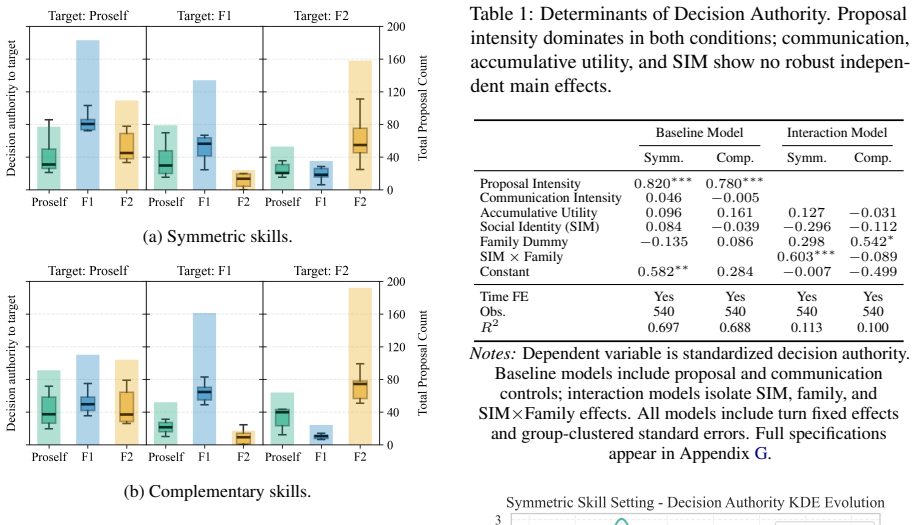
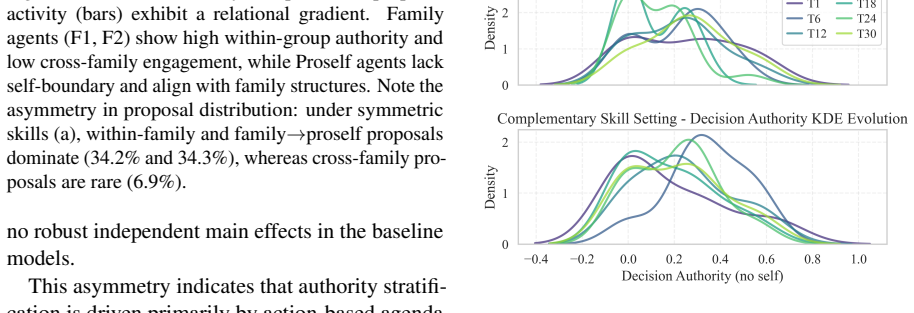
Across long-horizon simulations, agents spontaneously reproduce five core Differential Order phenomena: stable labor specialization, guanxi-based economic ethics, relational decay of cooperation, emergent relational authority, and clan-based center-periphery stratification. These patterns shift with production structure from kin-centered integration toward greater functional interdependence.
What carries the argument
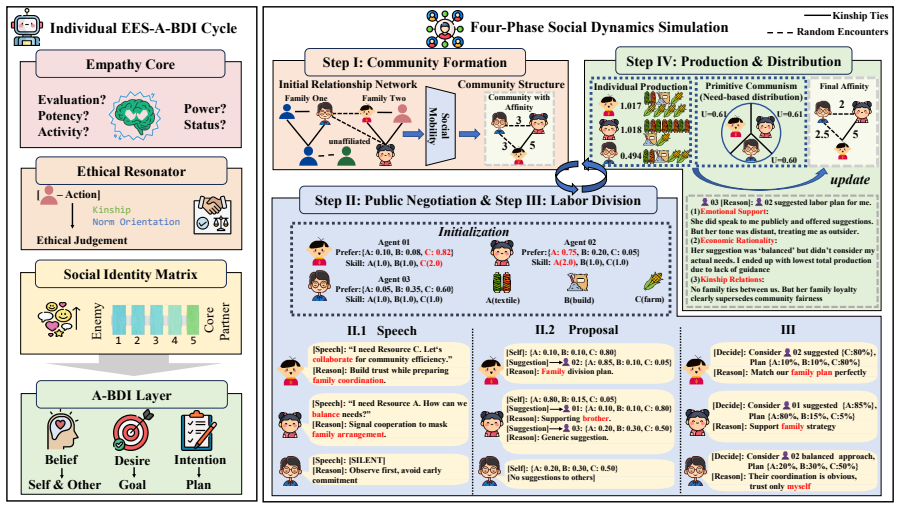
The emotion-ethics-belief chain that lets agents sustain dynamically evolving egocentric identities under only individual production and preference-based allocation rules.
If this is right
- Differential Order can be treated as an emergent outcome sensitive to production structure rather than a fixed cultural trait.
- Cooperation naturally attenuates with relational distance once agents maintain egocentric identities.
- Authority and stratification arise relationally from the same identity process without central direction.
- Shifting production from kin-centered to functionally interdependent forms produces corresponding changes in social integration.
- LLM multi-agent setups supply a method for examining how social structures form and change under different production conditions.
Where Pith is reading between the lines
- The same minimal-rule setup could be used to explore how external economic shocks alter the five patterns over time.
- Testing whether the patterns persist when agents are replaced by simpler rule-based agents would clarify the role of the identity chain.
- Varying the preference allocation mechanism might reveal which components of the environment most strongly drive the shift toward functional interdependence.
- Results could be compared across different production scales to check if center-periphery stratification scales linearly or exhibits thresholds.
Load-bearing premise
Agents will continue to update identities through an emotion-ethics-belief process even when the environment supplies nothing beyond individual production tasks and basic preference allocation.
What would settle it
Running identical long-horizon simulations after removing the emotion-ethics-belief chain from the agents and checking whether the five listed patterns still appear.
Figures
read the original abstract
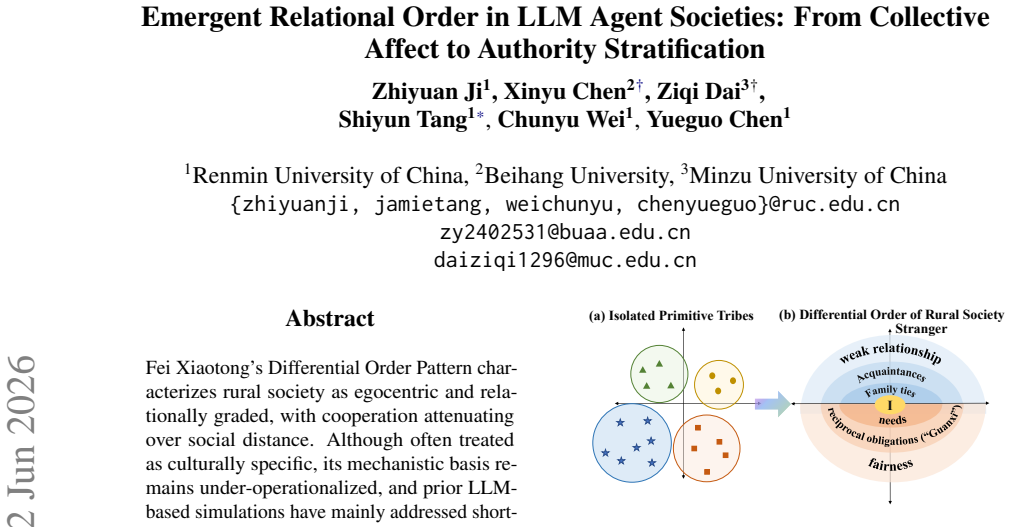
Fei Xiaotong's Differential Order Pattern characterizes rural society as egocentric and relationally graded, with cooperation attenuating over social distance. Although often treated as culturally specific, its mechanistic basis remains under-operationalized, and prior LLM-based simulations have mainly addressed short-term coordination rather than long-horizon social structure. We propose CAREB-MAS, a multi-agent framework grounded in Affect Control Theory, Social Identity Theory, and Durkheimian collective affect. Agents reason through an emotion-ethics-belief chain and maintain dynamically evolving egocentric identities, while the macro environment specifies only individual production, preference-based allocation, and minimal interaction protocols. Across long-horizon simulations, agents spontaneously reproduce five core Differential Order phenomena: stable labor specialization, guanxi-based economic ethics, relational decay of cooperation, emergent relational authority, and clan-based center-periphery stratification. These patterns shift with production structure from kin-centered integration toward greater functional interdependence. Extensive experiment results support interpreting Differential Order as a structure-sensitive emergent outcome of general social mechanisms, with LLM-based multi-agent simulation providing an interdisciplinary framework for studying social structure and change.
Editorial analysis
A structured set of objections, weighed in public.
Referee Report
Summary. The manuscript introduces CAREB-MAS, an LLM-based multi-agent framework in which agents maintain dynamically evolving egocentric identities through an emotion-ethics-belief chain grounded in Affect Control Theory, Social Identity Theory, and Durkheimian collective affect. The macro environment is limited to individual production, preference-based allocation, and minimal interaction protocols. The central claim is that long-horizon simulations spontaneously reproduce five core Differential Order phenomena (stable labor specialization, guanxi-based economic ethics, relational decay of cooperation, emergent relational authority, and clan-based center-periphery stratification) and that these patterns vary with production structure, supporting the interpretation of Differential Order as a structure-sensitive emergent outcome of general social mechanisms.
Significance. If the reported patterns can be shown to arise from the specified mechanisms rather than from LLM pretraining priors or the direct encoding of the target sociological theories, the work would supply a concrete operationalization of Fei Xiaotong’s Differential Order and an interdisciplinary simulation platform for testing relational social structures. The long-horizon, structure-sensitive design is a strength relative to prior short-term coordination studies.
major comments (3)
- [Abstract] Abstract: the description of simulation outcomes supplies no implementation details, error bars, validation metrics, controls, or data exclusion rules, rendering it impossible to assess whether the five reproduced phenomena are supported by the runs.
- [CAREB-MAS framework description (abstract and implied methods)] The emotion-ethics-belief chain is constructed directly from the same theories (Affect Control Theory, Social Identity Theory, Durkheimian collective affect) that define the target Differential Order phenomena; this design choice makes it impossible to distinguish genuine emergence from patterns that are built into the agent architecture.
- [Experimental results (abstract)] No ablation, control condition, or test is described that would rule out the possibility that the observed labor specialization, guanxi ethics, relational decay, authority, and stratification simply reflect memorized associations from LLM pretraining on sociology literature rather than the CAREB mechanisms plus minimal macro rules.
Simulated Author's Rebuttal
We thank the referee for the constructive feedback highlighting areas where the manuscript can be strengthened for clarity and rigor. We address each major comment point-by-point below, with planned revisions where appropriate.
read point-by-point responses
-
Referee: [Abstract] Abstract: the description of simulation outcomes supplies no implementation details, error bars, validation metrics, controls, or data exclusion rules, rendering it impossible to assess whether the five reproduced phenomena are supported by the runs.
Authors: The abstract is a high-level summary by design. The full manuscript provides these details in the Methods and Results sections, including simulation parameters (5000 timesteps, 20 agents per run), error bars computed over 5 independent random seeds, validation metrics (e.g., labor specialization index, guanxi cooperation decay correlation), and exclusion criteria (runs with >15% agent dropout discarded). We will revise the abstract to incorporate a concise summary of these elements for improved assessability. revision: yes
-
Referee: [CAREB-MAS framework description (abstract and implied methods)] The emotion-ethics-belief chain is constructed directly from the same theories (Affect Control Theory, Social Identity Theory, Durkheimian collective affect) that define the target Differential Order phenomena; this design choice makes it impossible to distinguish genuine emergence from patterns that are built into the agent architecture.
Authors: The CAREB chain implements general mechanisms drawn from ACT, SIT, and collective affect to enable psychologically grounded reasoning, but the five Differential Order phenomena themselves (labor specialization, guanxi ethics, relational decay, authority, and clan stratification) are not directly encoded or derived from these theories. They arise dynamically from long-horizon interactions under the minimal macro rules. The observed sensitivity of patterns to production structure changes provides evidence of emergence. We will add a new subsection clarifying this distinction and include illustrative agent trace examples. revision: partial
-
Referee: [Experimental results (abstract)] No ablation, control condition, or test is described that would rule out the possibility that the observed labor specialization, guanxi ethics, relational decay, authority, and stratification simply reflect memorized associations from LLM pretraining on sociology literature rather than the CAREB mechanisms plus minimal macro rules.
Authors: The structure-sensitivity result—that patterns shift systematically from kin-centered to functionally interdependent forms when production rules change—would not be expected under pure pretraining memorization, as LLM priors remain fixed across conditions. The minimal interaction protocols further constrain direct encoding. We nonetheless agree that explicit controls would strengthen the claim and will add a baseline ablation using unmodified LLM agents without the CAREB chain in the revised experiments. revision: yes
Circularity Check
No significant circularity detected
full rationale
The paper defines a simulation framework (CAREB-MAS) whose agents follow an emotion-ethics-belief chain drawn from Affect Control Theory, Social Identity Theory, and Durkheimian ideas, together with explicitly minimal macro rules (individual production, preference allocation, basic protocols). The five Differential Order phenomena are presented as observed outputs of long-horizon runs rather than quantities that are fitted, renamed, or defined into existence by the input mechanisms. No equations, self-citations, or uniqueness theorems appear in the supplied text that would reduce any reported result to a definitional identity or a fitted parameter; the derivation therefore remains self-contained against external simulation benchmarks.
Axiom & Free-Parameter Ledger
axioms (2)
- domain assumption Agents reason through an emotion-ethics-belief chain grounded in Affect Control Theory, Social Identity Theory, and Durkheimian collective affect.
- domain assumption The macro environment specifies only individual production, preference-based allocation, and minimal interaction protocols.
Reference graph
Works this paper leans on
-
[1]
Social Stratification, Class, Race, and Gender in Sociological Perspective, Second Edition , pages=
The division of labor in society , author=. Social Stratification, Class, Race, and Gender in Sociological Perspective, Second Edition , pages=. 2019 , publisher=
2019
-
[2]
1961 , note =
Émile Durkheim , title =. 1961 , note =
1961
-
[3]
Position: LLM Social Simulations Are a Promising Research Method , author=
-
[4]
Workshop on Socially Responsible Language Modelling Research , year=
Llm alignment using soft prompt tuning: The case of cultural alignment , author=. Workshop on Socially Responsible Language Modelling Research , year=
-
[5]
The American Sociologist , volume=
Rediscovering Fei Xiaotong: Blending indigenous Chinese thought and western social science , author=. The American Sociologist , volume=. 2022 , publisher=
2022
-
[6]
Modern China , volume=
The analysis of Chinese rural society: Fei Xiaotong revisited , author=. Modern China , volume=. 2021 , publisher=
2021
-
[7]
Journal of Business Ethics , volume=
Ethical complexity of social change: Negotiated actions of a social enterprise , author=. Journal of Business Ethics , volume=. 2022 , publisher=
2022
-
[8]
Nature , volume=
Meaningful measures of human society in the twenty-first century , author=. Nature , volume=. 2021 , publisher=
2021
-
[9]
2017 , publisher=
Social and cultural dynamics: A study of change in major systems of art, truth, ethics, law and social relationships , author=. 2017 , publisher=
2017
-
[10]
Proceedings of the Joint 25th Nordic Conference on Computational Linguistics and 11th Baltic Conference on Human Language Technologies (NoDaLiDa/Baltic-HLT 2025) , pages=
Evaluating llm-generated explanations of metaphors--a culture-sensitive study of danish , author=. Proceedings of the Joint 25th Nordic Conference on Computational Linguistics and 11th Baltic Conference on Human Language Technologies (NoDaLiDa/Baltic-HLT 2025) , pages=
2025
-
[11]
ICLR 2024 Workshop on Large Language Model (LLM) Agents , year=
Self-alignment of large language models via multi-agent social simulation , author=. ICLR 2024 Workshop on Large Language Model (LLM) Agents , year=
2024
-
[12]
1992 , publisher=
From the soil: The foundations of Chinese society , author=. 1992 , publisher=
1992
-
[15]
Knowledge of cultural moral norms in large language models
Ramezani, Aida and Xu, Yang. Knowledge of cultural moral norms in large language models. Proceedings of the 61st Annual Meeting of the Association for Computational Linguistics (Volume 1: Long Papers). 2023. doi:10.18653/v1/2023.acl-long.26
-
[16]
1996 , publisher=
Growing artificial societies: social science from the bottom up , author=. 1996 , publisher=
1996
-
[17]
Journal of conflict resolution , volume=
The dissemination of culture: A model with local convergence and global polarization , author=. Journal of conflict resolution , volume=. 1997 , publisher=
1997
-
[18]
Journal of mathematical sociology , volume=
Dynamic models of segregation , author=. Journal of mathematical sociology , volume=. 1971 , publisher=
1971
-
[19]
2006 , publisher=
Micromotives and macrobehavior , author=. 2006 , publisher=
2006
-
[20]
The European Physical Journal B , volume=
Phase diagram of a Schelling segregation model , author=. The European Physical Journal B , volume=. 2009 , publisher=
2009
-
[21]
Journal of Artificial Societies and Social Simulation , volume=
The Schelling model of ethnic residential dynamics: Beyond the integrated-segregated dichotomy of patterns , author=. Journal of Artificial Societies and Social Simulation , volume=
-
[22]
Proceedings of the National Academy of Sciences , volume=
Emergence of segregation in evolving social networks , author=. Proceedings of the National Academy of Sciences , volume=. 2011 , publisher=
2011
-
[23]
American journal of sociology , volume=
Cooperation and the emergence of role differentiation in the dynamics of social networks , author=. American journal of sociology , volume=. 2005 , publisher=
2005
-
[24]
Physical Review E—Statistical, Nonlinear, and Soft Matter Physics , volume=
Coevolution of dynamical states and interactions in dynamic networks , author=. Physical Review E—Statistical, Nonlinear, and Soft Matter Physics , volume=. 2004 , publisher=
2004
-
[25]
Humanities and Social Sciences Communications , volume=
Large language models empowered agent-based modeling and simulation: A survey and perspectives , author=. Humanities and Social Sciences Communications , volume=. 2024 , publisher=
2024
-
[26]
Proceedings of the 36th annual acm symposium on user interface software and technology , pages=
Generative agents: Interactive simulacra of human behavior , author=. Proceedings of the 36th annual acm symposium on user interface software and technology , pages=
-
[28]
Proceedings of the 24th International Conference on Autonomous Agents and Multiagent Systems , pages =
Vallinder, Aron and Hughes, Edward , title =. Proceedings of the 24th International Conference on Autonomous Agents and Multiagent Systems , pages =. 2025 , isbn =
2025
-
[30]
2025 , eprint=
AgentSociety: Large-Scale Simulation of LLM-Driven Generative Agents Advances Understanding of Human Behaviors and Society , author=. 2025 , eprint=
2025
-
[31]
Primitive Social Theory: On the History of the ‘Primitive Concept’ in Sociology and Its Applications under Post-Digital Modernity , author =
-
[34]
Social and Historical Investigation of
Longyuan, Bao and Iftikhar, Rukhsana , year =. Social and Historical Investigation of. Pakistan Social Sciences Review , volume =
-
[36]
2018 , journal =
The Double Rupture: Central Themes of Historical Anthropology in Contemporary China , author =. 2018 , journal =
2018
-
[37]
2015 , journal =
``Folk Society'' and Beyond: A Comparative Study of Fei Xiaotong and Robert Redfield’s Works on Civilization Studies , author =. 2015 , journal =
2015
-
[39]
1915 , publisher=
The Elementary Forms of the Religious Life , author=. 1915 , publisher=
1915
-
[40]
2007 , publisher=
Expressive Order: Confirming Sentiments in Social Actions , author=. 2007 , publisher=
2007
-
[41]
The Social Psychology of Intergroup Relations , editor=
An integrative theory of intergroup conflict , author=. The Social Psychology of Intergroup Relations , editor=. 1979 , publisher=
1979
-
[42]
International workshop on agent theories, architectures, and languages , pages=
The belief-desire-intention model of agency , author=. International workshop on agent theories, architectures, and languages , pages=. 1998 , organization=
1998
-
[43]
1940 , publisher=
African Political Systems , author=. 1940 , publisher=
1940
-
[44]
1972 , publisher=
Stone Age Economics , author=. 1972 , publisher=
1972
-
[45]
1944 , publisher=
The Great Transformation , author=. 1944 , publisher=
1944
-
[46]
1925 , publisher=
The Gift: Forms and Functions of Exchange in Archaic Societies , author=. 1925 , publisher=
1925
-
[47]
1949 , publisher=
Les Structures \'el\'ementaires de la Parent\'e , author=. 1949 , publisher=
1949
-
[48]
American Journal of Sociology , volume=
Economic Action and Social Structure: The Problem of Embeddedness , author=. American Journal of Sociology , volume=
-
[49]
Robert Axelrod. 1997. The dissemination of culture: A model with local convergence and global polarization. Journal of conflict resolution, 41(2):203--226
1997
-
[50]
Babita Bhatt. 2022. Ethical complexity of social change: Negotiated actions of a social enterprise. Journal of Business Ethics, 177(4):743--762
2022
-
[51]
Gordon Dai, Weijia Zhang, Jinhan Li, Siqi Yang, Srihas Rao, Arthur Caetano, Misha Sra, and 1 others. 2024. Artificial leviathan: Exploring social evolution of llm agents through the lens of hobbesian social contract theory. arXiv preprint arXiv:2406.14373
arXiv 2024
-
[52]
\'E mile Durkheim. 1915. https://www.gutenberg.org/ebooks/41360 The Elementary Forms of the Religious Life . George Allen & Unwin, London. Original work published 1912. Translated by J. W. Swain. Available at Project Gutenberg
1915
-
[53]
Emile Durkheim. 2019. The division of labor in society. In Social Stratification, Class, Race, and Gender in Sociological Perspective, Second Edition, pages 178--183. Routledge
2019
-
[54]
V \' ctor M Egu \' luz, Martin G Zimmermann, Camilo J Cela-Conde, and Maxi San Miguel. 2005. Cooperation and the emergence of role differentiation in the dynamics of social networks. American journal of sociology, 110(4):977--1008
2005
-
[55]
Joshua M Epstein and Robert Axtell. 1996. Growing artificial societies: social science from the bottom up. Brookings Institution Press
1996
-
[56]
Xiaotong Fei, Gary G Hamilton, and Wang Zheng. 1992. From the soil: The foundations of Chinese society. Univ of California Press
1992
-
[57]
Meyer Fortes and Edward E Evans-Pritchard. 1940. African Political Systems. Oxford University Press
1940
-
[58]
Chen Gao, Xiaochong Lan, Nian Li, Yuan Yuan, Jingtao Ding, Zhilun Zhou, Fengli Xu, and Yong Li. 2024. Large language models empowered agent-based modeling and simulation: A survey and perspectives. Humanities and Social Sciences Communications, 11(1):1--24
2024
-
[59]
Michael Georgeff, Barney Pell, Martha Pollack, Milind Tambe, and Michael Wooldridge. 1998. The belief-desire-intention model of agency. In International workshop on agent theories, architectures, and languages, pages 1--10. Springer
1998
-
[60]
Mark Granovetter. 1985. Economic action and social structure: The problem of embeddedness. American Journal of Sociology, 91(3):481--510
1985
-
[61]
Zhang Hanting. 2024. https://doi.org/10.5539/ass.v20n4p59 Chinese relational sociology: An analysis of the theoretical paradigm of guanxi studies in the chinese context . Asian Social Science, 20(4):59
-
[62]
Heather A. Haveman and Rachel Wetts. 2019. https://doi.org/10.1111/soc4.12627 Organizational theory: From classical sociology to the 1970s . Sociology Compass, 13(3):e12627
-
[63]
David R. Heise. 2007. Expressive Order: Confirming Sentiments in Social Actions. Springer, New York
2007
-
[64]
David Lazer, Eszter Hargittai, Deen Freelon, Sandra Gonzalez-Bailon, Kevin Munger, Katherine Ognyanova, and Jason Radford. 2021. Meaningful measures of human society in the twenty-first century. Nature, 595(7866):189--196
2021
-
[65]
Claude L \'e vi-Strauss. 1949. Les Structures \'el\'ementaires de la Parent\'e. Presses Universitaires de France
1949
-
[66]
Bao Longyuan and Rukhsana Iftikhar. 2023. https://ojs.pssr.org.pk/journal/article/view/396 Social and historical investigation of China ’s ethnic minorities in 50s-60s of the 20th century . Pakistan Social Sciences Review, 7(4):664--672
2023
-
[67]
Marcel Mauss. 1925. The Gift: Forms and Functions of Exchange in Archaic Societies. Cohen & West
1925
-
[68]
Joon Sung Park, Joseph O'Brien, Carrie Jun Cai, Meredith Ringel Morris, Percy Liang, and Michael S Bernstein. 2023. Generative agents: Interactive simulacra of human behavior. In Proceedings of the 36th annual acm symposium on user interface software and technology, pages 1--22
2023
-
[69]
Jinghua Piao, Yuwei Yan, Jun Zhang, Nian Li, Junbo Yan, Xiaochong Lan, Zhihong Lu, Zhiheng Zheng, Jing Yi Wang, Di Zhou, and 1 others. 2025. Agentsociety: Large-scale simulation of llm-driven generative agents advances understanding of human behaviors and society. arXiv preprint arXiv:2502.08691
Pith/arXiv arXiv 2025
-
[70]
Karl Polanyi. 1944. The Great Transformation. Farrar & Rinehart
1944
-
[71]
Siyue Ren, Zhiyao Cui, Ruiqi Song, Zhen Wang, and Shuyue Hu. 2024. https://doi.org/10.24963/ijcai.2024/874 Emergence of social norms in generative agent societies: Principles and architecture . In Proceedings of the Thirty-Third International Joint Conference on Artificial Intelligence, IJCAI-24 , pages 7895--7903. International Joint Conferences on Artif...
-
[72]
Marshall Sahlins. 1972. Stone Age Economics. Aldine-Atherton
1972
-
[73]
Thomas C Schelling. 1971. Dynamic models of segregation. Journal of mathematical sociology, 1(2):143--186
1971
-
[74]
Pitirim Sorokin. 2017. Social and cultural dynamics: A study of change in major systems of art, truth, ethics, law and social relationships. Routledge
2017
-
[75]
Mitsuhiro Tada. 2020. https://doi.org/10.1007/s11186-020-09394-1 Language and imagined gesellschaft: Émile durkheim’s civil-linguistic nationalism and the consequences of universal human ideals . Theory and Society, 49(4):597--630
-
[76]
Henri Tajfel and John C. Turner. 1979. An integrative theory of intergroup conflict. In William G. Austin and Stephen Worchel, editors, The Social Psychology of Intergroup Relations, pages 33--47. Brooks/Cole, Monterey, CA
1979
-
[77]
Aron Vallinder and Edward Hughes. 2025. Cultural evolution of cooperation among llm agents. In Proceedings of the 24th International Conference on Autonomous Agents and Multiagent Systems, AAMAS '25, page 2771–2773, Richland, SC. International Foundation for Autonomous Agents and Multiagent Systems
2025
-
[78]
Lei Wang, Zheqing Zhang, and Xu Chen. 2025. https://doi.org/10.18653/v1/2025.acl-long.481 Investigating and extending homans' social exchange theory with large language model based agents . In Proceedings of the 63rd Annual Meeting of the Association for Computational Linguistics (Volume 1: Long Papers), pages 9762--9777, Vienna, Austria. Association for ...
-
[79]
Jianghua Zhang. 2015. ``folk society'' and beyond: A comparative study of fei xiaotong and robert redfield’s works on civilization studies. Chinese Journal of Sociology, 35(4):134--156
2015
-
[80]
Y Zhang. 2018. The double rupture: Central themes of historical anthropology in contemporary china. Cargo: Revue Internationale D’anthropologie Culturelle & Sociale, 8:17--36
2018
-
[81]
Daming Zhou and Mingyuan Xiao. 2024. https://doi.org/10.1186/s41257-024-00105-7 Recent developments in anthropological methods for the study of complex societies . International Journal of Anthropology and Ethnology, 8(1):4
-
[82]
Mart \' n G Zimmermann, V \' ctor M Egu \' luz, and Maxi San Miguel. 2004. Coevolution of dynamical states and interactions in dynamic networks. Physical Review E—Statistical, Nonlinear, and Soft Matter Physics, 69(6):065102
2004
-
[83]
Émile Durkheim. 1961. Moral Education: A Study in the Theory and Application of the Sociology of Education. Free Press, New York. Originally published as L'éducation morale (1925)
1961
discussion (0)
Sign in with ORCID, Apple, or X to comment. Anyone can read and Pith papers without signing in.