Visualizing Symmetry Broken Chern Insulators and their Quantum Melting
Pith reviewed 2026-06-26 06:54 UTC · model grok-4.3
The pith
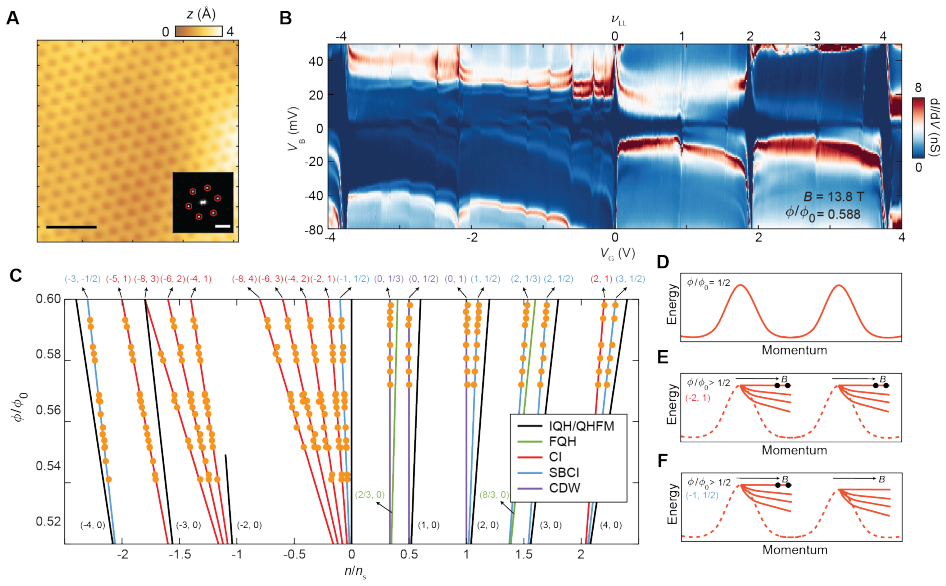
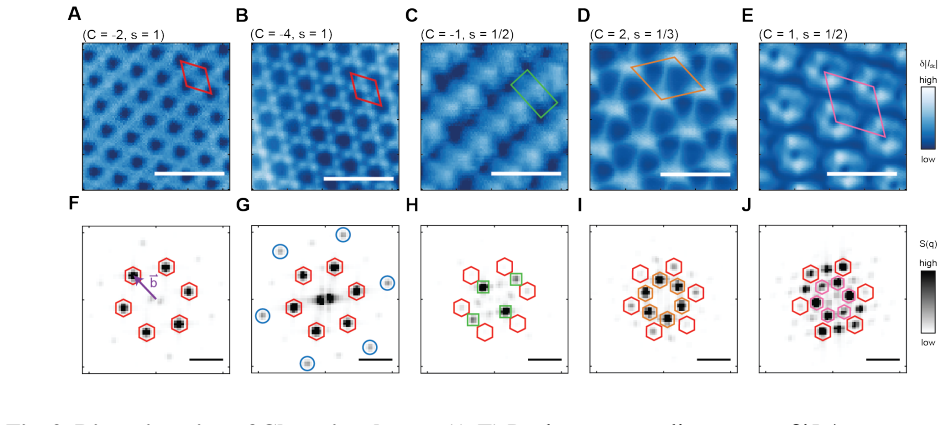
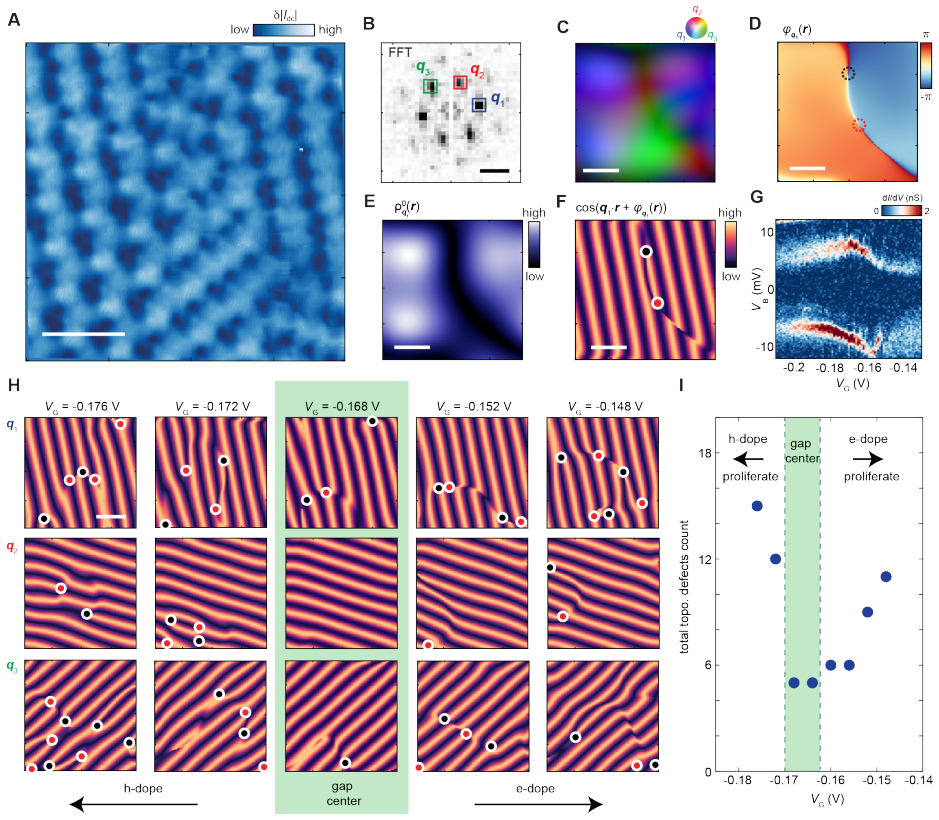
STM images show symmetry-broken Chern insulators forming enlarged moiré cells that then melt via topological defects at fractional Hofstadter fillings.
A machine-rendered reading of the paper's core claim, the machinery that carries it, and where it could break.
Core claim
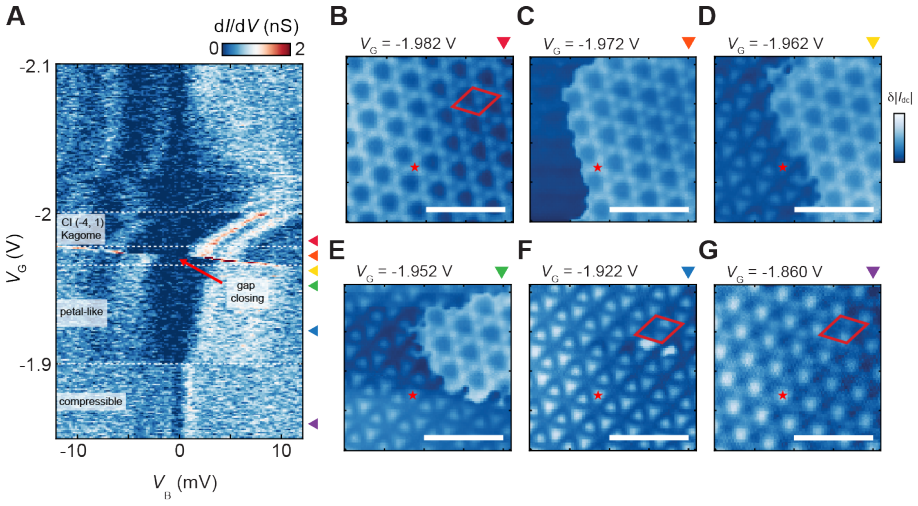
In bilayer graphene aligned with hexagonal boron nitride, the Hofstadter spectrum hosts interaction-driven Chern insulators that break symmetry by doubling, tripling, or quadrupling the moiré unit cell at fractional band fillings; some of these states also exhibit complex intra-unit-cell wave functions. In distinct Chern states the insulators undergo quantum melting driven by the appearance and proliferation of topological defects, while other states show quantum transitions that occur together with phase competition and separation.
What carries the argument
Scanning tunneling microscopy maps of moiré unit-cell enlargement and topological defect proliferation in interaction-driven symmetry-broken Chern insulators within the Hofstadter spectrum.
If this is right
- Phases that double, triple, or quadruple the moiré unit cell appear specifically at fractional fillings of the Hofstadter bands.
- Quantum melting proceeds through the nucleation and spread of topological defects inside certain Chern states.
- Quantum transitions between states occur in the presence of phase competition and spatial separation.
- Some symmetry-broken states develop complex wave-function patterns inside the enlarged moiré cell.
Where Pith is reading between the lines
- The same STM approach could be used to track how these enlarged-cell states evolve when the magnetic field strength or twist angle is varied continuously.
- Defect proliferation offers a concrete real-space mechanism by which topological protection in the Chern states is lost.
- Phase separation observed near the transitions may create domain walls that host additional conducting channels.
Load-bearing premise
The STM topographic and spectroscopic maps accurately reflect bulk electronic states of the symmetry-broken Chern insulators without dominant tip-induced artifacts or surface reconstruction effects that could mimic the reported unit-cell multiples and defect proliferation.
What would settle it
Repeated STM measurements on the same or equivalent devices that find no unit-cell multiplication or defect proliferation at the fractional fillings where the Hofstadter bands are partially filled would falsify the claim that interactions produce these symmetry-broken states.
Figures
read the original abstract
In the presence of a magnetic field, electronic states of moir\'e quantum materials develop a Hofstadter spectrum that provides a unique setting for studying the interplay between band topology and strong electron-electron interaction. Using scanning tunneling microscopy, we study Hofstadter's states in bilayer graphene aligned with hexagonal BN and directly visualize the formation of interaction-driven symmetry breaking Chern insulators. Our measurements reveal the formation of phases that double, triple or quadruple the moir\'e unit cell at fractional filling of the Hofstadter bands, as well as states with complex intra-unit-cell wave functions. We visualize two distinct quantum phenomena in different Chern states, including quantum melting driven by the appearance and proliferation of topological defects, and a quantum transition co-occurring with phase competition and separation.
Editorial analysis
A structured set of objections, weighed in public.
Referee Report
Summary. The manuscript reports scanning tunneling microscopy studies of Hofstadter states in bilayer graphene aligned with hBN. It claims direct visualization of interaction-driven symmetry-broken Chern insulators, with phases that double, triple or quadruple the moiré unit cell at fractional fillings of the Hofstadter bands, states with complex intra-unit-cell wave functions, quantum melting via proliferation of topological defects in some Chern states, and quantum transitions co-occurring with phase competition and separation in others.
Significance. If the STM maps accurately capture bulk electronic order, the work would be significant for providing real-space visualization of symmetry breaking, defect-driven quantum melting, and phase separation in interacting Chern insulators within the Hofstadter spectrum of moiré materials. This offers direct evidence for phenomena that are typically inferred indirectly from transport, strengthening the experimental toolkit for topological moiré systems.
major comments (2)
- [Results on fractional fillings] Results section on fractional fillings (abstract and main figures): the central claim that observed 2×/3×/4× unit-cell multiples and complex intra-cell wave functions correspond to symmetry-broken Chern insulators at specific fractional Hofstadter fillings lacks explicit filling-factor calibration, error bars, or comparison to expected Chern numbers; without these the assignment to particular states is unsecured.
- [Methods and results on STM maps] Methods and results sections describing STM topographic and spectroscopic maps: the interpretation of unit-cell multiples, defect proliferation, and phase separation as intrinsic bulk phenomena is load-bearing on the assumption that tip-induced band bending or local reconstruction is negligible, yet no bias-dependence series, tip-height controls, or transport cross-checks are presented to rule out artifacts that could mimic the reported features in this atomically thin system.
minor comments (1)
- [Abstract] Abstract: the phrase 'complex intra-unit-cell wave functions' is used without a brief definition or reference to how they are extracted from the maps, which would aid clarity.
Simulated Author's Rebuttal
We thank the referee for their careful review and constructive feedback. We are pleased that the referee recognizes the potential significance of our STM visualizations of symmetry-broken Chern insulators. Below we provide point-by-point responses to the major comments.
read point-by-point responses
-
Referee: [Results on fractional fillings] Results section on fractional fillings (abstract and main figures): the central claim that observed 2×/3×/4× unit-cell multiples and complex intra-cell wave functions correspond to symmetry-broken Chern insulators at specific fractional Hofstadter fillings lacks explicit filling-factor calibration, error bars, or comparison to expected Chern numbers; without these the assignment to particular states is unsecured.
Authors: We agree that explicit calibration would strengthen the claims. In the revised version, we will add a detailed analysis of the filling factors derived from the magnetic field dependence, including error bars estimated from the width of the features in the dI/dV maps. We will also include a comparison table or figure showing the expected Chern numbers for the fractional fillings based on the Hofstadter butterfly calculations for bilayer graphene/hBN. This will secure the assignment to the specific symmetry-broken states. revision: yes
-
Referee: [Methods and results on STM maps] Methods and results sections describing STM topographic and spectroscopic maps: the interpretation of unit-cell multiples, defect proliferation, and phase separation as intrinsic bulk phenomena is load-bearing on the assumption that tip-induced band bending or local reconstruction is negligible, yet no bias-dependence series, tip-height controls, or transport cross-checks are presented to rule out artifacts that could mimic the reported features in this atomically thin system.
Authors: This is a valid concern for STM on atomically thin systems. While the manuscript presents data from multiple tips and locations showing consistent features, we will include additional controls in the revision: a series of STM maps at different bias voltages and tip heights to demonstrate that the observed unit cell multiples and topological defects are robust. Regarding transport cross-checks, these are not directly feasible in our STM setup on the same device, but we note that the observed phases align with previous transport reports on similar systems. We believe these additions will address the artifact concern. revision: partial
Circularity Check
No circularity: purely observational STM study with no derivations or self-referential predictions
full rationale
The paper reports STM topographic and spectroscopic measurements of Hofstadter states in bilayer graphene/hBN, visualizing symmetry-broken Chern insulators at fractional fillings. No equations, fitted parameters, or derivation chains are present in the abstract or described content. Claims rest on direct imaging of unit-cell multiples, defects, and phase separation without any 'prediction' step that reduces to input data by construction. Self-citations, if present, are not load-bearing for any mathematical result. This matches the default case of a self-contained experimental report against external benchmarks (STM data), warranting score 0 with no steps.
Axiom & Free-Parameter Ledger
axioms (1)
- standard math Standard assumptions of quantum mechanics and band theory in 2D electron systems under magnetic field apply to the moiré superlattice.
Reference graph
Works this paper leans on
-
[1]
Streda, Quantised Hall effect in a two-dimensional periodic potential
P. Streda, Quantised Hall effect in a two-dimensional periodic potential. J. Phys. C Solid State Phys. 15, L1299 (1982). 11. A. H. MacDonald, Landau-level subband structure of electrons on a square lattice. Phys. Rev. B 28, 6713–6717 (1983). 12. K. P. Nuckolls, M. G. Scheer, D. Wong, M. Oh, R. L. Lee, J. Herzog-Arbeitman, K. Watanabe, T. Taniguchi, B. Lia...
1982
-
[2]
K. P. Nuckolls, A. Yazdani, A microscopic perspective on moiré materials. Nat. Rev. Mater. 9, 460–480 (2024). 25. G. Farahi, C.-L. Chiu, X. Liu, Z. Papic, K. Watanabe, T. Taniguchi, M. P. Zaletel, A. Yazdani, Broken symmetries and excitation spectra of interacting electrons in partially filled Landau levels. Nat. Phys. 19, 1482–1488 (2023). 26. Y . Hu, Y ...
2024
-
[3]
Visualizing Symmetry Broken Chern Insulators and their Quantum Melting
B. I. Halperin, D. R. Nelson, Theory of Two-Dimensional Melting. Phys. Rev. Lett. 41, 121–124 (1978). 38. J. Yu, H. Han, K. G. Wolinski, R. Fan, A. S. Mohammadi, T. Wang, T. Wang, L. Cohen, K. Watanabe, T. Taniguchi, A. F. Young, M. P. Zaletel, A. Yazdani, Visualizing interaction-driven restructuring of quantum Hall edge states. Nature 648, 585–590 (2025)...
discussion (0)
Sign in with ORCID, Apple, or X to comment. Anyone can read and Pith papers without signing in.