PDF evolution in alternative factorisation schemes
Pith reviewed 2026-06-26 07:47 UTC · model grok-4.3
The pith
Alternative factorisation schemes produce modified NLO DGLAP splitting functions for parton distributions whose leading behaviour corresponds to a rescaled evolution scale.
A machine-rendered reading of the paper's core claim, the machinery that carries it, and where it could break.
Core claim
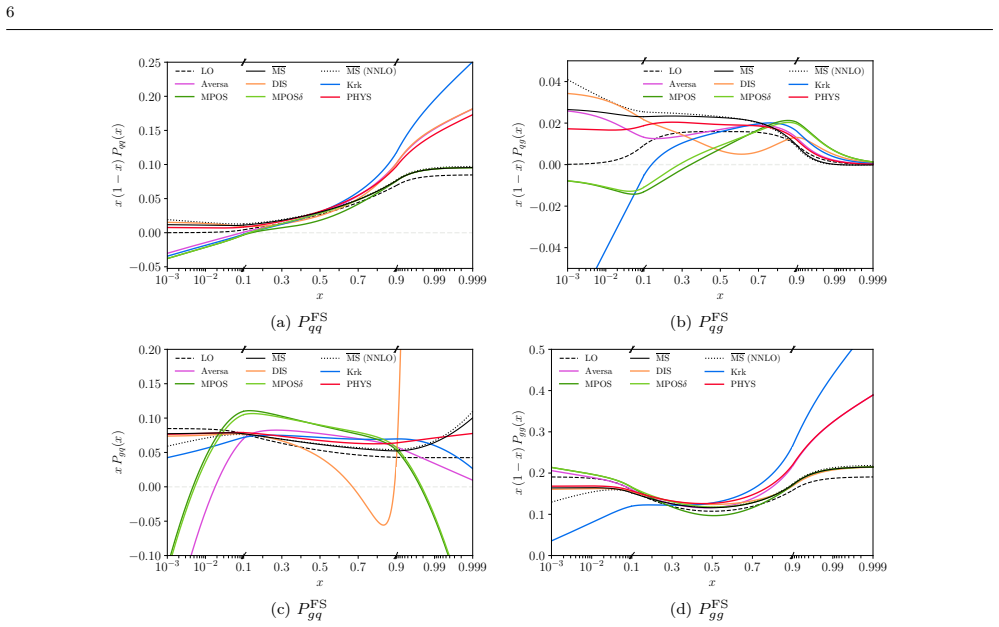
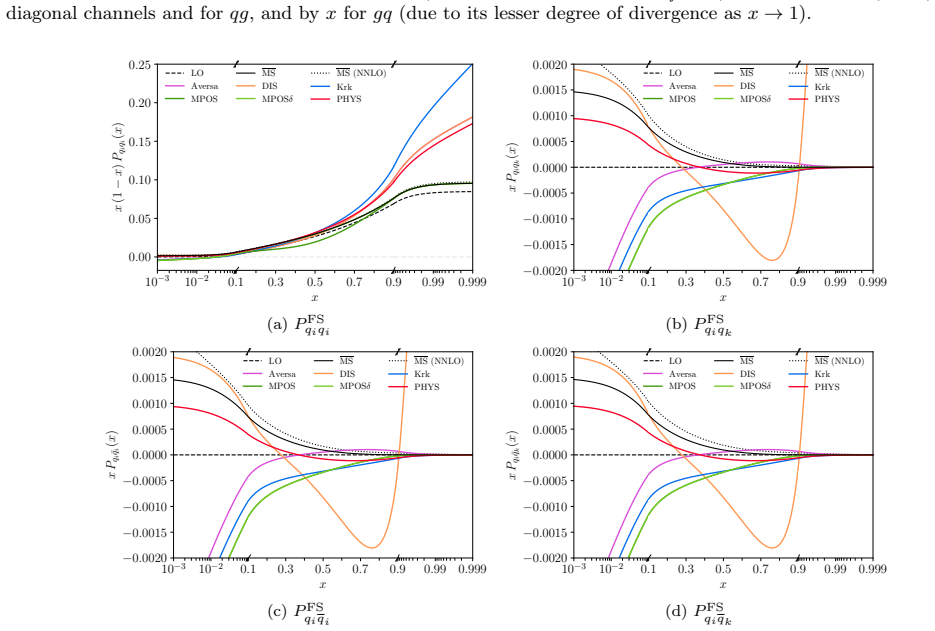
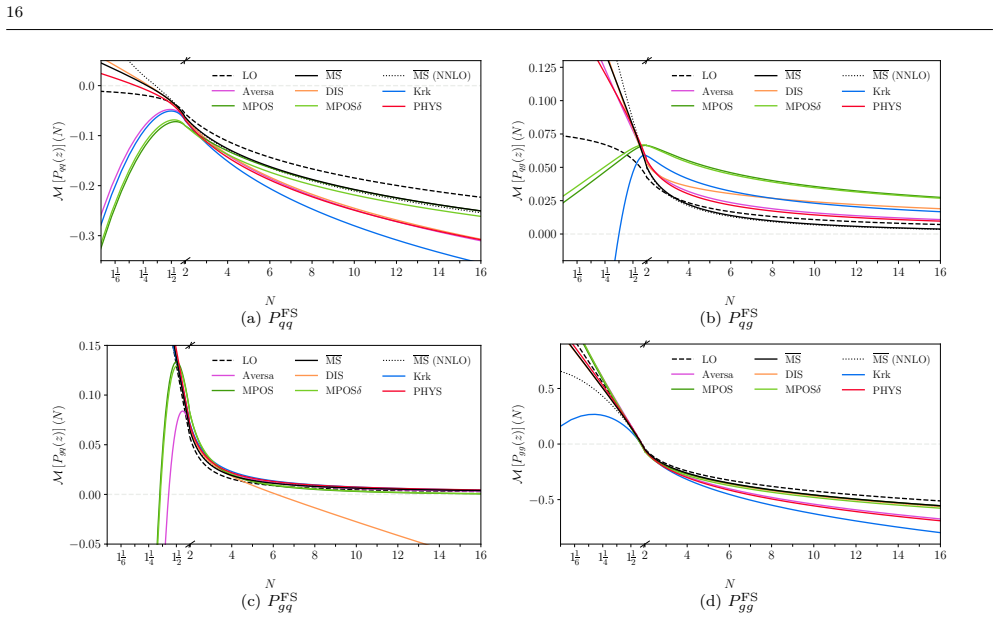
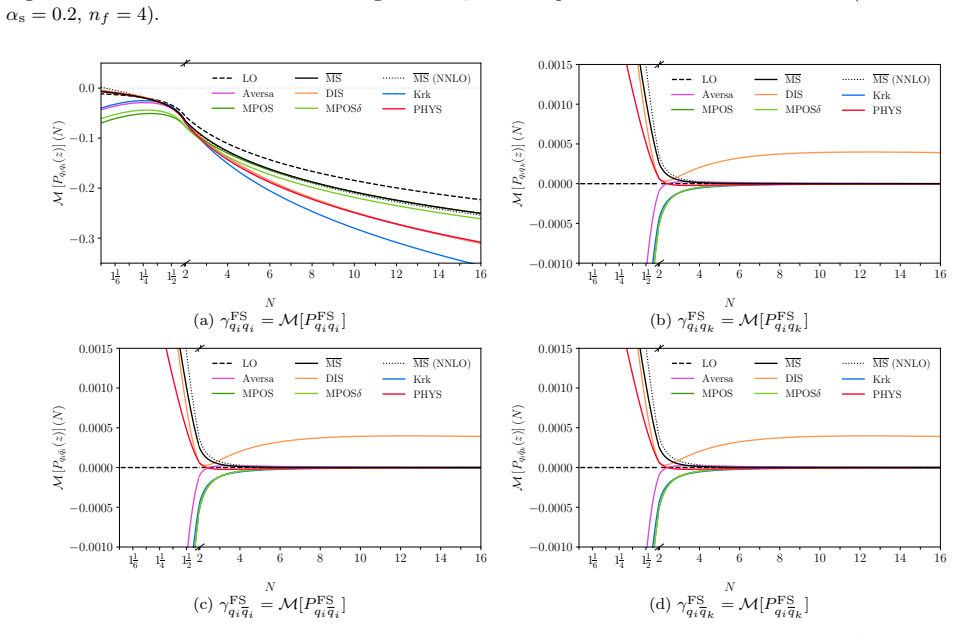
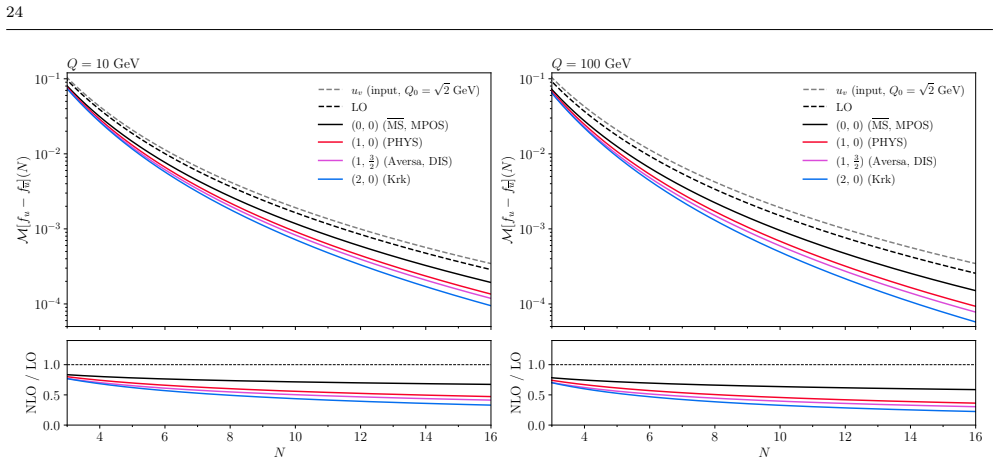
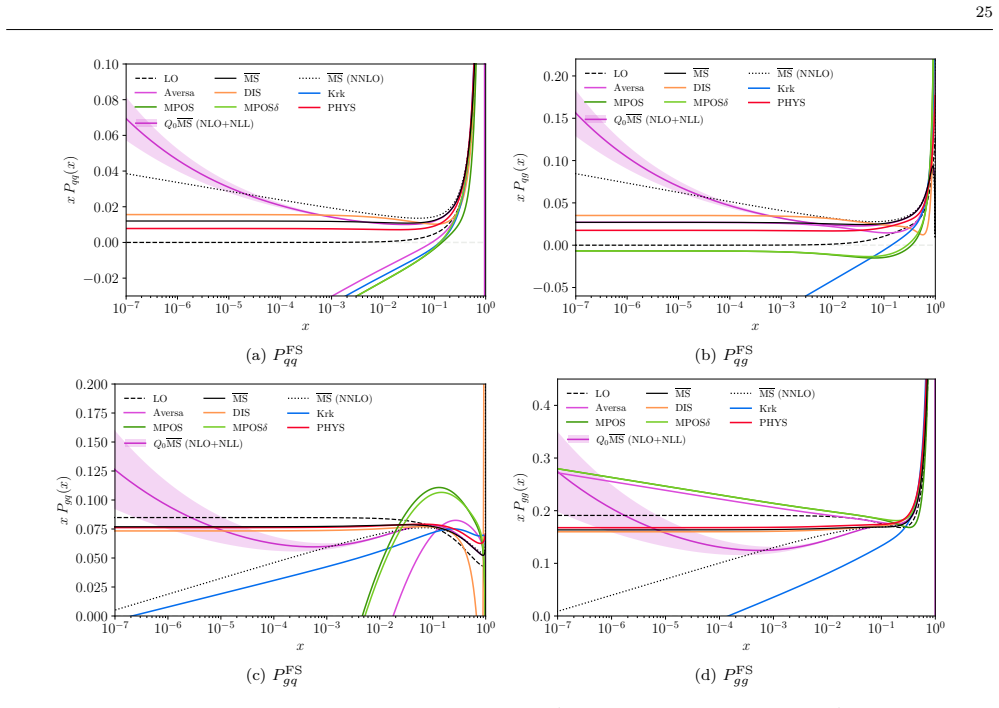
Beyond leading order, parton distribution functions require a choice of factorisation scheme. Different choices lead to PDFs that satisfy modified DGLAP evolution equations. We derive the NLO DGLAP splitting functions for PDFs in alternative factorisation schemes, including for a parametrised scheme spanning a subspace of the general factorisation-scheme space. We plot their Mellin-space counterparts, the anomalous dimensions, and study the leading large- and small-x behaviour, relevant to resummation. We find that the leading behaviour admits a natural interpretation as a modified effective evolution scale.
What carries the argument
The NLO DGLAP splitting functions obtained by consistent redefinition of the factorisation procedure in alternative schemes, together with their Mellin-space anomalous-dimension counterparts.
If this is right
- PDFs defined in the alternative schemes obey modified DGLAP evolution equations already at NLO.
- The anomalous dimensions exhibit altered leading large-x and small-x behaviour that can be absorbed into a rescaled evolution variable.
- The parametrised family of schemes allows continuous variation of the scheme choice while preserving the modified evolution structure.
- The derived functions constitute the necessary input for performing PDF evolution and global fits inside QCD calculations that employ non-MS-bar schemes.
Where Pith is reading between the lines
- The modified evolution could be combined with existing small-x or large-x resummation techniques to produce scheme-consistent predictions in extreme kinematic regions.
- Extending the same redefinition procedure to NNLO would allow consistent use of alternative schemes in calculations that include higher-order corrections.
- Global PDF fits performed directly in one of the parametrised schemes might yield different central values or uncertainties for the distributions extracted from the same data.
- The effective-scale interpretation suggests that numerical evolution codes could be adapted with only a trivial rescaling of the evolution variable rather than a full rewrite of the splitting functions.
Load-bearing premise
The NLO splitting functions in the chosen alternative schemes can be obtained by a consistent redefinition of the factorization procedure without introducing additional scheme-dependent terms that would invalidate the modified DGLAP equations at this order.
What would settle it
An independent calculation, by a different method, of the NLO splitting function in one specific alternative scheme that yields a numerically different result from the one presented here.
Figures
read the original abstract
Beyond leading order, parton distribution functions (PDFs) require a choice of factorisation scheme to be defined unambiguously. Different choices of factorisation scheme lead to PDFs that satisfy modified DGLAP evolution equations, relative to the conventional $\overline{\mathrm{MS}}$ scheme. In this paper we derive the NLO DGLAP splitting functions for PDFs in alternative factorisation schemes, including for a parametrised scheme spanning a subspace of the general factorisation-scheme space. We plot their Mellin-space counterparts, the anomalous dimensions, and study the leading large- and small-$x$ behaviour, relevant to resummation. We find that the leading behaviour admits a natural interpretation as a modified effective evolution scale. This is an essential step towards being able to evolve and fit PDFs in alternative schemes for use within QCD calculations.
Editorial analysis
A structured set of objections, weighed in public.
Referee Report
Summary. The manuscript derives the NLO DGLAP splitting functions for parton distribution functions in alternative factorization schemes (including a parametrized scheme spanning a subspace of the general scheme space), obtains the corresponding Mellin-space anomalous dimensions, and analyzes their leading large-x and small-x behavior. The leading behavior is interpreted as corresponding to a modified effective evolution scale. The work is presented as an essential step toward evolving and fitting PDFs in schemes other than the conventional MS-bar scheme.
Significance. If the derivations are correct, the results supply explicit NLO splitting functions and anomalous dimensions outside the standard scheme, enabling controlled exploration of factorization-scheme dependence in PDF evolution and fits. The observation that leading x-behavior admits a modified-scale interpretation is a concrete, potentially useful simplification for resummation studies. The parametrized subspace provides a systematic rather than ad-hoc exploration of scheme freedom.
minor comments (3)
- [Abstract / §2] The abstract asserts that derivations were performed and plots produced, but the manuscript would be strengthened by an explicit statement (e.g., in §2 or §3) of the precise redefinition of the factorization procedure used to obtain the alternative-scheme splitting functions at NLO, including confirmation that no additional scheme-dependent terms arise at this order.
- [Figures] Figure captions and axis labels for the Mellin-space anomalous dimensions should explicitly indicate the value(s) of the scheme parameter(s) used in each curve; without this, reproduction of the plotted results is unnecessarily difficult.
- A short table comparing the derived NLO splitting functions (or their first few Mellin moments) against the standard MS-bar expressions for at least one concrete choice of the parametrized scheme would improve readability and allow immediate verification.
Simulated Author's Rebuttal
We thank the referee for their positive summary and significance assessment of our manuscript deriving NLO splitting functions and anomalous dimensions in alternative factorization schemes. We note the recommendation for minor revision. No specific major comments were raised in the report.
Circularity Check
No significant circularity; derivation is self-contained
full rationale
The paper derives NLO DGLAP splitting functions in alternative factorisation schemes by redefining the factorisation procedure starting from standard QCD inputs. No load-bearing step reduces by construction to a fitted parameter, self-citation chain, or renamed input; the parametrised subspace is presented as an explicit controlled choice rather than a tautological output. The leading-behaviour interpretation is an observation on the derived functions, not a prediction forced by the inputs. The work remains externally falsifiable against standard MSbar results and does not invoke uniqueness theorems or ansatze smuggled via self-citation.
Axiom & Free-Parameter Ledger
Reference graph
Works this paper leans on
-
[1]
Yu. L. Dokshitzer,Calculation of the Structure Functions for Deep Inelastic Scattering and e+ e− Annihilation by Perturbation Theory in Quantum Chromodynamics,Sov. Phys. JETP46(1977) 641
1977
-
[2]
Gribov and L.N
V.N. Gribov and L.N. Lipatov,Deep inelastice pscattering in perturbation theory,Sov. J. Nucl. Phys.15(1972) 438
1972
-
[3]
Altarelli and G
G. Altarelli and G. Parisi,Asymptotic Freedom in Parton Language,Nucl. Phys. B126(1977) 298
1977
-
[4]
Altarelli, R.K
G. Altarelli, R.K. Ellis and G. Martinelli,Leptoproduction and Drell–Yan Processes Beyond the Leading Approximation in Chromodynamics,Nucl. Phys. B143(1978) 521
1978
-
[5]
Bardeen, A.J
W.A. Bardeen, A.J. Buras, D.W. Duke and T. Muta,Deep Inelastic Scattering Beyond the Leading Order in Asymptotically Free Gauge Theories,Phys. Rev. D18(1978) 3998
1978
-
[6]
Sterman,Summation of Large Corrections to Short Distance Hadronic Cross-Sections,Nucl
G.F. Sterman,Summation of Large Corrections to Short Distance Hadronic Cross-Sections,Nucl. Phys. B281(1987) 310
1987
-
[7]
Catani and L
S. Catani and L. Trentadue,Resummation of the QCD Perturbative Series for Hard Processes,Nucl. Phys. B327(1989) 323
1989
-
[8]
S. Catani, M.L. Mangano, P. Nason and L. Trentadue,The Resummation of soft gluons in hadronic collisions,Nucl. Phys. B 478(1996) 273 [hep-ph/9604351]
Pith/arXiv arXiv 1996
-
[9]
S. Catani and F. Hautmann,High-energy factorization and small-xdeep inelastic scattering beyond leading order,Nucl. Phys. B 427(1994) 475 [hep-ph/9405388]
Pith/arXiv arXiv 1994
-
[10]
R.D. Ball and S. Forte,Summation of leading logarithms at smallx,Phys. Lett. B351(1995) 313 [hep-ph/9501231]
Pith/arXiv arXiv 1995
-
[11]
R.D. Ball and S. Forte,Smallxbehavior of Altarelli–Parisi splitting functions,Phys. Lett. B465(1999) 271 [hep-ph/9906222]
Pith/arXiv arXiv 1999
-
[12]
G. Altarelli, R.D. Ball and S. Forte,Perturbatively stable resummed small x evolution kernels,Nucl. Phys. B742(2006) 1 [hep-ph/0512237]
Pith/arXiv arXiv 2006
-
[13]
M. Bonvini, S. Marzani and T. Peraro,Small-xresummation from HELL,Eur. Phys. J. C76(2016) 597 [1607.02153]
Pith/arXiv arXiv 2016
-
[14]
M. Bonvini, S. Marzani and C. Muselli,Towards parton distribution functions with small-xresummation: HELL 2.0,JHEP12 (2017) 117 [1708.07510]
Pith/arXiv arXiv 2017
-
[15]
M. Bonvini and S. Marzani,Four-loop splitting functions at smallx,JHEP06(2018) 145 [1805.06460]
Pith/arXiv arXiv 2018
-
[16]
M. Bonvini, S. Frixione and G. Stagnitto,New results on small-x resummation for splitting functions,2603.02312
-
[17]
G. Corcella and L. Magnea,Soft-gluon resummation effects on parton distributions,Phys. Rev. D72(2005) 074017 [hep-ph/0506278]
Pith/arXiv arXiv 2005
-
[18]
M. Bonvini, S. Marzani, J. Rojo, L. Rottoli et al.,Parton distributions with threshold resummation,JHEP09(2015) 191 [1507.01006]
Pith/arXiv arXiv 2015
-
[19]
R.D. Ball, V. Bertone, M. Bonvini, S. Marzani et al.,Parton distributions with small-x resummation: evidence for BFKL dynamics in HERA data,Eur. Phys. J. C78(2018) 321 [1710.05935]. 20.xFitter Developers’ Teamcollaboration,Impact of low-xresummation on QCD analysis of HERA data,Eur. Phys. J. C 78(2018) 621 [1802.00064]
Pith/arXiv arXiv 2018
-
[20]
Furmanski and R
W. Furmanski and R. Petronzio,Lepton–Hadron Processes Beyond Leading Order in Quantum Chromodynamics,Z. Phys. C 11(1982) 293
1982
-
[21]
Catani,Physical anomalous dimensions at small x,Z
S. Catani,Physical anomalous dimensions at small x,Z. Phys. C75(1997) 665 [hep-ph/9609263]
Pith/arXiv arXiv 1997
-
[22]
S. Moch and A. Vogt,On non-singlet physical evolution kernels and large-xcoefficient functions in perturbative QCD,JHEP11 (2009) 099 [0909.2124]
Pith/arXiv arXiv 2009
-
[23]
M. Hentschinski and M. Stratmann,On the Practical Application of Physical Anomalous Dimensions,1311.2825
- [24]
- [25]
-
[26]
S. Jadach, W. Płaczek, S. Sapeta, A. Siódmok et al.,Matching NLO QCD with parton shower in Monte Carlo scheme — the KrkNLO method,JHEP10(2015) 052 [1503.06849]
Pith/arXiv arXiv 2015
-
[27]
S. Jadach, W. Płaczek, S. Sapeta, A. Siódmok et al.,Parton distribution functions in Monte Carlo factorisation scheme,Eur. Phys. J. C76(2016) 649 [1606.00355]
Pith/arXiv arXiv 2016
-
[28]
S. Jadach, G. Nail, W. Płaczek, S. Sapeta et al.,Monte Carlo simulations of Higgs-boson production at the LHC with the KrkNLO method,Eur. Phys. J. C77(2017) 164 [1607.06799]
Pith/arXiv arXiv 2017
-
[29]
A. Candido, S. Forte and F. Hekhorn,CanMSparton distributions be negative?,JHEP11(2020) 129 [2006.07377]
arXiv 2020
-
[30]
A. Candido, S. Forte, T. Giani and F. Hekhorn,On the positivity ofMSparton distributions,Eur. Phys. J. C84(2024) 335 [2308.00025]
Pith/arXiv arXiv 2024
-
[31]
Aversa, P
F. Aversa, P. Chiappetta, M. Greco and J.P. Guillet,QCD Corrections to Parton-Parton Scattering Processes,Nucl. Phys. B 327(1989) 105
1989
-
[32]
E.G. Oliveira, A.D. Martin and M.G. Ryskin,Physical factorisation scheme for PDFs for non-inclusive applications,JHEP11 (2013) 156 [1310.8289]
Pith/arXiv arXiv 2013
-
[33]
Ramalho and G.F
A. Ramalho and G.F. Sterman,High Moment Corrections to the Drell–Yan Cross-section and an Alternate Parton Density, Phys. Rev. D29(1984) 2517
1984
-
[34]
Z. Nagy and D.E. Soper,Summing threshold logs in a parton shower,JHEP10(2016) 019 [1605.05845]
Pith/arXiv arXiv 2016
-
[35]
Z. Nagy and D.E. Soper,What is a parton shower?,Phys. Rev. D98(2018) 014034 [1705.08093]
Pith/arXiv arXiv 2018
-
[36]
Z. Nagy and D.E. Soper,Multivariable evolution in parton showers with initial state partons,Phys. Rev. D106(2022) 014024 [2204.05631]
arXiv 2022
- [37]
- [38]
-
[39]
Lin et al.,Parton distributions and lattice QCD calculations: a community white paper,Prog
H.-W. Lin et al.,Parton distributions and lattice QCD calculations: a community white paper,Prog. Part. Nucl. Phys.100 (2018) 107 [1711.07916]
Pith/arXiv arXiv 2018
-
[40]
K. Cichy and M. Constantinou,A guide to light-cone PDFs from Lattice QCD: an overview of approaches, techniques and results,Adv. High Energy Phys.2019(2019) 3036904 [1811.07248]
Pith/arXiv arXiv 2019
-
[41]
Constantinou et al.,Parton distributions and lattice-QCD calculations: Toward 3D structure,Prog
M. Constantinou et al.,Parton distributions and lattice-QCD calculations: Toward 3D structure,Prog. Part. Nucl. Phys.121 (2021) 103908 [2006.08636]
arXiv 2021
-
[42]
G. Martinelli, C. Pittori, C.T. Sachrajda, M. Testa et al.,A general method for non-perturbative renormalization of lattice operators,Nucl. Phys. B445(1995) 81 [hep-lat/9411010]. 32
Pith/arXiv arXiv 1995
-
[43]
Y.-Q. Ma and J.-W. Qiu,Extracting Parton Distribution Functions from Lattice QCD Calculations,Phys. Rev. D98(2018) 074021 [1404.6860]
Pith/arXiv arXiv 2018
-
[44]
Y.-Q. Ma and J.-W. Qiu,Exploring Partonic Structure of Hadrons Using ab initio Lattice QCD Calculations,Phys. Rev. Lett. 120(2018) 022003 [1709.03018]
Pith/arXiv arXiv 2018
-
[45]
I.W. Stewart and Y. Zhao,Matching the quasiparton distribution in a momentum subtraction scheme,Phys. Rev. D97(2018) 054512 [1709.04933]
Pith/arXiv arXiv 2018
-
[46]
S. Delorme, A. Kusina, A. Siódmok and J. Whitehead,Factorisation schemes for proton PDFs,Eur. Phys. J. C85(2025) 505 [2501.18289]
arXiv 2025
-
[47]
S. Jadach, A. Kusina, W. Płaczek, M. Skrzypek et al.,Inclusion of the QCD next-to-leading order corrections in the quark-gluon Monte Carlo shower,Phys. Rev. D87(2013) 034029 [1103.5015]
Pith/arXiv arXiv 2013
-
[48]
R.K. Ellis, W.J. Stirling and B.R. Webber,QCD and Collider Physics, vol. 8, Cambridge University Press (2, 2011), 10.1017/CBO9780511628788
-
[49]
Gribov and L.N
V.N. Gribov and L.N. Lipatov,e+e− pair annihilation and deep inelasticepscattering in perturbation theory,Sov. J. Nucl. Phys.15(1972) 675
1972
-
[50]
Furmanski and R
W. Furmanski and R. Petronzio,Singlet Parton Densities Beyond Leading Order,Phys. Lett. B97(1980) 437
1980
-
[51]
Mathematica, Version 14.1
Wolfram Research, Inc., “Mathematica, Version 14.1.”
-
[52]
M. Höschele, J. Hoff, A. Pak, M. Steinhauser et al.,MT: A Mathematica package to compute convolutions,Comput. Phys. Commun.185(2014) 528 [1307.6925]
Pith/arXiv arXiv 2014
-
[53]
Maître,HPL, a Mathematica implementation of the harmonic polylogarithms,Comput
D. Maître,HPL, a Mathematica implementation of the harmonic polylogarithms,Comput. Phys. Commun.174(2006) 222 [hep-ph/0507152]
Pith/arXiv arXiv 2006
-
[54]
Maître,Extension of HPL to complex arguments,Comput
D. Maître,Extension of HPL to complex arguments,Comput. Phys. Commun.183(2012) 846 [hep-ph/0703052]
Pith/arXiv arXiv 2012
-
[55]
S. Moch, J.A.M. Vermaseren and A. Vogt,The three-loop splitting functions in QCD: the nonsinglet case,Nucl. Phys. B688 (2004) 101 [hep-ph/0403192]
Pith/arXiv arXiv 2004
-
[56]
A. Vogt, S. Moch and J.A.M. Vermaseren,The three-loop splitting functions in QCD: the singlet case,Nucl. Phys. B691(2004) 129 [hep-ph/0404111]
Pith/arXiv arXiv 2004
-
[57]
S. Forte, L. Magnea, A. Piccione and G. Ridolfi,Evolution of truncated moments of singlet parton distributions,Nucl. Phys. B 594(2001) 46 [hep-ph/0006273]
Pith/arXiv arXiv 2001
-
[58]
S. Catani and M.H. Seymour,A general algorithm for calculating jet cross-sections in NLO QCD,Nucl. Phys. B485(1997) 291 [hep-ph/9605323]
Pith/arXiv arXiv 1997
-
[59]
Curci, W
G. Curci, W. Furmanski and R. Petronzio,Evolution of Parton Densities Beyond Leading Order: The Nonsinglet Case,Nucl. Phys. B175(1980) 27
1980
-
[60]
Collins,Foundations of Perturbative QCD, vol
J. Collins,Foundations of Perturbative QCD, vol. 32 ofCambridge Monographs on Particle Physics, Nuclear Physics and Cosmology, Cambridge University Press (2011), 10.1017/9781009401845
-
[61]
Collins and D.E
J.C. Collins and D.E. Soper,Parton Distribution and Decay Functions,Nucl. Phys. B194(1982) 445
1982
-
[62]
A. Grozin, J. Henn and M. Stahlhofen,On the Casimir scaling violation in the cusp anomalous dimension at small angle,JHEP 10(2017) 052 [1708.01221]
Pith/arXiv arXiv 2017
- [63]
-
[64]
A. von Manteuffel, E. Panzer and R.M. Schabinger,Cusp and collinear anomalous dimensions in four-loop QCD from form factors,Phys. Rev. Lett.124(2020) 162001 [2002.04617]
arXiv 2020
-
[65]
Kuraev, L.N
E.A. Kuraev, L.N. Lipatov and V.S. Fadin,Multiregge processes in the Yang-Mills theory,Sov. Phys. JETP44(1976) 443
1976
-
[66]
Balitsky and L.N
I.I. Balitsky and L.N. Lipatov,The Pomeranchuk Singularity in Quantum Chromodynamics,Sov. J. Nucl. Phys.28(1978) 822
1978
-
[67]
Collins and R.K
J.C. Collins and R.K. Ellis,Heavy Quark Production in Very High-Energy Hadron Collisions,Nucl. Phys. B360(1991) 3
1991
-
[68]
Catani, M
S. Catani, M. Ciafaloni and F. Hautmann,High-energy factorization and small x heavy flavor production,Nucl. Phys. B366 (1991) 135
1991
-
[69]
Catani, M
S. Catani, M. Ciafaloni and F. Hautmann,Gluon contributions to smallxheavy flavor production,Phys. Lett. B242(1990) 97
1990
-
[70]
P. Kotko, K. Kutak, C. Marquet, E. Petreska et al.,Improved TMD factorization for forward dijet production in dilute-dense hadronic collisions,JHEP09(2015) 106 [1503.03421]
Pith/arXiv arXiv 2015
-
[71]
M. Hentschinski, A. Kusina, K. Kutak and M. Serino,TMD splitting functions inkT factorization: the real contribution to the gluon-to-gluon splitting,Eur. Phys. J. C78(2018) 174 [1711.04587]
Pith/arXiv arXiv 2018
-
[72]
A. van Hameren, L. Motyka and G. Ziarko,Hybrid kT-factorization and impact factors at NLO,JHEP11(2022) 103 [2205.09585]
arXiv 2022
-
[73]
Korchemsky,Asymptotics of the Altarelli–Parisi–Lipatov Evolution Kernels of Parton Distributions,Mod
G.P. Korchemsky,Asymptotics of the Altarelli–Parisi–Lipatov Evolution Kernels of Parton Distributions,Mod. Phys. Lett. A4 (1989) 1257
1989
-
[74]
G.P. Korchemsky and A.V. Radyushkin,Infrared factorization, Wilson lines and the heavy quark limit,Phys. Lett. B279 (1992) 359 [hep-ph/9203222]
Pith/arXiv arXiv 1992
-
[75]
S. Albino and R.D. Ball,Soft resummation of quark anomalous dimensions and coefficient functions inMSfactorization,Phys. Lett. B513(2001) 93 [hep-ph/0011133]
Pith/arXiv arXiv 2001
-
[76]
Yu. L. Dokshitzer, G. Marchesini and G.P. Salam,Revisiting parton evolution and the large-xlimit,Phys. Lett. B634(2006) 504 [hep-ph/0511302]
Pith/arXiv arXiv 2006
-
[77]
A. Vogt,Leading logarithmic large-xresummation of off-diagonal splitting functions and coefficient functions,Phys. Lett. B 691(2010) 77 [1005.1606]
Pith/arXiv arXiv 2010
-
[78]
C.D. White and R.S. Thorne,Comparison of NNLO DIS scheme splitting functions with results from exact gluon kinematics at smallx,Eur. Phys. J. C45(2006) 179 [hep-ph/0507244]
Pith/arXiv arXiv 2006
-
[79]
T. Becher and M. Neubert,Threshold resummation in momentum space from effective field theory,Phys. Rev. Lett.97(2006) 082001 [hep-ph/0605050]
Pith/arXiv arXiv 2006
-
[80]
T. Becher, M. Neubert and B.D. Pecjak,Factorization and Momentum-Space Resummation in Deep-Inelastic Scattering,JHEP 01(2007) 076 [hep-ph/0607228]
Pith/arXiv arXiv 2007
discussion (0)
Sign in with ORCID, Apple, or X to comment. Anyone can read and Pith papers without signing in.