Pareto-optimal control strategies in intrinsically nonequilibrium systems
Pith reviewed 2026-06-26 06:10 UTC · model grok-4.3
The pith
Pareto-optimal protocols in nonequilibrium control reduce to smooth branches joined by jumps, all governed by one intrinsic scale.
A machine-rendered reading of the paper's core claim, the machinery that carries it, and where it could break.
Core claim
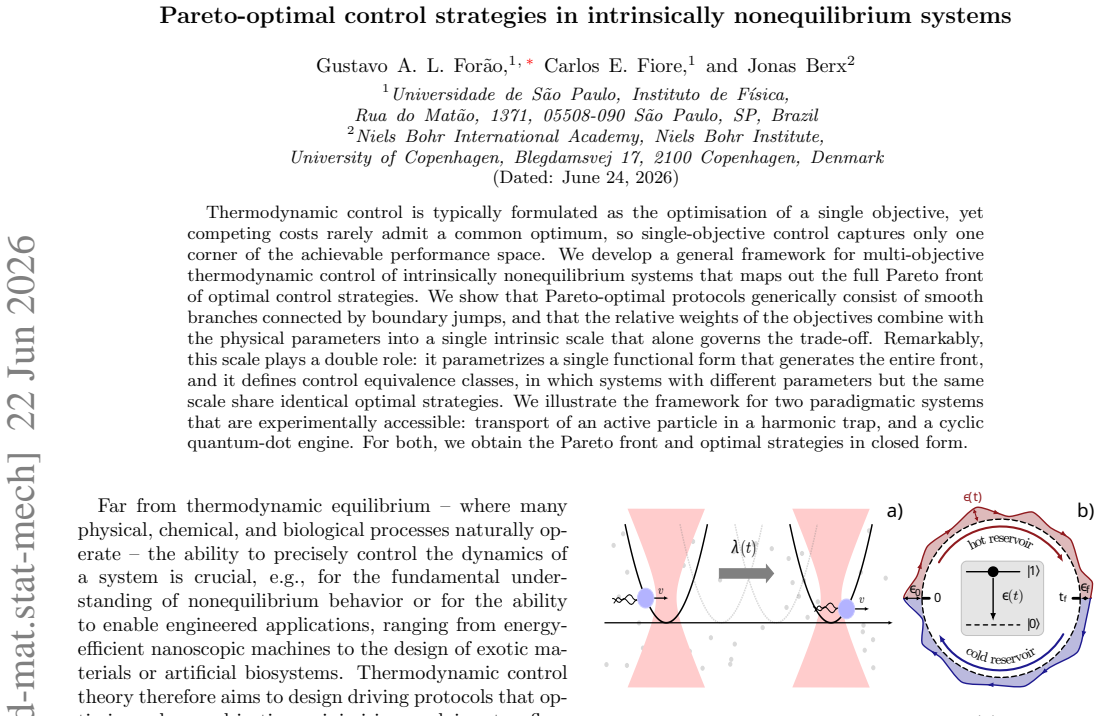
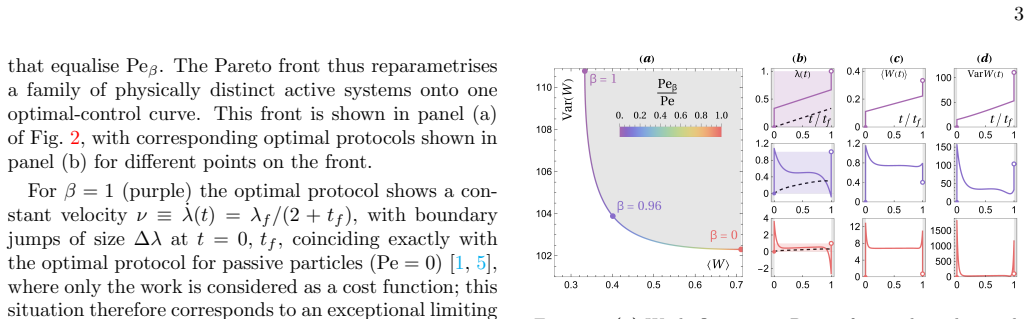
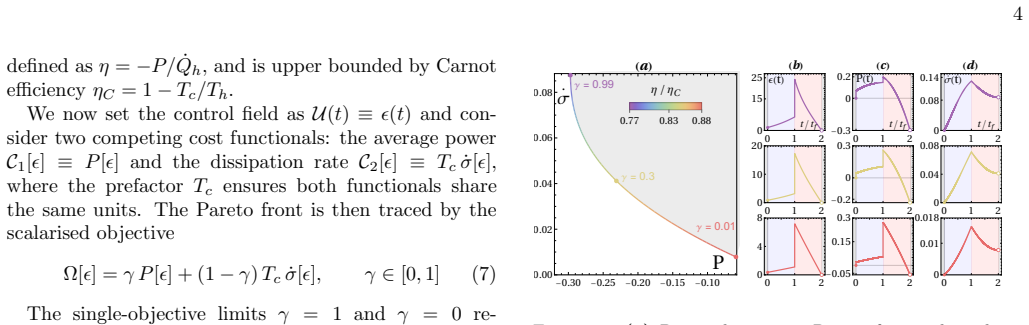
We develop a general framework for multi-objective thermodynamic control of intrinsically nonequilibrium systems that maps out the full Pareto front of optimal control strategies. We show that Pareto-optimal protocols generically consist of smooth branches connected by boundary jumps, and that the relative weights of the objectives combine with the physical parameters into a single intrinsic scale that alone governs the trade-off. This scale parametrizes a single functional form that generates the entire front, and it defines control equivalence classes, in which systems with different parameters but the same scale share identical optimal strategies. We illustrate the framework for two parad
What carries the argument
The single intrinsic scale obtained by combining objective weights with physical parameters, which both parametrizes the entire Pareto front via one functional form and partitions systems into control equivalence classes.
If this is right
- Pareto-optimal protocols are always assembled from smooth segments separated by boundary jumps.
- Systems with different parameters but identical intrinsic scale share exactly the same optimal strategies.
- The full Pareto front is generated by varying one parameter in a single functional form.
- Closed-form solutions exist for both the active-particle transport problem and the quantum-dot engine.
- Control design reduces to matching the intrinsic scale rather than tuning separate weights.
Where Pith is reading between the lines
- Matching the scale across different physical realizations could let experimenters transfer protocols from one device to another without re-optimizing.
- The same reduction might apply to systems with more than two objectives if their weights can still be absorbed into a single effective parameter.
- Testing whether real-time feedback control in the cited experiments exhibits the predicted jumps would directly check the framework.
- The equivalence classes suggest that control performance depends only on the scale, not on the separate values of weights or parameters.
Load-bearing premise
The competing objectives and system parameters can always be collapsed into one effective scale without extra hidden constraints that would split the equivalence classes.
What would settle it
Finding, in the active-particle or quantum-dot experiments, optimal protocols whose shape cannot be reproduced by any single value of the claimed scale or that require additional independent parameters to fit the observed jumps.
Figures
read the original abstract
Thermodynamic control is typically formulated as the optimisation of a single objective, yet competing costs rarely admit a common optimum, so single-objective control captures only one corner of the achievable performance space. We develop a general framework for multi-objective thermodynamic control of intrinsically nonequilibrium systems that maps out the full Pareto front of optimal control strategies. We show that Pareto-optimal protocols generically consist of smooth branches connected by boundary jumps, and that the relative weights of the objectives combine with the physical parameters into a single intrinsic scale that alone governs the trade-off. Remarkably, this scale plays a double role: it parametrizes a single functional form that generates the entire front, and it defines control equivalence classes, in which systems with different parameters but the same scale share identical optimal strategies. We illustrate the framework for two paradigmatic systems that are experimentally accessible: transport of an active particle in a harmonic trap, and a cyclic quantum-dot engine. For both, we obtain the Pareto front and optimal strategies in closed form.
Editorial analysis
A structured set of objections, weighed in public.
Referee Report
Summary. The manuscript develops a general framework for multi-objective thermodynamic control of intrinsically nonequilibrium systems. It maps the full Pareto front and shows that Pareto-optimal protocols generically consist of smooth branches connected by boundary jumps. The relative weights of the objectives combine with physical parameters into a single intrinsic scale that parametrizes the entire front via a single functional form and defines control equivalence classes in which systems with different parameters but the same scale share identical optimal strategies. Closed-form results are obtained for two experimentally accessible systems: transport of an active particle in a harmonic trap and a cyclic quantum-dot engine.
Significance. If the reduction to a single intrinsic scale is rigorously established without hidden parameters, the framework would provide a substantial conceptual advance in nonequilibrium thermodynamics by unifying trade-offs across objectives and enabling equivalence classes for control design. The closed-form expressions and experimental accessibility of the examples strengthen the potential impact.
major comments (1)
- [Abstract and main derivations for active particle and quantum-dot engine] The central claim that a single intrinsic scale fully captures the trade-off and defines equivalence classes (reader's weakest assumption) must be verified against the explicit derivations for the two example systems; without seeing the mapping from multi-objective weights to this scale, it is unclear whether system-specific constraints remain.
Simulated Author's Rebuttal
We thank the referee for their careful reading and for identifying the need to explicitly connect the central claim to the derivations in the example systems. We address the major comment below.
read point-by-point responses
-
Referee: [Abstract and main derivations for active particle and quantum-dot engine] The central claim that a single intrinsic scale fully captures the trade-off and defines equivalence classes (reader's weakest assumption) must be verified against the explicit derivations for the two example systems; without seeing the mapping from multi-objective weights to this scale, it is unclear whether system-specific constraints remain.
Authors: We thank the referee for this observation. Sections 3 and 4 of the manuscript contain the explicit derivations requested. For the active particle (Sec. 3), the multi-objective weights enter the variational problem only through the single combination λ = w_{1}/w_{2} imes (D/v_{0}), where D and v_{0} are the physical parameters; the resulting optimal protocol (velocity or force schedule) is a closed-form function of λ alone, with all system-specific constraints absorbed into λ. The same reduction occurs for the cyclic quantum-dot engine (Sec. 4), where the weights and engine parameters combine into an identical λ that parametrizes both the power-efficiency front and the optimal cycle times. Because the functional form depends only on λ, systems with different parameters but equal λ share identical optimal strategies, confirming the equivalence classes with no residual hidden constraints. These closed-form mappings are already present in the derivations and directly verify the claim. revision: no
Circularity Check
No significant circularity; derivation is self-contained
full rationale
The paper presents a general framework that maps multi-objective thermodynamic control to a Pareto front parametrized by a single intrinsic scale, with the claimed structure of smooth branches and jumps, plus equivalence classes, following directly from the optimization setup and illustrated via closed-form solutions for two specific systems. No load-bearing steps reduce by construction to fitted inputs, self-citations, or ansatzes imported from prior work; the results are derived from the stated multi-objective problem without redefining outputs in terms of the same quantities. The experimental accessibility of the examples provides independent verification paths outside any internal fitting.
Axiom & Free-Parameter Ledger
Reference graph
Works this paper leans on
-
[1]
Schmiedl and U
T. Schmiedl and U. Seifert, Optimal finite-time pro- cesses in stochastic thermodynamics, Phys. Rev. Lett. 98, 108301 (2007)
2007
-
[2]
Gomez-Marin, T
A. Gomez-Marin, T. Schmiedl, and U. Seifert, Optimal protocols for minimal work processes in underdamped stochastic thermodynamics, The Journal of Chemical Physics129, 024114 (2008)
2008
-
[3]
A. P. Solon and J. M. Horowitz, Phase transition in pro- tocols minimizing work fluctuations, Phys. Rev. Lett. 120, 180605 (2018)
2018
-
[4]
K. S. Olsen, R. Goerlich, Y. Roichman, and H. L¨ owen, Harnessing non-equilibrium forces to optimize work ex- traction, Nature Communications16, 11031 (2025)
2025
-
[5]
Sch¨ uttler, R
J. Sch¨ uttler, R. Garcia-Millan, M. E. Cates, and S. A. M. Loos, Active particles in moving traps: Minimum work protocols and information efficiency of work extraction, Phys. Rev. E112, 024119 (2025)
2025
-
[6]
Garcia-Millan, J
R. Garcia-Millan, J. Sch¨ uttler, M. E. Cates, and S. A. M. Loos, Optimal closed-loop control of active particles and a minimal information engine, Phys. Rev. Lett.135, 088301 (2025)
2025
-
[7]
A. C. Barato and U. Seifert, Thermodynamic uncertainty relation for biomolecular processes, Phys. Rev. Lett.114, 158101 (2015)
2015
-
[8]
Di Terlizzi and M
I. Di Terlizzi and M. Baiesi, Kinetic uncertainty relation, Journal of Physics A: Mathematical and Theoretical52, 02LT03 (2018)
2018
-
[9]
V. T. Vo, T. Van Vu, and Y. Hasegawa, Unified thermo- dynamic–kinetic uncertainty relation, Journal of Physics A: Mathematical and Theoretical55, 405004 (2022)
2022
-
[10]
Proesmans, Precision-dissipation trade-off for driven stochastic systems, Communications Physics6, 226 (2023)
K. Proesmans, Precision-dissipation trade-off for driven stochastic systems, Communications Physics6, 226 (2023)
2023
-
[11]
Berx and K
J. Berx and K. Proesmans, Trade-offs and thermodynam- ics of energy-relay proofreading, Journal of The Royal Society Interface21, 20240232 (2024)
2024
-
[12]
S. Put, J. Berx, and C. Vanderzande, Non-gaussian anomalous dynamics in systems of interacting run-and- tumble particles, Journal of Statistical Mechanics: The- ory and Experiment2019, 123205 (2019)
2019
-
[13]
Kamp and K
D. Kamp and K. Proesmans, Thermodynamic control of nonequilibrium systems, Phys. Rev. E113, 014140 (2026)
2026
-
[14]
Benamou and Y
J.-D. Benamou and Y. Brenier, A computational fluid mechanics solution to the monge–kantorovich mass trans- fer problem, Numerische Mathematik84, 375 (2000)
2000
-
[15]
Zhong and M
A. Zhong and M. R. DeWeese, Beyond linear response: Equivalence between thermodynamic geometry and op- timal transport, Phys. Rev. Lett.133, 057102 (2024)
2024
-
[16]
Josefsson, A
M. Josefsson, A. Svilans, A. M. Burke, E. A. Hoffmann, S. Fahlvik, C. Thelander, M. Leijnse, and H. Linke, A quantum-dot heat engine operating close to the ther- modynamic efficiency limits, Nature Nanotechnology13, 920 (2018)
2018
-
[17]
Esposito, R
M. Esposito, R. Kawai, K. Lindenberg, and C. Van den Broeck, Finite-time thermodynamics for a single-level quantum dot, Europhysics Letters89, 20003 (2010)
2010
-
[18]
Van Vu and K
T. Van Vu and K. Saito, Thermodynamic unification of optimal transport: Thermodynamic uncertainty relation, minimum dissipation, and thermodynamic speed limits, 6 Phys. Rev. X13, 011013 (2023)
2023
-
[19]
Blaber and D
S. Blaber and D. A. Sivak, Optimal control in stochastic thermodynamics, Journal of Physics Communications7, 033001 (2023)
2023
-
[20]
Buttinoni, L
I. Buttinoni, L. Caprini, L. Alvarez, F. J. Schwarzen- dahl, and H. L¨ owen, Active colloids in harmonic optical potentials(a), Europhysics Letters140, 27001 (2022)
2022
-
[21]
Goerlich, L
R. Goerlich, L. Hoek, O. Chor, S. Rahav, and Y. Roich- man, Experimental realizations of information engines: Beyond proof of concept, Europhysics Letters149, 61001 (2025). Supplemental Material for: Pareto-optimal control strategies in intrinsically nonequilibrium systems Gustavo A. L. For˜ ao,1,∗ Carlos E. Fiore, 1 and Jonas Berx 2 1Universidade de S˜ a...
2025
-
[22]
1−2pp ω2 ν + 4p(1−p) # ± 1 2 arctanh
precisely when one coefficient is negative. The active particle realises this second case (see Sec. II): thereα 2 =ω 2 grows fromτ −2 up to (1 + Pe)τ −2 along the front, and the boundary layers of widthα −1 sharpen accordingly, approaching the singular structure of underdamped optimal control. Whenc 2 →0 the root collides with the poleγ 2 2, the correspon...
-
[23]
Schmiedl and U
T. Schmiedl and U. Seifert, Optimal finite-time processes in stochastic thermodynamics, Phys. Rev. Lett.98, 108301 (2007)
2007
-
[24]
A. P. Solon and J. M. Horowitz, Phase transition in protocols minimizing work fluctuations, Phys. Rev. Lett.120, 180605 (2018)
2018
-
[25]
S. A. M. Loos, S. Monter, F. Ginot, and C. Bechinger, Universal symmetry of optimal control at the microscale, Phys. Rev. X14, 021032 (2024)
2024
-
[26]
Esposito, R
M. Esposito, R. Kawai, K. Lindenberg, and C. Van den Broeck, Quantum-dot carnot engine at maximum power, Phys. Rev. E81, 041106 (2010). 14
2010
discussion (0)
Sign in with ORCID, Apple, or X to comment. Anyone can read and Pith papers without signing in.