Prediction of Viscoelastic Droplet Impact Dynamics Using a Vision Transformer-Based Approach
Pith reviewed 2026-06-26 06:33 UTC · model grok-4.3
The pith
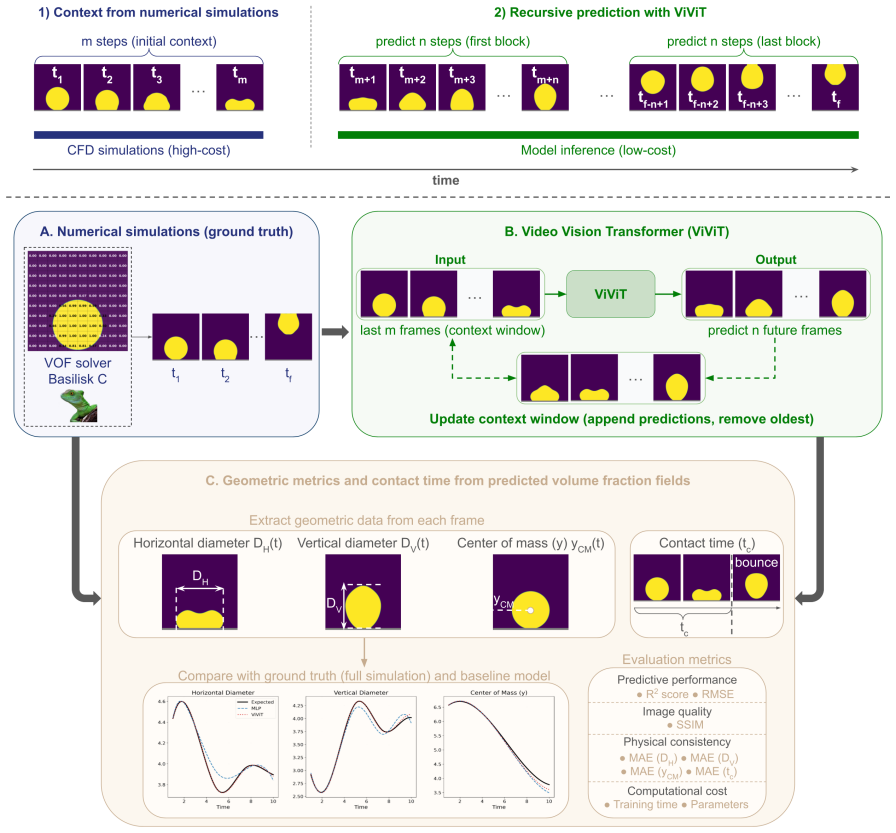
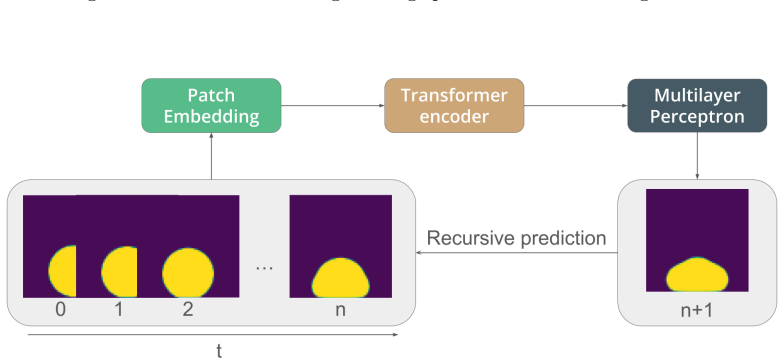
A Video Vision Transformer predicts the full impact evolution of viscoelastic droplets from only the first 10-20% of a volume-of-fluid simulation.
A machine-rendered reading of the paper's core claim, the machinery that carries it, and where it could break.
Core claim
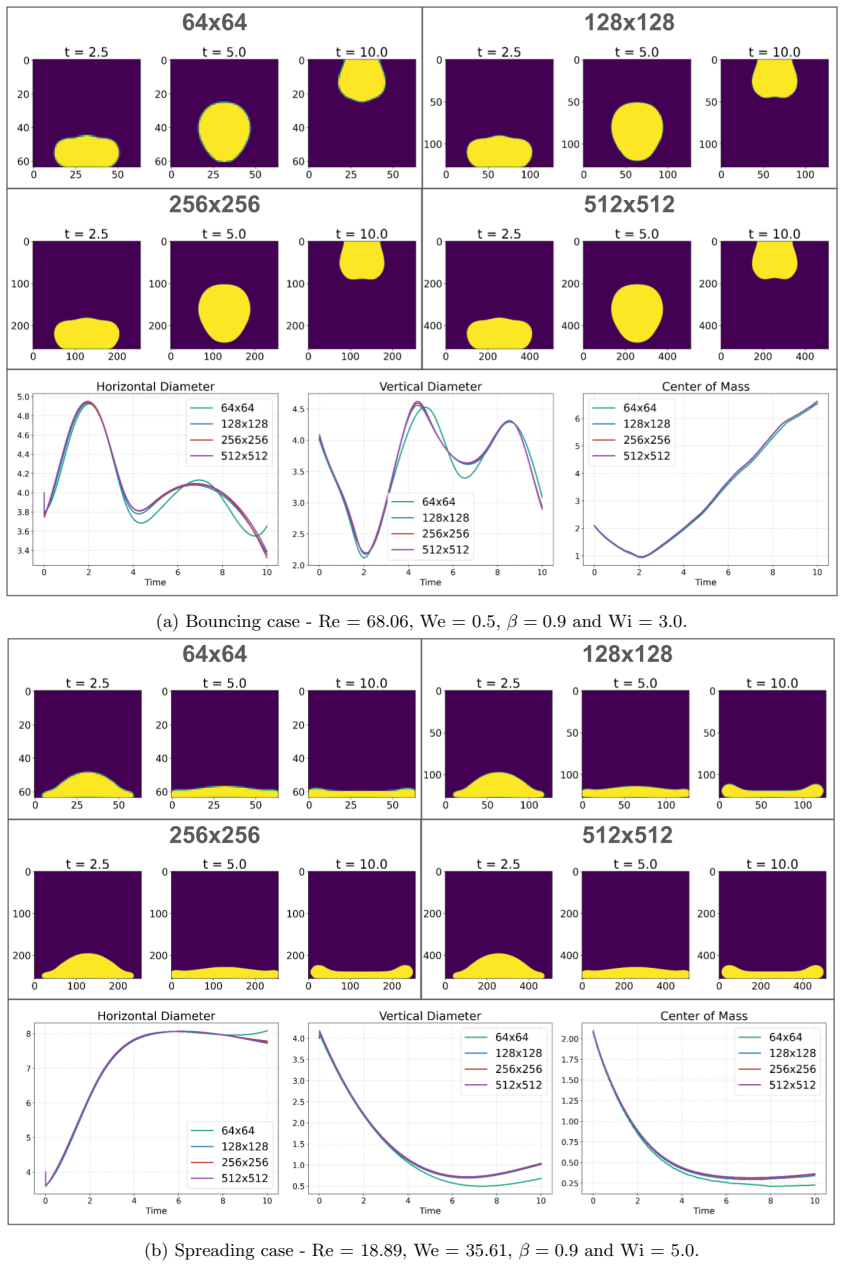
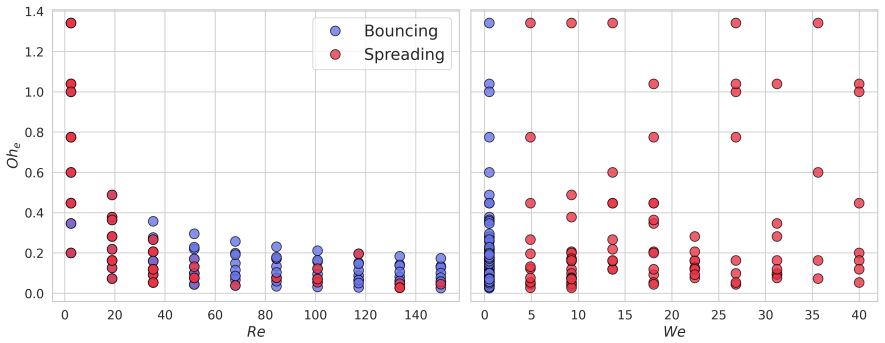
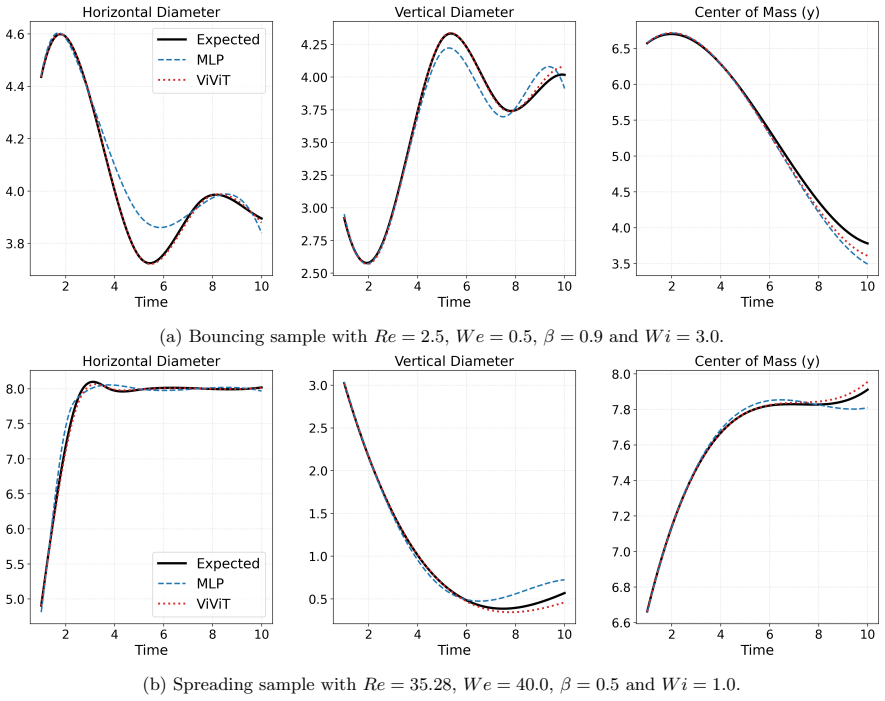
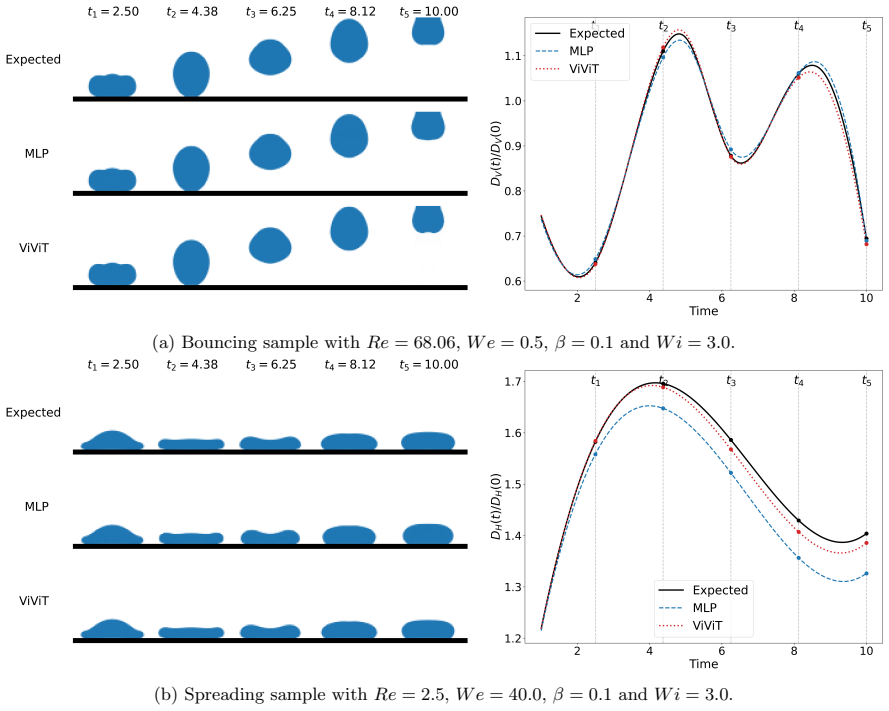
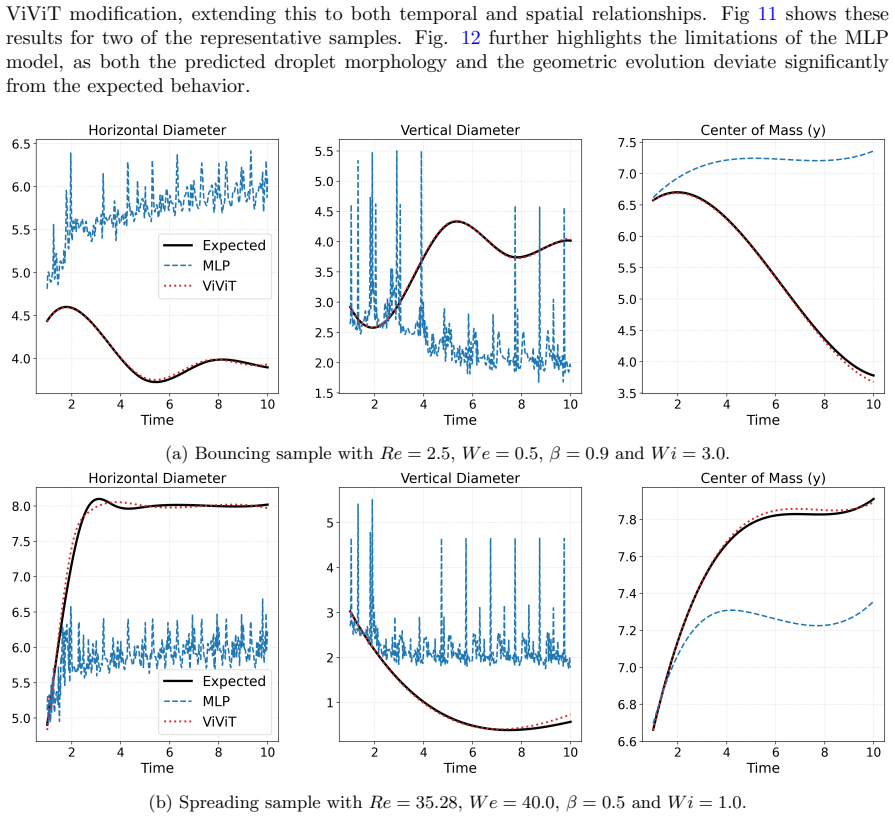
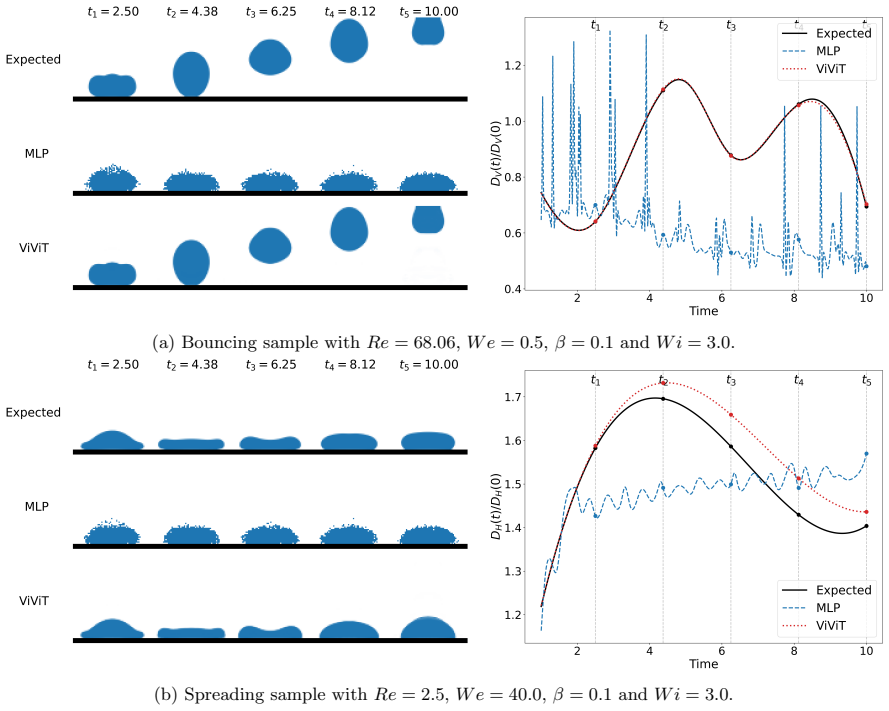
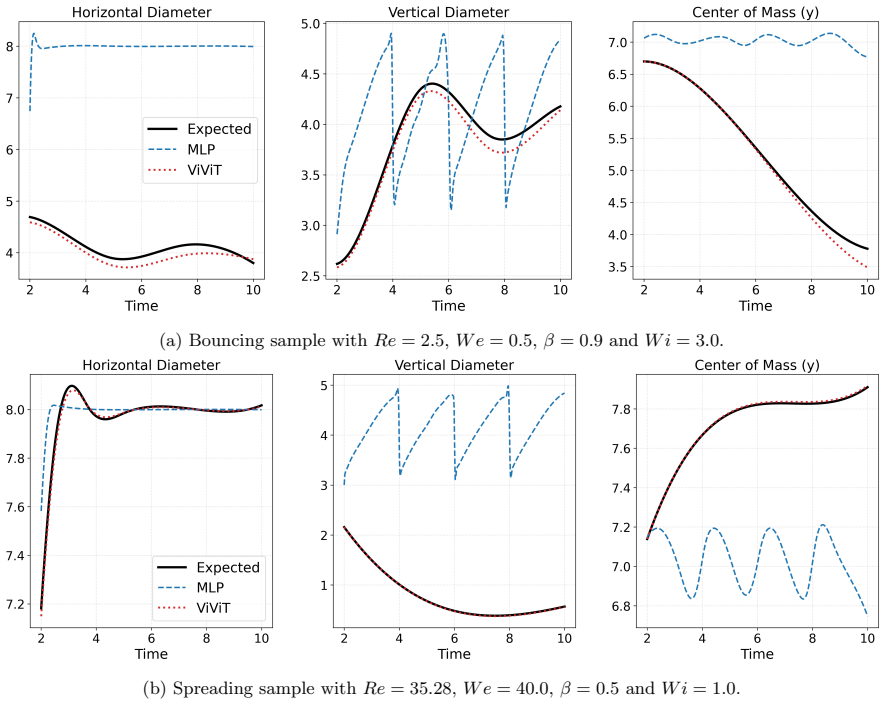
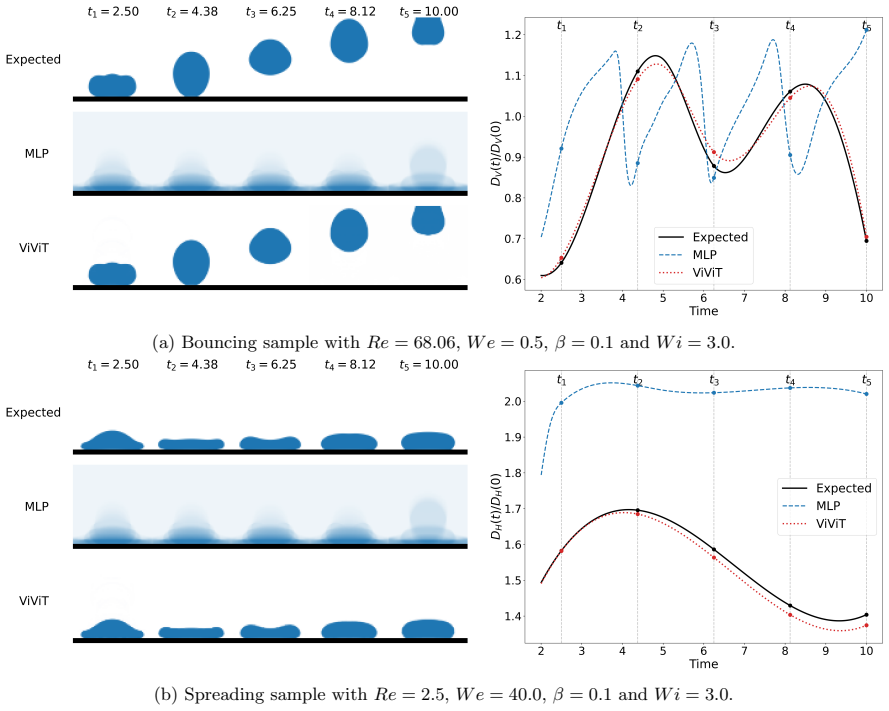
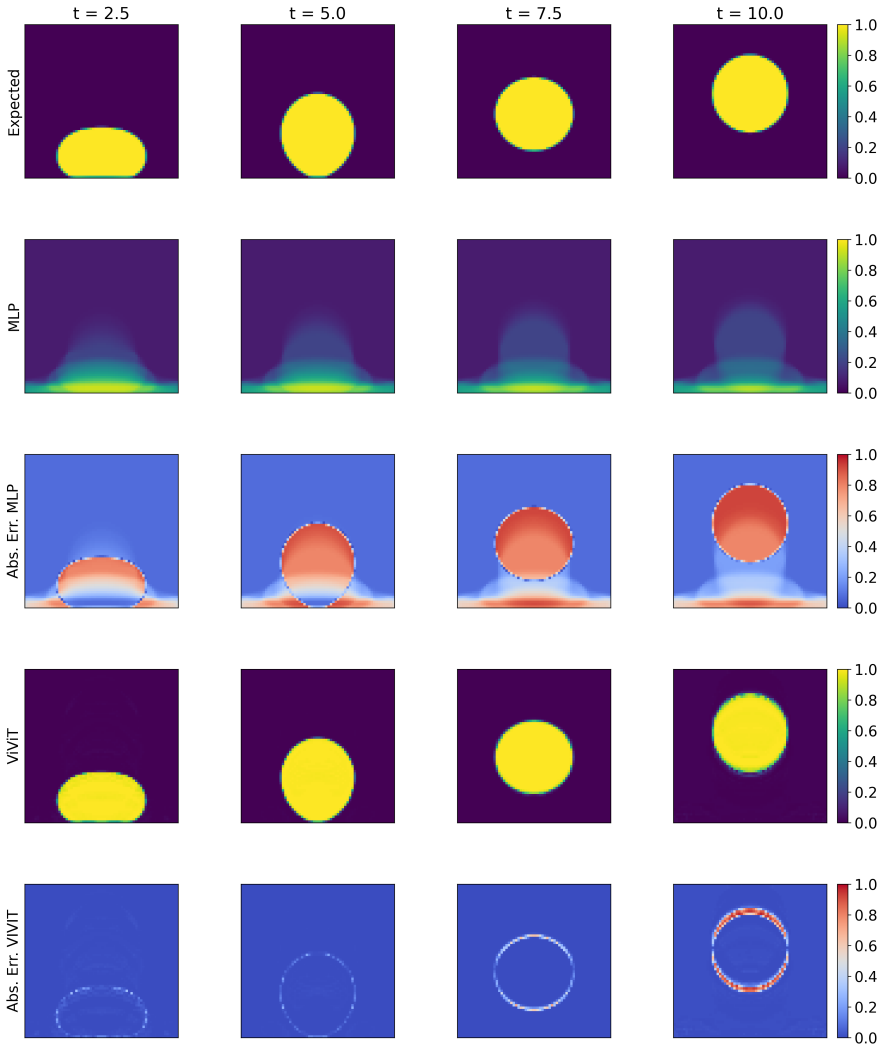
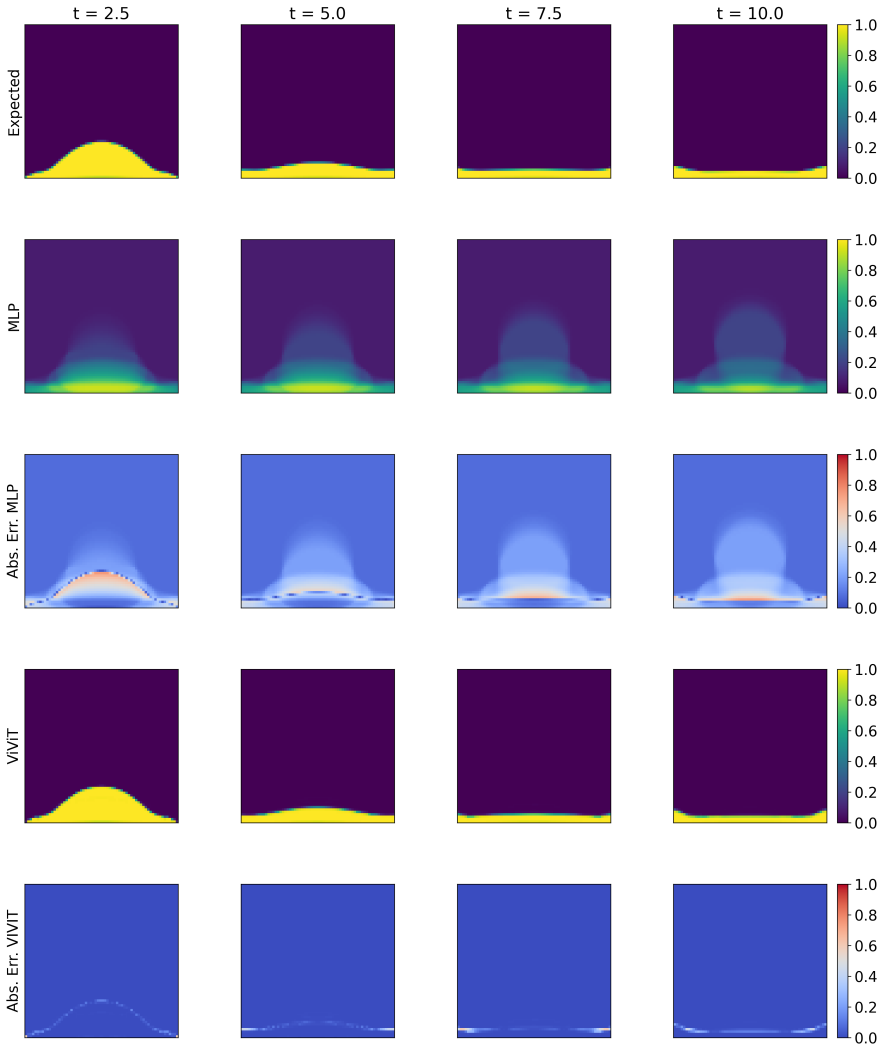
The ViViT architecture takes initial volume fraction fields from VOF simulations of viscoelastic droplet impacts and outputs the subsequent time evolution. It produces predictions that remain consistent with the governing physics for different values of Re, We, beta, and Wi, correctly distinguishing spreading from bouncing regimes and maintaining structural similarity to full simulations.
What carries the argument
Video Vision Transformer (ViViT) that ingests sequences of early volume fraction fields and autoregressively predicts later fields of the droplet-surface interaction.
If this is right
- The method reduces total computational cost by 80-90% while still capturing both spreading and bouncing regimes.
- Geometric features such as droplet shape and contact area remain structurally similar to full simulations.
- Predictions stay physically consistent when parameters change within the training distribution.
- Volume fraction fields from experiments could be substituted for simulation data during training.
- The same early-to-late mapping applies across different prediction horizons.
Where Pith is reading between the lines
- The same early-trajectory shortcut might apply to other free-surface flows where inertia and elasticity set the long-term outcome after a short initial transient.
- Training on mixed simulation and experimental video data could reduce reliance on any single modeling assumption about the fluid rheology.
- Extending the horizon further could test whether the transformer learns an implicit constitutive relation rather than simple pattern continuation.
Load-bearing premise
The initial 10-20% of a VOF simulation trajectory contains sufficient information to determine the full subsequent dynamics for unseen parameter combinations without loss of physical fidelity.
What would settle it
Full VOF simulations run to completion for a held-out combination of Re, We, beta, and Wi; direct pixel-wise or shape comparison of the ViViT-generated volume fraction fields at late times against the ground-truth fields reveals whether regime, contact line position, or droplet height deviate systematically.
Figures
read the original abstract
Droplet impact on solid surfaces is a complex fluid dynamics problem with applications in spray cooling, inkjet printing, and pharmaceutical processing. Although numerical simulations are widely used to investigate these dynamics, their computational cost becomes significant when multiple parametric variations are considered. In this work, we investigate the use of a Video Vision Transformer (ViViT) architecture to predict the temporal evolution of viscoelastic droplets impacting solid surfaces using volume fraction fields obtained from the Volume of Fluid (VOF) method. In Newtonian fluids, impact dynamics are mainly characterized by the Reynolds number $Re$, representing the ratio of inertial to viscous forces, and the Weber number $We$, representing the ratio of inertial to surface tension forces. For viscoelastic fluids, additional parameters are required to account for elastic effects, namely the solvent viscosity ratio $\beta$ and the Weissenberg number $Wi$, increasing simulation complexity and cost. Instead of simulating the entire droplet dynamics, the proposed approach uses only the initial 10% to 20% of the simulation to predict the remaining evolution. Depending on the prediction configuration, this strategy reduces computational cost by approximately 80% to 90% compared to full numerical simulations. The ViViT produces physically consistent predictions across different parameters and prediction horizons, successfully capturing both spreading and bouncing regimes while preserving geometric features and structural similarity. Since volume fraction fields can also be extracted from experimental videos, the proposed framework could be extended to incorporate experimental data during training, potentially improving the physical fidelity of the predicted dynamics.
Editorial analysis
A structured set of objections, weighed in public.
Referee Report
Summary. The paper proposes a Video Vision Transformer (ViViT) surrogate model that takes the initial 10-20% of a VOF simulation trajectory for viscoelastic droplet impact (parameterized by Re, We, β, Wi) and predicts the remaining temporal evolution of the volume-fraction field, claiming 80-90% computational savings while producing physically consistent results that capture both spreading and bouncing regimes for unseen parameter combinations.
Significance. If the quantitative accuracy and extrapolation fidelity hold, the method would enable substantially faster parametric sweeps in viscoelastic droplet dynamics relevant to spray cooling and inkjet applications; the potential to incorporate experimental video data is a further strength.
major comments (3)
- [Abstract, Results] Abstract and Results section: the central claim that the ViViT produces 'physically consistent predictions' and 'preserves geometric features' for unseen (β, Wi) rests on qualitative visual inspection and structural similarity only; no L2 norms, interface error metrics, or quantitative comparison against held-out full VOF trajectories are reported, leaving the extrapolation error for delayed elastic recoil unquantified.
- [Methods, Results] Methods and Results: the assumption that the first 10-20% of the trajectory encodes the full viscoelastic memory (via Wi) is load-bearing for the cost-saving claim, yet no ablation on prediction horizon length versus parameter distance from the training distribution is presented; viscoelastic stress history can produce recoil whose onset lies outside the supplied window.
- [Results] Results: the reported 'across different parameters and prediction horizons' performance lacks any table or figure quantifying error growth with increasing Wi or decreasing β, which directly tests whether the initial-window sufficiency holds for the viscoelastic regime.
minor comments (2)
- [Introduction] Notation for the solvent viscosity ratio β and Weissenberg number Wi should be introduced with explicit definitions in the Introduction rather than assumed from the Newtonian case.
- [Methods] The manuscript should state the precise training/test split ratios and whether any parameter combinations in the test set lie outside the convex hull of the training set.
Simulated Author's Rebuttal
We thank the referee for their insightful comments, which have helped us identify areas where the manuscript can be strengthened with additional quantitative validation. We address each major comment below.
read point-by-point responses
-
Referee: [Abstract, Results] Abstract and Results section: the central claim that the ViViT produces 'physically consistent predictions' and 'preserves geometric features' for unseen (β, Wi) rests on qualitative visual inspection and structural similarity only; no L2 norms, interface error metrics, or quantitative comparison against held-out full VOF trajectories are reported, leaving the extrapolation error for delayed elastic recoil unquantified.
Authors: We agree that the current presentation relies on qualitative assessments and the structural similarity index. In the revised manuscript, we will include quantitative error metrics, specifically L2 norms between predicted and ground-truth volume fraction fields, as well as interface-specific errors such as the average distance between predicted and actual interfaces. These will be computed for held-out trajectories, including cases with delayed elastic recoil, and presented in the Results section to better quantify the extrapolation performance. revision: yes
-
Referee: [Methods, Results] Methods and Results: the assumption that the first 10-20% of the trajectory encodes the full viscoelastic memory (via Wi) is load-bearing for the cost-saving claim, yet no ablation on prediction horizon length versus parameter distance from the training distribution is presented; viscoelastic stress history can produce recoil whose onset lies outside the supplied window.
Authors: This is a valid point regarding the robustness of the input window choice. Although our model was trained with varying input lengths in the 10-20% range, a dedicated ablation study correlating input horizon with parameter deviation (e.g., distance in Wi-β space) was not included. We will add such an analysis in the revised Methods and Results sections, showing how prediction accuracy degrades with shorter input windows or larger parameter distances, to substantiate the sufficiency of the initial trajectory segment for capturing viscoelastic memory effects. revision: yes
-
Referee: [Results] Results: the reported 'across different parameters and prediction horizons' performance lacks any table or figure quantifying error growth with increasing Wi or decreasing β, which directly tests whether the initial-window sufficiency holds for the viscoelastic regime.
Authors: We acknowledge the absence of explicit error quantification with respect to the viscoelastic parameters. The revised manuscript will feature a new figure and accompanying table that report the error metrics as functions of Wi and β across different prediction horizons. This will directly address whether the initial 10-20% window remains adequate as elastic effects (higher Wi, lower β) become more pronounced. revision: yes
Circularity Check
No circularity: data-driven surrogate model with no self-referential derivations
full rationale
The paper trains a ViViT model on VOF volume-fraction fields to map initial 10-20% trajectories to later frames for viscoelastic droplet impact. No analytic derivation chain exists; the central claim is an empirical performance statement about learned predictions on held-out parameter combinations (β, Wi). No equations reduce a claimed result to a fitted parameter or self-defined quantity by construction. No self-citation load-bearing steps, uniqueness theorems, or ansatzes appear in the provided text. The information-sufficiency assumption is tested via model outputs rather than presupposed by definition. This is a standard supervised learning surrogate and remains self-contained against external benchmarks.
Axiom & Free-Parameter Ledger
free parameters (1)
- ViViT model weights and hyperparameters
axioms (1)
- domain assumption Initial 10-20% of VOF trajectory determines full dynamics
Reference graph
Works this paper leans on
-
[1]
Jingzu Yee and Daichi Igarashi and Shun Miyatake and Yoshiyuki Tagawa , title =. 2023 , publisher =. doi:10.1088/2632-2153/acc727 , url =
-
[2]
Hossein Hassanzadeh and Saptarshi Joshi and Seyed Mohammad Taghavi , title =. 2023 , publisher =. doi:doi:10.1515/cppm-2023-0026 , url =
-
[3]
Demo, Nicola and Tezzele, Marco and Rozza, Gianluigi , title =. 2023 , publisher =. doi:10.1186/s40323-023-00249-9 , url =
-
[4]
Csala, Hunor and Dawson, Scott and Arzani, Amirhossein , title =. 2022 , publisher =. doi:10.1063/5.0127284 , url =
-
[5]
Xiao, Qianhao and Zeng, Dongping and Yu, Zheqin and Zou, Shuyun and Liu, Zhong , title =. 2024 , publisher =. doi:10.1016/j.ijhydene.2024.08.465 , url =
-
[6]
2024 , eprint=
Sanderse, Benjamin and Stinis, Panos and Maulik, Romit and Ahmed, Shady E , title =. 2024 , eprint=
2024
-
[7]
, volume=
, author=. , volume=. , publisher=
-
[8]
Zhou, Hao and Cheng, Sibo and Arcucci, Rossella , title =. 2024 , publisher =. doi:10.1016/j.cma.2024.116758 , url =
-
[9]
ModelFLOWs-app: data-driven post-processing and reduced order modelling tools , journal =
Hetherington, Ashton and Corrochano, Adri. ModelFLOWs-app: data-driven post-processing and reduced order modelling tools , journal =. 2024 , publisher =. doi:10.1016/j.cpc.2024.109217 , url =
-
[10]
Oishi, Cassio M and Kaptanoglu, Alan A and Kutz, J Nathan and Brunton, Steven L , title =. 2024 , publisher =. doi:10.1098/rsos.240995 , url =
-
[11]
Wang, Zihao and Zhang, Guiyong and Xing, Xiuqing and Xu, Xiangguo and Sun, Tiezhi , title =. 2024 , publisher =. doi:10.1016/j.oceaneng.2023.116421 , url =
-
[12]
Chen, Wenqian and Stinis, Panos , title =. 2024 , publisher =. doi:10.1016/j.jcp.2023.112683 , url =
-
[13]
Omata, Noriyasu and Shirayama, Susumu , title =. 2019 , publisher =. doi:10.1063/1.5067313 , url =
-
[14]
Daniel Lörstad and Marianne Francois and Wei Shyy and Laszlo Fuchs , title =. 2004 , publisher =. doi:https://doi.org/10.1002/fld.746 , url =
-
[15]
Hai-Zhuan Yuan and Qing Liu and Gang Zeng , title =. 2022 , publisher =. doi:https://doi.org/10.1002/fld.5061 , url =
-
[16]
Markel and Robert N K Browning , title =
Hua Tan and Erik Torniainen and David P. Markel and Robert N K Browning , title =. 2015 , publisher =. doi:https://doi.org/10.1002/fld.3997 , url =
-
[17]
Karrar H. Al-Dirawi and Andrew E. Bayly , title =. 2019 , publisher =. doi:10.1063/1.5085762 , url =
-
[18]
Proceedings of the Royal Society A , volume=
Multi-fidelity reduced-order surrogate modelling , author=. Proceedings of the Royal Society A , volume=. 2024 , publisher=
2024
-
[19]
Proceedings of the IEEE conference on computer vision and pattern recognition , pages=
Multi-task learning using uncertainty to weigh losses for scene geometry and semantics , author=. Proceedings of the IEEE conference on computer vision and pattern recognition , pages=
-
[20]
Long short-term memory.Neural Comput., 9(8): 1735–1780, November 1997
Sepp Hochreiter and Jürgen Schmidhuber , title =. 1997 , publisher =. doi:10.1162/neco.1997.9.8.1735 , url =
-
[21]
Seol-Hyun Noh , title =. 2021 , publisher =. doi:10.3390/info12110442 , url =
-
[22]
University of Toronto Computer Science , year =
Grosse, Roger , title =. University of Toronto Computer Science , year =
-
[23]
1988 , publisher=
Spectral Methods inFfluid Dynamics , author=. 1988 , publisher=
1988
-
[24]
Kelshaw, Daniel and Lestang, Thibault and Elise , title =
-
[25]
2021 , author =
An Image is Worth 16x16 Words: Transformers for Image Recognition at Scale , eprint=. 2021 , author =
2021
-
[26]
Proceedings of the IEEE/CVF international conference on computer vision , pages=
Vivit: A video vision transformer , author=. Proceedings of the IEEE/CVF international conference on computer vision , pages=
-
[27]
2017 , publisher =
Vaswani, Ashish and Shazeer, Noam and Parmar, Niki and Uszkoreit, Jakob and Jones, Llion and Gomez, Aidan N and Kaiser, Lukasz and Polosukhin, Illia , booktitle =. 2017 , publisher =
2017
-
[28]
Journal of computational physics , volume=
A continuum method for modeling surface tension , author=. Journal of computational physics , volume=. 1992 , publisher=
1992
-
[29]
2013--2025 , howpublished =
Stéphane Popinet and collaborators , title =. 2013--2025 , howpublished =
2013
-
[30]
Journal of Non-Newtonian Fluid Mechanics , volume=
Time-dependent simulation of viscoelastic flows at high Weissenberg number using the log-conformation representation , author=. Journal of Non-Newtonian Fluid Mechanics , volume=. 2005 , publisher=
2005
-
[31]
Proceedings of the 25th ACM SIGKDD international conference on knowledge discovery & data mining , pages=
Optuna: A next-generation hyperparameter optimization framework , author=. Proceedings of the 25th ACM SIGKDD international conference on knowledge discovery & data mining , pages=
-
[32]
Detlef Lohse , title =. 2022 , publisher =. doi:10.1146/annurev-fluid-022321-114001 , url =
-
[33]
Advanced drug delivery reviews , volume=
3D bioprinting of tissues and organs for regenerative medicine , author=. Advanced drug delivery reviews , volume=. 2018 , publisher=
2018
-
[34]
Physical Review Fluids , volume=
Influence of the impact energy on the pattern of blood drip stains , author=. Physical Review Fluids , volume=. 2018 , publisher=
2018
-
[35]
Advances in colloid and interface science , volume=
Impact of a heterogeneous liquid droplet on a dry surface: Application to the pharmaceutical industry , author=. Advances in colloid and interface science , volume=. 2010 , publisher=
2010
-
[36]
Heat Transfer Research , volume=
A review on thermo-fluidic study of droplet impact in spray cooling , author=. Heat Transfer Research , volume=. 2025 , publisher=
2025
-
[37]
Food research international , volume=
Drop impact behavior on food using spray coating: Fundamentals and applications , author=. Food research international , volume=. 2013 , publisher=
2013
-
[38]
Fluid dynamics research , volume=
Phenomena of liquid drop impact on solid and liquid surfaces , author=. Fluid dynamics research , volume=. 1993 , publisher=
1993
-
[39]
Journal of Fluid Mechanics , volume=
Maximal deformation of an impacting drop , author=. Journal of Fluid Mechanics , volume=. 2004 , publisher=
2004
-
[40]
Journal of Fluid Mechanics , volume=
Drop impact of yield-stress fluids , author=. Journal of Fluid Mechanics , volume=. 2009 , publisher=
2009
-
[41]
Journal of Fluid Mechanics , volume=
Normal and oblique drop impact of yield stress fluids with thixotropic effects , author=. Journal of Fluid Mechanics , volume=. 2019 , publisher=
2019
-
[42]
Journal of Fluid Mechanics , volume=
The role of viscoplastic drop shape in impact , author=. Journal of Fluid Mechanics , volume=. 2024 , publisher=
2024
-
[43]
Siddhartha F. Lunkad and Vivek V. Buwa and K.D.P. Nigam , title =. 2007 , publisher =. doi:https://doi.org/10.1016/j.ces.2007.07.036 , url =
-
[44]
Ilia V. Roisman , title =. 2009 , publisher =. doi:10.1063/1.3129283 , url =
-
[45]
de Bruin and Denis Bartolo and Christophe Josserand and Daniel Bonn , title =
Nick Laan and Karla G. de Bruin and Denis Bartolo and Christophe Josserand and Daniel Bonn , title =. 2014 , publisher =. doi:10.1103/PhysRevApplied.2.044018 , url =
-
[46]
Jae Bong Lee and Dominique Derome and Robert Guyer and Jan Carmeliet , title =. 2016 , publisher =. doi:10.1021/acs.langmuir.5b04557 , url =
-
[47]
Shiji Lin and Binyu Zhao and Song Zou and Jianwei Guo and Zheng Wei and Longquan Chen , title =. 2018 , publisher =. doi:https://doi.org/10.1016/j.jcis.2017.12.086 , url =
-
[48]
Jiguo Tang and Shengzhi Yu and Xiaofan Hou and Tianhui Wu and Hongtao Liu , title =. 2023 , publisher =. doi:10.1021/acs.iecr.3c01560 , url =
-
[49]
Chemical Engineering Science , volume=
A machine learning-based approach to predict the outcome of binary droplet collision , author=. Chemical Engineering Science , volume=. 2026 , publisher=
2026
-
[50]
IEEE Access , year=
Machine Learning-Based Classification of Suspension Droplet-Solid Wall Impacts for Control of Droplet Fragmentation , author=. IEEE Access , year=
-
[51]
IEEE Transactions on Instrumentation and Measurement , volume=
Robust fluid motion estimator based on attentional transformer , author=. IEEE Transactions on Instrumentation and Measurement , volume=. 2023 , publisher=
2023
-
[52]
Nature Communications , volume=
-variational autoencoders and transformers for reduced-order modelling of fluid flows , author=. Nature Communications , volume=. 2024 , publisher=
2024
-
[53]
Physics of Fluids , volume=
Self-supervised learning based on transformer for flow reconstruction and prediction , author=. Physics of Fluids , volume=. 2024 , publisher=
2024
-
[54]
Physics of Fluids , volume=
Transformer model learning driven analysis of Casson fluid flow influenced by Hall currents and Darcy--Forchheimer effects , author=. Physics of Fluids , volume=. 2025 , publisher=
2025
-
[55]
Physics of Fluids , volume=
Reconstruction of time-resolved three-dimensional flow fields based on a multi-domain fusion transformer , author=. Physics of Fluids , volume=. 2026 , publisher=
2026
-
[56]
Processes , volume=
Reservoir Surrogate Modeling Using U-Net with Vision Transformer and Time Embedding , author=. Processes , volume=. 2025 , publisher=
2025
-
[57]
Mathematical and Computational Applications , volume=
Permeability prediction using vision transformers , author=. Mathematical and Computational Applications , volume=. 2025 , publisher=
2025
-
[58]
AIP Advances , volume=
A new fluid flow approximation method using a vision transformer and a U-shaped convolutional neural network , author=. AIP Advances , volume=. 2023 , publisher=
2023
-
[59]
arXiv preprint arXiv:2604.02483 , year=
A Multimodal Vision Transformer-based Modeling Framework for Prediction of Fluid Flows in Energy Systems , author=. arXiv preprint arXiv:2604.02483 , year=
-
[60]
Proceedings of the European conference on computer vision (ECCV) , pages=
Folded recurrent neural networks for future video prediction , author=. Proceedings of the European conference on computer vision (ECCV) , pages=
-
[61]
Proceedings of the IEEE international conference on computer vision , pages=
Learning spatiotemporal features with 3d convolutional networks , author=. Proceedings of the IEEE international conference on computer vision , pages=
-
[62]
Advances in neural information processing systems , volume=
Convolutional LSTM network: A machine learning approach for precipitation nowcasting , author=. Advances in neural information processing systems , volume=
-
[63]
Physics of Fluids , volume=
Impact of capillary drops of complex fluids on a solid surface , author=. Physics of Fluids , volume=. 2019 , publisher=
2019
-
[64]
Journal of Non-Newtonian Fluid Mechanics , volume=
Numerical simulation of drop impact and jet buckling problems using the eXtended Pom--Pom model , author=. Journal of Non-Newtonian Fluid Mechanics , volume=. 2012 , publisher=
2012
-
[65]
arXiv preprint arXiv:2411.15949 , year=
PINNs4Drops: Video-conditioned physics-informed neural networks for two-phase flow reconstruction , author=. arXiv preprint arXiv:2411.15949 , year=
-
[66]
International journal of heat and mass transfer , volume=
An experimental study of bouncing Leidenfrost drops: comparison between Newtonian and viscoelastic liquids , author=. International journal of heat and mass transfer , volume=. 2009 , publisher=
2009
-
[67]
Journal of Non-Newtonian Fluid Mechanics , volume=
Impact of viscoelastic droplets , author=. Journal of Non-Newtonian Fluid Mechanics , volume=. 2017 , publisher=
2017
-
[68]
Physical Review Fluids , volume=
Effects of viscoelasticity on drop impact and spreading on a solid surface , author=. Physical Review Fluids , volume=. 2016 , publisher=
2016
-
[69]
Microfluidics and nanofluidics , volume=
The role of viscoelasticity in drop impact and spreading for inkjet printing of polymer solution on a wettable surface , author=. Microfluidics and nanofluidics , volume=. 2013 , publisher=
2013
-
[70]
Journal of Rheology , volume=
Influence of fluid elasticity on drops impacting on dry surfaces , author=. Journal of Rheology , volume=. 2000 , publisher=
2000
-
[71]
Journal of Fluid Mechanics , volume=
Spreading of a viscoelastic drop on a solid substrate , author=. Journal of Fluid Mechanics , volume=. 2024 , publisher=
2024
discussion (0)
Sign in with ORCID, Apple, or X to comment. Anyone can read and Pith papers without signing in.