REVIEW 3 minor 50 references
Probing the pairing symmetry of moir\'e graphene superconductors
T0 review · 0 major / 3 minor · reviewed 2026-06-26 · grok-4.3
Pith's one-line read Zeeman field orientation distinguishes singlet from triplet pairing in moiré graphene superconductors that emerge from the IKS normal state.
desk verdict The paper takes IKS normal state plus nodal SC as given, narrows to singlet or triplet, and proposes Zeeman-orientation tests in spectroscopy, thermodynamics, and Andreev states to distinguish them. read the letter →
The pith
A machine-rendered reading of the paper's core claim, the machinery that carries it, and where it could break.
The reading
What carries the argument
Orientation-dependent response of nodal excitations and topologically protected Andreev bound states to Zeeman field direction.
What would settle it
Observation that the low-energy density of states near the nodes or the Andreev bound state spectrum at boundaries shows no dependence on Zeeman field orientation would eliminate the proposed distinction between singlet and triplet pairing.
Extended reading notes
Core claim
Starting from the IKS normal state and imposing nodal superconductivity, the possible order parameters are reduced to a set whose singlet versus triplet character and d-vector direction can be determined by the orientation dependence of the superconducting state under Zeeman field in spectroscopic, thermodynamic, and phase-sensitive Andreev-bound-state measurements.
Load-bearing premise
The normal state on the hole-doped side of ν = −2 is the incommensurate Kekulé spiral and the superconductivity is nodal.
Editorial extensions
If this is right
- Spectroscopic and thermodynamic probes will exhibit different field-angle anisotropies for singlet pairing than for triplet pairing with a given d-vector.
- Andreev bound state spectroscopy at sample boundaries will display a zero-bias peak or its splitting pattern that serves as a direct identifier of the pairing symmetry.
- Phase-sensitive measurements will confirm whether the bound states are topologically protected in a manner tied to the d-vector orientation.
- The combination of bulk and boundary responses together will over-constrain the possible order parameters and rule out entire classes of pairing.
Reading between the lines
- If the Zeeman tests select triplet pairing, the same normal-state constraint could be applied to other dopings or twist angles where IKS order is suspected.
- The boundary Andreev-state signatures could be searched for in related moiré systems that share a similar normal state but different pairing candidates.
- A mismatch between the predicted and measured angle dependence would require revisiting either the IKS assignment or the nodal character of the gap.
Editorial analysis
A structured set of objections, weighed in public.
Referee Report
Summary. The paper combines prior experimental and theoretical constraints on the incommensurate Kekulé spiral (IKS) normal state at hole doping near ν = −2 with the observation of nodal superconductivity to restrict the allowed superconducting order parameters. This leaves the task of distinguishing singlet versus triplet pairing (and, for triplet, the d-vector orientation). The authors propose concrete diagnostics based on the response of low-energy excitations and topologically protected Andreev bound states to the orientation of an applied Zeeman field, with predictions for spectroscopic, thermodynamic, and phase-sensitive measurements.
Significance. If the mapping from IKS plus nodal constraint to the remaining candidate pairings is robust and the Zeeman-orientation signatures are observable, the work supplies a practical experimental route to settle the pairing symmetry in magic-angle graphene, a central open question. The explicit identification of smoking-gun Andreev-bound-state spectra is a concrete strength that can be tested with existing techniques.
minor comments (3)
- [§3] §3, paragraph following Eq. (7): the statement that the IKS state 'projects out' certain pairing channels would benefit from an explicit table or list of the surviving irreducible representations under the residual symmetry.
- [Fig. 4] Fig. 4 caption: the color scale for the spectral function is not labeled with units or normalization; this makes quantitative comparison with the thermodynamic predictions in §4.2 difficult.
- [§5] The discussion of Andreev bound states in §5 assumes a sharp boundary; a brief remark on the effect of realistic disorder or smooth confinement would strengthen the claim that the zero-bias peak is a smoking-gun signature.
Simulated Author's Rebuttal
We thank the referee for their positive assessment of our work and for recommending minor revision. The report accurately captures the manuscript's scope and contributions. Since no specific major comments were raised, we have no points requiring detailed rebuttal at this stage and will incorporate any minor suggestions in the revised version.
Circularity Check
No significant circularity; derivation applies standard theory to external constraints
full rationale
The paper takes the IKS normal state on the hole-doped side of ν = -2 and nodal superconductivity as external inputs from prior literature, uses them only to narrow the space of allowed order parameters (singlet vs. triplet, d-vector orientation), and then derives independent predictions for Zeeman-orientation responses in spectroscopy, thermodynamics, and Andreev bound states. No equation or step reduces a claimed prediction to a fitted quantity defined by those inputs, no self-citation is load-bearing for the central mapping, and the final diagnostics are obtained from standard superconducting response theory applied after the constraints are imposed. The derivation chain is therefore self-contained once the external premises are granted.
Assumptions & free parameters
assumptions (2)
- domain assumption The normal state on the hole-doped side of ν = -2 is the incommensurate Kekulé spiral (IKS).
- domain assumption Superconductivity is nodal.
Cite this review
Pith. "Pith review of Probing the pairing symmetry of moir\'e graphene superconductors." pith.science (2026). https://pith.science/paper/V4TVRHBV
@misc{pith2026260623994,
  author       = {Pith},
  title        = {Pith review of: Probing the pairing symmetry of moir\'e graphene superconductors},
  year         = {2026},
  howpublished = {\url{https://pith.science/paper/V4TVRHBV}},
  note         = {Machine review of arXiv:2606.23994}
}
abstract
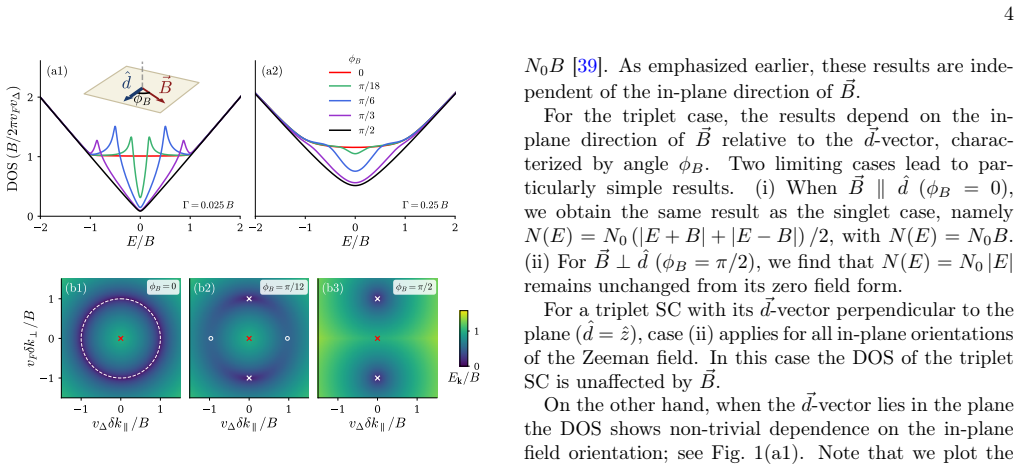
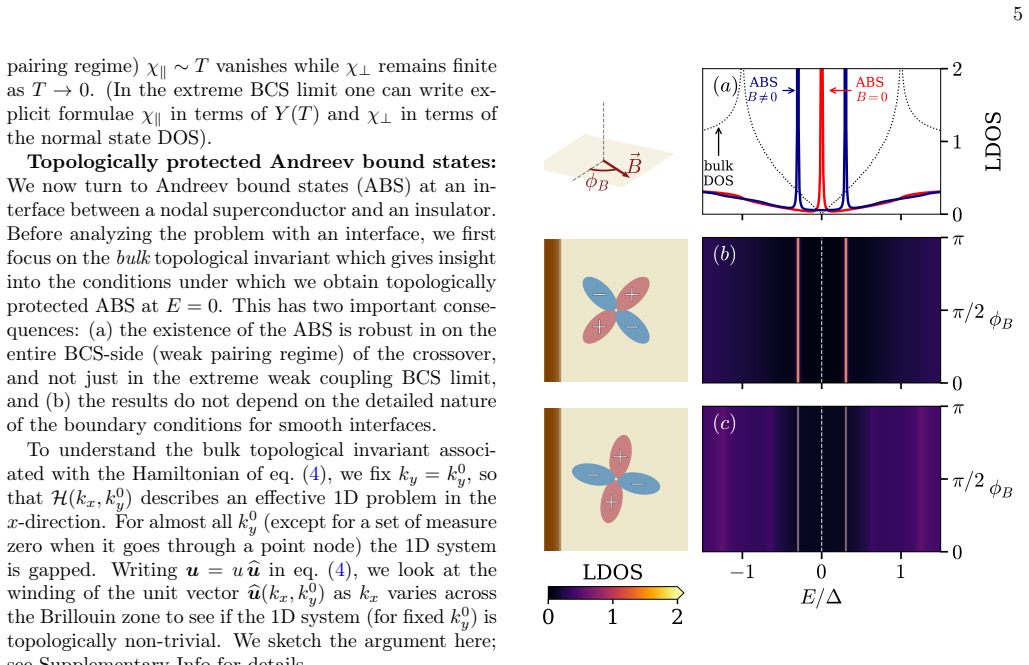
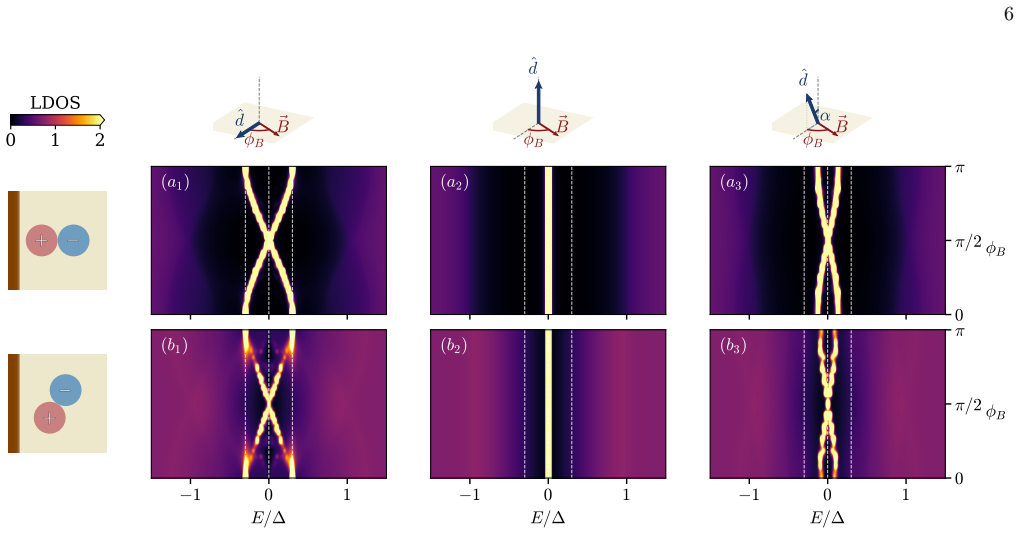
The pairing symmetry of magic-angle moir\'e graphene is a fundamental question that remains unresolved. Combining experimental and theoretical inputs, we constrain the superconducting order parameters that can emerge from the incommensurate Kekul\'e spiral (IKS) normal state on the hole-doped side of $\nu = -2$. Imposing the additional experimental constraint of nodal superconductivity, we are left with the task of distinguishing between singlet or triplet pairing, and of determining the d-vector in the latter case. We propose definitive tests to identify the pairing symmetry based on two classes of experiments using the response of the superconducting state to Zeeman field orientation. The first set of predictions is for spectroscopic and thermodynamic measurements sensitive to low-energy excitations near the nodes. The second set is for phase-sensitive measurements of topologically protected Andreev bound states near boundaries, whose spectroscopy is shown to provide a smoking gun signature of the pairing symmetry.
Figures
Figures from the paper (1 more)
Reference graph
Works this paper leans on
-
[1]
Y. Cao, V. Fatemi, S. Fang, K. Watanabe, T. Taniguchi, E. Kaxiras, and P. Jarillo-Herrero, Nature556, 43 (2018)
2018
-
[2]
Y. Cao, V. Fatemi, A. Demir, S. Fang, S. L. Tomarken, J. Y. Luo, J. D. Sanchez-Yamagishi, K. Watanabe, T. Taniguchi, E. Kaxiras, R. C. Ashoori, and P. Jarillo- Herrero, Nature556, 80 (2018)
2018
-
[3]
Z. Hao, A. M. Zimmerman, P. Ledwith, E. Khalaf, D. H. Najafabadi, K. Watanabe, T. Taniguchi, A. Vishwanath, and P. Kim, Science371, 1133 (2021)
2021
-
[4]
J. M. Park, Y. Cao, K. Watanabe, T. Taniguchi, and P. Jarillo-Herrero, Nature590, 249 (2021)
2021
-
[5]
Bistritzer and A
R. Bistritzer and A. H. MacDonald, Proc. Nat. Acad. Sci. 108, 12233 (2011)
2011
-
[6]
Khalaf, A
E. Khalaf, A. J. Kruchkov, G. Tarnopolsky, and A. Vish- wanath, Phys. Rev. B100, 085109 (2019)
2019
-
[7]
E. Y. Andrei, D. K. Efetov, P. Jarillo-Herrero, A. H. MacDonald, K. F. Mak, T. Senthil, E. Tutuc, A. Yaz- dani, and A. F. Young, Nature Reviews Materials6, 201 (2021)
2021
-
[8]
Balents, C
L. Balents, C. R. Dean, D. K. Efetov, and A. F. Young, Nature Physics16, 725 (2020)
2020
Show all 50 references
-
[9]
K. P. Nuckolls and A. Yazdani, Nature Reviews Materials 9, 460 (2024)
2024
-
[10]
E. Lake, A. S. Patri, and T. Senthil, Phys. Rev. B106, 104506 (2022)
2022
-
[11]
M. S. Scheurer and R. Samajdar, Phys. Rev. Res.2, 033062 (2020)
2020
-
[12]
Y. H. Kwan, G. Wagner, T. Soejima, M. P. Zaletel, S. H. Simon, S. A. Parameswaran, and N. Bultinck, Phys. Rev. X11, 041063 (2021)
2021
-
[13]
Wagner, Y
G. Wagner, Y. H. Kwan, N. Bultinck, S. H. Simon, and S. A. Parameswaran, Phys. Rev. Lett.128, 156401 (2022)
2022
-
[14]
K. P. Nuckolls, R. L. Lee, M. Oh, D. Wong, T. Soe- jima, J. P. Hong, D. Călugăru, J. Herzog-Arbeitman, B. A. Bernevig, K. Watanabe, T. Taniguchi, N. Reg- nault, M. P. Zaletel, and A. Yazdani, Nature620, 525 (2023)
2023
-
[15]
H. Kim, Y. Choi, É. Lantagne-Hurtubise, C. Lewandowski, A. Thomson, L. Kong, H. Zhou, E. Baum, Y. Zhang, L. Holleis, K. Watanabe, T. Taniguchi, A. F. Young, J. Alicea, and S. Nadj- Perge, Nature623, 942 (2023)
2023
-
[16]
Vollhardt and P
D. Vollhardt and P. Wölfle,The Superfluid Phases of Helium 3(Taylor & Francis, London, 1990)
1990
-
[17]
Y. Cao, D. Rodan-Legrain, J. M. Park, N. F. Q. Yuan, K. Watanabe, T. Taniguchi, R. M. Fernandes, L. Fu, and P. Jarillo-Herrero, Science372, 264 (2021)
2021
-
[18]
J. M. Park, Y. Cao, L.-Q. Xia, S. Sun, K. Watanabe, T. Taniguchi, and P. Jarillo-Herrero, Nature Materials 21, 877 (2022)
2022
-
[19]
Hu, Phys
C.-R. Hu, Phys. Rev. Lett.72, 1526 (1994)
1994
-
[20]
J. A. Sauls, Phil. Trans. R. Soc. A376, 20180140 (2018)
2018
-
[21]
N. J. Zhang, P. A. Nosov, O. E. Sommer, Y. Wang, K. Watanabe, T. Taniguchi, E. Khalaf, and J. I. A. Li, Nature Physics22, 527 (2026)
2026
-
[22]
J.Herzog-Arbeitman, D.Călugăru, H.Hu, J.Yu, N.Reg- nault, J. Kang, B. A. Bernevig, and O. Vafek, Phys. Rev. B112, 125129 (2025)
2025
-
[23]
J. Xiao, A. Inbar, J. Birkbeck, N. Gershon, Y. Zamir, T. Taniguchi, K. Watanabe, E. Berg, and S. Ilani, arXiv preprint arXiv:2506.20738 (2025), arXiv:2506.20738 [cond-mat.mes-hall]
2025
-
[24]
P. J. Ledwith, J. Dong, A. Vishwanath, and E. Khalaf, Phys. Rev. X15, 021087 (2025)
2025
-
[25]
Z. Wang, G. Wagner, Y. H. Kwan, N. Bultinck, S. H. Si- mon, and S. A. Parameswaran, (2025), arXiv:2509.12320 [cond-mat.str-el]
2025
-
[26]
F. K. de Vries, E. Portolés, G. Zheng, T. Taniguchi, K. Watanabe, T. Ihn, K. Ensslin, and P. Rickhaus, Nat. Nanotechnol.16, 760 (2021)
2021
-
[27]
Y. Cao, J. M. Park, K. Watanabe, T. Taniguchi, and P. Jarillo-Herrero, Nature595, 526 (2021)
2021
-
[28]
M. Oh, K. P. Nuckolls, D. Wong, R. L. Lee, X. Liu, K.Watanabe, T.Taniguchi,andA.Yazdani,Nature600, 240 (2021)
2021
-
[29]
H. Kim, Y. Choi, C. Lewandowski, A. Thomson, Y. Zhang, R. Polski, K. Watanabe, T. Taniguchi, J. Al- icea, and S. Nadj-Perge, Nature606, 494 (2022)
2022
-
[30]
J. M. Park, S. Sun, K. Watanabe, T. Taniguchi, and P. Jarillo-Herrero, Science391, 79 (2026)
2026
-
[31]
Banerjee, Z
A. Banerjee, Z. Hao, M. Kreidel, P. Ledwith, I. Phinney, J. M. Park, A. Zimmerman, M. E. Wesson, K. Watanabe, T. Taniguchi, R. M. Westervelt, A. Yacoby, P. Jarillo- Herrero, P. A. Volkov, A. Vishwanath, K. C. Fong, and P. Kim, Nature638, 93 (2025)
2025
-
[32]
Tanaka, J
M. Tanaka, J. Î.-j. Wang, T. H. Dinh, D. Rodan-Legrain, S. Zaman, M. Hays, A. Almanakly, B. Kannan, D. K. Kim, B. M. Niedzielski, K. Serniak, M. E. Schwartz, K. Watanabe, T. Taniguchi, T. P. Orlando, S. Gustavs- son, J. A. Grover, P. Jarillo-Herrero, and W. D. Oliver, Nature63...
2025
-
[33]
H. Kim, G. Rai, L. Crippa, D. Călugăru, H. Hu, Y. Choi, L. Kong, E. Baum, Y. Zhang, L. Holleis, K. Watanabe, T. Taniguchi, A. F. Young, B. A. Bernevig, R. Valentí, G. Sangiovanni, T. Wehling, and S. Nadj-Perge, Nature 650, 592 (2026)
2026
-
[34]
Biswas, S
S. Biswas, S. Suman, M. Randeria, and R. Sensarma, Proc. Nat. Acad. Sci.122, e2509881122 (2025)
2025
-
[35]
H. Tian, X. Gao, Y. Zhang, S. Che, T. Xu, P. Che- ung, K. Watanabe, T. Taniguchi, M. Randeria, F. Zhang, C. N. Lau, and M. W. Bockrath, Nature614, 440 (2023)
2023
-
[36]
Randeria and E
M. Randeria and E. Taylor, Annual Review of Condensed Matter Physics5, 209 (2014)
2014
-
[37]
Randeria, J.-M
M. Randeria, J.-M. Duan, and L.-Y. Shieh, Physical Re- view B41, 327 (1990)
1990
-
[38]
X. Yang, S. Biswas, S. Lu, M. Randeria, and Y.-M. Lu, SciPost Phys.17, 161 (2024)
2024
-
[39]
Yang and S
K. Yang and S. L. Sondhi, Phys. Rev. B57, 8566 (1998)
1998
-
[40]
Kashiwaya and Y
S. Kashiwaya and Y. Tanaka, Reports on Progress in Physics63, 1641 (2000)
2000
-
[41]
M. Sato, Y. Tanaka, K. Yada, and T. Yokoyama, Phys. Rev. B83, 224511 (2011)
2011
-
[42]
A. P. Schnyder and S. Ryu, Phys. Rev. B84, 060504(R) (2011)
2011
-
[43]
Matsumoto and H
M. Matsumoto and H. Shiba, Journal of the Physical Society of Japan64, 1703 (1995)
1995
-
[44]
Fogelström, D
M. Fogelström, D. Rainer, and J. A. Sauls, Phys. Rev. Lett.79, 281 (1997)
1997
-
[45]
M. S. Kalenkov, M. Fogelström, and Y. S. Barash, Phys. Rev. B70, 184505 (2004)
2004
-
[46]
Suman, S
S. Suman, S. Biswas, M. Randeria, and R. Sensarma (2026), unpublished. 10
2026
-
[47]
D. F. Agterberg, J. S. Davis, S. D. Edkins, E. Fradkin, D. J. Van Harlingen, S. A. Kivelson, P. A. Lee, L. Radzi- hovsky, J. M. Tranquada, and Y. Wang, Ann. Rev. Cond. Mat. Phys.11, 231 (2020)
2020
-
[48]
M.Covington, R.Scheuerer, K.Bloom,andL.H.Greene, Appl. Phys. Lett.68, 1717 (1996)
1996
-
[49]
Covington, M
M. Covington, M. Aprili, E. Paraoanu, L. H. Greene, F. Xu, J. Zhu, and C. A. Mirkin, Phys. Rev. Lett.79, 277 (1997)
1997
-
[50]
Shrestha, S
K. Shrestha, S. Zhang, L. H. Greene, Y. Lai, R. E. Baum- bach, K. Sasmal, M. B. Maple, and W. K. Park, Phys. Rev. B103, 224515 (2021)
2021
Reviewed June 26, 2026 · model on record in the stance chip above.
Discussion (0). Continue with ORCID to comment.