A Novel Arm-Length Stabilization Scheme for Gravitational-Wave Detectors with AlGaAs/GaAs Coated Mirrors
Pith reviewed 2026-06-25 23:04 UTC · model grok-4.3
The pith
A multi-wavelength laser scheme using phase-locked 1596 nm and 1064 nm beams stabilizes arm lengths for gravitational-wave detectors with AlGaAs/GaAs coatings.
A machine-rendered reading of the paper's core claim, the machinery that carries it, and where it could break.
Core claim
The central claim is that the proposed multi-wavelength arm length stabilisation scheme, which frequency-triples the 1596 nm auxiliary locking beam to 532 nm and phase-locks it with the 1064 nm science laser through its second harmonic, permits stable cavity detuning and robust cavity locking transition without excessive absorption by AlGaAs/GaAs coatings, as shown by tabletop demonstration.
What carries the argument
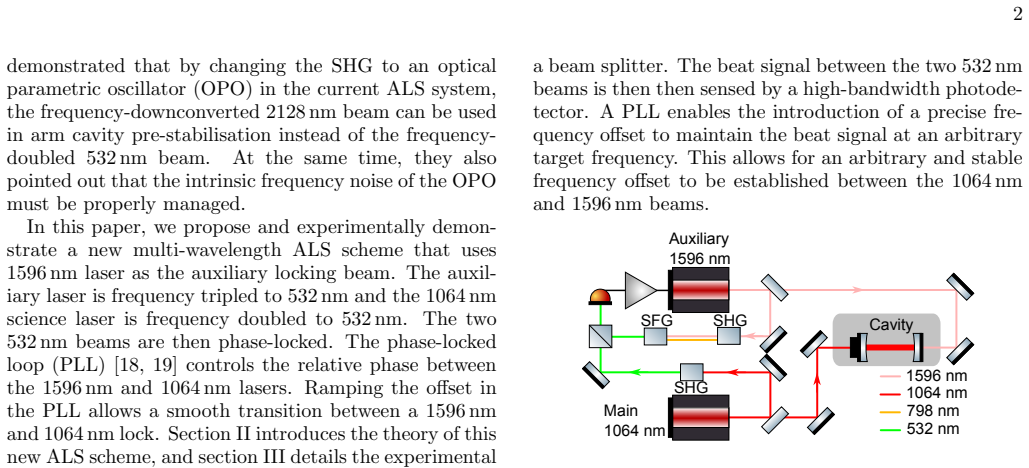
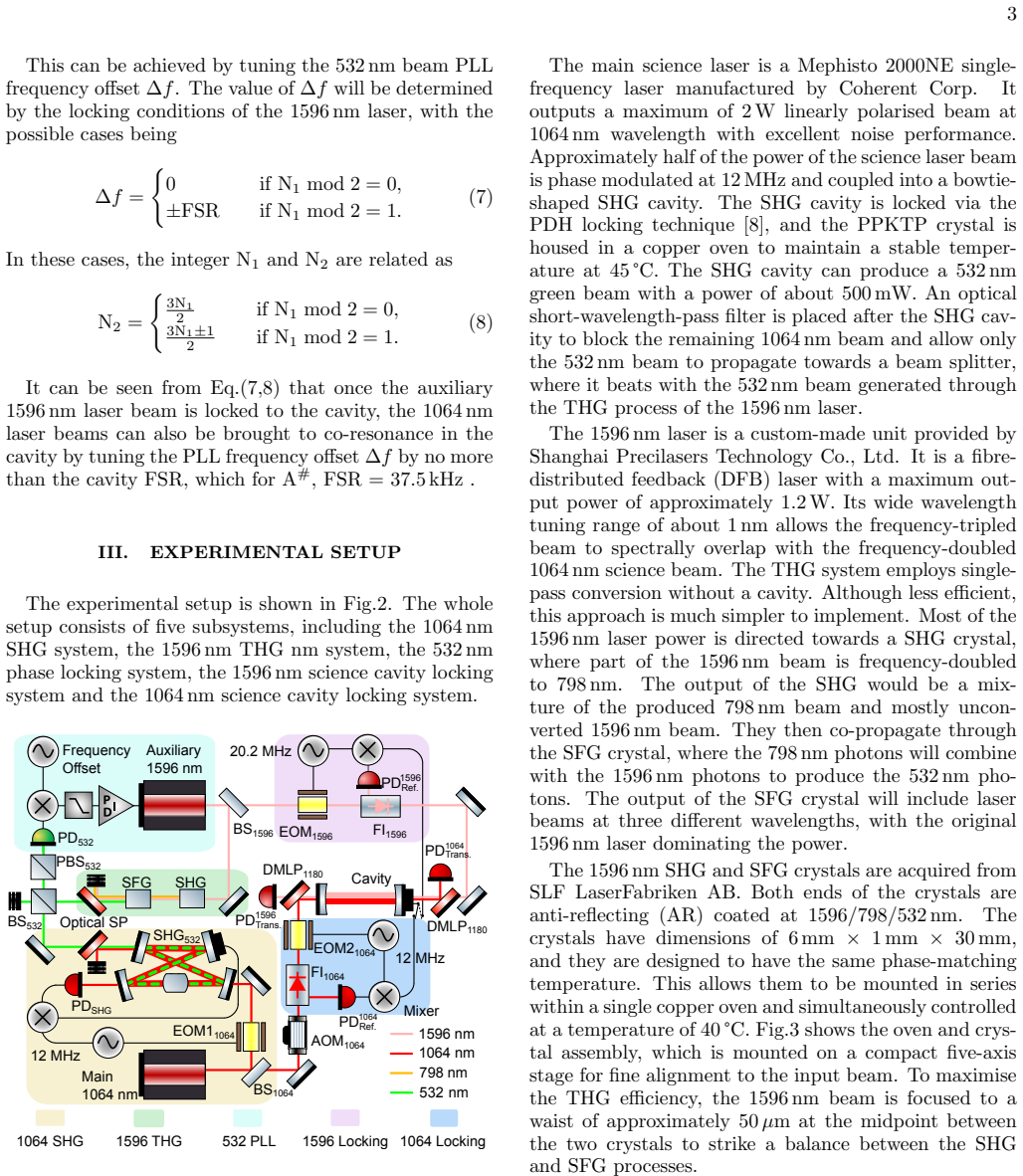
The phase-locked loop between the 1596 nm auxiliary laser and the 1064 nm science laser, combined with frequency tripling of the 1596 nm beam to produce the 532 nm auxiliary locking beam.
If this is right
- The scheme avoids excessive absorption of the auxiliary beam by AlGaAs/GaAs coatings.
- It supports arm length stabilization during upgrades such as A#.
- It enables compatibility with third-generation gravitational wave detectors that use AlGaAs/GaAs-coated test masses.
- Cavity detuning and locking transitions remain stable when the phase-locked loop is controlled.
Where Pith is reading between the lines
- The approach may permit higher circulating powers in future detectors by removing a coating absorption limit.
- Similar multi-wavelength phase-locking could address absorption constraints in other high-precision optical cavities.
- Integration with existing 1064 nm infrastructure appears straightforward because the locking occurs at the 532 nm harmonic.
Load-bearing premise
The tabletop demonstration of stable cavity detuning and locking transition with the phase-locked lasers will scale without new noise sources or instabilities to the high-power, vacuum, suspended-mirror environment of actual gravitational-wave detectors.
What would settle it
Observation of lock loss, excess noise, or instability when the phase-locked 1596 nm and 1064 nm scheme is applied to suspended mirrors at high optical power inside vacuum would falsify the claim of compatibility.
Figures

read the original abstract
The arm length stabilisation system is employed in gravitational-wave detectors to reduce the velocity of the mirrors such that the arm cavities can be brought onto resonance in a controlled manner required to attain the detector operating point. For future upgrades of current gravitational wave detectors such as A#, which will incorporate AlGaAs/GaAs coatings, the current frequency-doubled arm length stabilisation system is unsuitable due to excessive absorption of the frequency-doubled 532nm beam by the AlGaAs/GaAs coating. We propose a novel multi-wavelength arm length stabilisation scheme that uses both frequency-doubled and frequency-tripled beams. The 1596nm auxiliary locking beam is outside the absorption bands of AlGaAs/GaAs coating. It is frequencytripled to 532nm and phase-locked with the 1064nm science laser through its second harmonic at 532 nm. In a tabletop setup, we experimentally demonstrated the stable cavity detuning and robust cavity locking transition by controlling the 1596nm laser and 1064nm laser phase locked loop. This demonstration confirmed that the proposed novel arm length stabilisation scheme is compatible with future upgrades or third-generation gravitational wave detectors that use AlGaAs/GaAs-coated test masses.
Editorial analysis
A structured set of objections, weighed in public.
Referee Report
Summary. The manuscript proposes a novel multi-wavelength arm-length stabilization scheme for gravitational-wave detectors using AlGaAs/GaAs-coated test masses. It employs a 1596 nm auxiliary laser that is frequency-tripled to 532 nm and phase-locked to the 1064 nm science laser (via its second harmonic at 532 nm) to avoid excessive absorption at 532 nm. A tabletop demonstration of stable cavity detuning and robust locking transition is reported, which the authors state confirms compatibility with future upgrades such as A# or third-generation detectors.
Significance. If the optical control architecture can be shown to operate without new instabilities under realistic conditions, the scheme would remove a key obstacle to adopting low-absorption AlGaAs/GaAs coatings in arm cavities, enabling higher circulating power and improved sensitivity in advanced gravitational-wave detectors.
major comments (1)
- [Abstract] Abstract: the claim that the tabletop demonstration 'confirmed' compatibility with future detectors is not supported by the evidence presented. The experiment is performed with a fixed cavity at low power in air; no data address radiation-pressure noise, coating thermal transients at 532 nm, suspension resonances coupling into the PLL, or vacuum-induced effects that dominate in the target environment.
minor comments (2)
- [Abstract] The reported demonstration provides no quantitative metrics (e.g., residual detuning noise, lock acquisition time statistics, or error budgets), limiting assessment of robustness.
- Notation for the phase-locked loop and frequency-tripling stages should be defined explicitly with a schematic or block diagram for clarity.
Simulated Author's Rebuttal
We thank the referee for their review. We agree that the abstract overstates the implications of the tabletop demonstration and will revise the wording to reflect its limited scope.
read point-by-point responses
-
Referee: [Abstract] Abstract: the claim that the tabletop demonstration 'confirmed' compatibility with future detectors is not supported by the evidence presented. The experiment is performed with a fixed cavity at low power in air; no data address radiation-pressure noise, coating thermal transients at 532 nm, suspension resonances coupling into the PLL, or vacuum-induced effects that dominate in the target environment.
Authors: We agree that the abstract claim is not supported by the presented evidence. The demonstration was performed with a fixed cavity at low power in air and does not address radiation-pressure noise, coating thermal transients at 532 nm, suspension resonances in the PLL, or vacuum effects. We will revise the abstract to replace the word 'confirmed' with 'demonstrates the principle of' or equivalent phrasing that accurately limits the claim to the laboratory conditions shown. This change will appear in the revised manuscript. revision: yes
Circularity Check
No circularity: claim rests on independent tabletop experiment
full rationale
The paper advances a multi-wavelength arm-length stabilization scheme and supports its central claim—that the approach is compatible with AlGaAs/GaAs-coated detectors—solely via a tabletop experimental demonstration of stable cavity detuning and locking transition using phase-locked 1596 nm and 1064 nm lasers. No derivation, first-principles calculation, or prediction is presented that reduces by construction to fitted inputs, self-definitions, or self-citation chains. The experiment itself constitutes external evidence under the reported conditions; the scaling assumption to high-power vacuum environments is an untested extrapolation but does not create circularity within the paper's logic. No steps match any enumerated circularity pattern.
Axiom & Free-Parameter Ledger
Reference graph
Works this paper leans on
-
[1]
After filtering, we measured about 400 nW 532 nm beam with about 1.2 W original 1596 nm beam at the input of the oven
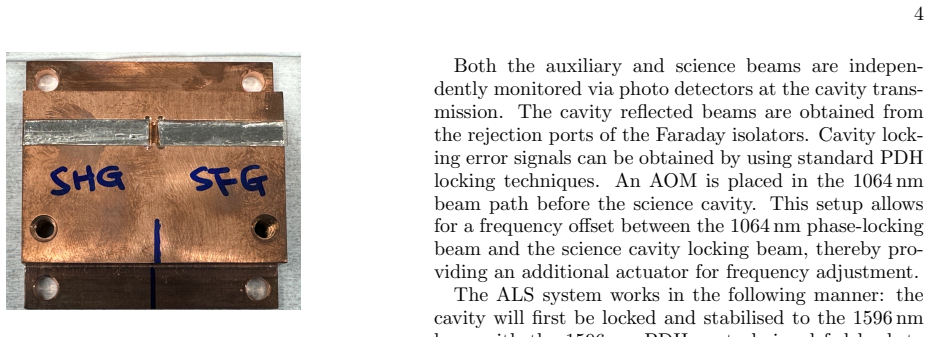
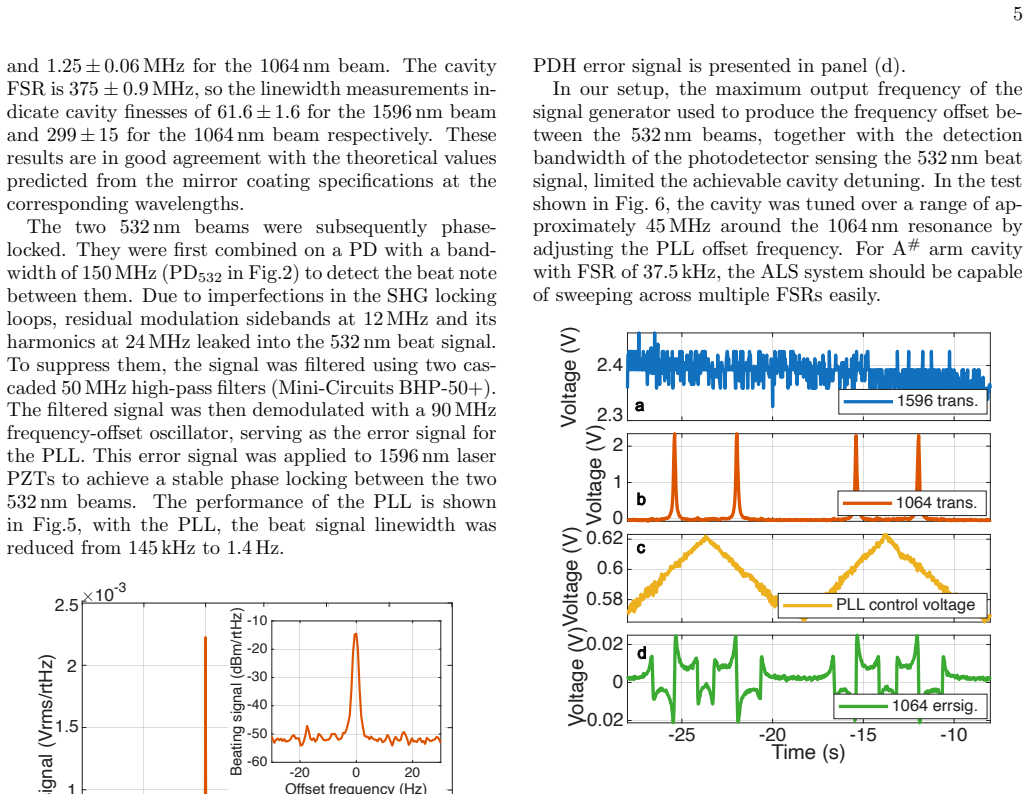
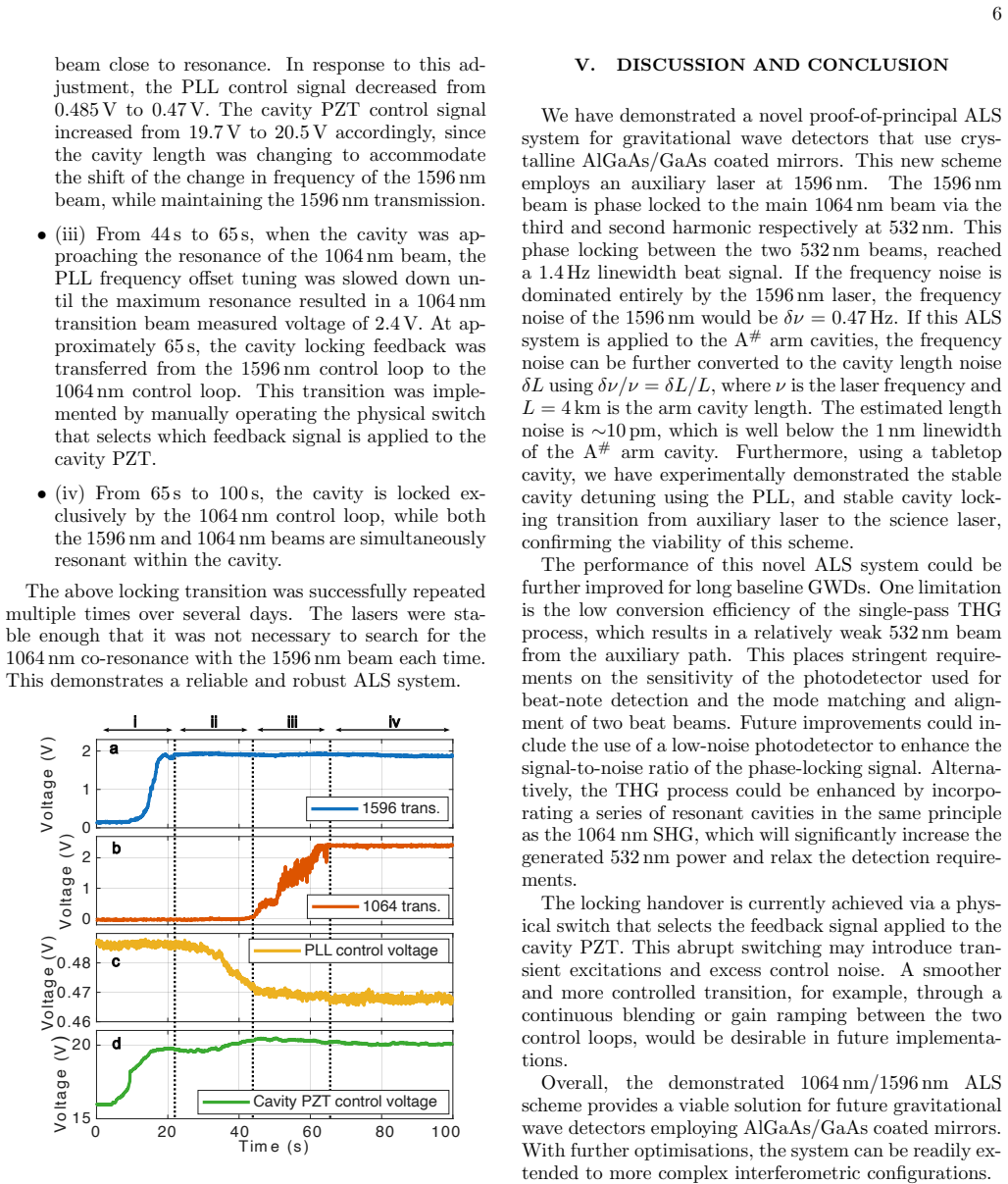
filters out the other two co-propagating beams, leav- ing only the 532 nm beam. After filtering, we measured about 400 nW 532 nm beam with about 1.2 W original 1596 nm beam at the input of the oven. The two 532 nm beams, one generated from the THG process of the 1596 nm auxiliary beam and the other from the SHG process of the 1064 nm science beam, are com...
-
[2]
J. Aasi, B. Abbott, R. Abbott, T. Abbott, M. Aber- nathy, K. Ackley, C. Adams, T. Adams, P. Addesso, R. Adhikari,et al., Advanced ligo, Classical and Quan- tum Gravity32, 074001 (2015)
2015
-
[3]
F. a. Acernese, M. Agathos, K. Agatsuma, D. Aisa, N. Allemandou, A. Allocca, J. Amarni, P. Astone, G. Balestri, G. Ballardin,et al., Advanced virgo: a second-generation interferometric gravitational wave de- tector, Classical and Quantum Gravity32, 024001 (2014)
2014
-
[4]
Y. Aso, Y. Michimura, K. Somiya, M. Ando, O. Miyakawa, T. Sekiguchi, D. Tatsumi, H. Yamamoto, K. Collaboration,et al., Interferometer design of the ka- gra gravitational wave detector, Physical Review D88, 043007 (2013)
2013
-
[5]
Staley, D
A. Staley, D. Martynov, R. Abbott, R. Adhikari, K. Arai, S. Ballmer, L. Barsotti, A. Brooks, R. DeRosa, S. Dwyer,et al., Achieving resonance in the advanced ligo gravitational-wave interferometer, Classical and Quan- tum Gravity31, 245010 (2014)
2014
-
[6]
A. J. Mullavey, B. J. Slagmolen, J. Miller, M. Evans, P. Fritschel, D. Sigg, S. J. Waldman, D. A. Shaddock, and D. E. McClelland, Arm-length stabilisation for inter- ferometric gravitational-wave detectors using frequency- doubled auxiliary lasers, Optics Express20, 81 (2011)
2011
-
[7]
Akutsu, M
T. Akutsu, M. Ando, K. Arai, K. Arai, Y. Arai, S. Araki, A. Araya, N. Aritomi, Y. Aso, S. Bae,et al., An arm length stabilization system for kagra and fu- ture gravitational-wave detectors, Classical and Quan- tum Gravity37, 035004 (2020)
2020
-
[8]
Izumi, K
K. Izumi, K. Arai, B. Barr, J. Betzwieser, A. Brooks, K. Dahl, S. Doravari, J. C. Driggers, W. Z. Korth, H. Miao,et al., Multicolor cavity metrology, Journal of the Optical Society of America A29, 2092 (2012)
2092
-
[9]
R. W. Drever, J. L. Hall, F. V. Kowalski, J. Hough, G. Ford, A. Munley, and H. Ward, Laser phase and fre- quency stabilization using an optical resonator, Applied Physics B31, 97 (1983)
1983
-
[10]
Capote, W
E. Capote, W. Jia, N. Aritomi, M. Nakano, V. Xu, R. Ab- bott, I. Abouelfettouh, R. Adhikari, A. Ananyeva, S. Ap- pert,et al., Advanced ligo detector performance in the fourth observing run, Physical Review D111, 062002 (2025)
2025
-
[11]
G. D. Cole, W. Zhang, M. J. Martin, J. Ye, and M. As- pelmeyer, Tenfold reduction of brownian noise in high- reflectivity optical coatings, Nature Photonics7, 644 (2013)
2013
-
[12]
G. D. Cole, S. Ballmer, G. Billingsley, S. Cata˜ no-Lopez, M. Fejer, P. Fritschel, A. Gretarsson, G. Harry, D. Kedar, T. Legero,et al., Substrate-transferred gaas/algaas crys- talline coatings for gravitational-wave detectors, Applied Physics Letters122(2023)
2023
-
[13]
G. M. Harry, M. R. Abernathy, A. E. Becerra-Toledo, H. Armandula, E. Black, K. Dooley, M. Eichenfield, C. Nwabugwu, A. Villar, D. Crooks,et al., Titania-doped tantala/silica coatings for gravitational-wave detection, Classical and Quantum Gravity24, 405 (2007)
2007
-
[14]
Gupta, C
I. Gupta, C. Afle, K. Arun, A. Bandopadhyay, M. Baryakhtar, S. Biscoveanu, S. Borhanian, F. Broek- gaarden, A. Corsi, A. Dhani,et al., Characterizing grav- itational wave detector networks: from A# to cosmic explorer, Classical and Quantum Gravity41, 245001 (2024)
2024
-
[15]
M. Evans, R. X. Adhikari, C. Afle, S. W. Ballmer, S. Bis- coveanu, S. Borhanian, D. A. Brown, Y. Chen, R. Eisen- stein, A. Gruson,et al., A horizon study for cosmic explorer: science, observatories, and community, arXiv preprint arXiv:2109.09882 (2021)
Pith/arXiv arXiv 2021
-
[16]
Punturo, M
M. Punturo, M. Abernathy, F. Acernese, B. Allen, N. An- dersson, K. Arun, F. Barone, B. Barr, M. Barsug- lia, M. Beker,et al., The einstein telescope: A third- generation gravitational wave observatory, Classical and Quantum Gravity27, 194002 (2010)
2010
-
[17]
Blakemore, Semiconducting and other major proper- ties of gallium arsenide, Journal of Applied Physics53, R123 (1982)
J. Blakemore, Semiconducting and other major proper- ties of gallium arsenide, Journal of Applied Physics53, R123 (1982)
1982
-
[18]
Tanioka, B
S. Tanioka, B. Wu, and S. W. Ballmer, Experimental demonstration of frequency-downconverted arm-length stabilization for a future upgraded gravitational wave de- tector, Optics Letters49, 5763 (2024)
2024
-
[19]
F. Wang, W. Ma, F. Mei, Z. Ji, D. Su, Y. Zhao, L. Xiao, and S. Jia, Simple, low-cost, and well-performing opti- cal phase-locked loop for frequency and phase locking of semiconductor lasers, Applied Optics62, 7169 (2023)
2023
-
[20]
Kulur Ramamohan, S
A. Kulur Ramamohan, S. Chua, Y. Zhang, M. Yap, J. Wright, N. Holland, P. Forsyth, and B. Slagmolen, Characterization of heterodyne optical phase locking for relative laser frequency noise suppression in differential measurement, Optics Express32, 39793 (2024)
2024
-
[21]
Yeaton-Massey and R
D. Yeaton-Massey and R. X. Adhikari, A new bound on excess frequency noise in second harmonic generation in ppktp at the 10- 19 level, Optics Express20, 21019 (2012)
2012
discussion (0)
Sign in with ORCID, Apple, or X to comment. Anyone can read and Pith papers without signing in.