Evaluating the solution performance of the augmented Lagrangian function on Ising machines
Reviewed by Pith T0 review T1 audit T2 compute T3 formal T4 kernel 2026-06-25 22:49 UTCgrok-4.3pith:VHRS6KRUrecord.jsonopen to challenge →
The pith
Augmented Lagrangian formulation reduces time-to-epsilon on Ising machines by roughly an order of magnitude over penalty methods.
A machine-rendered reading of the paper's core claim, the machinery that carries it, and where it could break.
Core claim
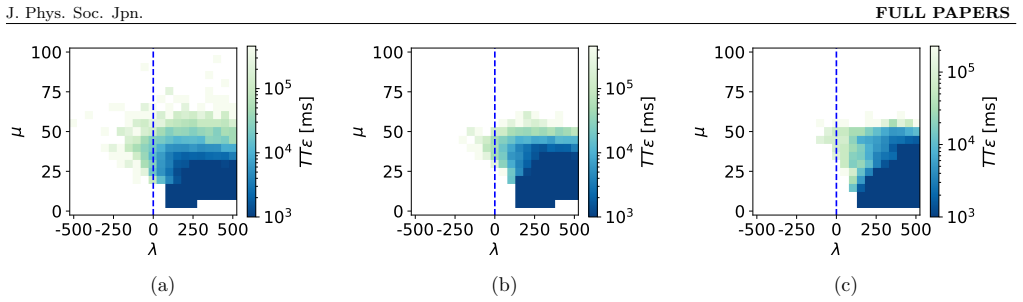
The augmented Lagrangian function (ALF) applied to Ising machines for the quadratic knapsack problem reduces TTε by roughly an order of magnitude compared with the penalty function formulation. It achieves this while keeping μ small, obtaining feasible solutions, and reaching high-precision solutions earlier in the search for representative parameter settings.
What carries the argument
The augmented Lagrangian function, which augments the objective with both quadratic penalty terms and linear Lagrange-multiplier terms to enforce constraints during Ising-machine energy minimization.
If this is right
- The ALF permits smaller μ values while still returning feasible solutions.
- High-precision solutions appear earlier in the annealing or search trajectory.
- Overall time-to-epsilon improves by about tenfold for the tested problem class.
- The formulation extends naturally to other constrained combinatorial problems solved on Ising machines.
Where Pith is reading between the lines
- If the gain generalizes, mapping pipelines for Ising machines could shift from pure penalty methods to augmented Lagrangian encodings as a default.
- Adaptive schemes that update the Lagrange multipliers on the fly during the machine run might amplify the observed benefit.
- Hardware designs could incorporate direct support for multiplier variables to reduce the need for extra spins.
Load-bearing premise
Ising machines minimize the augmented Lagrangian formulation with the same fidelity as the penalty formulation, and hyperparameter searches for μ and λ are performed under comparable conditions for both methods.
What would settle it
Execute identical quadratic knapsack instances on physical Ising hardware using both formulations with matched hyperparameter grids and check whether TTε fails to drop by roughly an order of magnitude under the augmented Lagrangian version.
Figures


read the original abstract
We apply the augmented Lagrangian function (ALF) as a formulation for Ising machines and evaluate its performance by time-to-epsilon (\mathrm{TT\varepsilon}). The ALF has been well studied in continuous optimization for its numerical stability and convergence, and its advantage over the penalty function formulation is demonstrated here through the following results. Using the quadratic knapsack problem as a benchmark, we examine the dependence of \mathrm{TT\varepsilon} on the hyperparameters \mu and \lambda. The augmented Lagrangian formulation reduces \mathrm{TT\varepsilon} by roughly an order of magnitude compared with the penalty function formulation, keeping \mu small while obtaining feasible solutions and, for representative parameter settings, reaching high-precision solutions earlier in the search. These findings indicate that the augmented Lagrangian function is a promising formulation for improving the solution performance of Ising machines.
Editorial analysis
A structured set of objections, weighed in public.
Referee Report
Summary. The paper evaluates the augmented Lagrangian function (ALF) as a formulation for Ising machines on the quadratic knapsack problem benchmark. It reports that ALF reduces time-to-epsilon (TTε) by roughly an order of magnitude relative to the standard penalty formulation, while allowing small μ values, producing feasible solutions, and reaching high-precision solutions earlier for representative parameter settings. The study examines dependence of TTε on hyperparameters μ and λ.
Significance. If the empirical comparison holds under equivalent tuning budgets and machine fidelity, the result would indicate that ALF can improve practical performance of Ising machines on combinatorial problems by leveraging its known stability properties from continuous optimization. This is a targeted, falsifiable benchmark claim rather than a theoretical derivation; its value lies in the quantitative TTε comparison, but verification requires full disclosure of the experimental protocol.
major comments (3)
- [Abstract and experimental results section] The central TTε comparison (abstract) rests on hyperparameter search over (μ, λ) for ALF versus μ for the penalty method, yet no protocol is supplied for grid density, ranges, number of trials, or total tuning budget. This leaves open the possibility that the reported ~10× improvement arises from unequal search effort rather than the formulation itself.
- [Methods / experimental protocol] The manuscript does not specify the exact Ising machine model, embedding procedure, noise/precision characteristics, or data-exclusion rules used for both formulations. Without these, it is impossible to confirm that the ALF-augmented QUBO is minimized with equivalent fidelity to the penalty QUBO, which is required for the performance claim.
- [Results and figures] No error bars, statistical tests, or number of independent runs are reported for the TTε values or the order-of-magnitude reduction. This weakens the quantitative headline result, especially given that TTε is a stochastic performance metric on hardware solvers.
minor comments (2)
- [Abstract] Notation for TTε should be defined explicitly on first use, including the precise definition of ε and how feasibility is checked.
- [Figures] The dependence of TTε on μ and λ is mentioned but the corresponding plots or tables lack axis labels or legends that clearly separate ALF from penalty curves.
Simulated Author's Rebuttal
We thank the referee for the thorough review and constructive comments on our manuscript. We address each of the major comments below and outline the revisions we will make to strengthen the paper.
read point-by-point responses
-
Referee: [Abstract and experimental results section] The central TTε comparison (abstract) rests on hyperparameter search over (μ, λ) for ALF versus μ for the penalty method, yet no protocol is supplied for grid density, ranges, number of trials, or total tuning budget. This leaves open the possibility that the reported ~10× improvement arises from unequal search effort rather than the formulation itself.
Authors: We agree that the hyperparameter tuning protocol requires more detail to ensure the comparison is equitable. In the revised manuscript, we will provide a full description of the grid search procedure, including the ranges and densities for μ and λ, the number of trials conducted, and confirmation that the total tuning budget was equivalent for both the ALF and penalty formulations. This will clarify that the performance improvement is attributable to the formulation rather than search effort. revision: yes
-
Referee: [Methods / experimental protocol] The manuscript does not specify the exact Ising machine model, embedding procedure, noise/precision characteristics, or data-exclusion rules used for both formulations. Without these, it is impossible to confirm that the ALF-augmented QUBO is minimized with equivalent fidelity to the penalty QUBO, which is required for the performance claim.
Authors: The referee correctly identifies a gap in the experimental protocol description. We will revise the Methods section to explicitly state the Ising machine model employed, the embedding procedure used, the noise and precision characteristics of the solver, and the rules for data exclusion or handling of invalid solutions. These details will be provided for both formulations to demonstrate equivalent fidelity in the minimization process. revision: yes
-
Referee: [Results and figures] No error bars, statistical tests, or number of independent runs are reported for the TTε values or the order-of-magnitude reduction. This weakens the quantitative headline result, especially given that TTε is a stochastic performance metric on hardware solvers.
Authors: We acknowledge that the lack of statistical reporting limits the robustness of the claims. In the revision, we will report the number of independent runs for each TTε measurement, include error bars in the relevant figures, and perform appropriate statistical tests to quantify the significance of the observed order-of-magnitude reduction. This will provide stronger support for the quantitative results. revision: yes
Circularity Check
No circularity: empirical benchmark with measured TTε improvements
full rationale
The paper is an empirical benchmark study comparing augmented Lagrangian function (ALF) and penalty formulations on Ising machines for the quadratic knapsack problem, reporting measured reductions in time-to-epsilon (TTε). The central performance claim rests on direct experimental results under varying μ and λ, with no derivation chain, mathematical prediction, or result that reduces by construction to fitted inputs, self-citations, or renamed known quantities. No load-bearing self-citation, self-definitional step, or ansatz smuggling is present in the provided text or abstract. The study is self-contained against external benchmarks via reported TTε values.
Axiom & Free-Parameter Ledger
free parameters (2)
- μ
- λ
axioms (1)
- domain assumption The augmented Lagrangian function provides numerical stability and convergence advantages over the pure penalty method, as established in continuous optimization.
Reference graph
Works this paper leans on
-
[1]
Evaluating the solution performance of the augmented Lagrangian function on Ising machines
Introduction Combinatorial optimization is a mathematical prob- lem of finding a combination of decision variables that minimizes or maximizes an objective function under given constraints. 1) Many real-world problems, such as logistics optimization, manufacturing scheduling, and communication routing, can be reduced to this form. 2–5) As the number of de...
work page internal anchor Pith review Pith/arXiv arXiv 2026
-
[2]
First, Subsect
Input F ormat for the Ising Machine This section presents the form of the energy function that is input to the Ising machine, in order to clar- ify the formulation of the constraint-handling methods described later. First, Subsect. 2.1 describes the Ising model, which is the input format of the Ising machine. Then, Subsect. 2.2 introduces Quadratic Uncons...
-
[3]
Method The main comparison in this study is between the penalty function and the augmented Lagrangian func- tion at fixed hyperparameters. The penalty method and the augmented Lagrangian method are described to clar- ify their relation to iterative hyperparameter tuning, and the augmented Lagrangian method is examined as an auxiliary analysis in Sect. 6. ...
-
[4]
3.1.3, we conducted two investigations
Experimental Setup To test the hypothesis described in Subsubsect. 3.1.3, we conducted two investigations. First, we evaluated TTε over theλ−µparameter space, visualized as a heatmap, to identify the parameter region in which TTεis small. 4 J. Phys. Soc. Jpn. FULL P APERS Second, for representative parameter settings selected from this region, we examined...
-
[5]
Hobj =− X 1≤i≤j≤N pi,jxixj, x i ∈ {0,1},(14) wherex i is a binary variable that takes the value 1 when itemiis included in the knapsack and 0 when it is not
p N,N .(13) Since the original problem maximizes the total value, its objective function is expressed as the following mini- mization problem by negating the total value. Hobj =− X 1≤i≤j≤N pi,jxixj, x i ∈ {0,1},(14) wherex i is a binary variable that takes the value 1 when itemiis included in the knapsack and 0 when it is not. As the constraint, an u...
1957
-
[6]
Subsection 5.1 presents the hyperparameter dependence of TTε
Results This section presents the results obtained in this study. Subsection 5.1 presents the hyperparameter dependence of TTε. The following Subsect. 5.2 presents the compar- ison of the evolution of the incumbent solution under specific hyperparameter settings, based on the findings obtained from the heatmaps. 5.1TTε(ε= 0.05) This subsection describes t...
-
[7]
Discussion This section discusses the results presented in Sect. 5. Subsection 6.1 examines, from the structural change in the formulation, the mechanism by which the augmented Lagrangian function reduces TTε, and Subsect. 6.2 ex- amines, as an auxiliary analysis, whether the augmented Lagrangian method can reach the favorable parameter region without a p...
1957
-
[8]
The initial valueλ (0) was commonly set toλ (0) = 0
In addition, for the hyperparameter update trajec- tories of the augmented Lagrangian method, the initial valueµ (0) and the growth factorαwere set under multi- ple conditions, and the computation was performed. The initial valueλ (0) was commonly set toλ (0) = 0. At each step, the hyperparameters were retained until at least one feasible solution, in the...
-
[9]
Promoting the application of advanced quantum technology platforms to social issues
Conclusion In this study, the augmented Lagrangian function was evaluated as a formulation for the Ising machine, us- ing TTεas the evaluation metric. For the QKP, which is an inequality-constrained combinatorial optimization problem, the dependence of TTεon the hyperparame- tersµandλwas investigated using the benchmark in- stances listed in Table II. The...
-
[10]
R. M. Karp, Reducibility among combinatorial problems, 50 Years of Integer Programming 1958-2008: from the Early Years to the State-of-the-Art, pp. 219–241. Springer, 2009
1958
-
[11]
B.Dantzig and J
G. B.Dantzig and J. H.Ramser: Management Science6(1959) 80
1959
-
[12]
Laporte: Transportation Science43(2009) 408
G. Laporte: Transportation Science43(2009) 408
2009
-
[13]
T. L. Magnanti and R. T. Wong: Transportation Science18 (1984) 1
1984
-
[14]
Alonso-Mora, S
J. Alonso-Mora, S. Samaranayake, A. Wallar, E. Frazzoli, and D. Rus: Proceedings of the National Academy of Sciences114 (2017) 462
2017
-
[15]
Mohseni, P
N. Mohseni, P. L. McMahon, and T. Byrnes: Nature Reviews Physics4(2022) 363
2022
-
[16]
Rosenberg, P
G. Rosenberg, P. Haghnegahdar, P. Goddard, P. Carr, K. Wu, and M. L. De Prado: Proceedings of the 8th workshop on high performance computational finance, 2015, pp. 1–7
2015
-
[17]
Tatsumura, R
K. Tatsumura, R. Hidaka, J. Nakayama, T. Kashimata, and M. Yamasaki: IEEE Access11(2023) 120023
2023
-
[18]
K. Takahashi, T. Abe, Y. Nakamura, R. Hidaka, S. Kikuchi, and S. Tanaka: arXiv preprint arXiv:2510.23310 (2025)
-
[19]
Tanahashi, S
K. Tanahashi, S. Takayanagi, T. Motohashi, and S. Tanaka: Journal of the Physical Society of Japan88(2019) 061010
2019
-
[20]
Mukasa, T
Y. Mukasa, T. Wakaizumi, S. Tanaka, and N. Togawa: IEICE TRANSACTIONS on Information and Systems104(2021) 1592
2021
-
[21]
S. J. Weinberg, F. Sanches, T. Ide, K. Kamiya, and R. Correll: Scientific Reports13(2023) 4770
2023
-
[22]
Kanai, M
H. Kanai, M. Yamashita, K. Tanahashi, and S. Tanaka: IEEE Access12(2024) 157669
2024
-
[23]
Scientific Reports14(1), 23053 (2024)
E. Kawase, S. Kikuchi, H. Tamai, and S. Tanaka: Scientific Re- ports (2026). Advance online publication, doi:10.1038/s41598- 026-57443-z
-
[24]
Harris, Y
R. Harris, Y. Sato, A. J. Berkley, M. Reis, F. Altomare, M. H. Amin, K. Boothby, P. Bunyk, C. Deng, C. Enderud, et al.: Science361(2018) 162
2018
-
[25]
A. D. King, J. Carrasquilla, J. Raymond, I. Ozfidan, E. An- driyash, A. Berkley, M. Reis, T. Lanting, R. Harris, F. Al- tomare, et al.: Nature560(2018) 456
2018
-
[26]
Kitai, J
K. Kitai, J. Guo, S. Ju, S. Tanaka, K. Tsuda, J. Shiomi, and R. Tamura: Physical Review Research2(2020) 013319
2020
-
[27]
Utimula, T
K. Utimula, T. Ichibha, G. I. Prayogo, K. Hongo, K. Nakano, and R. Maezono: Scientific Reports11(2021) 7261
2021
-
[28]
Sampei, K
H. Sampei, K. Saegusa, K. Chishima, T. Higo, S. Tanaka, Y. Yayama, M. Nakamura, K. Kimura, and Y. Sekine: JACS Au3(2023) 991
2023
-
[29]
Couzini´ e, Y
Y. Couzini´ e, Y. Seki, Y. Nishiya, H. Nishi, T. Kosugi, S. Tanaka, and Y.-i. Matsushita: Journal of the Physical So- ciety of Japan94(2025) 044802
2025
-
[30]
K. Endo, Y. Matsuda, S. Tanaka, and M. Muramatsu: Scien- tific Reports12(2022) 10794
2022
-
[31]
Honda, K
R. Honda, K. Endo, T. Kaji, Y. Suzuki, Y. Matsuda, S. Tanaka, and M. Muramatsu: Scientific Reports14(2024) 13872
2024
-
[32]
Kondo, T
T. Kondo, T. Kohira, and Y. Minamoto: Transactions of So- ciety of Automotive Engineers of Japan56(2025)
2025
-
[33]
Perdomo-Ortiz, N
A. Perdomo-Ortiz, N. Dickson, M. Drew-Brook, G. Rose, and A. Aspuru-Guzik: Scientific Reports2(2012) 571
2012
-
[34]
Irb¨ ack, L
A. Irb¨ ack, L. Knuthson, S. Mohanty, and C. Peterson: Physi- cal Review Research4(2022) 043013
2022
-
[35]
Kikuchi and S
S. Kikuchi and S. Tanaka: 2026 International Conference on Quantum Communications, Networking, and Computing (QCNC), 2026, pp. 924–929
2026
-
[36]
S. Kikuchi and S. Tanaka: Scientific Reports (2026). Advance online publication, doi:10.1038/s41598-026-50891-7
-
[37]
Kirkpatrick, C
S. Kirkpatrick, C. D. Gelatt Jr, and M. P. Vecchi: Science220 (1983) 671
1983
-
[38]
D. S. Johnson, C. R. Aragon, L. A. McGeoch, and C. Schevon: 10 J. Phys. Soc. Jpn. FULL P APERS 0 50 100 150 10 20 30 40 (0) = 1, = 1.1 (0) = 5, = 1.1 (0) = 1, = 1.5 (0) = 1, = 2.0 0 10 20 30 40 50 Constraint violation (a) 0 50 100 150 10 20 30 40 (0) = 1, = 1.1 (0) = 5, = 1.1 (0) = 1, = 1.5 (0) = 1, = 2.0 103 104 105 TT [ms] (b) Fig. 4.Distributions in th...
1989
-
[39]
D. S. Johnson, C. R. Aragon, L. A. McGeoch, and C. Schevon: Operations Research39(1991) 378
1991
-
[40]
Kadowaki and H
T. Kadowaki and H. Nishimori: Physical Review E58(1998) 5355
1998
-
[41]
Takehara, D
K. Takehara, D. Oku, Y. Matsuda, S. Tanaka, and N. To- gawa: 2019 IEEE 9th International Conference on Consumer Electronics (ICCE-Berlin), 2019, pp. 64–69
2019
-
[42]
Ayodele: European Conference on Evolutionary Computa- tion in Combinatorial Optimization (Part of EvoStar), 2022, pp
M. Ayodele: European Conference on Evolutionary Computa- tion in Combinatorial Optimization (Part of EvoStar), 2022, pp. 159–174
2022
-
[43]
F. Yin, H. Tamura, Y. Furue, and Y. Watanabe: IEEE Access 12(2024) 168303
2024
- [44]
-
[45]
Yu, and X.-B.Wang: Quantum Science and Tech- nology11(2026) 015039
J.-Q.Qin, Y. Yu, and X.-B.Wang: Quantum Science and Tech- nology11(2026) 015039
2026
-
[46]
Unfair Sampling of Quantum Annealing in Weighted Graph Bipartitioning Problems
S. Ide and S. Tanaka: arXiv preprint arXiv:2604.11449 (2026)
work page internal anchor Pith review Pith/arXiv arXiv 2026
-
[47]
M. R. Hestenes: Journal of Optimization Theory and Appli- cations4(1969) 303
1969
-
[48]
H. N. Djidjev: Advanced Quantum Technologies6(2023) 2300104
2023
-
[49]
Cellini, A
L. Cellini, A. Macaluso, and M. Lombardi: Scientific Reports 14(2024) 5142
2024
-
[50]
W. Hong, W. Xu, and F. Teng: arXiv preprint arXiv:2502.15917 (2025)
work page internal anchor Pith review Pith/arXiv arXiv 2025
-
[51]
Tanahashi and S
K. Tanahashi and S. Tanaka. Augmented Lagrangian Method for Constrained Optimization Problems in Quantum Anneal- ing, 2021. in Adiabatic Quantum Compututing Conference
2021
-
[52]
H. N. Djidjev: Quantum Science and Technology8(2023) 035013
2023
-
[53]
Ising: Zeitschrift f¨ ur Physik31(1925) 253
E. Ising: Zeitschrift f¨ ur Physik31(1925) 253
1925
-
[54]
T. F. Rønnow, Z. Wang, J. Job, S. Boixo, S. V. Isakov, D. Wecker, J. M. Martinis, D. A. Lidar, and M. Troyer: Science 345(2014) 420
2014
-
[55]
Munoz-Bauza and D
H. Munoz-Bauza and D. A. Lidar: Physical Review Letters 134(2025) 160601
2025
-
[56]
Lucas: Frontiers in Physics2(2014) 5
A. Lucas: Frontiers in Physics2(2014) 5
2014
-
[57]
Tanaka, R
S. Tanaka, R. Tamura, and B. K. Chakrabarti:Quantum spin glasses, annealing and computation(Cambridge University Press, 2017)
2017
-
[58]
Zaman, K
M. Zaman, K. Tanahashi, and S. Tanaka: IEEE Transactions on Computers71(2021) 838
2021
-
[59]
Fixstars Amplify Engine Performance
Fixstars Corporation. Fixstars Amplify Engine Performance. https://amplify.fixstars.com/ja/engine#performance, 2026
2026
-
[60]
E. Soutif. Instances of the 0-1 Quadratic Knapsack Problem (QKP).https://cedric.cnam.fr/ ~soutif/QKP/, April 2005
2005
-
[61]
Parizy: Ph
M. Parizy: Ph. D thesis, Waseda University (2022). 11
2022
discussion (0)
Sign in with ORCID, Apple, or X to comment. Anyone can read and Pith papers without signing in.