Simulating the Haldane model in ultra-clean GaAs heterostructures
Pith reviewed 2026-06-25 22:52 UTC · model grok-4.3
The pith
Combined electrostatic and magnetic superlattices in GaAs heterostructures can emulate the topological properties of the Haldane model.
A machine-rendered reading of the paper's core claim, the machinery that carries it, and where it could break.
Core claim
The combined electrostatic and magnetic superlattices furnish a viable route to emulate the topological properties of the Haldane model in ultra-clean GaAs/AlGaAs heterostructures.
What carries the argument
The combined gate-defined honeycomb electrostatic potential and laterally periodic magnetic field generated by patterned ferromagnetic structures, which together produce the required Peierls phases.
If this is right
- The device would display a quantized Hall conductance without Landau levels or net magnetic flux.
- Topological edge states characteristic of the Haldane model would appear at the boundaries of the patterned region.
- The 2D electron gas would allow continuous tuning of the effective next-nearest-neighbor hopping phases through gate voltage and magnet geometry.
- The proposal extends existing experiments on honeycomb potentials and ferromagnetic superlattices into a single platform.
Where Pith is reading between the lines
- If successful, the approach could be adapted to other lattice models that require engineered complex hoppings.
- The high mobility of GaAs might reduce disorder effects that obscure topology in other realizations.
- Varying the relative strength of the electrostatic and magnetic components could map out a phase diagram of the effective Haldane model.
Load-bearing premise
The gate-defined honeycomb potential and the laterally periodic magnetic field can be realized with sufficient spatial precision, strength, and cleanliness to produce the exact Peierls phases required by the Haldane model.
What would settle it
Measuring whether the Hall conductance becomes quantized at the value expected for the Haldane model's Chern number, in the absence of Landau levels, when the electrostatic and magnetic superlattices are applied.
Figures
read the original abstract
The Haldane model represents the minimal lattice-based realization of a Chern insulator, exhibiting a quantized Hall conductance in the absence of Landau levels. Despite its conceptual elegance, the implementation in crystalline solids of the requisite pattern of Peierls phases breaking time-reversal symmetry remains experimentally demanding. In this work, we theoretically investigate the possibility to simulate the Haldane model in ultra-clean GaAs/AlGaAs heterostructures. Our proposal relies on recent experiments in which a high-mobility two-dimensional electron gas is subject to a gate-defined honeycomb electrostatic potential and a laterally periodic magnetic field generated by patterned ferromagnetic structures. The combined electrostatic and magnetic superlattices furnish a viable route to emulate the topological properties of the Haldane model.
Editorial analysis
A structured set of objections, weighed in public.
Referee Report
Summary. The paper claims that a combination of gate-defined honeycomb electrostatic potentials and laterally periodic magnetic fields generated by patterned ferromagnetic structures in ultra-clean GaAs/AlGaAs heterostructures provides a viable route to emulate the topological properties of the Haldane model, specifically realizing the required pattern of Peierls phases that break time-reversal symmetry to produce a Chern insulator without Landau levels.
Significance. If the emulation is shown to hold quantitatively, the proposal would supply a controllable semiconductor platform for studying Chern insulators by leveraging existing high-mobility 2DEG techniques, potentially enabling tunable studies of topological edge states in a clean, gate-tunable system.
major comments (1)
- [Abstract] Abstract: the central claim that the combined electrostatic and magnetic superlattices 'furnish a viable route' to emulate the Haldane model rests entirely on qualitative arguments; no effective Hamiltonian, mapping of Peierls phases, or numerical verification of the required complex next-nearest-neighbor hopping phases is provided to substantiate viability.
minor comments (1)
- The manuscript should explicitly reference the specific recent experiments on gate-defined honeycomb potentials and ferromagnetic structures that are invoked as the basis for the proposal.
Simulated Author's Rebuttal
We thank the referee for the detailed reading and the constructive criticism of the abstract. We address the single major comment below and will revise the manuscript accordingly to strengthen the quantitative support for our proposal.
read point-by-point responses
-
Referee: [Abstract] Abstract: the central claim that the combined electrostatic and magnetic superlattices 'furnish a viable route' to emulate the Haldane model rests entirely on qualitative arguments; no effective Hamiltonian, mapping of Peierls phases, or numerical verification of the required complex next-nearest-neighbor hopping phases is provided to substantiate viability.
Authors: We agree that the current abstract is high-level and that the viability claim would be more convincing with explicit quantitative backing. In the revised manuscript we will (i) derive the effective tight-binding Hamiltonian for the combined electrostatic honeycomb potential plus periodic magnetic field, (ii) explicitly map the resulting complex next-nearest-neighbor hopping phases onto the Haldane model, and (iii) present numerical diagonalization or tight-binding calculations confirming a nonzero Chern number in the absence of Landau levels. These additions will be summarized concisely in an updated abstract. revision: yes
Circularity Check
No significant circularity detected
full rationale
The manuscript is a theoretical proposal that combines externally developed experimental techniques (gate-defined honeycomb potentials and periodic magnetic fields from ferromagnetic structures) to emulate the Haldane model. No derivations, effective Hamiltonians, or parameter fittings are presented that reduce the target topological properties to self-defined inputs, fitted subsets of the same data, or self-citation chains. The central claim rests on the viability of realizing required Peierls phases via known fabrication methods, which is an external realizability question rather than an internal definitional loop. The derivation chain is therefore self-contained against external benchmarks.
Axiom & Free-Parameter Ledger
Reference graph
Works this paper leans on
-
[1]
In particular, if bothnandmare even, the field is explicitly equal to the caser 0 =0, and parity holds trivially
= β 2π Φ0 h (−1)n cos(G1 ·r) + (−1) m cos(G3 ·r) + (−1) n+m cos(G5 ·r) i ,(10) which is even under parity since it is a superposition of even functions ofr. In particular, if bothnandmare even, the field is explicitly equal to the caser 0 =0, and parity holds trivially. The conditions in Eq. (8) are explicitly satisfied by rp 0 = a0 2 −m √ 3 2 , n+ m 2 ! ...
-
[2]
Band structure and topological phase diagram.—Using a plane-wave expansion (see Sec
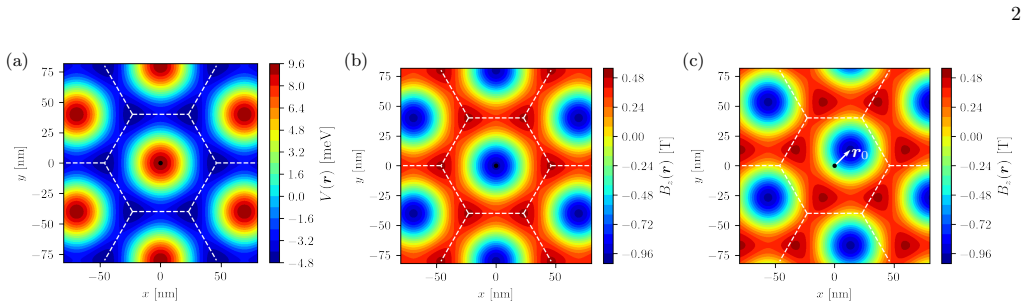
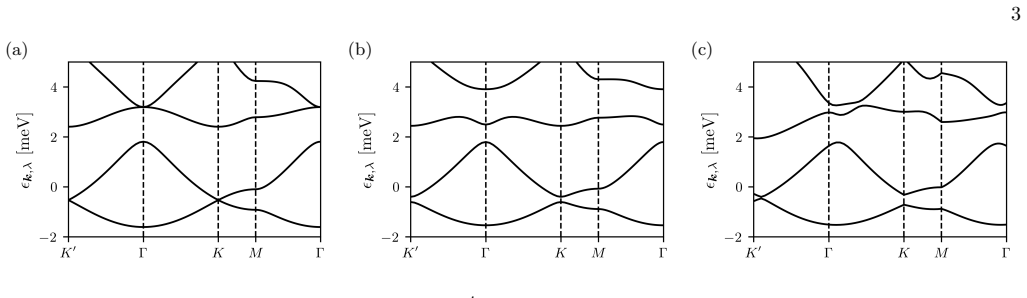
The dashed black lines outline the hexagonal UC of the direct lattice. Band structure and topological phase diagram.—Using a plane-wave expansion (see Sec. S1 of the Supplemental Material (SM) [38]), one can diagonalize ˆHand obtain the band dispersionϵ k,λ, whereλrepresents the band in- dex (λ= 1 denoting the lowest band). Fig. 2 shows three representati...
-
[3]
We shall see below that an analogy with the Haldane model can be drawn by introducing a low-energy effective model of the Hamiltonian Eq
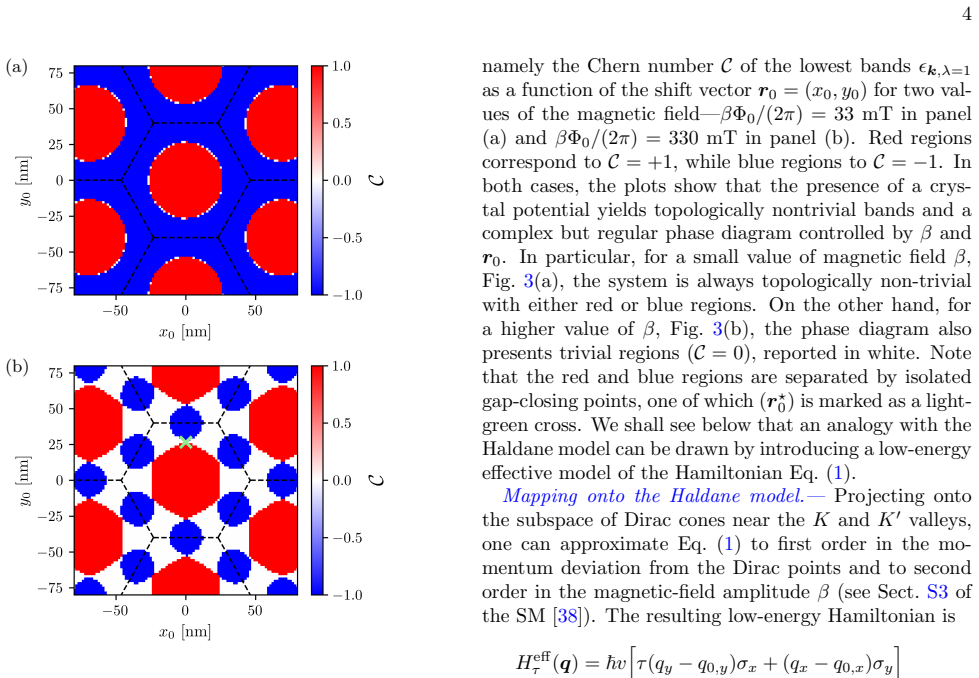
is marked as a light- green cross. We shall see below that an analogy with the Haldane model can be drawn by introducing a low-energy effective model of the Hamiltonian Eq. (1). Mapping onto the Haldane model.—Projecting onto the subspace of Dirac cones near theKandK ′ valleys, one can approximate Eq. (1) to first order in the mo- mentum deviation from th...
-
[4]
To make this argument quantitative, we use the ap- proximate expressions (15a) and (15b) and expandm H andm S aboutr ⋆
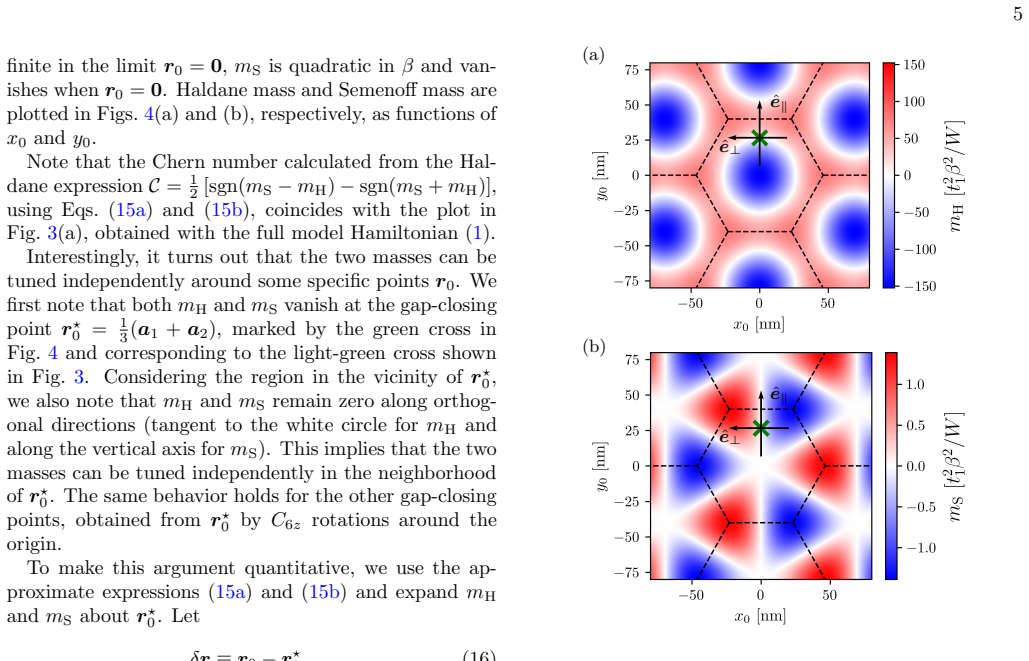
The same behavior holds for the other gap-closing points, obtained fromr ⋆ 0 byC 6z rotations around the origin. To make this argument quantitative, we use the ap- proximate expressions (15a) and (15b) and expandm H andm S aboutr ⋆
-
[5]
Non-equilibrium coherent thermal effects in quantum systems
Let δr≡r 0 −r ⋆ 0 ,(16) and define unit vectors that are parallel and perpendic- ular tor ⋆ 0 (see Fig. 4), ˆe∥ ≡ r⋆ 0 |r⋆ 0| , ˆe⊥ such that ˆe⊥ · ˆe∥ = 0,(17) so that δr=δ ∥ ˆe∥ +δ ⊥ ˆe⊥ .(18) Expanding the Haldane mass (15a) inδryields mH(r⋆ 0 +δr) = 2πt1 a0 β δ∥ +O(δ 2 ∥, δ2 ⊥),(19) the leading term beingO(δ ∥). In particular, notice that there is no ...
2022
-
[6]
parity anomaly
F. D. M. Haldane, Model for a quantum Hall effect with- out Landau levels: Condensed-matter realization of the “parity anomaly”, Phys. Rev. Lett.61, 2015 (1988)
2015
-
[7]
Jotzu, M
G. Jotzu, M. Messer, R. Desbuquois, M. Lebrat, T. Uehlinger, D. Greif, and T. Esslinger, Experimental real- ization of the topological Haldane model with ultracold fermions, Nature515, 237 (2014)
2014
-
[8]
Qi and S.-C
X.-L. Qi and S.-C. Zhang, Topological insulators and su- perconductors, Rev. Mod. Phys.83, 1057 (2011)
2011
-
[9]
Wright, Realising Haldane’s vision for a Chern insu- lator in buckled lattices
A. Wright, Realising Haldane’s vision for a Chern insu- lator in buckled lattices. Sci. Rep.3, 2736 (2013)
2013
-
[10]
Kim and H.-Y
H.-S. Kim and H.-Y. Kee, Realizing Haldane model in Fe- based honeycomb ferromagnetic insulators, npj Quant. Mater.2, 20 (2017)
2017
-
[11]
Y.-H. Ho, E. V. Castro, and M. A. Cazalilla, Haldane model under nonuniform strain Phys. Rev. B96, 155446 (2017)
2017
-
[12]
Nagaosa, J
N. Nagaosa, J. Sinova, S. Onoda, A. H. MacDonald, and N. P. Ong, Anomalous Hall effect, Rev. Mod. Phys.82, 1539 (2010)
2010
-
[13]
R. Yu, W. Zhang, H.-J. Zhang, S.-C. Zhang, X. Dai, and Z. Fang, Quantized anomalous Hall effect in magnetic topological insulators, Science329, 61 (2010)
2010
-
[14]
Chang, J
C.-Z. Chang, J. Zhang, X. Feng, J. Shen, Z. Zhang, M. Guo, K. Li, Y. Ou, P. Wei, L.-L. Wang, Z.-Q. Ji, Y. Feng, S. Ji, X. Chen, J. Jia, X. Dai, Z. Fang, S.-C. Zhang, K. He, Y. Wang, L. Lu, X.-C. Ma, and Q.-K. Xue, Ex- perimental observation of the quantum anomalous Hall effect in a magnetic topological insulator, Science340, 167 (2013)
2013
-
[15]
Chang, W
C.-Z. Chang, W. Zhao, D. Y. Kim, H. Zhang, B. A. Assaf, D. Heiman, S.-C. Zhang, C. Liu, M. H. W. Chan, and J. S. Moodera High-precision realization of robust quantum anomalous Hall state in a hard ferromagnetic topological insulator, Nat. Mater.14, 473 (2015)
2015
-
[16]
Y. Deng, Y. Yu, M. Z. Shi, Z. Guo, Z. Xu, J. Wang, X. H. Chen, and Y. Zhang, Quantum anomalous Hall effect in intrinsic magnetic topological insulator MnBi 2Te4, Sci- ence367, 895 (2020)
2020
-
[17]
Y.-F. Zhao, R. Zhang, R. Mei, L.-J. Zhou, H. Yi, Y.- Q. Zhang, J. Yu1, R. Xiao, K. Wang, N. Samarth, M. H. W. Chan, C.-X. Liu, and C.-Z. Chang, Tuning the Chern number in quantum anomalous Hall insula- tors, Nature588, 419 (2020)
2020
-
[18]
Y.-F. Zhao, R. Zhang, J. Cai, D. Zhuo, L.-J. Zhou, Z.- J. Yan, M. H. W. Chan, X. Xu, and C.-Z. Chang, Nat. Commun.14, 770 (2023)
2023
-
[19]
A. L. Sharpe, E. J. Fox, A. W. Barnard, J. Finney, K. Watanabe, T. Taniguchi, M. A. Kastner, and D. Goldhaber-Gordon, Emergent ferromagnetism near three-quarters filling in twisted bilayer graphene, Sci- ence365, 605 (2019)
2019
-
[20]
Serlin, C
M. Serlin, C. L. Tschirhart, H. Polshyn, Y. Zhang, J. Zhu, K. Watanabe, T. Taniguchi, L. Balents, and A. F. Young, Intrinsic quantized anomalous Hall effect in a moir´ e heterostructure, Science367, 900 (2020)
2020
-
[21]
G. Chen, A. L. Sharpe, E. J. Fox, Y.-H. Zhang, S. Wang, L. Jiang, B. Lyu, H. Li, K. Watanabe, T. Taniguchi, Z. Shi, T. Senthil, D. Goldhaber-Gordon, Y. Zhang, and F. Wang, Tunable correlated Chern insulator and ferromag- netism in a moir´ e superlattice, Nature579, 56 (2020)
2020
-
[22]
W. Zhao, K. Kang, Y. Zhang, P. Kn¨ uppel, Z. Tao, L. Li, C. L. Tschirhart, E. Redekop, K. Watanabe, T. Taniguchi, A. F. Young, J. Shan, and K. F. Mak, Real- ization of the Haldane Chern insulator in a moir´ e lattice. Nat. Phys.20, 275 (2024)
2024
-
[23]
M. J. Manfra, Molecular beam epitaxy of ultra- high-quality AlGaAs/GaAs heterostructures: Enabling physics in low-dimensional electronic systems, Annu. Rev. Condens. Matter Phys.5, 347 (2014)
2014
-
[24]
Y. J. Chung, K. A. Villegas Rosales, K. W. Baldwin, P. T. Madathil, K. W. West, M. Shayegan, and L. N. Pfeiffer, Ultra-high-quality two-dimensional electron sys- tems, Nat. Mater.20, 632 (2021)
2021
-
[25]
Park and S
C.-H. Park and S. G. Louie, Making massless Dirac fermions from a patterned two-dimensional electron gas, Nano Lett.9, 1793 (2009). 7
2009
-
[26]
Gibertini, A
M. Gibertini, A. Singha, V. Pellegrini, M. Polini, G. Vi- gnale, A. Pinczuk, L. N. Pfeiffer, and K. W. West, Engi- neering artificial graphene in a two-dimensional electron gas, Phys. Rev. B79, 241406(R) (2009)
2009
-
[27]
Polini, F
M. Polini, F. Guinea, M. Lewenstein, H. C. Manoharan, and V. Pellegrini, Artificial honeycomb lattices for elec- trons, atoms and photons, Nat. Nanotech.8, 625 (2013)
2013
-
[28]
Soibel, U
A. Soibel, U. Meirav, D. Mahalu, and H. Shtrikman, Fabrication and transport measurements of honeycomb surface superlattices, Semicond. Sci. Technol.11, 1756 (1996)
1996
-
[29]
Scarabelli, S
D. Scarabelli, S. Wang, A. Pinczuk, S. J. Wind, Y. Y. Kuznetsova, L. N. Pfeiffer, K. West, G. C. Gardner, M. J. Manfra, and V. Pellegrini, Fabrication of artificial graphene in a GaAs quantum well, J. Vac. Sci. Technol. B33, 06FG03 (2015)
2015
-
[30]
S. Wang, D. Scarabelli, Y. Y. Kuznetsova, S. J. Wind, A. Pinczuk, V. Pellegrini, M. J. Manfra, G. C. Gard- ner, L. N. Pfeiffer, and K. W. West, Observation of elec- tron states of small period artificial graphene in nano- patterned GaAs quantum wells, Appl. Phys. Lett.109, 113101 (2016)
2016
-
[31]
S. Wang, D. Scarabelli, L. Du, Y. Y. Kuznetsova, L. N. Pfeiffer, K. W. West, G. C. Gardner, M. J. Manfra, V. Pellegrini, S. J. Wind, and A. Pinczuk, Observa- tion of Dirac bands in artificial graphene in small-period nanopatterned GaAs quantum wells, Nat. Nanotech13, 29 (2018)
2018
-
[32]
L. Du, Z. Liu, S. Wind, V. Pellegrini, K. West, S. Fal- lahi, L. Pfeiffer, M. Manfra, and A. Pinczuk, Observation of flat bands in gated semiconductor artificial graphene, Phys. Rev. Lett.126, 106402 (2021)
2021
-
[33]
De Simoni, A
G. De Simoni, A. Singha, M. Gibertini, B. Karmakar, M. Polini, V. Piazza, L. N. Pfeiffer, K. W. West, F. Bel- tram, and V. Pellegrini Delocalized-localized transition in a semiconductor two-dimensional honeycomb lattice, Appl. Phys. Lett.97, 132113 (2010)
2010
-
[34]
Singha, M
A. Singha, M. Gibertini, B. Karmakar, S. Yuan, M. Polini, G. Vignale, M. I. Katsnelson, A. Pinczuk, L. N. Pfeiffer, K. W. West, and V. Pellegrini, Two-dimensional Mott-Hubbard electrons in an artificial honeycomb lat- tice, Science332, 1176 (2011)
2011
-
[35]
D. Q. Wang, Z. Krix, O. A. Tkachenko, V. A. Tkachenko, C. Chen, I. Farrer, D. A. Ritchie, O. P. Sushkov, A. R. Hamilton, and O. Klochan, Artificial electrostatic crys- tals: A new platform for creating correlated quantum states, Preprint at arXiv:2402.12769
-
[36]
H. A. Carmona, A. K. Geim, A. Nogaret, P. C. Main, T. J. Foster, M. Henini, S. P. Beaumont, and M. G. Blamire, Two-dimensional electrons in a lateral magnetic superlattice, Phys. Rev. Lett.74, 3009 (1995)
1995
-
[37]
D. Ye, D. Weiss, R. R. Gerhardts, M. Seeger, K. von Kl- itzing, K. Eberl, and H. Nickel, Electrons in a periodic magnetic field induced by a regular array of micromag- nets, Phys. Rev. Lett.74, 3013 (1995)
1995
-
[38]
Nogaret, Electron dynamics in inhomogeneous mag- netic fields, J
A. Nogaret, Electron dynamics in inhomogeneous mag- netic fields, J. Phys.: Condens. Matter22, 253201 (2010)
2010
-
[39]
J. N. Engdahl, A. C. Keser, T. Schmidt, and O. P. Sushkov, Driving viscous hydrodynamics in bulk elec- tron flow in graphene using micromagnets, Phys. Rev. B109, 195402 (2024)
2024
-
[40]
P. M. T. Vianez, Y. Jin, W. K. Tan, Q. Liu, J. P. Griffiths, I. Farrer, D. A. Ritchie, O. Tsyplyatyev, and C. J. B. Ford, Decoupling of the many-body effects from the electron mass in GaAs by means of reduced dimen- sionality, Phys. Rev. B107, 115128 (2023)
2023
-
[41]
Z. E. Krix, H. D. Scammell, and O. P. Sushkov, Corre- lated physics in an artificial triangular anti-dot lattice, Phys. Rev. B105, 075120 (2022)
2022
-
[42]
Taillefumier, V
M. Taillefumier, V. K. Dugaev, B. Canals, C. Lacroix, and P. Bruno, Chiral two-dimensional electron gas in a periodic magnetic field: Persistent current and quantized anomalous Hall effect, Phys. Rev. B78, 155330 (2008)
2008
-
[43]
(1), the calculation of the Chern num- ber, the detailedK-point three-plane-wave expansion used to derive the low-energy Hamiltonian of Eq
See the Supplemental Material file for more details on the plane-wave expansion method used to diagonalize the Hamiltonian of Eq. (1), the calculation of the Chern num- ber, the detailedK-point three-plane-wave expansion used to derive the low-energy Hamiltonian of Eq. (14), and results concerning the topological phase diagram for different periodic magne...
-
[44]
Simulating the Haldane model on ultra-clean GaAs heterostructures
B. A. Bernevig and T. L. Hughes,Topological Insula- tors and Superconductors(Princeton University Press, Princeton and Oxford, 2013) 1 Supplemental Material for: “Simulating the Haldane model on ultra-clean GaAs heterostructures” Francesco Cioni,1 Lorenzo Cavicchi,2 Fabio Taddei,3 Marco Polini4,5 1 NEST, Scuola Normale Superiore, I-56126 Pisa, Italy 2 Scu...
2013
discussion (0)
Sign in with ORCID, Apple, or X to comment. Anyone can read and Pith papers without signing in.