Fractional Magnonic Frequency Combs
Pith reviewed 2026-06-25 22:46 UTC · model grok-4.3
The pith
Adding a low-power detuned microwave compresses magnonic comb spacings to rational fractions via three-magnon scattering.
A machine-rendered reading of the paper's core claim, the machinery that carries it, and where it could break.
Core claim
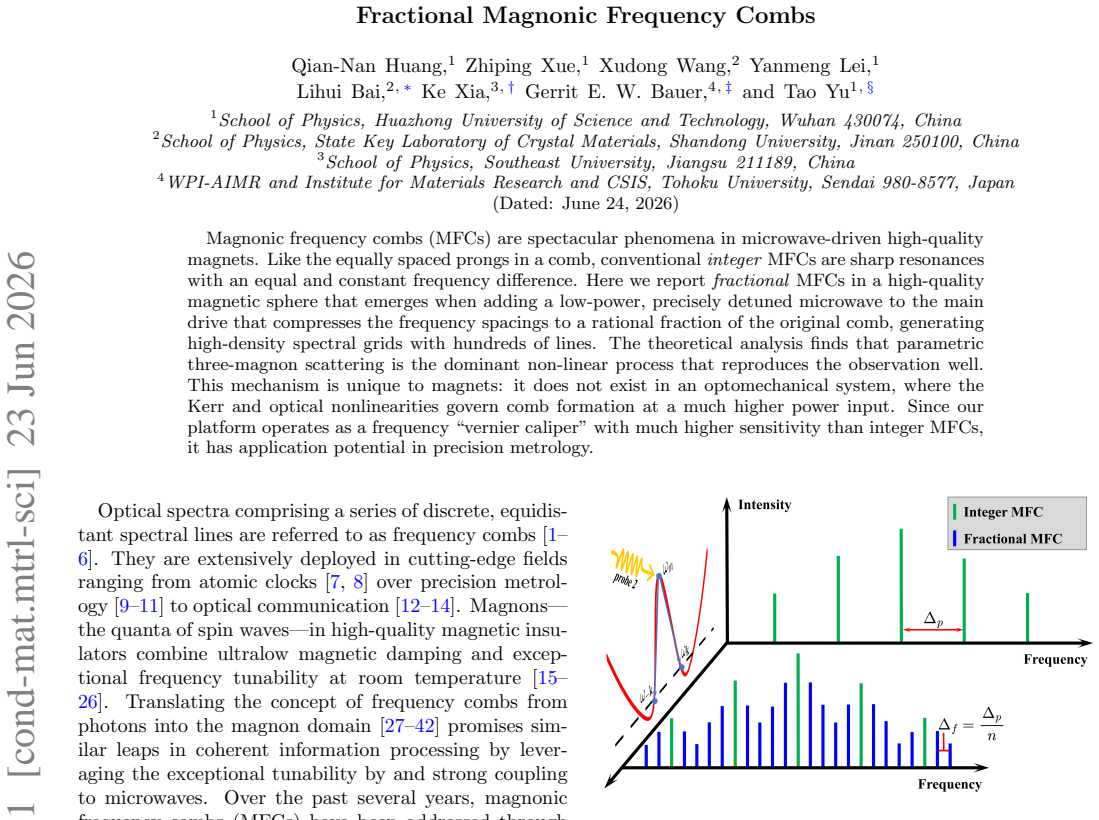
In a high-quality magnetic sphere, microwave driving produces integer magnonic frequency combs with equal spacing. Adding a low-power, precisely detuned secondary microwave compresses these spacings to a rational fraction of the original, generating high-density spectral grids with hundreds of lines. Theoretical analysis shows that parametric three-magnon scattering is the dominant nonlinear process reproducing the observations, a mechanism unique to magnets that does not exist in optomechanical systems where Kerr and optical nonlinearities require much higher power.
What carries the argument
Parametric three-magnon scattering: the nonlinear magnon interaction process that dominates at low power and enables the rational compression of frequency spacings when the detuned drive is present.
If this is right
- The platform operates as a frequency vernier caliper with much higher sensitivity than integer MFCs.
- High-density spectral grids with hundreds of lines become accessible at low input power.
- The mechanism remains unique to magnetic systems and does not appear in optomechanical combs.
- The approach enables precision metrology applications through the compressed fractional spacings.
Where Pith is reading between the lines
- Similar detuning techniques could be tested in other spin-wave or magnon systems to produce even denser fractional grids.
- The low-power operation might allow integration with existing microwave measurement setups for routine frequency calibration.
- Exploring different sphere sizes or materials could reveal how the fractional ratio depends on material parameters.
Load-bearing premise
The high-quality magnetic sphere and precise detuning of the secondary microwave allow three-magnon scattering to dominate the nonlinear dynamics at low power without interference from other processes.
What would settle it
Varying the detuning or power of the secondary microwave in the same sphere and observing that the resulting spectrum either fails to form lines at rational fractional spacings or requires higher power for the effect to appear.
Figures
read the original abstract
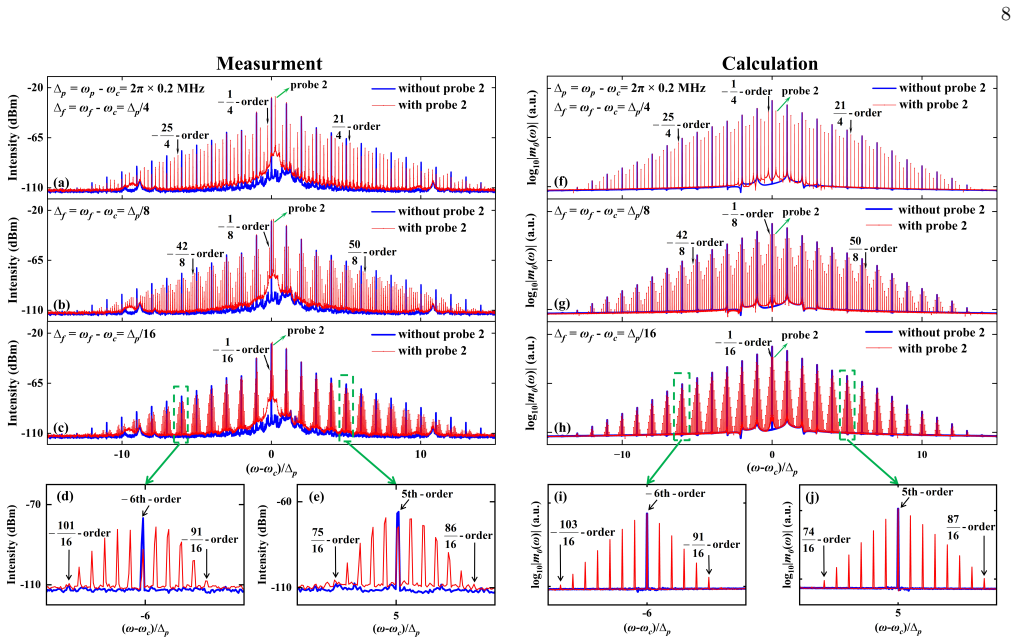
Magnonic frequency combs (MFCs) are spectacular phenomena in microwave-driven high-quality magnets. Like the equally spaced prongs in a comb, conventional \textit{integer} MFCs are sharp resonances with an equal and constant frequency difference. Here we report \textit{fractional} MFCs in a high-quality magnetic sphere that emerges when adding a low-power, precisely detuned microwave to the main drive that compresses the frequency spacings to a rational fraction of the original comb, generating high-density spectral grids with hundreds of lines. The theoretical analysis finds that parametric three-magnon scattering is the dominant non-linear process that reproduces the observation well. This mechanism is unique to magnets: it does not exist in an optomechanical system, where the Kerr and optical nonlinearities govern comb formation at a much higher power input. Since our platform operates as a frequency ``vernier caliper" with much higher sensitivity than integer MFCs, it has application potential in precision metrology.
Editorial analysis
A structured set of objections, weighed in public.
Referee Report
Summary. The paper reports the observation of fractional magnonic frequency combs in a high-quality magnetic sphere. Adding a low-power, precisely detuned secondary microwave to the main drive compresses the comb spacings to a rational fraction of the original, producing high-density grids with hundreds of lines. Parametric three-magnon scattering is identified as the dominant nonlinear process that reproduces the observations, a mechanism absent in optomechanical systems.
Significance. If the result holds, the work introduces a low-power route to dense spectral grids in magnonics with enhanced sensitivity compared to integer combs, offering a frequency vernier for precision metrology. The explicit distinction from Kerr/optical nonlinearities in other platforms is a useful conceptual contribution.
minor comments (2)
- [Theoretical analysis section] The abstract states that the three-magnon model reproduces the data well; the main text should include a dedicated subsection with the explicit model equations, fitting procedure, and quantitative error metrics to support this claim.
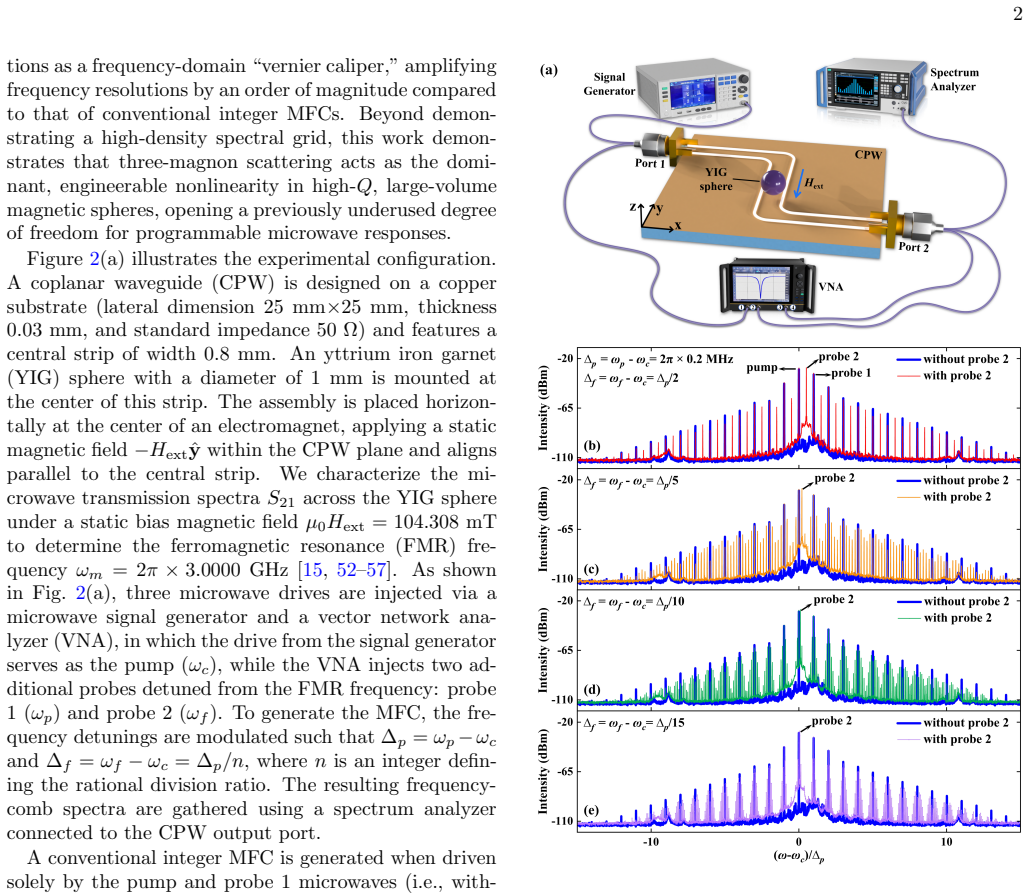
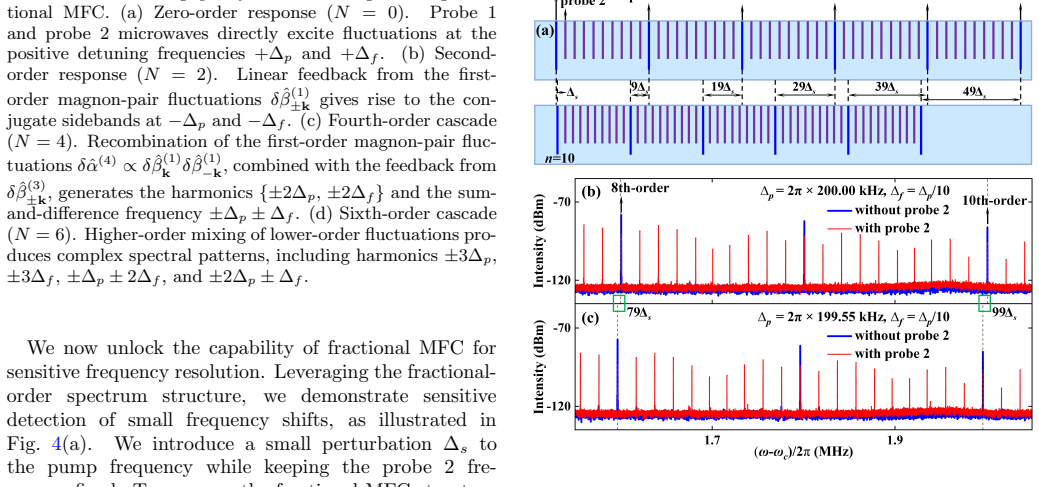
- Figure captions and axis labels should explicitly state the observed number of lines, the exact detuning values, and the power levels used in the fractional-comb experiments.
Simulated Author's Rebuttal
We thank the referee for the positive summary, recognition of the significance of fractional magnonic frequency combs, and the recommendation for minor revision. No specific major comments appear in the report provided.
Circularity Check
No significant circularity detected
full rationale
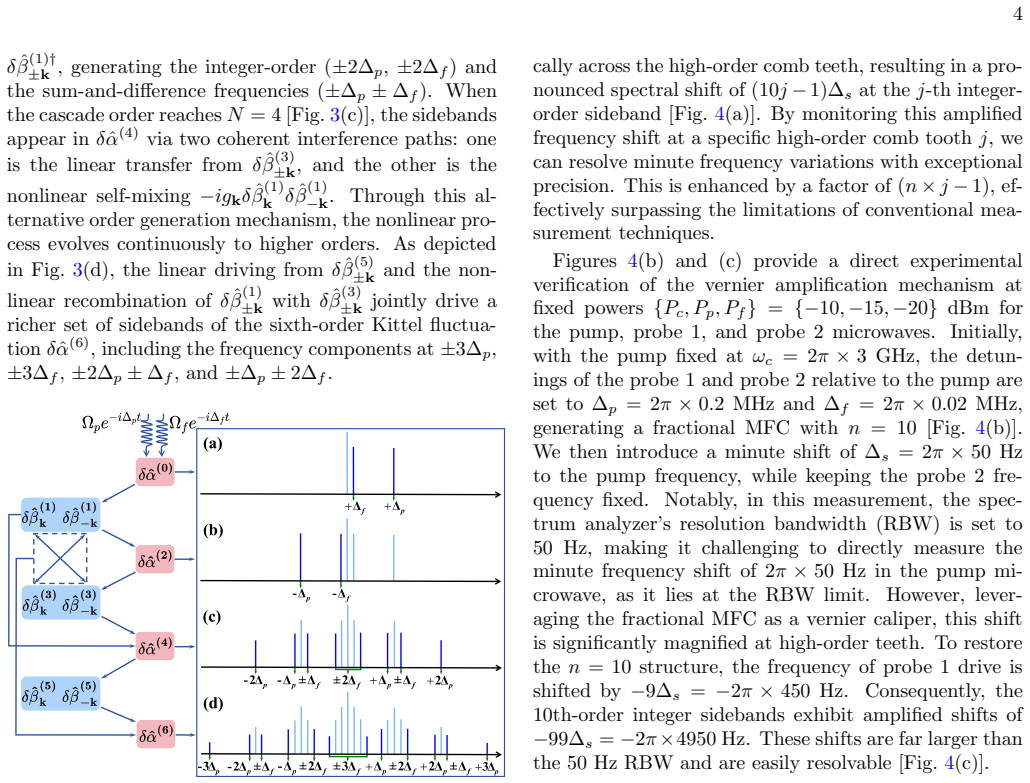
The paper reports an experimental observation of fractional magnonic frequency combs under dual microwave drive and attributes the compressed spacings to parametric three-magnon scattering via standard nonlinear magnon dynamics. No derivation chain reduces a claimed prediction or uniqueness result to a fitted parameter or self-citation by construction; the theoretical reproduction is a physical model applied to measured spectra rather than a tautological renaming or ansatz smuggled through prior work. The distinction from optomechanics is presented as a material-specific property, not a load-bearing mathematical necessity. The derivation remains self-contained against external benchmarks of magnon scattering theory.
Axiom & Free-Parameter Ledger
axioms (1)
- domain assumption Parametric three-magnon scattering is the dominant nonlinear process
Reference graph
Works this paper leans on
-
[1]
T. Udem, R. Holzwarth, and T. W. H¨ ansch, Optical frequency metrology, Nature 416, 233 (2002)
2002
-
[2]
S. T. Cundiff and J. Ye, Colloquium: Femtosecond opti- cal frequency combs, Rev. Mod. Phys. 75, 325 (2003)
2003
-
[3]
T. W. H¨ ansch, Nobel lecture: Passion for precision, Rev. Mod. Phys. 78, 1297 (2006)
2006
-
[4]
Del ´Haye, A
P. Del ´Haye, A. Schliesser, O. Arcizet, T. Wilken, R. Holzwarth, and T. J. Kippenberg, Optical frequency comb generation from a monolithic microresonator, Na- ture 450, 1214 (2007)
2007
-
[5]
Fortier and E
T. Fortier and E. Baumann, 20 years of developments in optical frequency comb technology and applications, Commun. Phys. 2 (2019)
2019
-
[6]
Hillbrand, D
J. Hillbrand, D. Auth, M. Piccardo, N. Opaˇ cak, E. Gornik, G. Strasser, F. Capasso, S. Breuer, and B. Schwarz, In-phase and anti-phase synchronization in a laser frequency comb, Phys. Rev. Lett. 124, 023901 (2020)
2020
-
[7]
S. B. Papp, K. Beha, P. Del ´Haye, F. Quinlan, H. Lee, K. J. Vahala, and S. A. Diddams, Microresonator fre- quency comb optical clock, Optica 1, 10 (2014)
2014
-
[8]
A. D. Ludlow, M. M. Boyd, J. Ye, E. Peik, and P. O. Schmidt, Optical atomic clocks, Rev. Mod. Phys. 87, 637 (2015)
2015
-
[9]
J. L. Hall, Nobel lecture: Defining and measuring optical frequencies, Rev. Mod. Phys. 78, 1279 (2006)
2006
-
[10]
Trocha, M
P. Trocha, M. Karpov, D. Ganin, M. H. P. Pfeiffer, A. Kordts, S. Wolf, J. Krockenberger, P. Marin-Palomo, C. Weimann, and C. Koos, Ultrafast optical ranging us- ing microresonator soliton frequency combs, Science 359, 887 (2018)
2018
-
[11]
J. Wang, Z. Lu, W. Wang, F. Zhang, J. Chen, Y. Wang, J. Zheng, S. T. Chu, W. Zhao, B. E. Little, X. Qu, and W. Zhang, Long-distance ranging with high precision us- ing a soliton microcomb, Photonics Res. 8, 1964 (2020)
1964
-
[12]
Marin-Palomo, J
P. Marin-Palomo, J. N. Kemal, M. Karpov, A. Kordts, J. Pfeifle, M. H. P. Pfeiffer, P. Trocha, S. Wolf, V. Brasch, M. H. Anderson, R. Rosenberger, K. Vijayan, W. Freude, T. J. Kippenberg, and C. Koos, Microresonator-based solitons for massively parallel coherent optical communi- cations, Nature 546, 274 (2017)
2017
-
[13]
J. Tan, Z. Zhao, Y. Wang, Z. Zhang, J. Liu, and N. Zhu, 12.5 gb/s multi-channel broadcasting transmission for free-space optical communication based on the optical frequency comb module, Opt. Express 26, 2099 (2018)
2099
-
[14]
Corcoran, M
B. Corcoran, M. Tan, X. Xu, A. Boes, J. Wu, T. G. Nguyen, S. T. Chu, B. E. Little, R. Morandotti, A. Mitchell, and D. J. Moss, Ultra-dense optical data transmission over standard fibre with a single chip source, Nat. Commun. 11, 2568 (2020)
2020
-
[15]
A. A. Serga, A. V. Chumak, and B. Hillebrands, Yig magnonics, J. Phys. D 43, 264002 (2010)
2010
-
[16]
B. Lenk, H. Ulrichs, F. Garbs, and M. Muenzenberg, The building blocks of magnonics, Phys. Rep. 507, 107 (2011)
2011
-
[17]
G. E. W. Bauer, E. Saitoh, and B. J. van Wees, Spin caloritronics, Nat. Mater. 11, 391 (2012)
2012
-
[18]
A. V. Chumak, V. I. Vasyuchka, A. A. Serga, and B. Hillebrands, Magnon spintronics, Nat. Phys. 11, 453 (2015)
2015
-
[19]
Grundler, Nanomagnonics around the corner, Nat
D. Grundler, Nanomagnonics around the corner, Nat. Nanotechnol. 11, 407 (2016)
2016
-
[20]
V. E. Demidov, S. Urazhdin, G. de Loubens, O. Klein, V. Cros, A. Anane, and S. O. Demokritov, Magnetiza- tion oscillations and waves driven by pure spin currents, 6 Phys. Rep. 673, 1 (2017)
2017
-
[21]
Wang, G.-Q
Y.-P. Wang, G.-Q. Zhang, D. Zhang, T.-F. Li, C.-M. Hu, and J. Q. You, Bistability of cavity magnon polaritons, Phys. Rev. Lett. 120, 057202 (2018)
2018
-
[22]
Manchon, J
A. Manchon, J. ˇZelezn´ y, I. M. Miron, T. Jungwirth, J. Sinova, A. Thiaville, K. Garello, and P. Gambardella, Current-induced spin-orbit torques in ferromagnetic and antiferromagnetic systems, Rev. Mod. Phys. 91, 035004 (2019)
2019
-
[23]
H. Wang, J. Chen, T. Liu, J. Zhang, K. Baumgaertl, C. Guo, Y. Li, C. Liu, P. Che, S. Tu, S. Liu, P. Gao, X. Han, D. Yu, M. Wu, D. Grundler, and H. Yu, Chiral spin-wave velocities induced by all-garnet inter- facial dzyaloshinskii-moriya interaction in ultrathin yt- trium iron garnet films, Phys. Rev. Lett. 124, 027203 (2020)
2020
-
[24]
Shen, G.-T
Z. Shen, G.-T. Xu, M. Zhang, Y.-L. Zhang, Y. Wang, C.- Z. Chai, C.-L. Zou, G.-C. Guo, and C.-H. Dong, Coher- ent coupling between phonons, magnons, and photons, Phys. Rev. Lett. 129, 243601 (2022)
2022
-
[25]
T. Yu, J. Zou, B. Zeng, J. W. Rao, and K. Xia, Non- hermitian topological magnonics, Phys. Rep. 1062, 1 (2024)
2024
-
[26]
N. J. Lambert, A. Schumer, J. J. Longdell, S. Rot- ter, and H. G. L. Schwefel, Coherent control of magnon–polaritons using an exceptional point, Nat. Phys. 21, 1570 (2025)
2025
-
[27]
Z.-X. Liu, B. Wang, H. Xiong, and Y. Wu, Magnon- induced high-order sideband generation, Opt. Lett. 43, 3698 (2018)
2018
-
[28]
Z. Wang, H. Y. Yuan, Y. Cao, Z.-X. Li, R. A. Duine, and P. Yan, Magnonic frequency comb through nonlin- ear magnon-skyrmion scattering, Phys. Rev. Lett. 127, 037202 (2021)
2021
-
[29]
T. Hula, K. Schultheiss, F. J. T. Gon¸ calves, L. K¨ orber, M. Bejarano, M. Copus, L. Flacke, L. Liensberger, A. Buzdakov, A. K´ akay, M. Weiler, R. Camley, J. Fass- bender, and H. Schultheiss, Spin-wave frequency combs, Appl. Phys. Lett. 121, 112404 (2022)
2022
-
[30]
J. Sun, S. Shi, and J. Wang, Strain modulation of magnonic frequency comb by magnon–skyrmion interac- tion in ferromagnetic materials, Adv. Eng. Mater. 24, 2101245 (2022)
2022
-
[31]
Xiong, Magnonic frequency combs based on the reso- nantly enhanced magnetostrictive effect, Fundam Res 3, 8 (2023)
H. Xiong, Magnonic frequency combs based on the reso- nantly enhanced magnetostrictive effect, Fundam Res 3, 8 (2023)
2023
-
[32]
Z.-X. Liu, J. Peng, and H. Xiong, Generation of magnonic frequency combs via a two-tone microwave drive, Phys. Rev. A 107, 053708 (2023)
2023
-
[33]
G.-T. Xu, M. Zhang, Y. Wang, Z. Shen, G.-C. Guo, and C.-H. Dong, Magnonic frequency comb in the magnome- chanical resonator, Phys. Rev. Lett. 131, 243601 (2023)
2023
-
[34]
J. W. Rao, B. Yao, C. Y. Wang, C. Zhang, T. Yu, and W. Lu, Unveiling a pump-induced magnon mode via its strong interaction with walker modes, Phys. Rev. Lett. 130, 046705 (2023)
2023
-
[35]
Y. Liu, T. Liu, Q. Yang, G. Tian, Z. Hou, D. Chen, Z. Fan, M. Zeng, X. Lu, X. Gao, M. Qin, and J. Liu, Design of controllable magnon frequency comb in syn- thetic ferrimagnets, Phys. Rev. B 109, 174412 (2024)
2024
-
[36]
Wu, H.-J
Q. Wu, H.-J. Sun, Y.-D. Chen, and Z.-X. Liu, Microwave frequency combs through the rotational enhanced mag- netostrictive effect, Phys. Rev. A 110, 023507 (2024)
2024
-
[37]
Liu, Dissipative coupling induced UWB magnonic frequency comb generation, Appl
Z.-X. Liu, Dissipative coupling induced UWB magnonic frequency comb generation, Appl. Phys. Lett. 124, 032403 (2024)
2024
-
[38]
C. Wang, J. Rao, Z. Chen, K. Zhao, L. Sun, B. Yao, T. Yu, Y.-P. Wang, and W. Lu, Enhancement of magnonic frequency combs by exceptional points, Nat. Phys. 20, 1139 (2024)
2024
-
[39]
Liu, K.-K
Y. Liu, K.-K. Zhang, R.-S. Zhao, X. Fei, X. Liu, Z. Jia, X. Liu, and X.-T. Xie, Nonreciprocal frequency combs by two-photon driving in cavity magnonics, Opt. Lett. 50, 4234 (2025)
2025
-
[40]
Wang, X.-H
B. Wang, X.-H. Lu, X. Jia, and H. Xiong, Mechanically induced magnonic frequency combs via the magnetostric- tive effect, Phys. Rev. A 111, 063703 (2025)
2025
-
[41]
Lan, K.-Y
G. Lan, K.-Y. Liu, Z. Wang, F. Xia, H. Xu, T. Guo, Y. Zhang, B. He, J. Li, C. Wan, G. E. W. Bauer, P. Yan, G.-Q. Liu, X.-Y. Pan, X. Han, and G. Yu, Coherent harmonic generation of magnons in spin textures, Nat. Commun. 16, 1178 (2025)
2025
-
[42]
Heins, L
C. Heins, L. K¨ orber, J.-V. Kim, T. Devolder, J. H. Mentink, A. K¨ akay, J. Fassbender, K. Schultheiss, and H. Schultheiss, Self-induced Floquet magnons in mag- netic vortices, Science 391, 190 (2026)
2026
-
[43]
J.-H. Liu, G. He, Q. Wu, Y.-F. Yu, J.-D. Wang, and Z.-M. Zhang, Fraction-order sideband generation in an optomechanical system, Opt. Lett. 45, 5169 (2020)
2020
-
[44]
Liu, Y.-F
J.-H. Liu, Y.-F. Yu, Q. Wu, J.-D. Wang, and Z.-M. Zhang, Tunable high-order sideband generation in a cou- pled double-cavity optomechanical system, Opt. Express 29, 12266 (2021)
2021
-
[45]
S. Liu, Y. Li, Z. Song, S. Zhou, J. Wang, and B. Liu, Mul- tiple frequency combs via pump modulation in a three- mode optomechanical system, Opt. Express 33, 7016 (2025)
2025
-
[46]
Wang, K.-W
X. Wang, K.-W. Huang, Q.-Y. Qiu, and H. Xiong, Nonreciprocal double-carrier frequency combs in cav- ity magnonics, Chaos, Solitons & Fractals 176, 114137 (2023)
2023
-
[47]
Wu, Y.-D
Q. Wu, Y.-D. Chen, and Z.-X. Liu, Fraction-order side- band generation in a driven magnomechanical system, Chaos, Solitons & Fractals 200, 117072 (2025)
2025
-
[48]
L. Zhou, H. Chen, S. Lei, C. Nie, and P. Luo, Magnon-squeezing-enhanced fractional magnonic fre- quency combs in cavity magnomechanics, Opt. Commun. 608, 132995 (2026)
2026
-
[49]
T. Qu, Y. Xiong, X. Zhang, Y. Li, and W. Zhang, Pump- induced magnon anticrossing due to three-magnon split- ting and confluence, Phys. Rev. B 111, L180410 (2025)
2025
-
[50]
Arfini, A
M. Arfini, A. Bermejillo-Seco, A. Bondarenko, C. A. Potts, Y. M. Blanter, H. S. J. van der Zant, and G. A. Steele, Magnon-magnon interaction induced by nonlin- ear spin-wave dynamics, Phys. Rev. Lett. 135, 166703 (2025)
2025
-
[51]
Huang, Z
Q.-N. Huang, Z. Xue, and T. Yu, Observation of long- lifetime magnon pairs by Fano resonance of photons, APL Quantum 3, 026101 (2026)
2026
-
[52]
B. Yao, T. Yu, Y. S. Gui, J. W. Rao, Y. T. Zhao, W. Lu, and C.-M. Hu, Coherent control of magnon radiative damping with local photon states, Commun. Phys.2, 161 (2019)
2019
-
[53]
T. Yu, X. Zhang, S. Sharma, Y. M. Blanter, and G. E. W. Bauer, Chiral coupling of magnons in waveg- uides, Phys. Rev. B 101, 094414 (2020)
2020
-
[54]
B. Z. Rameshti, S. V. Kusminskiy, J. A. Haigh, K. Usami, D. Lachance-Quirion, Y. Nakamura, C.-M. Hu, H. X. 7 Tang, G. E. W. Bauer, and Y. M. Blanter, Cavity magnonics, Phys. Rep. 979, 1 (2022)
2022
-
[55]
L. R. Walker, Magnetostatic modes in ferromagnetic res- onance, Phys. Rev. 105, 390 (1957)
1957
-
[56]
J. F. Dillon, Jr., Ferrimagnetic resonance in yttrium iron garnet, Phys. Rev. 105, 759 (1957)
1957
-
[57]
Gloppe, R
A. Gloppe, R. Hisatomi, Y. Nakata, Y. Nakamura, and K. Usami, Resonant magnetic induction tomography of a magnetized sphere, Phys. Rev. Appl. 12, 014061 (2019)
2019
-
[58]
four-magnon process in frequency combs, and derivation of cascade process of fractional MFCs
Refer to the Supplementary Material [...] for the observa- tion of integer MFCs at different pump powers, the mea- surement of operational upper limits of fractional MFC, the analysis of three-magnon vs. four-magnon process in frequency combs, and derivation of cascade process of fractional MFCs
-
[59]
P. W. Anderson and H. Suhl, Instability in the motion of ferromagnets at high microwave power levels, Phys. Rev. 100, 1788 (1955)
1955
-
[60]
Suhl, The theory of ferromagnetic resonance at high signal powers, J
H. Suhl, The theory of ferromagnetic resonance at high signal powers, J. Phys. Chem. Solids 1, 209 (1957)
1957
-
[61]
L. M. Pecora, Derivation and generalization of the Suhl spin-wave instability relations, Phys. Rev. B 37, 5473 (1988)
1988
-
[62]
Schultheiss, K
H. Schultheiss, K. Vogt, and B. Hillebrands, Direct ob- servation of nonlinear four-magnon scattering in spin- wave microconduits, Phys. Rev. B 86, 054414 (2012)
2012
-
[63]
Pirro, T
P. Pirro, T. Sebastian, T. Br¨ acher, A. A. Serga, T. Kub- ota, H. Naganuma, M. Oogane, Y. Ando, and B. Hille- brands, Non-Gilbert-damping mechanism in a ferromag- netic Heusler compound probed by nonlinear spin dy- namics, Phys. Rev. Lett. 113, 227601 (2014)
2014
-
[64]
P. C. Fletcher and R. O. Bell, Ferrimagnetic resonance modes in spheres, J. Appl. Phys. 30, 687 (1959)
1959
-
[65]
Balucani, F
U. Balucani, F. Barocchi, and V. Tognetti, Three- magnon parametric processes: Damping-modified many- time green’s-function theory, Phys. Rev. B 6, 292 (1972)
1972
-
[66]
C. B. de Araujo and S. M. Rezende, Saturation and co- herence properties of three-magnon nonlinear processes, Phys. Rev. B 9, 3074 (1974)
1974
-
[67]
R.-C. Shen, J. Li, Z.-Y. Fan, Y.-P. Wang, and J. Q. You, Mechanical bistability in kerr-modified cavity magnome- chanics, Phys. Rev. Lett. 129, 123601 (2022)
2022
-
[68]
Wang, G.-Q
Y.-P. Wang, G.-Q. Zhang, D. Zhang, X.-Q. Luo, W. Xiong, S.-P. Wang, T.-F. Li, C.-M. Hu, and J. Q. You, Magnon kerr effect in a strongly coupled cavity- magnon system, Phys. Rev. B 94, 224410 (2016)
2016
-
[69]
Zhang, Y
G. Zhang, Y. Wang, and J. You, Theory of the magnon kerr effect in cavity magnonics, Science China Physics, Mechanics & Astronomy 62, 987511 (2019)
2019
-
[70]
J. C. Slonczewski, Origin of magnetic anisotropy in cobalt-substituted magnetite, Phys. Rev. 110, 1341 (1958)
1958
-
[71]
J. C. Slonczewski, Anisotropy and magnetostriction in magnetic oxides, J. Appl. Phys. 32, S253 (1961)
1961
-
[72]
B. Yao, T. Yu, X. Zhang, W. Lu, Y. Gui, C.-M. Hu, and Y. M. Blanter, The microscopic origin of magnon- photon level attraction by traveling waves: Theory and experiment, Phys. Rev. B 100, 214426 (2019)
2019
-
[73]
Peˇ rina,Quantum Statistics of Linear and Nonlinear Optical Phenomena (Springer Netherlands, Dordrecht, 1991)
J. Peˇ rina,Quantum Statistics of Linear and Nonlinear Optical Phenomena (Springer Netherlands, Dordrecht, 1991)
1991
-
[74]
Liu and Y.-Q
Z.-X. Liu and Y.-Q. Li, Optomagnonic frequency combs, Photon. Res. 10, 2786 (2022)
2022
-
[75]
Ghimire, A
S. Ghimire, A. D. DiChiara, E. Sistrunk, P. Agostini, L. F. DiMauro, and D. A. Reis, Observation of high- order harmonic generation in a bulk crystal, Nature Physics 7, 138 (2011)
2011
-
[76]
X. Mi, J. Rao, L. Yan, X. Wang, B. Lyu, B. Yao, S. Yan, and L. Bai, Ultrasensitive magnetometer based on cusp points of the photon-magnon synchronization mode, Phys. Rev. Lett. 136, 066701 (2026). END MA TTER Disregarding the negligible self-Kerr nonlinearity and accounting for the intrinsic dissipation γ0 for the Kit- tel magnon and γ±k for the magnon pa...
2026
discussion (0)
Sign in with ORCID, Apple, or X to comment. Anyone can read and Pith papers without signing in.