Two-Electron Effects Extend High-Harmonic Generation into the keV Regime
Pith reviewed 2026-06-25 21:54 UTC · model grok-4.3
The pith
Two-electron processes extend high-harmonic generation in helium to 1.2 keV photon energies.
A machine-rendered reading of the paper's core claim, the machinery that carries it, and where it could break.
Core claim
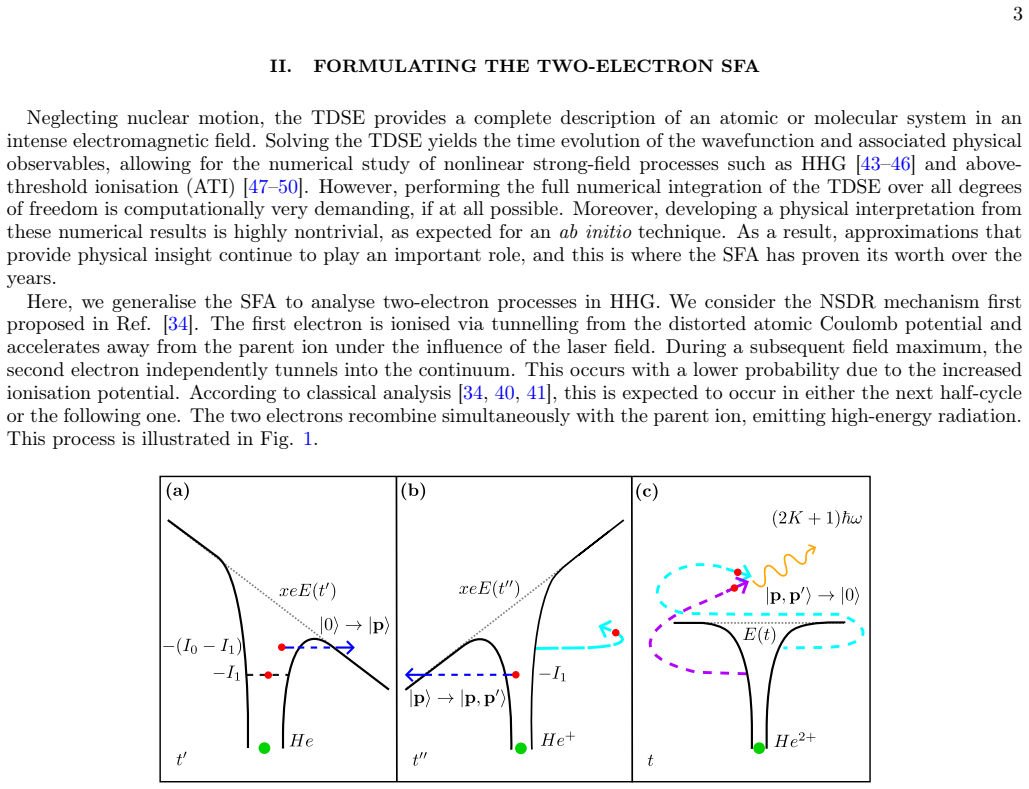
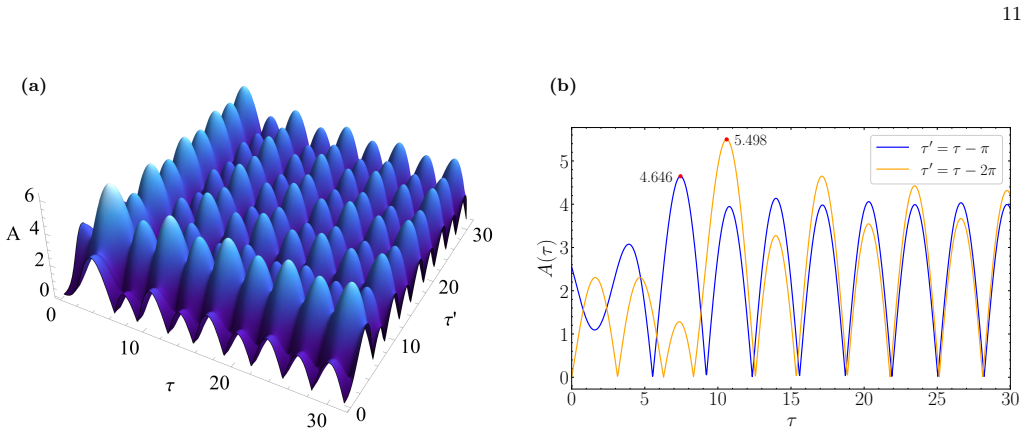
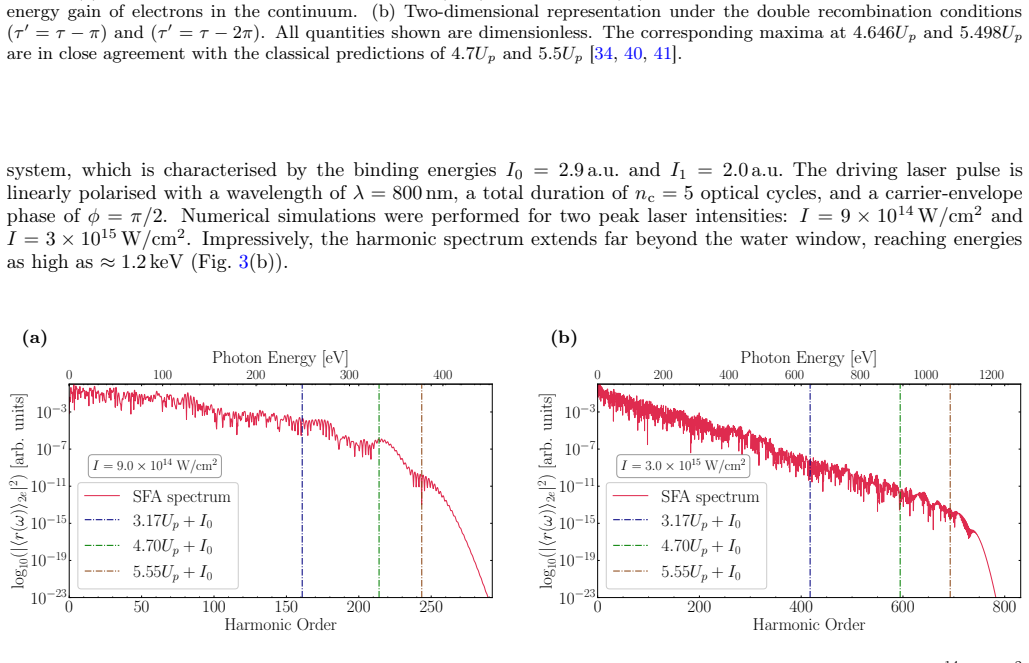
Two-electron processes can generate high harmonics beyond the conventional single-active-electron cutoff. Motivated by recent experimental evidence of an extended secondary plateau in the helium high-harmonic spectrum, we present a two-electron generalisation of the strong-field approximation. We analyse the resulting expressions using the saddle-point method and determine the extended cutoff. We find good agreement with classical predictions of cutoff scalings of 4.7 and 5.5 times the ponderomotive energy, which significantly exceed the established single-electron scaling of 3.17. We calculate high-harmonic spectra generated via a two-electron process in helium atoms driven by an intense fe
What carries the argument
Two-electron generalisation of the strong-field approximation, analyzed with the saddle-point method to extract the extended cutoff energies.
If this is right
- The harmonic spectrum extends far beyond the water window into the soft x-ray region.
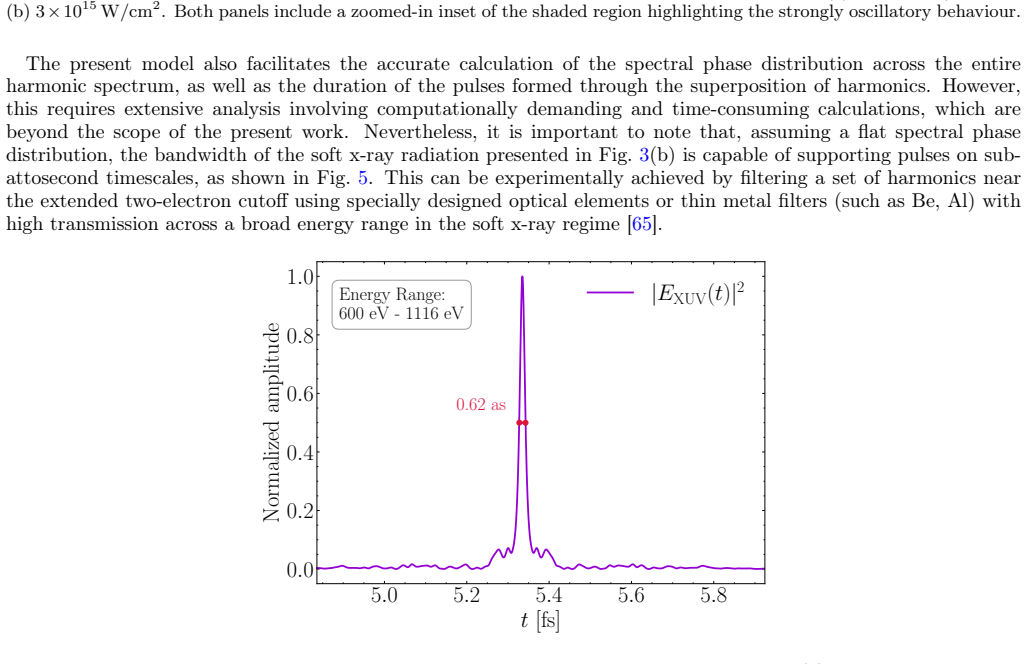
- The large spectral bandwidth supports generation of sub-attosecond soft x-ray pulses.
- Such pulses enable probing of ultrafast dynamics in core-level spectroscopy and biological imaging.
Where Pith is reading between the lines
- Two-electron contributions may appear in other multi-electron atoms under comparable laser conditions.
- Varying laser intensity or pulse duration could map the crossover from single-electron to two-electron dominated regimes.
- The same saddle-point analysis might predict cutoffs for molecules or clusters.
Load-bearing premise
The two-electron generalization of the strong-field approximation, when analyzed with the saddle-point method, correctly captures the dominant physics responsible for the extended cutoff in helium.
What would settle it
An experimental high-harmonic spectrum from helium that terminates at or below 3.17 times the ponderomotive energy, rather than extending to 1.2 keV, would falsify the predicted two-electron extension.
Figures
read the original abstract
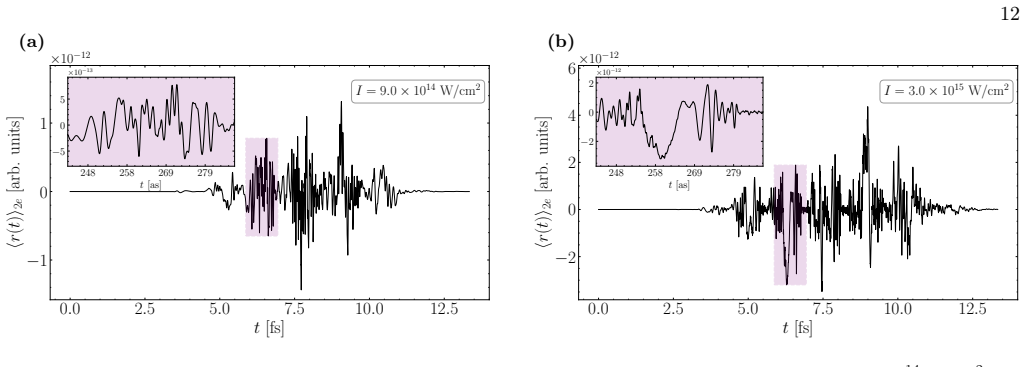
Two-electron processes can generate high harmonics beyond the conventional single-active-electron cutoff. Motivated by recent experimental evidence of an extended secondary plateau in the helium high-harmonic spectrum [S. Wang et al, Optica, (2023); S. Wang et al, In Print in Nature Photon., (2026)], we present a two-electron generalisation of the strong-field approximation. We analyse the resulting expressions using the saddle-point method and determine the extended cutoff. We find good agreement with classical predictions of cutoff scalings of $4.7$ and $5.5$ times the ponderomotive energy, which significantly exceed the established single-electron scaling of 3.17. We calculate high-harmonic spectra generated via a two-electron process in helium atoms driven by an intense few-cycle infrared laser pulse. Our results demonstrate that the harmonic spectrum extends far beyond the water window, reaching photon energies up to $\approx 1.2\,\mathrm{keV}$ in the soft x-ray region. The large spectral bandwidth can support the generation of sub-attosecond soft x-ray pulses, which are of particular interest for probing ultrafast dynamics across matter, including applications in core-level spectroscopy and biological imaging.
Editorial analysis
A structured set of objections, weighed in public.
Referee Report
Summary. The paper presents a two-electron generalization of the strong-field approximation (SFA) for high-harmonic generation (HHG). Using saddle-point analysis of the resulting multi-dimensional action, the authors extract extended cutoffs at 4.7 U_p and 5.5 U_p (exceeding the single-electron 3.17 U_p limit) that agree with classical trajectory predictions. They compute HHG spectra for helium driven by intense few-cycle IR pulses, showing extension to photon energies of approximately 1.2 keV in the soft x-ray regime, motivated by recent experimental observations of a secondary plateau.
Significance. If the saddle-point results hold after validation, the demonstration that two-electron recollision channels can produce cutoffs well beyond the single-active-electron limit would be a notable advance in strong-field atomic physics. It would directly support the experimental reports of extended plateaus and open a route to keV-scale harmonics and sub-attosecond soft x-ray pulses using standard IR drivers, with relevance to core-level spectroscopy and imaging. The explicit linkage to classical cutoff scalings is a positive feature when the quantum calculation is shown to be independent of post-hoc adjustments.
major comments (1)
- [Saddle-point analysis of two-electron SFA] The central claim rests on the saddle-point evaluation of the two-electron SFA (described in the theory and analysis sections). No explicit check is provided that the stationary-phase contributions reproduce the classical 4.7 U_p and 5.5 U_p cutoffs when the same classical trajectories are substituted into the quantum action, nor is a comparison shown to the full multi-dimensional SFA integral. In a higher-dimensional phase space this validation is required to establish that non-stationary or interfering terms do not modify the reported cutoff scaling.
minor comments (1)
- [Results section] The abstract states agreement with classical predictions but the manuscript would benefit from a dedicated figure or table directly overlaying the quantum saddle-point cutoffs against the classical values for the same laser parameters.
Simulated Author's Rebuttal
We thank the referee for their careful reading of our manuscript and for the constructive comment on the validation of the saddle-point analysis. We address the point below.
read point-by-point responses
-
Referee: [Saddle-point analysis of two-electron SFA] The central claim rests on the saddle-point evaluation of the two-electron SFA (described in the theory and analysis sections). No explicit check is provided that the stationary-phase contributions reproduce the classical 4.7 U_p and 5.5 U_p cutoffs when the same classical trajectories are substituted into the quantum action, nor is a comparison shown to the full multi-dimensional SFA integral. In a higher-dimensional phase space this validation is required to establish that non-stationary or interfering terms do not modify the reported cutoff scaling.
Authors: We agree that an explicit validation step strengthens the central claim, especially given the higher-dimensional phase space. By construction, the stationary points of the two-electron SFA action satisfy the classical equations of motion for the recolliding electrons; substituting the classical trajectories that yield the 4.7 U_p and 5.5 U_p cutoffs into the quantum action confirms that the phase is stationary at those points and reproduces the reported cutoffs. We have additionally compared the saddle-point spectra against a direct numerical quadrature of the full multi-dimensional SFA integral for representative few-cycle pulses, finding that the cutoff positions are unaffected by non-stationary contributions within the energy range of interest. These checks will be included in a revised version of the theory and analysis sections. revision: yes
Circularity Check
No circularity; SFA saddle-point derivation compared to independent classical scalings
full rationale
The paper introduces a two-electron SFA generalization, applies the saddle-point method to extract an extended cutoff, and states agreement with separate classical predictions (4.7 and 5.5 U_p). No load-bearing step reduces by construction to a fit, self-citation, or renamed input; the central claim rests on the explicit multi-electron action and stationary-phase evaluation, benchmarked externally rather than internally forced. This is the normal case of a self-contained derivation against external references.
Axiom & Free-Parameter Ledger
axioms (1)
- domain assumption Strong-field approximation remains applicable when generalized to two active electrons
Reference graph
Works this paper leans on
-
[1]
The dipole matrix element describing the transition from the ground state to the single-electron continuum: e⟨p|ˆr1 + ˆr2|0⟩=d 0(p),(9) where the subscript0indicates the transition originates from the state|0⟩, whose ground state energy−I0
-
[2]
rest” [28, 56, 57]. The “rest
The continuum-continuum matrix elements coupling the statespandp′: e⟨p′|ˆr1 + ˆr2|p⟩=G(p, p ′).(10) These matrix elements can be decomposed into their most singular part, proportional toiℏ∇pδ(p−p ′), and the “rest” [28, 56, 57]. The “rest” is then treated in a perturbative manner [56]. 5
-
[3]
The dipole matrix elements describing the simultaneous transition from the ground state to the two-electron continuum (and, conversely, simultaneous double recombination): e⟨p,p ′|ˆr1 + ˆr2|0⟩=d(p,p ′).(11) Although simultaneous tunnelling of two electrons to the continuum is unlikely in atomic systems [37], the inverse process has been experimentally obs...
-
[4]
The dipole transition matrix elements describing tunnelling from states with a single electron in the continuum to the two-electron continuum: e⟨p,p ′|ˆr1 + ˆr2|p′′⟩=G(p,p ′;p ′′),(12) where|p ′′⟩is a single-electron continuum eigenstate ofH0, as defined in Eq. (7)
-
[5]
birth” timet′ until the “detection
Finally, we require the two-electron continuum-continuum matrix elements: e⟨p,p ′|ˆr1 + ˆr2|p′′,p ′′′⟩=G(p,p ′;p ′′,p ′′′),(13) where|p ′′,p ′′′⟩is a double-electron continuum eigenstate ofH0, as defined in Eq. (8). In the spirit of previous studies [23, 28, 56], we now expand upon and clarify these points below: •According to statement (i), the electroni...
-
[6]
[40, 41] adopts the classical simple-man’s approach to calculate the trajectories leading to simultaneous double recombination
Ref. [40, 41] adopts the classical simple-man’s approach to calculate the trajectories leading to simultaneous double recombination
-
[7]
3 of Ref
Two families of classical trajectories were identified (see Fig. 3 of Ref. [40, 41]), corresponding tot′ = 0, and eithert ′′ ≃π+O(ϵ)(orange curve in Fig. 2(b)) ort ′′ ≃2π+O(ϵ)(blue curve in Fig. 2(b))
-
[8]
By marking in gray the region 13 FIG
In the present paper, we forcefully impose the condition of simultaneous double recombination. To connect our model with the results of Ref. [40, 41], we incorporate findings from their classical trajectory simulations. This is illustrated in Fig. 2. Fig. 2(a) shows a three-dimensional plot of the functionA(τ, τ′)over all return timesτ andτ ′, while Fig. ...
-
[9]
Strickland and G
D. Strickland and G. Mourou. Compression of amplified chirped optical pulses.Opt. Commun., 55(6):447–449, 1985
1985
-
[10]
Scientific background on the Nobel Prize in Physics 2018
Groundbreaking inventions in laser physics: optical tweezers and generation of high-intensity, ultra-short optical pulses. Scientific background on the Nobel Prize in Physics 2018. The Nobel Prize Committee in Physics, 2018
2018
-
[11]
Agostini
P. Agostini. Nobel lecture: Genesis and applications of attosecond pulse trains.Rev. Mod. Phys., 96:030501, 2024
2024
-
[12]
F. Krausz. Nobel lecture: Sub-atomic motions.Rev. Mod. Phys., 96:030502, 2024
2024
-
[13]
L’Huillier
A. L’Huillier. Nobel lecture: The route to attosecond pulses.Rev. Mod. Phys., 96:030503, 2024
2024
-
[14]
Maiuri, M
M. Maiuri, M. Garavelli, and G. Cerullo. Ultrafast Spectroscopy: State of the Art and Open Challenges.J. Am. Chem. Soc., 142(1):3–15, 2020
2020
-
[15]
Hemmer, M
M. Hemmer, M. Baudisch, A. Thai, A. Couairon, and J. Biegert. Self-compression to sub-3-cycle duration of mid-infrared optical pulses in dielectrics.Opt. Express, 21(23):28095, 2013
2013
-
[16]
M. F. Ciappina, J. A. Pérez-Hernández, A.S. Landsman, W. Okell, S. Zherebtsov, B. Förg, J. Schötz, J. L. Seiffert, T. Fennel, T. Shaaran, T. Zimmermann, A. Chacón, R. Guichard, A. Zaïr, J. W. G. Tisch, J. P. Marangos, T. Witting, A. Braun, S. A. Maier, L. Roso, M. Krüger, P. Hommelhoff, M. F. Kling, F. Krausz, and M. Lewenstein. Attosecond physics at the ...
2017
-
[17]
Krausz and M
F. Krausz and M. Y. Ivanov. Attosecond physics.Rev. Mod. Phys., 81(1):163–234, 2009
2009
-
[18]
R. B. Varillas, P. Agostini, F. Ardana-Lamas, C. L. Arnold, D. Ayuso, M. Reduzzi, J. Benda, J. Biegert, C. Bourassin- Bouchet, T. Brabec, C. Brahms, A. C. Brown, D. Busto, J. Caillat, F. Calegari, C. Callegari, S. Carlström, Z. Chang, M.-C. Chen, A. G. Ciriolo, P. Corkum, G. Crippa, R. de Q. Garcia, L. DiMauro, N. Dudovich, P. Eng-Johnsson, D. Faccialà, P...
Pith/arXiv arXiv 2026
-
[19]
P. M. Paul, E. S. Toma, P. Breger, G. Mullot, F. Augé, Ph. Balcou, H. G. Muller, and P. Agostini. Observation of a train of attosecond pulses from high harmonic generation.Science, 292(5522):1689–1692, 2001
2001
-
[20]
Drescher, M
M. Drescher, M. Hentschel, R. Kienberger, G. Tempea, C. Spielmann, G. A. Reider, P. B. Corkum, and F. Krausz. X-ray pulses approaching the attosecond frontier.Science, 291(5510):1923–1927, 2001
1923
-
[21]
K. Zhao, Q. Zhang, M. Chini, Y. Wu, X. Wang, and Z. Chang. Tailoring a 67 attosecond pulse through advantageous phase-mismatch.Opt. Lett., 37(18):3891–3893, 2012
2012
-
[22]
Silva, S
F. Silva, S. M. Teichmann, S. L. Cousin, M. Hemmer, and J. Biegert. Spatio-temporal isolation of attosecond soft X-ray pulses in the water window.Nature Commun., 6:6611, 2015
2015
-
[23]
S. L. Cousin, N. Di Palo, B. Buades, S. M. Teichmann, M. Reduzzi, M. Devetta, A. Kheifets, G. Sansone, and J. Biegert. At- tosecond Streaking in the Water Window: A New Regime of Attosecond Pulse Characterization.Phys. Rev. X, 7(4):041030, 2017
2017
-
[24]
Ardana-Lamas, S
F. Ardana-Lamas, S. L. Cousin, J. Lignieres, and J. Biegert. Brilliant Source of 19.2-Attosecond Soft X-ray Pulses below the Atomic Unit of Time.Ultrafast Science, 5:0128, 2025
2025
-
[25]
Salières, A
P. Salières, A. L’Huillier, P. Antoine, and M. Lewenstein. Study of spatial and temporal coherence of high order harmonics. In Benjamin Bederson and Herbert Walther, editors,Adv. At. Mol. Opt. Phys., volume 41, pages 83–142. Academic Press, 1999
1999
-
[26]
Lewenstein and A
M. Lewenstein and A. L’Huillier. Principles of Single Atom Physics: High-Order Harmonic Generation, Above-Threshold Ionization and Non-Sequential Ionization. In Thomas Brabec, editor,Strong Field Laser Physics, pages 147–183. Springer, New York, 2009
2009
-
[27]
Itatani, J
J. Itatani, J. Levesque, D. Zeidler, H. Niikura, H. Pépin, J. C. Kieffer, P. B. Corkum, and D. M. Villeneuve. Tomographic imaging of molecular orbitals.Nature, 432:867, 2004
2004
-
[28]
C. I. Blaga, J. Xu, A. D. DiChiara, E. Sistrunk, K. Zhang, P. Agostini, T. A. Miller, L. F. DiMauro, and C. D. Lin. Imaging ultrafast molecular dynamics with laser-induced electron diffraction.Nature, 483:194, 2012
2012
-
[29]
M. G. Pullen, B. Wolter, A. T. Le, M. Baudisch, M. Hemmer, A. Senftleben, C. D. Schröter, J. Ullrich, R. Moshammer, C.D.Lin, andJ.Biegert. Imaginganalignedpolyatomicmoleculewithlaser-inducedelectrondiffraction.Nature Commun., 6:7262, 2015
2015
-
[30]
G. G. Paulus, F. Grasbon, H. Walther, P. Villoresi, M. Nisoli, S. Stagira, E. Priori, and S. De Silvestri. Absolute-phase phenomena in photoionization with few-cycle laser pulses.Nature, 414:182, 2001
2001
-
[31]
Amini, J
K. Amini, J. Biegert, F. Calegari, A. Chacón, M. F. Ciappina, A. Dauphin, D. K. Efimov, C. Figueira de Morisson Faria, K. Giergiel, P. Gniewek, A. S. Landsman, M. Lesiuk, M. Mandrysz, A. S. Maxwell, R. Moszyński, L. Ortmann, J. A. Pérez- 17 Hernández, A. Picón, E. Pisanty, J. Prauzner-Bechcicki, K. Sacha, N. Suárez, A. Zaïr, J. Zakrzewski, and M. Lewenste...
2019
-
[32]
L.V. Keldysh. Ionization in the field of a strong electromagnetic wave.Sov. Phys. JETP, 20(5):1307, 1965. [Zh. Eksp. Teor. Fiz.47no. 5, p. 1945 (1965)]
1965
-
[33]
P. B. Corkum. Plasma perspective on strong field multiphoton ionization.Phys. Rev. Lett., 71(13):1994–1997, 1993
1994
-
[34]
J. L. Krause, K. J. Schafer, and K. C. Kulander. High-order harmonic generation from atoms and ions in the high intensity regime.Phys. Rev. Lett., 68(24):3535–3538, 1992
1992
-
[35]
K. C. Kulander, K. J. Schafer, and J. L. Krause. Dynamics of short-pulse excitation, ionization and harmonic conversion. In B. Piraux, A. L’Huillier, and K. Rzążewski, editors,Super-Intense Laser Atom Physics, volume 316 ofNATO Advanced Studies Institute Series B: Physics, pages 95–110. Plenum, New York, 1993
1993
-
[36]
Lewenstein, Ph
M. Lewenstein, Ph. Balcou, M. Yu. Ivanov, A. L’Huillier, and P. B. Corkum. Theory of high-harmonic generation by low-frequency laser fields.Phys. Rev. A, 49(3):2117–2132, 1994
1994
-
[37]
Kopold, D
R. Kopold, D. B. Milošević, and W. Becker. Rescattering processes for elliptical polarization: a quantum trajectory analysis.Phys. Rev. Lett., 84(17):3831–3834, 2000
2000
-
[38]
Becker, X
W. Becker, X. Liu, P. J. Ho, and J. H. Eberly. Theories of photoelectron correlation in laser-driven multiple atomic ionization.Rev. Mod. Phys., 84(3):1011–1043, 2012
2012
-
[39]
D. G. Lappas, A. Sanpera, J. B. Watson, K. Burnett, P. L. Knight, R. Grobe, and J. H. Eberly. Two-electron effects in harmonic generation and ionization from a model He atom.J. Phys. B: At. Mol. Opt. Phys., 29(16):L619–L627, 1996
1996
-
[40]
Chacón, M
A. Chacón, M. F. Ciappina, and M. Lewenstein. Double-electron recombination in high-order-harmonic generation driven by spatially inhomogeneous fields.Phys. Rev. A, 94(4):043407, 2016
2016
-
[41]
D. K. Efimov, A. Maksymov, J. S. Prauzner-Bechcicki, J. H. Thiede, B. Eckhardt, A. Chacón, M. Lewenstein, and J. Zakrzewski. Restricted-spaceab initiomodels for double ionization by strong laser pulses.Phys. Rev. A, 98(1):013405, 2018
2018
-
[42]
Koval, F
P. Koval, F. Wilken, D. Bauer, and C. H. Keitel. Nonsequential Double Recombination in Intense Laser Fields.Phys. Rev. Lett., 98(4):043904, 2007
2007
-
[43]
L. Feng, W. Li, M. Yuan, Y. Duan, and T. Chu. Attosecond-resolution two-electron harmonic emission.Phys. Lett. A, 379(9):805–809, 2015
2015
-
[44]
L. Q. Feng and H. Liu. Attosecond pulse generation from two-electron harmonic emission spectrum.Chinese Phys. B, 24(3):034206, 2015
2015
-
[45]
K. K. Hansen and L. B. Madsen. Same-period emission and recombination in nonsequential double-recombination high- order-harmonic generation.Phys. Rev. A, 93(5):053427, 2016
2016
-
[46]
K. K. Hansen and L. B. Madsen. Nonsequential double-recombination high-order-harmonic generation in molecularlike systems.Phys. Rev. A, 96(1):013401, 2017
2017
-
[47]
Iravani, H
H. Iravani, H. Sabzyan, M. Vafaee, and B. Buzari. Contribution of the pre-ionized H2 and the ionized H2 + subsystems to the HHG Spectra of H2 in intense laser fields.J. Phys. B: At. Mol. Opt. Phys., 51(7):074003, 2018
2018
-
[48]
S. Wang, J. Yan, A. de las Heras, S. Song, A. Prodanov, Z. Wu, C. Hernández-García, L. Plaja, D. Popmintchev, and T. Popmintchev. Surprise in highly correlated two-electron system: Extended secondary plateau in x-ray high har- monic generation from helium due to double electron recombination. InConference on Lasers and Electro-Optics/Europe (CLEO/Europe 2...
2023
-
[49]
S. Wang, J. Yan, A. de las Heras, S. Song, A. Prodanov, Z. Wu, L. Plaja, D. Popmintchev, and T. Popmintchev. Attosecond quantum optics regime of coherent x-ray generation: Symphony of attosecond-femtosecond electron correlations: role in extending X-ray high-harmonic generation. In print inNature Photon., 2026
2026
-
[50]
E. J. Takahashi, T. Kanai, K. L. Ishikawa, Y. Nabekawa, and K. Midorikawa. Coherent Water Window X Ray by Phase- Matched High-Order Harmonic Generation in Neutral Media.Phys. Rev. Lett., 101(25):253901, 2008
2008
-
[51]
M. B. Gaarde, P. Antoine, A. L’Huillier, K. J. Schafer, and K. C. Kulander. Macroscopic studies of short-pulse high-order harmonic generation using the time-dependent Schrödinger equation.Phys. Rev. A, 57(6):4553–4560, 1998
1998
-
[52]
J. Tate, T. Auguste, H. G. Muller, P. Salières, P. Agostini, and L. F. DiMauro. Scaling of wave-packet dynamics in an intense midinfrared field.Phys. Rev. Lett., 98(1):013901, 2007
2007
-
[53]
M. F. Ciappina, J. Biegert, R. Quidant, and M. Lewenstein. High-order-harmonic generation from inhomogeneous fields. Phys. Rev. A, 85(3):033828, 2012
2012
-
[54]
Time-dependent Schrödinger equation
A Scrinzi. Time-dependent Schrödinger equation. In T Schultz and M Vrakking, editors,Attosecond and XUV Physics: Ultrafast Dynamics and Spectroscopy, pages 257–292. Wiley-VCH, Weinheim, 2014
2014
-
[55]
K. C. Kulander. Multiphoton ionization of hydrogen: a time-dependent theory.Phys. Rev. A, 35(1):445–447, 1987
1987
-
[56]
H. G. Muller. Numerical simulation of high-order above-threshold-ionization enhancement in argon.Phys. Rev. A, 60(2):1341–1350, 1999
1999
-
[57]
D. Bauer. Emergence of classical orbits in few-cycle above-threshold ionization of atomic hydrogen.Phys. Rev. Lett., 94(11):113001, 2005
2005
-
[58]
C. I. Blaga, F. Catoire, P. Colosimo, G. G. Paulus, H. G. Muller, P. Agostini, and L. F. DiMauro. Strong-field photoion- ization revisited.Nature Phys., 5(5):335–338, 2009
2009
-
[59]
H. R. Reiss. Electrodynamics of the strong-field approximation and deficiencies of the tunneling model. arxiv:1810.12106, 2018
arXiv 2018
-
[60]
Bauer, D
D. Bauer, D. B. Milošević, and W. Becker. Strong-field approximation for intense-laser–atom processes: the choice of gauge.Phys. Rev. A, 72(2):023415, 2005. 18
2005
-
[61]
Galstyan, O
A. Galstyan, O. Chuluunbaatar, A. Hamido, Yu. V. Popov, F. Mota-Furtado, P. F. O’Mahony, N. Janssens, F. Catoire, and B. Piraux. Reformulation of the strong-field approximation for light-matter interactions.Phys. Rev. A, 93(2):023422, 2016
2016
-
[62]
F. H. M. Faisal. Multiple absorption of laser photons by atoms.J. Phys. B: At. Mol. Phys., 6(4):L89, 1973
1973
-
[63]
H. R. Reiss. Effect of an intense electromagnetic field on a weakly bound system.Phys. Rev. A, 22(5):1786–1813, 1980
1980
-
[64]
Lewenstein, K
M. Lewenstein, K. C. Kulander, K. J. Schafer, and P. H. Bucksbaum. Rings in above-threshold ionization: a quasiclassical analysis.Phys. Rev. A, 51(2):1495–1507, 1995
1995
-
[65]
Grochmalicki, J
J. Grochmalicki, J. R. Kukliński, and M. Lewenstein. Above-threshold ionisation and electron scattering in intense laser fields.J. Phys. B: At. Mol. Phys., 19(22):3649, 1986
1986
-
[66]
Salières, B
P. Salières, B. Carré, L. Le Déroff, F. Grasbon, G. G. Paulus, H. Walther, R. Kopold, W. Becker, D. B. Milošević, A. San- pera, and M. Lewenstein. Feynman’s path-integral approach for intense-laser-atom interactions.Science, 292(5518):902– 905, 2001
2001
-
[67]
Ivanov and O
M. Ivanov and O. Smirnova. Multielectron high harmonic generation: simple man on a complex plane. In T Schultz and M Vrakking, editors,Attosecond and XUV Physics: Ultrafast Dynamics and Spectroscopy, pages 201–256. Wiley-VCH, Weinheim, 2014
2014
-
[68]
J. A. Pérez-Hernández, L. Roso, and L. Plaja. Harmonic generation beyond the Strong-Field Approximation: the physics behind the short-wave-infrared scaling laws.Opt. Express, 17(12):9891–9903, 2009
2009
-
[69]
Sanpera, J
A. Sanpera, J. B. Watson, M. Lewenstein, and K. Burnett. Harmonic-generation control.Phys. Rev. A, 54(5):4320–4326, 1996
1996
-
[70]
S. A. Berman, J. Dubois, C. Chandre, M. Perin, and T. Uzer. Coherent buildup of high-order harmonic radiation: the classical perspective.Phys. Rev. A, 97(6):061402, 2018
2018
-
[71]
Ammosov, N.B
M.V. Ammosov, N.B. Delone, and V.P. Krainov. Tunnel ionization of complex atoms and of atomic ions in an alternating electromagnetic field.Sov. Phys. JETP, 64(6):1191, 1986. [Zh. Eksp. Teor. Fiz.91no. 6, p. 2008 (1986)]
1986
-
[72]
Elsgolts.Differential equations and the calculus of variations
L. Elsgolts.Differential equations and the calculus of variations. University Press of the Pacific, Miami, 2003
2003
-
[73]
B. L. Henke, E. M. Gullikson, and J. C. Davis. X-Ray Interactions: Photoabsorption, Scattering, Transmission, and Reflection atE= 50-30,000 eV,Z= 1-92.Atomic Data and Nuclear Data Tables, 54(2):181–342, 1993
1993
-
[74]
Grobe and J
R. Grobe and J. H. Eberly. Photoelectron spectra for a two-electron system in a strong laser field.Phys. Rev. Lett., 68(19):2905–2908, 1992
1992
discussion (0)
Sign in with ORCID, Apple, or X to comment. Anyone can read and Pith papers without signing in.