Pocket-SLAM: Rendering-Area-Aware Pruning for Memory-Efficient 3DGS-SLAM
Pith reviewed 2026-06-26 00:15 UTC · model grok-4.3
The pith
Rendering-area-aware pruning removes redundant Gaussians to cut 3DGS-SLAM memory use by over 60 percent while preserving accuracy.
A machine-rendered reading of the paper's core claim, the machinery that carries it, and where it could break.
Core claim
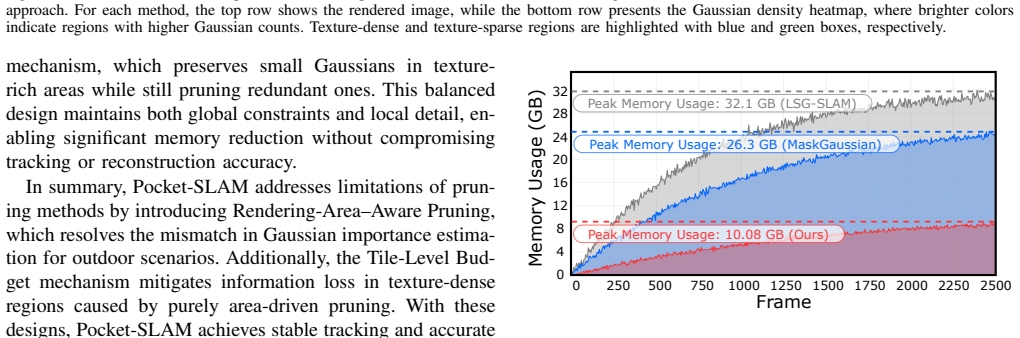
The central claim is that selectively pruning Gaussians whose contribution to the effective rendering area falls below a threshold reduces peak memory footprint and increases rendering speed in 3DGS-SLAM, achieving over 60 percent memory reduction and more than 2 times FPS improvement on EuRoC and KITTI datasets while keeping localization and mapping accuracy intact.
What carries the argument
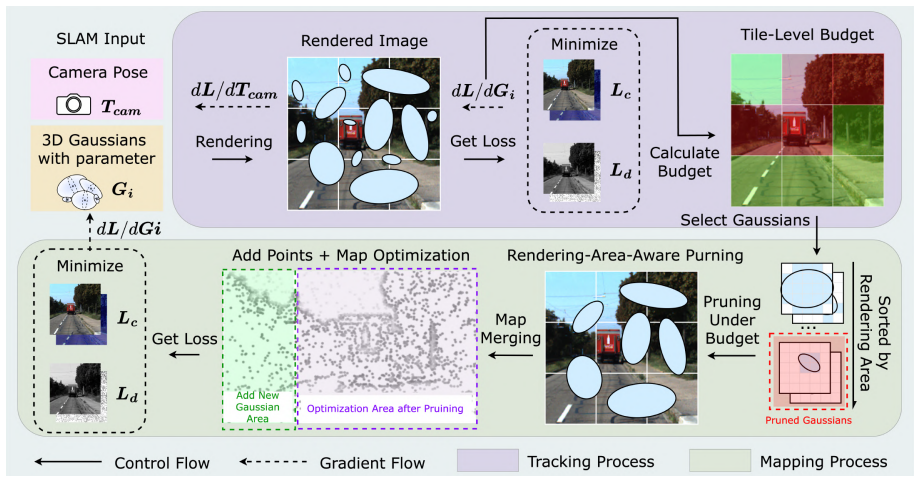
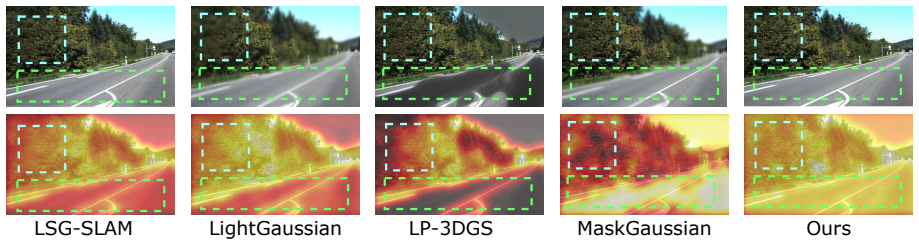
Rendering-area-aware pruning, which scores each Gaussian by its contribution to the rendered image area and removes low-scoring points to control map size.
If this is right
- Memory consumption remains bounded rather than growing without limit during extended operation.
- Frame rates increase because fewer Gaussians need to be processed at each render step.
- The same accuracy can be achieved with substantially smaller peak memory on large-scale outdoor data.
- Existing 3DGS-SLAM pipelines can adopt the pruning step without changing the underlying representation or optimization.
Where Pith is reading between the lines
- The area-based criterion could be applied at regular intervals rather than only at the end of mapping to keep memory low throughout a run.
- Thresholds might be made scene-dependent to handle varying density in indoor versus outdoor environments.
- The method opens a route to running full 3DGS-SLAM on embedded platforms that currently cannot store the full Gaussian set.
- Combining area-aware pruning with other compression steps such as quantization could produce further memory savings.
Load-bearing premise
That pruning Gaussians by low rendering-area contribution will not leave gaps or reduce robustness in the map in ways that the chosen accuracy metrics on the tested sequences fail to detect.
What would settle it
A long outdoor trajectory where, after pruning, either map completeness metrics fall sharply or tracking is lost on sections that the unpruned system handles correctly.
Figures

read the original abstract
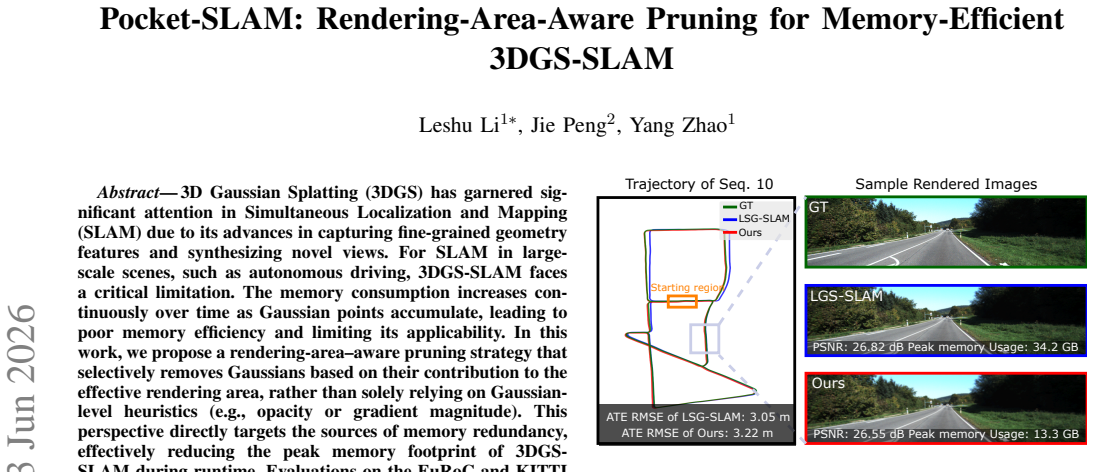
3D Gaussian Splatting (3DGS) has garnered significant attention in Simultaneous Localization and Mapping (SLAM) due to its advances in capturing fine-grained geometry features and synthesizing novel views. For SLAM in large-scale scenes, such as autonomous driving, 3DGS-SLAM faces a critical limitation: memory consumption increases continuously over time as Gaussian points accumulate, leading to poor memory efficiency and limiting its applicability. In this work, we propose a rendering-area-aware pruning strategy that selectively removes Gaussians based on their contribution to the effective rendering area, rather than solely relying on Gaussian-level heuristics such as opacity or gradient magnitude. This perspective directly targets the sources of memory redundancy, effectively reducing the peak memory footprint of 3DGS-SLAM during runtime. Evaluations on the EuRoC and KITTI datasets demonstrate that our method consistently outperforms existing pruning approaches in large-scale outdoor scenes, achieving over 60% memory reduction and more than 2 times FPS improvement while preserving localization and mapping accuracy. These results highlight rendering-area-aware pruning as a promising direction for scaling 3DGS-SLAM to real-world autonomous driving scenarios. Our code is publicly available at https://github.com/UMN-ZhaoLab/Pocket-SLAM.git.
Editorial analysis
A structured set of objections, weighed in public.
Referee Report
Summary. The manuscript presents Pocket-SLAM, a rendering-area-aware pruning strategy for 3D Gaussian Splatting SLAM. It selectively removes Gaussians according to their contribution to the effective rendering area (rather than opacity or gradient heuristics) to curb memory growth in large-scale scenes, claiming >60% memory reduction, >2 imes FPS improvement, and preserved localization/mapping accuracy on EuRoC and KITTI.
Significance. If the experimental claims hold under detailed scrutiny, the targeted pruning could meaningfully extend 3DGS-SLAM to memory-constrained autonomous-driving scenarios. Public code release at the cited GitHub repository is a positive factor for reproducibility.
major comments (1)
- [Abstract] Abstract: the central claim that accuracy is preserved rests on quantitative results whose supporting details (exact metrics, error bars, ablation on the rendering-area threshold, and comparison tables) are absent from the provided text; without these the >60% memory / >2 imes FPS figures cannot be assessed for robustness.
minor comments (1)
- The abstract would be clearer if it named the concrete accuracy metrics (e.g., ATE, RPE) used to assert that localization and mapping quality are preserved.
Simulated Author's Rebuttal
We thank the referee for the detailed feedback. We address the concern about the abstract below and will make the requested clarifications in the revised manuscript.
read point-by-point responses
-
Referee: [Abstract] Abstract: the central claim that accuracy is preserved rests on quantitative results whose supporting details (exact metrics, error bars, ablation on the rendering-area threshold, and comparison tables) are absent from the provided text; without these the >60% memory / >2 times FPS figures cannot be assessed for robustness.
Authors: We agree that the abstract would be strengthened by including more specific quantitative support for the claims. The full manuscript contains the requested details in the Experiments section: exact ATE/RPE metrics with standard deviations (error bars) appear in Tables 2 and 3, memory and FPS numbers with direct baseline comparisons are in Table 1, and an ablation study varying the rendering-area threshold is presented in Section 4.3 with accompanying figures. To improve accessibility, we will revise the abstract to cite the key numerical results (e.g., specific memory-reduction percentages and accuracy values on each dataset) and explicitly reference the supporting tables and ablation. This change will be made without altering the underlying experimental claims. revision: yes
Circularity Check
No significant circularity
full rationale
The paper proposes a rendering-area-aware pruning strategy for 3DGS-SLAM and reports empirical results on EuRoC and KITTI showing memory reduction and FPS gains while preserving accuracy. The provided abstract and context contain no equations, fitted parameters, self-citations, or derivation steps that reduce any claimed prediction or result to the inputs by construction. The method is presented as a heuristic choice evaluated externally on standard datasets, with no load-bearing self-referential steps or renamings of known results. This is a standard empirical systems paper whose central claims rest on experimental outcomes rather than internal definitional closure.
Axiom & Free-Parameter Ledger
Reference graph
Works this paper leans on
-
[1]
3d gaussian splatting for real-time radiance field rendering,
B. Kerbl, G. Kopanas, T. Leimk ¨uhler, and G. Drettakis, “3d gaussian splatting for real-time radiance field rendering,”ACM Transactions on Graphics, vol. 42, no. 4, July 2023. [Online]. Available: https://repo-sam.inria.fr/fungraph/3d-gaussian-splatting/
2023
-
[2]
Gaussian Splatting SLAM,
H. Matsuki, R. Murai, P. H. J. Kelly, and A. J. Davison, “Gaussian Splatting SLAM,” inProceedings of the IEEE/CVF Conference on Computer Vision and Pattern Recognition, 2024
2024
-
[3]
Gs-slam: Dense visual slam with 3d gaussian splatting,
C. Yan, D. Qu, D. Xu, B. Zhao, Z. Wang, D. Wang, and X. Li, “Gs-slam: Dense visual slam with 3d gaussian splatting,” 2024. [Online]. Available: https://arxiv.org/abs/2311.11700
arXiv 2024
-
[4]
Lihi- gs: Lidar-supervised gaussian splatting for highway driving scene reconstruction,
P.-C. Kung, X. Zhang, K. A. Skinner, and N. Jaipuria, “Lihi- gs: Lidar-supervised gaussian splatting for highway driving scene reconstruction,” 2024. [Online]. Available: https://arxiv.org/abs/2412. 15447
2024
-
[5]
Lt-gaussian: Long-term map update using 3d gaussian splatting for autonomous driving,
L. Cheng, Z. Qi, Z. Zhou, C. Lu, and G. Xiong, “Lt-gaussian: Long-term map update using 3d gaussian splatting for autonomous driving,” 2025. [Online]. Available: https://arxiv.org/abs/2508.01704
arXiv 2025
-
[6]
Dronesplat: 3d gaussian splatting for robust 3d reconstruction from in-the-wild drone imagery,
J. Tang, Y . Gao, D. Yang, L. Yan, Y . Yue, and Y . Yang, “Dronesplat: 3d gaussian splatting for robust 3d reconstruction from in-the-wild drone imagery,” 2025. [Online]. Available: https://arxiv.org/abs/2503.16964
arXiv 2025
-
[7]
Large-scale gaussian splatting slam,
Z. Xin, C. Wu, P. Huang, Y . Zhang, Y . Mao, and G. Huang, “Large-scale gaussian splatting slam,” 2025. [Online]. Available: https://arxiv.org/abs/2505.09915
arXiv 2025
-
[8]
Wildgs-slam: Monocular gaussian splatting slam in dynamic environments,
J. Zheng, Z. Zhu, V . Bieri, M. Pollefeys, S. Peng, and I. Armeni, “Wildgs-slam: Monocular gaussian splatting slam in dynamic environments,” 2025. [Online]. Available: https://arxiv.org/abs/2504. 03886
2025
-
[9]
Lightgaussian: Unbounded 3d gaussian compression with 15x reduction and 200+ fps,
Z. Fan, K. Wang, K. Wen, Z. Zhu, D. Xu, and Z. Wang, “Lightgaussian: Unbounded 3d gaussian compression with 15x reduction and 200+ fps,” 2024. [Online]. Available: https://arxiv.org/ abs/2311.17245
arXiv 2024
-
[10]
Pup 3d-gs: Principled uncertainty pruning for 3d gaussian splatting,
A. Hanson, A. Tu, V . Singla, M. Jayawardhana, M. Zwicker, and T. Goldstein, “Pup 3d-gs: Principled uncertainty pruning for 3d gaussian splatting,” 2025. [Online]. Available: https: //arxiv.org/abs/2406.10219
arXiv 2025
-
[11]
Lp-3dgs: Learning to prune 3d gaussian splatting,
Z. Zhang, T. Song, Y . Lee, L. Yang, C. Peng, R. Chellappa, and D. Fan, “Lp-3dgs: Learning to prune 3d gaussian splatting,” 2024. [Online]. Available: https://arxiv.org/abs/2405.18784
arXiv 2024
-
[12]
Maskgaussian: Adaptive 3d gaussian representation from probabilistic masks,
Y . Liu, Z. Zhong, Y . Zhan, S. Xu, and X. Sun, “Maskgaussian: Adaptive 3d gaussian representation from probabilistic masks,” 2025. [Online]. Available: https://arxiv.org/abs/2412.20522
arXiv 2025
-
[13]
Gevo: Memory-efficient monocular visual odometry using gaussians,
D. Gao, P. Z. X. Li, V . Sze, and S. Karaman, “Gevo: Memory-efficient monocular visual odometry using gaussians,”IEEE Robotics and Automation Letters, vol. 10, no. 3, p. 2774–2781, Mar. 2025. [Online]. Available: http://dx.doi.org/10.1109/LRA.2025.3534683
-
[14]
Kitti-360: A novel dataset and benchmarks for urban scene understanding in 2d and 3d,
Y . Liao, J. Xie, and A. Geiger, “Kitti-360: A novel dataset and benchmarks for urban scene understanding in 2d and 3d,” 2022. [Online]. Available: https://arxiv.org/abs/2109.13410
arXiv 2022
-
[15]
Orb-slam: A versatile and accurate monocular slam system,
R. Mur-Artal, J. M. M. Montiel, and J. D. Tardos, “Orb-slam: A versatile and accurate monocular slam system,”IEEE Transactions on Robotics, vol. 31, no. 5, p. 1147–1163, Oct. 2015. [Online]. Available: http://dx.doi.org/10.1109/TRO.2015.2463671
-
[16]
Orb-slam3: An accurate open-source library for visual, visual–inertial, and multimap slam,
C. Campos, R. Elvira, J. J. G. Rodriguez, J. M. M. Montiel, and J. D. Tardos, “Orb-slam3: An accurate open-source library for visual, visual–inertial, and multimap slam,”IEEE Transactions on Robotics, vol. 37, no. 6, p. 1874–1890, Dec. 2021. [Online]. Available: http://dx.doi.org/10.1109/TRO.2021.3075644
-
[17]
Object-oriented slam using quadrics and symmetry properties for indoor environments,
Z. Liao, W. Wang, X. Qi, X. Zhang, L. Xue, J. Jiao, and R. Wei, “Object-oriented slam using quadrics and symmetry properties for indoor environments,” 2020. [Online]. Available: https://arxiv.org/abs/2004.05303
arXiv 2020
-
[18]
Comparison of various slam systems for mobile robot in an indoor environment,
M. Filipenko and I. Afanasyev, “Comparison of various slam systems for mobile robot in an indoor environment,” in2018 International Conference on Intelligent Systems (IS). IEEE, Sep. 2018, p. 400–407. [Online]. Available: http://dx.doi.org/10.1109/IS.2018.8710464
-
[19]
ORB-SLAM2: An open-source SLAM system for monocular, stereo, and RGB-D cameras,
R. Mur-Artal and J. D. Tardos, “Orb-slam2: An open-source slam system for monocular, stereo, and rgb-d cameras,”IEEE Transactions on Robotics, vol. 33, no. 5, p. 1255–1262, Oct. 2017. [Online]. Available: http://dx.doi.org/10.1109/TRO.2017.2705103
-
[20]
Stereo 3d gaussian splatting slam for outdoor urban scenes,
X. Li, Z. Gong, F. Tosi, M. Poggi, S. Mattoccia, D. Liu, and J. Wu, “Stereo 3d gaussian splatting slam for outdoor urban scenes,” 2025. [Online]. Available: https://arxiv.org/abs/2507.23677
arXiv 2025
-
[21]
The stdyn-slam: A stereo vision and semantic segmentation approach for slam in dynamic outdoor environments,
D. Esparza and G. Flores, “The stdyn-slam: A stereo vision and semantic segmentation approach for slam in dynamic outdoor environments,” 2021. [Online]. Available: https://arxiv.org/abs/2010. 09857
2021
-
[22]
Liv-gs: Lidar-vision integration for 3d gaussian splatting slam in outdoor environments,
R. Xiao, W. Liu, Y . Chen, and L. Hu, “Liv-gs: Lidar-vision integration for 3d gaussian splatting slam in outdoor environments,”
-
[23]
Available: https://arxiv.org/abs/2411.12185
[Online]. Available: https://arxiv.org/abs/2411.12185
-
[24]
A flexible framework for accurate lidar odometry, map manipulation, and localization,
J. L. Blanco-Claraco, “A flexible framework for accurate lidar odometry, map manipulation, and localization,”The International Journal of Robotics Research, vol. 44, no. 9, p. 1553–1599, Feb. 2025. [Online]. Available: http://dx.doi.org/10.1177/02783649251316881
-
[25]
H. Huang, L. Li, H. Cheng, and S.-K. Yeung, “Photo-slam: Real-time simultaneous localization and photorealistic mapping for monocular, stereo, and rgb-d cameras,” 2024. [Online]. Available: https://arxiv.org/abs/2311.16728
arXiv 2024
-
[26]
Loopsplat: Loop closure by registering 3d gaussian splats,
L. Zhu, Y . Li, E. Sandstr ¨om, S. Huang, K. Schindler, and I. Armeni, “Loopsplat: Loop closure by registering 3d gaussian splats,” 2024. [Online]. Available: https://arxiv.org/abs/2408.10154
arXiv 2024
-
[27]
F. Schmidt, C. Blessing, M. Enzweiler, and A. Valada, “Visual- inertial slam for unstructured outdoor environments: Benchmarking the benefits and computational costs of loop closing,” 2025. [Online]. Available: https://arxiv.org/abs/2408.01716
arXiv 2025
-
[28]
Rover: A multiseason dataset for visual slam,
F. Schmidt, J. Daubermann, M. Mitschke, C. Blessing, S. Meyer, M. Enzweiler, and A. Valada, “Rover: A multiseason dataset for visual slam,”IEEE Transactions on Robotics, vol. 41, p. 4005–4022, 2025. [Online]. Available: http://dx.doi.org/10.1109/TRO.2025.3577026
-
[29]
O. ´Alvarez Tu ˜n´on, Y . Brodskiy, and E. Kayacan, “Monocular visual simultaneous localization and mapping: (r)evolution from geometry to deep learning-based pipelines,”IEEE Transactions on Artificial Intelligence, vol. 5, no. 5, p. 1990–2010, May 2024. [Online]. Available: http://dx.doi.org/10.1109/TAI.2023.3321032
-
[30]
The euroc micro aerial vehicle datasets,
M. Burri, J. Nikolic, P. Gohl, T. Schneider, J. Rehder, S. Omari, M. W. Achtelik, and R. Siegwart, “The euroc micro aerial vehicle datasets,”The International Journal of Robotics Research, 2016. [Online]. Available: http://ijr.sagepub.com/content/early/2016/01/21/ 0278364915620033.abstract
2016
-
[31]
Benchmarking and comparing popular visual slam algorithms,
A. Kasar, “Benchmarking and comparing popular visual slam algorithms,” 2018. [Online]. Available: https://arxiv.org/abs/1811. 09895
2018
-
[32]
Image quality assessment: From error visibility to structural similarity,
Z. Wang, A. C. Bovik, H. R. Sheikh, and E. P. Simoncelli, “Image quality assessment: From error visibility to structural similarity,”IEEE Transactions on Image Processing, vol. 13, no. 4, pp. 600–612, 2004
2004
-
[33]
The unreasonable effectiveness of deep features as a perceptual metric,
R. Zhang, P. Isola, A. A. Efros, E. Shechtman, and O. Wang, “The unreasonable effectiveness of deep features as a perceptual metric,”
-
[34]
Available: https://arxiv.org/abs/1801.03924
[Online]. Available: https://arxiv.org/abs/1801.03924
-
[35]
Adr-gaussian: Accelerating gaussian splatting with adaptive radius,
X. Wang, R. Yi, and L. Ma, “Adr-gaussian: Accelerating gaussian splatting with adaptive radius,” inSIGGRAPH Asia 2024 Conference Papers. ACM, Dec. 2024, p. 1–10. [Online]. Available: http: //dx.doi.org/10.1145/3680528.3687675
-
[36]
Tc-gs: A faster gaussian splatting module utilizing tensor cores,
Z. Liao, J. Ding, R. Fu, S. Cui, R. Gong, L. Wang, B. Hu, Y . Wang, H. Li, X. Zhang, and H. Wang, “Tc-gs: A faster gaussian splatting module utilizing tensor cores,” 2025. [Online]. Available: https://arxiv.org/abs/2505.24796
arXiv 2025
-
[37]
Sg-splatting: Accelerating 3d gaussian splatting with spherical gaussians,
Y . Wang, S. Chen, and R. Yi, “Sg-splatting: Accelerating 3d gaussian splatting with spherical gaussians,” 2024. [Online]. Available: https://arxiv.org/abs/2501.00342
arXiv 2024
-
[38]
Nvidia rtx a6000 graphics card,
“Nvidia rtx a6000 graphics card,” NVIDIA, Workstation GPU, 2020, 48 GB GDDR6 ECC memory, Ampere architecture, PCIe 4.0, Workstation graphics accelerator. [Online]. Available: https: //www.nvidia.com/en-us/products/workstations/rtx-a6000/
2020
-
[39]
Jetson orin for next-gen robotics — nvidia,
“Jetson orin for next-gen robotics — nvidia,” https://www.nvidia. com/en-us/autonomous-machines/embedded-systems/jetson-orin/, (Accessed on 04/02/2024)
2024
-
[40]
Gauspu: 3d gaussian splatting processor for real-time slam systems,
L. Wu, H. Zhu, S. He, J. Zheng, C. Chen, and X. Zeng, “Gauspu: 3d gaussian splatting processor for real-time slam systems,” in2024 57th IEEE/ACM International Symposium on Microarchitecture (MICRO), 2024, pp. 1562–1573
2024
-
[41]
Gsarch: Break- ing memory barriers in 3d gaussian splatting training via architectural support,
H. He, G. Li, F. Liu, L. Jiang, X. Liang, and Z. Song, “Gsarch: Break- ing memory barriers in 3d gaussian splatting training via architectural support,” in2025 IEEE International Symposium on High Performance Computer Architecture (HPCA), 2025, pp. 366–379
2025
-
[42]
Distwar: Fast differentiable rendering on raster-based rendering pipelines,
S. Durvasula, A. Zhao, F. Chen, R. Liang, P. K. Sanjaya, and N. Vijaykumar, “Distwar: Fast differentiable rendering on raster-based rendering pipelines,” 2023. [Online]. Available: https: //arxiv.org/abs/2401.05345
arXiv 2023
discussion (0)
Sign in with ORCID, Apple, or X to comment. Anyone can read and Pith papers without signing in.