Anomalous weak values in a generalized Mach-Zehnder interferometer extracted directly from intensity measurements
Pith reviewed 2026-06-25 23:53 UTC · model grok-4.3
The pith
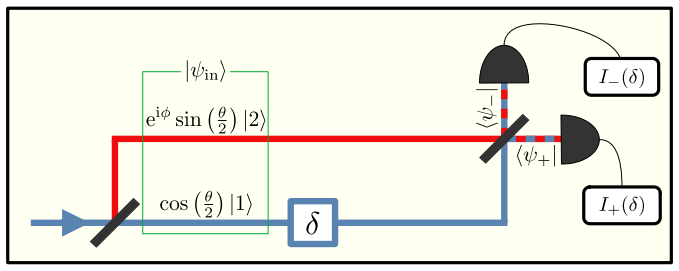
Path weak values are extracted from intensity measurements and phase shifts in a generalized Mach-Zehnder interferometer without meter states or weak interactions.
A machine-rendered reading of the paper's core claim, the machinery that carries it, and where it could break.
Core claim
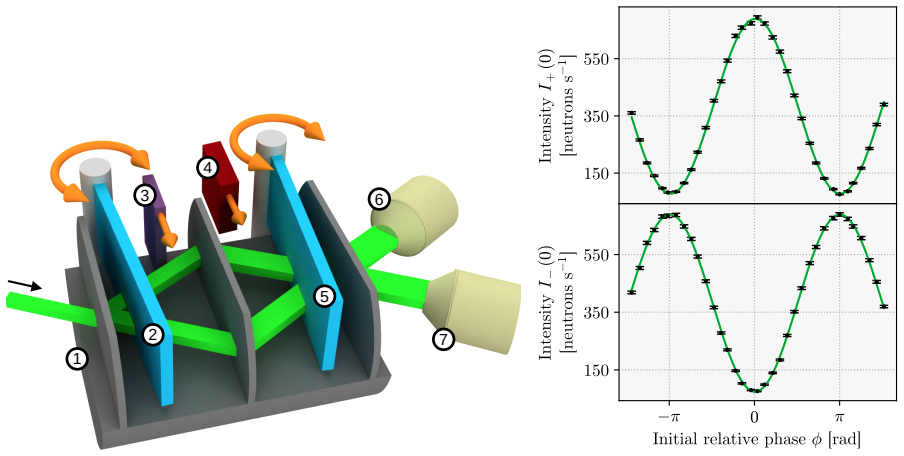
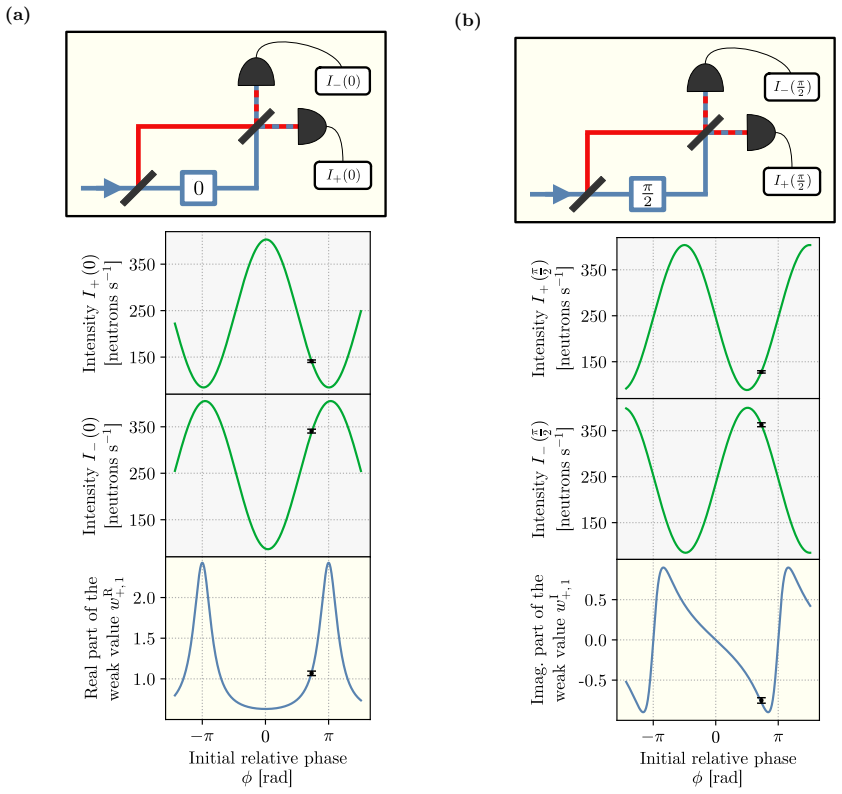
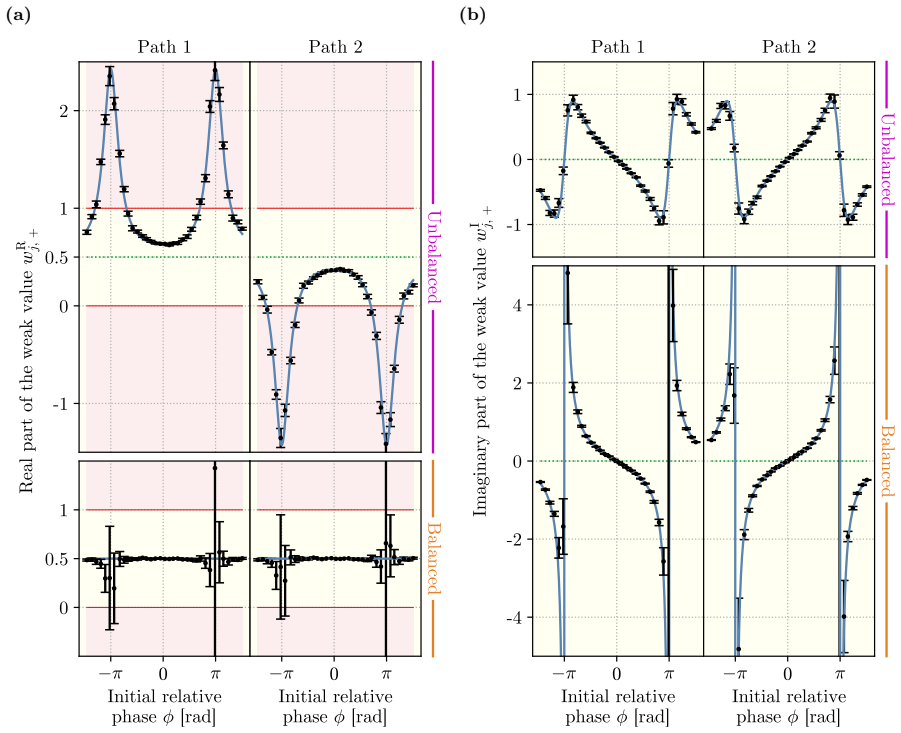
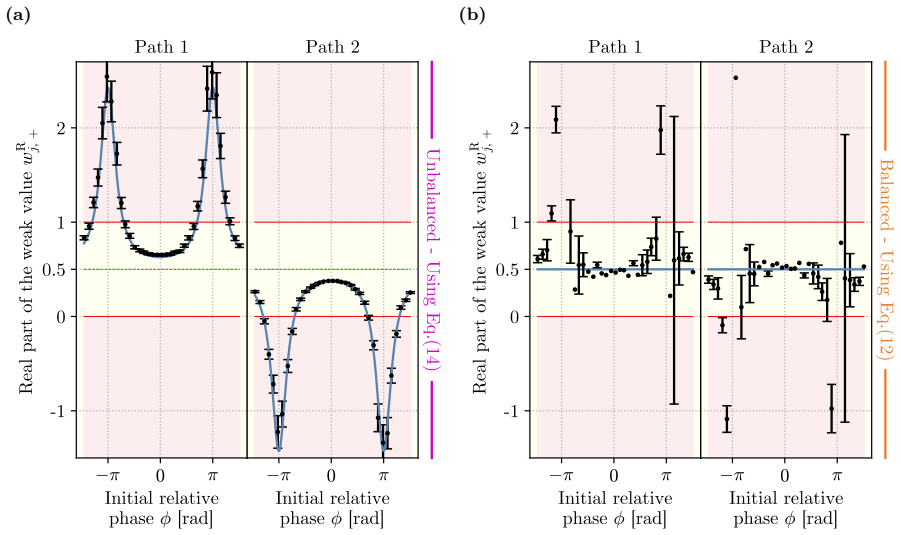
Path weak-values in a generalized Mach-Zehnder interferometer can be fully characterized employing neither meter states nor weak interactions by relying uniquely on intensity measurements at the output ports combined with controlled relative phase shifts between the paths, as experimentally shown by identifying anomalous weak values and negative quasiprobability distributions in matter-wave interferometry.
What carries the argument
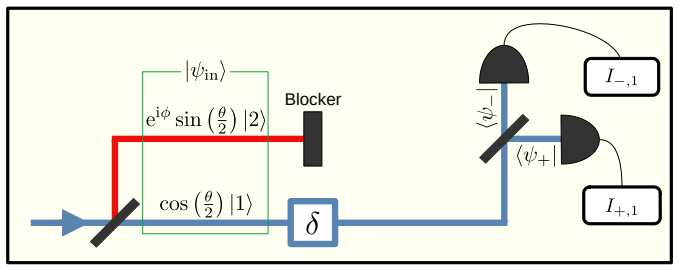
Intensity measurements at the output ports of the interferometer combined with controlled relative phase shifts between the paths, which together reconstruct the complete path weak values.
If this is right
- The method identifies anomalous weak values and negative quasiprobability distributions reflecting nonclassical behavior.
- The absence of meter states enables considerable simplification of the setup and shorter measurement times.
- Full access to weak values is preserved with comparable or increased accuracy.
- The scheme is directly applicable to a broad class of experiments involving two-level quantum systems.
Where Pith is reading between the lines
- The approach may extend to photonic or atomic two-path systems that already use intensity detection and phase control.
- Integration with existing interferometers could enable faster characterization of nonclassical features without added hardware.
- The technique might simplify experiments that previously combined weak measurements with other quantum tomography methods.
Load-bearing premise
Intensity measurements at the interferometer output ports together with controlled relative phase shifts between paths are mathematically sufficient to reconstruct the complete path weak values without any meter state or weak interaction being present.
What would settle it
A direct comparison in the same interferometer where weak values reconstructed from intensities disagree with those from conventional weak measurements would falsify the method's sufficiency.
Figures
read the original abstract
Weak values provide a powerful framework for characterizing quantum systems. Their experimental extraction conventionally relies on weak conditioned von Neumann measurements, involving weak interactions and meter states that increase experimental complexity and often limit measurement efficiency. Here we introduce a method to fully characterize path weak-values in a generalized Mach-Zehnder interferometer employing neither meter states nor weak interactions. We experimentally demonstrate the technique in matter-wave interferometry. We identify anomalous weak values and, equivalently, negative quasiprobability distributions, which reflect the nonclassical behavior of the quantum system. The approach relies uniquely on intensity measurements at the output ports of the interferometer combined with controlled relative phase shifts between the paths. The absence of meter states enables considerable simplification of the setup and shorter measurement times, while preserving full access to weak values with comparable or increased accuracy. The scheme is directly applicable to a broad class of experiments involving two-level quantum systems.
Editorial analysis
A structured set of objections, weighed in public.
Referee Report
Summary. The manuscript introduces a method to fully characterize path weak values (generally complex) for a two-level system in a generalized Mach-Zehnder interferometer using only intensity measurements at the two output ports together with controlled relative phase shifts between the paths. No meter states or weak von Neumann interactions are required. The technique is experimentally demonstrated in matter-wave interferometry, where anomalous weak values and the associated negative quasiprobability distributions are recovered.
Significance. If the central reconstruction holds, the result offers a meaningful simplification for weak-value experiments on two-level systems by removing auxiliary meter degrees of freedom, thereby shortening measurement times while preserving or improving accuracy. The explicit experimental realization in matter waves and the direct link to negative quasiprobabilities constitute concrete strengths that would be noted in any assessment of the work.
minor comments (2)
- The abstract states that intensities and phase shifts suffice to reconstruct the full complex weak values, but does not indicate the explicit algebraic inversion (real and imaginary parts) that is presumably derived in the main text; adding one sentence referencing the relevant equations would improve clarity for readers.
- Figure captions and axis labels should explicitly state the range and step size of the controlled phase shifts used in the data sets, as these directly enter the reconstruction.
Simulated Author's Rebuttal
We thank the referee for the positive assessment of our manuscript, the recognition of its significance in simplifying weak-value extraction, and the recommendation for minor revision. No specific major comments appear in the report.
Circularity Check
No significant circularity; derivation is algebraic inversion of measured intensities
full rationale
The paper derives the path weak values by writing the two output-port intensities as explicit functions of the controllable relative phase φ and then algebraically solving the resulting linear system for the real and imaginary parts of the weak values (equivalently the quasiprobability). This inversion uses only the definitions of intensity in a two-path interferometer and the controlled phase; no parameter is fitted to a subset of data and then re-used as a prediction, no self-citation supplies a uniqueness theorem or ansatz, and the mapping is presented as a direct, invertible relation between observables and the target quantities. The experimental demonstration simply confirms that the extracted values match the expected anomalous regime, without circular closure. The central claim therefore remains self-contained against external benchmarks.
Axiom & Free-Parameter Ledger
Reference graph
Works this paper leans on
-
[1]
Aharonov, Y., Albert, D. Z. & Vaidman, L. How the result of a measurement of a component of the spin of a spin-1/2 particle can turn out to be 100.Phys. Rev. Lett.60, 1351–1354 (1988). URLhttps: //link.aps.org/doi/10.1103/PhysRevLett.60.1351
-
[2]
Ritchie, N. W. M., Story, J. G. & Hulet, R. G. Realization of a measurement of a “weak value”.Phys. Rev. Lett.66, 1107–1110 (1991). URLhttps://link.aps.org/doi/10.1103/PhysRevLett.66.1107
-
[3]
Hosten, O. & Kwiat, P. Observation of the spin hall effect of light via weak measurements.Science319, 787– 790 (2008). URLhttps://www.science.org/doi/abs/10.1126/science.1152697.https://www.science. org/doi/pdf/10.1126/science.1152697
work page doi:10.1126/science.1152697.https://www.science 2008
-
[4]
S., Sutherland, B., Patel, A., Stewart, C
Lundeen, J. S., Sutherland, B., Patel, A., Stewart, C. & Bamber, C. Direct measurement of the quantum wavefunction.Nature474, 188–191 (2011). URLhttp://dx.doi.org/10.1038/nature10120
-
[5]
Lundeen, J. S. & Steinberg, A. M. Experimental joint weak measurement on a photon pair as a probe of hardy’s paradox.Phys. Rev. Lett.102(2009). URLhttp://dx.doi.org/10.1103/PhysRevLett.102. 020404
-
[6]
Denkmayr, T.et al.Observation of a quantum cheshire cat in a matter-wave interferometer experiment. Nat. Commun.5, 4492 (2014). 10
2014
-
[7]
& Hasegawa, Y
Wagner, R., Kersten, W., Lemmel, H., Sponar, S. & Hasegawa, Y. Quantum causality emerging in a delayed-choice quantum cheshire cat experiment with neutrons.Sci. Rep.13, 3865 (2023)
2023
-
[8]
Phys.7, 14 (2024)
Danner, A.et al.Three-path quantum cheshire cat observed in neutron interferometry.Commun. Phys.7, 14 (2024)
2024
-
[9]
Waegell, M.et al.Confined contextuality in neutron interferometry: Observing the quantum pigeonhole effect.Phys. Rev. A96, 052131 (2017). URLhttps://link.aps.org/doi/10.1103/PhysRevA.96.052131
-
[10]
Weak values as interference phenomena.Phys
Dressel, J. Weak values as interference phenomena.Phys. Rev. A91, 032116 (2015). URLhttps://link. aps.org/doi/10.1103/PhysRevA.91.032116
-
[11]
& Tollaksen, J
Aharonov, Y., Botero, A., Popescu, S., Reznik, B. & Tollaksen, J. Revisiting hardy’s paradox: counterfactual statements, real measurements, entanglement and weak values.Phys. Lett. A301, 130–138 (2002). URL https://www.sciencedirect.com/science/article/pii/S0375960102009866
2002
-
[12]
Hall, M. J. W. Prior information: How to circumvent the standard joint-measurement uncertainty relation. Phys. Rev. A69, 052113 (2004). URLhttps://link.aps.org/doi/10.1103/PhysRevA.69.052113
-
[13]
Ozawa, M., Ralph, T. & Lam, P. K. Universal uncertainty principle, simultaneous measurability, and weak values. InAIP Conference Proceedings(AIP, 2011). URLhttp://dx.doi.org/10.1063/1.3630147
-
[14]
Arvidsson-Shukur, D. R. M.et al.Properties and applications of the kirkwood–dirac distribution.New J. Phys.26, 121201 (2024). URLhttps://doi.org/10.1088/1367-2630/ada05d
-
[15]
Spekkens, R. W. Contextuality for preparations, transformations, and unsharp measurements.Phys. Rev. A71, 052108 (2005). URLhttps://link.aps.org/doi/10.1103/PhysRevA.71.052108
-
[16]
Pusey, M. F. Anomalous weak values are proofs of contextuality.Phys. Rev. Lett.113, 200401 (2014). URL https://link.aps.org/doi/10.1103/PhysRevLett.113.200401
-
[17]
& Pusey, M
Kunjwal, R., Lostaglio, M. & Pusey, M. F. Anomalous weak values and contextuality: Robustness, tight- ness, and imaginary parts.Phys. Rev. A100, 042116 (2019). URLhttps://link.aps.org/doi/10.1103/ PhysRevA.100.042116
2019
-
[18]
Dressel, J., Agarwal, S. & Jordan, A. N. Contextual values of observables in quantum measurements.Phys. Rev. Lett.104(2010). URLhttp://dx.doi.org/10.1103/PhysRevLett.104.240401
-
[19]
Dressel, J. & Jordan, A. N. Significance of the imaginary part of the weak value.Phys. Rev. A85(2012). URLhttp://dx.doi.org/10.1103/PhysRevA.85.012107
-
[20]
V., Dvorak, A., Lemmel, H., Danner, A
Masiello, I. V., Dvorak, A., Lemmel, H., Danner, A. & Hasegawa, Y. Simultaneous determination of two path weak-values with time-dependent phase manipulation in neutron interferometry.New J. Phys.27, 023017 (2025). URLhttps://dx.doi.org/10.1088/1367-2630/adb175
-
[21]
& Sponar, S
Denkmayr, T., Dressel, J., Geppert-Kleinrath, H., Hasegawa, Y. & Sponar, S. Weak values from strong interactions in neutron interferometry.Phys. B Condensed Matter.551, 339–346 (2018). URLhttps: //www.sciencedirect.com/science/article/pii/S0921452618302722
2018
-
[22]
Rep.14(2024)
Danner, A.et al.Simultaneous path weak-measurements in neutron interferometry.Sci. Rep.14(2024)
2024
-
[23]
Dvorak, A.et al.Tight qubit uncertainty relations studied through weak values in neutron interferometry. Phys. Rev. Res.7, 043334 (2025). URLhttps://link.aps.org/doi/10.1103/pthn-81pm
-
[24]
& Hasegawa, Y
Klepp, J., Sponar, S. & Hasegawa, Y. Fundamental phenomena of quantum mechanics explored with neutron interferometers.Prog. Theor. Exp. Phys.2014, 082A01 (2014). URLhttps://doi.org/10.1093/ ptep/ptu085
2014
-
[25]
& Werner, S
Rauch, H. & Werner, S. A.Neutron interferometry: lessons in experimental quantum mechanics, wave- particle duality, and entanglement, vol. 12 (Oxford University Press, 2015)
2015
-
[26]
I., Pitschmann, M., Abele, H
Sponar, S., Sedmik, R. I., Pitschmann, M., Abele, H. & Hasegawa, Y. Tests of fundamental quantum mechanics and dark interactions with low-energy neutrons.Nat. Rev. Phys.3, 309–327 (2021)
2021
-
[27]
& Hasegawa, Y
Danner, A., Lemmel, H., Wagner, R., Sponar, S. & Hasegawa, Y. Neutron interferometer experiments studying fundamental features of quantum mechanics.Atoms11(2023). URLhttps://www.mdpi.com/ 2218-2004/11/6/98
2023
-
[28]
& Rauch, H
Hasegawa, Y., Loidl, R., Badurek, G., Baron, M. & Rauch, H. Violation of a bell-like inequality in single- neutron interferometry.Nature425, 45–48 (2003)
2003
-
[29]
& Hasegawa, Y
Durstberger-Rennhofer, K. & Hasegawa, Y. Energy entanglement in neutron interferometry.Physica B: Condensed Matter406, 2373–2376 (2011). URLhttps://www.sciencedirect.com/science/article/pii/ S092145261001121X
2011
-
[30]
& Arndt, M
Hornberger, K., Gerlich, S., Haslinger, P., Nimmrichter, S. & Arndt, M. Colloquium: Quantum interference of clusters and molecules.Rev. Mod. Phys.84, 157–173 (2012). URLhttps://link.aps.org/doi/10.1103/ RevModPhys.84.157. 11
2012
-
[31]
& Tuppinger, D
Summhammer, J., Rauch, H. & Tuppinger, D. Stochastic and deterministic absorption in neutron- interference experiments.Phys. Rev. A36, 4447–4455 (1987). URLhttps://link.aps.org/doi/10.1103/ PhysRevA.36.4447
1987
-
[32]
Complex weak values in quantum measurement.Phys
Jozsa, R. Complex weak values in quantum measurement.Phys. Rev. A76(2007). URLhttp://dx.doi. org/10.1103/PhysRevA.76.044103
-
[33]
Hariri, A., Curic, D., Giner, L. & Lundeen, J. S. Experimental simultaneous readout of the real and imaginary parts of the weak value.Phys. Rev. A100, 032119 (2019). URLhttps://link.aps.org/doi/ 10.1103/PhysRevA.100.032119
-
[34]
Colloquium: Understanding quantum weak values: Basics and applications
Dressel, J., Malik, M., Miatto, F. M., Jordan, A. N. & Boyd, R. W. Colloquium: Understanding quantum weak values: Basics and applications.Rev. Mod. Phys.86, 307–316 (2014). URLhttps://link.aps.org/ doi/10.1103/RevModPhys.86.307
-
[35]
Johansen, L. M. Reconstructing weak values without weak measurements.Phys. Lett. A366, 374–376 (2007). URLhttps://www.sciencedirect.com/science/article/pii/S0375960107002654
2007
-
[36]
& Hasegawa, Y
Geppert, H., Denkmayr, T., Sponar, S., Lemmel, H. & Hasegawa, Y. Improvement of the polarized neutron interferometer setup demonstrating violation of a bell-like inequality.Nucl. Instrum. Methods Phys. Res. A 763, 417–423 (2014). URLhttps://www.sciencedirect.com/science/article/pii/S0168900214008341
2014
-
[37]
& Spekkens, R
Catani, L., Leifer, M., Scala, G., Schmid, D. & Spekkens, R. W. Aspects of the phenomenology of interference that are genuinely nonclassical.Phys. Rev. A108, 022207 (2023). URLhttps://link.aps.org/doi/10. 1103/PhysRevA.108.022207
2023
-
[38]
Johansen, L. M. Quantum theory of successive projective measurements.Phys. Rev. A76, 012119 (2007). URLhttps://link.aps.org/doi/10.1103/PhysRevA.76.012119. Acknowledgments This research was funded in part by the Austrian Science Fund (FWF) (grant DOI: 10.55776/P34105). For open access purposes, the authors have applied a CC BY public copyright license to ...
discussion (0)
Sign in with ORCID, Apple, or X to comment. Anyone can read and Pith papers without signing in.