Exact log-odds representation and mean-field criticality of a growing social group model
Pith reviewed 2026-06-25 21:52 UTC · model grok-4.3
The pith
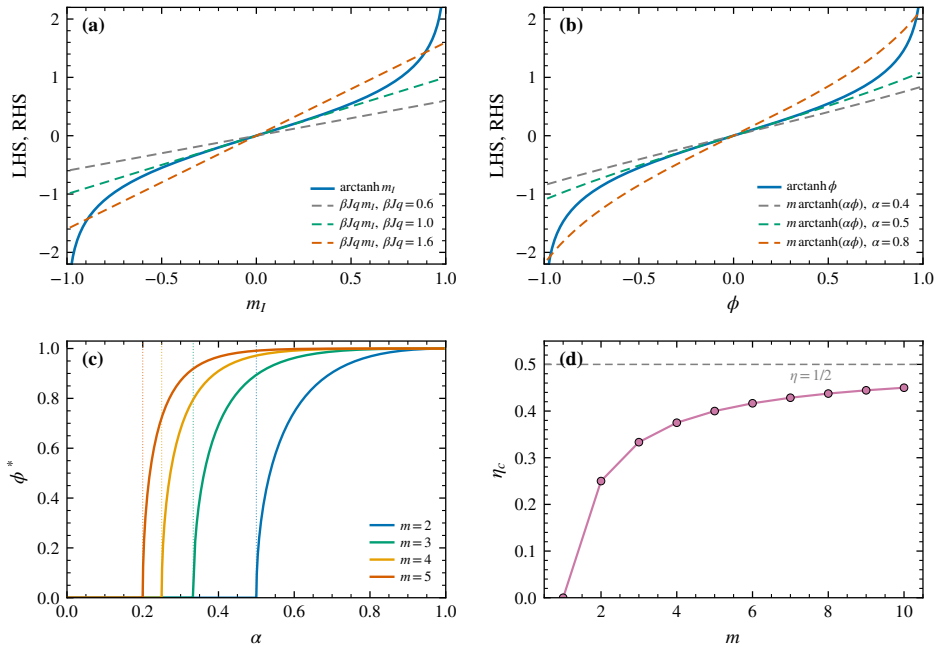
A growing social group model reduces exactly to the self-consistent equation arctanh(φ*) = m · arctanh(α φ*) for its polarization fixed points.
A machine-rendered reading of the paper's core claim, the machinery that carries it, and where it could break.
Core claim
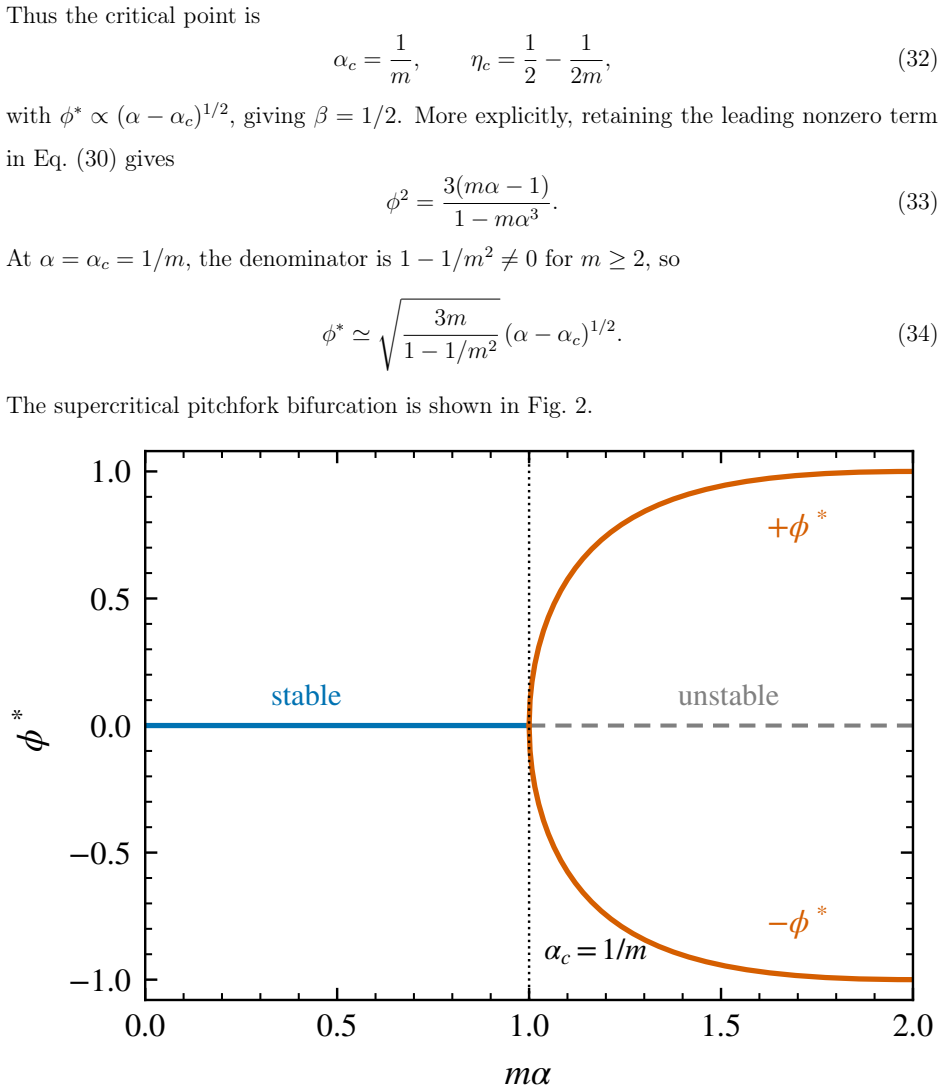
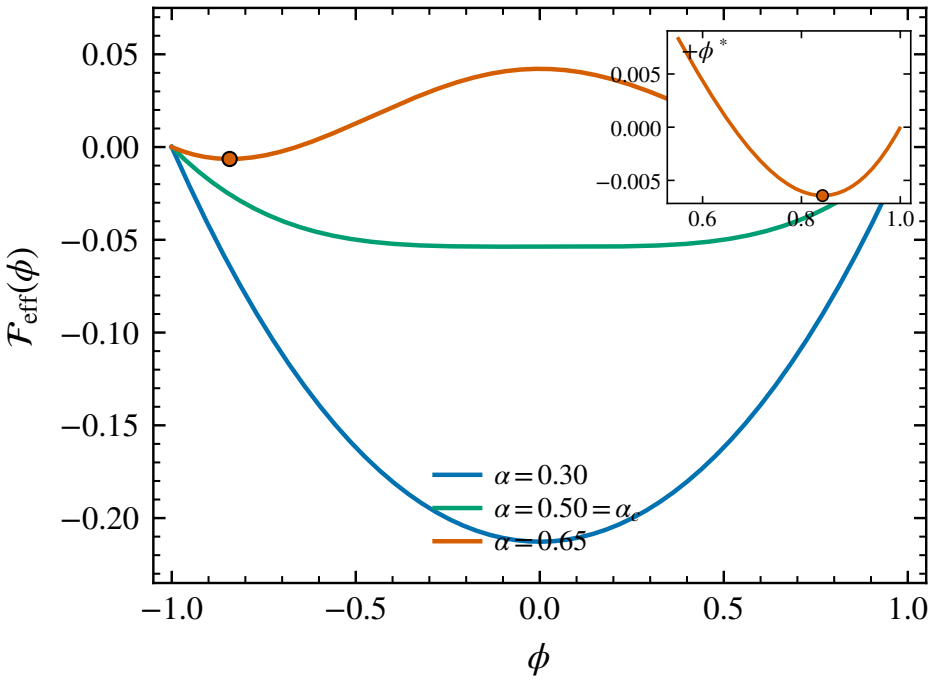
The dynamics constitutes an exact mean-field theory of self-consistent inference whose fixed points satisfy arctanh(φ*) = m · arctanh(α φ*), with α = 1 − 2η the evaluation reliability and m the number of evaluators. Each verdict contributes a log-likelihood ratio 2 arctanh(α φ); unanimity therefore accumulates m independent pieces of evidence. Ordering occurs when the collective gain mα overcomes the dilution of growth. The framework also yields a Landau-like effective potential, shared critical exponents with the mean-field Ising model, and a nested arctanh structure that has no equilibrium counterpart.
What carries the argument
The single self-consistent arctanh equation for polarization φ*, which encodes the accumulation of log-odds from m independent verdicts under the gradient flow on logarithmic time.
If this is right
- The model exhibits criticality with the same exponents as the mean-field Ising model yet a distinct nested arctanh structure.
- A frozen-N Freidlin–Wentzell quasipotential supplies Kramers-type escape rates for metastable polarization states.
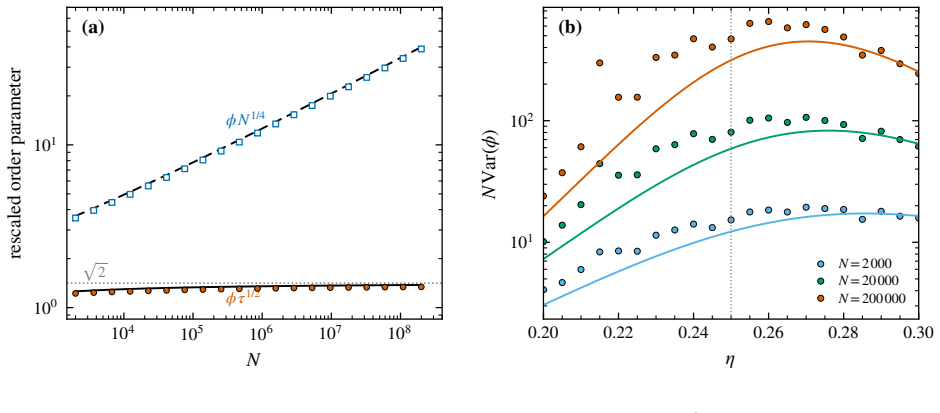
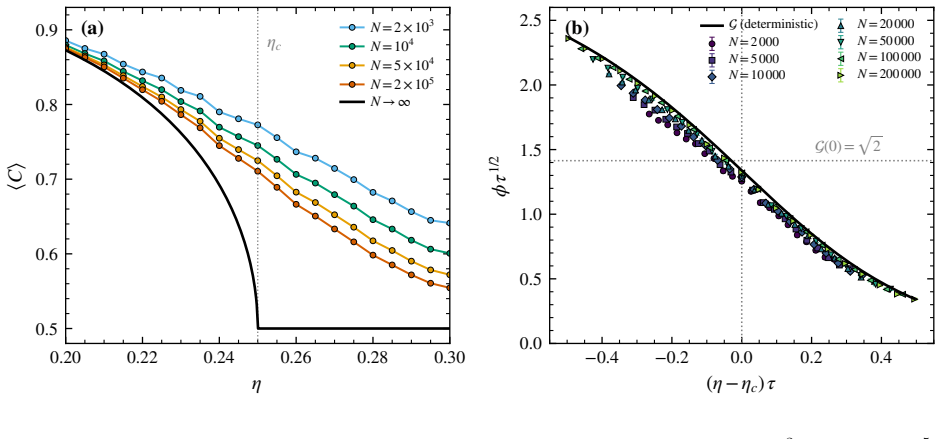
- Simulations of the microscopic process collapse onto a parameter-free deterministic trajectory on logarithmic time.
- Systematic comparison with the mean-field Ising model isolates which critical features survive without an equilibrium Hamiltonian.
Where Pith is reading between the lines
- The log-odds accumulation view may supply a template for analyzing other growing-network or opinion-formation models that lack a Hamiltonian.
- Because the flow is defined on logarithmic time, similar gradient-flow reformulations could apply to other irreversible growth processes in statistical mechanics.
- Empirical tests could check whether real group-admission data satisfy the arctanh relation for measured values of m and α.
Load-bearing premise
The growing social group process can be exactly cast as a gradient flow on logarithmic time whose fixed points are governed by the arctanh equation.
What would settle it
Monte Carlo trajectories of the growing group model fail to collapse onto a single deterministic master curve when time is rescaled to logarithmic form, or the measured steady-state polarization deviates from the predicted arctanh relation across different values of m and α.
Figures



read the original abstract
We present an exact analytical reformulation of a growing social group model -- a Hamiltonian-free nonequilibrium process in which a group grows by noisy, consensus-driven admission. Cast as a gradient flow on logarithmic time, the fixed-point structure collapses to a single self-consistent equation: $\arctanh(\phi^*) = m \cdot \arctanh(\alpha\phi^*)$, where $\phi$ is the polarization, $\alpha=1-2\eta$ the evaluation reliability, and $m$ the number of evaluators. The equation has a direct log-odds interpretation: each verdict contributes log-likelihood ratio $2\arctanh(\alpha\phi)$; unanimity accumulates $m$ independent evidence pieces. The dynamics thus constitutes an exact mean-field theory of self-consistent inference, ordering when the collective gain $m\alpha$ overcomes the dilution of growth. We develop a systematic three-layer framework: core theory (Landau-like effective potential, comparison with the mean-field Ising model, and features without equilibrium counterpart), mathematical foundations (criticality from correlated verdicts, P\'{o}lya-urn martingale convergence, and an RG-like flow with group size as scale), and complementary perspectives on irreversibility and information geometry. A frozen-$N$ Freidlin--Wentzell quasipotential yields Kramers-type escape estimates for metastable states, while Monte Carlo simulations collapse onto a parameter-free deterministic master curve on logarithmic time. Systematic comparison with the mean-field Ising model reveals shared critical exponents but a nested arctanh structure unique to growth. These results provide a detailed analytical characterization of a minimal model of growth-driven collective behavior and map which elements of the equilibrium critical toolbox -- suitably reinterpreted -- survive without a Hamiltonian.
Editorial analysis
A structured set of objections, weighed in public.
Referee Report
Summary. The manuscript presents an exact analytical reformulation of a growing social group model as a Hamiltonian-free nonequilibrium process. Cast as a gradient flow on logarithmic time, the fixed-point structure reduces to the self-consistent equation arctanh(φ*) = m · arctanh(α φ*), interpreted via log-odds accumulation from m evaluators with reliability α=1-2η. Monte Carlo simulations are reported to collapse onto a parameter-free deterministic master curve. The work develops a three-layer framework (core theory with Landau-like potential and Ising comparison, mathematical foundations via Pólya-urn martingales and RG-like flow, and perspectives on irreversibility/information geometry) and derives Kramers-type escape estimates from a frozen-N Freidlin-Wentzell quasipotential.
Significance. If the exact gradient-flow mapping holds, the result would be significant for supplying a parameter-free analytical characterization of a minimal model of growth-driven collective behavior. The collapse of simulations onto a master curve, the direct log-odds interpretation, and the systematic contrast with mean-field Ising criticality (shared exponents but nested arctanh structure) are clear strengths. The framework also supplies falsifiable predictions and reinterprets equilibrium tools for nonequilibrium growth.
major comments (1)
- [Abstract] Abstract (paragraph beginning 'Cast as a gradient flow on logarithmic time'): The central claim that the stochastic admission process maps exactly onto the deterministic gradient flow dφ/dτ = -dV/dφ with τ = log N, yielding the fixed-point equation arctanh(φ*) = m arctanh(α φ*), is asserted without an explicit derivation of the master equation, Fokker-Planck approximation, or demonstration that jump rates produce no non-gradient or 1/N correction terms. This mapping is load-bearing for the 'exact mean-field theory' assertion and the parameter-free collapse claim.
minor comments (1)
- The abstract describes a 'systematic three-layer framework' but the manuscript would benefit from explicit subsection headings or a roadmap paragraph that maps the sections to 'core theory', 'mathematical foundations', and 'complementary perspectives'.
Simulated Author's Rebuttal
We thank the referee for the positive assessment of the work's significance and for the constructive comment on the central mapping. We address the point below and will revise the manuscript to strengthen the presentation of the derivation.
read point-by-point responses
-
Referee: [Abstract] Abstract (paragraph beginning 'Cast as a gradient flow on logarithmic time'): The central claim that the stochastic admission process maps exactly onto the deterministic gradient flow dφ/dτ = -dV/dφ with τ = log N, yielding the fixed-point equation arctanh(φ*) = m arctanh(α φ*), is asserted without an explicit derivation of the master equation, Fokker-Planck approximation, or demonstration that jump rates produce no non-gradient or 1/N correction terms. This mapping is load-bearing for the 'exact mean-field theory' assertion and the parameter-free collapse claim.
Authors: We agree that an explicit derivation of the master equation and confirmation of the purely gradient structure would make the load-bearing claim more transparent. The mathematical foundations section already invokes Pólya-urn martingale convergence to establish that the deterministic limit is reached exactly, but we will add a dedicated subsection deriving the master equation from the microscopic jump rates for group-size and polarization updates. This will include the Fokker-Planck expansion in 1/N, explicit verification that the drift term is -dV/dφ with no non-gradient contributions at leading order, and the demonstration that the fixed-point equation follows directly. The revised text will also link this derivation to the observed parameter-free collapse of the Monte Carlo trajectories. These additions will be placed in the core-theory layer without changing any results or conclusions. revision: yes
Circularity Check
No significant circularity; derivation presented as independent analytical reformulation
full rationale
The supplied abstract and context present the arctanh(φ*) = m · arctanh(α φ*) fixed-point equation as the outcome of casting the discrete growing process as a gradient flow on logarithmic time, with the equation having a direct log-odds interpretation. No quoted step reduces the claimed result to a fitted parameter, self-citation chain, or input by construction. The mean-field assumption and gradient-flow mapping are asserted as part of the reformulation, but the provided text contains no explicit reduction (e.g., no equation shown to equal its own inputs or a self-cited uniqueness theorem). This matches the default expectation of a self-contained derivation without load-bearing circular steps.
Axiom & Free-Parameter Ledger
axioms (2)
- domain assumption The growing social group process can be cast as a gradient flow on logarithmic time
- domain assumption The mean-field description with m evaluators and reliability α accurately captures the noisy consensus admission dynamics
Reference graph
Works this paper leans on
-
[1]
H. E. Stanley,Introduction to Phase Transitions and Critical Phenomena(Oxford Uni- versity Press, Oxford, 1971)
1971
-
[2]
Ma,Modern Theory of Critical Phenomena(Benjamin, Reading, MA, 1976)
S.-K. Ma,Modern Theory of Critical Phenomena(Benjamin, Reading, MA, 1976)
1976
-
[3]
N.Goldenfeld,Lectures on Phase Transitions and the Renormalization Group(Addison- Wesley, Reading, MA, 1992)
1992
-
[4]
Ising, Beitrag zur Theorie des Ferromagnetismus, Z
E. Ising, Beitrag zur Theorie des Ferromagnetismus, Z. Phys.31, 253 (1925)
1925
-
[5]
Onsager, Crystal statistics
L. Onsager, Crystal statistics. I. A two-dimensional model with an order-disorder tran- sition, Phys. Rev.65, 117 (1944)
1944
-
[6]
C. N. Yang, The spontaneous magnetization of a two-dimensional Ising model, Phys. Rev.85, 808 (1952)
1952
-
[7]
Galam, Minority opinion spreading in random geometry, Eur
S. Galam, Minority opinion spreading in random geometry, Eur. Phys. J. B25, 403 (2002)
2002
-
[8]
Castellano, S
C. Castellano, S. Fortunato, and V. Loreto, Statistical physics of social dynamics, Rev. Mod. Phys.81, 591 (2009)
2009
-
[9]
Axelrod, The dissemination of culture, J
R. Axelrod, The dissemination of culture, J. Confl. Resolut.41, 203 (1997)
1997
-
[10]
R. V. Solé, Phase transitions in ecology, J. R. Soc. Interface8, 163 (2011). 56
2011
-
[11]
Bialek et al., Statistical mechanics for natural flocks of birds, Proc
W. Bialek et al., Statistical mechanics for natural flocks of birds, Proc. Natl. Acad. Sci. USA109, 4786 (2012)
2012
-
[12]
S. P. Hubbell,The Unified Neutral Theory of Biodiversity and Biogeography(Princeton University Press, Princeton, 2001)
2001
-
[13]
Azaele et al., Statistical mechanics of ecological systems, Rev
S. Azaele et al., Statistical mechanics of ecological systems, Rev. Mod. Phys.88, 035003 (2016)
2016
-
[14]
Backstrom et al., Group formation in large social networks, inProc
L. Backstrom et al., Group formation in large social networks, inProc. 12th ACM SIGKDD(ACM, New York, 2006), pp. 44–54
2006
-
[15]
14th ACM SIGKDD (ACM, New York, 2008), pp
J.Leskovecetal., Microscopicevolutionofsocialnetworks, inProc. 14th ACM SIGKDD (ACM, New York, 2008), pp. 462–470
2008
-
[16]
D. J. de Solla Price, A general theory of bibliometric processes, J. Am. Soc. Inf. Sci. 27, 292 (1976)
1976
-
[17]
Barabási and R
A.-L. Barabási and R. Albert, Emergence of scaling in random networks, Science286, 509 (1999)
1999
-
[18]
Gabaix, Zipf’s law for cities, Q
X. Gabaix, Zipf’s law for cities, Q. J. Econ.114, 739 (1999)
1999
-
[19]
Delhey, Do enlargements make the European Union less cohesive? J
J. Delhey, Do enlargements make the European Union less cohesive? J. Common Mark. Stud.45, 253 (2007)
2007
-
[20]
S. A. Wheelan, Group size, group development, and group productivity, Small Group Res.40, 247 (2009)
2009
-
[21]
A. V. Carron, S. R. Bray, and M. A. Eys, Team cohesion and team success, J. Sports Sci.20, 119 (2002)
2002
-
[22]
Bruhn, The concept of social cohesion, inThe Group Effect(Springer, Boston, 2009), pp
J. Bruhn, The concept of social cohesion, inThe Group Effect(Springer, Boston, 2009), pp. 31–48. 57
2009
-
[23]
E.M.Fenoaltea, F.Meng, R.-R.Liu, andM.Medo, Phasetransitionsingrowinggroups: How cohesion can persist, Phys. Rev. Res.5, 013023 (2023)
2023
-
[24]
B. M. Hill, D. Lane, and W. Sudderth, A strong law for some generalized urn processes, Ann. Probab.8, 214 (1980)
1980
-
[25]
Bianconi and A.-L
G. Bianconi and A.-L. Barabási, Bose–Einstein condensation in complex networks, Phys. Rev. Lett.86, 5632 (2001)
2001
-
[26]
P. L. Krapivsky, S. Redner, and F. Leyvraz, Connectivity of growing random networks, Phys. Rev. Lett.85, 4629 (2000)
2000
-
[27]
M. I. Freidlin and A. D. Wentzell,Random Perturbations of Dynamical Systems, 3rd ed. (Springer, Berlin, 2012)
2012
-
[28]
Touchette, The large deviation approach to statistical mechanics, Phys
H. Touchette, The large deviation approach to statistical mechanics, Phys. Rep.478, 1 (2009)
2009
-
[29]
S. H. Strogatz,Nonlinear Dynamics and Chaos, 2nd ed. (Westview Press, Boulder, 2018)
2018
-
[30]
K. B. Athreya and S. Karlin, Embedding of urn schemes, J. Math. Anal. Appl.24, 462 (1968)
1968
-
[31]
Pemantle, A survey of random processes with reinforcement, Probab
R. Pemantle, A survey of random processes with reinforcement, Probab. Surv.4, 1 (2007)
2007
-
[32]
Seifert, Stochastic thermodynamics, Rep
U. Seifert, Stochastic thermodynamics, Rep. Prog. Phys.75, 126001 (2012)
2012
-
[33]
A. C. Barato and U. Seifert, Thermodynamic uncertainty relation, Phys. Rev. Lett. 114, 158101 (2015)
2015
-
[34]
T. R. Gingrich et al., Dissipation bounds all steady-state current fluctuations, Phys. Rev. Lett.116, 120601 (2016). 58
2016
-
[35]
Amari and H
S. Amari and H. Nagaoka,Methods of Information Geometry(AMS, Providence, 2000)
2000
-
[36]
Ruppeiner, Riemannian geometry in thermodynamic fluctuation theory, Rev
G. Ruppeiner, Riemannian geometry in thermodynamic fluctuation theory, Rev. Mod. Phys.67, 605 (1995)
1995
-
[37]
Hinrichsen, Non-equilibrium critical phenomena and phase transitions into absorbing states, Adv
H. Hinrichsen, Non-equilibrium critical phenomena and phase transitions into absorbing states, Adv. Phys.49, 815 (2000)
2000
-
[38]
H. K. Janssen, On the nonequilibrium phase transition in reaction-diffusion systems, Z. Phys. B42, 151 (1981)
1981
-
[39]
Grassberger, On phase transitions in Schlögl’s second model, Z
P. Grassberger, On phase transitions in Schlögl’s second model, Z. Phys. B47, 365 (1982)
1982
-
[40]
J. L. Cardy,Scaling and Renormalization in Statistical Physics(Cambridge University Press, Cambridge, 1996)
1996
-
[41]
Doi, Second quantization representation for classical many-particle system, J
M. Doi, Second quantization representation for classical many-particle system, J. Phys. A9, 1465 (1976)
1976
-
[42]
Peliti, Path integral approach to birth-death processes, J
L. Peliti, Path integral approach to birth-death processes, J. Phys. (Paris)46, 1469 (1985)
1985
-
[43]
H. K. Janssen, On a Lagrangian for classical field dynamics, Z. Phys. B23, 377 (1976)
1976
-
[44]
P. C. Nowell, The clonal evolution of tumor cell populations, Science194, 23 (1976)
1976
-
[45]
E. M. Rogers,Diffusion of Innovations, 5th ed. (Free Press, New York, 2003)
2003
-
[46]
L. M. A. Bettencourt et al., Growth, innovation, scaling, and the pace of life in cities, Proc. Natl. Acad. Sci. USA104, 7301 (2007)
2007
-
[47]
M. Medo, M. S. Mariani, and L. Lü, The fragility of opinion formation in a complex world, Commun. Phys.4, 75 (2021). 59
2021
-
[48]
Nishimori and G
H. Nishimori and G. Ortiz,Elements of Phase Transitions and Critical Phenomena (Oxford University Press, Oxford, 2010)
2010
-
[49]
Binder, Finite size scaling analysis of Ising model block distribution functions, Z
K. Binder, Finite size scaling analysis of Ising model block distribution functions, Z. Phys. B43, 119 (1981)
1981
-
[50]
Gärtner, On large deviations from the invariant measure, Theory Probab
J. Gärtner, On large deviations from the invariant measure, Theory Probab. Appl.22, 24 (1977)
1977
-
[51]
Dembo and O
A. Dembo and O. Zeitouni,Large Deviations Techniques and Applications, 2nd ed. (Springer, Berlin, 2010)
2010
-
[52]
R. B. Griffiths, Thermodynamics near the two-fluid critical mixing point in He3–He4, Phys. Rev. Lett.24, 715 (1970)
1970
-
[53]
I. D. Lawrie and S. Sarbach, Theory of tricritical points, inPhase Transitions and Critical Phenomena, Vol. 9, edited by C. Domb and J. L. Lebowitz (Academic Press, London, 1984), pp. 1–161
1984
-
[54]
Blume, Theory of the first-order magnetic phase change in UO2, Phys
M. Blume, Theory of the first-order magnetic phase change in UO2, Phys. Rev.141, 517 (1966)
1966
-
[55]
H. W. Capel, On the possibility of first-order phase transitions in Ising systems of triplet ions with zero-field splitting, Physica32, 966 (1966)
1966
-
[56]
Berglund and B
N. Berglund and B. Gentz,Noise-Induced Phenomena in Slow-Fast Dynamical Systems (Springer, London, 2007)
2007
-
[57]
M. I. Dykman, E. Mori, J. Ross, and P. M. Hunt, Large fluctuations and optimal paths in chemical kinetics, J. Chem. Phys.100, 5735 (1994). 60 Table 1: Provenance of the main results. Result Ref. [23] This work Critical noiseη c = 1 2 − 1 2m yes — m= 2closed form yes new derivation Discontinuous transition (f <1/2) yes field reading; ordinary (not tri-) cr...
1994
discussion (0)
Sign in with ORCID, Apple, or X to comment. Anyone can read and Pith papers without signing in.