Local spectroscopy of anyons bound to charge traps
Pith reviewed 2026-06-25 22:12 UTC · model grok-4.3
The pith
STM spectroscopy near charged impurities in graphene reveals an extra energy splitting in fractional quantum Hall states only inside the gap, linked to trapped anyon configurations that require anisotropic confinement.
A machine-rendered reading of the paper's core claim, the machinery that carries it, and where it could break.
Core claim
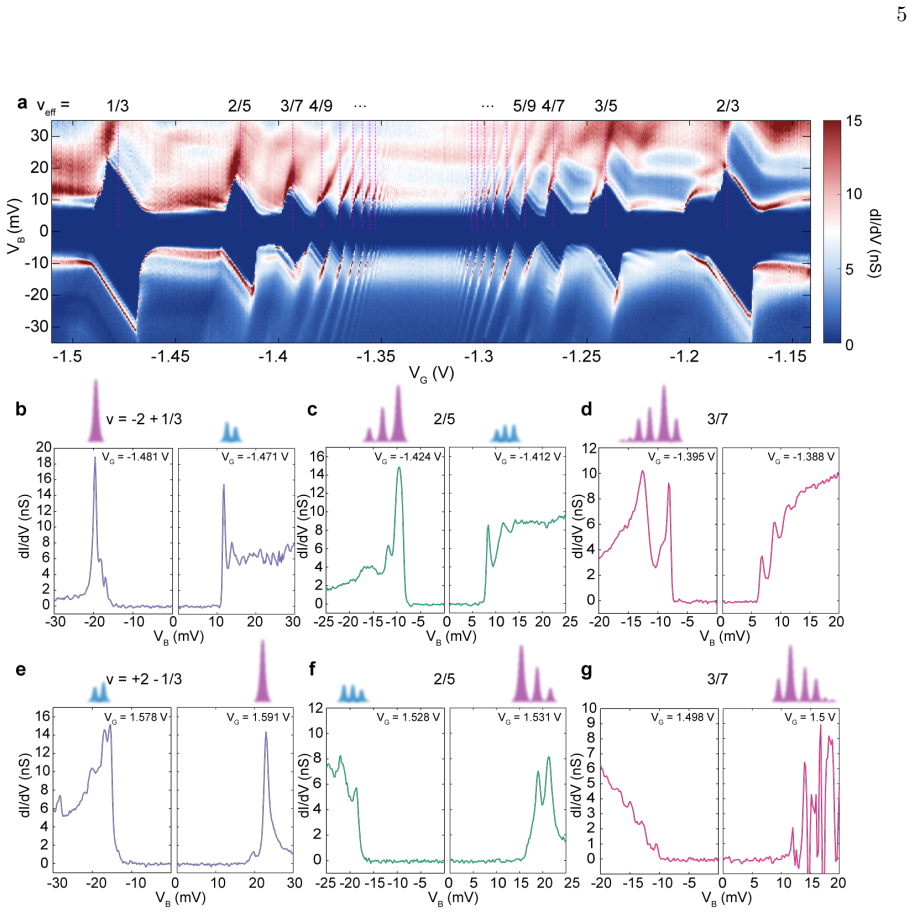
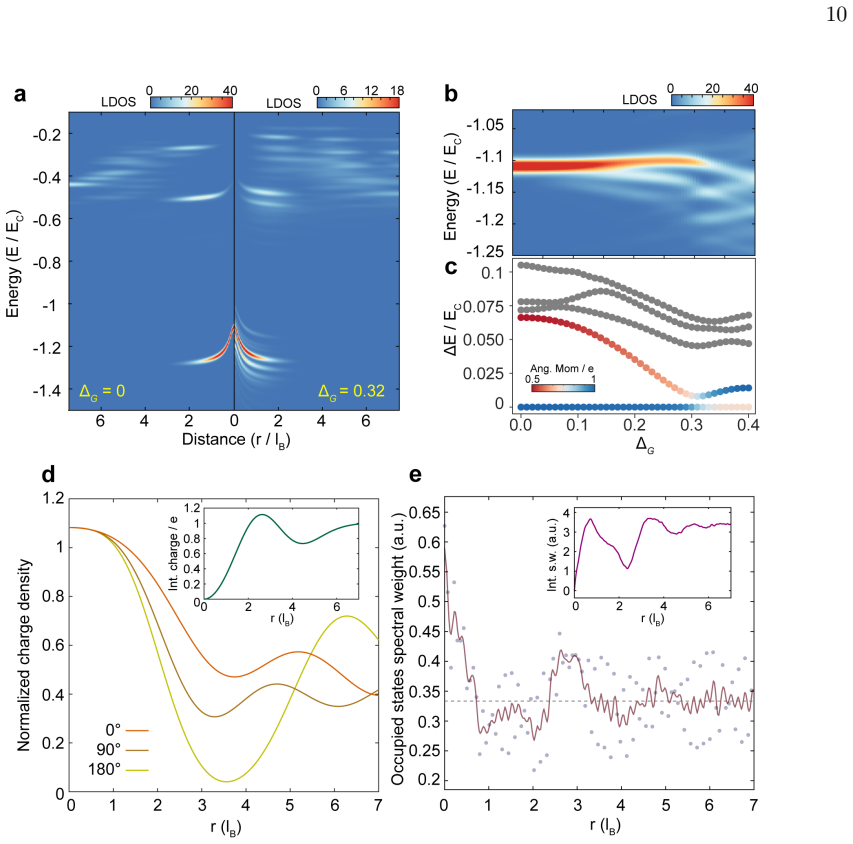
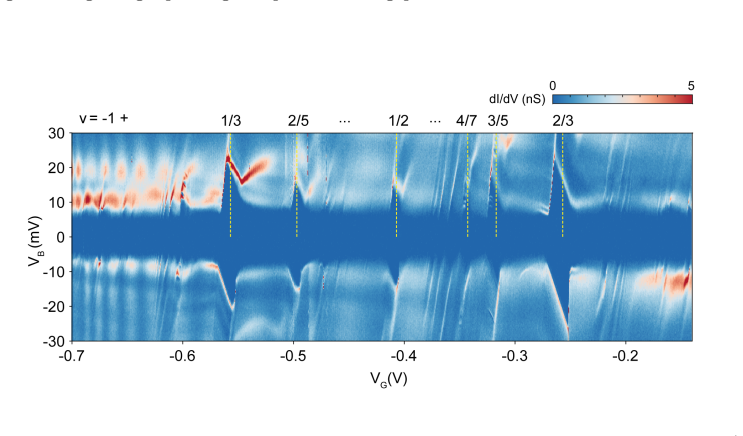
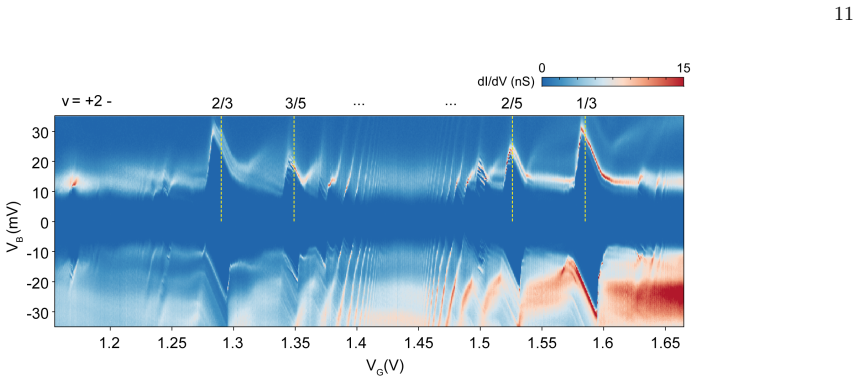
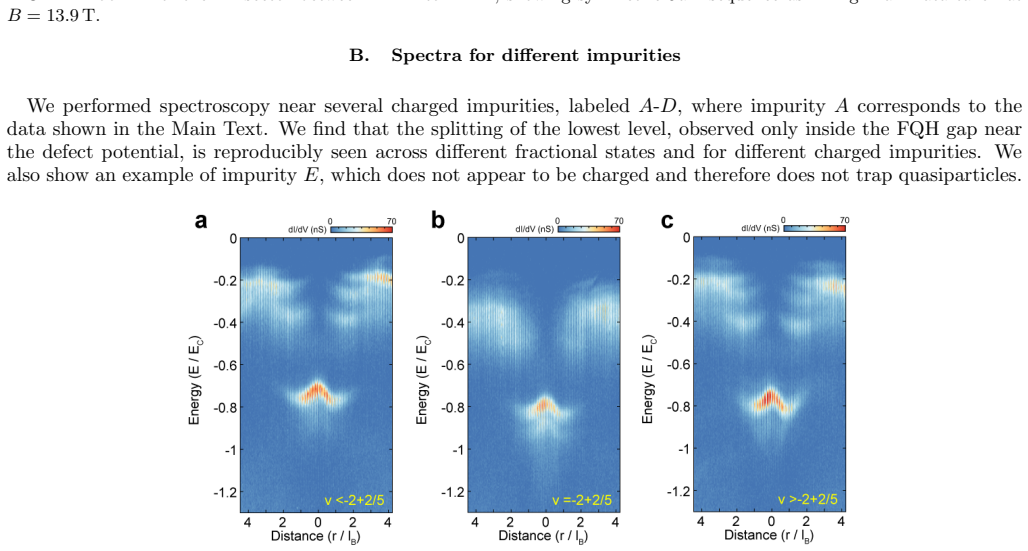
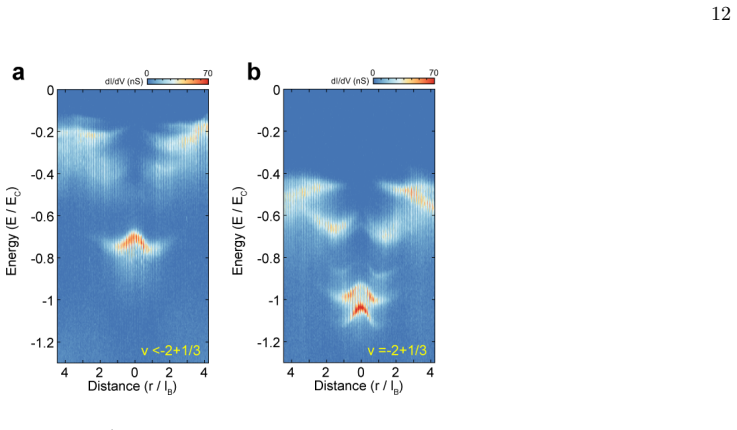
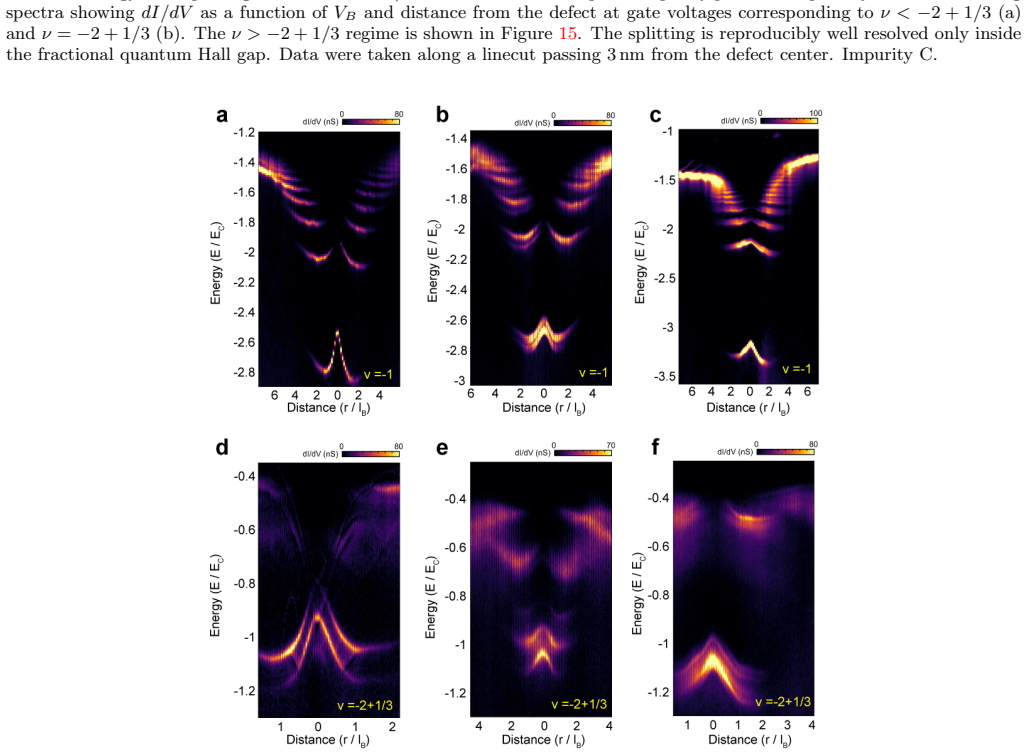
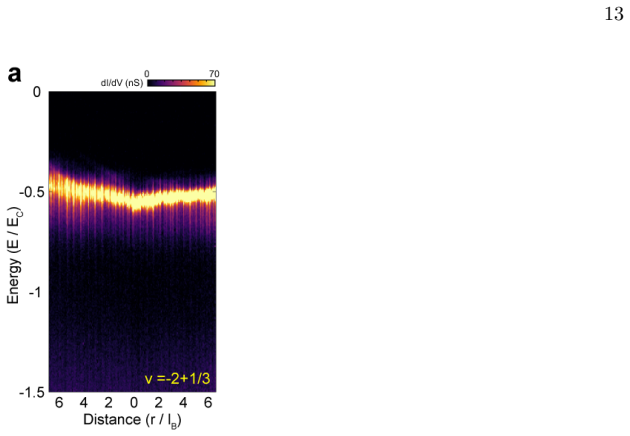
In the fractional quantum Hall states at ν=1/3 and 2/5, scanning tunneling spectra near charged impurities exhibit an additional energy splitting of the lowest-energy spectral feature that occurs only when the chemical potential lies within a fractional gap and is absent in compressible or integer regimes. Numerical calculations demonstrate that this splitting requires an anisotropic confining potential and vanishes for a rotationally symmetric trap. The competing multi-anyon states carry nearly identical charge within the core of the potential but differ in how that charge is redistributed at larger radius.
What carries the argument
Many-body configurations of anyons trapped by an anisotropic impurity potential, which produce distinct energies through different outer-radius charge redistributions while sharing nearly identical core charge.
If this is right
- Local tunneling spectroscopy acts as a direct probe of anyon bound states in confined geometries.
- The splitting is absent in integer quantum Hall states and compressible regimes.
- Competing multi-anyon states can be distinguished by outer charge distribution despite similar core charge.
- Anisotropic confinement is required to make the splitting observable.
Where Pith is reading between the lines
- The technique could be used to test whether specific anyon configurations can be selected by tuning trap anisotropy.
- Similar local signatures may appear when anyons are confined in other fractional states or in different host materials.
- Engineering controlled anisotropy around impurities might allow local manipulation of anyon positions or fusion outcomes.
Load-bearing premise
The splitting is produced by many-body anyon configurations rather than single-particle orbital effects or disorder, which rests on the numerical result that the splitting vanishes for rotationally symmetric traps together with the assumption that the experimental potential is sufficiently anisotropic.
What would settle it
Observation of the same splitting in a rotationally symmetric confining potential, or its complete absence when the chemical potential sits inside a fractional gap, would contradict the attribution to anisotropic anyon bound states.
Figures
read the original abstract
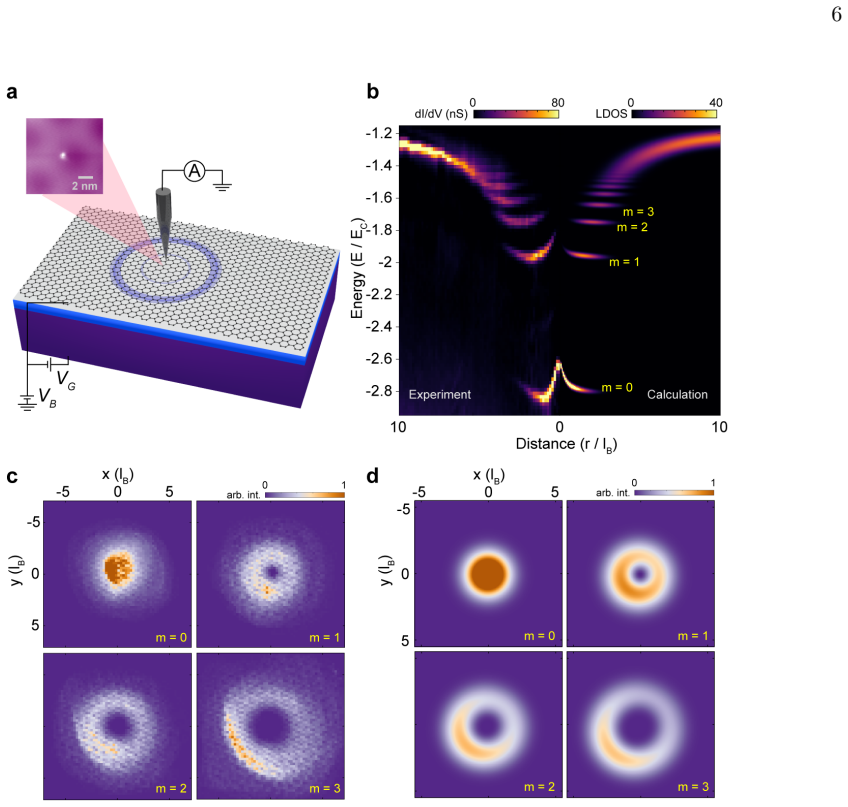
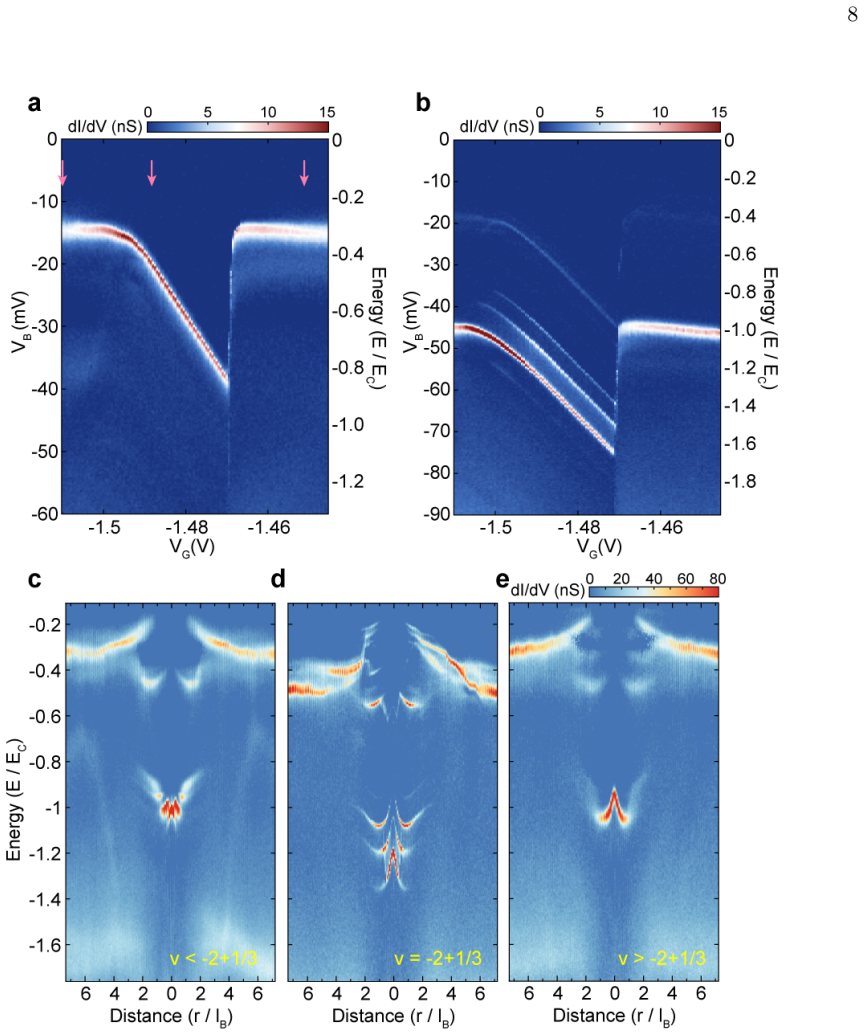
Fractional quantum Hall states host anyons, emergent quasiparticles with fractional charge and nontrivial exchange statistics. Controlling, trapping, and braiding anyons are central goals for both fundamental physics and topological quantum computation. A key step toward such control is understanding how anyons behave when confined in local potentials, where their internal structure can become relevant. Here, we use the scanning tunneling microscopy/spectroscopy (STM/STS) to study the excitation spectrum in integer and fractional quantum Hall states of monolayer graphene near individual charged impurities. In the integer quantum Hall states, the STS spectra show lifting of orbital degeneracy near defects, appearing as a band of discrete energy levels. In fractional states, (v=1/3 and 2/5), however, we observe an additional energy splitting of the lowest-energy spectral feature that occurs only when the chemical potential lies within a fractional gap and is absent in compressible or integer regimes. We attribute this to many-body configurations of anyons trapped by an impurity potential. Strikingly, numerical calculations show that the splitting requires an anisotropic confining potential, vanishing for a rotationally symmetric trap. The competing multi-anyon states carry nearly identical charge within the core of the potential but differ in how that charge is redistributed at larger radius. Our results establish local tunneling spectroscopy as a direct probe of anyon bound states, providing a key step toward understanding and controlling their behavior in confined geometries relevant for braiding and fusion.
Editorial analysis
A structured set of objections, weighed in public.
Referee Report
Summary. The manuscript reports STM/STS measurements near charged impurities in monolayer graphene under integer and fractional quantum Hall conditions. In integer states, spectra exhibit discrete levels from lifted orbital degeneracy. In fractional states (ν=1/3 and 2/5), an additional splitting of the lowest-energy feature appears exclusively when the chemical potential lies inside a fractional gap and is absent in compressible or integer regimes. The authors attribute this splitting to many-body anyon configurations bound by the impurity potential. Numerical calculations are presented showing that the splitting requires an anisotropic confining potential and vanishes for rotationally symmetric traps; the competing multi-anyon states carry nearly identical core charge but differ in radial redistribution.
Significance. If the central attribution is sustained, the work supplies a local spectroscopic signature of confined anyons and demonstrates that potential anisotropy is essential for the observed splitting. The explicit numerical demonstration that the effect disappears under rotational symmetry constitutes a concrete, falsifiable control that strengthens the interpretation. This constitutes a useful step toward local probes of anyon fusion and braiding in engineered potentials.
major comments (1)
- [STS spectra and numerical calculations section] The section describing the STS spectra and the numerical calculations: the attribution of the splitting to anyon bound states rests on the numerical result that the splitting vanishes for rotationally symmetric traps. The experimental analysis does not report an independent quantification or fit of the impurity potential anisotropy (via topography, electrostatic modeling, or otherwise). Without such a measurement, it remains possible that the real potential lies below the anisotropy threshold used in the simulations, allowing single-particle orbital effects or other many-body states to produce the observed splitting.
Simulated Author's Rebuttal
We thank the referee for the positive assessment of the manuscript's significance and for the detailed comment. We respond point-by-point below.
read point-by-point responses
-
Referee: [STS spectra and numerical calculations section] The section describing the STS spectra and the numerical calculations: the attribution of the splitting to anyon bound states rests on the numerical result that the splitting vanishes for rotationally symmetric traps. The experimental analysis does not report an independent quantification or fit of the impurity potential anisotropy (via topography, electrostatic modeling, or otherwise). Without such a measurement, it remains possible that the real potential lies below the anisotropy threshold used in the simulations, allowing single-particle orbital effects or other many-body states to produce the observed splitting.
Authors: The additional splitting appears exclusively inside the fractional gaps (ν=1/3, 2/5) and is absent both in the integer quantum Hall regime and in compressible regions. In the integer regime the same impurities produce only the expected discrete levels from orbital-degeneracy lifting, without the further splitting. This regime selectivity already excludes generic single-particle orbital effects from the impurity potential. The numerical calculations establish that anyonic multi-particle states produce the observed splitting only when the confining potential is anisotropic and that the splitting vanishes under rotational symmetry; the competing states differ in radial charge redistribution while carrying nearly identical core charge. Because the experimental feature is tied to the fractional regime, the anisotropy threshold relevant for anyons is the one that matters, and the absence of the feature outside fractional gaps supplies the necessary control. We therefore maintain that the attribution is supported without requiring an independent experimental fit of the anisotropy. revision: no
Circularity Check
No significant circularity detected
full rationale
The paper's central claim rests on direct experimental STS observations of an energy splitting that appears exclusively inside fractional gaps (ν=1/3, 2/5) and is absent in integer or compressible regimes, together with separate numerical calculations showing that the splitting vanishes for rotationally symmetric traps. No step in the reported chain reduces by the paper's own equations to a fitted parameter, a self-definition, or a self-citation whose content is itself the target result. The numerics are presented as an independent computational check rather than a renaming or tautological fit, and the experimental attribution does not invoke any load-bearing self-citation or ansatz smuggled from prior work. The derivation chain is therefore self-contained against external benchmarks.
Axiom & Free-Parameter Ledger
axioms (1)
- domain assumption Fractional quantum Hall states host anyons with fractional charge and nontrivial exchange statistics.
invented entities (1)
-
anyon bound states in anisotropic impurity traps
no independent evidence
Reference graph
Works this paper leans on
-
[1]
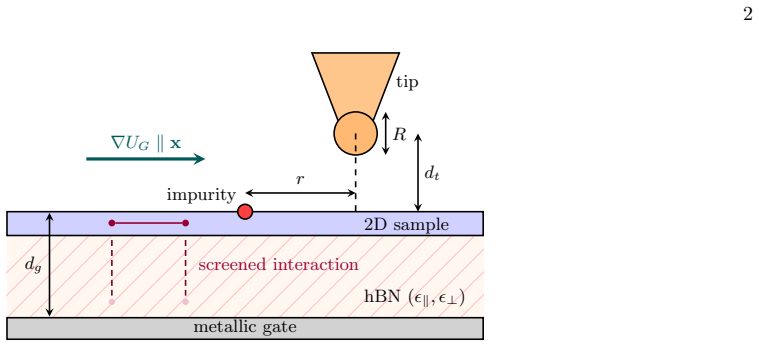
Sample fabrication The monolayer graphene device was prepared by assembling an open surface van der Waals heterostructure with a modified dry pickup technique. A polyvinyl alcohol (PVA) film on trans- 16 parent tape, mounted on a polydimethylsiloxane (PDMS) stamp, was used to pick up the exfoliated flakes in the order of monolayer graphene, hBN dielectric...
-
[2]
Local spectroscopy of anyons bound to charge traps
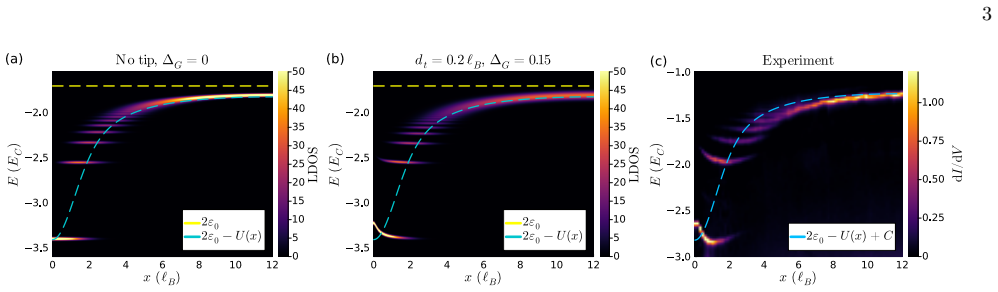
STM/STS measurements and data analysis Scanning tunneling microscopy and spectroscopy measurements were performed in a home-built dilution refrigerator STM. The mixing chamber temperature was approximately 20 mK, with the effective electron temperature around 210 mK (calibrated using an Al (100) reference surface). All measurements were performed at perpe...
-
[3]
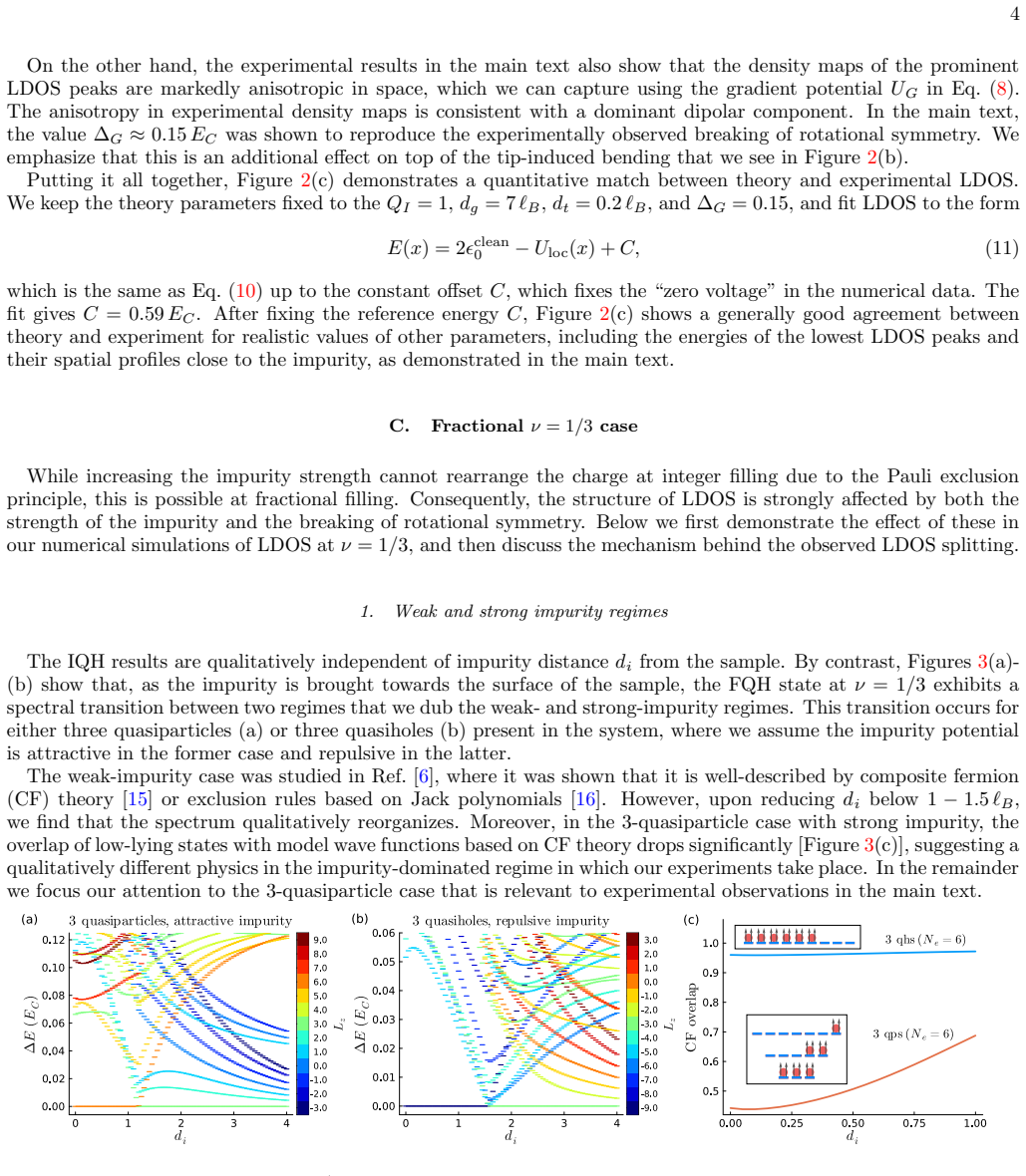
Weak and strong impurity regimes The IQH results are qualitatively independent of impurity distanced i from the sample. By contrast, Figures 3(a)- (b) show that, as the impurity is brought towards the surface of the sample, the FQH state atν= 1/3 exhibits a spectral transition between two regimes that we dub the weak- and strong-impurity regimes. This tra...
-
[4]
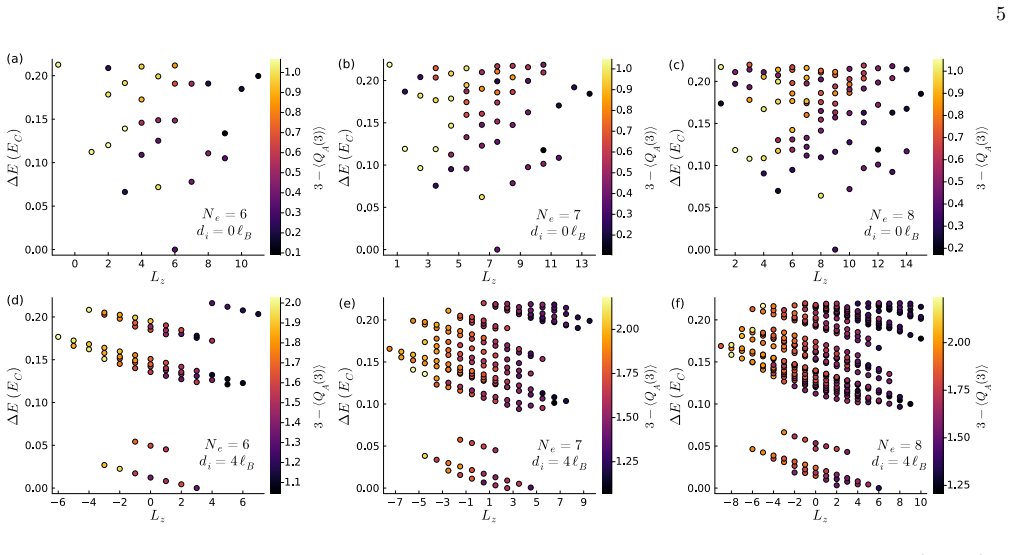
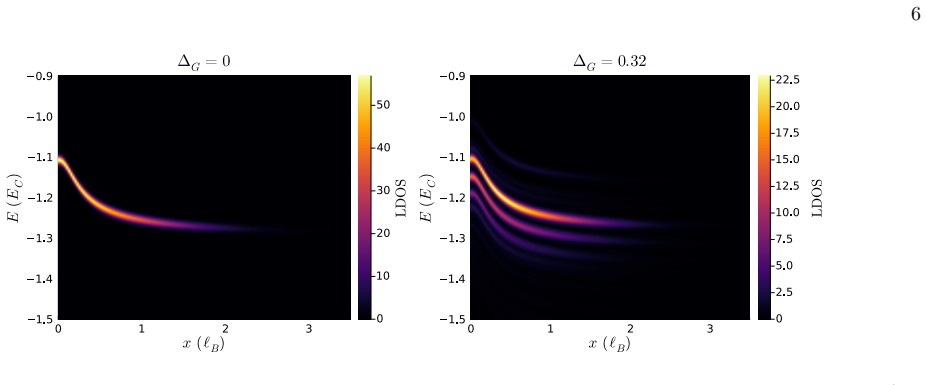
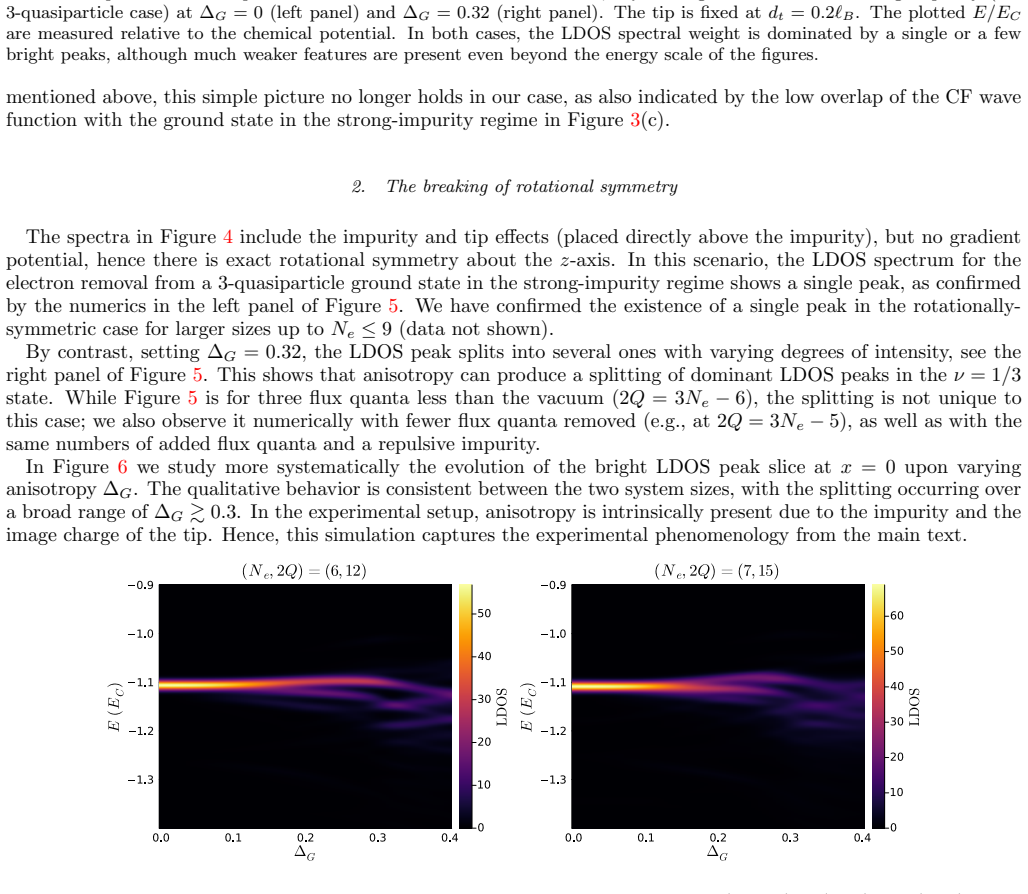
The breaking of rotational symmetry The spectra in Figure 4 include the impurity and tip effects (placed directly above the impurity), but no gradient potential, hence there is exact rotational symmetry about thez-axis. In this scenario, the LDOS spectrum for the electron removal from a 3-quasiparticle ground state in the strong-impurity regime shows a si...
-
[5]
While the final energy spectra (after the tunneling event) have a significant impact on the LDOS, the resonances above the impurity appear at high energies
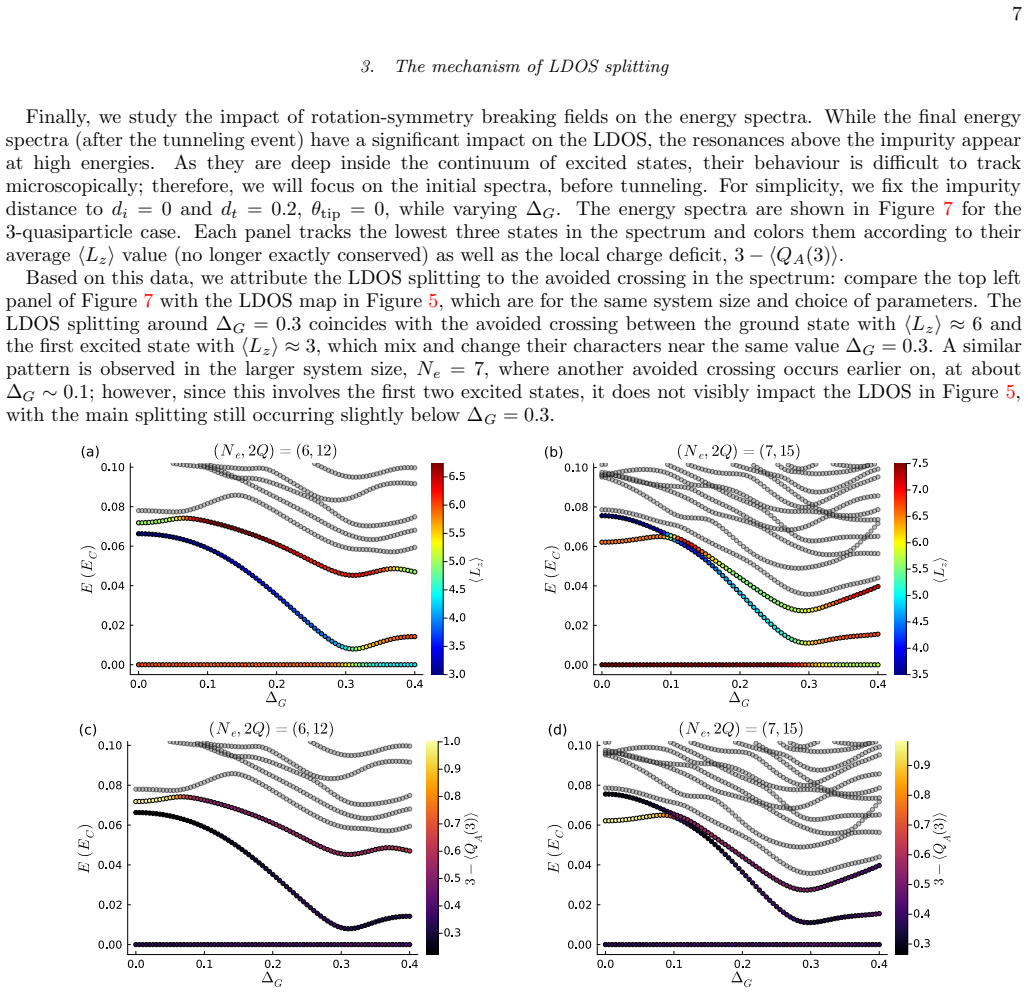
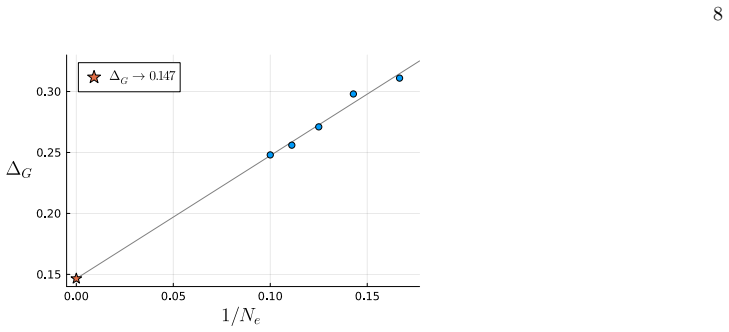
The mechanism of LDOS splitting Finally, we study the impact of rotation-symmetry breaking fields on the energy spectra. While the final energy spectra (after the tunneling event) have a significant impact on the LDOS, the resonances above the impurity appear at high energies. As they are deep inside the continuum of excited states, their behaviour is dif...
-
[6]
F. D. M. Haldane, Fractional quantization of the Hall effect: A hierarchy of incompressible quantum fluid states, Phys. Rev. Lett.51, 605 (1983)
1983
-
[7]
X. G. Wen and A. Zee, Shift and spin vector: New topological quantum numbers for the Hall fluids, Phys. Rev. Lett.69, 953 (1992)
1992
-
[8]
S. He, P. M. Platzman, and B. I. Halperin, Tunneling into a two-dimensional electron system in a strong magnetic field, Phys. Rev. Lett.71, 777 (1993)
1993
-
[9]
Haussmann, H
R. Haussmann, H. Mori, and A. H. MacDonald, Correlation energy and tunneling density of states in the fractional quantum Hall regime, Phys. Rev. Lett.76, 979 (1996)
1996
-
[10]
J. K. Jain and M. R. Peterson, Reconstructing the electron in a fractionalized quantum fluid, Phys. Rev. Lett.94, 186808 (2005)
2005
-
[11]
Papi´ c, R
Z. Papi´ c, R. S. K. Mong, A. Yazdani, and M. P. Zaletel, Imaging anyons with scanning tunneling microscopy, Phys. Rev. X8, 011037 (2018)
2018
-
[12]
X. Liu, G. Farahi, C.-L. Chiu, Z. Papic, K. Watanabe, T. Taniguchi, M. P. Zaletel, and A. Yazdani, Visualizing broken symmetry and topological defects in a quantum Hall ferromagnet, Science375, 321 (2022)
2022
-
[13]
G. Farahi, C.-L. Chiu, X. Liu, Z. Papic, K. Watanabe, T. Taniguchi, M. P. Zaletel, and A. Yazdani, Broken symmetries and excitation spectra of interacting electrons in partially filled Landau levels, Nature Physics 10.1038/s41567-023-02126-z (2023)
-
[14]
S. Pu, A. C. Balram, Y. Hu, Y.-C. Tsui, M. He, N. Regnault, M. P. Zaletel, A. Yazdani, and Z. Papi´ c, Fingerprints of composite fermion Lambda levels in scanning tunneling microscopy, Phys. Rev. B110, L081107 (2024)
2024
-
[15]
Gattu, G
M. Gattu, G. J. Sreejith, and J. K. Jain, Scanning tunneling microscopy of fractional quantum hall states: Spectroscopy of composite-fermion bound states, Phys. Rev. B109, L201123 (2024)
2024
-
[16]
Yue and A
X. Yue and A. Stern, Electronic excitations in the bulk of fractional quantum hall states, Phys. Rev. B110, 115428 (2024)
2024
-
[17]
Shizuya, Electromagnetic response and effective gauge theory of graphene in a magnetic field, Phys
K. Shizuya, Electromagnetic response and effective gauge theory of graphene in a magnetic field, Phys. Rev. B75, 245417 (2007)
2007
-
[18]
R. H. Morf, N. d’Ambrumenil, and S. Das Sarma, Excitation gaps in fractional quantum Hall states: An exact diagonal- ization study, Phys. Rev. B66, 075408 (2002)
2002
-
[19]
A. C. Balram and A. W´ ojs, Fractional quantum Hall effect atν= 2 + 4/9, Phys. Rev. Research2, 032035 (2020)
2020
-
[20]
J. K. Jain,Composite Fermions(Cambridge University Press, New York, US, 2007)
2007
-
[21]
B. A. Bernevig and F. D. M. Haldane, Model fractional quantum Hall states and jack polynomials, Phys. Rev. Lett.100, 246802 (2008)
2008
-
[22]
Wagner and T
G. Wagner and T. Neupert, Sensing the binding and unbinding of anyons at impurities, Phys. Rev. Res.8, 013263 (2026)
2026
-
[23]
B. A. Bernevig and F. D. M. Haldane, Generalized clustering conditions of jack polynomials at negative jack parameter α, Phys. Rev. B77, 184502 (2008)
2008
-
[24]
Yang and F
B. Yang and F. D. M. Haldane, Nature of quasielectrons and the continuum of neutral bulk excitations in laughlin quantum hall fluids, Phys. Rev. Lett.112, 026804 (2014)
2014
-
[25]
E. H. Rezayi and F. D. M. Haldane, Incompressible states of the fractionally quantized hall effect in the presence of impurities: A finite-size study, Phys. Rev. B32, 6924(R) (1985)
1985
discussion (0)
Sign in with ORCID, Apple, or X to comment. Anyone can read and Pith papers without signing in.