EveLoad: Cognitive Workload Recognition from Event-Based Eye Movements
Pith reviewed 2026-06-25 23:43 UTC · model grok-4.3
The pith
Event cameras can classify six levels of cognitive workload from eye movements at over 96 percent subject-specific accuracy using a controlled fixation task.
A machine-rendered reading of the paper's core claim, the machinery that carries it, and where it could break.
Core claim
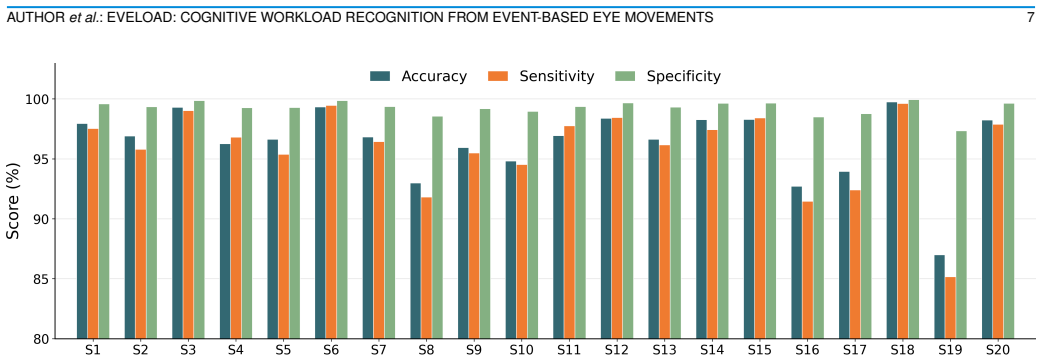
EveLoad supplies the first event-based eye-movement recordings annotated with six workload levels from twenty participants under a controlled N-back fixation paradigm. A spatiotemporal event encoding framework trained on this data yields 96.36 percent and 96.13 percent average subject-specific accuracy, showing that event streams from the eyes carry information usable for cognitive workload recognition in workload-aware rehabilitation settings.
What carries the argument
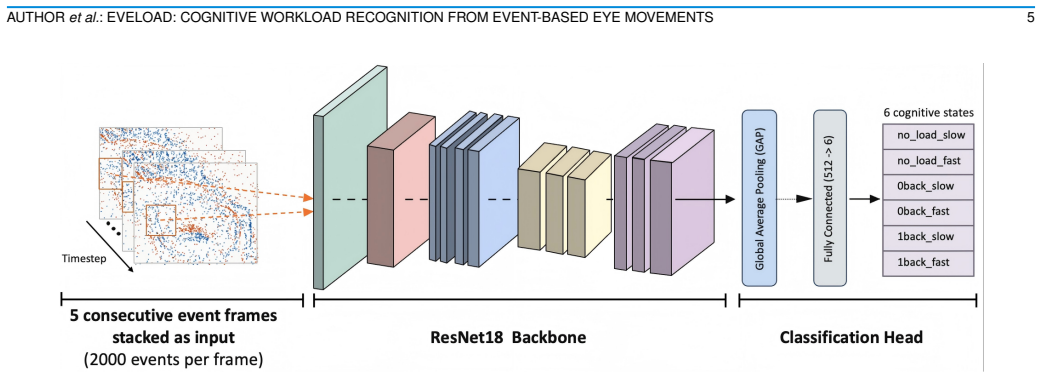
The EveLoad dataset together with a learning framework that converts asynchronous event-camera streams into spatiotemporal representations for workload classification.
If this is right
- Rehabilitation interfaces can use event cameras to adjust task difficulty in real time according to detected workload.
- Event-based sensing offers microsecond temporal resolution that frame-based trackers lack when tracking rapid eye movements.
- The controlled fixation design reduces the risk that models simply memorize spatial gaze patterns instead of workload signatures.
- The same pipeline could support adaptive pacing in extended-reality training environments.
Where Pith is reading between the lines
- The method might extend to free-viewing tasks if an additional spatial normalization step is added.
- Clinical populations with altered eye-movement patterns could be tested to check whether the same accuracy holds outside healthy participants.
- Pairing the sensor with robot-assisted devices would allow closed-loop systems that respond to both physical and cognitive load.
Load-bearing premise
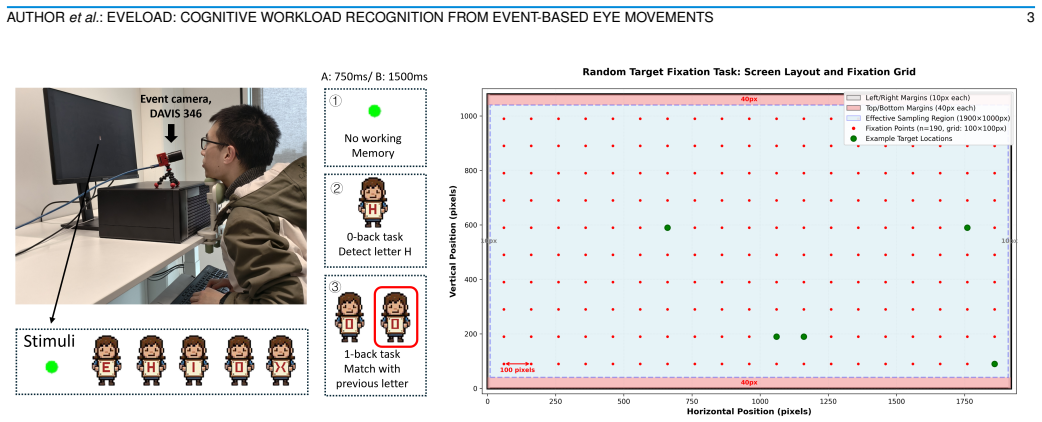
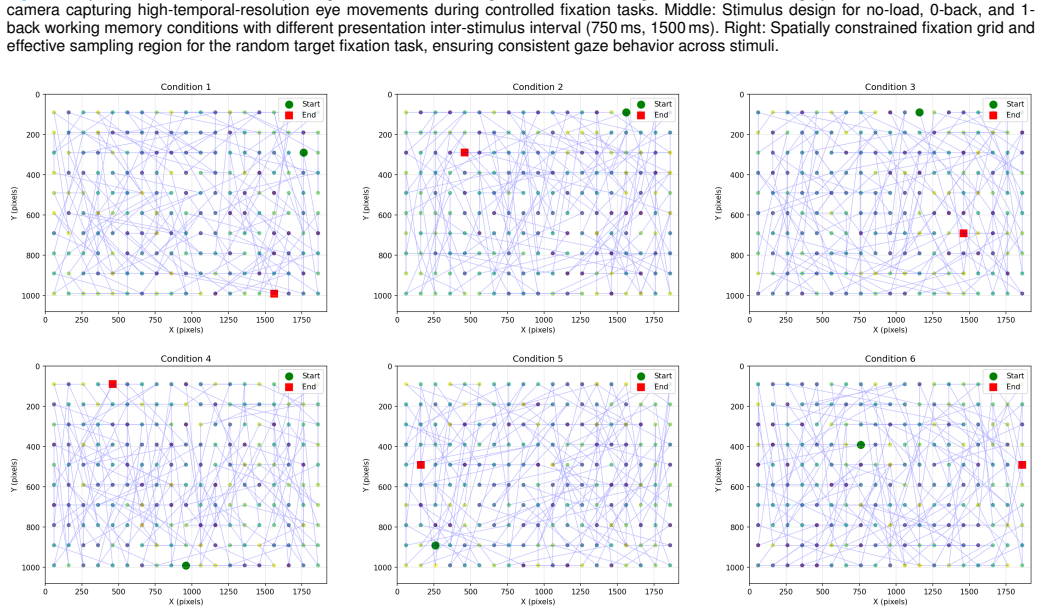
The N-back fixation paradigm isolates eye-movement features caused by cognitive load rather than by differences in gaze location.
What would settle it
A model trained on the dataset would lose most of its accuracy if tested on new recordings in which gaze locations are forced to be identical across workload levels while the workload itself still varies.
Figures
read the original abstract
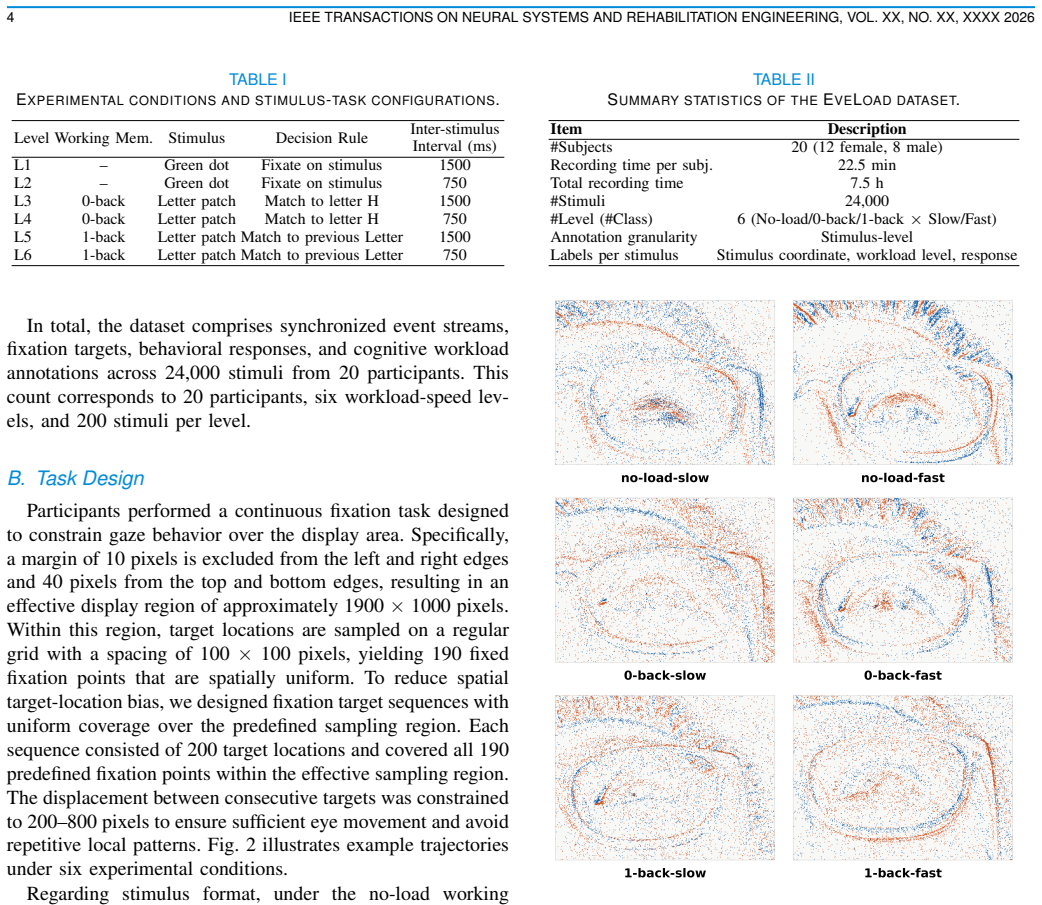
Cognitive workload monitoring is important for adaptive rehabilitation and assistive interfaces, where task difficulty, pacing, and feedback should be adjusted according to the user's cognitive state to avoid overload and under-challenge. Emerging extended reality and robot-assisted rehabilitation environments provide controllable training tasks, but they require unobtrusive sensing methods that can capture rapid ocular dynamics during interaction. Existing eye-movement-based cognitive workload recognition methods mainly rely on frame-based eye trackers, which often suffer from limited temporal resolution and degraded robustness under rapid eye movements. In contrast, event cameras provide microsecond-level temporal resolution, high dynamic range and low latency, making them suitable for capturing fine-grained ocular dynamics. Many previous studies rely on free-viewing or similar paradigms, where gaze locations can vary across tasks. As a result, models may learn associations between gaze-location distributions and cognitive workload, rather than workload-related eye movement characteristics themselves. In this work, we introduce EveLoad, which, to the best of our knowledge, is the first event-based eye-movement dataset with graded cognitive workload annotations, collected from 20 healthy participants under spatially constrained and task-driven conditions using a controlled N-back-guided fixation paradigm. Based on this dataset, we establish a benchmark for cognitive workload recognition with six workload levels and propose a learning framework that encodes spatiotemporal event representations. Experimental results show that our approach achieves an average subject-specific accuracy of 96.36% and 96.13% under mixed random split evaluation. These results suggest that event-based eye movements may provide a useful sensing pathway for future workload-aware rehabilitation.
Editorial analysis
A structured set of objections, weighed in public.
Referee Report
Summary. The manuscript introduces EveLoad, the first event-based eye-movement dataset with graded cognitive workload annotations, collected from 20 participants under a spatially constrained N-back-guided fixation paradigm. It proposes a spatiotemporal event representation learning framework and reports average subject-specific accuracies of 96.36% and 96.13% for six workload levels under mixed random split evaluation, claiming this supports event cameras as a sensing pathway for workload-aware rehabilitation.
Significance. If the accuracies reflect workload-related ocular dynamics rather than residual spatial cues, the work would supply a high-temporal-resolution sensing method suited to dynamic XR and robot-assisted rehabilitation settings where frame-based trackers are limited. The dataset itself constitutes a reusable resource for event-based ocular research.
major comments (2)
- [Abstract] Abstract: the claim that the 'spatially constrained and task-driven' N-back paradigm avoids gaze-location associations with workload is presented without any quantitative validation (e.g., Kolmogorov-Smirnov tests, fixation heatmaps, or event-density statistics) showing that distributions are statistically identical across the six workload levels. This assumption is load-bearing for interpreting the reported accuracies as evidence of cognitive-load sensing.
- [§4] §4 (Experimental Results): the 96.36%/96.13% figures are given without accompanying per-level confusion matrices, feature-ablation results, or analysis demonstrating that performance remains high when location-derived features are explicitly removed or when fixation locations are balanced.
minor comments (2)
- [Abstract] Abstract: the two accuracy values are reported without defining the precise difference between the two evaluation protocols mentioned.
- The manuscript would benefit from an explicit statement of the number of trials per workload level and the precise definition of 'subject-specific' versus 'mixed' splits.
Simulated Author's Rebuttal
We thank the referee for the constructive feedback on validating the spatial constraints of our paradigm and providing additional analyses to support the interpretation of our results. We address each major comment below and outline the revisions we will make.
read point-by-point responses
-
Referee: [Abstract] Abstract: the claim that the 'spatially constrained and task-driven' N-back paradigm avoids gaze-location associations with workload is presented without any quantitative validation (e.g., Kolmogorov-Smirnov tests, fixation heatmaps, or event-density statistics) showing that distributions are statistically identical across the six workload levels. This assumption is load-bearing for interpreting the reported accuracies as evidence of cognitive-load sensing.
Authors: We agree that explicit quantitative validation would strengthen the manuscript. The N-back-guided fixation paradigm was intentionally designed to require participants to maintain fixation on a single central target regardless of workload level, thereby eliminating gaze-location variation by task construction. To address the referee's concern, the revised manuscript will include fixation heatmaps, event-density statistics, and Kolmogorov-Smirnov tests comparing gaze distributions across the six workload levels. revision: partial
-
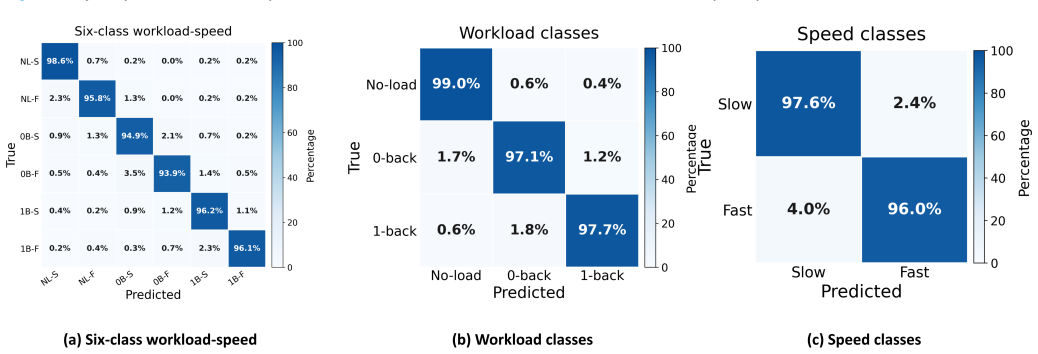
Referee: [§4] §4 (Experimental Results): the 96.36%/96.13% figures are given without accompanying per-level confusion matrices, feature-ablation results, or analysis demonstrating that performance remains high when location-derived features are explicitly removed or when fixation locations are balanced.
Authors: We acknowledge that these additional analyses would improve transparency. The revised manuscript will include per-level confusion matrices. Because the paradigm constrains all fixations to the identical central location, location-derived features are not present by design; however, we will add a feature-ablation study that explicitly removes any spatial components and will report performance under conditions where fixation locations are balanced across classes. revision: partial
Circularity Check
No significant circularity; results rest on new empirical data collection
full rationale
The paper collects a novel event-based eye-movement dataset under an N-back-guided fixation paradigm and reports subject-specific classification accuracies from a proposed spatiotemporal encoding framework. No equations, parameter-fitting steps, or self-citations are described that would make the 96.36%/96.13% accuracies reduce by construction to inputs or prior self-work. The central claim is an empirical measurement on held-out splits from independently gathered data, rendering the derivation self-contained.
Axiom & Free-Parameter Ledger
Reference graph
Works this paper leans on
-
[1]
Cross-task cognitive workload recognition based on eeg and domain adaptation,
Y . Zhou, Z. Xu, Y . Niu, P. Wang, X. Wen, X. Wu, and D. Zhang, “Cross-task cognitive workload recognition based on eeg and domain adaptation,”IEEE Transactions on Neural Systems and Rehabilitation Engineering, vol. 30, pp. 50–60, 2022. AUTHORet al.: EVELOAD: COGNITIVE WORKLOAD RECOGNITION FROM EVENT -BASED EYE MOVEMENTS 9
2022
-
[2]
Understanding task “challenge
E. Gomes, G. Alder, F. A. Bright, and N. Signal, “Understanding task “challenge” in stroke rehabilitation: an interdisciplinary concept analysis,”Disability and Rehabilitation, vol. 47, no. 3, pp. 560–570, 2025
2025
-
[3]
Real-time closed-loop control of cognitive load in neurological patients during robot-assisted gait training,
A. Koenig, D. Novak, X. Omlin, M. Pulfer, E. Perreault, L. Zimmerli, M. Mihelj, and R. Riener, “Real-time closed-loop control of cognitive load in neurological patients during robot-assisted gait training,”IEEE Transactions on Neural Systems and Rehabilitation Engineering, vol. 19, no. 4, pp. 453–464, 2011
2011
-
[4]
Adaptive conjunctive cognitive training (acct) in virtual reality for chronic stroke patients: a randomized controlled pilot trial,
M. Maier, B. R. Ballester, N. Leiva Ba ˜nuelos, E. Duarte Oller, and P. F. Verschure, “Adaptive conjunctive cognitive training (acct) in virtual reality for chronic stroke patients: a randomized controlled pilot trial,” Journal of neuroengineering and rehabilitation, vol. 17, no. 1, p. 42, 2020
2020
-
[5]
Cognitive load influences oculomotor behavior in natural scenes,
K. Walter and P. Bex, “Cognitive load influences oculomotor behavior in natural scenes,”Scientific Reports, vol. 11, no. 1, p. 12405, 2021
2021
-
[6]
Post-saccadic eye movement indices under cognitive load: a path analysis to determine visual performance,
M. S. Fadardi, J. S. Fadardi, M. Mahjoob, and H. Doosti, “Post-saccadic eye movement indices under cognitive load: a path analysis to determine visual performance,”Journal of Ophthalmic & Vision Research, vol. 17, no. 3, p. 397, 2022
2022
-
[7]
Eye tracking cognitive load using pupil diameter and microsaccades with fixed gaze,
K. Krejtz, A. T. Duchowski, A. Niedzielska, C. Biele, and I. Krejtz, “Eye tracking cognitive load using pupil diameter and microsaccades with fixed gaze,”PloS one, vol. 13, no. 9, p. e0203629, 2018
2018
-
[8]
Eye movement as indicators of mental workload to trigger adaptive automation,
T. de Greef, H. Lafeber, H. van Oostendorp, and J. Lindenberg, “Eye movement as indicators of mental workload to trigger adaptive automation,” inInternational conference on foundations of augmented cognition. Springer, 2009, pp. 219–228
2009
-
[9]
Studying developer eye movements to measure cognitive workload and visual effort for expertise assessment,
S. D. Aljehane, B. Sharif, and J. I. Maletic, “Studying developer eye movements to measure cognitive workload and visual effort for expertise assessment,”Proceedings of the ACM on Human-Computer Interaction, vol. 7, no. ETRA, pp. 1–18, 2023
2023
-
[10]
Colet: A dataset for cognitive workload estimation based on eye-tracking,
E. Ktistakis, V . Skaramagkas, D. Manousos, N. S. Tachos, E. Tripoliti, D. I. Fotiadis, and M. Tsiknakis, “Colet: A dataset for cognitive workload estimation based on eye-tracking,”Computer Methods and Programs in Biomedicine, vol. 224, p. 106989, 2022
2022
-
[11]
A 128×128 120 db 15µs latency asynchronous temporal contrast vision sensor,
P. Lichtsteiner, C. Posch, and T. Delbruck, “A 128×128 120 db 15µs latency asynchronous temporal contrast vision sensor,”IEEE Journal of Solid-State Circuits, vol. 43, no. 2, pp. 566–576, 2008
2008
-
[12]
3et: Efficient event-based eye tracking using a change-based convlstm network,
Q. Chen, Z. Wang, S.-C. Liu, and C. Gao, “3et: Efficient event-based eye tracking using a change-based convlstm network,” in2023 IEEE Biomedical Circuits and Systems Conference (BioCAS). IEEE, 2023, pp. 1–5
2023
-
[13]
Retina: Low-power eye tracking with event camera and spiking hardware. ieee,
P. Bonazzi, S. Bian, G. Lippolis, Y . Li, S. Sheik, and M. Magno, “Retina: Low-power eye tracking with event camera and spiking hardware. ieee,” inCVF Conference on Computer Vision and Pattern Recognition (CVPR) Workshops, vol. 1, 2024
2024
-
[14]
E-gaze: Gaze estimation with event camera,
N. Li, M. Chang, and A. Raychowdhury, “E-gaze: Gaze estimation with event camera,”IEEE Transactions on Pattern Analysis and Machine Intelligence, vol. 46, no. 7, pp. 4796–4811, 2024
2024
-
[15]
Event based, near eye gaze tracking beyond 10,000 hz,
A. N. Angelopoulos, J. N. Martel, A. P. Kohli, J. Conradt, and G. Wet- zstein, “Event based, near eye gaze tracking beyond 10,000 hz,”arXiv preprint arXiv:2004.03577, 2020
arXiv 2004
-
[16]
Event-based eye tracking. ais 2024 challenge survey,
Z. Wang, C. Gao, Z. Wu, M. V . Conde, R. Timofte, S.-C. Liu, Q. Chen, Z.-J. Zha, W. Zhai, H. Hanet al., “Event-based eye tracking. ais 2024 challenge survey,” inProceedings of the IEEE/CVF Conference on Computer Vision and Pattern Recognition, 2024, pp. 5810–5825
2024
-
[17]
A lightweight spatiotemporal network for online eye tracking with event camera,
Y . R. Pei, S. Br ¨uers, S. Crouzet, D. McLelland, and O. Coenen, “A lightweight spatiotemporal network for online eye tracking with event camera,” inProceedings of the IEEE/CVF Conference on Computer Vision and Pattern Recognition, 2024, pp. 5780–5788
2024
-
[18]
Ev- eye: Rethinking high-frequency eye tracking through the lenses of event cameras,
G. Zhao, Y . Yang, J. Liu, N. Chen, Y . Shen, H. Wen, and G. Lan, “Ev- eye: Rethinking high-frequency eye tracking through the lenses of event cameras,”Advances in Neural Information Processing Systems, vol. 36, 2024
2024
-
[19]
E-track: Eye tracking with event camera for extended reality (xr) applications,
N. Li, A. Bhat, and A. Raychowdhury, “E-track: Eye tracking with event camera for extended reality (xr) applications,” in2023 IEEE 5th International Conference on Artificial Intelligence Circuits and Systems (AICAS). IEEE, 2023, pp. 1–5
2023
-
[20]
Mambapupil: Bidirectional selective recurrent model for event- based eye tracking,
Z. Wang, Z. Wan, H. Han, B. Liao, Y . Wu, W. Zhai, Y . Cao, and Z.-j. Zha, “Mambapupil: Bidirectional selective recurrent model for event- based eye tracking,” inProceedings of the IEEE/CVF Conference on Computer Vision and Pattern Recognition, 2024, pp. 5762–5770
2024
-
[21]
Event-based kilohertz eye tracking using coded differential lighting,
T. Stoffregen, H. Daraei, C. Robinson, and A. Fix, “Event-based kilohertz eye tracking using coded differential lighting,” inProceedings of the IEEE/CVF Winter Conference on Applications of Computer Vision, 2022, pp. 2515–2523
2022
-
[22]
Fapnet: An effective frequency adaptive point-based eye tracker,
X. Lin, H. Ren, and B. Cheng, “Fapnet: An effective frequency adaptive point-based eye tracker,” inProceedings of the IEEE/CVF Conference on Computer Vision and Pattern Recognition, 2024, pp. 5789–5798
2024
-
[23]
Facet: Fast and accurate event-based eye tracking using ellipse modeling for extended reality,
J. Ding, Z. Wang, C. Gao, M. Liu, and Q. Chen, “Facet: Fast and accurate event-based eye tracking using ellipse modeling for extended reality,” in2025 IEEE International Conference on Robotics and Au- tomation (ICRA), 2025, pp. 10 347–10 354
2025
-
[24]
Em-cogload: An investi- gation into age and cognitive load detection using eye tracking and deep learning,
G. Miles, M. Smith, N. Zook, and W. Zhang, “Em-cogload: An investi- gation into age and cognitive load detection using eye tracking and deep learning,”Computational and Structural Biotechnology Journal, vol. 24, pp. 264–280, 2024
2024
-
[25]
Exploring eye tracking to detect cognitive load in complex virtual reality training,
M. Nasri, M. Kosa, L. Chukoskie, M. Moghaddam, and C. Harteveld, “Exploring eye tracking to detect cognitive load in complex virtual reality training,” in2024 IEEE International Symposium on Mixed and Augmented Reality Adjunct (ISMAR-Adjunct). IEEE, 2024, pp. 51–54
2024
-
[26]
A look at the free-viewing paradigm in eye-tracking research to assess positive attentional bias,
T. Suslow, D. Hoepfel, T. Wenk, A. Kersting, and V . G ¨unther, “A look at the free-viewing paradigm in eye-tracking research to assess positive attentional bias,”Frontiers in Psychiatry, vol. 16, p. 1659072, 2025
2025
-
[27]
Understanding the impact of the reality-virtuality contin- uum on visual search using fixation-related potentials and eye tracking features,
F. Chiossi, U. Gruenefeld, B. J. Hou, J. Newn, C. Ou, R. Liao, R. Welsch, and S. Mayer, “Understanding the impact of the reality-virtuality contin- uum on visual search using fixation-related potentials and eye tracking features,”Proceedings of the ACM on Human-Computer Interaction, vol. 8, no. MHCI, pp. 1–33, 2024
2024
-
[28]
Age differences in short-term retention of rapidly changing information
W. K. Kirchner, “Age differences in short-term retention of rapidly changing information.”Journal of experimental psychology, vol. 55, no. 4, p. 352, 1958
1958
-
[29]
Mental workload during n-back task—quantified in the prefrontal cortex using fnirs,
C. Herff, D. Heger, O. Fortmann, J. Hennrich, F. Putze, and T. Schultz, “Mental workload during n-back task—quantified in the prefrontal cortex using fnirs,”Frontiers in human neuroscience, vol. 7, p. 935, 2014
2014
-
[30]
Event-based Vision: A Survey,
G. Gallego, T. Delbruck, G. Orchard, C. Bartolozzi, B. Taba, A. Censi, S. Leutenegger, A. Davison, J. Conradt, K. Daniilidis, and D. Scara- muzza, “Event-based Vision: A Survey,”IEEE Transactions on Pattern Analysis and Machine Intelligence, vol. 44, no. 1, pp. 154–180, Jan. 2022
2022
-
[31]
Bringing a blurry frame alive at high frame-rate with an event camera,
L. Pan, C. Scheerlinck, X. Yu, R. Hartley, M. Liu, and Y . Dai, “Bringing a blurry frame alive at high frame-rate with an event camera,” in Proceedings of the IEEE/CVF conference on computer vision and pattern recognition, 2019, pp. 6820–6829
2019
-
[32]
Eventcap: Monocular 3d capture of high-speed human motions using an event camera,
L. Xu, W. Xu, V . Golyanik, M. Habermann, L. Fang, and C. Theobalt, “Eventcap: Monocular 3d capture of high-speed human motions using an event camera,” inProceedings of the IEEE/CVF Conference on Computer Vision and Pattern Recognition, 2020, pp. 4968–4978
2020
-
[33]
Measuring cognitive load through event camera based human-pose estimation,
M. Aitsam, D. Lacroix, G. Goyal, C. Bartolozzi, and A. Di Nuovo, “Measuring cognitive load through event camera based human-pose estimation,” inInternational Workshop on Human-Friendly Robotics. Springer, 2024, pp. 229–239
2024
-
[34]
A survey on measuring cognitive workload in human- computer interaction,
T. Kosch, J. Karolus, J. Zagermann, H. Reiterer, A. Schmidt, and P. W. Wo´zniak, “A survey on measuring cognitive workload in human- computer interaction,”ACM Computing Surveys, vol. 55, no. 13s, pp. 1–39, 2023
2023
-
[35]
A systematic review of physiological measures of mental workload,
D. Tao, H. Tan, H. Wang, X. Zhang, X. Qu, and T. Zhang, “A systematic review of physiological measures of mental workload,”International journal of environmental research and public health, vol. 16, no. 15, p. 2716, 2019
2019
-
[36]
Spectral and temporal feature learning with two-stream neural networks for mental workload assessment,
P. Zhang, X. Wang, J. Chen, W. You, and W. Zhang, “Spectral and temporal feature learning with two-stream neural networks for mental workload assessment,”IEEE Transactions on Neural Systems and Re- habilitation Engineering, vol. 27, no. 6, pp. 1149–1159, 2019
2019
-
[37]
A unified analytical framework with multiple fnirs features for mental workload assessment in the prefrontal cortex,
L. G. Lim, W. C. Ung, Y . L. Chan, C.-K. Lu, S. Sutoko, T. Funane, M. Kiguchi, and T. B. Tang, “A unified analytical framework with multiple fnirs features for mental workload assessment in the prefrontal cortex,”IEEE Transactions on Neural Systems and Rehabilitation En- gineering, vol. 28, no. 11, pp. 2367–2376, 2020
2020
-
[38]
Combining and comparing eeg, peripheral physiology and eye-related measures for the assessment of mental workload,
M. A. Hogervorst, A.-M. Brouwer, and J. B. Van Erp, “Combining and comparing eeg, peripheral physiology and eye-related measures for the assessment of mental workload,”Frontiers in neuroscience, vol. 8, p. 322, 2014
2014
-
[39]
Unraveling the physiological correlates of mental workload variations in tracking and collision prediction tasks,
A. R. John, A. K. Singh, T.-T. N. Do, A. Eidels, E. Nalivaiko, A. M. Gavgani, S. Brown, M. Bennett, S. Lal, A. M. Simpsonet al., “Unraveling the physiological correlates of mental workload variations in tracking and collision prediction tasks,”IEEE Transactions on Neural Systems and Rehabilitation Engineering, vol. 30, pp. 770–781, 2022
2022
-
[40]
Eog metrics for cognitive workload detection,
C. Belkhiria and V . Peysakhovich, “Eog metrics for cognitive workload detection,”Procedia Computer Science, vol. 192, pp. 1875–1884, 2021
2021
-
[41]
Johnston, A
R. Johnston, A. C. Snyder, S. B. Khanna, D. Issar, and M. A. Smith, “The eyes reflect an internal cognitive state hidden in the population activity 10 IEEE TRANSACTIONS ON NEURAL SYSTEMS AND REHABILITATION ENGINEERING, VOL. XX, NO. XX, XXXX 2026 of cortical neurons,”Cerebral Cortex, vol. 32, no. 15, pp. 3331–3346, 2022
2026
-
[42]
Comparing eye-tracking metrics of mental workload caused by ndrts in semi-autonomous driving,
W. Chen, T. Sawaragi, and T. Hiraoka, “Comparing eye-tracking metrics of mental workload caused by ndrts in semi-autonomous driving,”Trans- portation research part F: traffic psychology and behaviour, vol. 89, pp. 109–128, 2022
2022
-
[43]
Cognitive load classification of mixed reality human computer interaction tasks based on multimodal sensor signals,
Y . Hou, Q. Xie, N. Zhang, and J. Lv, “Cognitive load classification of mixed reality human computer interaction tasks based on multimodal sensor signals,”Scientific Reports, vol. 15, no. 1, p. 13732, 2025
2025
-
[44]
Evaluating a camera-based approach to assess cognitive load during manufacturing computer tasks,
N. Vasta, N. Jajo, F. Graf, L. Zhang, and F. N. Biondi, “Evaluating a camera-based approach to assess cognitive load during manufacturing computer tasks,”Electronics, vol. 14, no. 3, p. 467, 2025
2025
-
[45]
Retaining image fea- ture matching performance under low light conditions,
P. Shyam, A. Bangunharcana, and K.-S. Kim, “Retaining image fea- ture matching performance under low light conditions,” in2020 20th International Conference on Control, Automation and Systems (ICCAS). IEEE, 2020, pp. 1079–1085
2020
-
[46]
Testing a cognitive control model of human intelligence,
Y . Chen, A. Spagna, T. Wu, T. H. Kim, Q. Wu, C. Chen, Y . Wu, and J. Fan, “Testing a cognitive control model of human intelligence,” Scientific reports, vol. 9, no. 1, p. 2898, 2019
2019
-
[47]
Changes in task performance and frontal cortex activation within and over sessions during the n-back task,
M. K. Yeung and Y . M. Han, “Changes in task performance and frontal cortex activation within and over sessions during the n-back task,” Scientific reports, vol. 13, no. 1, p. 3363, 2023
2023
-
[48]
Hundred days of cog- nitive training enhance broad cognitive abilities in adulthood: Findings from the cogito study,
F. Schmiedek, M. L ¨ovd´en, and U. Lindenberger, “Hundred days of cog- nitive training enhance broad cognitive abilities in adulthood: Findings from the cogito study,”Frontiers in aging neuroscience, vol. 2, p. 27, 2010
2010
-
[49]
A task is a task is a task: Putting complex span, n-back, and other working memory indicators in psychometric context,
——, “A task is a task is a task: Putting complex span, n-back, and other working memory indicators in psychometric context,”Frontiers in psychology, vol. 5, p. 1475, 2014
2014
-
[50]
Alphabetic letter identification: Effects of perceivability, similarity, and bias,
S. T. Mueller and C. T. Weidemann, “Alphabetic letter identification: Effects of perceivability, similarity, and bias,”Acta psychologica, vol. 139, no. 1, pp. 19–37, 2012
2012
-
[51]
Deep residual learning for image recognition,
K. He, X. Zhang, S. Ren, and J. Sun, “Deep residual learning for image recognition,” inProceedings of the IEEE conference on computer vision and pattern recognition, 2016, pp. 770–778
2016
-
[52]
Searching for mobilenetv3,
A. Howard, M. Sandler, G. Chu, L.-C. Chen, B. Chen, M. Tan, W. Wang, Y . Zhu, R. Pang, V . Vasudevanet al., “Searching for mobilenetv3,” inProceedings of the IEEE/CVF international conference on computer vision, 2019, pp. 1314–1324
2019
-
[53]
Mobilevit: light-weight, general- purpose, and mobile-friendly vision transformer,
S. Mehta and M. Rastegari, “Mobilevit: light-weight, general- purpose, and mobile-friendly vision transformer,”arXiv preprint arXiv:2110.02178, 2021
Pith/arXiv arXiv 2021
-
[54]
Cognitive workload level estimation based on eye tracking: A machine learning approach,
V . Skaramagkas, E. Ktistakis, D. Manousos, N. S. Tachos, E. Kazantzaki, E. E. Tripoliti, D. I. Fotiadis, and M. Tsiknakis, “Cognitive workload level estimation based on eye tracking: A machine learning approach,” in2021 IEEE 21st International Conference on Bioinformatics and Bioengineering (BIBE), 2021, pp. 1–5
2021
-
[55]
Cognitive load classification during online shopping using deep learning on time series eye movement indices,
S. Wibirama, M. A. Fikri, I. K. Aliza, K. A. Nugraha, S. A. I. Alfarozi, N. A. Setiawan, A. R. Suhari, and S. Kusrohmaniah, “Cognitive load classification during online shopping using deep learning on time series eye movement indices,”Array, p. 100669, 2026
2026
-
[56]
Multimodal machine learning framework for driver mental workload classification: A comparative and interpretable approach,
X. Shao, X. Ma, F. Chen, and X. Pan, “Multimodal machine learning framework for driver mental workload classification: A comparative and interpretable approach,”Applied Sciences, vol. 16, no. 7, p. 3581, 2026
2026
-
[57]
Your eyes under pressure: Real-time estimation of cognitive load with smooth pursuit tracking,
P. Dell’Acqua, M. Garofalo, F. La Rosa, and M. Villari, “Your eyes under pressure: Real-time estimation of cognitive load with smooth pursuit tracking,”Big Data and Cognitive Computing, vol. 9, no. 11, p. 288, 2025
2025
discussion (0)
Sign in with ORCID, Apple, or X to comment. Anyone can read and Pith papers without signing in.