Efficient and Trainable Language Model Test-Time Scaling via Local Branch Routing
Pith reviewed 2026-06-25 21:27 UTC · model grok-4.3
The pith
Local Branch Routing improves language-model reasoning by routing among short lookahead branches using their hidden states.
A machine-rendered reading of the paper's core claim, the machinery that carries it, and where it could break.
Core claim
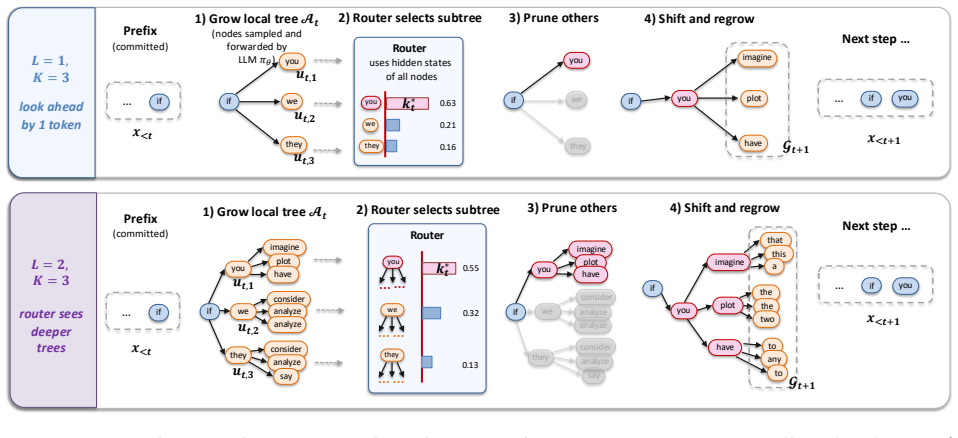
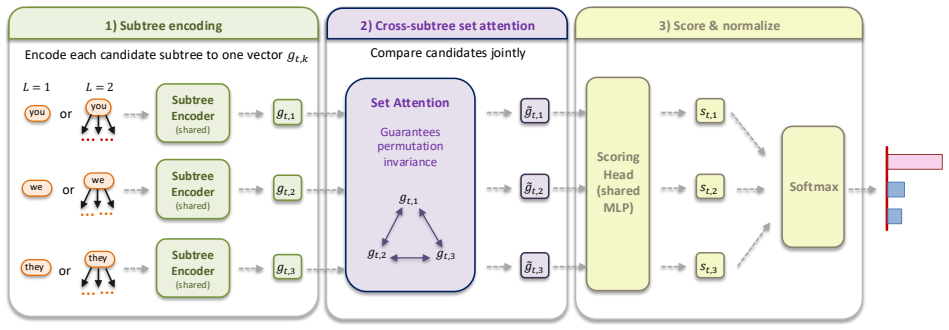
Local Branch Routing expands a small local lookahead tree, forwards every sampled branch through the language model, and uses a router over the hidden states of those local futures to choose which depth-1 subtree to commit; the resulting discrete trajectory admits an explicit likelihood that supports joint reinforcement learning of the base model and router under the likelihood-ratio principle.
What carries the argument
Local Branch Routing (LBR): a router that selects the next depth-1 subtree by inspecting hidden states of candidate local futures rather than only the root next-token distribution.
If this is right
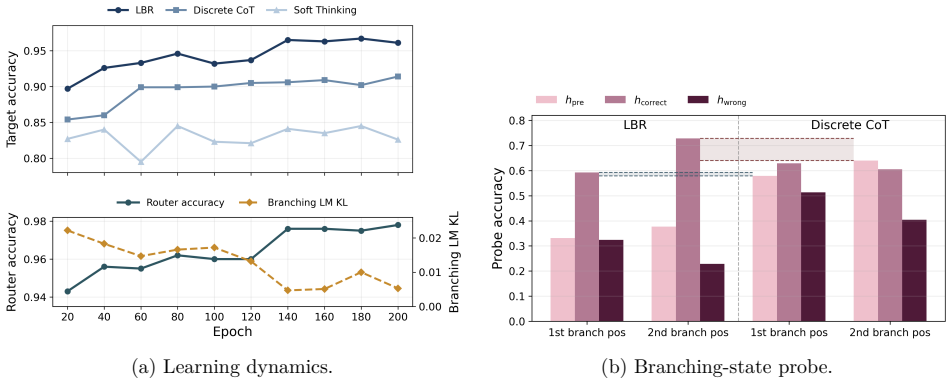
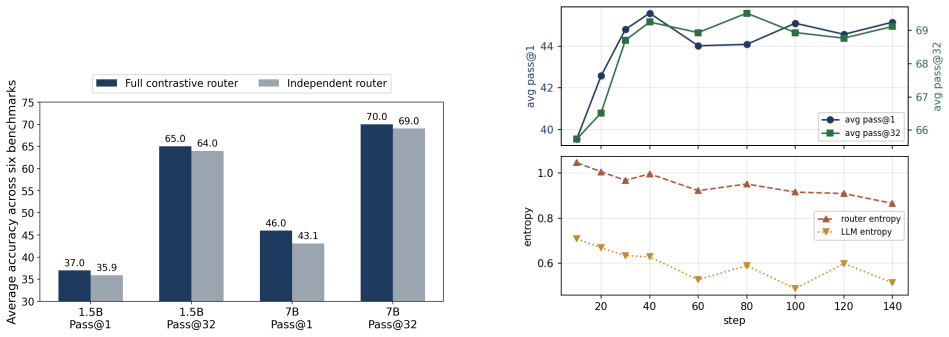
- LBR raises both Pass@1 and Pass@32 on mathematical reasoning benchmarks over discrete chain-of-thought, vanilla discrete-token RLVR, and RL-compatible soft-token branching baselines.
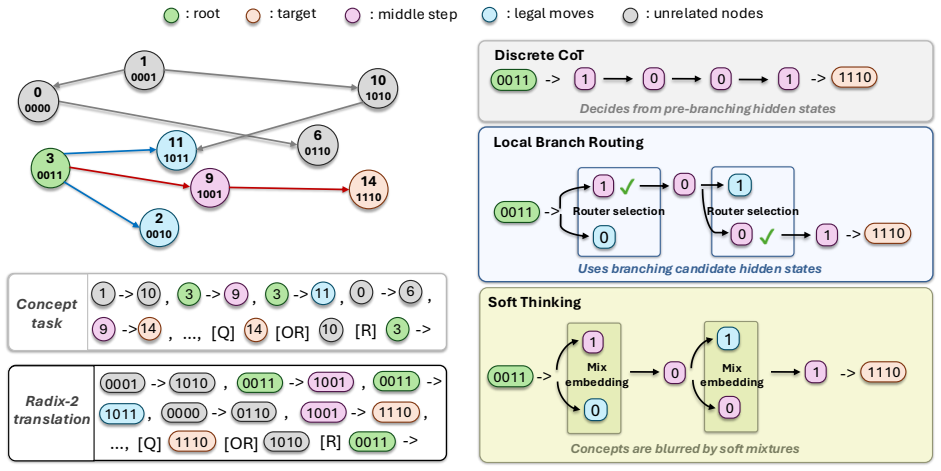
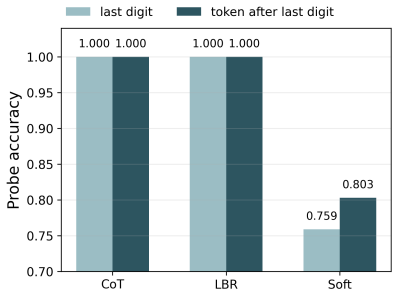
- Post-candidate hidden states supply measurable routing evidence on synthetic hierarchical-planning tasks.
- The prune-shift-grow process preserves discrete branch identities and yields a tractable tree-trajectory likelihood for end-to-end RL.
- The framework jointly optimizes the base model and router under the same likelihood-ratio principle used for discrete-token RLVR.
Where Pith is reading between the lines
- If the local-hidden-state signal generalizes, the same router could be attached to non-math reasoning domains that already use short lookahead.
- Increasing the local tree depth beyond one might trade additional compute for further accuracy gains while still avoiding full-solution search.
- Because branches remain discrete, LBR trajectories could be combined with external verifiers without changing the likelihood definition.
- The method's efficiency may allow repeated test-time application inside an outer search loop that the paper itself does not explore.
Load-bearing premise
Routing decisions based on the hidden states of candidate local futures supply useful evidence beyond the root next-token distribution and permit reliable selection of the depth-1 subtree to commit.
What would settle it
An ablation in which the router is replaced by a decision that uses only the root next-token distribution and yields statistically identical Pass@1 and Pass@32 scores on the same mathematical reasoning benchmarks.
Figures
read the original abstract
Test-time scaling improves language-model reasoning, but existing approaches often face a difficult trade-off: long chain-of-thought sampling remains single-threaded, while sentence- or solution-level search can be computationally expensive and hard to train end-to-end. We introduce Local Branch Routing (LBR), a token-level test-time scaling framework that expands a small local lookahead tree, forwards all sampled branches through the language model, and uses a lightweight router to select the depth-1 subtree to commit. By routing over the hidden states of candidate local futures, LBR allows each token decision to use evidence beyond the root next-token distribution while avoiding full solution-level search. The resulting prune-shift-grow decoding process preserves discrete branch identities and defines a tractable tree-trajectory likelihood: newly grown nodes are counted when first sampled, and router decisions are assigned explicit probabilities. This enables end-to-end reinforcement learning with verifiable rewards, jointly optimizing the base model and router under the same likelihood-ratio principle as discrete-token RLVR. On synthetic hierarchical-planning tasks, LBR shows that post-candidate hidden states provide useful routing evidence. On mathematical reasoning benchmarks, LBR improves both Pass@1 and Pass@32 over discrete chain-of-thought, vanilla discrete-token RLVR, and RL-compatible soft-token branching baselines. These results suggest that lightweight local branching offers an efficient, trainable, and discrete form of language-model test-time scaling.
Editorial analysis
A structured set of objections, weighed in public.
Referee Report
Summary. The manuscript proposes Local Branch Routing (LBR), a token-level test-time scaling framework for language models. At each step it expands a small local lookahead tree, forwards all branches through the model, and employs a lightweight router over the hidden states of the candidate depth-1 futures to select which subtree to commit. The resulting prune-shift-grow process preserves discrete branch identities and yields a tractable tree-trajectory likelihood (newly grown nodes counted on first sampling, router decisions given explicit probabilities), enabling end-to-end RL with verifiable rewards that jointly optimizes the base model and router. The paper reports that hidden-state routing supplies useful evidence on synthetic hierarchical-planning tasks and that LBR improves both Pass@1 and Pass@32 on mathematical reasoning benchmarks relative to discrete chain-of-thought, vanilla discrete-token RLVR, and RL-compatible soft-token branching baselines.
Significance. If the empirical claims hold, LBR supplies an efficient, trainable, and discrete alternative to full solution-level search while still allowing each token decision to condition on evidence beyond the immediate next-token distribution. The explicit, tractable likelihood definition that supports joint RL optimization of model and router is a clear methodological strength that could be reused in other test-time scaling settings.
major comments (2)
- [Abstract (results paragraph) and experimental results section] The central claim that routing decisions based on hidden states of candidate local futures supply useful evidence beyond the root next-token distribution is load-bearing for attributing the reported Pass@1/Pass@32 gains to LBR rather than to the prune-shift-grow structure or the joint RL objective alone. The abstract states that this utility is demonstrated on synthetic hierarchical-planning tasks, yet no corresponding ablation, analysis, or comparison against a router that receives only the root hidden state is provided for the mathematical reasoning benchmarks where the headline improvements are claimed.
- [Method section on likelihood and RL objective] The definition of the tree-trajectory likelihood (newly grown nodes counted when first sampled, router decisions assigned explicit probabilities) is presented as enabling standard likelihood-ratio RL. Without the explicit equations or pseudocode that show how the likelihood is normalized across the local tree and how the router probability is folded into the trajectory probability, it is impossible to confirm that the RL objective remains unbiased with respect to the discrete branch identities.
minor comments (2)
- [Abstract] The abstract asserts performance gains without any numerical values, dataset names, or error bars; the experimental section should include these details together with the exact number of runs used for the reported Pass@1 and Pass@32 figures.
- [Method] Notation for the router input (post-candidate hidden states) should be introduced once with a clear equation or diagram rather than relying on prose descriptions that appear in multiple places.
Simulated Author's Rebuttal
We thank the referee for the detailed and constructive feedback. We agree that both major comments identify areas where the manuscript can be strengthened for clarity and attribution of results. We will revise the paper accordingly to address these points.
read point-by-point responses
-
Referee: [Abstract (results paragraph) and experimental results section] The central claim that routing decisions based on hidden states of candidate local futures supply useful evidence beyond the root next-token distribution is load-bearing for attributing the reported Pass@1/Pass@32 gains to LBR rather than to the prune-shift-grow structure or the joint RL objective alone. The abstract states that this utility is demonstrated on synthetic hierarchical-planning tasks, yet no corresponding ablation, analysis, or comparison against a router that receives only the root hidden state is provided for the mathematical reasoning benchmarks where the headline improvements are claimed.
Authors: We agree that the manuscript would be strengthened by providing evidence of the hidden-state router's utility specifically on the mathematical reasoning benchmarks. The current version demonstrates this on synthetic hierarchical-planning tasks to isolate the routing mechanism, while reporting overall Pass@1/Pass@32 gains on math benchmarks. In the revised manuscript, we will add an ablation or analysis in the experimental results section comparing the full LBR router against a root-hidden-state-only variant on the math tasks to better attribute the gains. revision: yes
-
Referee: [Method section on likelihood and RL objective] The definition of the tree-trajectory likelihood (newly grown nodes counted when first sampled, router decisions assigned explicit probabilities) is presented as enabling standard likelihood-ratio RL. Without the explicit equations or pseudocode that show how the likelihood is normalized across the local tree and how the router probability is folded into the trajectory probability, it is impossible to confirm that the RL objective remains unbiased with respect to the discrete branch identities.
Authors: We acknowledge that the method section would benefit from greater explicitness. The current description outlines the counting of newly grown nodes and assignment of router probabilities, but does not include the full normalization equations or pseudocode. In the revision, we will add the complete mathematical formulation of the tree-trajectory likelihood, including normalization across the local tree and how router probabilities are incorporated into the trajectory probability, to confirm unbiasedness under the likelihood-ratio RL objective. revision: yes
Circularity Check
No significant circularity; derivation self-contained via explicit definitions
full rationale
The paper's central construction explicitly defines a tractable tree-trajectory likelihood by counting newly grown nodes at first sampling and assigning explicit probabilities to router decisions, then applies standard likelihood-ratio RL under the same principle as discrete-token RLVR. This is presented as an enabling mechanism rather than a reduction of results to fitted inputs or prior self-citations by construction. Benchmark gains and synthetic-task validation of hidden-state routing evidence are reported as empirical outcomes of the defined process, with no load-bearing step shown to equate to its inputs via self-definition, fitted prediction, or imported uniqueness. The derivation therefore remains independent of the enumerated circular patterns.
discussion (0)
Sign in with ORCID, Apple, or X to comment. Anyone can read and Pith papers without signing in.