Towards Robust Optimal Measurements Against Noise in Quantum Metrology
Pith reviewed 2026-06-25 21:14 UTC · model grok-4.3
The pith
Experiments confirm that FI MENOS identifies the worst-case noise impact on estimation precision in quantum metrology.
A machine-rendered reading of the paper's core claim, the machinery that carries it, and where it could break.
Core claim
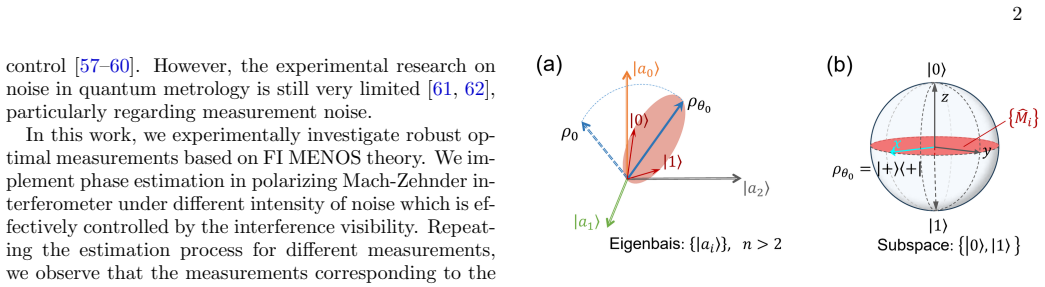
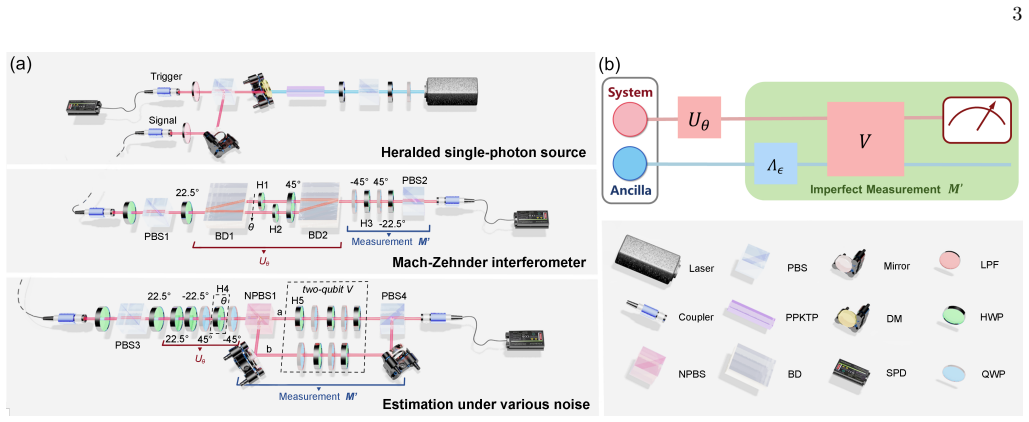
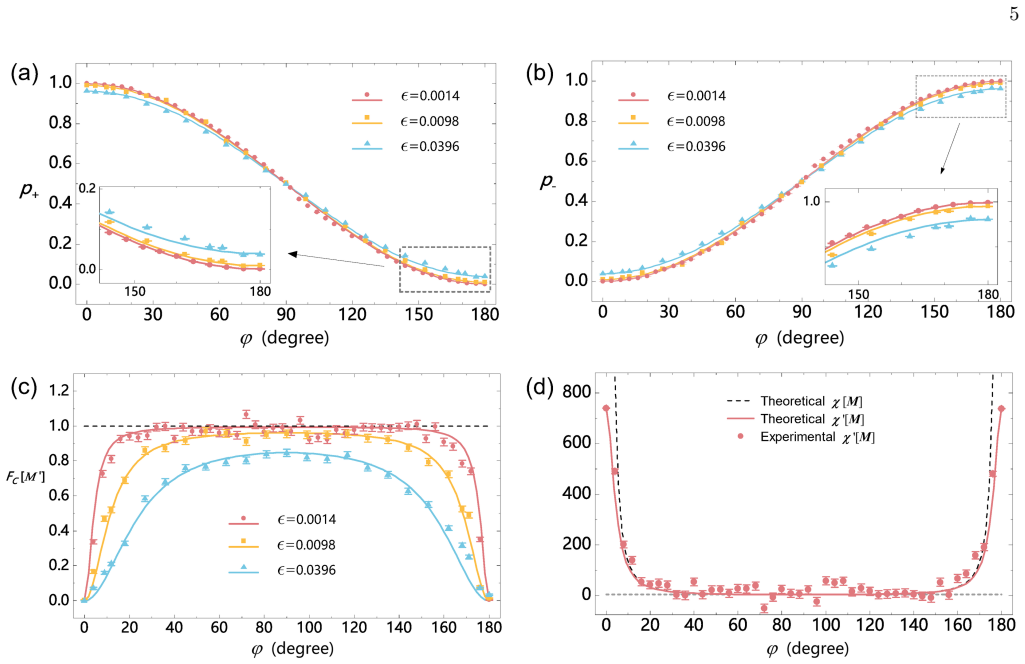
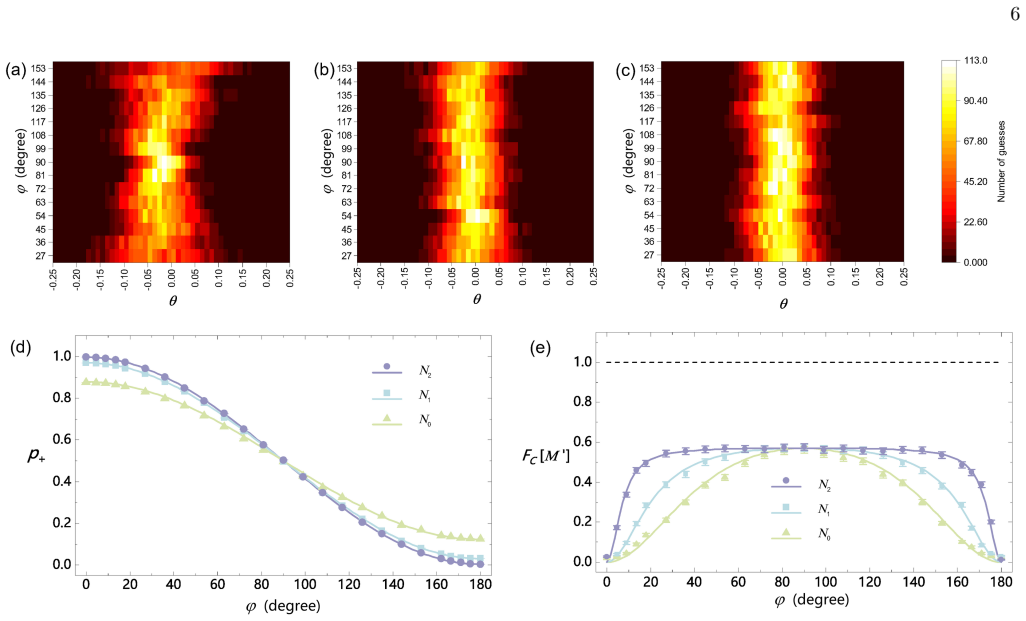
Through experiments in a polarizing Mach-Zehnder interferometer for phase estimation under controlled noise, we demonstrate that different measurements exhibit distinct sensitivities to noise. We further introduce various noise types and show that FI MENOS corresponds to the worst-case estimation precision, thereby allowing evaluation of the noise immunity of optimal measurements.
What carries the argument
Fisher information measurement noise susceptibility (FI MENOS), a quantity that measures how susceptible a given measurement is to noise and identifies the worst-case loss in estimation precision.
If this is right
- Measurements can be ranked by their FI MENOS values to select those with greater noise immunity for phase estimation.
- Different controlled noise types produce measurable differences in precision that FI MENOS captures as its worst-case bound.
- The method supplies a concrete criterion for assessing robustness when choosing among candidate optimal measurements.
- The approach extends the analysis of noise effects beyond single noise sources to multiple forms in one setup.
Where Pith is reading between the lines
- The same FI MENOS ranking could be applied to other estimation tasks such as frequency or amplitude to guide sensor design in noisy settings.
- Protocols that minimize FI MENOS might be combined with error-correction techniques to further improve real-device performance.
- Long-term tests with uncontrolled environmental noise would reveal whether the laboratory ranking holds outside controlled conditions.
Load-bearing premise
The controlled noise sources introduced in the two experimental setups are representative of the dominant noise mechanisms present in practical quantum metrology implementations outside the laboratory.
What would settle it
An experiment in which a measurement with higher FI MENOS value achieves higher precision than one with lower FI MENOS under the same added noise would falsify the claim that FI MENOS represents the worst-case scenario.
Figures
read the original abstract
Quantum parameter estimation utilizes quantum mechanical effects to attain higher measurement precision than classical schemes. In practical implementations, however, noise is inevitably present during the measurement process, causing a decrease in precision. Quantifying the impact of noise on different measurements is of considerable significance. Here, we experimentally investigate robust optimal measurements based on the theory of Fisher information measurement noise susceptibility (FI MENOS), which quantifies how susceptible a measurement is to noise. By constructing a polarizing Mach-Zehnder interferometer, we implement phase estimation under controlled noise. Our results indicate that different measurements exhibit distinct sensitivities to noise. To assess the influence of diverse noise types on precision, we further construct an experimental setup capable of introducing various forms of noise. The experimental results affirm that FI MENOS represents the worst-case scenario for estimation precision, enabling us to evaluate the noise immunity of optimal measurements. Our work provides a deeper insight into quantum metrology with noise, marking a notable advancement in quantifying the robustness of quantum estimation schemes against measurement noise effects.
Editorial analysis
A structured set of objections, weighed in public.
Referee Report
Summary. The manuscript experimentally investigates robust optimal measurements in quantum metrology using the Fisher information measurement noise susceptibility (FI MENOS) framework. By implementing phase estimation in a polarizing Mach-Zehnder interferometer under controlled phase/polarization fluctuations and constructing a second setup for diverse noise types, the authors report that experimental outcomes affirm FI MENOS as the worst-case scenario for estimation precision, thereby enabling evaluation of the noise immunity of optimal measurements.
Significance. If the central experimental claim holds and the tested noises prove representative, the work would supply a concrete experimental benchmark for assessing measurement robustness in noisy quantum parameter estimation, potentially guiding protocol design. The direct comparison of multiple measurements against a pre-existing theoretical quantity is a methodological strength.
major comments (2)
- [Experimental Results] Experimental Results section: the claim that outcomes match the worst-case prediction of FI MENOS receives only moderate support because the manuscript provides neither raw data, error bars, exact fitting procedures, nor exclusion criteria.
- [Conclusion] Conclusion: the generalization that FI MENOS quantifies noise immunity for optimal measurements in practical settings is load-bearing on the untested assumption that the introduced phase/polarization fluctuations and other controlled noises are representative of dominant mechanisms (e.g., amplitude damping or detector dark counts) outside the laboratory; no comparative analysis or discussion of alternative noise statistics is supplied.
minor comments (1)
- [Abstract] Abstract: the acronym FI MENOS is used without prior expansion, reducing immediate clarity for readers outside the immediate subfield.
Simulated Author's Rebuttal
We thank the referee for the constructive comments on our manuscript. We address each major point below and indicate the changes we will implement.
read point-by-point responses
-
Referee: [Experimental Results] Experimental Results section: the claim that outcomes match the worst-case prediction of FI MENOS receives only moderate support because the manuscript provides neither raw data, error bars, exact fitting procedures, nor exclusion criteria.
Authors: We agree that additional details would strengthen the support for the claims. In the revised manuscript we will add error bars to all relevant plots in the Experimental Results section, provide a precise description of the fitting procedures employed, specify any data exclusion criteria, and deposit the raw data in a public repository with a link in the paper. revision: yes
-
Referee: [Conclusion] Conclusion: the generalization that FI MENOS quantifies noise immunity for optimal measurements in practical settings is load-bearing on the untested assumption that the introduced phase/polarization fluctuations and other controlled noises are representative of dominant mechanisms (e.g., amplitude damping or detector dark counts) outside the laboratory; no comparative analysis or discussion of alternative noise statistics is supplied.
Authors: We accept that the current conclusion extrapolates beyond the specific controlled noises tested. We will revise the Conclusion and add a dedicated Limitations paragraph that (i) explicitly lists the noise types realized in the two setups, (ii) discusses their relevance to laboratory quantum metrology, and (iii) notes that other mechanisms such as amplitude damping or detector dark counts remain untested and would require separate validation. A short comparative remark on the statistics of the implemented noises versus common alternatives will also be included. revision: yes
Circularity Check
No circularity: experimental validation of pre-existing FI MENOS theory
full rationale
The manuscript is an experimental study that constructs Mach-Zehnder setups to introduce controlled phase/polarization noise and compares measured estimation precisions against the pre-existing theoretical quantity FI MENOS. The abstract and described results treat FI MENOS as an input from prior theory rather than deriving or fitting it from the present data. No equations are shown that define a prediction in terms of the same fitted parameters, and the central claim (that FI MENOS ranks worst-case noise susceptibility) is tested by direct comparison to independent experimental outcomes. Self-citation, if present for the original FI MENOS definition, is not load-bearing for the reported experimental ranking. The derivation chain therefore remains non-circular and externally falsifiable.
Axiom & Free-Parameter Ledger
Reference graph
Works this paper leans on
-
[1]
Here, the measure- ment noiseϵNis introduced and controlled by the in- terference visibilityV, which is consistent with the the- oretical model
Notice that our objec- tive is to have measurements influenced by small noise to demonstrate FI MENOS theory. Here, the measure- ment noiseϵNis introduced and controlled by the in- terference visibilityV, which is consistent with the the- oretical model. The exact form of imperfect measure- ment we realized is ˜M={ ˆM ′ ±(φ)}, where ˆM ′ ±(φ) = (1−ϵ) ˆM±(...
-
[2]
By changing the operator ˆU1, we could change the form of noiseN
We can find that the form of noise depends on the unitary operator ˆU1, which cor- responding to the combination of HWPs and QWPs in patha, as shown in the bottom layer of Figure 2(a). By changing the operator ˆU1, we could change the form of noiseN. In our experimental setup, the noisy channel Λϵ is realized by nonpolarizing beam splitter1 (NPBS1). IV. P...
2020
-
[3]
H. Zhou, C. Zhao, M. Cain, D. Bluvstein, N. Maskara, C. Duckering, H.-Y. Hu, S.-T. Wang, A. Kubica, and M. D. Lukin, Nature646, 303 (2025)
2025
-
[4]
Aghaee Rad, T
H. Aghaee Rad, T. Ainsworth, R.N. Alexander, B. Al- tieri, M. F. Askarani, et al., Nature638, 912 (2025)
2025
-
[5]
Ma, Q.-X
D.-Q. Ma, Q.-X. Jie, Y.-D. Hu, W.-Y. Zhu, Y.-C. Zhang, H.-J. Fan, X.-K. Zhong, G.-J. Chen, Y.-L. Zhang, T.-Y. Zhang, X.-F. Ren, L. Chen, Z.-B. Wang, G.-C. Guo, and C.-L. Zou, Sci. China-Phys. Mech. Astron.69, 220314 (2026)
2026
-
[6]
Pedalino, B
S. Pedalino, B. E. Ram´ ırez-Galindo, R. Ferstl, K. Horn- berger, M. Arndt, and S. Gerlich, Nature649, 866 (2026)
2026
-
[7]
X. Yang, X. Yu, L. Li, X. Zhao, T. Zheng, C. Zhang, C.-F. Li, and G.-C. Guo, Sci. China-Phys. Mech. Astron. 68, 250312 (2025)
2025
-
[8]
Zheng, H
Y. Zheng, H. Wang, X. Jia, J. Huang, H. Yuan, C. Zhai, J. Dai, J. Shi, L. Zhang, X. Zhang, M. Zhuang, J. Liu, J. Mao, T. Dai, Z. Fu, Y. Jiao, Y. Shi, D. Dai, X. Wang, Y. Li, Q. Gong, Z. Yuan, L. Chang, and J. Wang,Nature 651, 68 (2026)
2026
-
[9]
Lv, X.-M
M.-Y. Lv, X.-M. Hu, N.-F. Gong, T.-J. Wang, Y. Guo, B.-H. Liu, Y.-F. Huang, C.-F. Li, and G.-C. Guo, Sci. China-Phys. Mech. Astron.67, 230311 (2024)
2024
-
[10]
D. S. Weiss, B. C. Young, and S. Chu, Phys. Rev. Lett. 70, 2706 (1993)
1993
-
[11]
Bouchendira, P
R. Bouchendira, P. Clad´ e, S. Guellati-Kh´ elifa, F. Nez, and F. Biraben, Phys. Rev. Lett.106, 080801 (2011)
2011
-
[12]
R. H. Parker, C. Yu, W. Zhong, B. Estey, and H. M¨ uller, Science360, 191 (2018)
2018
-
[13]
Elder, J
B. Elder, J. Khoury, P. Haslinger, M. Jaffe, H. M¨ uller, and P. Hamilton, Phys. Rev. D94, 044051 (2016)
2016
-
[14]
Hamilton, M
P. Hamilton, M. Jaffe, P. Haslinger, Q. Simmons, H. M¨ uller, and J. Khoury, Science349, 849 (2015)
2015
-
[15]
Dimopoulos, P
S. Dimopoulos, P. W. Graham, J. M. Hogan, M. A. Kase- vich, and S. Rajendran, Phys. Rev. D78, 122002 (2008)
2008
-
[16]
B. P. Abbott, R. Abbott, T. D. Abbott, M. R. Aber- nathy, F. Acernese, K. Ackley, C. Adams, T. Adams, P. Addesso, R. X. Adhikari,et al., Phys. Rev. Lett.116, 061102 (2016)
2016
-
[17]
J. M. Hogan and M. A. Kasevich, Phys. Rev. A94, 033632 (2016)
2016
-
[18]
Ganapathy, W
D. Ganapathy, W. Jia, M. Nakano, V. Xu, N. Aritomi, T. Cullen, N. Kijbunchoo, S. E. Dwyer, A. Mullavey et al., Phys. Rev. X13, 041021 (2023)
2023
-
[19]
C. W. Helstrom,Quantum detection and estimation the- ory(Academic Press, 1976)
1976
-
[20]
A. S. Holevo,Probabilistic and statistical aspects of quan- tum theory(North-Holland Publishing Company, 1982)
1982
-
[21]
S. L. Braunstein and C. M. Caves, Phys. Rev. Lett.72, 3439 (1994)
1994
-
[22]
S. L. Braunstein, C. M. Caves, and G. Milburn, Ann. Phys247, 135 (1996)
1996
-
[23]
J. J. Bollinger, W. M. Itano, D. J. Wineland, and D. J. Heinzen, Phys. Rev. A54, R4649 (1996)
1996
-
[24]
Giovannetti, S
V. Giovannetti, S. Lloyd, and L. Maccone, Science306, 1330 (2004)
2004
-
[25]
Giovannetti, S
V. Giovannetti, S. Lloyd, and L. Maccone, Phys. Rev. Lett.96, 010401 (2006)
2006
-
[26]
Q. Liu, Z. Hu, H. Yuan, and Y. Yang, Phys. Rev. Lett. 130, 070803 (2023)
2023
-
[27]
Nagata, R
T. Nagata, R. Okamoto, J. L. O’Brien, K. Sasaki, and S. Takeuchi, Science316, 726 (2007)
2007
-
[28]
Xiang, B
G.-Y. Xiang, B. L. Higgins, D. Berry, H. M. Wiseman, and G. Pryde, Nature Photon5, 43(2011)
2011
-
[29]
B. L. Higgins, D. W. Berry, S. D. Bartlett, H. M. Wise- man, and G. J. Pryde, Nature450, 393 (2007)
2007
-
[30]
Yuan, C.-H
H. Yuan, C.-H. F. Fung, Phys. Rev. Lett.115, 110401 (2015)
2015
-
[31]
Braun, G
D. Braun, G. Adesso, F. Benatti, R. Floreanini, U. Mar- zolino, M. W. Mitchell, and S. Pirandola, Rev. Mod. Phys.90, 035006 (2018)
2018
-
[32]
Hou, R.-J
Z. Hou, R.-J. Wang, J.-F. Tang, H. Yuan, G.-Y. Xiang, C.-F. Li, and G.-C. Guo, Phys. Rev. Lett.123, 040501 (2019)
2019
-
[33]
Hou, J.-F
Z. Hou, J.-F. Tang, H. Chen, H. Yuan, G.-Y. Xiang, C.- F. Li and G.-C. Guo, Sci. Adv.7, eabd2986 (2021)
2021
-
[34]
X. Zhao, Y. Yang, and G. Chiribella, Phys. Rev. Lett. 124, 190503 (2020)
2020
-
[35]
P. Yin, X. Zhao, Y. Yang, Y. Guo, W.-H. Zhang, G.- C. Li, Y.-J. Han, B.-H. Liu, J.-S. Xu, G. Chiribella, G. Chen, C.-F. Li and G.-C. Guo, Nat. Phys.19, 1122 (2023)
2023
-
[36]
Kurdzia lek, W
S. Kurdzia lek, W. G´ orecki, F. Albarelli, and R. Demkowicz-Dobrza´ nski, Phys. Rev. Lett.131, 090801 (2023)
2023
-
[37]
Wiersig, Phys
J. Wiersig, Phys. Rev. Lett.112, 203901 (2014)
2014
-
[38]
Wiersig, Phys
J. Wiersig, Phys. Rev. A93, 033809 (2016)
2016
-
[39]
Z.-P. Liu1, J. Zhang, S ¸. K. ¨Ozdemir, B. Peng, H. Jing, X.-Y. L¨ u, C.-W. Li, L. Yang, F. Nori, Phys. Rev. Lett. 117, 110802 (2016)
2016
-
[40]
Chen, S ¸
W. Chen, S ¸. K. ¨Ozdemir, G. Zhao, J. Wiersig and L. Yang, Nature548, 192 (2017)
2017
-
[41]
Hodaei, A
H. Hodaei, A. U. Hassan, S. Wittek, H. Garcia-Gracia, R. El-Ganainy, D. N. Christodoulides and M. Khajavikhan, Nature548, 187 (2017)
2017
-
[42]
Yu and C
X. Yu and C. Zhang, Phys. Rev. A108, 022215 (2023)
2023
-
[43]
X. Yu, X. Zhao, L. Li, X.-M. Hu, X. Duan, H. Yuan, and C. Zhang, Science Advances10, eadk7616 (2024)
2024
-
[44]
Datta, L
A. Datta, L. Zhang, N. Thomas-Peter, U. Dorner, B. J. Smith, and I. A. Walmsley, Phys. Rev. A83, 063836 (2011)
2011
-
[45]
C. L. Degen, F. Reinhard, and P. Cappellaro, Rev. Mod. Phys.89, 035002 (2017)
2017
-
[46]
Y. L. Len, T. Gefen, A. Retzker and J. Ko lody´ nski, Nat Commun13, 6971 (2022)
2022
-
[47]
Kurdzia lek and Rafa l Demkowicz-Dobrza´ nski, Phys
S. Kurdzia lek and Rafa l Demkowicz-Dobrza´ nski, Phys. Rev. Lett.130, 160802 (2023)
2023
-
[48]
K. Bai, Z. Peng, H.-G. Luo, and J.-H. An, Phys. Rev. Lett.123, 040402 (2019). 8
2019
-
[49]
Bai and J.-H
S.-Y. Bai and J.-H. An, Phys. Rev. Lett.131, 050801 (2023)
2023
-
[50]
Leibfried, B
D. Leibfried, B. DeMarco, V. Meyer, D. Lucas, M. Bar- rett, J. Britton, W. M. Itano, B. Jelenkovi´ c, C. Langer, T. Rosenband and D. J. Wineland, Nature422, 412 (2003)
2003
-
[51]
Urbanek, B
M. Urbanek, B. Nachman, V. R. Pascuzzi, A. He, C. W. Bauer, and W. A. de Jong, Phys. Rev. Lett.127, 270502 (2021)
2021
-
[52]
Harper, S
R. Harper, S. T. Flammia and J. J. Wallman, Nat. Phys. 16, 1184 (2020)
2020
-
[53]
Y. Kim, A. Eddins, S. Anand, K. X. Wei, E. v. d. Berg, S. Rosenblatt, H. Nayfeh, Y. Wu, M. Zaletel, K. Temme and A. Kandala, Nature618, 500 (2023)
2023
-
[54]
X.-M. Hu, C. Zhang, Y. Guo, F.-X. Wang, W.-B. Xing, C.-X. Huang, B.-H. Liu, Y.-F. Huang, C.-F. Liet al., Phys. Rev. Lett.127, 110505 (2021)
2021
-
[55]
Bouchard, D
F. Bouchard, D. England, P. J. Bustard, K. L. Fenwick, E. Karimi, K. Heshami, and B. Sussman, Phys. Rev. Ap- plied15, 024027 (2021)
2021
-
[56]
Lamoureux, E
L.-P. Lamoureux, E. Brainis, N. J. Cerf, Ph. Emplit, M. Haelterman, and S. Massar, Phys. Rev. Lett. 94, 230501 (2025)
2025
-
[57]
K. B. A. Dragan, W. Wasilewski, and C. Radzewicz, Phys. Rev. Lett.92, 257901 (2004)
2004
-
[58]
Rubino, L
G. Rubino, L. A. Rozema, D. Ebler, H. Kristj´ ansson, S. Salek, P. A. Gu´ erin, A. A. Abbott, C. Branciard, ˇC. Brukner, Phys. Rev. Research3, 013093 (2021)
2021
-
[59]
Soare, H
A. Soare, H. Ball, D. Hayes, J. Sastrawan, M. C. Jar- ratt, J. J. McLoughlin, X. Zhen, T. J. Green and M. J. Biercuk, Nature Phys10, 825 (2014)
2014
-
[60]
Rossi, D
M. Rossi, D. Mason, J. Chen, Y. Tsaturyan and A. Schliesser, Nature563, 53 (2018)
2018
-
[61]
Magrini, P
L. Magrini, P. Rosenzweig, C. Bach, A. Deutschmann- Olek, S. G. Hofer, S. Hong, N. Kiesel, A. Kugi and M. Aspelmeyer, Nature595, 373 (2021)
2021
-
[62]
Z. Zhou, R. Sitler, Y. Oda, K. Schultz, and G. Quiroz, Phys. Rev. Lett.131, 210802 (2023)
2023
-
[63]
K. Wang, X. Wang, X. Zhan, Z. Bian, J. Li, B. C. Sanders, and P. Xue, Phys. Rev. A97, 042112 (2018)
2018
-
[64]
Long, W.-T
X. Long, W.-T. He, N.-N. Zhang, K. Tang, Z. Lin, H. Liu, X. Nie, G. Feng, J. Liet al., Phys. Rev. Lett.129, 070502 (2022)
2022
-
[65]
Albarelli, I
F. Albarelli, I. Gianani, M. G. Genoni and M. Barbieri, Phys. Rev. A110, 032436 (2024)
2024
-
[66]
Zhou, C.-L
S. Zhou, C.-L. Zou and L. Jiang, Quantum Sci. Technol. 5025005 (2020)
2020
-
[67]
T. Kim, M. Fiorentino, and F. N. C. Wong, Phys. Rev. A73, 012316 (2006)
2006
-
[68]
Yamamoto, S
K. Yamamoto, S. Endo, H. Hakoshima, Y. Matsuzaki, and Y. Tokunaga, Phys. Rev. Lett.129, 250503 (2022)
2022
-
[69]
Q. Liu, M. Xue, M. Radzihovsky, X. Li, D. V. Vasilyev, L.-N. Wu, and V. Vuleti´ c,Phys. Rev. Lett.135, 040801 (2024)
2024
-
[70]
J.-X. Peng, B. Zhu, W. Zhang and K. Zhang,Phys. Rev. Lett.133, 090801 (2024)
2024
discussion (0)
Sign in with ORCID, Apple, or X to comment. Anyone can read and Pith papers without signing in.