Space-based Missile Defense
Pith reviewed 2026-06-25 20:42 UTC · model grok-4.3
The pith
Space-based missile defense systems face fundamental physical constraints from operating in orbit when attempting intercepts in boost, ascent, and midcourse phases.
A machine-rendered reading of the paper's core claim, the machinery that carries it, and where it could break.
Core claim
By reviewing the technical issues, available interceptor technology, and missile characteristics, then analyzing a specific proposed space-based system for boost, ascent, and midcourse intercepts, the paper shows the details of such an analysis and the constraints imposed on these systems by the physics of operating in space.
What carries the argument
The physics of operating interceptors in space, including orbital positioning and response times, when facing representative ballistic missiles.
If this is right
- The proposed system would require specific numbers and placements of interceptors to attempt coverage of all three phases.
- Boost-phase intercepts would be limited by the short time available and the need for interceptors to be positioned correctly in orbit.
- Ascent and midcourse phases would face similar coverage gaps due to the physics of space-based operations.
- Current interceptor technology levels would need to meet precise speed and accuracy thresholds to overcome the identified constraints.
Where Pith is reading between the lines
- These space-based constraints could interact with ground-based systems in ways that affect overall defense architecture choices.
- Advances in propulsion or sensor technology might shift the timing windows but would still operate under the same orbital mechanics.
- Public discussions of missile defense options would benefit from explicit comparison of these physical limits to other proposed approaches.
Load-bearing premise
The characteristics of the missiles a space-based system would face and the current state of interceptor technology are sufficiently well-known and representative to allow a valid illustration of the physical constraints.
What would settle it
A calculation or test showing that a space-based interceptor system can achieve consistent successful intercepts in boost phase against representative missiles while satisfying the orbital and timing constraints identified in the analysis.
Figures
read the original abstract
This paper reviews the technical issues underlying space-based boost-phase missile defense and examines the current technology available for space-based interceptors and the characteristics of the missiles such a system would face. It then analyzes a particular space-based missile defense system that has been proposed to intercept in boost, ascent, and midcourse phases to illustrate the details of such an analysis and the constraints imposed on such systems by the physics of operating in space.
Editorial analysis
A structured set of objections, weighed in public.
Referee Report
Summary. The manuscript reviews technical issues in space-based boost-phase missile defense, examines current technology for space-based interceptors and characteristics of target missiles, and analyzes one proposed system for intercepts in boost, ascent, and midcourse phases to illustrate physical constraints imposed by space operations.
Significance. If the input parameters are representative, the paper supplies a concrete, physics-grounded illustration of coverage, timeline, and orbital requirements for space-based missile defense. This type of detailed example is useful for clarifying feasibility limits in a field where policy discussions often lack technical grounding.
major comments (1)
- [analysis of the particular proposed system] The central illustration of physical constraints rests on the representativeness of the chosen missile burn times, velocities, trajectories, and interceptor delta-v/sensor/basing parameters. The manuscript should explicitly justify these values (e.g., by reference to public sources or ranges) and include a sensitivity analysis showing how derived constraints change under plausible variations; without this, the analysis illustrates one possible case rather than general physics limits.
Simulated Author's Rebuttal
We thank the referee for the constructive comment on the illustrative example. We agree that explicit justification of parameters and a sensitivity analysis will strengthen the demonstration of physical constraints and will revise the manuscript accordingly.
read point-by-point responses
-
Referee: The central illustration of physical constraints rests on the representativeness of the chosen missile burn times, velocities, trajectories, and interceptor delta-v/sensor/basing parameters. The manuscript should explicitly justify these values (e.g., by reference to public sources or ranges) and include a sensitivity analysis showing how derived constraints change under plausible variations; without this, the analysis illustrates one possible case rather than general physics limits.
Authors: We agree with the referee that the chosen parameters for the particular proposed system require explicit justification. In revision we will add references to public sources (e.g., unclassified DoD reports and technical literature) for the missile burn times, velocities, trajectories, and interceptor characteristics, along with stated ranges where values are approximate. We will also add a sensitivity analysis that varies key parameters (burn time, ascent velocity, interceptor delta-v, and sensor range) over plausible intervals and shows the resulting changes in coverage, timeline, and orbital requirements. This will make clear both the constraints for the specific case and their robustness under variation. revision: yes
Circularity Check
No circularity: analysis uses external parameters to illustrate physics constraints
full rationale
The paper reviews technical issues, current technology, and missile characteristics, then performs an illustrative analysis of one proposed system to show physical constraints from operating in space. No equations, derivations, or predictions are described that reduce to fitted inputs or self-citations. The central contribution is an external-parameter-driven illustration rather than a self-referential derivation; representativeness of inputs is an external validity question, not an internal circularity. No load-bearing steps match any enumerated circularity pattern.
Axiom & Free-Parameter Ledger
Reference graph
Works this paper leans on
-
[1]
the value of attempting bus intercept is very unclear, and it usually does not figure prominently in [missile defense] discussions
d be required for boost and ascent-phase intercepts in each case. Missile Defense Basics Midcourse defense The current US defense against long-range missiles, the Ground-based Midcourse Defense (GMD) system based in Alaska and California, is designed to intercept warheads during the midcourse phase of flight, which has two advantages: This phase lasts for...
2011
-
[2]
interceptor
A standard trajectory for a 10,000 km-range missile. Booster burnout occurs at 3 minutes after launch and ascent phase is assumed to end by 3.5 minutes. The dots show the location at 30 second intervals. The Interceptor-Satellites An interceptor-satellite consists of three parts: (1) A kill vehicle that homes on and collides with the target missile or war...
2003
-
[3]
The size of the circles is set so that there are no gaps in the coverage of the constellation
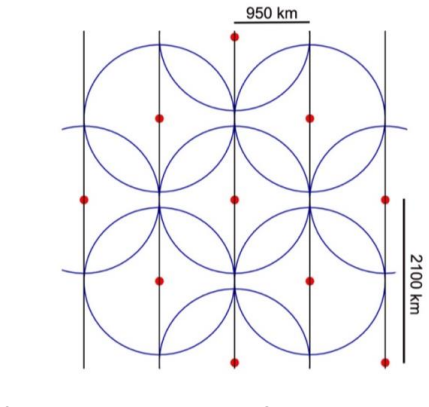
A version of the original Booz Allen Brilliant Swarms constellation shown in Figure 2, but with the circles showing the required coverage area of the interceptors to give complete defense coverage. The size of the circles is set so that there are no gaps in the coverage of the constellation. For 300-km altitude orbits the groups of interceptors are separa...
2025
-
[4]
sophisticated countermeasures, decoys, and re-entry vehicles
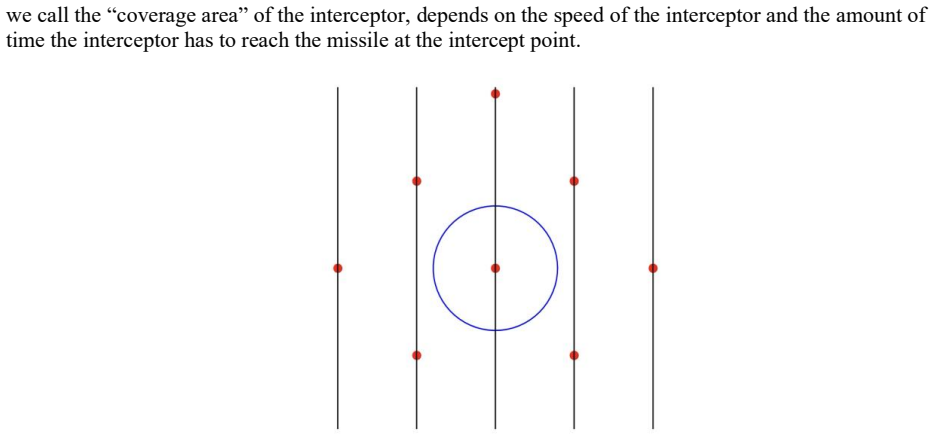
The circles show the boost-phase coverage provided by 240-kg space-based interceptors in the dense alternate constellation shown in Figure 4, at 45o latitude, assuming no decision time before firing the interceptors. Each dot represents a single interceptor in 300 km altitude orbits indicated by the vertical lines. In this constellation only a single inte...
2025
-
[6]
The Role of Space-Based Interceptors in Golden Dome,
14 Space News, “The Role of Space-Based Interceptors in Golden Dome,” panel discussion, 12 November, 2025, https://spacenews.com/live-event-the-role-of-space-based-interceptors-in-golden-dome/. One potential response discussed in this panel, which is adding maneuverability to the support satellites that carry the interceptors, is unlikely to be effective:...
2025
-
[7]
Russian Nuclear Weapons, 2025,
16 Booz Allen press conference. 17 Burntimes of the US Minuteman III stages can be found at astronautix.com; Russia’s Start-1 satellite launcher uses the stages of the RT-2PM Topol ballistic missile (Steven J. Isakowitz, Joshua B. Hopkins, Joseph. P. Hopkins, Jr., International Reference Guide to Space Launch Systems, Fourth Edition, (Reston, VA: American...
-
[8]
The Clementine Satellite,
23 If the coverage areas of neighboring satellites overlap, more than one satellite may be within reach of the intercept point. 24 NRC, Making Sense, Figure 5.6. This report also assumes 20-cm optics for a space-based midcourse interceptor. Note that an interceptor intended only for boost-phase intercepts could use a smaller optical system because a boost...
1994
-
[9]
Report of the APS
Congressional Budget Office (CBO), Alternatives for Boost-Phase Missile Defense, July 2004, https://www.cbo.gov/sites/default/files/108th-congress-2003-2004/reports/07-22-missiledefense.pdf, p. 52, notes that engineers from Lawrence Livermore National Laboratory also supported a value of 2.5 km/s. Barton, “Report of the APS”, p. S235, states that a divert...
2004
-
[10]
Booz Allen unveils
35 Booz Allen press conference; Erwin, “Booz Allen unveils.” 36 Personal communication, Michael Keebler. 37 A 300-km-altitude sun-synchronous orbit would have an inclination of 96.6 degrees; orbits passing over the poles have an inclination of 90 degrees. 38 Ryan Chan, “China Map Shows Nuclear Missile Silo Locations,” Newsweek, 23 December 2025, https://w...
2025
-
[11]
Airborne Boost-Phase Ballistic Missile Defense,
41 See NRC, Making Sense, p. 63 and footnote 23; Dean A. Wilkening, “Airborne Boost-Phase Ballistic Missile Defense,” Science and Global Security, 12 (2004), p. 8, https://scienceandglobalsecurity.org/archive/sgs12wilkening.pdf. 42 Terminating the thrust of a 10,000 km range solid-propellant missile 4 s before its burntime would still leave it with enough...
-
[12]
21 Appendix A: Estimated Kill Vehicle Mass Kill Vehicle Mass without Propellant and Tankage To estimate the mass of the kill vehicle (KV) without propellant and tankage we follow the mass breakdown in the 2003 American Physical Society (APS) report and give updated estimates of the component masses.1 The APS report estimated a dry KV mass without tankage ...
2003
-
[14]
Clementine Long-Wavelength Infrared Camera (LWIR), 19 August 2011, http://nssdc.gsfc.nasa.gov/nmc/masterCatalog.do?sc=1994-004A&ex=03. 6 Shannon, “The Clementine Satellite
5 NASA, “Clementine Long-Wavelength Infrared Camera (LWIR), 19 August 2011, http://nssdc.gsfc.nasa.gov/nmc/masterCatalog.do?sc=1994-004A&ex=03. 6 Shannon, “The Clementine Satellite.” 7 Barton, “Report of the APS,” p. S248. 8 L3Harris, “Bipropellant Rocket Engines,” 2025, https://www.l3harris.com/sites/default/files/2025-05/l3harris-ar- bipropellant-rocket...
2011
-
[15]
Report of the APS
Congressional Budget Office (CBO), Alternatives for Boost-Phase Missile Defense, July 2004, https://www.cbo.gov/sites/default/files/108th-congress-2003-2004/reports/07-22-missiledefense.pdf, p. 52, notes that engineers from Lawrence Livermore National Laboratory also supported a value of 2.5 km/s. Barton, “Report of the APS”, p. S235, states that a divert...
2004
-
[16]
] (𝐵8) where 𝑃 = 𝑀𝐾𝑉 𝑑𝑟𝑦 is the kill vehicle mass without propellant or tankage. For the solid-propellant rocket motor of the interceptor, we assume s = 0.1, u = 0, and Ve = 2.75 km/s, which corresponds to an effective specific impulse of 281 s. For a two-stage booster, the initial mass of the booster plus payload, assuming Ve is the same for both stages,...
discussion (0)
Sign in with ORCID, Apple, or X to comment. Anyone can read and Pith papers without signing in.