Symbol sequences from three-rotor coincidences and their word-complexity
Pith reviewed 2026-06-25 19:06 UTC · model grok-4.3
The pith
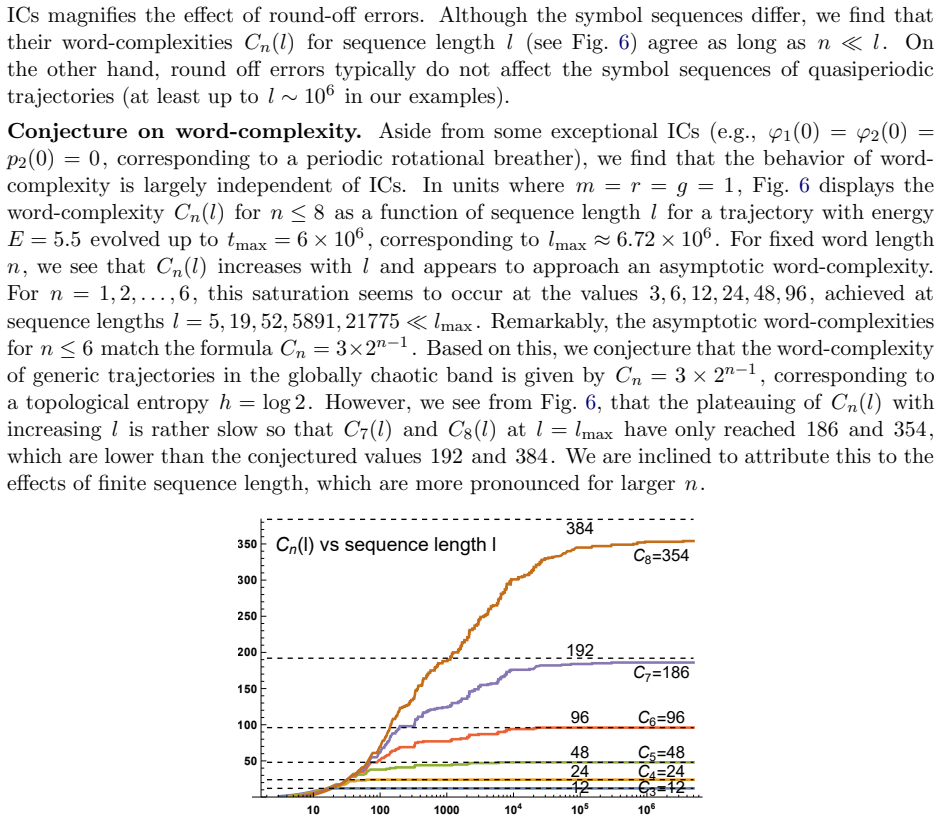
Coincidence symbol sequences from three-rotor motions have word complexity growing as 3 times 2 to the n-1 for chaotic orbits.
A machine-rendered reading of the paper's core claim, the machinery that carries it, and where it could break.
Core claim
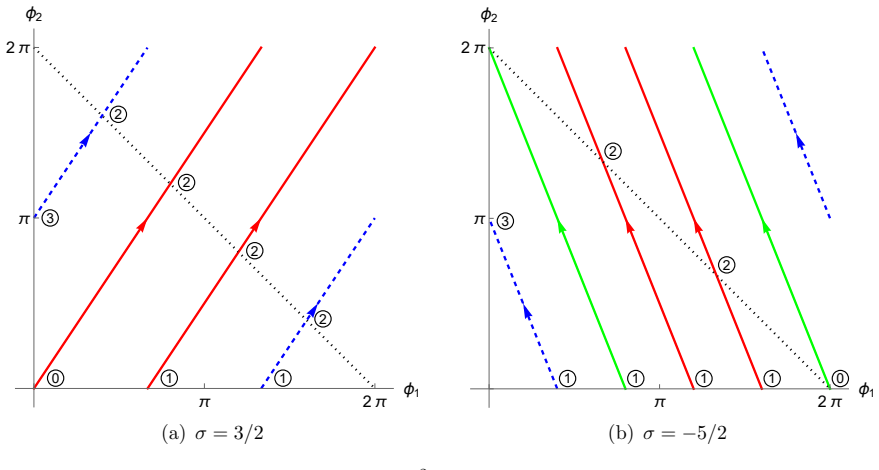
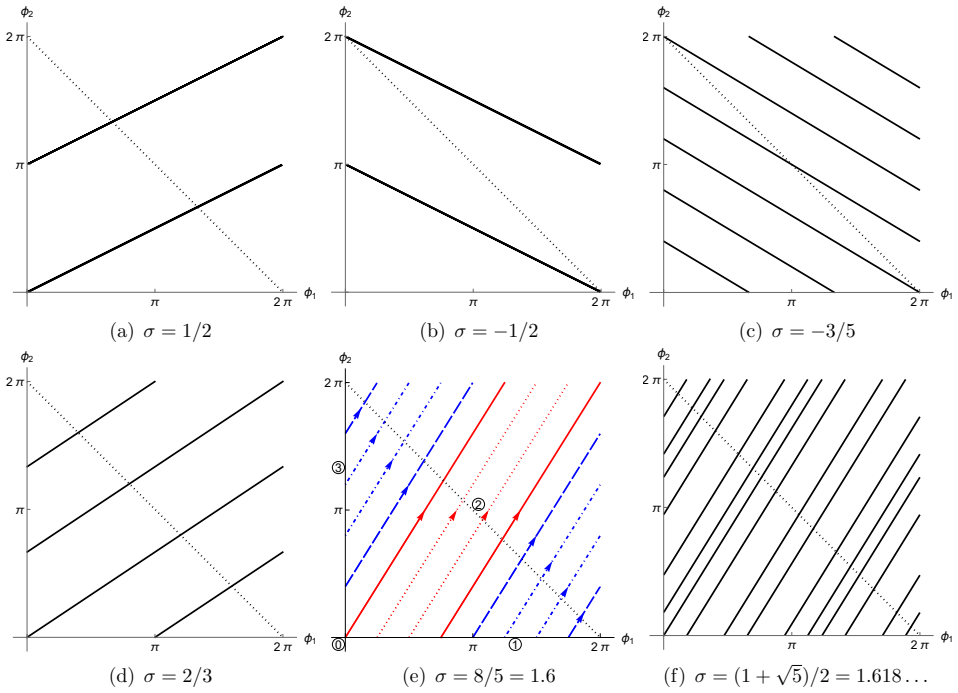
In the three-rotor problem, replacing trajectories by four-symbol sequences based on isolated rotor coincidences captures key qualitative features. Quasiperiodic sequences from irrational slopes have C_n = n+3 and zero entropy by mapping to Sturmian sequences, while chaotic sequences are conjectured to satisfy C_n = 3 imes 2^{n-1} with entropy log 2 and to be generated by a subshift of finite type, complete with explicit grammar rules that the quasiperiodic case lacks.
What carries the argument
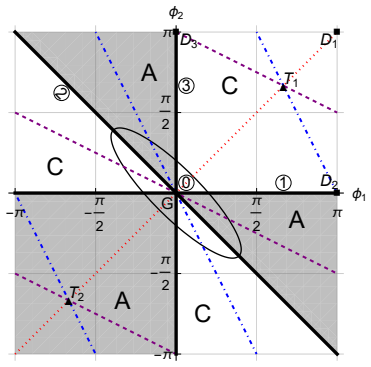
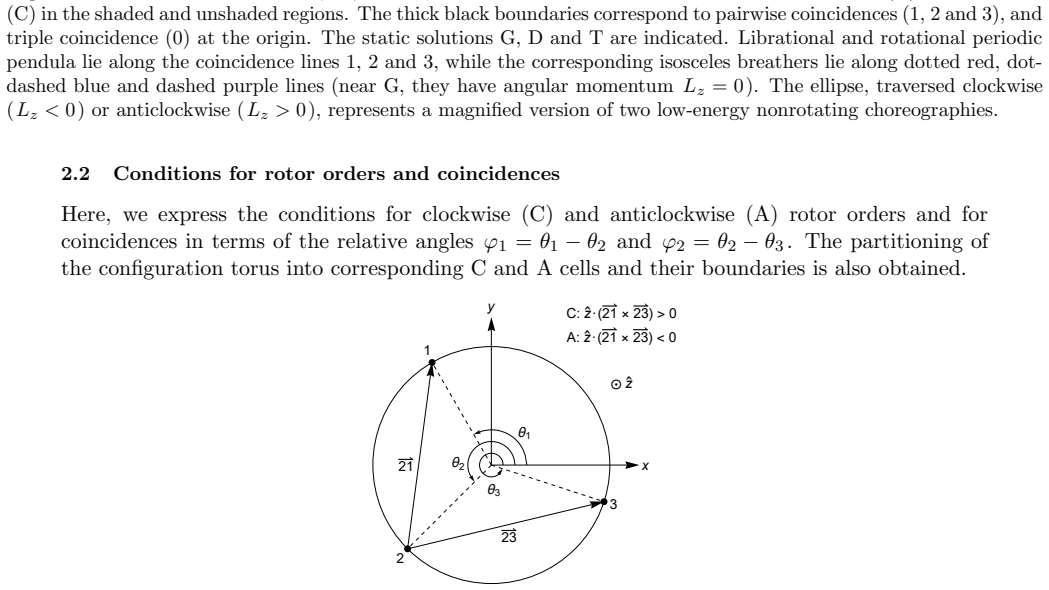
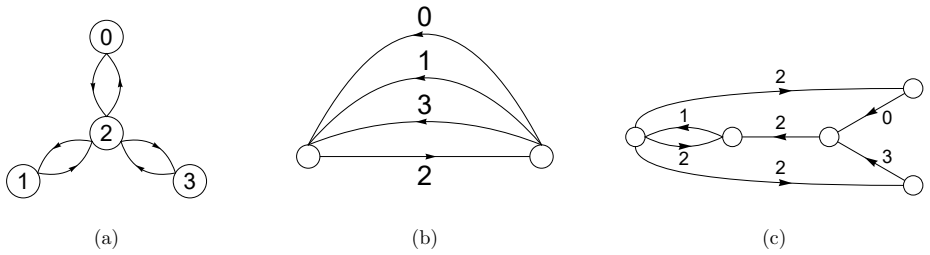
The four-symbol digitization that records successive isolated pair and triple coincidences, partitioning the configuration torus into ordered-rotor cells whose boundaries mark the symbols.
If this is right
- Periodic orbits produce sequences whose word-complexity stops growing once n reaches the period.
- Quasiperiodic sequences have zero topological entropy and cannot be realized as a topological Markov shift.
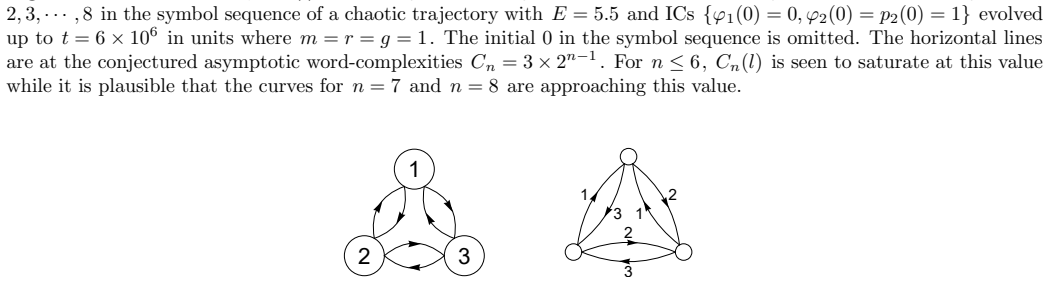
- Chaotic sequences obey a finite set of grammar rules that allow complete description by a subshift of finite type.
- The encoding distinguishes quasiperiodic from chaotic dynamics even though it is coarse.
Where Pith is reading between the lines
- The same coincidence digitization could be used to forecast when chains of coupled Josephson junctions enter chaotic regimes.
- Proving the exact growth rate would require constructing the transition matrix of the conjectured subshift.
- The linear complexity of the quasiperiodic case shows that the encoding preserves the rigid ordering constraints absent in chaos.
Load-bearing premise
The four-symbol recording of isolated coincidences is detailed enough to capture the full grammar rules and complexity growth that separate quasiperiodic from chaotic regimes.
What would settle it
A long chaotic orbit whose symbol sequence yields a number of distinct n-letter words other than 3 imes 2^{n-1} for large n, or contains a word forbidden by the conjectured grammar.
Figures
read the original abstract
In the three-rotor problem, three equally massive point particles move on a circle interacting via attractive pairwise cosine potentials. Rotors can represent superconducting phases of distinct metallic segments in a chain of coupled Josephson junctions. We propose a digitization of the classical dynamics that records successive pair and triple coincidences of rotors using four symbols. Rotor coincidences correspond to boundaries in a disjoint partition of the configuration torus into cells where the rotors are ordered clockwise and anticlockwise. It is shown that isolated rotor coincidences must be crossings. Despite being a rather coarse digitization, we find that replacing trajectories by coincidence symbol sequences captures significant qualitative features of the dynamics through word statistics. Word-complexity $C_n$ measures the diversity of $n$-letter words in the symbol sequence while topological entropy governs asymptotic exponential growth of $C_n$. Sequences from periodic orbits have a word-complexity that saturates at the period. Ultra-high-energy trajectories with irrational 'slope' are quasiperiodic. We show that they have zero entropy and $C_n = n+3$ by examining limiting slopes and by a mapping to Sturmian sequences. We examine their grammar rules and propose how their right-special words may be identified. On the other hand, numerical investigation of sequences from chaotic orbits in the band of global chaos leads us to conjecture an exponentially growing word-complexity $C_n = 3 \times 2^{n-1}$, corresponding to a topological entropy $\log 2$. We identify their grammar rules and model them by a subshift of finite type, unlike the quasiperiodic ultra-high-energy sequences which cannot be modeled as a topological Markov shift.
Editorial analysis
A structured set of objections, weighed in public.
Referee Report
Summary. The manuscript proposes a four-symbol digitization of the three-rotor dynamics based on isolated pair and triple coincidences. For ultra-high-energy quasiperiodic orbits it rigorously establishes word complexity C_n = n+3 and zero topological entropy via a mapping to Sturmian sequences. For chaotic orbits in the band of global chaos, numerical examination of grammar rules leads to the conjecture that C_n = 3 × 2^{n-1} (topological entropy log 2) and that the sequences are generated by a subshift of finite type.
Significance. If the conjecture holds, the work supplies a concrete symbolic dynamics for the three-rotor problem that distinguishes quasiperiodic from chaotic regimes on the configuration torus and yields a falsifiable prediction for word counts in the chaotic case. The rigorous Sturmian mapping for the quasiperiodic regime is a clear strength, providing a parameter-free derivation and explicit grammar rules.
major comments (2)
- [Abstract and chaotic-orbits section] Abstract and chaotic-orbits section: the conjecture that the observed grammar rules are exhaustive and that the four-symbol partition induces a subshift of finite type with exactly C_n = 3 × 2^{n-1} is load-bearing for the central claim; the manuscript supplies no analytic argument or exhaustive enumeration (e.g., of all admissible words up to length 12) showing that no further forbidden words arise from the underlying flow on the torus.
- [Digitization and chaotic-orbits section] Digitization and chaotic-orbits section: the claim that the coarse coincidence partition suffices to capture the qualitative distinction between quasiperiodic and chaotic dynamics (including the full set of grammar rules) is not independently verified; an explicit check that the extracted transition matrix reproduces the numerically observed periodic-orbit counts or entropy estimate would be required to support the modeling statement.
minor comments (3)
- [Digitization paragraph] The four symbols are introduced in the digitization paragraph but lack an accompanying table that lists the geometric meaning of each symbol together with the corresponding coincidence type.
- [Quasiperiodic section] In the quasiperiodic section the right-special words are discussed but the explicit recurrence or substitution rule that generates them is not written as an equation.
- Figure captions for the complexity plots should state the length of the symbol sequences used and the number of sampled orbits.
Simulated Author's Rebuttal
We thank the referee for the careful reading and constructive suggestions. The two major comments correctly identify that the chaotic-orbit results rest on a numerically supported conjecture rather than a complete analytic proof. We respond to each point below and will revise the manuscript to incorporate additional numerical checks.
read point-by-point responses
-
Referee: [Abstract and chaotic-orbits section] Abstract and chaotic-orbits section: the conjecture that the observed grammar rules are exhaustive and that the four-symbol partition induces a subshift of finite type with exactly C_n = 3 × 2^{n-1} is load-bearing for the central claim; the manuscript supplies no analytic argument or exhaustive enumeration (e.g., of all admissible words up to length 12) showing that no further forbidden words arise from the underlying flow on the torus.
Authors: We agree that the conjecture is load-bearing and that the manuscript presents it on the basis of numerical observation of grammar rules rather than an analytic demonstration of exhaustiveness. No analytic argument is supplied because a rigorous proof that the observed rules capture all constraints imposed by the flow would require a complete topological analysis of the three-rotor system, which lies outside the scope of the present work. In the revision we will add an explicit enumeration of admissible words up to length 12 obtained from long chaotic trajectories; this will confirm that no additional forbidden words appear within the resolution of the simulations. The conjecture status of the claim will be stated more explicitly. revision: partial
-
Referee: [Digitization and chaotic-orbits section] Digitization and chaotic-orbits section: the claim that the coarse coincidence partition suffices to capture the qualitative distinction between quasiperiodic and chaotic dynamics (including the full set of grammar rules) is not independently verified; an explicit check that the extracted transition matrix reproduces the numerically observed periodic-orbit counts or entropy estimate would be required to support the modeling statement.
Authors: We accept that an independent consistency check between the proposed subshift and the underlying flow is needed. In the revised manuscript we will extract the transition matrix implied by the observed grammar rules, compute the number of periodic sequences of periods 2 through 10, and compare these counts (as well as the topological entropy given by the logarithm of the largest eigenvalue) with the corresponding quantities obtained by direct numerical integration of the three-rotor equations. This verification will be reported in a new subsection of the chaotic-orbits section. revision: yes
Circularity Check
No significant circularity; results are numerical conjecture plus independent Sturmian mapping
full rationale
The paper's analytic component for ultra-high-energy quasiperiodic orbits derives C_n = n+3 and zero entropy via an explicit mapping to Sturmian sequences on limiting slopes, which is independent of the target result and relies on standard combinatorial word theory. The chaotic case is presented explicitly as a numerical conjecture C_n = 3×2^{n-1} obtained by direct counting of words in generated coincidence sequences, with grammar rules identified from the same sequences but not claimed as a closed derivation. No parameter is fitted to a subset and then relabeled a prediction, no self-definition equates X to Y, and no load-bearing step reduces to a self-citation. The work is therefore self-contained against external benchmarks (Sturmian theory and direct enumeration) with no circular reduction.
Axiom & Free-Parameter Ledger
axioms (2)
- domain assumption The three-rotor system is governed by Newtonian mechanics with attractive pairwise cosine potentials.
- domain assumption Isolated rotor coincidences correspond to crossings in the configuration space partition.
Reference graph
Works this paper leans on
-
[1]
N.,Deterministic nonperiodic flow, J
Lorenz, E. N.,Deterministic nonperiodic flow, J. Atmos. Sci.20, 130 (1963). 2
1963
-
[2]
Hadamard, J.,Les surfaces ` a courbures oppos´ ees et leurs lignes g´ eod´ esiques, Journal de Math´ ematiques Pures et Appliqu´ ees4, 27-73 (1898). 2
-
[3]
D.,Dynamical Systems, American Mathematical Society (1927)
Birkhoff, G. D.,Dynamical Systems, American Mathematical Society (1927). 2
1927
-
[4]
and Hedlund, G
Morse, M. and Hedlund, G. A.,Symbolic dynamics, Amer. J. Math.60, 815–866 (1938). 2, 21
1938
-
[5]
and Hedlund, G
Morse, M. and Hedlund, G. A.,Symbolic dynamics II. Sturmian trajectories, Amer. J. Math.62, 1-42 (1940). 2, 4, 10, 21
1940
-
[6]
Hao, B.,Symbolic dynamics and characterization of complexity, Physica D51, 161-176 (1991) 2
1991
-
[7]
Arioli, G.,Periodic orbits, symbolic dynamics and topological entropy for the restricted 3-body problem, Commun. Math. Phys.231, 1-24 (2002). 2
2002
-
[8]
and Mees, A
Hirata, Y. and Mees, A. I.,Estimating topological entropy via a symbolic data compression technique, Phys. Rev. E67, 026205 (2003). 2
2003
-
[9]
and Hiraide, K.,Computation of entropy and Lyapunov exponent by a shift transform, Chaos 25(10), 103110 (2015)
Matsuoka, C. and Hiraide, K.,Computation of entropy and Lyapunov exponent by a shift transform, Chaos 25(10), 103110 (2015). 2
2015
-
[10]
and Trevino, R.,Algorithms for rigorous entropy bounds and symbolic dynamics, SIAM J
Day, S., Frongillo, R. and Trevino, R.,Algorithms for rigorous entropy bounds and symbolic dynamics, SIAM J. Applied Dynamical Systems7(4), 477-1506(2008). 2
2008
-
[11]
and Soloviev, I.,On a method of applied symbolic dynamics for investigation of dynamical systems, Vibroengineering Procedia25(4), 128-134 (2019)
Ampilova, N. and Soloviev, I.,On a method of applied symbolic dynamics for investigation of dynamical systems, Vibroengineering Procedia25(4), 128-134 (2019). 2
2019
-
[12]
and Marcus, B.An Introduction to Symbolic Dynamics and Coding, 2nd Ed., Cambridge University Press (1995)
Lind, D. and Marcus, B.An Introduction to Symbolic Dynamics and Coding, 2nd Ed., Cambridge University Press (1995). 2, 4, 20, 21
1995
-
[13]
P.,Substitutions in Dynamics, Arithmetics and Combinatorics, Vol
Fogg, N. P.,Substitutions in Dynamics, Arithmetics and Combinatorics, Vol. 1794 of Lecture Notes in Mathe- matics, Eds. Berth´ e, V., Ferenczi S., Mauduit, C. and Siegel A., Springer-Verlag (2002). 2, 17, 20, 21
2002
-
[14]
and Williams, S.,Symbolic dynamics, Scholarpedia3(11):2923 (2008)
Marcus, B. and Williams, S.,Symbolic dynamics, Scholarpedia3(11):2923 (2008). 2
2008
-
[15]
and Zheng, W.,Applied Symbolic Dynamics and Chaos, 2nd Ed., World Scientific (2018)
Hao, B. and Zheng, W.,Applied Symbolic Dynamics and Chaos, 2nd Ed., World Scientific (2018). 2
2018
-
[16]
2, 4, 7, 8, 10, 20, 21, 22
Bruin, H.,Topological and ergodic theory of symbolic dynamics, American Mathematical Society (2022). 2, 4, 7, 8, 10, 20, 21, 22
2022
-
[17]
and Amigo, J
Hirata, Y. and Amigo, J. M.,A review of symbolic dynamics and symbolic reconstruction of dynamical systems, Chaos33(5), 052101 (2023). 2
2023
-
[18]
Montgomery, R.,Infinitely many syzygiesArch. Ration. Mech. Anal.164311-40 (2002). 2
2002
-
[19]
Dullin, H. R. and Montgomery, R.,Syzygies in the two center problem, Nonlinearity29, 1212-1237 (2016). 2, 4, 21
2016
-
[20]
and Misiurewicz, M.,Topological entropy, Scholarpedia,3(2):2200 (2008)
Adler, R., Downarowicz, T. and Misiurewicz, M.,Topological entropy, Scholarpedia,3(2):2200 (2008). 2
2008
-
[21]
Catalan, T.,A link between topological entropy and Lyapunov exponents, Ergodic Theory and Dynamical Sys- tems39(3), 620-637 (2019). 2
2019
-
[22]
Krishnaswami, G. S. and Senapati, H.,Classical three rotor problem: periodic solutions, stability and chaos, Chaos29(12), 123121 (2019). 2, 3, 8, 9 25
2019
-
[23]
P., Mooij, J
Orlando, T. P., Mooij, J. E., Tian, L., van der Wal, C.H., Levitov, L.S., Lloyd, S. and Mazo, J. J.,Supercon- ducting persistent-current qubit, Phys. Rev. B60, 15398 (1999). 2
1999
-
[24]
Krishnaswami, G. S. and Yadav, A.,Bifurcation cascade, self-similarity, and duality in the three-rotor problem, Chaos33, 083101 (2023). 2, 3, 10, 22
2023
-
[25]
Senapati, H.,Instabilities and chaos in the classical three-body and three-rotor problems, PhD thesis, Chennai Mathematical Institute (2020). 3
2020
-
[26]
Krishnaswami, G. S. and Senapati, H.,Ergodicity, mixing and recurrence in the three rotor problem, Chaos30 (4), 043112 (2020). 3, 22
2020
-
[27]
Krishnaswami, G. S. and Senapati, H.,Quantum three-rotor problem in the identity representation, Phys. Rev. E111, 014221 (2025). 3, 5, 13
2025
-
[28]
4, 20, 21, 22
Lothaire, M.,Algebraic Combinatorics on Words, Cambridge University Press (2002). 4, 20, 21, 22
2002
-
[29]
thesis, UM-DAE Centre for Excellence in Basic Sciences, University of Mumbai (2024)
Rameshan, A.,Symbol sequences from three rotor coincidences, M.Sc. thesis, UM-DAE Centre for Excellence in Basic Sciences, University of Mumbai (2024). 4
2024
-
[30]
and Hasselblatt, B.,Introduction to modern theory of dynamical systems, Cambridge University Press (1995)
Katok, A. and Hasselblatt, B.,Introduction to modern theory of dynamical systems, Cambridge University Press (1995). 18, 20 26
1995
discussion (0)
Sign in with ORCID, Apple, or X to comment. Anyone can read and Pith papers without signing in.