REVIEW 2 major objections 49 references
Converging on bound states in coupled-channel calculations
T0 review · 2 major / 0 minor · reviewed 2026-06-25 · grok-4.3
Pith's one-line read Bound states are located where one eigenvalue of the matching matrix crosses zero, and a new algorithm tracks that eigenvalue across all energies.
desk verdict The paper gives a practical algorithm for tracking one eigenvalue of the matching matrix across energies to locate bound states, but the abstract supplies no implementation details or tests so the robustness claim stays unverified. read the letter →
The pith
A machine-rendered reading of the paper's core claim, the machinery that carries it, and where it could break.
The reading
What carries the argument
The specific eigenvalue of the log-derivative or ratio matching matrix, tracked to detect its zero crossing as energy varies.
What would settle it
A numerical test case in which the tracked eigenvalue crosses another one and the algorithm misses a known bound state.
Extended reading notes
Core claim
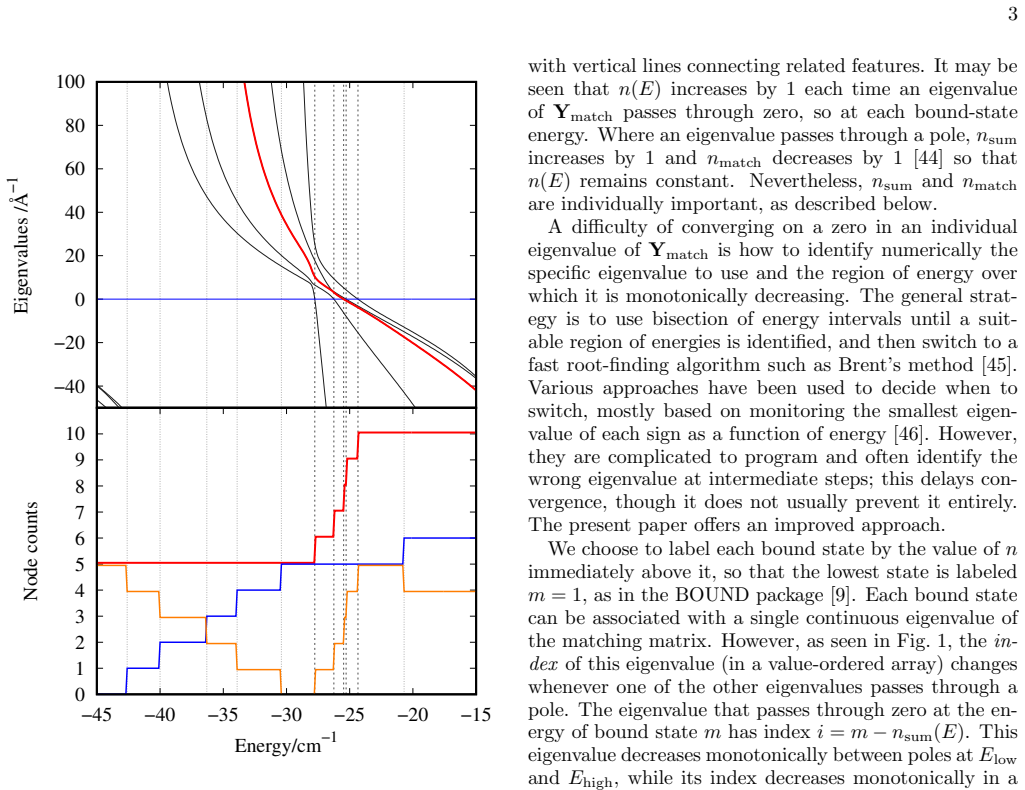
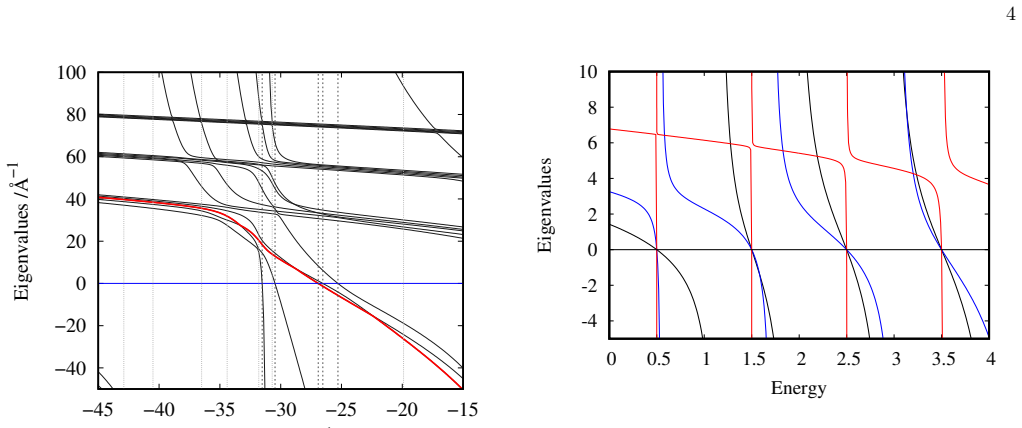
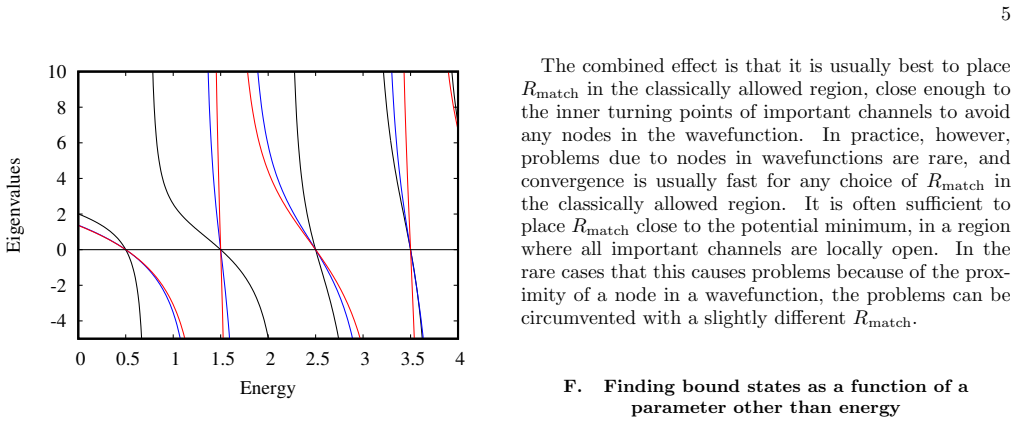
Bound states occur at energies where an individual eigenvalue of the log-derivative or ratio matching matrix passes through zero. The algorithm reliably identifies the required eigenvalue over the entire energy range in which it exists, allowing simpler code for bound-state searches. The matching distance is best chosen in the classically allowed region for channels that support the bound states of interest, but not very close to a node in the wavefunction.
Load-bearing premise
The specific eigenvalue can be identified and followed reliably across the energy range without crossings or numerical instabilities.
Editorial extensions
If this is right
- Bound-state location in coupled-channel problems requires less complex programming.
- The search remains stable over wide energy intervals.
- Computational efficiency increases when the matching point lies in classically allowed regions away from nodes.
Reading between the lines
- The tracking approach could be adapted to locate resonances by monitoring poles instead of real-axis zeros.
- It may reduce the need for manual intervention when fitting potentials to many bound states in molecular systems.
- Similar eigenvalue tracking might apply to other matrix-based quantum methods that use log-derivative propagation.
Editorial analysis
A structured set of objections, weighed in public.
Referee Report
Summary. The paper claims to develop a robust algorithm for locating bound states in coupled-channel calculations. Bound states exist at energies where an individual eigenvalue of a log-derivative or ratio matching matrix passes through zero. It describes an algorithm to identify and track the required eigenvalue of the matching matrix over the full relevant energy range, enabling simpler programming than prior methods. It also discusses the choice of matching distance R_match, recommending it lie in the classically allowed region for channels supporting bound states of interest but not near wavefunction nodes.
Significance. If the algorithm reliably tracks the target eigenvalue without instabilities or crossings, the work could simplify implementation of bound-state searches in coupled-channel problems common to chemical physics and quantum chemistry. The guidance on R_match selection may also improve computational efficiency for such calculations.
major comments (2)
- [Abstract] Abstract: The central claim rests on the existence of a described algorithm that identifies and tracks one specific eigenvalue of the matching matrix across the full energy range where it exists. However, the provided text supplies no concrete steps for initialization, tracking, detection of crossings, or maintenance of numerical conditioning, leaving the robustness assertion unverified and load-bearing for the paper's contribution.
- [Abstract] Abstract: No validation data, numerical examples, error analysis, or implementation details are presented to test the algorithm's performance against eigenvalue crossings or instabilities. This absence undermines assessment of whether the method works as claimed for practical coupled-channel problems.
Simulated Author's Rebuttal
We thank the referee for their constructive comments on our manuscript. We address each major comment below and indicate the revisions we will make.
read point-by-point responses
-
Referee: [Abstract] Abstract: The central claim rests on the existence of a described algorithm that identifies and tracks one specific eigenvalue of the matching matrix across the full energy range where it exists. However, the provided text supplies no concrete steps for initialization, tracking, detection of crossings, or maintenance of numerical conditioning, leaving the robustness assertion unverified and load-bearing for the paper's contribution.
Authors: The full manuscript body following the abstract does outline the algorithm, including initialization at a reference energy by sorting eigenvalues and tracking via continuity across energy steps while detecting crossings through sign changes in the determinant. However, we agree that the description lacks sufficient explicit steps and pseudocode for reproducibility. We will revise the manuscript to include a dedicated subsection with detailed algorithmic steps, initialization procedure, and handling of numerical conditioning. revision: yes
-
Referee: [Abstract] Abstract: No validation data, numerical examples, error analysis, or implementation details are presented to test the algorithm's performance against eigenvalue crossings or instabilities. This absence undermines assessment of whether the method works as claimed for practical coupled-channel problems.
Authors: The current version is primarily a methods paper focused on the algorithm and R_match guidance. We acknowledge that the absence of numerical tests limits evaluation of robustness. We will add a new section with validation on a model two-channel problem, including examples of eigenvalue tracking across crossings, stability tests at varying R_match, and basic error analysis. revision: yes
Circularity Check
No circularity: direct numerical algorithm for eigenvalue tracking in coupled-channel bound-state search
full rationale
The paper presents a numerical procedure to locate bound states by tracking when a chosen eigenvalue of the log-derivative or ratio matching matrix crosses zero. No equations or claims reduce a derived quantity to a fitted input, self-defined quantity, or load-bearing self-citation chain. The algorithm is described as a self-contained computational method for identifying and following the relevant eigenvalue across energy, with no evidence that its correctness is presupposed by the inputs or prior author work. This is the expected non-finding for a methods paper whose central contribution is an independent numerical technique.
Assumptions & free parameters
Cite this review
Pith. "Pith review of Converging on bound states in coupled-channel calculations." pith.science (2026). https://pith.science/paper/3DCXB7J6
@misc{pith2026260626069,
  author       = {Pith},
  title        = {Pith review of: Converging on bound states in coupled-channel calculations},
  year         = {2026},
  howpublished = {\url{https://pith.science/paper/3DCXB7J6}},
  note         = {Machine review of arXiv:2606.26069}
}
abstract
We develop a robust algorithm for locating bound states in coupled-channel calculations. Bound states exist at energies where an individual eigenvalue of a log-derivative or ratio matching matrix passes through zero. We describe an algorithm to identify the required eigenvalue of the matching matrix over the full range of energy where it exists. This allows much simpler programming than previous methods. We also consider the choice of the matching distance $R_\textrm{match}$, where the matching matrix is defined; coupled-channel methods are most efficient if $R_\textrm{match}$ is chosen to be in the classically allowed region for all channels that support bound states of interest, but not very close to a node in the wavefunction.
Figures
Reference graph
Works this paper leans on
-
[1]
Baˇ ci´ c, Z.; Light, J. C. Theoretical methods for rovibra- tional states of floppy molecules.Annu. Rev. Phys. Chem. 1989,40, 469–498
1989
-
[2]
Tennyson, J.; Miller, S.; Henderson, J. R. InMethods in Computational Chemistry, Vol. 5; Wilson, S., Ed.; Plenum: New York, 1991
1991
-
[3]
G.; Olson, R
Truhlar, D. G.; Olson, R. W.; Jeannotte, A. C.; Ov- erend, J. Anharmonic force constants of polyatomic molecules. Test of the procedure for deducing a force field from the vibration-rotation spectrum.J. Am. Chem. Soc. 1976,98, 2373–2379
1976
-
[4]
R.; Saigal, S.; Dossa, D.; Shertzer, J
Ram-Mohan, L. R.; Saigal, S.; Dossa, D.; Shertzer, J. The finite element method for energy eigenvalues of quantum mechanical systems.Comput. Phys.1990,4, 50
1990
-
[5]
Gordon, R. G. A new method for constructing wavefunc- tions for bound states and scattering.J. Chem. Phys. 1969,51, 14–25
1969
-
[6]
Johnson, B. R. The renormalized Numerov method ap- plied to calculating bound states of the coupled-channel Schr¨ odinger equation.J. Chem. Phys.1978,69, 4678– 4688
1978
-
[7]
Theoretical studies of van der Waals molecules: general formulation.J
Danby, G. Theoretical studies of van der Waals molecules: general formulation.J. Phys. B - At. Mol. Opt.1983,16, 3393–3410
1983
-
[8]
Hutson, J. M. Coupled-channel methods for solving the bound-state Schr¨ odinger equation.Comput. Phys. Com- mun.1994,84, 1–18
1994
Show all 49 references
-
[9]
M.; Le Sueur, C
Hutson, J. M.; Le Sueur, C. R.boundandfield: pro- grams for calculating bound states of interacting pairs of atoms and molecules.Comp. Phys. Comm.2019,241, 1–8
2019
-
[10]
M.; Gordon, R
Dunker, A. M.; Gordon, R. G. Calculations on the HCl- Ar van der Waals complex.J. Chem. Phys.1976,64, 354–363
1976
-
[11]
Theoretical studies of van der Waals molecules: the H 2-H2 dimer.J
Danby, G. Theoretical studies of van der Waals molecules: the H 2-H2 dimer.J. Phys. B - At. Mol. Opt. 1983,16, 3411–3422
1983
-
[12]
M.; Thornley, A
Hutson, J. M.; Thornley, A. E. Atom-spherical top van der Waals complexes: A theoretical study.J. Chem. Phys.1994,100, 2505–2521
1994
-
[13]
Hutson, J. M. Vibrational dependence of the anisotropic intermolecular potential of Ar-HF.J. Chem. Phys.1992, 96, 6752–6767
1992
-
[14]
Hutson, J. M. Vibrational dependence of the anisotropic intermolecular potential of Ar-HCl.J. Phys. Chem. 1992,96, 4237–4247
1992
-
[15]
L.; Hutson, J
Dubernet, M. L.; Hutson, J. M. Potential energy surfaces for ArOH (X 2Π) obtained by fitting to high-resolution spectroscopy.J. Chem. Phys.1993,99, 7477–7486
1993
-
[16]
A.; Marr, A
Carrington, A.; Leach, C. A.; Marr, A. J.; Shaw, A. M.; Viant, M. R.; Hutson, J. M.; Law, M. M. Microwave spectroscopy and interaction potential of the long-range He. . .Ar+ ion.J. Chem. Phys.1995,102, 2379
1995
-
[17]
M.; Ernesti, A.; Law, M
Hutson, J. M.; Ernesti, A.; Law, M. M.; Roche, C. F.; Wheatley, R. J. The intermolecular potential energy sur- face for CO 2-Ar: Fitting to high-resolution spectroscopy of Van der Waals complexes and second virial coeffi- cients.J. Chem. Phys.1996,105, 9130–9140
1996
-
[18]
L.; Ray, D.; Gwo, D
Robinson, R. L.; Ray, D.; Gwo, D. H.; Saykally, R. J. An extended study of the lowest Π bending vibration- rotation spectrum of Ar-HCl by intracavity far in- frared laser/microwave double resonance spectroscopy.J. Chem. Phys.1987,87, 5149–5155
1987
-
[19]
L.; Gwo, D
Robinson, R. L.; Gwo, D. H.; Saykally, R. J. Far infrared laser Stark spectroscopy of the Σ bending vibration of ArHCl: strong evidence for a double minimum potential surface.Molec. Phys.1988,63, 1021–1029. 7
1988
-
[20]
J.; Lovejoy, C
Nesbitt, D. J.; Lovejoy, C. M. Sub-Doppler infrared spec- troscopy in slit supersonic jets. A study of all three van der Waals modes inν 1-excited ArHCl.Faraday Discuss. Chem. Soc.1988,86, 13–20
1988
-
[21]
M.; Nesbitt, D
Lovejoy, C. M.; Nesbitt, D. J. Infrared-active combina- tion bands in ArHCl.Chem. Phys. Lett.1988,146, 582– 588
1988
-
[22]
M.; Nesbitt, D
Lovejoy, C. M.; Nesbitt, D. J. Intramolecular dynamics of van der Waals molecules: An extended infrared study of ArHF.J. Chem. Phys.1989,91, 2790
1989
-
[23]
T.; Loomis, R
Berry, M. T.; Loomis, R. A.; Giancarlo, L. C.; Lester, M. I. Stimulated emission pumping of intermolec- ular vibrations in OH-Ar (X 2Π).J. Chem. Phys.1992, 96, 7890–7903
1992
-
[24]
Kendrick, B.; Pack, R. T. Geometric phase effects in the resonance spectrum, state-to-state transition probabili- ties and bound state spectrum of HO 2.J. Chem. Phys. 1997,106, 3519–3539
1997
-
[25]
M.; Tiesinga, E.; Julienne, P
Hutson, J. M.; Tiesinga, E.; Julienne, P. S. Avoided cross- ings between bound states of ultracold cesium dimers. Phys. Rev. A2008,78, 052703
-
[26]
A.; Hutson, J
Brue, D. A.; Hutson, J. M. Prospects of forming molecules in 2Σ states by magnetoassociation of alkali- metal atoms with Yb.Phys. Rev. A2013,87, 052709
-
[27]
D.; Reddel, J
Karman, T.; Frye, M. D.; Reddel, J. D.; Hutson, J. M. Near-threshold bound states of the dipole-dipole interac- tion.Phys. Rev. A2018,98, 062502
-
[28]
D.; Cornish, S
Frye, M. D.; Cornish, S. L.; Hutson, J. M. Prospects of forming high-spin polar molecules from ultracold atoms. Phys. Rev. X2020,10, 041005
-
[29]
Mukherjee, B.; Hutson, J. M. Controlling collisional loss and scattering lengths of ultracold dipolar molecules with static electric fields.Phys. Rev. Res.2024,6, 013145
2024
-
[30]
Optical excitation and sta- bilization of ultracold field-linked tetratomic molecules
Mukherjee, B.; Tomza, M. Optical excitation and sta- bilization of ultracold field-linked tetratomic molecules. Phys. Rev. Lett.2026,136, 013401
2026
-
[31]
R.; Hut- son, J
Takekoshi, T.; Debatin, M.; Rameshan, R.; Ferlaino, F.; Grimm, R.; N¨ agerl, H.-C.; Le Sueur, C. R.; Hut- son, J. M.; Julienne, P. S.; Kotochigova, S.; Tiemann, E. Towards the production of ultracold ground-state RbCs molecules: Feshbach resonances, weakly bound states, and co...
-
[32]
S.; Hutson, J
Berninger, M.; Zenesini, A.; Huang, B.; Harm, W.; N¨ agerl, H.-C.; Ferlaino, F.; Grimm, R.; Julienne, P. S.; Hutson, J. M. Feshbach resonances, weakly bound molec- ular states and coupled-channel potentials for cesium at high magnetic field.Phys. Rev. A2013,87, 032517
-
[33]
Brookes, S. G. H.; Hutson, J. M. Interaction potential for NaCs for ultracold scattering and spectroscopy.J. Phys. Chem. A2022,126, 3987–4001
-
[34]
C.; Le Sueur, C
Bird, R. C.; Le Sueur, C. R.; Hutson, J. M. Making molecules by mergoassociation: two atoms in adjacent nonspherical optical traps.Phys. Rev. Res.2023,5, 043086
2023
-
[35]
T.; Parker, G
Pack, R. T.; Parker, G. A. Quantum reactive scattering in three dimensions using hypersperical (APH) coordinates. Theory.J. Chem. Phys.1987,87, 3888–3921
1987
-
[36]
Johnson, B. R. Multichannel log-derivative method for scattering calculations.J. Comput. Phys.1973,13, 445– 449
1973
-
[37]
Alexander, M. H. Hybrid quantum scattering algorithms for long-range potentials.J. Chem. Phys.1984,81, 4510–4516
1984
-
[38]
Manolopoulos, D. E. An improved log-derivative method for inelastic scattering.J. Chem. Phys.1986,85, 6425– 6429
1986
-
[39]
E.; Gray, S
Manolopoulos, D. E.; Gray, S. K. Symplectic integra- tors for the multichannel Schr¨ odinger equation.J. Chem. Phys.1995,102, 9214–9227
1995
-
[40]
M.; Le Sueur, C
Hutson, J. M.; Le Sueur, C. R.molscat,boundand field, version 2025.0.https://github.com/molscat/ molscat, 2025
2025
-
[41]
Hutson, J. M. BOUND computer program, version 1. Distributed by Collaborative Computational Project No. 6 of the UK Engineering and Physical Sciences Research Council, 1984
1984
-
[42]
Differ- ential energy-loss spectra for CH4 + Ar collisions.Chem
Buck, U.; Kohlhase, A.; Phillips, T.; Secrest, D. Differ- ential energy-loss spectra for CH4 + Ar collisions.Chem. Phys. Lett.1983,98, 199–202
1983
-
[43]
M.; Davison, W
Calvert, J. M.; Davison, W. D. Oscillation theory and computational procedures for matrix Sturm-Liouville eigenvalue problems, with an application to the hydro- gen molecular ion.J. Phys. A1969,2, 278
-
[44]
Manolopoulos, D. E. Close-coupled equations: the log- derivative approach to inelastic scattering, bound-state and photofragmentation problems. Ph.D. thesis, Cam- bridge University, Cambridge, 1988
1988
-
[45]
P.Algorithms for Minimization Without Derivatives; Prentice-Hall: Englewood Cliffs, NJ, 1973; Chapter 3-4
Brent, R. P.Algorithms for Minimization Without Derivatives; Prentice-Hall: Englewood Cliffs, NJ, 1973; Chapter 3-4
1973
-
[46]
M.; Le Sueur, C
Hutson, J. M.; Le Sueur, C. R. User Manual formolscat, boundandfield, version 2025.0.arXiv:1903.06755 2025,
2025
-
[47]
S.Molecular Collision Theory; Academic Press: London, 1974
Child, M. S.Molecular Collision Theory; Academic Press: London, 1974
1974
-
[48]
G.; Vaillant, C
Green, D. G.; Vaillant, C. L.; Frye, M. D.; Morita, M.; Hutson, J. M. Quantum chaos in ultracold collisions be- tween Yb( 1S0) and Yb( 3P2).Phys. Rev. A2016,93, 022703
-
[49]
D.; Morita, M.; Vaillant, C
Frye, M. D.; Morita, M.; Vaillant, C. L.; Green, D. G.; Hutson, J. M. Approach to chaos in ultracold atomic and molecular physics: Statistics of near-threshold bound states for Li+CaH and Li+CaF.Phys. Rev. A2016,93, 052713
Reviewed June 25, 2026 · model on record in the stance chip above.
Discussion (0). Sign in to comment.