Fast Simultaneous Surveys with On-the-Fly Mapping
Pith reviewed 2026-06-26 01:30 UTC · model grok-4.3
The pith
On-the-fly mapping produces 14-arcsecond continuum images at 25 microJansky sensitivity over 10,000 square degrees while simultaneously performing intensity mapping.
A machine-rendered reading of the paper's core claim, the machinery that carries it, and where it could break.
Core claim
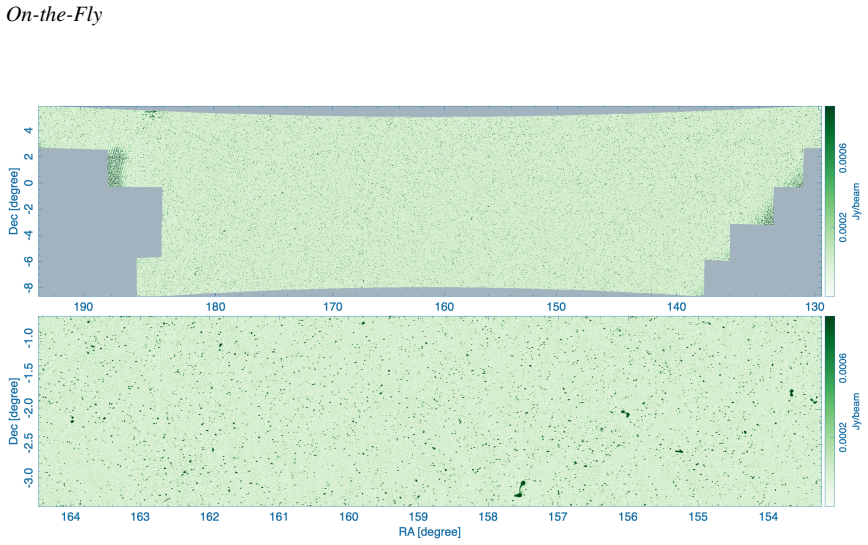
The paper claims that the on-the-fly imaging technique, relying on constant elevation fast scanning, enables commensal surveys that achieve a speed of approximately 3.5 square degrees per minute. After applying corrections for smearing in a custom pipeline, the data reach 25 microJansky per beam rms noise at 14 arcsecond resolution over 10,000 square degrees. This approach is shown to be economical for obtaining both continuum images and intensity mapping data in a single pass.
What carries the argument
The on-the-fly imaging technique that uses constant elevation fast scanning together with a custom pipeline to correct for smearing and scanning artifacts.
If this is right
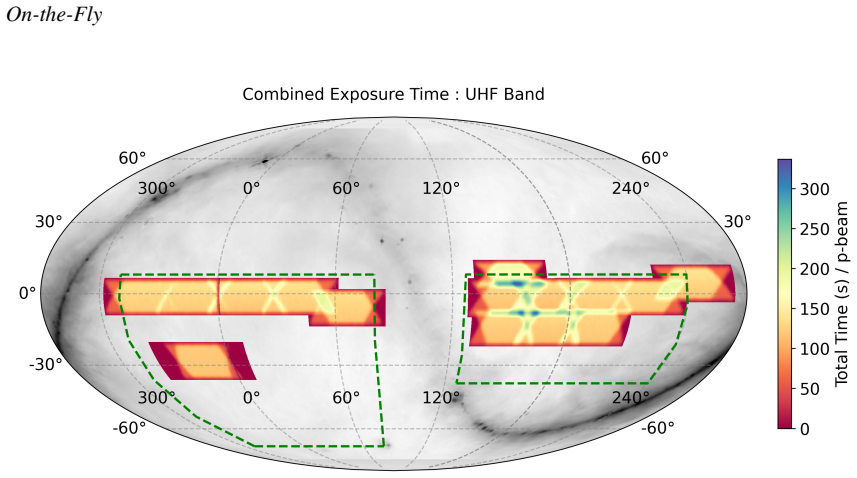
- The survey covers 10,000 square degrees in the southern sky while avoiding the Galactic plane.
- The technique achieves the target sensitivity and resolution in the UHF band.
- Lessons from this method inform the design of similar surveys for the Square Kilometre Array.
- Future improvements in the correlator are expected to make smearing effects negligible.
Where Pith is reading between the lines
- The technique's speed could allow multiple passes over the same area to improve sensitivity without extra dedicated time.
- Pipeline methods developed here may apply to other fast-scanning radio observations.
- The commensality reduces scheduling conflicts between different observing programs.
- Scaling this to larger arrays could test the limits of artifact correction at higher resolutions.
Load-bearing premise
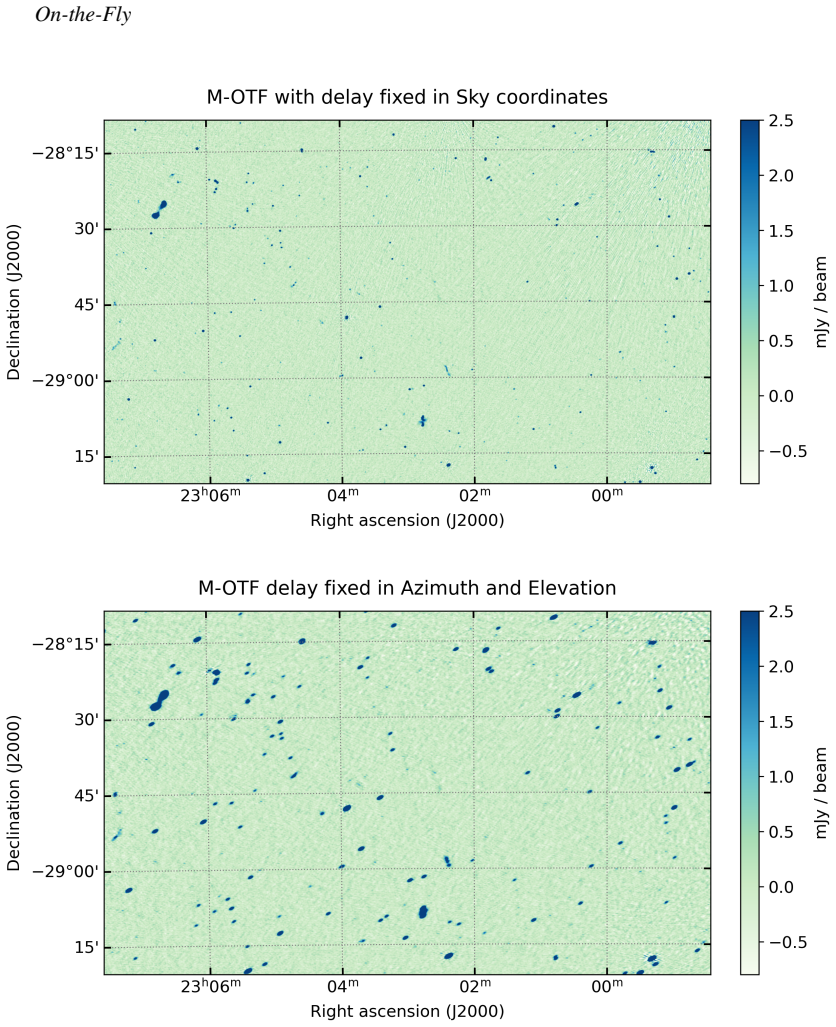
The custom imaging pipeline can correct smearing and other artifacts well enough to deliver the target sensitivity and resolution over the full survey area.
What would settle it
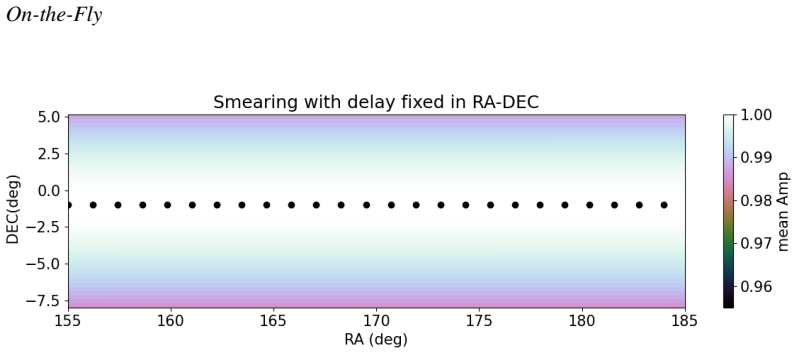
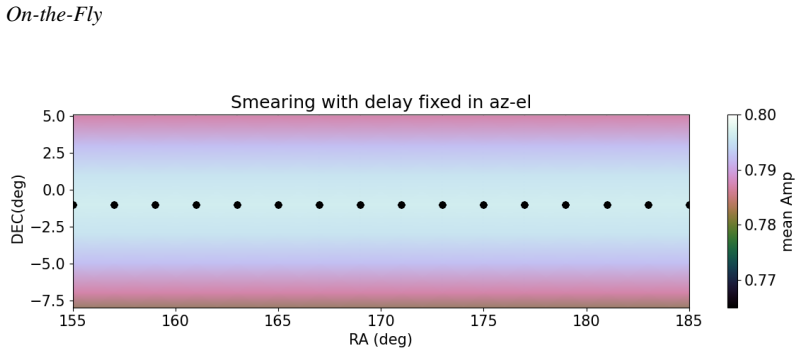
Measurement of the actual noise level and presence of smearing in the processed images from a substantial portion of the 10,000 square degree field compared to the predicted values.
Figures
read the original abstract
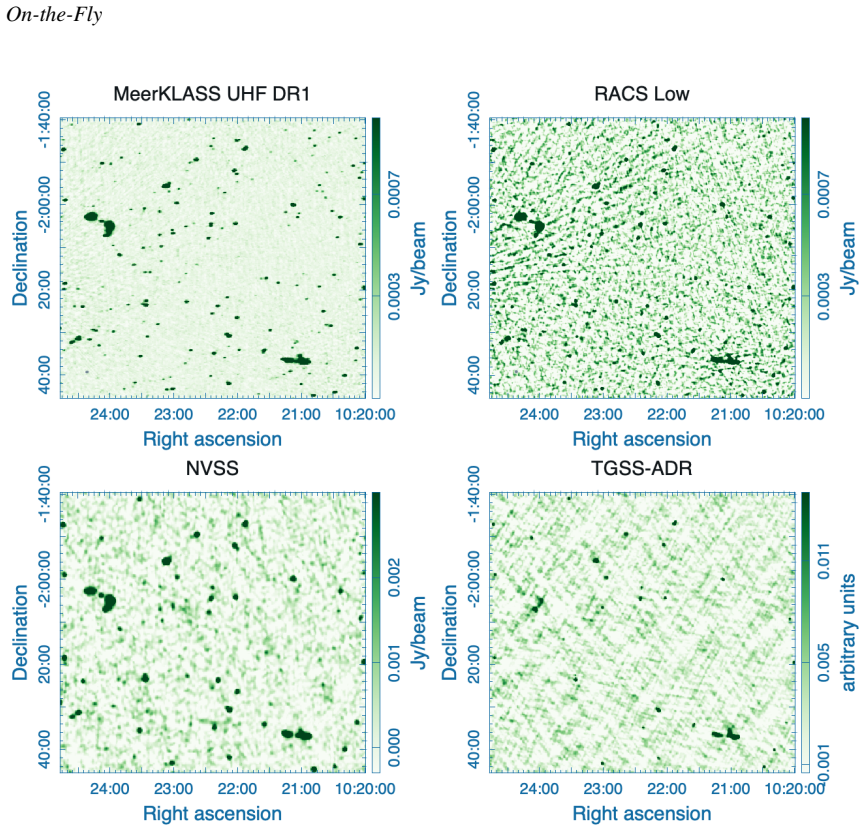
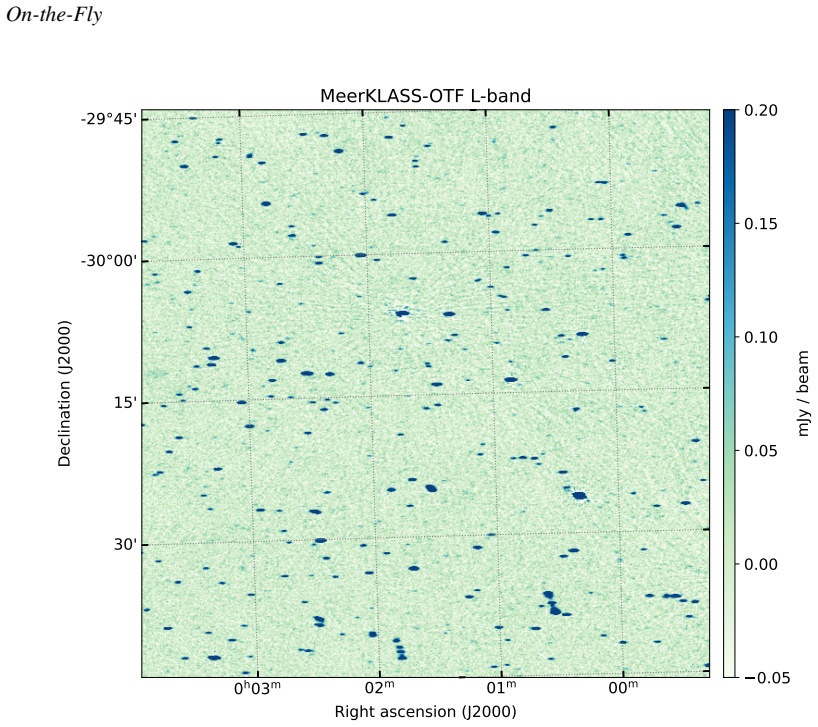
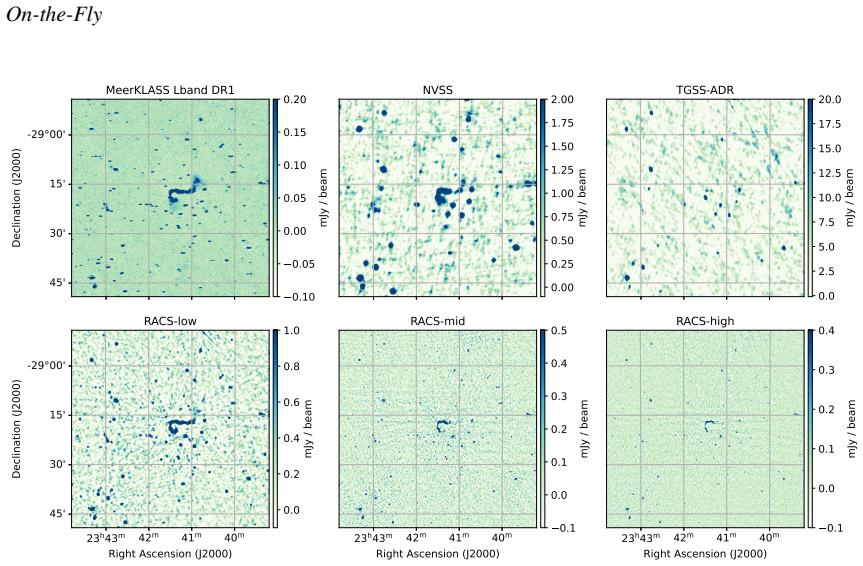
The SKAO is a next-generation radio telescope that will transform our understanding of the formation and evolution of radio galaxies, quasars, transients, and other cosmic sources. Surveys conducted on precursor telescopes can inform us about the capabilities and challenges to be overcome in preparation for SKAO science. The MeerKAT Large Area Synoptic Survey (MeerKLASS), is a pathfinder large area survey to probe cosmology using the single-dish ${\rm H\hspace{0.5mm}}{\scriptsize {\rm I}}$~intensity mapping (IM). MeerKLASS provides an additional wide, high angular-resolution commensal survey by utilizing the ``On-the-Fly'' (OTF) imaging technique. The survey target is to cover 10,000 sq. degrees in the Southern sky avoiding the Galactic plane, using the UHF-band (544-1088 MHz). The survey aims to achieve an r.m.s. of 25 $\mu$Jy/beam and $14''$ resolution. In this chapter we discuss the survey strategy, observational status, the development of the MeerKLASS OTF imaging pipeline and the science prospects of the data products. OTF imaging, which relies upon constant elevation fast scanning, comes with its own set of challenges, such as smearing. Here we detail how we have mitigated them and the current scientific impact. Significantly fast survey speed ($\sim 3.5$ sq. deg per min), commensality with ${\rm H\hspace{0.5mm}}{\scriptsize {\rm I}}$~IM survey, deep and large area continuum images make MeerKLASS OTF an economic survey technique. Lessons from this technique will be valuable for the upcoming SKA-Mid, where we expect a better resolution $(< 2'')$ and sensitivity $(\sim 7\mu {\rm Jy/beam})$ of the OTF images with the AA4 configuration. Furthermore, improvements in the correlator will result in negligible smearing effects in the imaging.
Editorial analysis
A structured set of objections, weighed in public.
Referee Report
Summary. The manuscript describes the MeerKLASS pathfinder survey on MeerKAT, which uses On-the-Fly (OTF) mapping in the UHF band to conduct a commensal wide-area continuum survey alongside the primary single-dish HI intensity mapping program. The survey targets 10,000 sq. deg in the Southern sky (avoiding the Galactic plane) at 25 μJy/beam rms and 14'' resolution, with a claimed survey speed of ~3.5 sq. deg per min. The text covers survey strategy, observational status, development of a custom OTF imaging pipeline, mitigation of scanning-induced smearing, and science prospects including lessons for SKA-Mid (expected <2'' resolution and ~7 μJy/beam sensitivity).
Significance. If the pipeline performance claims are substantiated with quantitative validation, the work demonstrates an efficient commensal observing mode that maximizes telescope time for large-area radio surveys. This is directly relevant to SKA pathfinding, as the described OTF technique and smearing mitigation strategies could scale to SKA-Mid with the noted improvements in resolution and sensitivity.
major comments (2)
- [Abstract / pipeline development section] Abstract and pipeline development section: The central claim that smearing has been mitigated to deliver the target 25 μJy/beam rms and 14'' resolution across the full survey area is stated without accompanying quantitative validation, error budgets, measured noise levels from test fields, or example images showing achieved performance. This is load-bearing for the assertion that the survey targets are met.
- [Survey strategy section] Survey strategy section: The stated survey speed of ~3.5 sq. deg per min and commensality with the HI IM survey are presented as achieved outcomes, but the manuscript supplies no explicit calculation, timing measurements, or area coverage metrics from actual observations to support these figures.
minor comments (1)
- [Abstract] The abstract uses inconsistent formatting for 'H I' (e.g., ${ m H\hspace{0.5mm}}{\scriptsize {\rm I}}$); standardize notation for clarity.
Simulated Author's Rebuttal
We thank the referee for their constructive feedback on the MeerKLASS manuscript. The comments highlight areas where additional quantitative support would strengthen the presentation of the pipeline performance and survey metrics. We address each point below and will revise the manuscript to incorporate the requested validation.
read point-by-point responses
-
Referee: [Abstract / pipeline development section] Abstract and pipeline development section: The central claim that smearing has been mitigated to deliver the target 25 μJy/beam rms and 14'' resolution across the full survey area is stated without accompanying quantitative validation, error budgets, measured noise levels from test fields, or example images showing achieved performance. This is load-bearing for the assertion that the survey targets are met.
Authors: We agree that the current text would benefit from more explicit quantitative validation to support the performance claims. The pipeline section details the smearing mitigation strategies developed for OTF imaging, but we will add in revision: noise measurements and rms values from test fields, a breakdown of the error budget, and example continuum images demonstrating the achieved 14'' resolution and 25 μJy/beam sensitivity after mitigation. This will provide direct evidence that the survey targets are being met. revision: yes
-
Referee: [Survey strategy section] Survey strategy section: The stated survey speed of ~3.5 sq. deg per min and commensality with the HI IM survey are presented as achieved outcomes, but the manuscript supplies no explicit calculation, timing measurements, or area coverage metrics from actual observations to support these figures.
Authors: The ~3.5 sq. deg per min speed derives from the constant-elevation scanning parameters and telescope slew rates, while commensality follows from the shared observing mode with the primary HI IM program. To address the request for supporting evidence, the revised manuscript will include the explicit calculation of survey speed, timing data from executed observations, and cumulative area coverage metrics from the current observational status. revision: yes
Circularity Check
No significant circularity
full rationale
The manuscript is a descriptive survey-strategy and pipeline-status paper. It states target survey speed, rms, and resolution as design goals and reports that mitigation of smearing has been performed, but contains no equations, fitted parameters, predictions derived from those parameters, or load-bearing self-citations. The central claims rest on external validation data products and pipeline metrics rather than on any internal reduction to the paper's own inputs. No step satisfies the criteria for any of the enumerated circularity kinds.
Axiom & Free-Parameter Ledger
Reference graph
Works this paper leans on
-
[1]
The Second Data Release of the Sloan Digital Sky Survey. , eprint =. doi:10.1086/421365 , adsurl =
-
[2]
The First Data Release of the Sloan Digital Sky Survey. , eprint =. doi:10.1086/378165 , adsurl =
-
[3]
Aguirre and Paul Alexander and Zaki S
Zara Abdurashidova and James E. Aguirre and Paul Alexander and Zaki S. Ali and Yanga Balfour and Adam P. Beardsley and Gianni Bernardi and Tashalee S. Billings and Judd D. Bowman and Richard F. Bradley and Philip Bull and Jacob Burba and Steve Carey and Chris L. Carilli and Carina Cheng and David R. DeBoer and Matt Dexter and Eloy de Lera Acedo and Taylor...
-
[4]
The Formation of the First Star in the Universe. Science , eprint =. doi:10.1126/science.295.5552.93 , adsurl =
-
[5]
Planck 2013 results. XVI. Cosmological parameters , DOI= "10.1051/0004-6361/201321591", url= "https://doi.org/10.1051/0004-6361/201321591", journal =
-
[6]
Aguena, M. and others. The Atacama Cosmology Telescope: DR6 Sunyaev-Zel'dovich Selected Galaxy Clusters Catalog. 2025. arXiv:2507.21459
arXiv 2025
-
[7]
H. H. 2001 IEEE International Conference on Acoustics, Speech, and Signal Processing. Proceedings (Cat. No.01CH37221) , title=. 2001 , volume=. doi:10.1109/ICASSP.2001.940309 , ISSN=
-
[8]
, year = 1974, month = jul, volume = 79, pages =
Survey of the galactic background radiation at 3.93 and 6.55 MHz. , year = 1974, month = jul, volume = 79, pages =. doi:10.1086/111608 , adsurl =
-
[9]
, volume=
What will anisotropies in the clustering pattern in redshifted 21-cm maps tell us? , author=. , volume=. 2005 , publisher=
2005
-
[10]
, archivePrefix = "arXiv", eprint =
PAPER-64 Constraints on Reionization: The 21 cm Power Spectrum at z = 8.4. , archivePrefix = "arXiv", eprint =. doi:10.1088/0004-637X/809/1/61 , adsurl =
-
[11]
Foregrounds for redshifted 21-cm studies of reionization: Giant Meter Wave Radio Telescope 153-MHz observations. , archivePrefix = "arXiv", eprint =. doi:10.1111/j.1365-2966.2008.12984.x , adsurl =
-
[12]
Prospects for Detecting the 326.5 MHz Redshifted 21-cm HI Signal with the Ooty Radio Telescope (ORT). J. Astrophys. Astron. , keywords =. doi:10.1007/s12036-014-9301-1 , adsurl =
-
[13]
and Maartens, Roy and Santos, Mário G
Alonso, David and Bull, Philip and Ferreira, Pedro G. and Maartens, Roy and Santos, Mário G. , title =. The Astrophysical Journal , abstract =. 2015 , month =. doi:10.1088/0004-637X/814/2/145 , url =
-
[14]
Alonso, David and Bellini, Emilio and Hale, Catherine and Jarvis, Matt J and Schwarz, Dominik J , title =. Monthly Notices of the Royal Astronomical Society , volume =. 2021 , month =. doi:10.1093/mnras/stab046 , url =
-
[15]
A 45-MHz continuum survey of the southern hemisphere , DOI= "10.1051/aas:1997196", url= "https://doi.org/10.1051/aas:1997196", journal =
-
[16]
Hill and Gary Hinshaw and Carolin Höfer and Joseph Kania and Peter Klages and T
The CHIME Collaboration and Mandana Amiri and Kevin Bandura and Anja Boskovic and Tianyue Chen and Jean-François Cliche and Meiling Deng and Nolan Denman and Matt Dobbs and Mateus Fandino and Simon Foreman and Mark Halpern and David Hanna and Alex S. Hill and Gary Hinshaw and Carolin Höfer and Joseph Kania and Peter Klages and T. L. Landecker and Joshua M...
-
[17]
Bursts from Space: MeerKAT - the first citizen science project dedicated to commensal radio transients. , keywords =. doi:10.1093/mnras/stad1298 , archivePrefix =. 2304.14157 , primaryClass =
-
[18]
ArXiv e-prints , archivePrefix = "arXiv", eprint =
Reconstruction of HI power spectra with radio-interferometers to study dark energy. ArXiv e-prints , archivePrefix = "arXiv", eprint =
-
[19]
Inflation and Early Dark Energy with a Stage II Hydrogen Intensity Mapping experiment
Ansari, Réza and others. Inflation and Early Dark Energy with a Stage II Hydrogen Intensity Mapping experiment. 2018. arXiv:1810.09572
arXiv 2018
-
[20]
Asad, K. M. B. and Koopmans, L. V. E. and Jelić, V. and Pandey, V. N. and Ghosh, A. and Abdalla, F. B. and Bernardi, G. and Brentjens, M. A. and de Bruyn, A. G. and Bus, S. and Ciardi, B. and Chapman, E. and Daiboo, S. and Fernandez, E. R. and Harker, G. and Iliev, I. T. and Jensen, H. and Martinez-Rubi, O. and Mellema, G. and Mevius, M. and Offringa, A. ...
-
[21]
Asad, K M B and Koopmans, L V E and Jelić, V and de Bruyn, A G and Pandey, V N and Gehlot, B K , title = ". , volume =. 2018 , month =. doi:10.1093/mnras/sty258 , url =
-
[22]
Modelling MeerKAT L-band beams
Asad, K M B and Girard, J N and de Villiers, M and Ansah-Narh, T and Iheanetu, K and Smirnov, O and Santos, M G and Lehmensiek, R and Jonas, J and de Villiers, D I L and Thorat, K and Hugo, B and Makhathini, S and Jozsa, G I G and Sirothia, S K , title =. Monthly Notices of the Royal Astronomical Society , volume =. 2021 , month =. doi:10.1093/mnras/stab1...
-
[23]
RFI Mitigation in Radio Astronomy (invited)
Baan, Willem. RFI Mitigation in Radio Astronomy (invited). PoS. doi:10.22323/1.107.0001
-
[24]
, keywords =
The absolute spectrum of Cas A: an accurate flux density scale and a set of secondary calibrators. , keywords =
-
[25]
HI as a probe of the large-scale structure in the post-reionization universe. , archivePrefix = "arXiv", eprint =. doi:10.1111/j.1365-2966.2010.16933.x , adsurl =
-
[26]
Canadian Hydrogen Intensity Mapping Experiment (CHIME) Pathfinder
Canadian Hydrogen Intensity Mapping Experiment (CHIME) pathfinder. Ground-based and Airborne Telescopes V , year = 2014, series =. doi:10.1117/12.2054950 , adsurl =. arXiv:1406.2288 , primaryClass = "astro-ph.IM", month = jul, eid =
work page internal anchor Pith review Pith/arXiv arXiv doi:10.1117/12.2054950 2014
-
[27]
In the beginning: the first sources of light and the reionization of the universe , volume=
In the beginning: the first sources of light and the reionization of the universe. , eprint =. doi:10.1016/S0370-1573(01)00019-9 , adsurl =
-
[28]
2005, MNRAS, 364, L18, doi: 10.1111/j.1745-3933.2005.00096.x
Probing the epoch of early baryonic infall through 21-cm fluctuations. , eprint =. doi:10.1111/j.1745-3933.2005.00079.x , adsurl =
-
[29]
Possible interaction between baryons and dark-matter particles revealed by the first stars
Barkana, Rennan. Possible interaction between baryons and dark-matter particles revealed by the first stars. Nature. 2018. doi:10.1038/nature25791. arXiv:1803.06698
work page internal anchor Pith review Pith/arXiv arXiv doi:10.1038/nature25791 2018
-
[30]
, archivePrefix = "arXiv", eprint =
The EoR sensitivity of the Murchison Widefield Array. , archivePrefix = "arXiv", eprint =. doi:10.1093/mnrasl/sls013 , adsurl =
-
[31]
N. Barry and M. Wilensky and C. M. Trott and B. Pindor and A. P. Beardsley and B. J. Hazelton and I. S. Sullivan and M. F. Morales and J. C. Pober and J. Line and B. Greig and R. Byrne and A. Lanman and W. Li and C. H. Jordan and R. C. Joseph and B. McKinley and M. Rahimi and S. Yoshiura and J. D. Bowman and B. M. Gaensler and J. N. Hewitt and D. C. Jacob...
-
[32]
Battye, Richard A. and Davies, Rod D. and Weller, Jochen , title =. Monthly Notices of the Royal Astronomical Society , volume =. 2004 , month =. doi:10.1111/j.1365-2966.2004.08416.x , url =
-
[33]
, archivePrefix = "arXiv", eprint =
First Season MWA EoR Power spectrum Results at Redshift 7. , archivePrefix = "arXiv", eprint =. doi:10.3847/1538-4357/833/1/102 , adsurl =
-
[34]
Spectroscopy of the double quasars Q1343+266A, B: A new determination of the size of Lyman-alpha forest absorbers. , eprint =. doi:10.1086/187688 , adsurl =
-
[35]
doi:10.1086/176166 , adsnote =
The FIRST Survey: Faint Images of the Radio Sky at Twenty Centimeters. , keywords =. doi:10.1086/176166 , adsurl =
-
[36]
Evidence for Reionization at z\ 6: Detection of a Gunn-Peterson Trough in a z=6.28 Quasar. , eprint =. doi:10.1086/324231 , adsurl =
-
[37]
Kinematics of the faintest gas-rich galaxy in the Local Group: DDO210. , eprint =. doi:10.1051/0004-6361:20031549 , adsurl =
-
[38]
Power spectrum of HI intensity fluctuations in DDO 210. , eprint =. doi:10.1111/j.1745-3933.2006.00220.x , adsurl =
-
[39]
The acceleration of cosmic rays in shock fronts. I. , keywords =. doi:10.1093/mnras/182.2.147 , adsurl =
-
[40]
The acceleration of cosmic rays in shock fronts. II. , keywords =. doi:10.1093/mnras/182.3.443 , adsurl =
-
[41]
Four-Year COBE DMR Cosmic Microwave Background Observations: Maps and Basic Results. , eprint =. doi:10.1086/310075 , adsurl =
-
[42]
The Microwave Anisotropy Probe Mission. , eprint =. doi:10.1086/345346 , adsurl =
-
[43]
, archivePrefix = "arXiv", eprint =
Nine-year Wilkinson Microwave Anisotropy Probe (WMAP) Observations: Final Maps and Results. , archivePrefix = "arXiv", eprint =. doi:10.1088/0067-0049/208/2/20 , adsurl =
-
[44]
The HI Mass Function of Star-forming Galaxies at z 0.35. , keywords =. doi:10.3847/2041-8213/ac9d32 , archivePrefix =. 2210.17018 , primaryClass =
-
[45]
Holographic Beam Mapping of the CHIME Pathfinder Array
Berger, Philippe and others. Holographic Beam Mapping of the CHIME Pathfinder Array. Proc. SPIE Int. Soc. Opt. Eng. 2016. doi:10.1117/12.2233782. arXiv:1607.01473
work page internal anchor Pith review Pith/arXiv arXiv doi:10.1117/12.2233782 2016
-
[46]
Probing CDM cosmology with the Evolutionary Map of the Universe survey , journal =
Jos. Probing CDM cosmology with the Evolutionary Map of the Universe survey , journal =. doi:10.1088/1475-7516/2019/02/030 , url =
-
[47]
Foregrounds for observations of the cosmological 21 cm line. I. First Westerbork measurements of Galactic emission at 150 MHz in a low latitude field. , archivePrefix = "arXiv", eprint =. doi:10.1051/0004-6361/200911627 , adsurl =
-
[48]
Foregrounds for observations of the cosmological 21 cm line. II. Westerbork observations of the fields around 3C 196 and the North Celestial Pole. , archivePrefix = "arXiv", eprint =. doi:10.1051/0004-6361/200913420 , adsurl =
-
[49]
HI Fluctuations at Large Redshifts: I--Visibility correlation. J. Astrophys. Astron. , eprint =. doi:10.1007/BF02702273 , adsurl =
-
[50]
Using HI to Probe Large Scale Structures at z \ 3. J. Astrophys. Astron. , eprint =. doi:10.1007/BF02933588 , adsurl =
-
[51]
HI Fluctuations at Large Redshifts: II - the Signal Expected for the GMRT. J. Astrophys. Astron. , eprint =. doi:10.1007/BF03012189 , adsurl =
-
[52]
HI Fluctuations at Large Redshifts: III - Simulating the Signal Expected at GMRT. J. Astrophys. Astron. , eprint =. doi:10.1007/BF02702289 , adsurl =
-
[53]
The cosmic microwave background radiation fluctuations from HI perturbations prior to reionization. , eprint =. doi:10.1111/j.1365-2966.2004.07907.x , adsurl =
-
[54]
On using visibility correlations to probe the HI distribution from the dark ages to the present epoch - I. Formalism and the expected signal. , eprint =. doi:10.1111/j.1365-2966.2004.08604.x , adsurl =
-
[55]
, archivePrefix = "arXiv", eprint =
Estimation of cosmological parameters from neutral hydrogen observations of the post-reionization epoch. , archivePrefix = "arXiv", eprint =. doi:10.1103/PhysRevD.79.083538 , adsurl =
-
[56]
Fisher Matrix Predictions for Detecting the Cosmological 21-cm Signal with the Ooty Wide Field Array (OWFA). J. Astrophys. Astron. , archivePrefix = "arXiv", eprint =. doi:10.1007/s12036-015-9346-9 , adsurl =
-
[57]
Bharadwaj, Somnath and Pal, Srijita and Choudhuri, Samir and Dutta, Prasun , title = ". , volume =. 2018 , month =. doi:10.1093/mnras/sty3501 , url =
-
[58]
, archivePrefix = "arXiv", eprint =
Correcting direction-dependent gains in the deconvolution of radio interferometric images. , archivePrefix = "arXiv", eprint =. doi:10.1051/0004-6361:20079284 , adsurl =
-
[59]
, keywords =
An alternative model for the Ly-alpha absorption forest. , keywords =
-
[60]
, keywords =
On the radio continuum flux from the disks of spiral galaxies. , keywords =
-
[61]
and Borrill, Julian , title =
Blake, Chris and Ferreira, Pedro G. and Borrill, Julian , title =. , volume =. 2004 , doi =
2004
-
[62]
Relativistic jets as compact radio sources. , keywords =. doi:10.1086/157262 , adsurl =
-
[63]
Formation of galaxies and large-scale structure with cold dark matter. , keywords =. doi:10.1038/311517a0 , adsurl =
-
[64]
Blyth, Sarah and Baker, A. J. and Holwerda, Benne and Bouchard, Antoine and Catinella, Barbara and Chemin, Laurent and Cunnama, Daniel and Davé, Romeel and Faltenbacher, Andreas and February, Sean and Fernández, Ximena and Gawiser, Eric and Heywood, Ian and Kereš, Dušan and Klöckner, Hans-Rainer and Lah, Philip and Lochner, Michelle and Maddox, Natasha an...
-
[65]
Bock, D. C.-J. and Large, M. I. and Sadler, Elaine M. , title =. The Astronomical Journal , abstract =. 1999 , month =. doi:10.1086/300786 , url =
-
[66]
The COBE mission - Its design and performance two years after launch. , keywords =. doi:10.1086/171797 , adsurl =
-
[67]
Monthly Notices of the Royal Astronomical Society , volume =
Bonaldi, Anna and Bonato, Matteo and Galluzzi, Vincenzo and Harrison, Ian and Massardi, Marcella and Kay, Scott and De Zotti, Gianfranco and Brown, Michael L , title = ". Monthly Notices of the Royal Astronomical Society , volume =. 2018 , month =. doi:10.1093/mnras/sty2603 , url =
-
[68]
The VVDS-VLA deep field. III. GMRT observations at 610 MHz and the radio spectral index properties of the sub-mJy population. , eprint =. doi:10.1051/0004-6361:20066428 , adsurl =
-
[69]
The Sensitivity of First-Generation Epoch of Reionization Observatories and Their Potential for Differentiating Theoretical Power Spectra. , eprint =. doi:10.1086/498703 , adsurl =
-
[70]
, archivePrefix = "arXiv", eprint =
Toward Empirical Constraints on the Global Redshifted 21 cm Brightness Temperature During the Epoch of Reionization. , archivePrefix = "arXiv", eprint =. doi:10.1086/528675 , adsurl =
-
[71]
, archivePrefix = "arXiv", eprint =
Foreground Contamination in Interferometric Measurements of the Redshifted 21 cm Power Spectrum. , archivePrefix = "arXiv", eprint =. doi:10.1088/0004-637X/695/1/183 , adsurl =
-
[72]
Bowman, Judd D. and Rogers, Alan E. E. and Monsalve, Raul A. and Mozdzen, Thomas J. and Mahesh, Nivedita. An absorption profile centred at 78 megahertz in the sky-averaged spectrum. Nature. 2018. doi:10.1038/nature25792
-
[73]
, archivePrefix = "arXiv", eprint =
A lower limit of z 0.06 for the duration of the reionization epoch. , archivePrefix = "arXiv", eprint =. doi:10.1038/nature09601 , adsurl =
-
[74]
American Astronomical Society Meeting Abstracts \#215 , year = 2010, series =
The End of the Beginning: The Dawn of 21 cm Cosmology With EDGES. American Astronomical Society Meeting Abstracts \#215 , year = 2010, series =
2010
-
[75]
, archivePrefix = "arXiv", eprint =
Science with the Murchison Widefield Array. , archivePrefix = "arXiv", eprint =. doi:10.1017/pas.2013.009 , adsurl =
-
[76]
2019 , eprint=
Anticipated Performance of the Square Kilometre Array -- Phase 1 (SKA1) , author=. 2019 , eprint=
2019
-
[77]
, year = 1984, month = jan, volume =
Extragalactic Radio Jets. , year = 1984, volume = 22, pages =. doi:10.1146/annurev.aa.22.090184.001535 , adsurl =
-
[78]
Biggs, A. D. and Ivison, R. J. , title =. , volume =. 2006 , doi =
2006
-
[79]
High fidelity deconvolution of moderately resolved sources
-
[80]
, archivePrefix = "arXiv", eprint =
Late-time Cosmology with 21 cm Intensity Mapping Experiments. , archivePrefix = "arXiv", eprint =. doi:10.1088/0004-637X/803/1/21 , adsurl =
discussion (0)
Sign in with ORCID, Apple, or X to comment. Anyone can read and Pith papers without signing in.